Diploma in Community Services - Communication and Case Study Report
VerifiedAdded on 2023/02/01
|10
|2387
|26
Report
AI Summary
This report provides a comprehensive analysis of a community service assignment, encompassing a three-stage scenario, a digital social media communication strategy, and a detailed case study. The scenario explores communication challenges and solutions within a citizen and advice service, emphasizing the role of team leadership and strategic communication plans. The communication strategy focuses on promoting a musical festival for young people through various social media platforms and traditional media, including the development of contingency plans, budgeting, and accountability measures. The case study examines a ten-year-old male client with a history of sexual and physical trauma and developmental delays, employing developmental theories to identify the client's needs. The report applies Abraham Maslow's hierarchy of needs, Piaget's theory of cognitive development, Erikson's stages of psychosocial development, and trauma and attachment theory to understand the client's condition. It suggests referrals to various governmental and non-governmental services for assessment and management of the client's developmental and psychosocial issues. The report includes references to support its findings and recommendations.
Last name 1
Topic: Diploma Community Service
Topic: Diploma Community Service

Paraphrase This Document
Need a fresh take? Get an instant paraphrase of this document with our AI Paraphraser
Last name 2
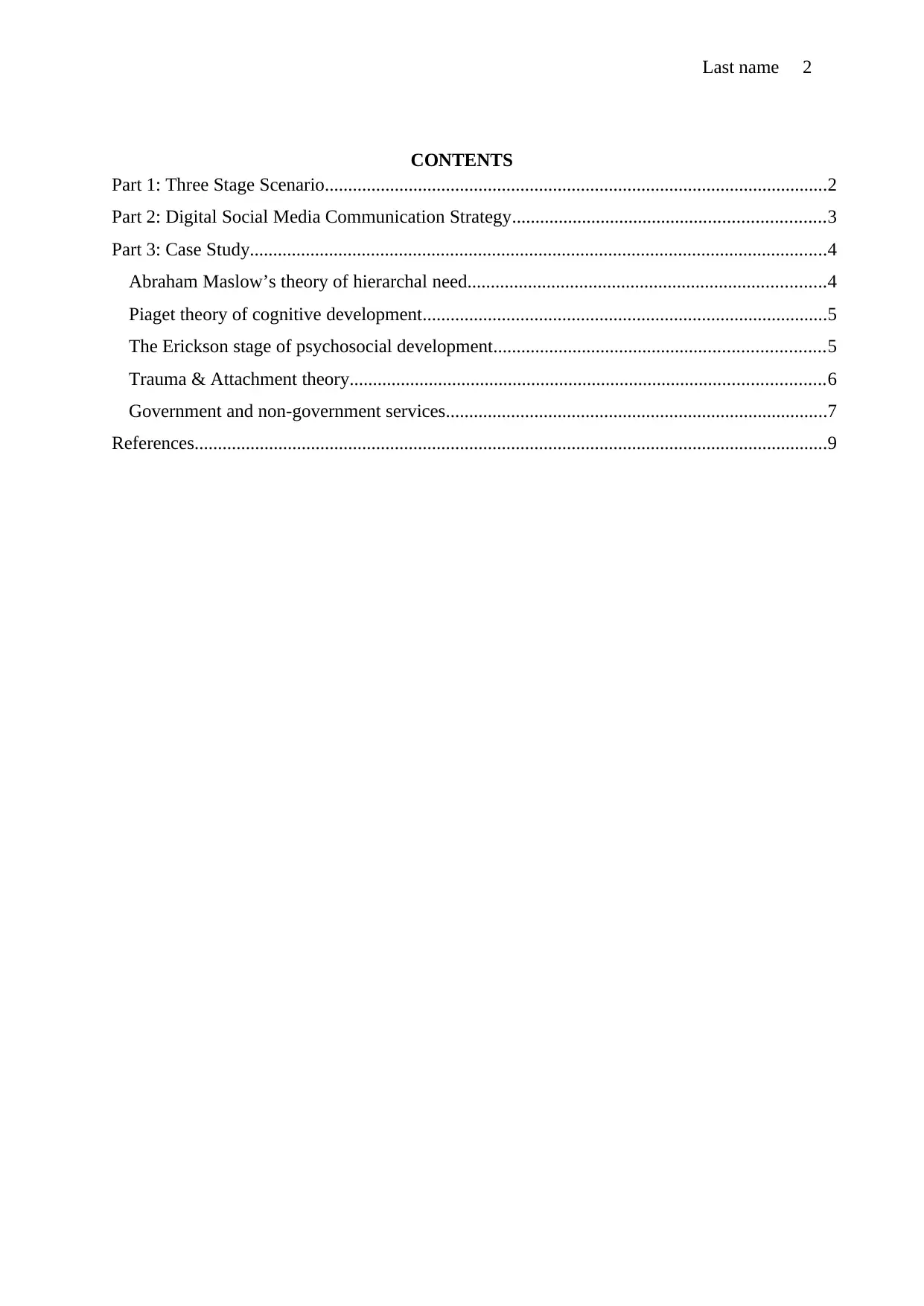
CONTENTS
Part 1: Three Stage Scenario............................................................................................................2
Part 2: Digital Social Media Communication Strategy...................................................................3
Part 3: Case Study............................................................................................................................4
Abraham Maslow’s theory of hierarchal need.............................................................................4
Piaget theory of cognitive development.......................................................................................5
The Erickson stage of psychosocial development.......................................................................5
Trauma & Attachment theory......................................................................................................6
Government and non-government services..................................................................................7
References........................................................................................................................................9
CONTENTS
Part 1: Three Stage Scenario............................................................................................................2
Part 2: Digital Social Media Communication Strategy...................................................................3
Part 3: Case Study............................................................................................................................4
Abraham Maslow’s theory of hierarchal need.............................................................................4
Piaget theory of cognitive development.......................................................................................5
The Erickson stage of psychosocial development.......................................................................5
Trauma & Attachment theory......................................................................................................6
Government and non-government services..................................................................................7
References........................................................................................................................................9
Last name 3
Part 1: Three Stage Scenario
The citizen and advice service employers provided the best services to the community
for resolving the issues and conflicts among people. (Bergman, Dellve, & Skagert, 2016).
The citizen and advice services work collaboratively in a team to facilitate its target audience.
The role of the team leader is crucial as he identifies and describes the different information
needs. To provide the best services to the community, a team of an external contractor, full
and part-time staff has been hired. The competing interest of the team was to facilitate the
people who were attending the program. The conflicting interest among the team was the
lack of strategic communication plans (Persson et al., 2018). The conflicting barriers can be
eradicated, through proper training would be given to the staff members.
The advanced communication system will be added up to avoid inconvenience. In the
new communication system, numerous problems such as complicated communication
instrument, internal connection, mutual relationships of the employees might be encountered.
The team would introduce legal and ethical consideration. The feedback will be taken
through face to face interview, emails, social media campaigns, and surveys.
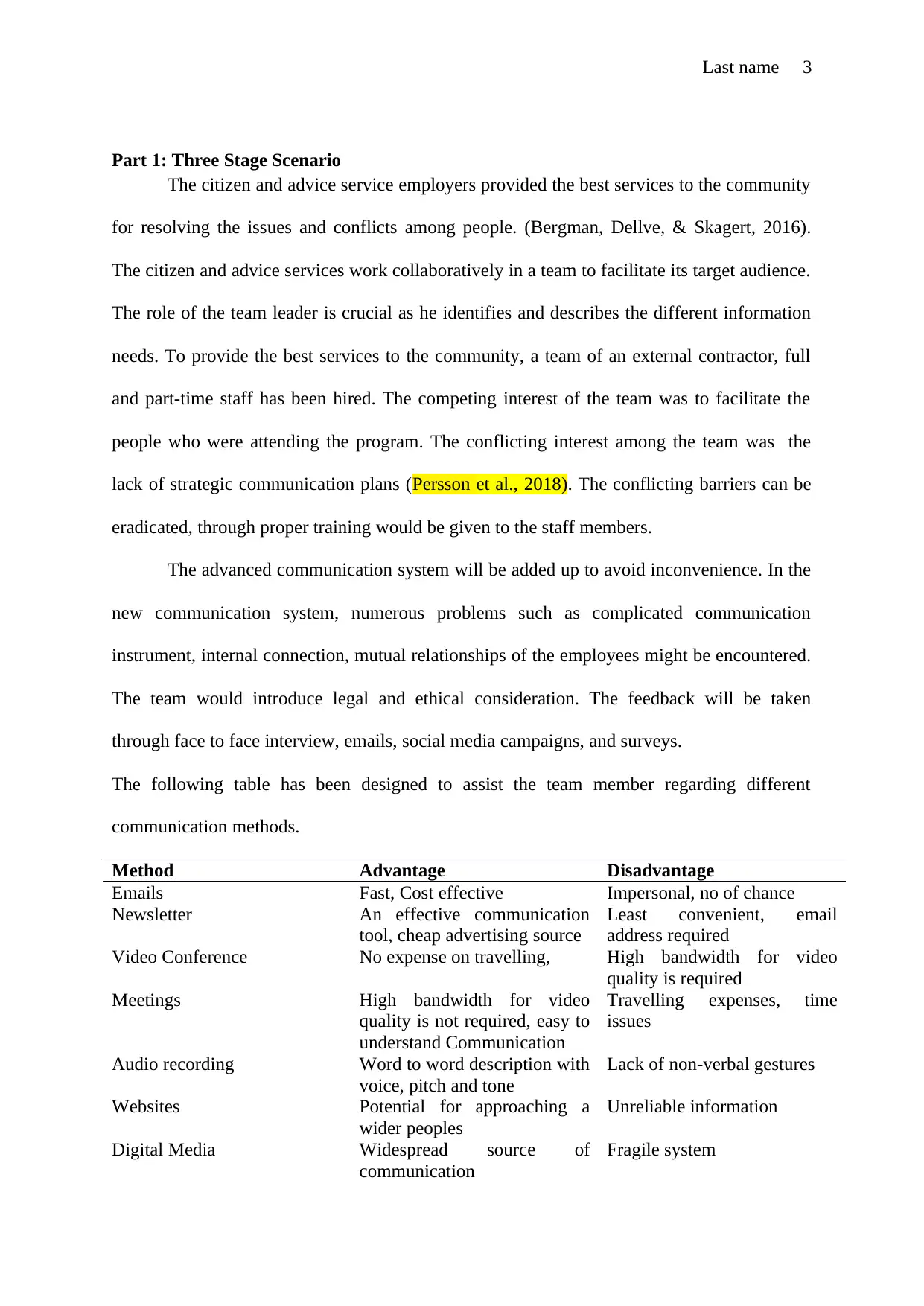
The following table has been designed to assist the team member regarding different
communication methods.
Method Advantage Disadvantage
Emails Fast, Cost effective Impersonal, no of chance
Newsletter An effective communication
tool, cheap advertising source
Least convenient, email
address required
Video Conference No expense on travelling, High bandwidth for video
quality is required
Meetings High bandwidth for video
quality is not required, easy to
understand Communication
Travelling expenses, time
issues
Audio recording Word to word description with
voice, pitch and tone
Lack of non-verbal gestures
Websites Potential for approaching a
wider peoples
Unreliable information
Digital Media Widespread source of
communication
Fragile system
Part 1: Three Stage Scenario
The citizen and advice service employers provided the best services to the community
for resolving the issues and conflicts among people. (Bergman, Dellve, & Skagert, 2016).
The citizen and advice services work collaboratively in a team to facilitate its target audience.
The role of the team leader is crucial as he identifies and describes the different information
needs. To provide the best services to the community, a team of an external contractor, full
and part-time staff has been hired. The competing interest of the team was to facilitate the
people who were attending the program. The conflicting interest among the team was the
lack of strategic communication plans (Persson et al., 2018). The conflicting barriers can be
eradicated, through proper training would be given to the staff members.
The advanced communication system will be added up to avoid inconvenience. In the
new communication system, numerous problems such as complicated communication
instrument, internal connection, mutual relationships of the employees might be encountered.
The team would introduce legal and ethical consideration. The feedback will be taken
through face to face interview, emails, social media campaigns, and surveys.
The following table has been designed to assist the team member regarding different
communication methods.
Method Advantage Disadvantage
Emails Fast, Cost effective Impersonal, no of chance
Newsletter An effective communication
tool, cheap advertising source
Least convenient, email
address required
Video Conference No expense on travelling, High bandwidth for video
quality is required
Meetings High bandwidth for video
quality is not required, easy to
understand Communication
Travelling expenses, time
issues
Audio recording Word to word description with
voice, pitch and tone
Lack of non-verbal gestures
Websites Potential for approaching a
wider peoples
Unreliable information
Digital Media Widespread source of
communication
Fragile system
⊘ This is a preview!⊘
Do you want full access?
Subscribe today to unlock all pages.

Trusted by 1+ million students worldwide
Last name 4
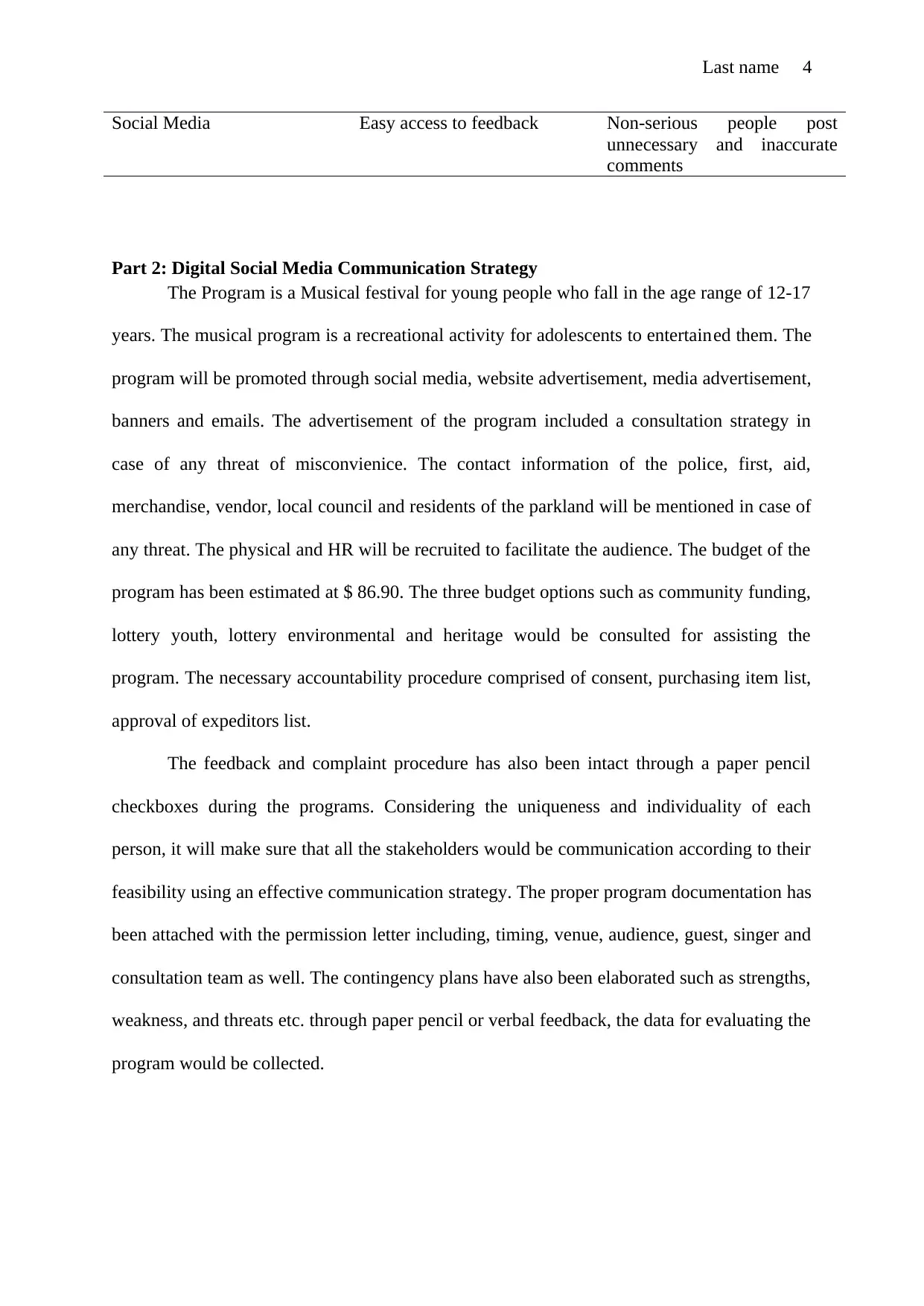
Social Media Easy access to feedback Non-serious people post
unnecessary and inaccurate
comments
Part 2: Digital Social Media Communication Strategy
The Program is a Musical festival for young people who fall in the age range of 12-17
years. The musical program is a recreational activity for adolescents to entertained them. The
program will be promoted through social media, website advertisement, media advertisement,
banners and emails. The advertisement of the program included a consultation strategy in
case of any threat of misconvienice. The contact information of the police, first, aid,
merchandise, vendor, local council and residents of the parkland will be mentioned in case of
any threat. The physical and HR will be recruited to facilitate the audience. The budget of the
program has been estimated at $ 86.90. The three budget options such as community funding,
lottery youth, lottery environmental and heritage would be consulted for assisting the
program. The necessary accountability procedure comprised of consent, purchasing item list,
approval of expeditors list.
The feedback and complaint procedure has also been intact through a paper pencil
checkboxes during the programs. Considering the uniqueness and individuality of each
person, it will make sure that all the stakeholders would be communication according to their
feasibility using an effective communication strategy. The proper program documentation has
been attached with the permission letter including, timing, venue, audience, guest, singer and
consultation team as well. The contingency plans have also been elaborated such as strengths,
weakness, and threats etc. through paper pencil or verbal feedback, the data for evaluating the
program would be collected.
Social Media Easy access to feedback Non-serious people post
unnecessary and inaccurate
comments
Part 2: Digital Social Media Communication Strategy
The Program is a Musical festival for young people who fall in the age range of 12-17
years. The musical program is a recreational activity for adolescents to entertained them. The
program will be promoted through social media, website advertisement, media advertisement,
banners and emails. The advertisement of the program included a consultation strategy in
case of any threat of misconvienice. The contact information of the police, first, aid,
merchandise, vendor, local council and residents of the parkland will be mentioned in case of
any threat. The physical and HR will be recruited to facilitate the audience. The budget of the
program has been estimated at $ 86.90. The three budget options such as community funding,
lottery youth, lottery environmental and heritage would be consulted for assisting the
program. The necessary accountability procedure comprised of consent, purchasing item list,
approval of expeditors list.
The feedback and complaint procedure has also been intact through a paper pencil
checkboxes during the programs. Considering the uniqueness and individuality of each
person, it will make sure that all the stakeholders would be communication according to their
feasibility using an effective communication strategy. The proper program documentation has
been attached with the permission letter including, timing, venue, audience, guest, singer and
consultation team as well. The contingency plans have also been elaborated such as strengths,
weakness, and threats etc. through paper pencil or verbal feedback, the data for evaluating the
program would be collected.
Paraphrase This Document
Need a fresh take? Get an instant paraphrase of this document with our AI Paraphraser
Last name 5
Part 3: Case Study
The client is ten years old male referred to sexual and physical trauma. He was also
having developmental delays such as limited interaction and communication skill compared
to his age mates.
The cognitive, emotional, physical and social developmental stages help to identify
developmental delays. The delays in any stage limit the interaction, communication and
behavioural functioning among children (Muste, 2012). The multiple theories provide
evidence regarding the sexual and physical pathologies in the behaviour of the patient. The
Erickson Psychosocial stages of development, Abraham Maslow's Hierarchy of needs, Jean
Piaget theory of cognitive development, and Trauma and attachment theory provides a clear
description of every stage of human development and pathologies. The mother or caregiver
would be asked the question regarding developmental milestones.
Abraham Maslow’s theory of hierarchal need
Abraham Maslow postulated the theory of hierarchal needs. According to him, the
very first need of human being is a biological need, which is mandatory for the essence of
life. If a child of deprived of basic needs in the prenatal, postnatal or early stages of his life,
his physical development might deteriorate (South, 2011 Due to the lack of nutrients, many
cognitive and behavioural deficits may occur. The second stage is safety and security; the
child feels secure and safe in the presence of caretaker. In the above case, the child had a
traumatic experience due to his father. It can be assumed that his safety needs have been in
threatening that leads to limited interaction and communication issues. The third need is love
and belongingness. The lack of love and belongings leads to isolation and other psychological
disturbances. The fourth stage is the self-esteem stage if the child feels of self-esteem due to
parental rejection or parental abuse or neglect. As a result, he may suffer from physical and
sexual trauma.
Part 3: Case Study
The client is ten years old male referred to sexual and physical trauma. He was also
having developmental delays such as limited interaction and communication skill compared
to his age mates.
The cognitive, emotional, physical and social developmental stages help to identify
developmental delays. The delays in any stage limit the interaction, communication and
behavioural functioning among children (Muste, 2012). The multiple theories provide
evidence regarding the sexual and physical pathologies in the behaviour of the patient. The
Erickson Psychosocial stages of development, Abraham Maslow's Hierarchy of needs, Jean
Piaget theory of cognitive development, and Trauma and attachment theory provides a clear
description of every stage of human development and pathologies. The mother or caregiver
would be asked the question regarding developmental milestones.
Abraham Maslow’s theory of hierarchal need
Abraham Maslow postulated the theory of hierarchal needs. According to him, the
very first need of human being is a biological need, which is mandatory for the essence of
life. If a child of deprived of basic needs in the prenatal, postnatal or early stages of his life,
his physical development might deteriorate (South, 2011 Due to the lack of nutrients, many
cognitive and behavioural deficits may occur. The second stage is safety and security; the
child feels secure and safe in the presence of caretaker. In the above case, the child had a
traumatic experience due to his father. It can be assumed that his safety needs have been in
threatening that leads to limited interaction and communication issues. The third need is love
and belongingness. The lack of love and belongings leads to isolation and other psychological
disturbances. The fourth stage is the self-esteem stage if the child feels of self-esteem due to
parental rejection or parental abuse or neglect. As a result, he may suffer from physical and
sexual trauma.
Last name 6
Piaget theory of cognitive development
Piaget theory of cognitive development comprised of four stages. The sensory-motor
stage preoperational stage, operational and formal stage (Marwaha, Goswami, & Vashist,
2017). All the four stages provide a detailed description of each developmental stage, which
millstones a child in each stage. Such as in the sensory-motor stages the child explores the
world through his senses and mouth. In the preoperational stage, the child develops the
egocentrism. The egocentrisms reflect that the child cannot view the world from others
perspective. This stage s very crucially as the child is considered more self-centred. The
operational stage the child developed the concrete thinking and began to understand the
complex concept to some extent, in the formal stage the child began to develop the logical
and abstract thinking.
In the current case, the child is ten years old and stands in the operational stage of the
Piaget, but has not achieved the milestones, such as his communication and understanding
with the world is limited.
The Erickson stage of psychosocial development
The Erickson stage of psychosocial development provides an understanding of how
each stage is crucial in the psychological and sexual development of the child (Malone,
2015). The trust vs mistrust stage develops the secure or insecure attachment styles between
the child and caregiver. The child considers that other people will always be there to support
him. If he finds a lack of support, the crises began to start, and as a result, he develops the
mistrust, insecurity and fear. All these psychological aspect increases with the passage of
time and the child develop the anxious or antisocial personality in the later life. The second
stage of autonomy vs. shame and doubt/guilt is the second stage of psychosocial
development. The child in this stage strives to develop personal skill and independence. The
parental support to provide freedom, appreciation and love for accomplishing their task lead
to the degree of virtue.
Piaget theory of cognitive development
Piaget theory of cognitive development comprised of four stages. The sensory-motor
stage preoperational stage, operational and formal stage (Marwaha, Goswami, & Vashist,
2017). All the four stages provide a detailed description of each developmental stage, which
millstones a child in each stage. Such as in the sensory-motor stages the child explores the
world through his senses and mouth. In the preoperational stage, the child develops the
egocentrism. The egocentrisms reflect that the child cannot view the world from others
perspective. This stage s very crucially as the child is considered more self-centred. The
operational stage the child developed the concrete thinking and began to understand the
complex concept to some extent, in the formal stage the child began to develop the logical
and abstract thinking.
In the current case, the child is ten years old and stands in the operational stage of the
Piaget, but has not achieved the milestones, such as his communication and understanding
with the world is limited.
The Erickson stage of psychosocial development
The Erickson stage of psychosocial development provides an understanding of how
each stage is crucial in the psychological and sexual development of the child (Malone,
2015). The trust vs mistrust stage develops the secure or insecure attachment styles between
the child and caregiver. The child considers that other people will always be there to support
him. If he finds a lack of support, the crises began to start, and as a result, he develops the
mistrust, insecurity and fear. All these psychological aspect increases with the passage of
time and the child develop the anxious or antisocial personality in the later life. The second
stage of autonomy vs. shame and doubt/guilt is the second stage of psychosocial
development. The child in this stage strives to develop personal skill and independence. The
parental support to provide freedom, appreciation and love for accomplishing their task lead
to the degree of virtue.
⊘ This is a preview!⊘
Do you want full access?
Subscribe today to unlock all pages.
Trusted by 1+ million students worldwide
Last name 7
In contrast, the lack of support and freedom and overly criticism make the child
doubtful about their skills. The third stage is initiative vs. guilt, the stage of assertiveness.
The children interacted with peers in schools and strived to take the initiative role in play
activities. If they provide opportunities to take the lead to control the activities and make an
informed decision, they develop positive incline for decision making. Otherwise, they began
to mistrust their ability to take control of situation and decision making. Another crucial stage
is the industry vs. inferiority, which determine the level of competence among children. In
this stage, the child plays the role of a student, and teacher-student interaction develops a
need for approval. The teacher asks a student multiple questions and the child answer the
questions to feel competent. If the child could not answer the question, he develops the
inferiority complex which further psychological issues. In the above case, they must have
been fixation at any stage of the psychosocial development that leads him towards
psychological issues.
Trauma & Attachment theory
According to the theory, there are four basic attachment style, authoritative,
authoritarian, and submissive and negligence. The authoritative parenting does not allow a
child to make their decision and practice strict parenting regardless of child needs, wants and
desires. Such parenting style leads to insecure attachment with the child. The other types of
parenting style lead to secure attachment style to some extent. The trauma theory also
suggests that any obnoxious experience or event adversely affect the development of the
child. The signs of trauma are significant to eliminate the development of the child (Nouami,
2018). On the basis of the above theories, the questions would be asked, and after initial
diagnoses, the child would be referred to a doctor for further assessment As the child was
diagnosed with developmental and psychosocial issues, therefore, he will be referred to the
child psychologist or the pediatric for management. Multiple centres are working for the
In contrast, the lack of support and freedom and overly criticism make the child
doubtful about their skills. The third stage is initiative vs. guilt, the stage of assertiveness.
The children interacted with peers in schools and strived to take the initiative role in play
activities. If they provide opportunities to take the lead to control the activities and make an
informed decision, they develop positive incline for decision making. Otherwise, they began
to mistrust their ability to take control of situation and decision making. Another crucial stage
is the industry vs. inferiority, which determine the level of competence among children. In
this stage, the child plays the role of a student, and teacher-student interaction develops a
need for approval. The teacher asks a student multiple questions and the child answer the
questions to feel competent. If the child could not answer the question, he develops the
inferiority complex which further psychological issues. In the above case, they must have
been fixation at any stage of the psychosocial development that leads him towards
psychological issues.
Trauma & Attachment theory
According to the theory, there are four basic attachment style, authoritative,
authoritarian, and submissive and negligence. The authoritative parenting does not allow a
child to make their decision and practice strict parenting regardless of child needs, wants and
desires. Such parenting style leads to insecure attachment with the child. The other types of
parenting style lead to secure attachment style to some extent. The trauma theory also
suggests that any obnoxious experience or event adversely affect the development of the
child. The signs of trauma are significant to eliminate the development of the child (Nouami,
2018). On the basis of the above theories, the questions would be asked, and after initial
diagnoses, the child would be referred to a doctor for further assessment As the child was
diagnosed with developmental and psychosocial issues, therefore, he will be referred to the
child psychologist or the pediatric for management. Multiple centres are working for the
Paraphrase This Document
Need a fresh take? Get an instant paraphrase of this document with our AI Paraphraser
Last name 8
assessment and management of the child problem; the child will be referred to as one of the
following centres.
Government and non-government services
Centre for intellectual and developmental disabilities is the leading research centre
that deals with the assessment and management of the developmental issues of the
children.
Centre for developmental disorder focus on autism, intellectual disability, down
syndrome and numerous other developmental disorders impact on daily living and
propose unique interventions plan.
Centre for intellectual and developmental disabilities research aimed to conduct
high-quality research for the betterment of children with developmental
disabilities.
Child developmental services deal with the special developmental needs of the
children to enhance their potential.
The Tizard centre provides the best services to provide high quality care to the
children's with developmental disabilities.
Children identity developmental services provide assistant to the children to
identify their identities.
Child development centre works for the treatment and assessment of the children
with developmental needs.
Developmental behaviour pediatric clinic diagnose the children with
developmental delays.
Newham child developmental centre strives to meet the multiple developmental
needs of the children.
assessment and management of the child problem; the child will be referred to as one of the
following centres.
Government and non-government services
Centre for intellectual and developmental disabilities is the leading research centre
that deals with the assessment and management of the developmental issues of the
children.
Centre for developmental disorder focus on autism, intellectual disability, down
syndrome and numerous other developmental disorders impact on daily living and
propose unique interventions plan.
Centre for intellectual and developmental disabilities research aimed to conduct
high-quality research for the betterment of children with developmental
disabilities.
Child developmental services deal with the special developmental needs of the
children to enhance their potential.
The Tizard centre provides the best services to provide high quality care to the
children's with developmental disabilities.
Children identity developmental services provide assistant to the children to
identify their identities.
Child development centre works for the treatment and assessment of the children
with developmental needs.
Developmental behaviour pediatric clinic diagnose the children with
developmental delays.
Newham child developmental centre strives to meet the multiple developmental
needs of the children.
Last name 9
Development vision clinic assists the children with developmental vision issues
and other developmental delays.
The centre for disability studies conducts scientific research for the management
of child developmental issues.
Child development centre fulfils the needs of the pediatrics with developmental
dilemmas.
developmental service resources centre provides support to the children having
developmental disabilities
The lighthouse child development centre aimed to benefit the parent and children
dealing with developmental delays.
Development vision clinic assists the children with developmental vision issues
and other developmental delays.
The centre for disability studies conducts scientific research for the management
of child developmental issues.
Child development centre fulfils the needs of the pediatrics with developmental
dilemmas.
developmental service resources centre provides support to the children having
developmental disabilities
The lighthouse child development centre aimed to benefit the parent and children
dealing with developmental delays.
⊘ This is a preview!⊘
Do you want full access?
Subscribe today to unlock all pages.
Trusted by 1+ million students worldwide
Last name 10
References
Bergman, C., Dellve, L., & Skagert, K. (2016). Exploring communication processes
in workplace meetings: A mixed methods study in a Swedish healthcare organisation.
Work (Reading, Mass.), Vol. 54(3), pp. 533–541. doi:10.3233/WOR-162366
Malone, J. C., Liu, S. R., Vaillant, G. E., Rentz, D. M., & Waldinger, R. J. (2015).
Midlife Eriksonian psychosocial development: Setting the stage for late-life cognitive
and emotional health. Developmental psychology, Vol. 52(3), pp. 496–508.
doi:10.1037/a0039875
Marwaha, S., Goswami, M., & Vashist, B. (2017). Prevalence of Principles of Piaget's
Theory Among 4-7-year-old Children and their Correlation with IQ. Journal of
clinical and diagnostic research: JCDR, Vol. 11(8), ZC111–ZC115.
doi:10.7860/JCDR/2017/28435.10513
Muste, E., 2012. Therapy in an Inpatient and Day Treatment Group Setting. The
Wiley-Blackwell Handbook of Schema Therapy: Theory, Research, and Practice,
pp.359.
Nouami, F., 2018. Managing Healthcare Communication Efforts: A Case
Study (Doctoral dissertation, University of Phoenix).
Persson, S.S., Lindström, P.N., Pettersson, P. and Andersson, I., 2018. Workplace
relationships impact self-rated health: A survey of Swedish municipal health care
employees: work, (Preprint), pp.1-10.
South A. (2011). Designing and implementing a communications strategy: lessons
learnt from HIV and Sexual and Reproductive Health Research Programme
Consortia. Health research policy and systems, 9 Suppl 1(Suppl 1), S15.
doi:10.1186/1478-4505-9-S1-S15
References
Bergman, C., Dellve, L., & Skagert, K. (2016). Exploring communication processes
in workplace meetings: A mixed methods study in a Swedish healthcare organisation.
Work (Reading, Mass.), Vol. 54(3), pp. 533–541. doi:10.3233/WOR-162366
Malone, J. C., Liu, S. R., Vaillant, G. E., Rentz, D. M., & Waldinger, R. J. (2015).
Midlife Eriksonian psychosocial development: Setting the stage for late-life cognitive
and emotional health. Developmental psychology, Vol. 52(3), pp. 496–508.
doi:10.1037/a0039875
Marwaha, S., Goswami, M., & Vashist, B. (2017). Prevalence of Principles of Piaget's
Theory Among 4-7-year-old Children and their Correlation with IQ. Journal of
clinical and diagnostic research: JCDR, Vol. 11(8), ZC111–ZC115.
doi:10.7860/JCDR/2017/28435.10513
Muste, E., 2012. Therapy in an Inpatient and Day Treatment Group Setting. The
Wiley-Blackwell Handbook of Schema Therapy: Theory, Research, and Practice,
pp.359.
Nouami, F., 2018. Managing Healthcare Communication Efforts: A Case
Study (Doctoral dissertation, University of Phoenix).
Persson, S.S., Lindström, P.N., Pettersson, P. and Andersson, I., 2018. Workplace
relationships impact self-rated health: A survey of Swedish municipal health care
employees: work, (Preprint), pp.1-10.
South A. (2011). Designing and implementing a communications strategy: lessons
learnt from HIV and Sexual and Reproductive Health Research Programme
Consortia. Health research policy and systems, 9 Suppl 1(Suppl 1), S15.
doi:10.1186/1478-4505-9-S1-S15

1 out of 10


Related Documents


Your All-in-One AI-Powered Toolkit for Academic Success.
+13062052269
info@desklib.com
Available 24*7 on WhatsApp / Email
![[object Object]](/_next/static/media/star-bottom.7253800d.svg)
Unlock your academic potential
Copyright © 2020–2026 A2Z Services. All Rights Reserved. Developed and managed by ZUCOL.