Strategies for Domestic Violence Community Service Assessment
VerifiedAdded on 2023/01/11
|7
|1902
|57
Essay
AI Summary
This essay outlines a community service project designed to address domestic violence, emphasizing the importance of victim participation, women's empowerment, social inclusion, conflict management, and reflective practices. The project aims to increase awareness through media campaigns, provide empowerment through employment opportunities and seminars, and foster social inclusion by integrating victims into community programs. Strategies include training programs for conflict resolution, establishing helplines, and implementing stricter measures for offenders. Reflective practices are also highlighted to encourage self-awareness and healthy family dynamics. The essay concludes by emphasizing the key aspects of the project, which utilizes a community toolbox to foster a strategic advantage in combating domestic violence in society.
Running Head: DOMESTIC VIOLENCE COMMUNITY SERVICE
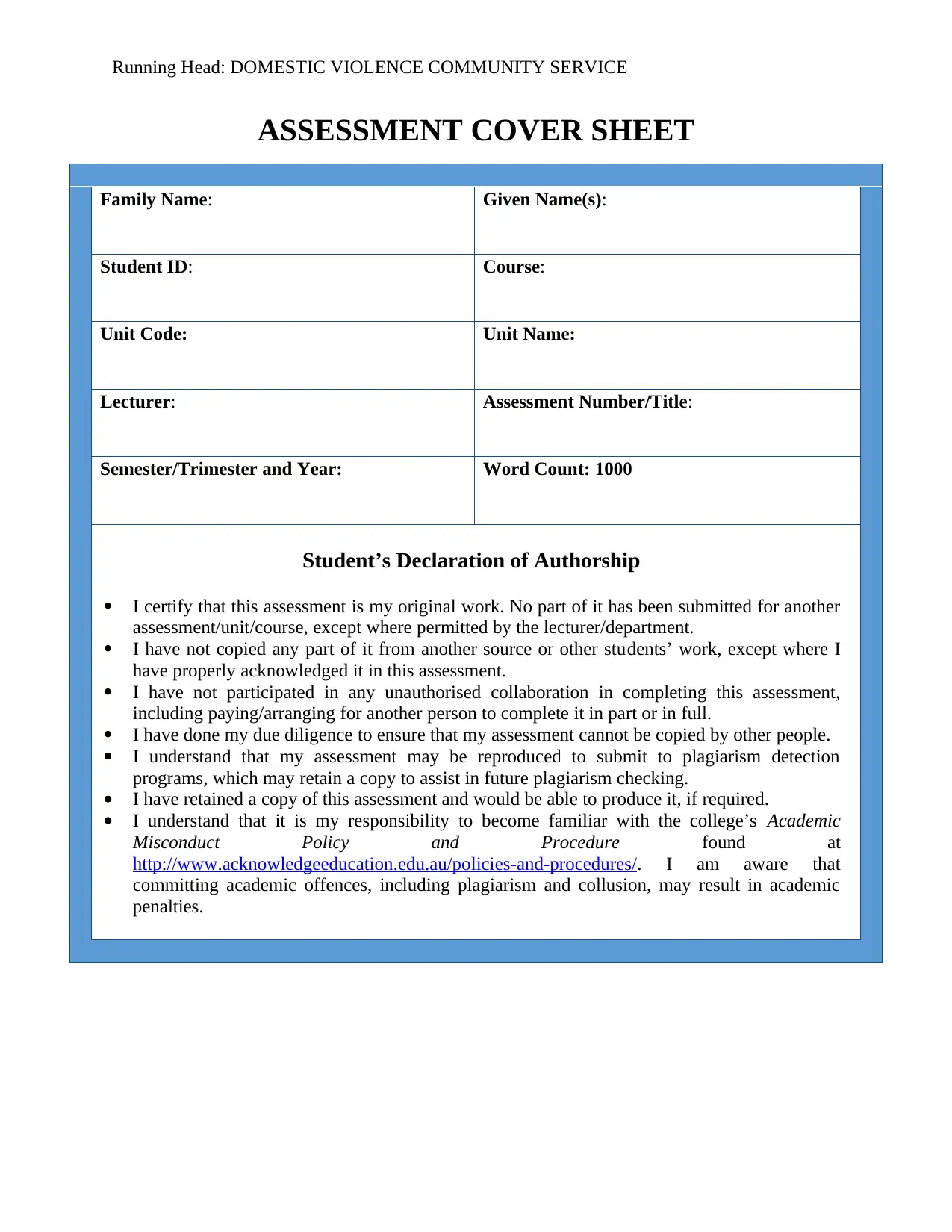
ASSESSMENT COVER SHEET
Family Name: Given Name(s):
Student ID: Course:
Unit Code: Unit Name:
Lecturer: Assessment Number/Title:
Semester/Trimester and Year: Word Count: 1000
Student’s Declaration of Authorship
I certify that this assessment is my original work. No part of it has been submitted for another
assessment/unit/course, except where permitted by the lecturer/department.
I have not copied any part of it from another source or other students’ work, except where I
have properly acknowledged it in this assessment.
I have not participated in any unauthorised collaboration in completing this assessment,
including paying/arranging for another person to complete it in part or in full.
I have done my due diligence to ensure that my assessment cannot be copied by other people.
I understand that my assessment may be reproduced to submit to plagiarism detection
programs, which may retain a copy to assist in future plagiarism checking.
I have retained a copy of this assessment and would be able to produce it, if required.
I understand that it is my responsibility to become familiar with the college’s Academic
Misconduct Policy and Procedure found at
http://www.acknowledgeeducation.edu.au/policies-and-procedures/. I am aware that
committing academic offences, including plagiarism and collusion, may result in academic
penalties.
ASSESSMENT COVER SHEET
Family Name: Given Name(s):
Student ID: Course:
Unit Code: Unit Name:
Lecturer: Assessment Number/Title:
Semester/Trimester and Year: Word Count: 1000
Student’s Declaration of Authorship
I certify that this assessment is my original work. No part of it has been submitted for another
assessment/unit/course, except where permitted by the lecturer/department.
I have not copied any part of it from another source or other students’ work, except where I
have properly acknowledged it in this assessment.
I have not participated in any unauthorised collaboration in completing this assessment,
including paying/arranging for another person to complete it in part or in full.
I have done my due diligence to ensure that my assessment cannot be copied by other people.
I understand that my assessment may be reproduced to submit to plagiarism detection
programs, which may retain a copy to assist in future plagiarism checking.
I have retained a copy of this assessment and would be able to produce it, if required.
I understand that it is my responsibility to become familiar with the college’s Academic
Misconduct Policy and Procedure found at
http://www.acknowledgeeducation.edu.au/policies-and-procedures/. I am aware that
committing academic offences, including plagiarism and collusion, may result in academic
penalties.
Paraphrase This Document
Need a fresh take? Get an instant paraphrase of this document with our AI Paraphraser

1DOMESTIC VIOLENCE COMMUNITY SERVICE
Violence against women is considered to be one of the major threat and complex issue in
present society. It needs urgent action for the social organisations and the government as well. it
is supplemented by rights of the women and the role of the civil society in curbing down the
nefarious practice of domestic violence especially on women. In this regards, the research is
going to design a community sustainable project with the help of a community tool box. The
primary focus of the research is vested on the participation of respondents, empowerment of the
women, social inclusion, managing conflict and the reflective practices.
Participation of the victims especially the women is a crucial part for the success of the
social work project that targets to reduce the domestic violence in Australia. In this regard,
emphasising on the marketing and promotion is crucial for the success of the project. According
to Waring and Crompton (2017) the role of marketing in a social campaign is crucial in order to
aware the common people about the benevolence and importance of the entire social work
practice. Therefore, it will be better for the project to include both the traditional media and the
social media to maximise the participants (Dragiewicz & Burgess, 2016). The traditional media
is associated with the television and radio broadcasting, theatre and art form. Moreover, the
social media practice is associated with the implementation of Facebook and Twitter and the
official website of the company for connecting more respondents and participants into the social
work project (Dragiewicz et al., 2018). As a result of that it will help to increase the number of
participants by raising the public awareness among the local communities.
Empowerment of the women is also a crucial part that this social work project tries to
put emphasis on. Most of the women who are victimised by the domestic violence lost their
confidence and succumb into trauma. Both the physical and mental vulnerability will lead
towards breakdown for the women (Hughes et al., 2015). Therefore, it is pertinent to imbue an
Violence against women is considered to be one of the major threat and complex issue in
present society. It needs urgent action for the social organisations and the government as well. it
is supplemented by rights of the women and the role of the civil society in curbing down the
nefarious practice of domestic violence especially on women. In this regards, the research is
going to design a community sustainable project with the help of a community tool box. The
primary focus of the research is vested on the participation of respondents, empowerment of the
women, social inclusion, managing conflict and the reflective practices.
Participation of the victims especially the women is a crucial part for the success of the
social work project that targets to reduce the domestic violence in Australia. In this regard,
emphasising on the marketing and promotion is crucial for the success of the project. According
to Waring and Crompton (2017) the role of marketing in a social campaign is crucial in order to
aware the common people about the benevolence and importance of the entire social work
practice. Therefore, it will be better for the project to include both the traditional media and the
social media to maximise the participants (Dragiewicz & Burgess, 2016). The traditional media
is associated with the television and radio broadcasting, theatre and art form. Moreover, the
social media practice is associated with the implementation of Facebook and Twitter and the
official website of the company for connecting more respondents and participants into the social
work project (Dragiewicz et al., 2018). As a result of that it will help to increase the number of
participants by raising the public awareness among the local communities.
Empowerment of the women is also a crucial part that this social work project tries to
put emphasis on. Most of the women who are victimised by the domestic violence lost their
confidence and succumb into trauma. Both the physical and mental vulnerability will lead
towards breakdown for the women (Hughes et al., 2015). Therefore, it is pertinent to imbue an

2DOMESTIC VIOLENCE COMMUNITY SERVICE
empowerment practice within the social work project so that the women suffered with domestic
violence can get the encouragement to deal with the problems on their own. In this regard, Lloyd
et al. (2017) stated that academic seminars and films or songs will be effective to create a social
awareness about the safety and security of the women and alleged domestic violence as a
punishable offense. As a matter of fact, employment opportunities for the victims can create a
better practice of empowering them. Moreover, they can develop confidence to deal with the
problems in the society. Therefore, this social welfare organisation is trying to create
employment possibilities for the domestic violence victimised women.
One of the key objectives of this social work campaign is to encourage the victims by
incorporating them into the social inclusion practice. In most of the developing countries,
victims of domestic violence become isolated and social stigmas make them alienated from the
mainstream social privileges. Therefore, it is surely a pivotal part for this social work project to
establish effective measure for the social inclusion of the women suffers (Trevillion et al., 2016).
Therefore, the social inclusion programs like sharing their stories in the social media can be a
good move for the organisation. It will make the people to understand the adverse impact of the
domestic violence on a woman and her sufferings. A social awareness can be made and people
will get acknowledged with the nefarious practice of domestic violence (Miller, 2017). As a
matter of fact, the victims can achieve the opportunity to initiate a new life with the social
inclusion and does not ashamed of their sufferings. It makes them strong and empowered enough
to deal with the consequences further.
It is also important for the social work project to initiate effective measure for reducing
and managing the domestic violence permanently. In this context, a lot of strategies can be
implemented by the social work organisation in the form of training and influencing the local
empowerment practice within the social work project so that the women suffered with domestic
violence can get the encouragement to deal with the problems on their own. In this regard, Lloyd
et al. (2017) stated that academic seminars and films or songs will be effective to create a social
awareness about the safety and security of the women and alleged domestic violence as a
punishable offense. As a matter of fact, employment opportunities for the victims can create a
better practice of empowering them. Moreover, they can develop confidence to deal with the
problems in the society. Therefore, this social welfare organisation is trying to create
employment possibilities for the domestic violence victimised women.
One of the key objectives of this social work campaign is to encourage the victims by
incorporating them into the social inclusion practice. In most of the developing countries,
victims of domestic violence become isolated and social stigmas make them alienated from the
mainstream social privileges. Therefore, it is surely a pivotal part for this social work project to
establish effective measure for the social inclusion of the women suffers (Trevillion et al., 2016).
Therefore, the social inclusion programs like sharing their stories in the social media can be a
good move for the organisation. It will make the people to understand the adverse impact of the
domestic violence on a woman and her sufferings. A social awareness can be made and people
will get acknowledged with the nefarious practice of domestic violence (Miller, 2017). As a
matter of fact, the victims can achieve the opportunity to initiate a new life with the social
inclusion and does not ashamed of their sufferings. It makes them strong and empowered enough
to deal with the consequences further.
It is also important for the social work project to initiate effective measure for reducing
and managing the domestic violence permanently. In this context, a lot of strategies can be
implemented by the social work organisation in the form of training and influencing the local
⊘ This is a preview!⊘
Do you want full access?
Subscribe today to unlock all pages.

Trusted by 1+ million students worldwide

3DOMESTIC VIOLENCE COMMUNITY SERVICE
communities to take care of the neighbours in the form of quick responses to domestic violence
(Walker et al., 2015). Moreover, a private helpline is also included into the strategic plan for the
social work organisation in order to reduce the practice of domestic violence within the society.
Draconian measures have to be implemented for the offenders so that they get afraid before
practicing domestic violence. The training measures is a positive step in order to develop safe
and healthy relationship skills between the partners (Cannon et al., 2016). It is important to spend
a healthy life and thus skip out the practice of domestic violence. In fact, the proactive nature of
the community can prohibit the family to use domestic violence. It creates an effective
environment where people do not think of violence and seek help of the neighbours to resolve
the issues.
Apart from that reflective practices are also significant part in the domestic violence
eradication strategy. It is essential for the social work organisation to make the families and the
couples to acknowledge the importance of healthy family lives. The essential part is to elucidate
and develop a self-reflection of the people so that they can eradicate the issues and practices of
domestic violence by their own means (Matheson et al., 2015). It will bring self-awareness
among the people regarding the disadvantages of domestic violence and its adverse impact on the
personal and social integrity and environment. The reflect practices propounds self-development
training and the ability to respect and restore personal value of others.
The above essay intends to portray different strategies that can deliver a better framework
for the social work organisation to deal with the issues of domestic violence. Therefore,
highlighting participation, empowerment, social isolation, managing the issue and reflective
practices are the key aspects on which the essay entirely develops its strategies. Based on this
understanding, it can be concluded that the essay rightly focuses on the important touch points
communities to take care of the neighbours in the form of quick responses to domestic violence
(Walker et al., 2015). Moreover, a private helpline is also included into the strategic plan for the
social work organisation in order to reduce the practice of domestic violence within the society.
Draconian measures have to be implemented for the offenders so that they get afraid before
practicing domestic violence. The training measures is a positive step in order to develop safe
and healthy relationship skills between the partners (Cannon et al., 2016). It is important to spend
a healthy life and thus skip out the practice of domestic violence. In fact, the proactive nature of
the community can prohibit the family to use domestic violence. It creates an effective
environment where people do not think of violence and seek help of the neighbours to resolve
the issues.
Apart from that reflective practices are also significant part in the domestic violence
eradication strategy. It is essential for the social work organisation to make the families and the
couples to acknowledge the importance of healthy family lives. The essential part is to elucidate
and develop a self-reflection of the people so that they can eradicate the issues and practices of
domestic violence by their own means (Matheson et al., 2015). It will bring self-awareness
among the people regarding the disadvantages of domestic violence and its adverse impact on the
personal and social integrity and environment. The reflect practices propounds self-development
training and the ability to respect and restore personal value of others.
The above essay intends to portray different strategies that can deliver a better framework
for the social work organisation to deal with the issues of domestic violence. Therefore,
highlighting participation, empowerment, social isolation, managing the issue and reflective
practices are the key aspects on which the essay entirely develops its strategies. Based on this
understanding, it can be concluded that the essay rightly focuses on the important touch points
Paraphrase This Document
Need a fresh take? Get an instant paraphrase of this document with our AI Paraphraser

4DOMESTIC VIOLENCE COMMUNITY SERVICE
and emphasis on the strategic measures that will foster a strategic advantage with the help of
community toolbox.
and emphasis on the strategic measures that will foster a strategic advantage with the help of
community toolbox.

5DOMESTIC VIOLENCE COMMUNITY SERVICE
Reference
Cannon, C., Hamel, J., Buttell, F., & Ferreira, R. J. (2016). A survey of domestic violence
perpetrator programs in the United States and Canada: Findings and implications for
policy and intervention. Partner abuse, 7(3), 226-276.
Dragiewicz, M., & Burgess, J. (2016). Domestic violence on# qanda: The “Man” question in live
Twitter discussion on the Australian Broadcasting Corporation's Q&A. Canadian journal
of women and the law, 28(1), 211-229.
Dragiewicz, M., Burgess, J., Matamoros-Fernández, A., Salter, M., Suzor, N. P., Woodlock, D.,
& Harris, B. (2018). Technology facilitated coercive control: domestic violence and the
competing roles of digital media platforms. Feminist Media Studies, 18(4), 609-625.
Hughes, C., Bolis, M., Fries, R., & Finigan, S. (2015). Women's economic inequality and
domestic violence: exploring the links and empowering women. Gender &
Development, 23(2), 279-297.
Lloyd, M., Ramon, S., Vakalopoulou, A., Videmšek, P., Meffan, C., Roszczynska-Michta, J., &
Rollè, L. (2017). Women’s experiences of domestic violence and mental health: Findings
from a European empowerment project. Psychology of violence, 7(3), 478.
Matheson, F. I., Daoud, N., Hamilton-Wright, S., Borenstein, H., Pedersen, C., & O'Campo, P.
(2015). Where did she go? The transformation of self-esteem, self-identity, and mental
well-being among women who have experienced intimate partner violence. Women's
health issues, 25(5), 561-569.
Reference
Cannon, C., Hamel, J., Buttell, F., & Ferreira, R. J. (2016). A survey of domestic violence
perpetrator programs in the United States and Canada: Findings and implications for
policy and intervention. Partner abuse, 7(3), 226-276.
Dragiewicz, M., & Burgess, J. (2016). Domestic violence on# qanda: The “Man” question in live
Twitter discussion on the Australian Broadcasting Corporation's Q&A. Canadian journal
of women and the law, 28(1), 211-229.
Dragiewicz, M., Burgess, J., Matamoros-Fernández, A., Salter, M., Suzor, N. P., Woodlock, D.,
& Harris, B. (2018). Technology facilitated coercive control: domestic violence and the
competing roles of digital media platforms. Feminist Media Studies, 18(4), 609-625.
Hughes, C., Bolis, M., Fries, R., & Finigan, S. (2015). Women's economic inequality and
domestic violence: exploring the links and empowering women. Gender &
Development, 23(2), 279-297.
Lloyd, M., Ramon, S., Vakalopoulou, A., Videmšek, P., Meffan, C., Roszczynska-Michta, J., &
Rollè, L. (2017). Women’s experiences of domestic violence and mental health: Findings
from a European empowerment project. Psychology of violence, 7(3), 478.
Matheson, F. I., Daoud, N., Hamilton-Wright, S., Borenstein, H., Pedersen, C., & O'Campo, P.
(2015). Where did she go? The transformation of self-esteem, self-identity, and mental
well-being among women who have experienced intimate partner violence. Women's
health issues, 25(5), 561-569.
⊘ This is a preview!⊘
Do you want full access?
Subscribe today to unlock all pages.

Trusted by 1+ million students worldwide

6DOMESTIC VIOLENCE COMMUNITY SERVICE
Miller, B. (2017). Employment law: A necessary safety net: The argument for paid domestic and
family violence leave. Ethos: Official Publication of the Law Society of the Australian
Capital Territory, (245), 16.
Trevillion, K., Corker, E., Capron, L. E., & Oram, S. (2016). Improving mental health service
responses to domestic violence and abuse. International review of psychiatry, 28(5), 423-
432.
Walker, K., Bowen, E., Brown, S., & Sleath, E. (2015). Desistance from intimate partner
violence: A conceptual model and framework for practitioners for managing the process
of change. Journal of interpersonal violence, 30(15), 2726-2750.
Waring, J., & Crompton, A. (2017). A ‘movement for improvement’? A qualitative study of the
adoption of social movement strategies in the implementation of a quality improvement
campaign. Sociology of health & illness, 39(7), 1083-1099.
Miller, B. (2017). Employment law: A necessary safety net: The argument for paid domestic and
family violence leave. Ethos: Official Publication of the Law Society of the Australian
Capital Territory, (245), 16.
Trevillion, K., Corker, E., Capron, L. E., & Oram, S. (2016). Improving mental health service
responses to domestic violence and abuse. International review of psychiatry, 28(5), 423-
432.
Walker, K., Bowen, E., Brown, S., & Sleath, E. (2015). Desistance from intimate partner
violence: A conceptual model and framework for practitioners for managing the process
of change. Journal of interpersonal violence, 30(15), 2726-2750.
Waring, J., & Crompton, A. (2017). A ‘movement for improvement’? A qualitative study of the
adoption of social movement strategies in the implementation of a quality improvement
campaign. Sociology of health & illness, 39(7), 1083-1099.
1 out of 7
Related Documents
Your All-in-One AI-Powered Toolkit for Academic Success.
+13062052269
info@desklib.com
Available 24*7 on WhatsApp / Email
Unlock your academic potential
Copyright © 2020–2025 A2Z Services. All Rights Reserved. Developed and managed by ZUCOL.