COMP2804 Discrete Structures II: Assignment 4 - Probability Problems

Verified

Added on  2022/09/14

|7
|1427
|12
Homework Assignment
AI Summary
This document provides a comprehensive solution to Assignment 4 of the COMP2804 Discrete Structures II course. The assignment covers various probability problems, including coin flips, conditional probability, and expected value. The solutions are presented step-by-step, with clear justifications for each answer. Question 1 deals with coin flip probabilities, calculating probabilities of specific outcomes. Question 2 explores conditional probability using dice rolls. Question 3 involves the Monty Hall problem, analyzing the impact of switching doors. Question 4 delves into genetic probability scenarios related to cystic fibrosis. Question 5 examines expected value in a cider-tasting scenario. Question 6 tackles a problem involving sick and healthy people in a circle. Finally, Question 7 calculates the probability of a head appearing on a specific toss. The document concludes with a bibliography of relevant resources. This assignment is a valuable resource for students studying discrete mathematics and probability.
Document Page
Assignment 4
Name of the student
Name of the University
tabler-icon-diamond-filled.svg

Paraphrase This Document

Need a fresh take? Get an instant paraphrase of this document with our AI Paraphraser
Document Page
Answer to question 1:
Let H denotes head and T tail
Pr(H) = Pr(T) = 1/2
[a] Pr(A)
= Pr(4H 2T) + Pr(5H 1A) + Pr(6H)
= C (1/2)⁴(1/2)² + C (1/2)⁵(1/2) + (1/2)
= 22/64
= 11/32
[b] Pr(B)
= Pr(3H 3T)
= C (1/2)³(1/2)³
= 20/64
= 10/32
[c] Pr(C)
= Pr(HHHHT_) + Pr(THHHHT) + Pr(_THHHH) + Pr(HHHHHT) + Pr(THHHHH) +
Pr(HHHHHH)
= (1/2)⁴(1/2) + (1/2)(1/2)⁴(1/2) + (1/2)(1/2)⁴ + (1/2)⁵(1/2) + (1/2)(1/2)⁵ + (1/2)
= (1/32) + (1/64) + (1/32) + (1/64) + (1/64) + (1/64)
= 1/8
[d] If the coin comes up heads at least four times, the coin comes up tails at most twice.
It is impossible that the number of heads is equal to the number of tails.
Pr(A and B) = 0
Pr(A|B)
= Pr(A and B) / Pr(B)
Document Page
= 0
[e] Pr(C and A)
= Pr(C)
= 1/8
P(C|A)
= Pr(C and A) / Pr(A)
= (1/8) / (11/32)
= 4/11
Answer to question 2:
Given A = d1 + d2 = 7
B = d1 + d2 = 5
C = A U B
Hence, P(A) = 6/36
P(B) = 4/36
P(C) = P(A U B) = P(A) + P(B) [since, A and B cannot occur together]
= 6/36 + 4/36 = 10/36 = 5/18
Hence, P(A|C) = P(A)/P(C) = (6/36) / (5/18)
= 3/5
Answer to question 3:
[a] P(choosing the right door at the first go).
= ¼
[b] Since, Monte Hall opens a door and showing a goat, if one door is chosen randomly from
three unopened door, then
Document Page
P(choosing the right door at the first go) = 1/3
[c] P(Winning | You switched ) = P( choosing incorrect door out of 4 doors)* P(choosing the
correct door out of two doors, remaining after host opens one door)
Hence, P(Winning| You switched) = 3/4 * 1/2 = 3/8.
Answer to question 4:
Let N-CF denotes the chosen people is non-carrier, C-CF denotes carrier and CF denotes
people having cystic fibrosis
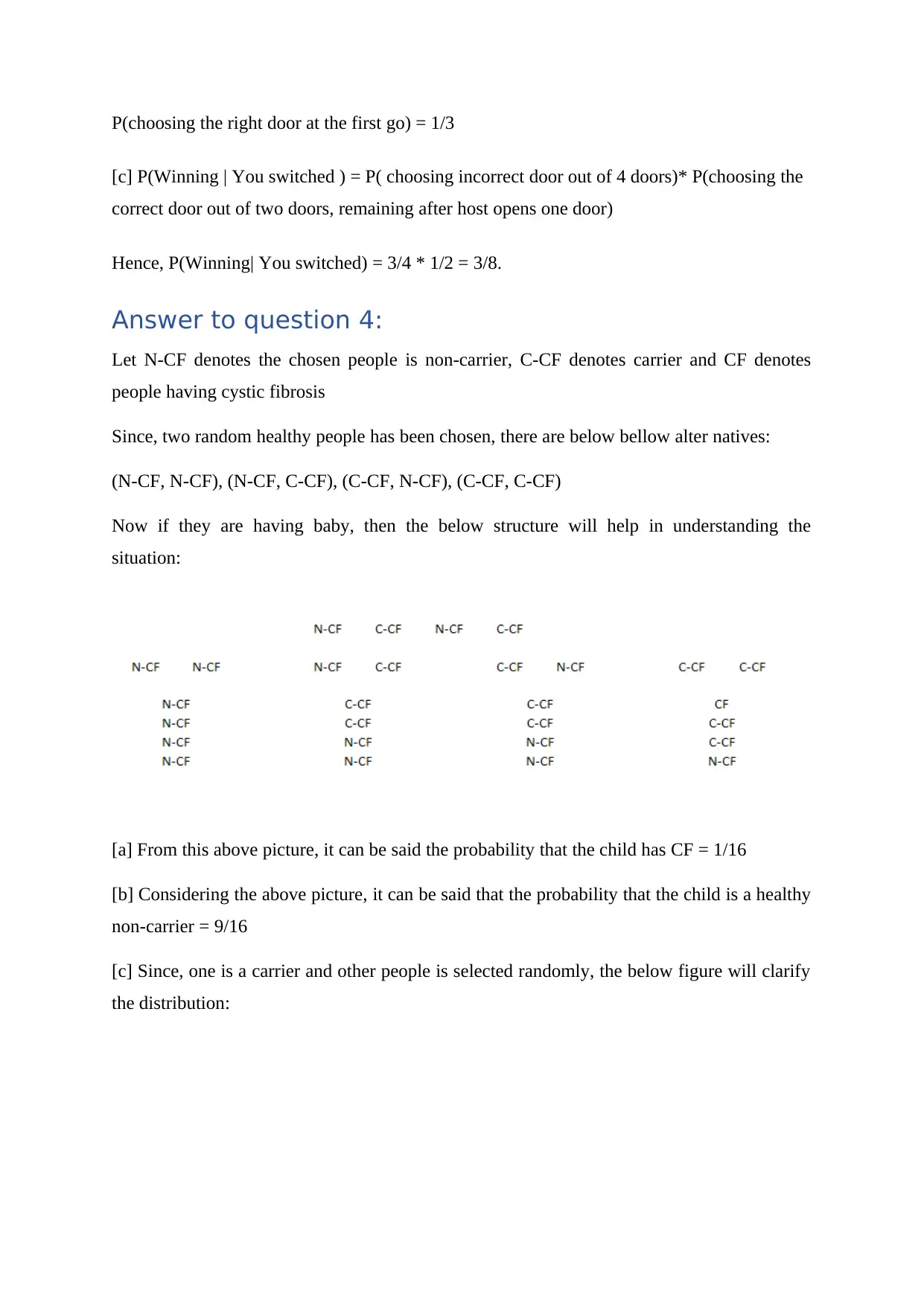
Since, two random healthy people has been chosen, there are below bellow alter natives:
(N-CF, N-CF), (N-CF, C-CF), (C-CF, N-CF), (C-CF, C-CF)
Now if they are having baby, then the below structure will help in understanding the
situation:
[a] From this above picture, it can be said the probability that the child has CF = 1/16
[b] Considering the above picture, it can be said that the probability that the child is a healthy
non-carrier = 9/16
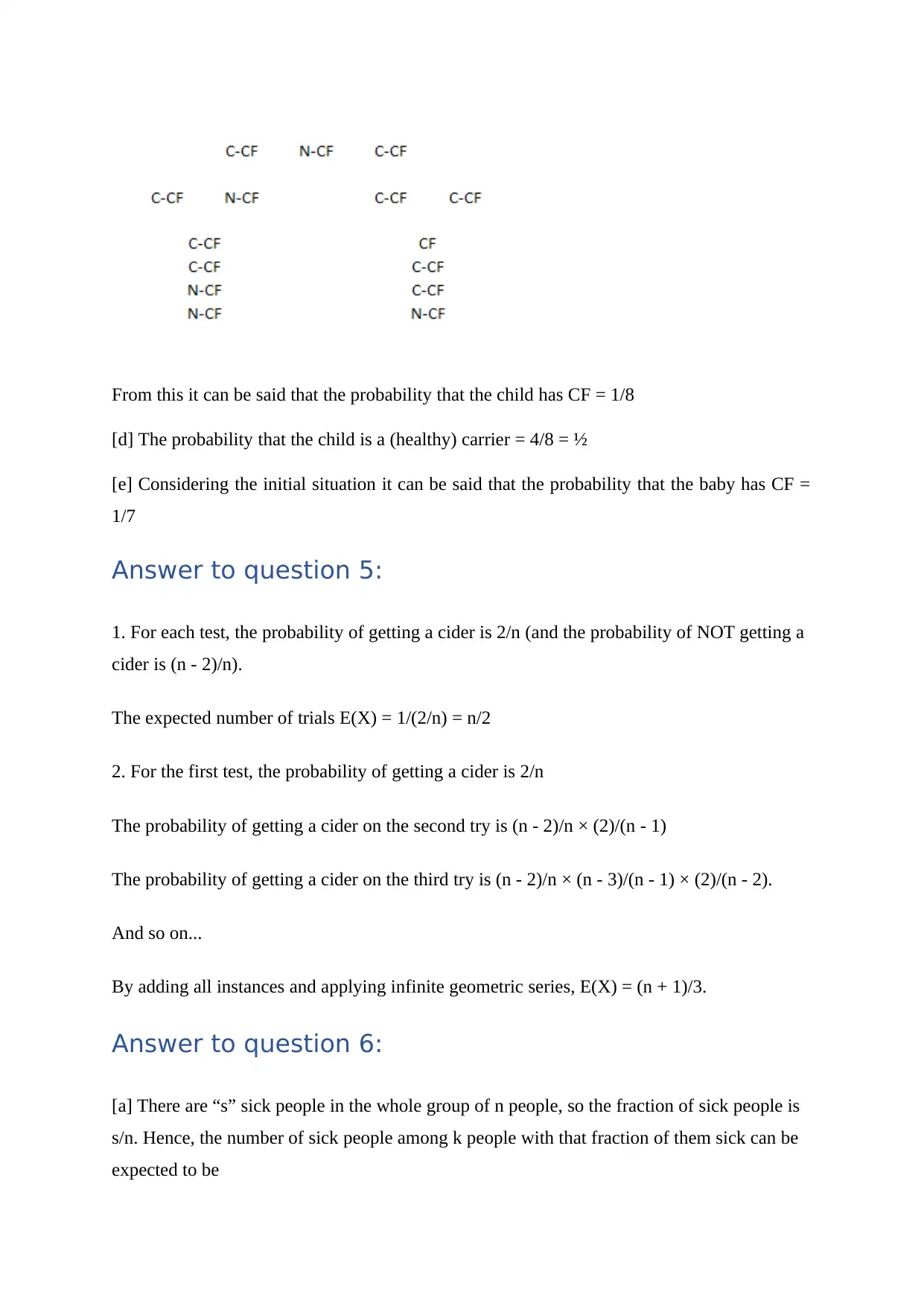
[c] Since, one is a carrier and other people is selected randomly, the below figure will clarify
the distribution:
tabler-icon-diamond-filled.svg

Paraphrase This Document

Need a fresh take? Get an instant paraphrase of this document with our AI Paraphraser
Document Page
From this it can be said that the probability that the child has CF = 1/8
[d] The probability that the child is a (healthy) carrier = 4/8 = ½
[e] Considering the initial situation it can be said that the probability that the baby has CF =
1/7
Answer to question 5:
1. For each test, the probability of getting a cider is 2/n (and the probability of NOT getting a
cider is (n - 2)/n).
The expected number of trials E(X) = 1/(2/n) = n/2
2. For the first test, the probability of getting a cider is 2/n
The probability of getting a cider on the second try is (n - 2)/n × (2)/(n - 1)
The probability of getting a cider on the third try is (n - 2)/n × (n - 3)/(n - 1) × (2)/(n - 2).
And so on...
By adding all instances and applying infinite geometric series, E(X) = (n + 1)/3.
Answer to question 6:
[a] There are “s” sick people in the whole group of n people, so the fraction of sick people is
s/n. Hence, the number of sick people among k people with that fraction of them sick can be
expected to be
Document Page
E(X) = ks/n
[b] We've got 39 sick people, and 70 - 39 = 31 healthy people in the circle.
Suppose we start looking for such a group of 7 consecutive people beginning with p[0] and
moving around the circle in order by subscript number. Suppose, also, that we FAIL to find 7
consecutive people, with at least 4 healthy, for as long as possible.
Then the first 7 people (p[0] through p[6]) must have at least 4 sick people, and every time
we look at a group farther around the circle, we see the same thing. The group p[7] through
p[13] must have at least 4 sick people, and the group p[14] through p[20] likewise, and so
on. Then when we've examined 9 consecutive, non-overlapping groups of 7 people, a total of
63 people, we must have found 36 sick people and there are 70 - 63 = 7 people left of
whom only 39 - 36 = 3 are sick. Therefore, even in the most extreme case, putting off finding
them as long as we can, we still find one group of 7 people of whom 4 are healthy.
Answer to question 7:
Here, the probability of Head = ½ and probability of tail = ½
Now, head appears at first toss = ½
Head appears at 2nd toss = (1/2)*(1/2) = ¼ = ½^2
Head appears at 3rd toss = (1/4)*(1/2) = 1/8 = ½^3
……………………………….
Head appears at nth toss = ½^n
Document Page
Bibliography
Anderson, D.R., Sweeney, D.J., Williams, T.A., Camm, J.D. and Cochran, J.J., 2020.
Modern business statistics with Microsoft Excel. Cengage Learning.
Anderson, D.R., Sweeney, D.J., Williams, T.A., Camm, J.D. and Cochran, J.J., 2020.
Essentials of modern business statistics with Microsoft Excel. Cengage Learning.
Black, K., 2019. Business statistics: for contemporary decision making. John Wiley & Sons.
Jaggia, S., Kelly, A., Salzman, S., Olaru, D., Sriananthakumar, S., Beg, R. and Leighton, C.,
2016. Essentials of Business Statistics: communicating with numbers. McGrawhill Education.
Siegel, A., 2016. Practical business statistics. Academic Press.
chevron_up_icon
1 out of 7
circle_padding
hide_on_mobile
zoom_out_icon
[object Object]