COMP2804 Discrete Mathematics Assignment 4 Solution, Fall 2019

Verified

Added on  2022/08/29

|6
|663
|19
Homework Assignment
AI Summary
This document presents a comprehensive solution to a Discrete Mathematics assignment, addressing various problems related to probability and discrete structures. The solution begins with an analysis of coin flips, calculating probabilities for different outcomes. It then delves into probability calculations involving rolling dice, including conditional probability and the probability of specific events occurring before others. The assignment also tackles the classic Four-Door Monte Hall problem, exploring the probabilities of winning under different strategies. Furthermore, the solution investigates problems related to estimating genetic diseases, calculating probabilities of carriers and affected children. Finally, the assignment explores probability with replacement and the calculation of expected values using geometric random variables. The document provides detailed explanations and justifications for each step, making it a valuable resource for students studying discrete mathematics.
Document Page
Running head: Discrete Mathematics
Discrete Mathematics
Name of the Student
Name of the University
tabler-icon-diamond-filled.svg

Paraphrase This Document

Need a fresh take? Get an instant paraphrase of this document with our AI Paraphraser
Document Page
2Discrete Mathematics
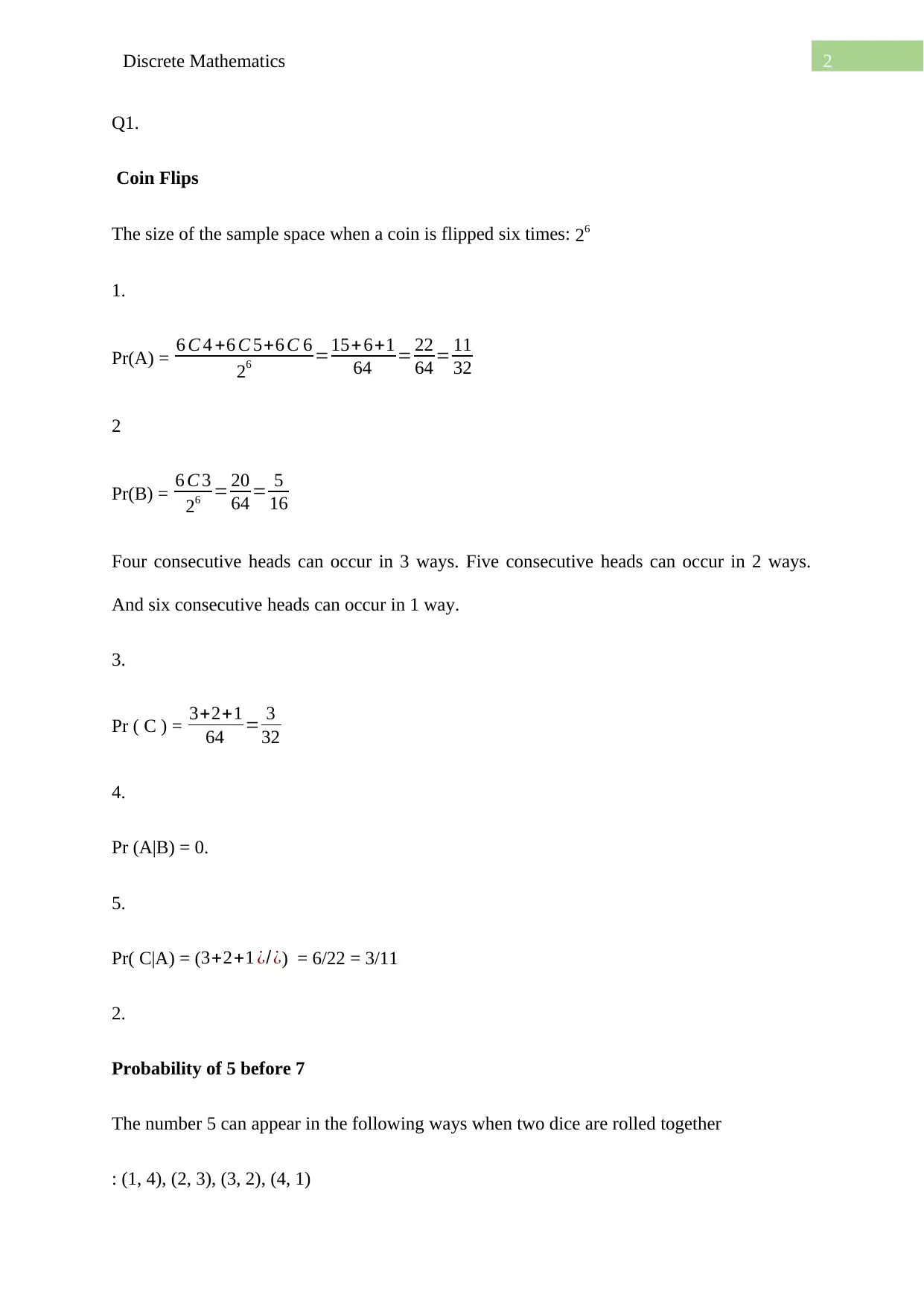
Q1.
Coin Flips
The size of the sample space when a coin is flipped six times: 26
1.
Pr(A) = 6 C 4 +6 C 5+6 C 6
26 =15+6+1
64 = 22
64 = 11
32
2
Pr(B) = 6 C 3
26 = 20
64 = 5
16
Four consecutive heads can occur in 3 ways. Five consecutive heads can occur in 2 ways.
And six consecutive heads can occur in 1 way.
3.
Pr ( C ) = 3+2+1
64 = 3
32
4.
Pr (A|B) = 0.
5.
Pr( C|A) = (3+2+1 ¿/¿) = 6/22 = 3/11
2.
Probability of 5 before 7
The number 5 can appear in the following ways when two dice are rolled together
: (1, 4), (2, 3), (3, 2), (4, 1)
Document Page
3Discrete Mathematics
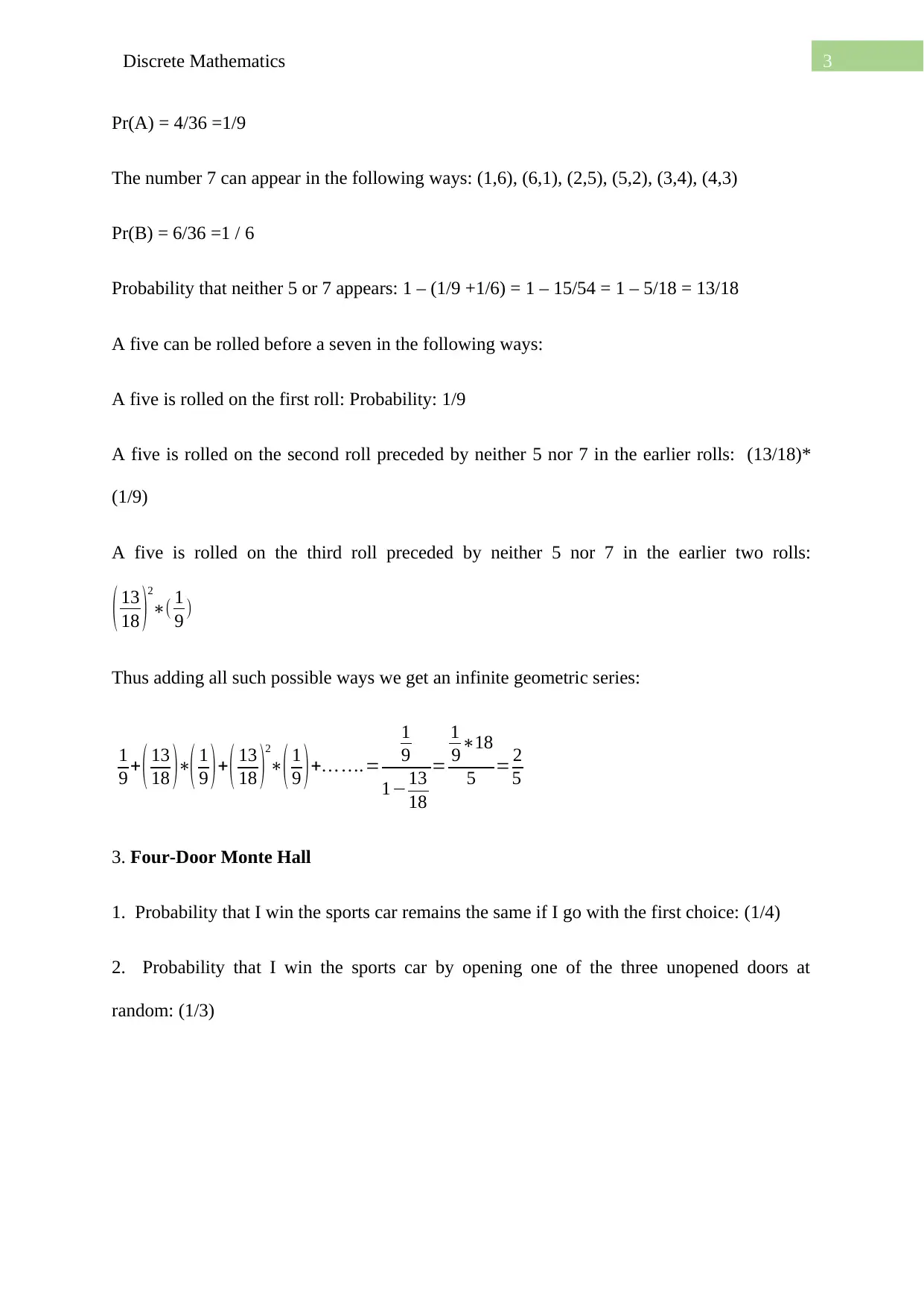
Pr(A) = 4/36 =1/9
The number 7 can appear in the following ways: (1,6), (6,1), (2,5), (5,2), (3,4), (4,3)
Pr(B) = 6/36 =1 / 6
Probability that neither 5 or 7 appears: 1 – (1/9 +1/6) = 1 – 15/54 = 1 – 5/18 = 13/18
A five can be rolled before a seven in the following ways:
A five is rolled on the first roll: Probability: 1/9
A five is rolled on the second roll preceded by neither 5 nor 7 in the earlier rolls: (13/18)*
(1/9)
A five is rolled on the third roll preceded by neither 5 nor 7 in the earlier two rolls:
( 13
18 )
2
( 1
9 )
Thus adding all such possible ways we get an infinite geometric series:
1
9 + ( 13
18 )( 1
9 )+ ( 13
18 )2
( 1
9 )+ .=
1
9
113
18
=
1
918
5 = 2
5
3. Four-Door Monte Hall
1. Probability that I win the sports car remains the same if I go with the first choice: (1/4)
2. Probability that I win the sports car by opening one of the three unopened doors at
random: (1/3)
Document Page
4Discrete Mathematics
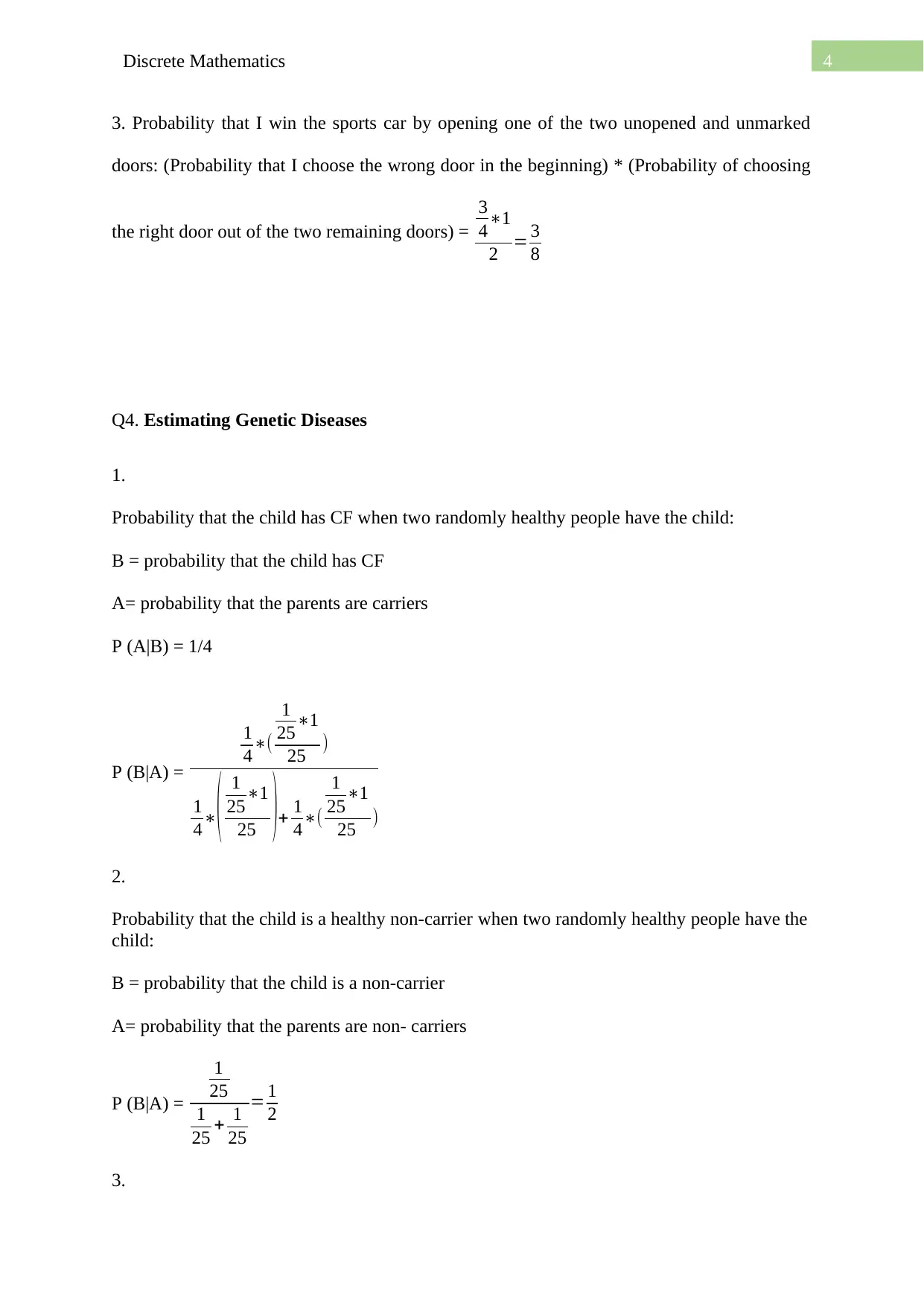
3. Probability that I win the sports car by opening one of the two unopened and unmarked
doors: (Probability that I choose the wrong door in the beginning) * (Probability of choosing
the right door out of the two remaining doors) =
3
41
2 = 3
8
Q4. Estimating Genetic Diseases
1.
Probability that the child has CF when two randomly healthy people have the child:
B = probability that the child has CF
A= probability that the parents are carriers
P (A|B) = 1/4
P (B|A) =
1
4(
1
251
25 )
1
4( 1
251
25 )+ 1
4(
1
251
25 )
2.
Probability that the child is a healthy non-carrier when two randomly healthy people have the
child:
B = probability that the child is a non-carrier
A= probability that the parents are non- carriers
P (B|A) =
1
25
1
25 + 1
25
= 1
2
3.
tabler-icon-diamond-filled.svg

Paraphrase This Document

Need a fresh take? Get an instant paraphrase of this document with our AI Paraphraser
Document Page
5Discrete Mathematics
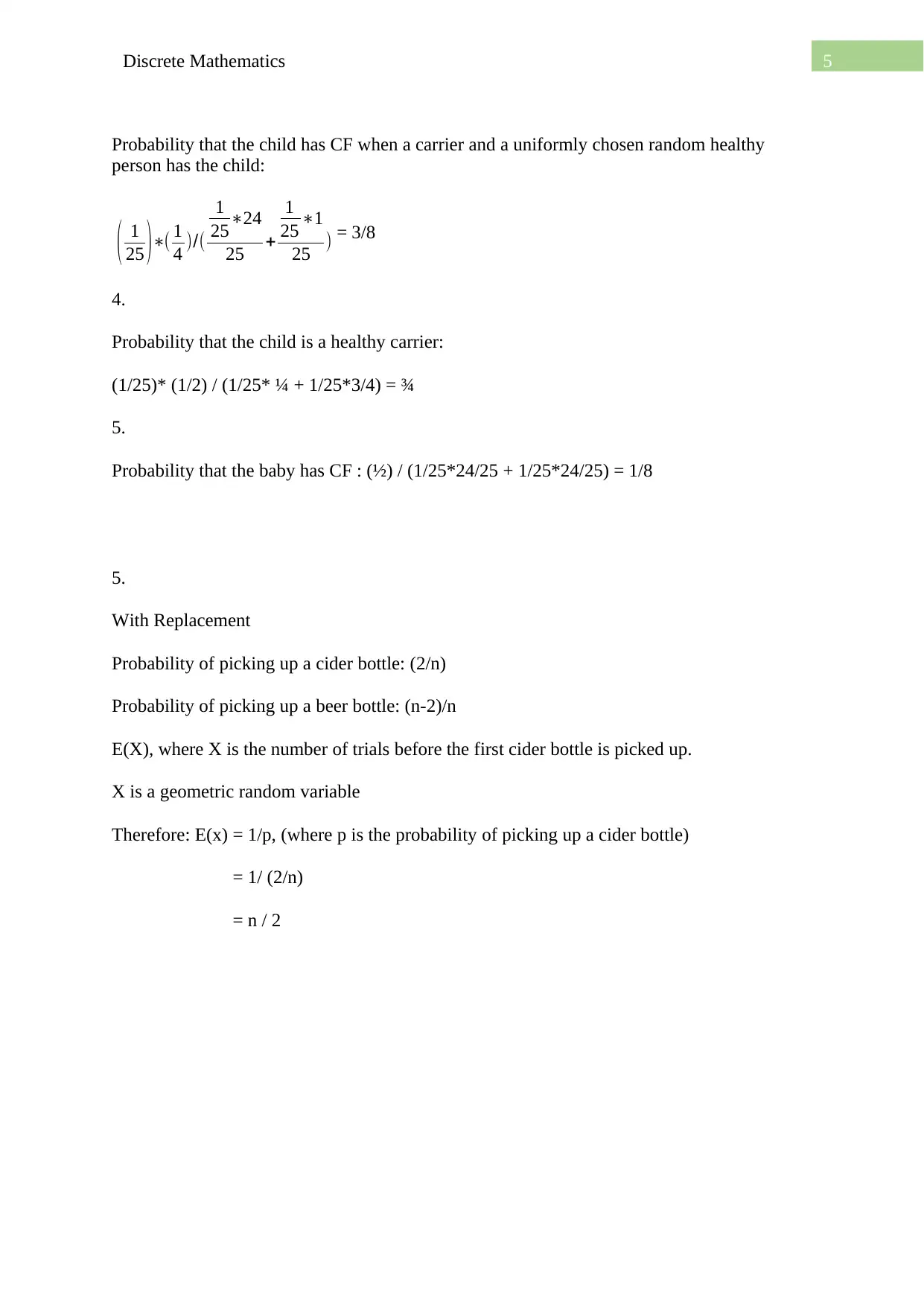
Probability that the child has CF when a carrier and a uniformly chosen random healthy
person has the child:
( 1
25 )( 1
4 )/(
1
2524
25 +
1
25 1
25 ) = 3/8
4.
Probability that the child is a healthy carrier:
(1/25)* (1/2) / (1/25* ¼ + 1/25*3/4) = ¾
5.
Probability that the baby has CF : (½) / (1/25*24/25 + 1/25*24/25) = 1/8
5.
With Replacement
Probability of picking up a cider bottle: (2/n)
Probability of picking up a beer bottle: (n-2)/n
E(X), where X is the number of trials before the first cider bottle is picked up.
X is a geometric random variable
Therefore: E(x) = 1/p, (where p is the probability of picking up a cider bottle)
= 1/ (2/n)
= n / 2
Document Page
6Discrete Mathematics
chevron_up_icon
1 out of 6
circle_padding
hide_on_mobile
zoom_out_icon
[object Object]