Victoria University BLO5540 Company Law Assignment - Semester 2, 2018
VerifiedAdded on 2023/06/03
|10
|2507
|189
Report
AI Summary
This report analyzes a company law assignment addressing director duties and shareholder rights under the Corporations Act 2001 (Cth). The first part examines a case study involving Food Works Ltd, where directors' actions are assessed against their legal obligations, focusing on potential breaches of sections 180, 181, 182, 183, and 588G, as well as available defenses and penalties. The second part explores remedies available to minority shareholders, Caitlin and Sarah, in Carpets Galore Pty Ltd, considering issues of unfair and oppressive conduct, non-payment of dividends, and related decisions by the majority shareholders, referencing sections 232 to 235 of the Act. The analysis includes relevant case law, such as ASIC v Narain, Morley v Statewide Tobacco Services Ltd, and Foss v Harbottle, to support the arguments and conclusions regarding the legal responsibilities and potential recourse for the parties involved.

Company Law

Paraphrase This Document
Need a fresh take? Get an instant paraphrase of this document with our AI Paraphraser
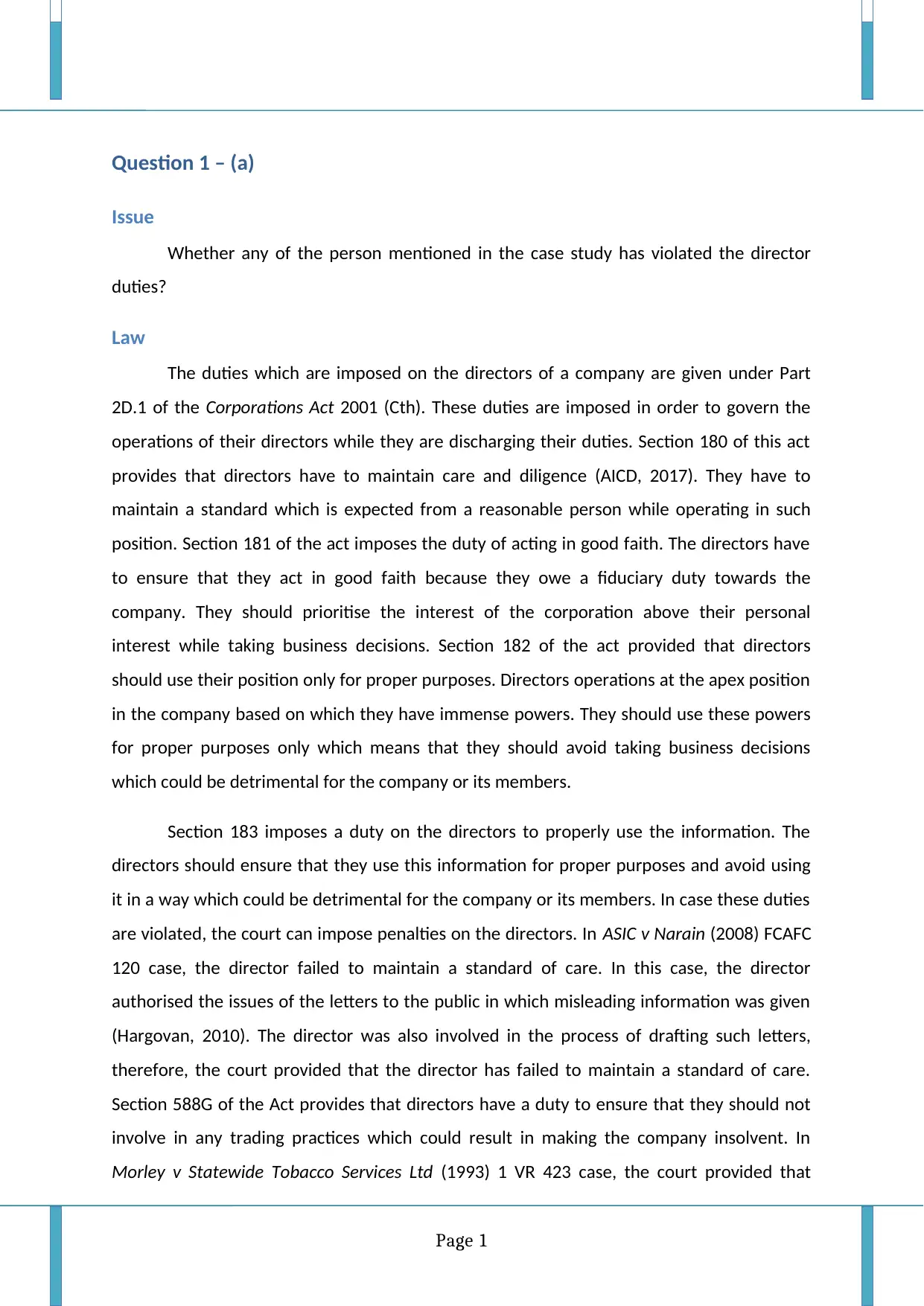
Question 1 – (a)
Issue
Whether any of the person mentioned in the case study has violated the director
duties?
Law
The duties which are imposed on the directors of a company are given under Part
2D.1 of the Corporations Act 2001 (Cth). These duties are imposed in order to govern the
operations of their directors while they are discharging their duties. Section 180 of this act
provides that directors have to maintain care and diligence (AICD, 2017). They have to
maintain a standard which is expected from a reasonable person while operating in such
position. Section 181 of the act imposes the duty of acting in good faith. The directors have
to ensure that they act in good faith because they owe a fiduciary duty towards the
company. They should prioritise the interest of the corporation above their personal
interest while taking business decisions. Section 182 of the act provided that directors
should use their position only for proper purposes. Directors operations at the apex position
in the company based on which they have immense powers. They should use these powers
for proper purposes only which means that they should avoid taking business decisions
which could be detrimental for the company or its members.
Section 183 imposes a duty on the directors to properly use the information. The
directors should ensure that they use this information for proper purposes and avoid using
it in a way which could be detrimental for the company or its members. In case these duties
are violated, the court can impose penalties on the directors. In ASIC v Narain (2008) FCAFC
120 case, the director failed to maintain a standard of care. In this case, the director
authorised the issues of the letters to the public in which misleading information was given
(Hargovan, 2010). The director was also involved in the process of drafting such letters,
therefore, the court provided that the director has failed to maintain a standard of care.
Section 588G of the Act provides that directors have a duty to ensure that they should not
involve in any trading practices which could result in making the company insolvent. In
Morley v Statewide Tobacco Services Ltd (1993) 1 VR 423 case, the court provided that
Page 1
Issue
Whether any of the person mentioned in the case study has violated the director
duties?
Law
The duties which are imposed on the directors of a company are given under Part
2D.1 of the Corporations Act 2001 (Cth). These duties are imposed in order to govern the
operations of their directors while they are discharging their duties. Section 180 of this act
provides that directors have to maintain care and diligence (AICD, 2017). They have to
maintain a standard which is expected from a reasonable person while operating in such
position. Section 181 of the act imposes the duty of acting in good faith. The directors have
to ensure that they act in good faith because they owe a fiduciary duty towards the
company. They should prioritise the interest of the corporation above their personal
interest while taking business decisions. Section 182 of the act provided that directors
should use their position only for proper purposes. Directors operations at the apex position
in the company based on which they have immense powers. They should use these powers
for proper purposes only which means that they should avoid taking business decisions
which could be detrimental for the company or its members.
Section 183 imposes a duty on the directors to properly use the information. The
directors should ensure that they use this information for proper purposes and avoid using
it in a way which could be detrimental for the company or its members. In case these duties
are violated, the court can impose penalties on the directors. In ASIC v Narain (2008) FCAFC
120 case, the director failed to maintain a standard of care. In this case, the director
authorised the issues of the letters to the public in which misleading information was given
(Hargovan, 2010). The director was also involved in the process of drafting such letters,
therefore, the court provided that the director has failed to maintain a standard of care.
Section 588G of the Act provides that directors have a duty to ensure that they should not
involve in any trading practices which could result in making the company insolvent. In
Morley v Statewide Tobacco Services Ltd (1993) 1 VR 423 case, the court provided that
Page 1
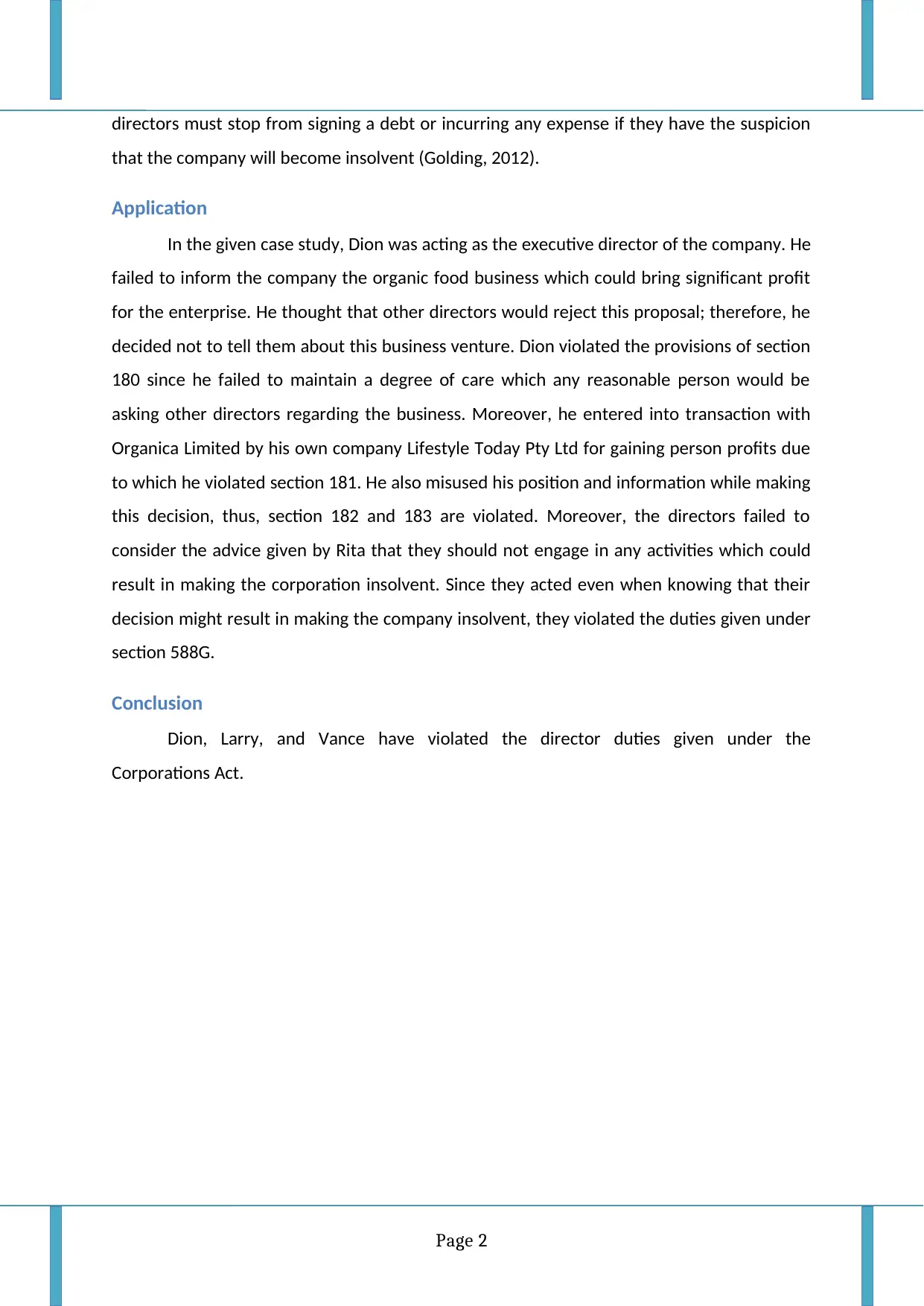
directors must stop from signing a debt or incurring any expense if they have the suspicion
that the company will become insolvent (Golding, 2012).
Application
In the given case study, Dion was acting as the executive director of the company. He
failed to inform the company the organic food business which could bring significant profit
for the enterprise. He thought that other directors would reject this proposal; therefore, he
decided not to tell them about this business venture. Dion violated the provisions of section
180 since he failed to maintain a degree of care which any reasonable person would be
asking other directors regarding the business. Moreover, he entered into transaction with
Organica Limited by his own company Lifestyle Today Pty Ltd for gaining person profits due
to which he violated section 181. He also misused his position and information while making
this decision, thus, section 182 and 183 are violated. Moreover, the directors failed to
consider the advice given by Rita that they should not engage in any activities which could
result in making the corporation insolvent. Since they acted even when knowing that their
decision might result in making the company insolvent, they violated the duties given under
section 588G.
Conclusion
Dion, Larry, and Vance have violated the director duties given under the
Corporations Act.
Page 2
that the company will become insolvent (Golding, 2012).
Application
In the given case study, Dion was acting as the executive director of the company. He
failed to inform the company the organic food business which could bring significant profit
for the enterprise. He thought that other directors would reject this proposal; therefore, he
decided not to tell them about this business venture. Dion violated the provisions of section
180 since he failed to maintain a degree of care which any reasonable person would be
asking other directors regarding the business. Moreover, he entered into transaction with
Organica Limited by his own company Lifestyle Today Pty Ltd for gaining person profits due
to which he violated section 181. He also misused his position and information while making
this decision, thus, section 182 and 183 are violated. Moreover, the directors failed to
consider the advice given by Rita that they should not engage in any activities which could
result in making the corporation insolvent. Since they acted even when knowing that their
decision might result in making the company insolvent, they violated the duties given under
section 588G.
Conclusion
Dion, Larry, and Vance have violated the director duties given under the
Corporations Act.
Page 2
⊘ This is a preview!⊘
Do you want full access?
Subscribe today to unlock all pages.

Trusted by 1+ million students worldwide
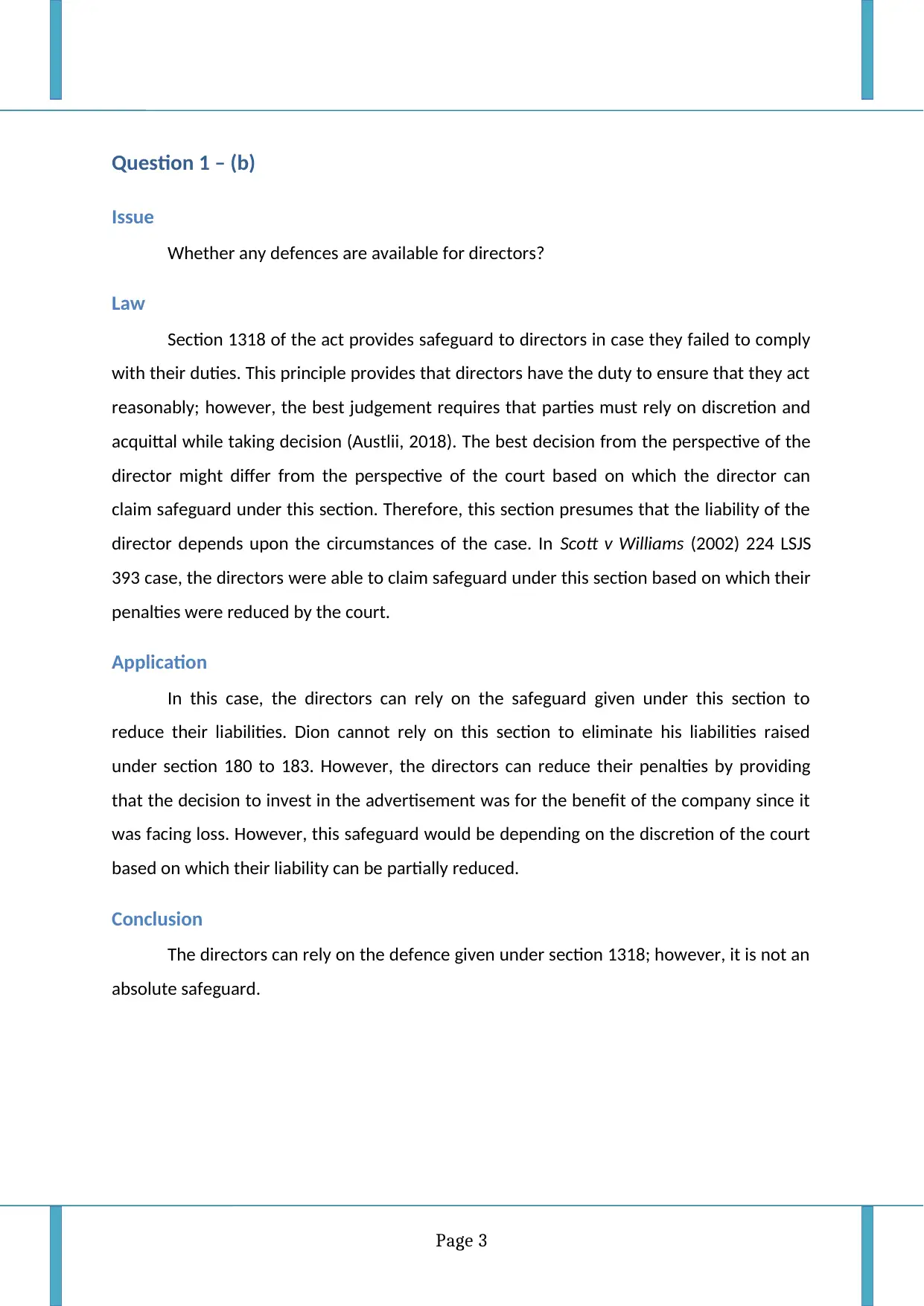
Question 1 – (b)
Issue
Whether any defences are available for directors?
Law
Section 1318 of the act provides safeguard to directors in case they failed to comply
with their duties. This principle provides that directors have the duty to ensure that they act
reasonably; however, the best judgement requires that parties must rely on discretion and
acquittal while taking decision (Austlii, 2018). The best decision from the perspective of the
director might differ from the perspective of the court based on which the director can
claim safeguard under this section. Therefore, this section presumes that the liability of the
director depends upon the circumstances of the case. In Scott v Williams (2002) 224 LSJS
393 case, the directors were able to claim safeguard under this section based on which their
penalties were reduced by the court.
Application
In this case, the directors can rely on the safeguard given under this section to
reduce their liabilities. Dion cannot rely on this section to eliminate his liabilities raised
under section 180 to 183. However, the directors can reduce their penalties by providing
that the decision to invest in the advertisement was for the benefit of the company since it
was facing loss. However, this safeguard would be depending on the discretion of the court
based on which their liability can be partially reduced.
Conclusion
The directors can rely on the defence given under section 1318; however, it is not an
absolute safeguard.
Page 3
Issue
Whether any defences are available for directors?
Law
Section 1318 of the act provides safeguard to directors in case they failed to comply
with their duties. This principle provides that directors have the duty to ensure that they act
reasonably; however, the best judgement requires that parties must rely on discretion and
acquittal while taking decision (Austlii, 2018). The best decision from the perspective of the
director might differ from the perspective of the court based on which the director can
claim safeguard under this section. Therefore, this section presumes that the liability of the
director depends upon the circumstances of the case. In Scott v Williams (2002) 224 LSJS
393 case, the directors were able to claim safeguard under this section based on which their
penalties were reduced by the court.
Application
In this case, the directors can rely on the safeguard given under this section to
reduce their liabilities. Dion cannot rely on this section to eliminate his liabilities raised
under section 180 to 183. However, the directors can reduce their penalties by providing
that the decision to invest in the advertisement was for the benefit of the company since it
was facing loss. However, this safeguard would be depending on the discretion of the court
based on which their liability can be partially reduced.
Conclusion
The directors can rely on the defence given under section 1318; however, it is not an
absolute safeguard.
Page 3
Paraphrase This Document
Need a fresh take? Get an instant paraphrase of this document with our AI Paraphraser
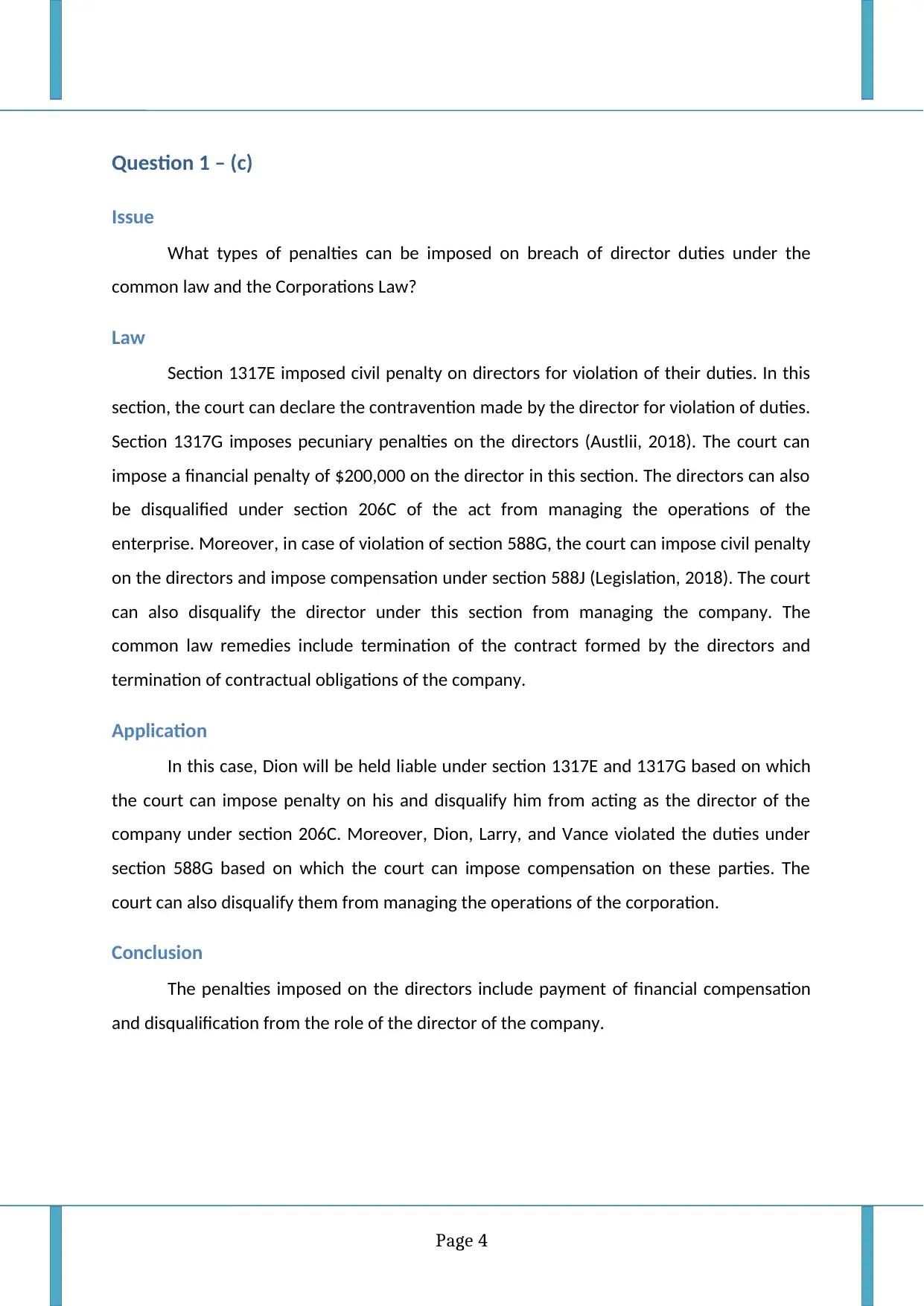
Question 1 – (c)
Issue
What types of penalties can be imposed on breach of director duties under the
common law and the Corporations Law?
Law
Section 1317E imposed civil penalty on directors for violation of their duties. In this
section, the court can declare the contravention made by the director for violation of duties.
Section 1317G imposes pecuniary penalties on the directors (Austlii, 2018). The court can
impose a financial penalty of $200,000 on the director in this section. The directors can also
be disqualified under section 206C of the act from managing the operations of the
enterprise. Moreover, in case of violation of section 588G, the court can impose civil penalty
on the directors and impose compensation under section 588J (Legislation, 2018). The court
can also disqualify the director under this section from managing the company. The
common law remedies include termination of the contract formed by the directors and
termination of contractual obligations of the company.
Application
In this case, Dion will be held liable under section 1317E and 1317G based on which
the court can impose penalty on his and disqualify him from acting as the director of the
company under section 206C. Moreover, Dion, Larry, and Vance violated the duties under
section 588G based on which the court can impose compensation on these parties. The
court can also disqualify them from managing the operations of the corporation.
Conclusion
The penalties imposed on the directors include payment of financial compensation
and disqualification from the role of the director of the company.
Page 4
Issue
What types of penalties can be imposed on breach of director duties under the
common law and the Corporations Law?
Law
Section 1317E imposed civil penalty on directors for violation of their duties. In this
section, the court can declare the contravention made by the director for violation of duties.
Section 1317G imposes pecuniary penalties on the directors (Austlii, 2018). The court can
impose a financial penalty of $200,000 on the director in this section. The directors can also
be disqualified under section 206C of the act from managing the operations of the
enterprise. Moreover, in case of violation of section 588G, the court can impose civil penalty
on the directors and impose compensation under section 588J (Legislation, 2018). The court
can also disqualify the director under this section from managing the company. The
common law remedies include termination of the contract formed by the directors and
termination of contractual obligations of the company.
Application
In this case, Dion will be held liable under section 1317E and 1317G based on which
the court can impose penalty on his and disqualify him from acting as the director of the
company under section 206C. Moreover, Dion, Larry, and Vance violated the duties under
section 588G based on which the court can impose compensation on these parties. The
court can also disqualify them from managing the operations of the corporation.
Conclusion
The penalties imposed on the directors include payment of financial compensation
and disqualification from the role of the director of the company.
Page 4
Question 2
Issue
The key issue raised in this case is whether any remedies are available for Caitlin and
Sarah under the Corporations Act?
Law
The Corporations Act provides various provisions in order to protect the rights of
minority shareholders of a company. Based on these guidelines, the rights of minority
shareholders are protected from unfair advantages of majority shareholders which they can
get by misusing their powers and position. Part 2F.1 of the act provides various statutory
remedies which are given to minority shareholders. The part also imposes various
restrictions on the majority shareholders to protect the minority group of members from
their oppression. The key guidelines are given under section 232 to 235. Section 232
provides that the court can issue an order if the company’s affairs or resolution is contrary
to the interest of its members or oppressive towards particular class of members
(Legislation, 2018). Section 233 of the act provides that the actions must be related to the
operations of the enterprise as given under section 232 (1) of the act. Section 53 also issues
a limitation of the corporation. It prohibits the company from keeping its affairs limited to
the internal management and proceeding of the enterprise. The affairs of a corporation are
public which can be accessed by its members.
Moreover, the affairs of a company include various factors such as transactions,
trading practices, control, business, establishment, ownership of the shares and others.
Section 234 of the act provides that an application for issuing of the order under section 233
can be made in case the member of the company omitted an act as the capacity of the
member (WIPO, 2013). The oppressive and unfair conduct against the minority members of
a corporation is prohibited by the act. The examples of unfair and oppressive conduct
include non-payment of dividend to the shareholders of the company and instead increased
the payment given to the directors when it is not justified. Moreover, it also includes
excluding the directors of the company from representing the shareholders from
representing any group of shareholders in the enterprise. It is also unfair if the shares are
Page 5
Issue
The key issue raised in this case is whether any remedies are available for Caitlin and
Sarah under the Corporations Act?
Law
The Corporations Act provides various provisions in order to protect the rights of
minority shareholders of a company. Based on these guidelines, the rights of minority
shareholders are protected from unfair advantages of majority shareholders which they can
get by misusing their powers and position. Part 2F.1 of the act provides various statutory
remedies which are given to minority shareholders. The part also imposes various
restrictions on the majority shareholders to protect the minority group of members from
their oppression. The key guidelines are given under section 232 to 235. Section 232
provides that the court can issue an order if the company’s affairs or resolution is contrary
to the interest of its members or oppressive towards particular class of members
(Legislation, 2018). Section 233 of the act provides that the actions must be related to the
operations of the enterprise as given under section 232 (1) of the act. Section 53 also issues
a limitation of the corporation. It prohibits the company from keeping its affairs limited to
the internal management and proceeding of the enterprise. The affairs of a corporation are
public which can be accessed by its members.
Moreover, the affairs of a company include various factors such as transactions,
trading practices, control, business, establishment, ownership of the shares and others.
Section 234 of the act provides that an application for issuing of the order under section 233
can be made in case the member of the company omitted an act as the capacity of the
member (WIPO, 2013). The oppressive and unfair conduct against the minority members of
a corporation is prohibited by the act. The examples of unfair and oppressive conduct
include non-payment of dividend to the shareholders of the company and instead increased
the payment given to the directors when it is not justified. Moreover, it also includes
excluding the directors of the company from representing the shareholders from
representing any group of shareholders in the enterprise. It is also unfair if the shares are
Page 5
⊘ This is a preview!⊘
Do you want full access?
Subscribe today to unlock all pages.
Trusted by 1+ million students worldwide
issued with an objective to dominate or dilute the voting rights of minority shareholders
(Anderson, Welsh, Ramsay & Gahan, 2012). The oppressive conduct includes applying the
funds of the company for the beneficial interest of particular shareholders of the enterprise.
Moreover, if the majority shareholders are refusing or avoiding the minority shareholders to
call the meetings, then it is determined as unfair conduct.
In Mopeke Pty Ltd v Airport Fine Foods Pty Ltd (2007) NSWSC 153 case, the court
provided that excluding the shareholders of the company from involving in the process of
management is considered as oppressive or unfair conduct (Dwfoxtucker, 2017). Various
provisions are given under section 233 of the act in order to discharge the minority
shareholders of a company from the negative impact of oppression caused by majority
shareholders. This section provides that the decision to purchase the shares of the minority
shareholder must be evaluated by the court. During this process, a receiver and manager is
appointed. The objective of appointing these parties is to perform the act of unwinding the
raising capital of the company. The last resort available in the situation is to wind up the
company or prohibit it from taking certain actions. The court has the authority to order a
director to buy the minority shareholders without controlling their prices if such director is
involved in unfair or oppressive conduct. The court established two rules in Foss v Harbottle
(1843) 2 Hare 461 case for proper plaintiff rule and internal management rule (Ping & Wing,
2011). Based on these provisions, the rights of the minority shareholders are protected from
the unfair or oppressive practices of majority shareholders.
Application
In the given case study, Caitlin and Sarah are minority shareholders of Carpets
Galore Pty Ltd which is a family owned business. Both of these parties are excluded from the
decision to raise the pay for Ben and David, and the decision was taken by Ben and David
themselves without their involvement. Moreover, they were also not consulted regarding
the decision to issue dividends in the company even when it is getting profits for the past
three years. They were also not consulted in the decision to sell four retail outlets of the
company to another enterprise in which Ben is a director. The independent valuation of the
outlets was not completed before the sale as well. Based on these activities, the provisions
given under section 232 apply in this case because the dealing of the company is unfair and
oppressive towards Caitlin and Sarah. Both of them are treated wrong by the enterprise,
Page 6
(Anderson, Welsh, Ramsay & Gahan, 2012). The oppressive conduct includes applying the
funds of the company for the beneficial interest of particular shareholders of the enterprise.
Moreover, if the majority shareholders are refusing or avoiding the minority shareholders to
call the meetings, then it is determined as unfair conduct.
In Mopeke Pty Ltd v Airport Fine Foods Pty Ltd (2007) NSWSC 153 case, the court
provided that excluding the shareholders of the company from involving in the process of
management is considered as oppressive or unfair conduct (Dwfoxtucker, 2017). Various
provisions are given under section 233 of the act in order to discharge the minority
shareholders of a company from the negative impact of oppression caused by majority
shareholders. This section provides that the decision to purchase the shares of the minority
shareholder must be evaluated by the court. During this process, a receiver and manager is
appointed. The objective of appointing these parties is to perform the act of unwinding the
raising capital of the company. The last resort available in the situation is to wind up the
company or prohibit it from taking certain actions. The court has the authority to order a
director to buy the minority shareholders without controlling their prices if such director is
involved in unfair or oppressive conduct. The court established two rules in Foss v Harbottle
(1843) 2 Hare 461 case for proper plaintiff rule and internal management rule (Ping & Wing,
2011). Based on these provisions, the rights of the minority shareholders are protected from
the unfair or oppressive practices of majority shareholders.
Application
In the given case study, Caitlin and Sarah are minority shareholders of Carpets
Galore Pty Ltd which is a family owned business. Both of these parties are excluded from the
decision to raise the pay for Ben and David, and the decision was taken by Ben and David
themselves without their involvement. Moreover, they were also not consulted regarding
the decision to issue dividends in the company even when it is getting profits for the past
three years. They were also not consulted in the decision to sell four retail outlets of the
company to another enterprise in which Ben is a director. The independent valuation of the
outlets was not completed before the sale as well. Based on these activities, the provisions
given under section 232 apply in this case because the dealing of the company is unfair and
oppressive towards Caitlin and Sarah. Both of them are treated wrong by the enterprise,
Page 6
Paraphrase This Document
Need a fresh take? Get an instant paraphrase of this document with our AI Paraphraser
and they have the right to safeguard their interest under section 233 of the act. Based on
this section, the court can prohibit Ben and David from acting oppressively against Caitlin
and Sarah. Thus, the minority shareholders have equal right to involve in the management
and decision making of the enterprise. In order to stop the unfair practices, the court can
give an order to wind up the company or ordered the majority shareholders to purchase the
shares of the minority shareholder. Moreover, the court can order Ben and David to pay the
compensation to Caitlin and Sarah for their oppressive behaviour.
Conclusion
To conclude, various remedies are given under the Corporations Act for Caitlin and
Sarah to protect their rights in the corporation from the oppressive behaviour of Ben and
David.
Page 7
this section, the court can prohibit Ben and David from acting oppressively against Caitlin
and Sarah. Thus, the minority shareholders have equal right to involve in the management
and decision making of the enterprise. In order to stop the unfair practices, the court can
give an order to wind up the company or ordered the majority shareholders to purchase the
shares of the minority shareholder. Moreover, the court can order Ben and David to pay the
compensation to Caitlin and Sarah for their oppressive behaviour.
Conclusion
To conclude, various remedies are given under the Corporations Act for Caitlin and
Sarah to protect their rights in the corporation from the oppressive behaviour of Ben and
David.
Page 7
References
AICD. (2017). General duties of directors. Retrieved from
https://aicd.companydirectors.com.au/resources/director-tools/practical-tools-for-
directors/duties-of-directors/general-duties-of-directors
Anderson, H., Welsh, M., Ramsay, I., & Gahan, P. (2012). The evolution of shareholder and
creditor protection in Australia: an international comparison. International &
Comparative Law Quarterly, 61(1), 171-207.
ASIC v Narain (2008) FCAFC 120
Austlii. (2018). Corporations Act 2001. Retrieved from
http://www5.austlii.edu.au/au/legis/cth/consol_act/ca2001172/
Corporations Act 2001 (Cth)
Dwfoxtucker. (2017). Oppression Claims by Minority Shareholders. Retrieved from
https://www.dwfoxtucker.com.au/2017/10/oppression-claims-minority-
shareholders/
Foss v Harbottle (1843) 2 Hare 461
Golding, G. (2012). Tightening the screws on directors: Care, delegation and
reliance. UNSWLJ, 35, 266.
Hargovan, A. (2010). Company Secretary: Directors' Liability for Misleading and Deceptive
Market Announcements-the'Citrofresh'Decision. Keeping Good Companies, 62(8),
454.
Legislation. (2018). Corporations Act 2001. Retrieved from
https://www.legislation.gov.au/Details/C2017C00328
Mopeke Pty Ltd v Airport Fine Foods Pty Ltd (2007) NSWSC 153
Morley v Statewide Tobacco Services Ltd (1993) 1 VR 423
Page 8
AICD. (2017). General duties of directors. Retrieved from
https://aicd.companydirectors.com.au/resources/director-tools/practical-tools-for-
directors/duties-of-directors/general-duties-of-directors
Anderson, H., Welsh, M., Ramsay, I., & Gahan, P. (2012). The evolution of shareholder and
creditor protection in Australia: an international comparison. International &
Comparative Law Quarterly, 61(1), 171-207.
ASIC v Narain (2008) FCAFC 120
Austlii. (2018). Corporations Act 2001. Retrieved from
http://www5.austlii.edu.au/au/legis/cth/consol_act/ca2001172/
Corporations Act 2001 (Cth)
Dwfoxtucker. (2017). Oppression Claims by Minority Shareholders. Retrieved from
https://www.dwfoxtucker.com.au/2017/10/oppression-claims-minority-
shareholders/
Foss v Harbottle (1843) 2 Hare 461
Golding, G. (2012). Tightening the screws on directors: Care, delegation and
reliance. UNSWLJ, 35, 266.
Hargovan, A. (2010). Company Secretary: Directors' Liability for Misleading and Deceptive
Market Announcements-the'Citrofresh'Decision. Keeping Good Companies, 62(8),
454.
Legislation. (2018). Corporations Act 2001. Retrieved from
https://www.legislation.gov.au/Details/C2017C00328
Mopeke Pty Ltd v Airport Fine Foods Pty Ltd (2007) NSWSC 153
Morley v Statewide Tobacco Services Ltd (1993) 1 VR 423
Page 8
⊘ This is a preview!⊘
Do you want full access?
Subscribe today to unlock all pages.
Trusted by 1+ million students worldwide
Ping, Z., & Wing, C. (2011). Corporate governance: A summary review on different theory
approaches. International Research Journal of Finance and Economics, 68, 7-13.
Scott v Williams (2002) 224 LSJS 393
WIPO. (2013). Corporations Act 2001. Retrieved from
http://www.wipo.int/edocs/lexdocs/laws/en/au/au196en.pdf
Page 9
approaches. International Research Journal of Finance and Economics, 68, 7-13.
Scott v Williams (2002) 224 LSJS 393
WIPO. (2013). Corporations Act 2001. Retrieved from
http://www.wipo.int/edocs/lexdocs/laws/en/au/au196en.pdf
Page 9

1 out of 10


Related Documents


Your All-in-One AI-Powered Toolkit for Academic Success.
+13062052269
info@desklib.com
Available 24*7 on WhatsApp / Email
![[object Object]](/_next/static/media/star-bottom.7253800d.svg)
Unlock your academic potential
Copyright © 2020–2026 A2Z Services. All Rights Reserved. Developed and managed by ZUCOL.