Company Law Case Study: Toy Train Ltd
VerifiedAdded on 2019/12/03
|11
|2742
|346
Report
AI Summary
This report analyzes a case study of Toy Train Ltd., a manufacturing company with five shareholders and directors facing internal conflicts. The report examines the applicability of the UK Companies Act 2006, specifically focusing on director removal, solicitor appointment, and amending articles of association. It details the legal provisions concerning voting rights, special resolutions, and the implications of the Bushell v Faith clause. The analysis concludes that the directors' proposed resolutions are not easily feasible due to voting power dynamics. The report recommends a strategic approach to gain majority support before implementing significant changes, emphasizing the importance of securing Ben's vote to achieve the desired outcomes.
Company Law
for business
1
for business
1

Paraphrase This Document
Need a fresh take? Get an instant paraphrase of this document with our AI Paraphraser
EXECUTIVE SUMMARY
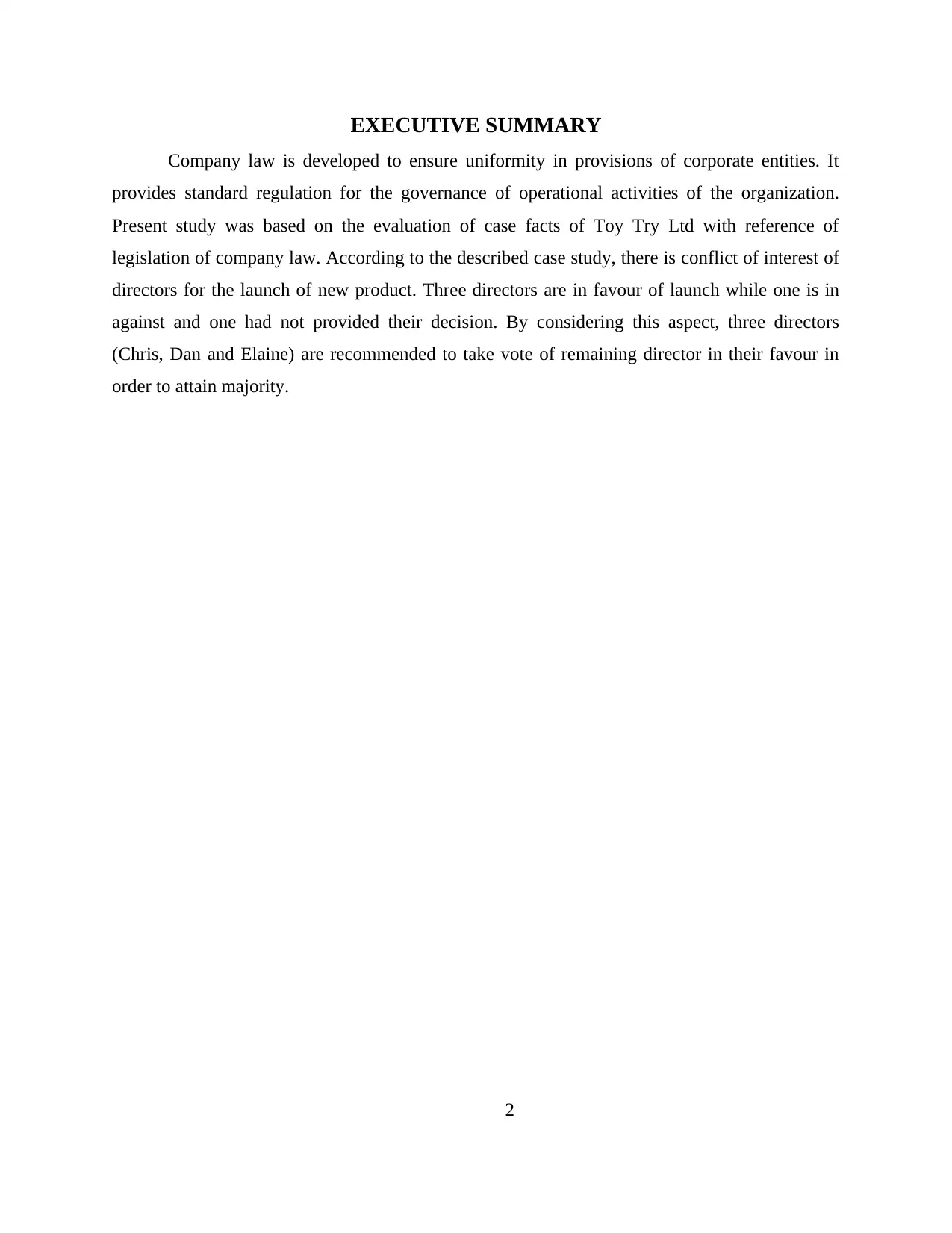
Company law is developed to ensure uniformity in provisions of corporate entities. It
provides standard regulation for the governance of operational activities of the organization.
Present study was based on the evaluation of case facts of Toy Try Ltd with reference of
legislation of company law. According to the described case study, there is conflict of interest of
directors for the launch of new product. Three directors are in favour of launch while one is in
against and one had not provided their decision. By considering this aspect, three directors
(Chris, Dan and Elaine) are recommended to take vote of remaining director in their favour in
order to attain majority.
2
Company law is developed to ensure uniformity in provisions of corporate entities. It
provides standard regulation for the governance of operational activities of the organization.
Present study was based on the evaluation of case facts of Toy Try Ltd with reference of
legislation of company law. According to the described case study, there is conflict of interest of
directors for the launch of new product. Three directors are in favour of launch while one is in
against and one had not provided their decision. By considering this aspect, three directors
(Chris, Dan and Elaine) are recommended to take vote of remaining director in their favour in
order to attain majority.
2
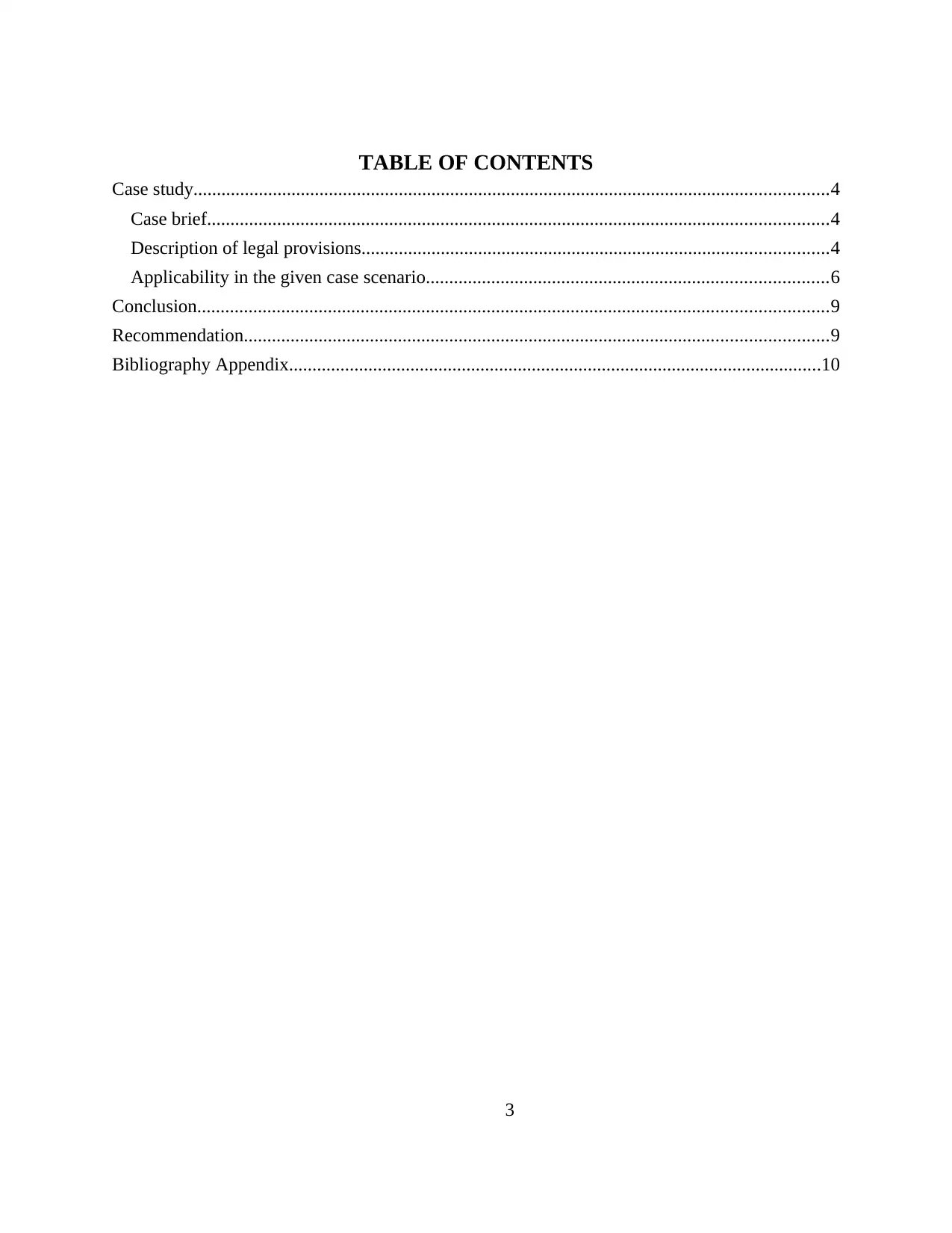
TABLE OF CONTENTS
Case study........................................................................................................................................4
Case brief.....................................................................................................................................4
Description of legal provisions....................................................................................................4
Applicability in the given case scenario......................................................................................6
Conclusion.......................................................................................................................................9
Recommendation.............................................................................................................................9
Bibliography Appendix..................................................................................................................10
3
Case study........................................................................................................................................4
Case brief.....................................................................................................................................4
Description of legal provisions....................................................................................................4
Applicability in the given case scenario......................................................................................6
Conclusion.......................................................................................................................................9
Recommendation.............................................................................................................................9
Bibliography Appendix..................................................................................................................10
3
⊘ This is a preview!⊘
Do you want full access?
Subscribe today to unlock all pages.

Trusted by 1+ million students worldwide
CASE STUDY
Case brief
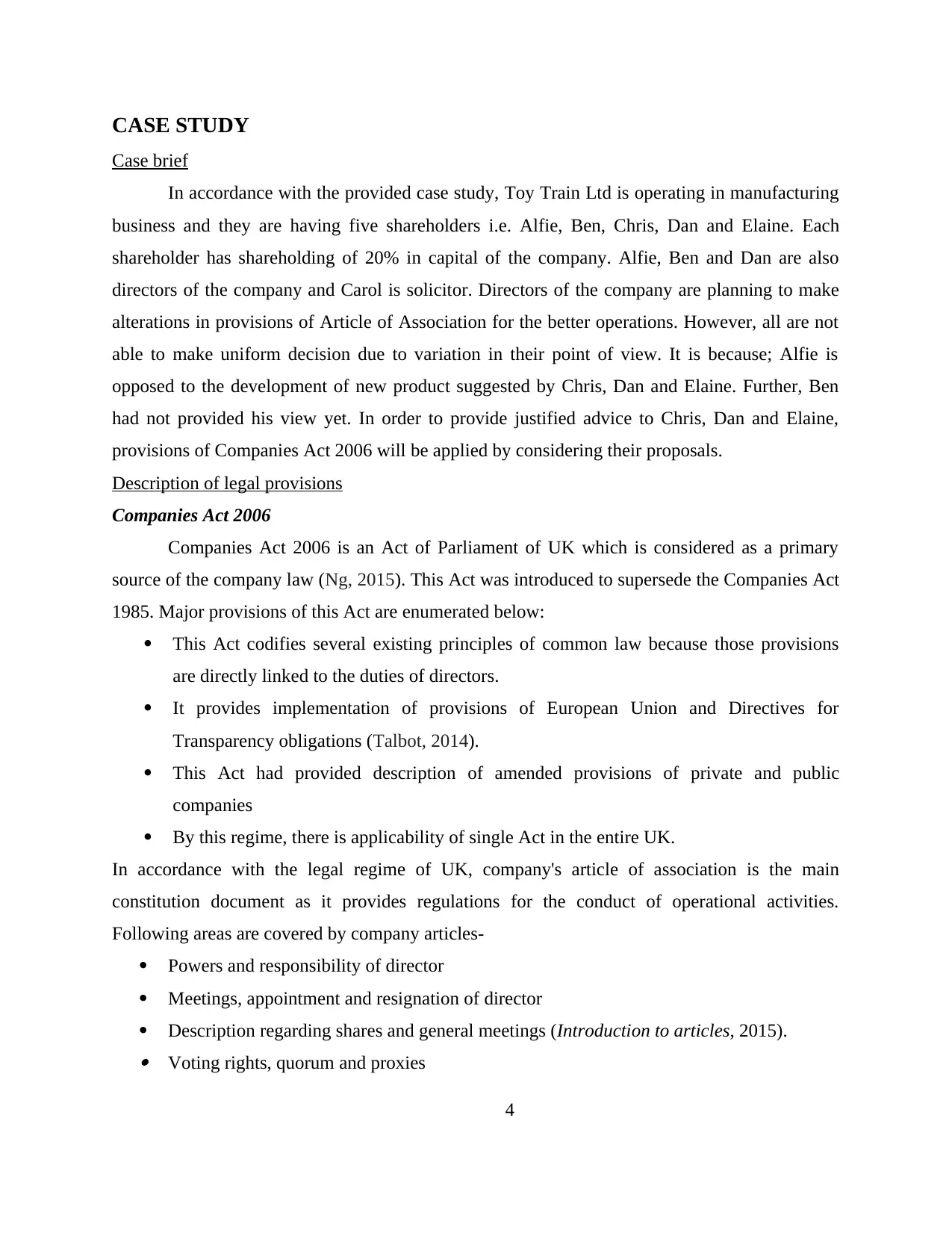
In accordance with the provided case study, Toy Train Ltd is operating in manufacturing
business and they are having five shareholders i.e. Alfie, Ben, Chris, Dan and Elaine. Each
shareholder has shareholding of 20% in capital of the company. Alfie, Ben and Dan are also
directors of the company and Carol is solicitor. Directors of the company are planning to make
alterations in provisions of Article of Association for the better operations. However, all are not
able to make uniform decision due to variation in their point of view. It is because; Alfie is
opposed to the development of new product suggested by Chris, Dan and Elaine. Further, Ben
had not provided his view yet. In order to provide justified advice to Chris, Dan and Elaine,
provisions of Companies Act 2006 will be applied by considering their proposals.
Description of legal provisions
Companies Act 2006
Companies Act 2006 is an Act of Parliament of UK which is considered as a primary
source of the company law (Ng, 2015). This Act was introduced to supersede the Companies Act
1985. Major provisions of this Act are enumerated below:
This Act codifies several existing principles of common law because those provisions
are directly linked to the duties of directors.
It provides implementation of provisions of European Union and Directives for
Transparency obligations (Talbot, 2014).
This Act had provided description of amended provisions of private and public
companies
By this regime, there is applicability of single Act in the entire UK.
In accordance with the legal regime of UK, company's article of association is the main
constitution document as it provides regulations for the conduct of operational activities.
Following areas are covered by company articles-
Powers and responsibility of director
Meetings, appointment and resignation of director
Description regarding shares and general meetings (Introduction to articles, 2015). Voting rights, quorum and proxies
4
Case brief
In accordance with the provided case study, Toy Train Ltd is operating in manufacturing
business and they are having five shareholders i.e. Alfie, Ben, Chris, Dan and Elaine. Each
shareholder has shareholding of 20% in capital of the company. Alfie, Ben and Dan are also
directors of the company and Carol is solicitor. Directors of the company are planning to make
alterations in provisions of Article of Association for the better operations. However, all are not
able to make uniform decision due to variation in their point of view. It is because; Alfie is
opposed to the development of new product suggested by Chris, Dan and Elaine. Further, Ben
had not provided his view yet. In order to provide justified advice to Chris, Dan and Elaine,
provisions of Companies Act 2006 will be applied by considering their proposals.
Description of legal provisions
Companies Act 2006
Companies Act 2006 is an Act of Parliament of UK which is considered as a primary
source of the company law (Ng, 2015). This Act was introduced to supersede the Companies Act
1985. Major provisions of this Act are enumerated below:
This Act codifies several existing principles of common law because those provisions
are directly linked to the duties of directors.
It provides implementation of provisions of European Union and Directives for
Transparency obligations (Talbot, 2014).
This Act had provided description of amended provisions of private and public
companies
By this regime, there is applicability of single Act in the entire UK.
In accordance with the legal regime of UK, company's article of association is the main
constitution document as it provides regulations for the conduct of operational activities.
Following areas are covered by company articles-
Powers and responsibility of director
Meetings, appointment and resignation of director
Description regarding shares and general meetings (Introduction to articles, 2015). Voting rights, quorum and proxies
4
Paraphrase This Document
Need a fresh take? Get an instant paraphrase of this document with our AI Paraphraser
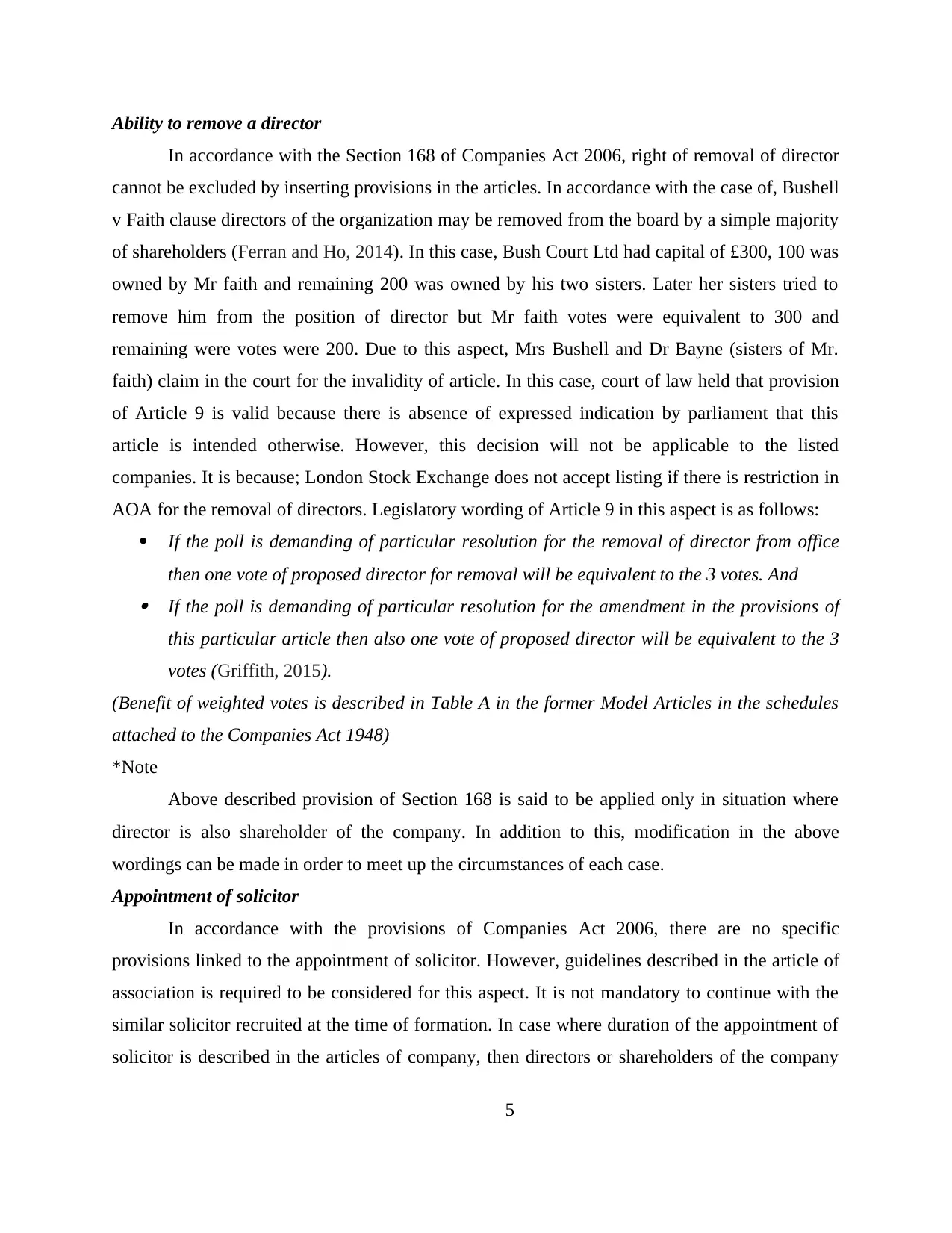
Ability to remove a director
In accordance with the Section 168 of Companies Act 2006, right of removal of director
cannot be excluded by inserting provisions in the articles. In accordance with the case of, Bushell
v Faith clause directors of the organization may be removed from the board by a simple majority
of shareholders (Ferran and Ho, 2014). In this case, Bush Court Ltd had capital of £300, 100 was
owned by Mr faith and remaining 200 was owned by his two sisters. Later her sisters tried to
remove him from the position of director but Mr faith votes were equivalent to 300 and
remaining were votes were 200. Due to this aspect, Mrs Bushell and Dr Bayne (sisters of Mr.
faith) claim in the court for the invalidity of article. In this case, court of law held that provision
of Article 9 is valid because there is absence of expressed indication by parliament that this
article is intended otherwise. However, this decision will not be applicable to the listed
companies. It is because; London Stock Exchange does not accept listing if there is restriction in
AOA for the removal of directors. Legislatory wording of Article 9 in this aspect is as follows:
If the poll is demanding of particular resolution for the removal of director from office
then one vote of proposed director for removal will be equivalent to the 3 votes. And If the poll is demanding of particular resolution for the amendment in the provisions of
this particular article then also one vote of proposed director will be equivalent to the 3
votes (Griffith, 2015).
(Benefit of weighted votes is described in Table A in the former Model Articles in the schedules
attached to the Companies Act 1948)
*Note
Above described provision of Section 168 is said to be applied only in situation where
director is also shareholder of the company. In addition to this, modification in the above
wordings can be made in order to meet up the circumstances of each case.
Appointment of solicitor
In accordance with the provisions of Companies Act 2006, there are no specific
provisions linked to the appointment of solicitor. However, guidelines described in the article of
association is required to be considered for this aspect. It is not mandatory to continue with the
similar solicitor recruited at the time of formation. In case where duration of the appointment of
solicitor is described in the articles of company, then directors or shareholders of the company
5
In accordance with the Section 168 of Companies Act 2006, right of removal of director
cannot be excluded by inserting provisions in the articles. In accordance with the case of, Bushell
v Faith clause directors of the organization may be removed from the board by a simple majority
of shareholders (Ferran and Ho, 2014). In this case, Bush Court Ltd had capital of £300, 100 was
owned by Mr faith and remaining 200 was owned by his two sisters. Later her sisters tried to
remove him from the position of director but Mr faith votes were equivalent to 300 and
remaining were votes were 200. Due to this aspect, Mrs Bushell and Dr Bayne (sisters of Mr.
faith) claim in the court for the invalidity of article. In this case, court of law held that provision
of Article 9 is valid because there is absence of expressed indication by parliament that this
article is intended otherwise. However, this decision will not be applicable to the listed
companies. It is because; London Stock Exchange does not accept listing if there is restriction in
AOA for the removal of directors. Legislatory wording of Article 9 in this aspect is as follows:
If the poll is demanding of particular resolution for the removal of director from office
then one vote of proposed director for removal will be equivalent to the 3 votes. And If the poll is demanding of particular resolution for the amendment in the provisions of
this particular article then also one vote of proposed director will be equivalent to the 3
votes (Griffith, 2015).
(Benefit of weighted votes is described in Table A in the former Model Articles in the schedules
attached to the Companies Act 1948)
*Note
Above described provision of Section 168 is said to be applied only in situation where
director is also shareholder of the company. In addition to this, modification in the above
wordings can be made in order to meet up the circumstances of each case.
Appointment of solicitor
In accordance with the provisions of Companies Act 2006, there are no specific
provisions linked to the appointment of solicitor. However, guidelines described in the article of
association is required to be considered for this aspect. It is not mandatory to continue with the
similar solicitor recruited at the time of formation. In case where duration of the appointment of
solicitor is described in the articles of company, then directors or shareholders of the company
5
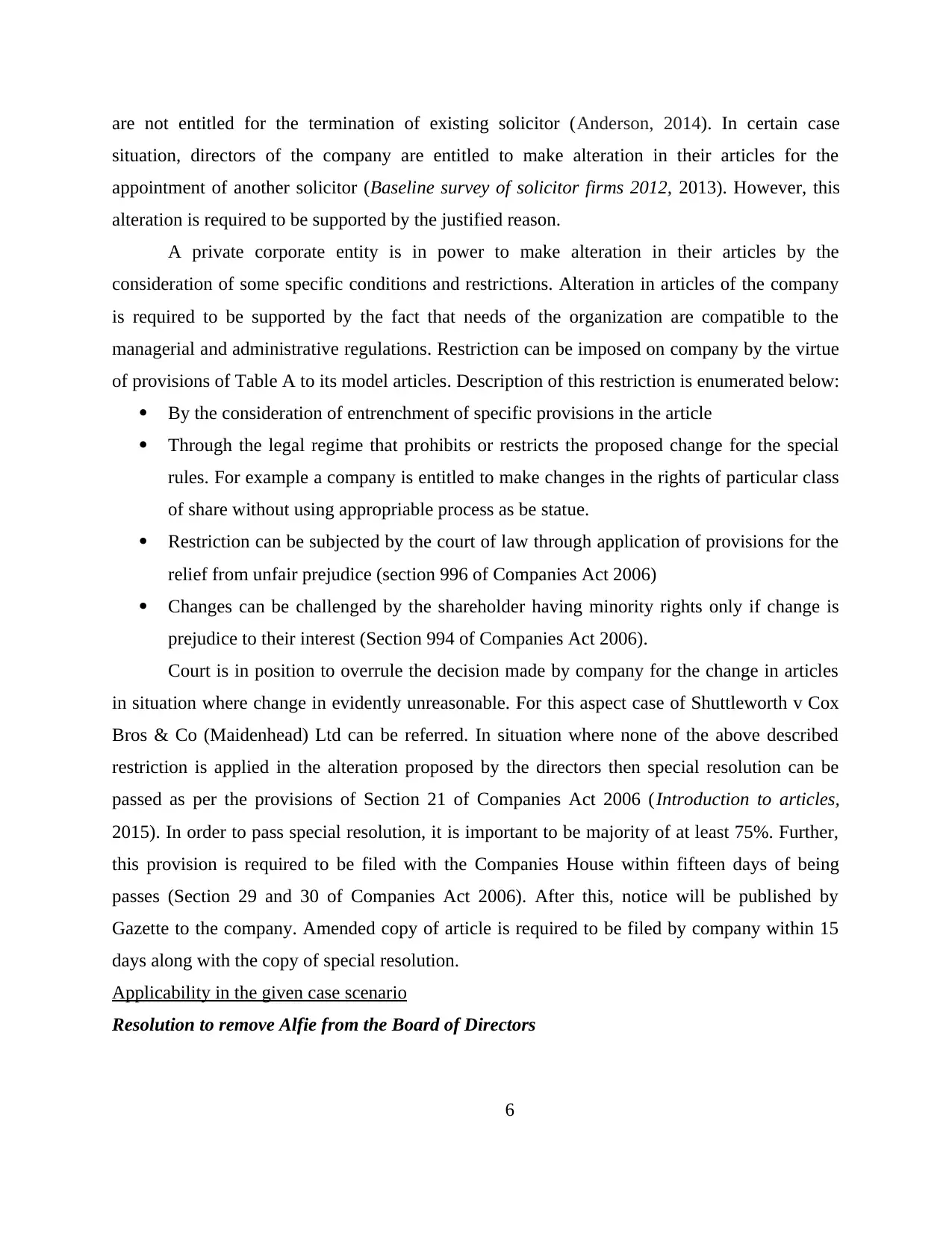
are not entitled for the termination of existing solicitor (Anderson, 2014). In certain case
situation, directors of the company are entitled to make alteration in their articles for the
appointment of another solicitor (Baseline survey of solicitor firms 2012, 2013). However, this
alteration is required to be supported by the justified reason.
A private corporate entity is in power to make alteration in their articles by the
consideration of some specific conditions and restrictions. Alteration in articles of the company
is required to be supported by the fact that needs of the organization are compatible to the
managerial and administrative regulations. Restriction can be imposed on company by the virtue
of provisions of Table A to its model articles. Description of this restriction is enumerated below:
By the consideration of entrenchment of specific provisions in the article
Through the legal regime that prohibits or restricts the proposed change for the special
rules. For example a company is entitled to make changes in the rights of particular class
of share without using appropriable process as be statue.
Restriction can be subjected by the court of law through application of provisions for the
relief from unfair prejudice (section 996 of Companies Act 2006)
Changes can be challenged by the shareholder having minority rights only if change is
prejudice to their interest (Section 994 of Companies Act 2006).
Court is in position to overrule the decision made by company for the change in articles
in situation where change in evidently unreasonable. For this aspect case of Shuttleworth v Cox
Bros & Co (Maidenhead) Ltd can be referred. In situation where none of the above described
restriction is applied in the alteration proposed by the directors then special resolution can be
passed as per the provisions of Section 21 of Companies Act 2006 (Introduction to articles,
2015). In order to pass special resolution, it is important to be majority of at least 75%. Further,
this provision is required to be filed with the Companies House within fifteen days of being
passes (Section 29 and 30 of Companies Act 2006). After this, notice will be published by
Gazette to the company. Amended copy of article is required to be filed by company within 15
days along with the copy of special resolution.
Applicability in the given case scenario
Resolution to remove Alfie from the Board of Directors
6
situation, directors of the company are entitled to make alteration in their articles for the
appointment of another solicitor (Baseline survey of solicitor firms 2012, 2013). However, this
alteration is required to be supported by the justified reason.
A private corporate entity is in power to make alteration in their articles by the
consideration of some specific conditions and restrictions. Alteration in articles of the company
is required to be supported by the fact that needs of the organization are compatible to the
managerial and administrative regulations. Restriction can be imposed on company by the virtue
of provisions of Table A to its model articles. Description of this restriction is enumerated below:
By the consideration of entrenchment of specific provisions in the article
Through the legal regime that prohibits or restricts the proposed change for the special
rules. For example a company is entitled to make changes in the rights of particular class
of share without using appropriable process as be statue.
Restriction can be subjected by the court of law through application of provisions for the
relief from unfair prejudice (section 996 of Companies Act 2006)
Changes can be challenged by the shareholder having minority rights only if change is
prejudice to their interest (Section 994 of Companies Act 2006).
Court is in position to overrule the decision made by company for the change in articles
in situation where change in evidently unreasonable. For this aspect case of Shuttleworth v Cox
Bros & Co (Maidenhead) Ltd can be referred. In situation where none of the above described
restriction is applied in the alteration proposed by the directors then special resolution can be
passed as per the provisions of Section 21 of Companies Act 2006 (Introduction to articles,
2015). In order to pass special resolution, it is important to be majority of at least 75%. Further,
this provision is required to be filed with the Companies House within fifteen days of being
passes (Section 29 and 30 of Companies Act 2006). After this, notice will be published by
Gazette to the company. Amended copy of article is required to be filed by company within 15
days along with the copy of special resolution.
Applicability in the given case scenario
Resolution to remove Alfie from the Board of Directors
6
⊘ This is a preview!⊘
Do you want full access?
Subscribe today to unlock all pages.
Trusted by 1+ million students worldwide
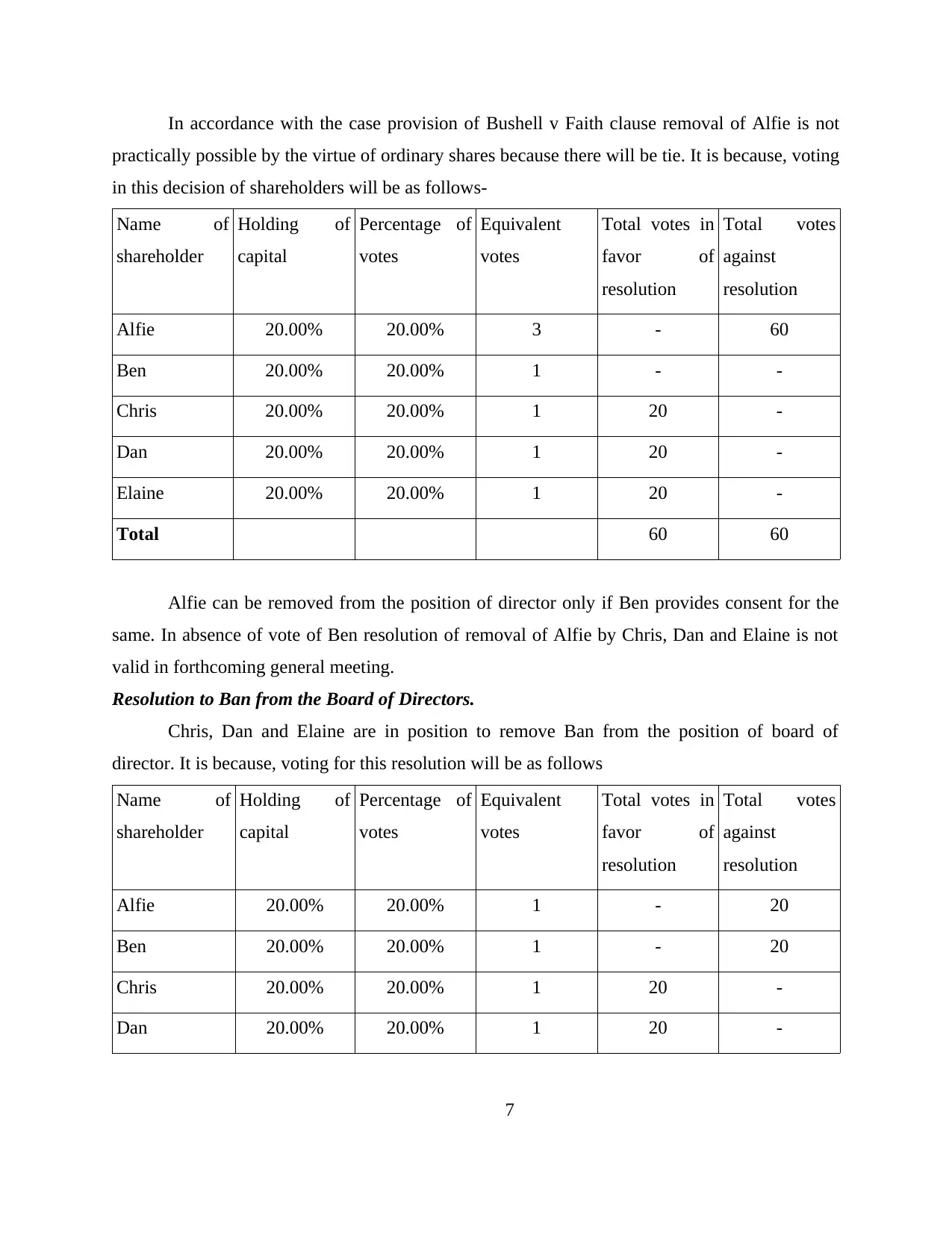
In accordance with the case provision of Bushell v Faith clause removal of Alfie is not
practically possible by the virtue of ordinary shares because there will be tie. It is because, voting
in this decision of shareholders will be as follows-
Name of
shareholder
Holding of
capital
Percentage of
votes
Equivalent
votes
Total votes in
favor of
resolution
Total votes
against
resolution
Alfie 20.00% 20.00% 3 - 60
Ben 20.00% 20.00% 1 - -
Chris 20.00% 20.00% 1 20 -
Dan 20.00% 20.00% 1 20 -
Elaine 20.00% 20.00% 1 20 -
Total 60 60
Alfie can be removed from the position of director only if Ben provides consent for the
same. In absence of vote of Ben resolution of removal of Alfie by Chris, Dan and Elaine is not
valid in forthcoming general meeting.
Resolution to Ban from the Board of Directors.
Chris, Dan and Elaine are in position to remove Ban from the position of board of
director. It is because, voting for this resolution will be as follows
Name of
shareholder
Holding of
capital
Percentage of
votes
Equivalent
votes
Total votes in
favor of
resolution
Total votes
against
resolution
Alfie 20.00% 20.00% 1 - 20
Ben 20.00% 20.00% 1 - 20
Chris 20.00% 20.00% 1 20 -
Dan 20.00% 20.00% 1 20 -
7
practically possible by the virtue of ordinary shares because there will be tie. It is because, voting
in this decision of shareholders will be as follows-
Name of
shareholder
Holding of
capital
Percentage of
votes
Equivalent
votes
Total votes in
favor of
resolution
Total votes
against
resolution
Alfie 20.00% 20.00% 3 - 60
Ben 20.00% 20.00% 1 - -
Chris 20.00% 20.00% 1 20 -
Dan 20.00% 20.00% 1 20 -
Elaine 20.00% 20.00% 1 20 -
Total 60 60
Alfie can be removed from the position of director only if Ben provides consent for the
same. In absence of vote of Ben resolution of removal of Alfie by Chris, Dan and Elaine is not
valid in forthcoming general meeting.
Resolution to Ban from the Board of Directors.
Chris, Dan and Elaine are in position to remove Ban from the position of board of
director. It is because, voting for this resolution will be as follows
Name of
shareholder
Holding of
capital
Percentage of
votes
Equivalent
votes
Total votes in
favor of
resolution
Total votes
against
resolution
Alfie 20.00% 20.00% 1 - 20
Ben 20.00% 20.00% 1 - 20
Chris 20.00% 20.00% 1 20 -
Dan 20.00% 20.00% 1 20 -
7
Paraphrase This Document
Need a fresh take? Get an instant paraphrase of this document with our AI Paraphraser
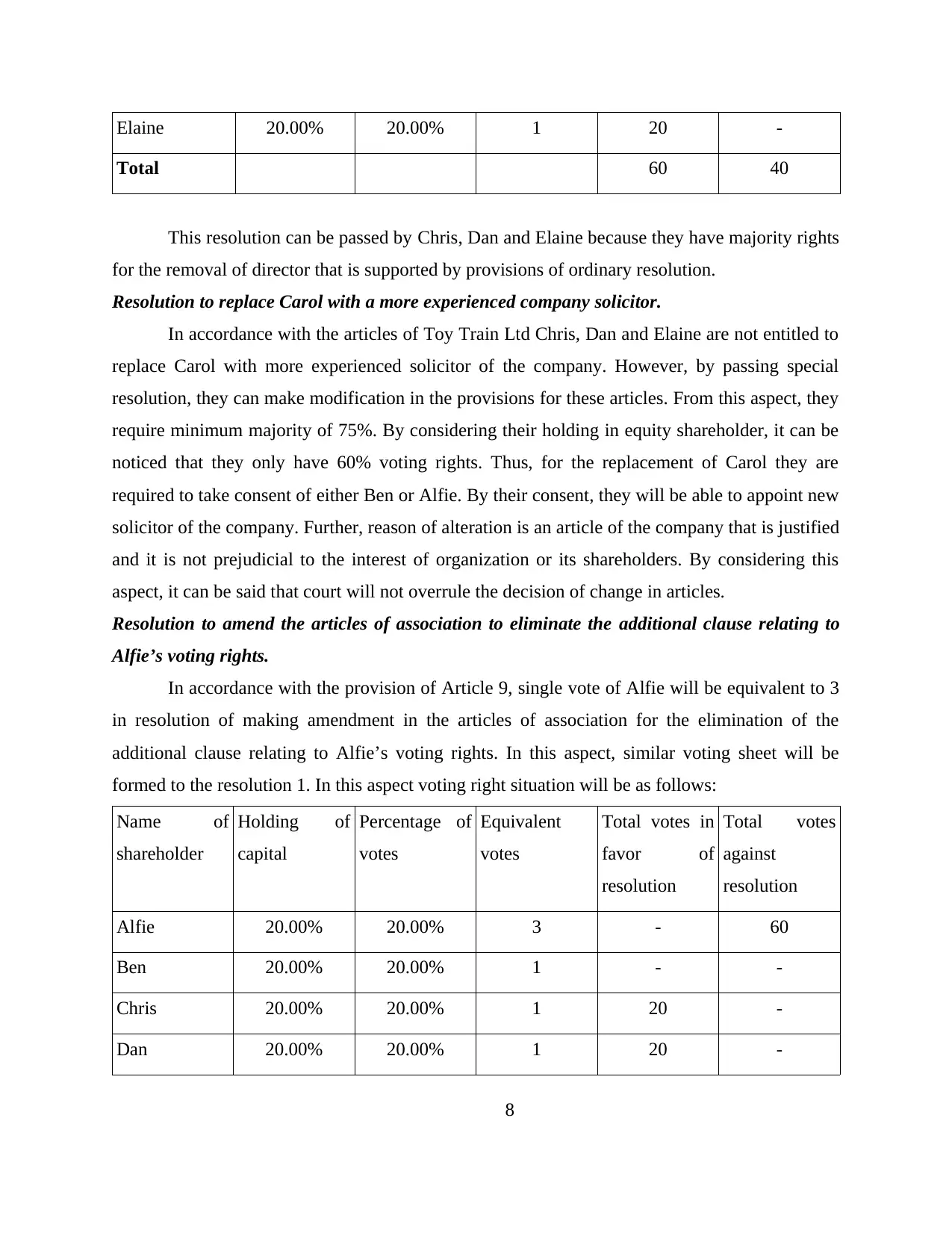
Elaine 20.00% 20.00% 1 20 -
Total 60 40
This resolution can be passed by Chris, Dan and Elaine because they have majority rights
for the removal of director that is supported by provisions of ordinary resolution.
Resolution to replace Carol with a more experienced company solicitor.
In accordance with the articles of Toy Train Ltd Chris, Dan and Elaine are not entitled to
replace Carol with more experienced solicitor of the company. However, by passing special
resolution, they can make modification in the provisions for these articles. From this aspect, they
require minimum majority of 75%. By considering their holding in equity shareholder, it can be
noticed that they only have 60% voting rights. Thus, for the replacement of Carol they are
required to take consent of either Ben or Alfie. By their consent, they will be able to appoint new
solicitor of the company. Further, reason of alteration is an article of the company that is justified
and it is not prejudicial to the interest of organization or its shareholders. By considering this
aspect, it can be said that court will not overrule the decision of change in articles.
Resolution to amend the articles of association to eliminate the additional clause relating to
Alfie’s voting rights.
In accordance with the provision of Article 9, single vote of Alfie will be equivalent to 3
in resolution of making amendment in the articles of association for the elimination of the
additional clause relating to Alfie’s voting rights. In this aspect, similar voting sheet will be
formed to the resolution 1. In this aspect voting right situation will be as follows:
Name of
shareholder
Holding of
capital
Percentage of
votes
Equivalent
votes
Total votes in
favor of
resolution
Total votes
against
resolution
Alfie 20.00% 20.00% 3 - 60
Ben 20.00% 20.00% 1 - -
Chris 20.00% 20.00% 1 20 -
Dan 20.00% 20.00% 1 20 -
8
Total 60 40
This resolution can be passed by Chris, Dan and Elaine because they have majority rights
for the removal of director that is supported by provisions of ordinary resolution.
Resolution to replace Carol with a more experienced company solicitor.
In accordance with the articles of Toy Train Ltd Chris, Dan and Elaine are not entitled to
replace Carol with more experienced solicitor of the company. However, by passing special
resolution, they can make modification in the provisions for these articles. From this aspect, they
require minimum majority of 75%. By considering their holding in equity shareholder, it can be
noticed that they only have 60% voting rights. Thus, for the replacement of Carol they are
required to take consent of either Ben or Alfie. By their consent, they will be able to appoint new
solicitor of the company. Further, reason of alteration is an article of the company that is justified
and it is not prejudicial to the interest of organization or its shareholders. By considering this
aspect, it can be said that court will not overrule the decision of change in articles.
Resolution to amend the articles of association to eliminate the additional clause relating to
Alfie’s voting rights.
In accordance with the provision of Article 9, single vote of Alfie will be equivalent to 3
in resolution of making amendment in the articles of association for the elimination of the
additional clause relating to Alfie’s voting rights. In this aspect, similar voting sheet will be
formed to the resolution 1. In this aspect voting right situation will be as follows:
Name of
shareholder
Holding of
capital
Percentage of
votes
Equivalent
votes
Total votes in
favor of
resolution
Total votes
against
resolution
Alfie 20.00% 20.00% 3 - 60
Ben 20.00% 20.00% 1 - -
Chris 20.00% 20.00% 1 20 -
Dan 20.00% 20.00% 1 20 -
8
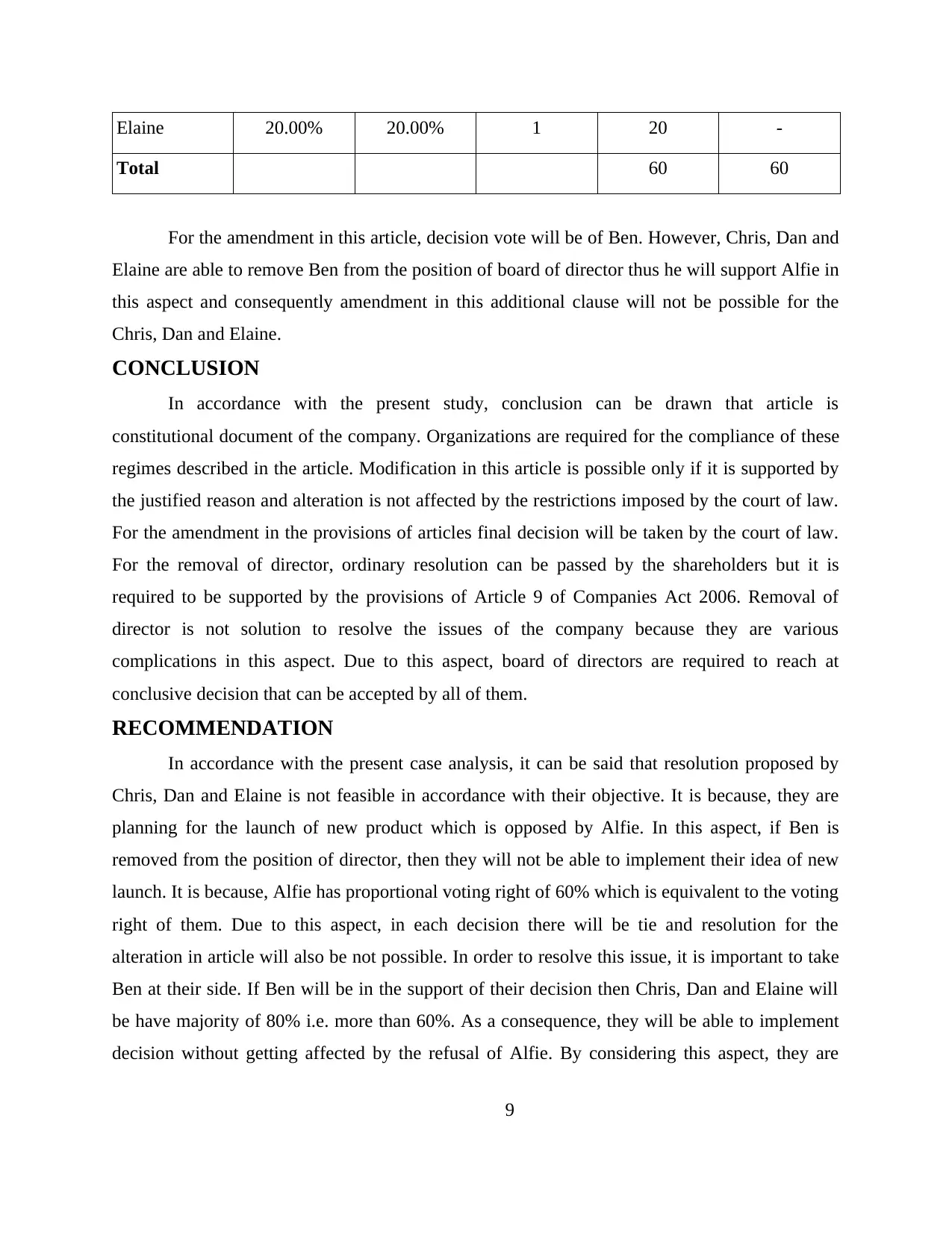
Elaine 20.00% 20.00% 1 20 -
Total 60 60
For the amendment in this article, decision vote will be of Ben. However, Chris, Dan and
Elaine are able to remove Ben from the position of board of director thus he will support Alfie in
this aspect and consequently amendment in this additional clause will not be possible for the
Chris, Dan and Elaine.
CONCLUSION
In accordance with the present study, conclusion can be drawn that article is
constitutional document of the company. Organizations are required for the compliance of these
regimes described in the article. Modification in this article is possible only if it is supported by
the justified reason and alteration is not affected by the restrictions imposed by the court of law.
For the amendment in the provisions of articles final decision will be taken by the court of law.
For the removal of director, ordinary resolution can be passed by the shareholders but it is
required to be supported by the provisions of Article 9 of Companies Act 2006. Removal of
director is not solution to resolve the issues of the company because they are various
complications in this aspect. Due to this aspect, board of directors are required to reach at
conclusive decision that can be accepted by all of them.
RECOMMENDATION
In accordance with the present case analysis, it can be said that resolution proposed by
Chris, Dan and Elaine is not feasible in accordance with their objective. It is because, they are
planning for the launch of new product which is opposed by Alfie. In this aspect, if Ben is
removed from the position of director, then they will not be able to implement their idea of new
launch. It is because, Alfie has proportional voting right of 60% which is equivalent to the voting
right of them. Due to this aspect, in each decision there will be tie and resolution for the
alteration in article will also be not possible. In order to resolve this issue, it is important to take
Ben at their side. If Ben will be in the support of their decision then Chris, Dan and Elaine will
be have majority of 80% i.e. more than 60%. As a consequence, they will be able to implement
decision without getting affected by the refusal of Alfie. By considering this aspect, they are
9
Total 60 60
For the amendment in this article, decision vote will be of Ben. However, Chris, Dan and
Elaine are able to remove Ben from the position of board of director thus he will support Alfie in
this aspect and consequently amendment in this additional clause will not be possible for the
Chris, Dan and Elaine.
CONCLUSION
In accordance with the present study, conclusion can be drawn that article is
constitutional document of the company. Organizations are required for the compliance of these
regimes described in the article. Modification in this article is possible only if it is supported by
the justified reason and alteration is not affected by the restrictions imposed by the court of law.
For the amendment in the provisions of articles final decision will be taken by the court of law.
For the removal of director, ordinary resolution can be passed by the shareholders but it is
required to be supported by the provisions of Article 9 of Companies Act 2006. Removal of
director is not solution to resolve the issues of the company because they are various
complications in this aspect. Due to this aspect, board of directors are required to reach at
conclusive decision that can be accepted by all of them.
RECOMMENDATION
In accordance with the present case analysis, it can be said that resolution proposed by
Chris, Dan and Elaine is not feasible in accordance with their objective. It is because, they are
planning for the launch of new product which is opposed by Alfie. In this aspect, if Ben is
removed from the position of director, then they will not be able to implement their idea of new
launch. It is because, Alfie has proportional voting right of 60% which is equivalent to the voting
right of them. Due to this aspect, in each decision there will be tie and resolution for the
alteration in article will also be not possible. In order to resolve this issue, it is important to take
Ben at their side. If Ben will be in the support of their decision then Chris, Dan and Elaine will
be have majority of 80% i.e. more than 60%. As a consequence, they will be able to implement
decision without getting affected by the refusal of Alfie. By considering this aspect, they are
9
⊘ This is a preview!⊘
Do you want full access?
Subscribe today to unlock all pages.
Trusted by 1+ million students worldwide

recommended to cancel the resolution of removal of Ben in case he does not agree with the
proposal of launching the new product.
10
proposal of launching the new product.
10
Paraphrase This Document
Need a fresh take? Get an instant paraphrase of this document with our AI Paraphraser
REFERENCES
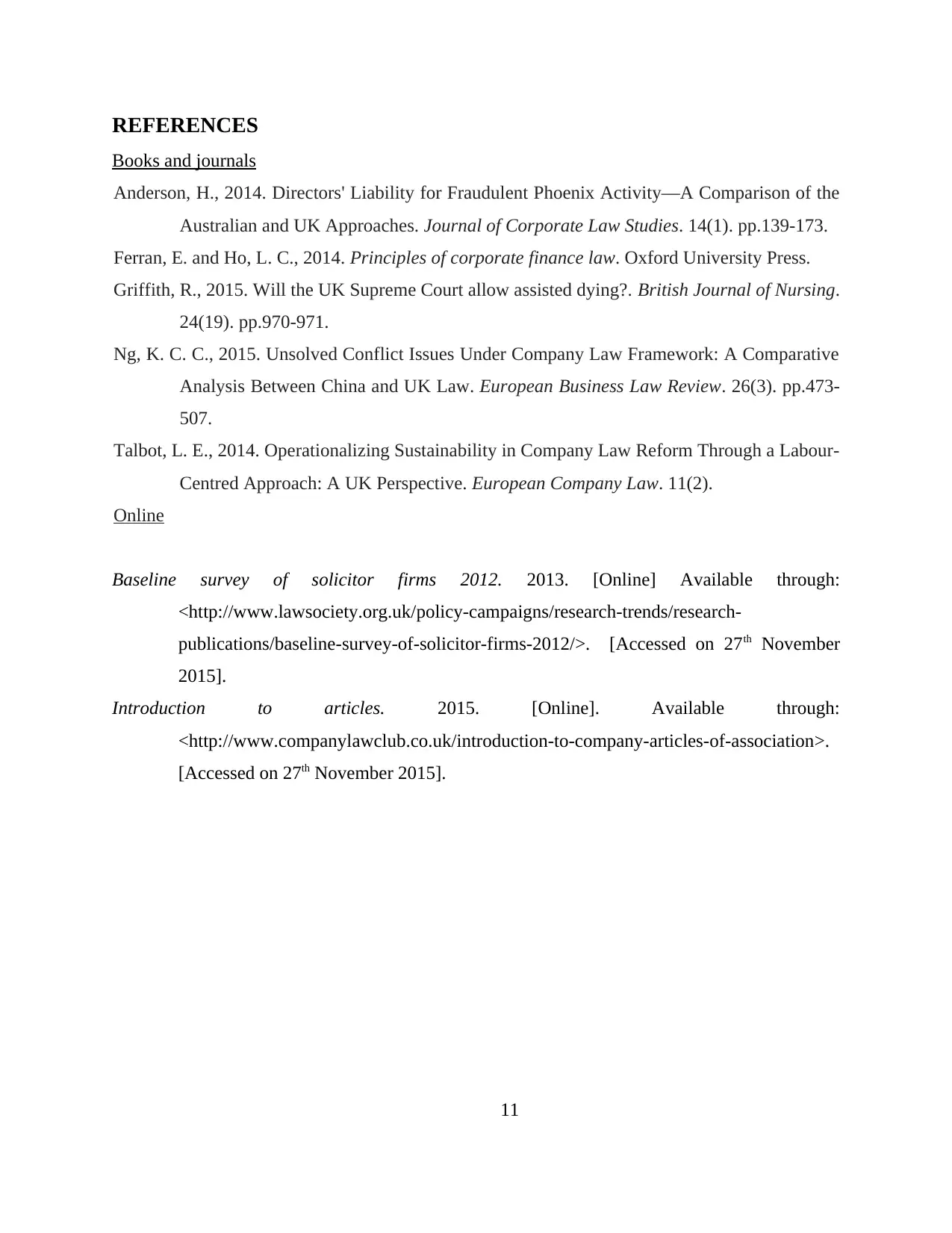
Books and journals
Anderson, H., 2014. Directors' Liability for Fraudulent Phoenix Activity—A Comparison of the
Australian and UK Approaches. Journal of Corporate Law Studies. 14(1). pp.139-173.
Ferran, E. and Ho, L. C., 2014. Principles of corporate finance law. Oxford University Press.
Griffith, R., 2015. Will the UK Supreme Court allow assisted dying?. British Journal of Nursing.
24(19). pp.970-971.
Ng, K. C. C., 2015. Unsolved Conflict Issues Under Company Law Framework: A Comparative
Analysis Between China and UK Law. European Business Law Review. 26(3). pp.473-
507.
Talbot, L. E., 2014. Operationalizing Sustainability in Company Law Reform Through a Labour-
Centred Approach: A UK Perspective. European Company Law. 11(2).
Online
Baseline survey of solicitor firms 2012. 2013. [Online] Available through:
<http://www.lawsociety.org.uk/policy-campaigns/research-trends/research-
publications/baseline-survey-of-solicitor-firms-2012/>. [Accessed on 27th November
2015].
Introduction to articles. 2015. [Online]. Available through:
<http://www.companylawclub.co.uk/introduction-to-company-articles-of-association>.
[Accessed on 27th November 2015].
11
Books and journals
Anderson, H., 2014. Directors' Liability for Fraudulent Phoenix Activity—A Comparison of the
Australian and UK Approaches. Journal of Corporate Law Studies. 14(1). pp.139-173.
Ferran, E. and Ho, L. C., 2014. Principles of corporate finance law. Oxford University Press.
Griffith, R., 2015. Will the UK Supreme Court allow assisted dying?. British Journal of Nursing.
24(19). pp.970-971.
Ng, K. C. C., 2015. Unsolved Conflict Issues Under Company Law Framework: A Comparative
Analysis Between China and UK Law. European Business Law Review. 26(3). pp.473-
507.
Talbot, L. E., 2014. Operationalizing Sustainability in Company Law Reform Through a Labour-
Centred Approach: A UK Perspective. European Company Law. 11(2).
Online
Baseline survey of solicitor firms 2012. 2013. [Online] Available through:
<http://www.lawsociety.org.uk/policy-campaigns/research-trends/research-
publications/baseline-survey-of-solicitor-firms-2012/>. [Accessed on 27th November
2015].
Introduction to articles. 2015. [Online]. Available through:
<http://www.companylawclub.co.uk/introduction-to-company-articles-of-association>.
[Accessed on 27th November 2015].
11

1 out of 11


Related Documents


Your All-in-One AI-Powered Toolkit for Academic Success.
+13062052269
info@desklib.com
Available 24*7 on WhatsApp / Email
![[object Object]](/_next/static/media/star-bottom.7253800d.svg)
Unlock your academic potential
Copyright © 2020–2026 A2Z Services. All Rights Reserved. Developed and managed by ZUCOL.