Legal Report: Registering Proprietary Companies and Non-Voting Shares

Verified

Added on  2020/06/05

|8
|1478
|139
Report
AI Summary
This report provides a detailed analysis of Australian corporate law, focusing on the process of registering a proprietary company under the Corporations Act 2001. It examines the key sections related to company registration, including the requirements for application, the role of replaceable rules, and the importance of maintaining a share register. The report also delves into the creation of a company constitution, specifically addressing the process of creating a class of non-voting shares and the legal requirements for notifying shareholders of meetings and the use of proxy forms. Furthermore, the report outlines the rights associated with preference shares and includes a sample proxy form, demonstrating how shareholders can participate in decision-making processes. The conclusion summarizes the key takeaways, emphasizing the legal frameworks for company registration and share class modifications.

Document Page
Law
tabler-icon-diamond-filled.svg

Paraphrase This Document

Need a fresh take? Get an instant paraphrase of this document with our AI Paraphraser
Document Page
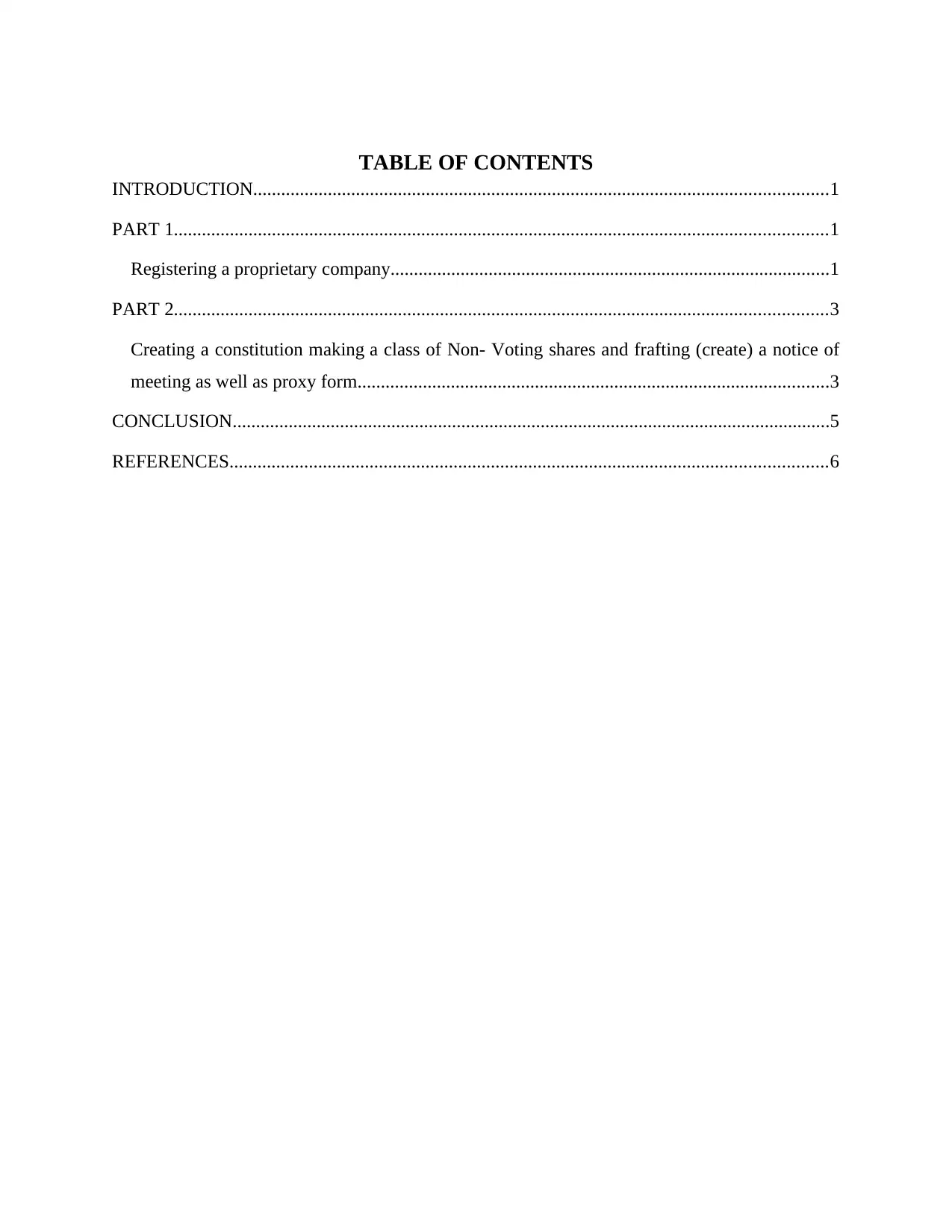
TABLE OF CONTENTS
INTRODUCTION...........................................................................................................................1
PART 1............................................................................................................................................1
Registering a proprietary company..............................................................................................1
PART 2............................................................................................................................................3
Creating a constitution making a class of Non- Voting shares and frafting (create) a notice of
meeting as well as proxy form.....................................................................................................3
CONCLUSION................................................................................................................................5
REFERENCES................................................................................................................................6
Document Page
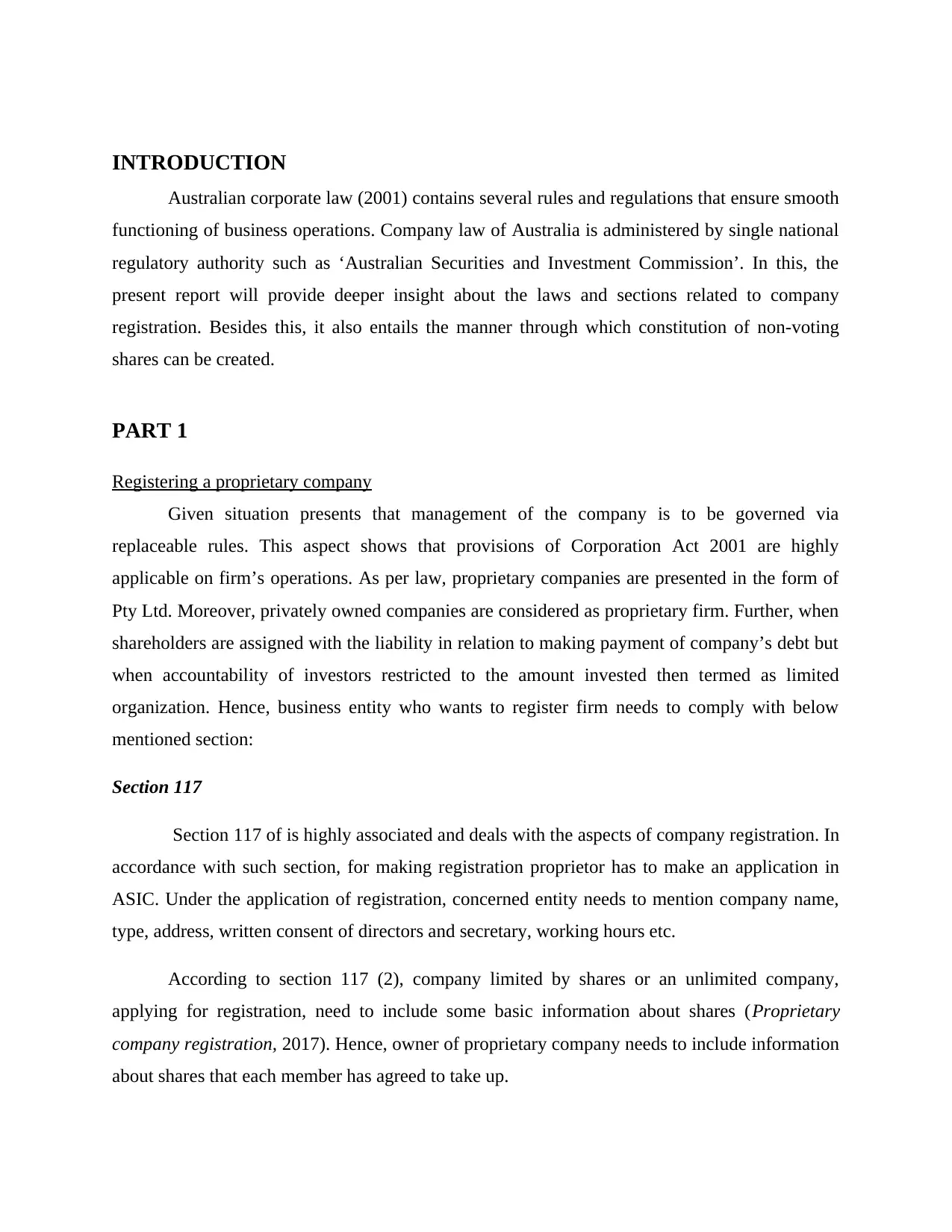
INTRODUCTION
Australian corporate law (2001) contains several rules and regulations that ensure smooth
functioning of business operations. Company law of Australia is administered by single national
regulatory authority such as ‘Australian Securities and Investment Commission’. In this, the
present report will provide deeper insight about the laws and sections related to company
registration. Besides this, it also entails the manner through which constitution of non-voting
shares can be created.
PART 1
Registering a proprietary company
Given situation presents that management of the company is to be governed via
replaceable rules. This aspect shows that provisions of Corporation Act 2001 are highly
applicable on firm’s operations. As per law, proprietary companies are presented in the form of
Pty Ltd. Moreover, privately owned companies are considered as proprietary firm. Further, when
shareholders are assigned with the liability in relation to making payment of company’s debt but
when accountability of investors restricted to the amount invested then termed as limited
organization. Hence, business entity who wants to register firm needs to comply with below
mentioned section:
Section 117
Section 117 of is highly associated and deals with the aspects of company registration. In
accordance with such section, for making registration proprietor has to make an application in
ASIC. Under the application of registration, concerned entity needs to mention company name,
type, address, written consent of directors and secretary, working hours etc.
According to section 117 (2), company limited by shares or an unlimited company,
applying for registration, need to include some basic information about shares (Proprietary
company registration, 2017). Hence, owner of proprietary company needs to include information
about shares that each member has agreed to take up.
Document Page
Hence, for registering company legally business entity needs to comply with section 117
following Corporation Act (2001).
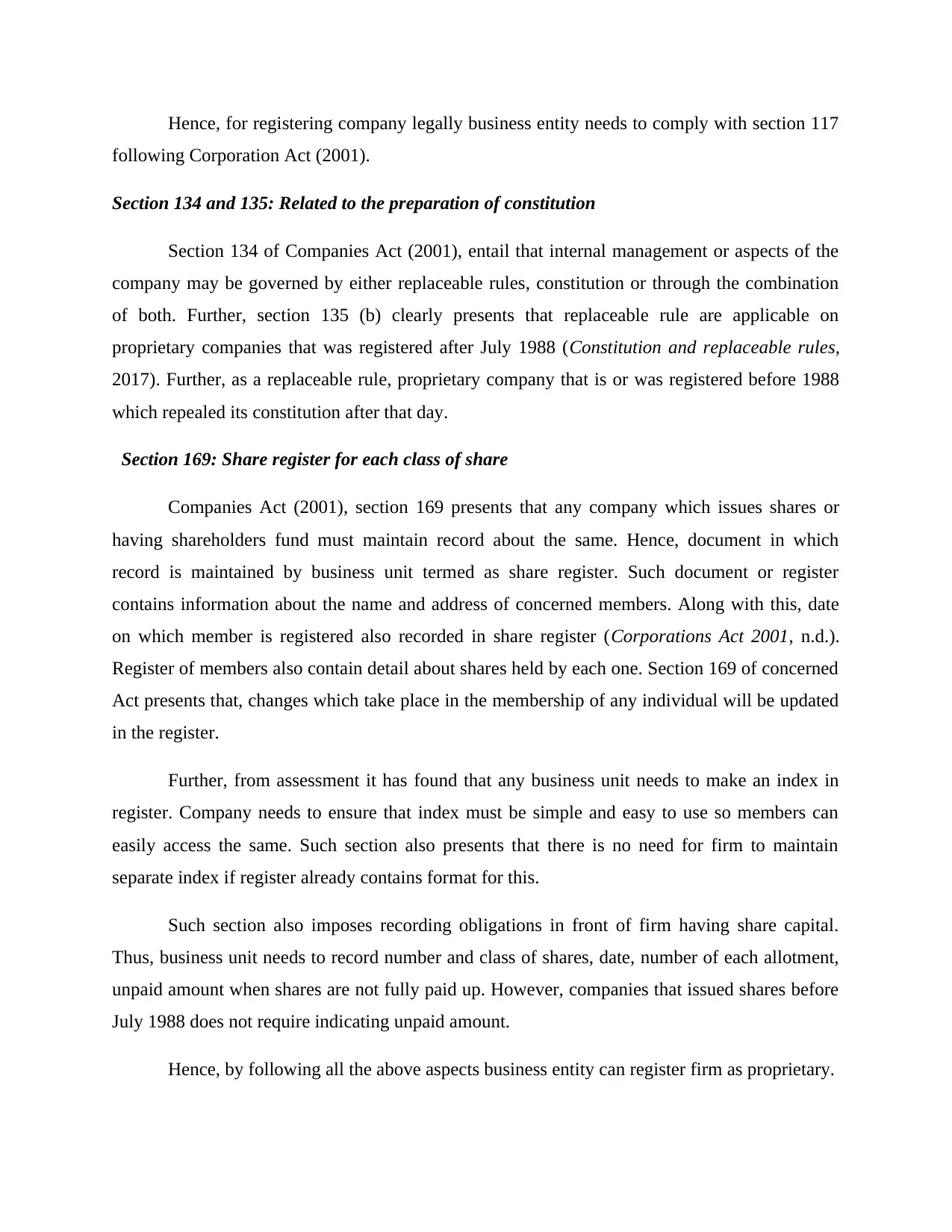
Section 134 and 135: Related to the preparation of constitution
Section 134 of Companies Act (2001), entail that internal management or aspects of the
company may be governed by either replaceable rules, constitution or through the combination
of both. Further, section 135 (b) clearly presents that replaceable rule are applicable on
proprietary companies that was registered after July 1988 (Constitution and replaceable rules,
2017). Further, as a replaceable rule, proprietary company that is or was registered before 1988
which repealed its constitution after that day.
Section 169: Share register for each class of share
Companies Act (2001), section 169 presents that any company which issues shares or
having shareholders fund must maintain record about the same. Hence, document in which
record is maintained by business unit termed as share register. Such document or register
contains information about the name and address of concerned members. Along with this, date
on which member is registered also recorded in share register (Corporations Act 2001, n.d.).
Register of members also contain detail about shares held by each one. Section 169 of concerned
Act presents that, changes which take place in the membership of any individual will be updated
in the register.
Further, from assessment it has found that any business unit needs to make an index in
register. Company needs to ensure that index must be simple and easy to use so members can
easily access the same. Such section also presents that there is no need for firm to maintain
separate index if register already contains format for this.
Such section also imposes recording obligations in front of firm having share capital.
Thus, business unit needs to record number and class of shares, date, number of each allotment,
unpaid amount when shares are not fully paid up. However, companies that issued shares before
July 1988 does not require indicating unpaid amount.
Hence, by following all the above aspects business entity can register firm as proprietary.
tabler-icon-diamond-filled.svg

Paraphrase This Document

Need a fresh take? Get an instant paraphrase of this document with our AI Paraphraser
Document Page
PART 2
Creating a constitution making a class of Non- Voting shares and frafting (create) a notice of
meeting as well as proxy form
In accordance with Australian rules and regulations, notice of meeting given to
shareholders must be fair or accurate. On the basis of law, business \unit does not provide
shareholders with the information which in turn mislead them. Corporation Act (2001), section
254 (a) shows that company is entitled to offer bonus, partly paid and preference shares to
investors. On the basis of cited case situation, firm wishes to create a class of non-voting shares.
In this, firm is required to take consent from shareholders by serving suitable notice to them
(Guidelines for notices of meeting, n.d.). This in turn leads participation of shareholders via
either direct voting or introduction of proxies. In accordance with Australian laws and
legislation, information must be given to shareholders pertaining to the appointment of proxies
through notice served. Given scenario exhibits that firm wishes to amend the constitution to
create a class of preference shares.
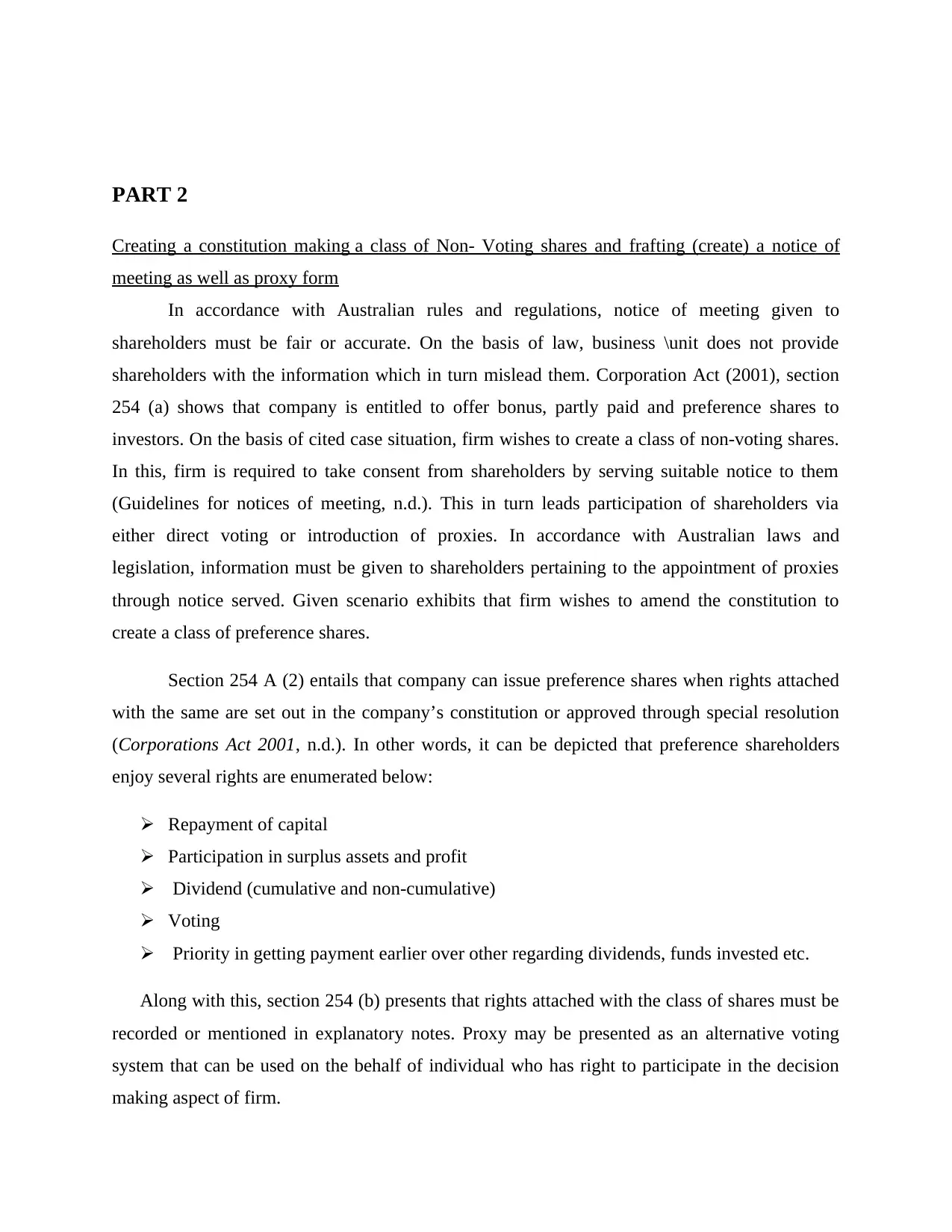
Section 254 A (2) entails that company can issue preference shares when rights attached
with the same are set out in the company’s constitution or approved through special resolution
(Corporations Act 2001, n.d.). In other words, it can be depicted that preference shareholders
enjoy several rights are enumerated below:
Repayment of capital
Participation in surplus assets and profit
Dividend (cumulative and non-cumulative)
Voting
Priority in getting payment earlier over other regarding dividends, funds invested etc.
Along with this, section 254 (b) presents that rights attached with the class of shares must be
recorded or mentioned in explanatory notes. Proxy may be presented as an alternative voting
system that can be used on the behalf of individual who has right to participate in the decision
making aspect of firm.
Document Page
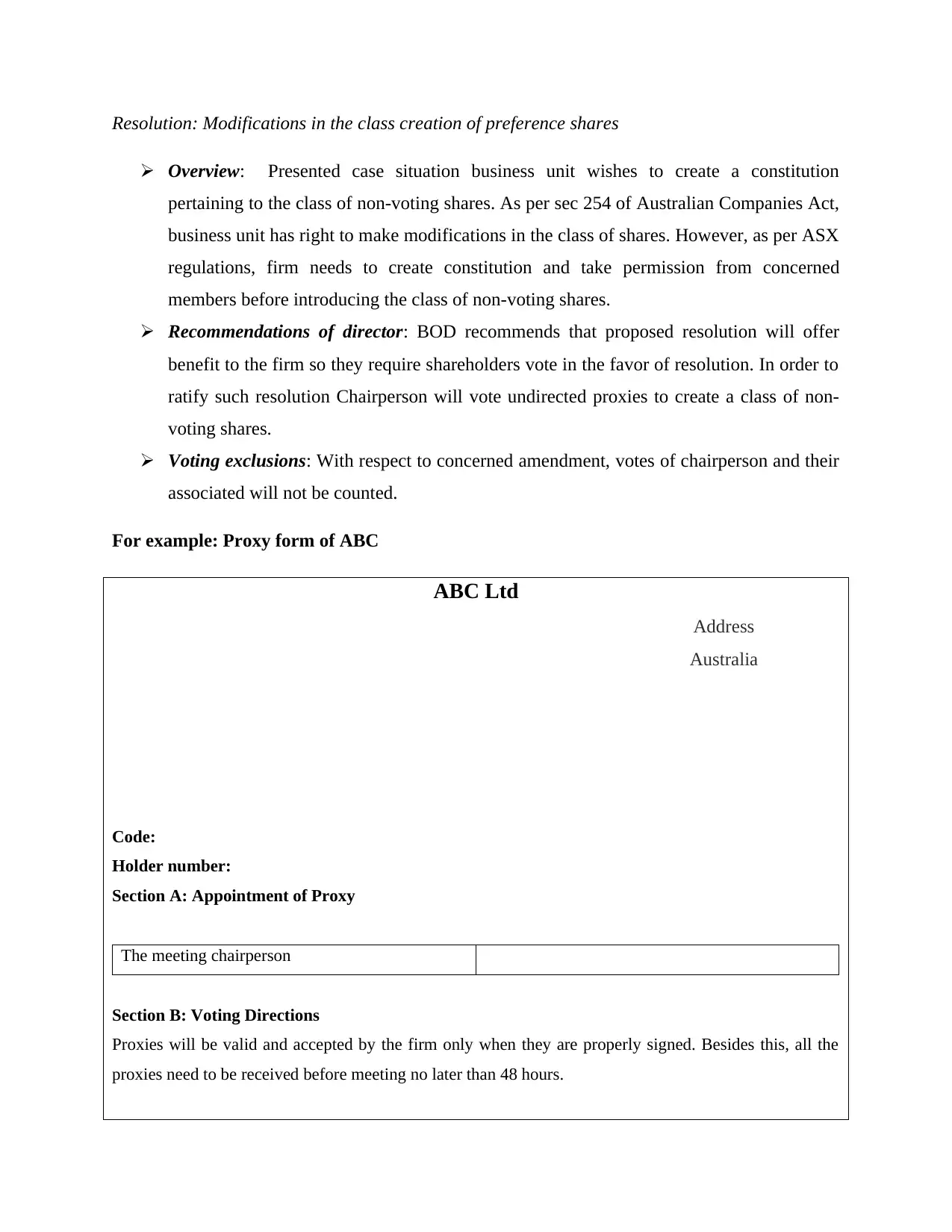
Resolution: Modifications in the class creation of preference shares
Overview: Presented case situation business unit wishes to create a constitution
pertaining to the class of non-voting shares. As per sec 254 of Australian Companies Act,
business unit has right to make modifications in the class of shares. However, as per ASX
regulations, firm needs to create constitution and take permission from concerned
members before introducing the class of non-voting shares.
Recommendations of director: BOD recommends that proposed resolution will offer
benefit to the firm so they require shareholders vote in the favor of resolution. In order to
ratify such resolution Chairperson will vote undirected proxies to create a class of non-
voting shares.
Voting exclusions: With respect to concerned amendment, votes of chairperson and their
associated will not be counted.
For example: Proxy form of ABC
ABC Ltd
Address
Australia
Code:
Holder number:
Section A: Appointment of Proxy
The meeting chairperson
Section B: Voting Directions
Proxies will be valid and accepted by the firm only when they are properly signed. Besides this, all the
proxies need to be received before meeting no later than 48 hours.
Document Page
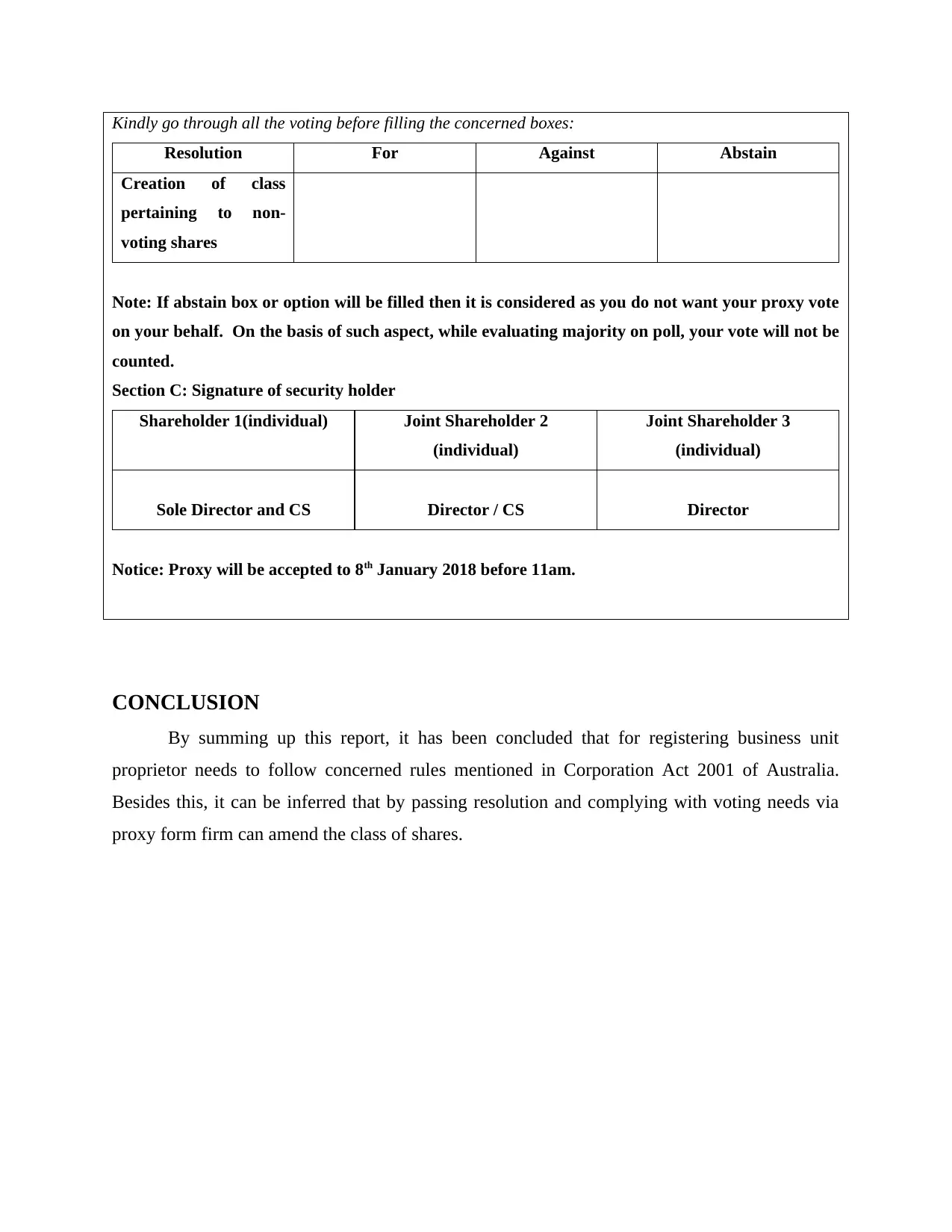
Kindly go through all the voting before filling the concerned boxes:
Resolution For Against Abstain
Creation of class
pertaining to non-
voting shares
Note: If abstain box or option will be filled then it is considered as you do not want your proxy vote
on your behalf. On the basis of such aspect, while evaluating majority on poll, your vote will not be
counted.
Section C: Signature of security holder
Shareholder 1(individual) Joint Shareholder 2
(individual)
Joint Shareholder 3
(individual)
Sole Director and CS Director / CS Director
Notice: Proxy will be accepted to 8th January 2018 before 11am.
CONCLUSION
By summing up this report, it has been concluded that for registering business unit
proprietor needs to follow concerned rules mentioned in Corporation Act 2001 of Australia.
Besides this, it can be inferred that by passing resolution and complying with voting needs via
proxy form firm can amend the class of shares.
tabler-icon-diamond-filled.svg

Paraphrase This Document

Need a fresh take? Get an instant paraphrase of this document with our AI Paraphraser
Document Page
REFERENCES
chevron_up_icon
1 out of 8
circle_padding
hide_on_mobile
zoom_out_icon
[object Object]