Exploring the Dynamics of Political Trust: A Comparative Study
VerifiedAdded on 2020/04/01
|17
|3942
|132
AI Summary
This research paper explores the multifaceted concept of political trust and its profound implications on democracy. Political trust is pivotal in shaping citizens' perceptions towards governance, influencing their willingness to comply with laws and engage politically. The study draws from various scholarly articles that discuss the determinants of political trust, such as procedural justice, e-government effectiveness, and media influence. Key findings indicate that higher levels of political trust correlate with greater support for democratic institutions and policy compliance. Conversely, declining political trust can lead to increased cynicism towards political processes, reducing citizen engagement and undermining democratic legitimacy. The paper further examines the role of social capital in fostering political trust and highlights the importance of transparent governance and accountable leadership in maintaining public confidence. By synthesizing empirical data from diverse democracies, this research provides a nuanced understanding of how political trust operates within different political contexts and its critical role in sustaining democratic norms.
Running head: TRUST IN POLITICIANS
1
Trust in politicians
Name
Institution Affiliation
1
Trust in politicians
Name
Institution Affiliation

Paraphrase This Document
Need a fresh take? Get an instant paraphrase of this document with our AI Paraphraser
TRUST IN POLITICIANS 2
Introduction
Trust in politicians by citizens of a state is relatively low compared to trust that is given
to other personnels in other fields of work for example doctors. From an investigation carried
out, it shows that for the last 40 years trust in politicians has been declining.This decline is easily
noticeable, while other professions like doctors trust by citizens keep on improving. The
increasing decline of trust in politicians seem to be triggered by the young guys that are joining
politics who do not have the competence but they overtake the old and the learned politicians in
the world.
When political trust crisis happens in a state, the political analysts come and discuss the
various issues that are going on by looking at the ideologies. These discussions tend to come up
with different solutions for the conflicts.The political analysts will differ with their solutions,
great debates are held between them and the end of it they get a solution through the discussions
of the contemporary issues. Political science is related to another field in the history, that is,
history of diplomacy, and the history of the public and constitutions. History of the public
focuses on the behavior and actions of people in society. In the decade 1975 and 1995, the
specialization of professors stated relating with a social history going up, the history of politics
went down, and this is greatly affecting trust of politicians by citizens.
Introduction
Trust in politicians by citizens of a state is relatively low compared to trust that is given
to other personnels in other fields of work for example doctors. From an investigation carried
out, it shows that for the last 40 years trust in politicians has been declining.This decline is easily
noticeable, while other professions like doctors trust by citizens keep on improving. The
increasing decline of trust in politicians seem to be triggered by the young guys that are joining
politics who do not have the competence but they overtake the old and the learned politicians in
the world.
When political trust crisis happens in a state, the political analysts come and discuss the
various issues that are going on by looking at the ideologies. These discussions tend to come up
with different solutions for the conflicts.The political analysts will differ with their solutions,
great debates are held between them and the end of it they get a solution through the discussions
of the contemporary issues. Political science is related to another field in the history, that is,
history of diplomacy, and the history of the public and constitutions. History of the public
focuses on the behavior and actions of people in society. In the decade 1975 and 1995, the
specialization of professors stated relating with a social history going up, the history of politics
went down, and this is greatly affecting trust of politicians by citizens.
TRUST IN POLITICIANS 3
Background of political trust
Political trust history was first written by Leopold Von Ranke in Germany in the 19th century
(Brug & Van Praag, 2007). It was later found that his ways of investigating affected the way
other historians analyzed facts and their completion of their research.In the history of politics, it
is important to study ideology as history cannot survive without referring to it. Political history is
greatly affected by the environment that we live and specialization. Scholars who have
specialized tend to perform better than the rest who deal with various issues while studying.
Earlier political history emphasized on events, leaders, movements and these made the
society. Political history explains the evolution of ideas of politics and various issues that are
focused on the sex, tribe, and the general society rather than the wellbeing of politicians (Brug &
Van Praag, 2007).
According to Grimes, (2006) trust of politicians by citizens is contributed by politicians
ignoring the citizens who voted for them and involving themselves in activities that benefit them
only forgetting the citizens. Convolution on agendas in the parliament and government has also
contributed a lot to lack of trust in politicians by citizens (Grimes, 2006). Politicians should
assure the citizens that they would work for them and stop engaging themselves in activities that
stop them from working for the citizens.
Problem Statement
Residents of a state are constantly faced with the disadvantage of untrustworthy
politicians in a state. Therefore, an adaptation of methods that would improve trust in politicians
by citizens in the world can be sought to enhance developments of a country, and hence
Background of political trust
Political trust history was first written by Leopold Von Ranke in Germany in the 19th century
(Brug & Van Praag, 2007). It was later found that his ways of investigating affected the way
other historians analyzed facts and their completion of their research.In the history of politics, it
is important to study ideology as history cannot survive without referring to it. Political history is
greatly affected by the environment that we live and specialization. Scholars who have
specialized tend to perform better than the rest who deal with various issues while studying.
Earlier political history emphasized on events, leaders, movements and these made the
society. Political history explains the evolution of ideas of politics and various issues that are
focused on the sex, tribe, and the general society rather than the wellbeing of politicians (Brug &
Van Praag, 2007).
According to Grimes, (2006) trust of politicians by citizens is contributed by politicians
ignoring the citizens who voted for them and involving themselves in activities that benefit them
only forgetting the citizens. Convolution on agendas in the parliament and government has also
contributed a lot to lack of trust in politicians by citizens (Grimes, 2006). Politicians should
assure the citizens that they would work for them and stop engaging themselves in activities that
stop them from working for the citizens.
Problem Statement
Residents of a state are constantly faced with the disadvantage of untrustworthy
politicians in a state. Therefore, an adaptation of methods that would improve trust in politicians
by citizens in the world can be sought to enhance developments of a country, and hence
⊘ This is a preview!⊘
Do you want full access?
Subscribe today to unlock all pages.

Trusted by 1+ million students worldwide
TRUST IN POLITICIANS 4
contribute to the overall gross domestic product of a country. The project will streamline policies
of the government, and hence provide recommendations to achieve better equity from politicians.
Objectives of the study
The study was set to analyze and examine the causes, effects, and impacts of trust in
politicians in the world, the constraints to its improvement and ways citizens and the government
can integrate new techniques to achieve full improvement of the political industry. This study
was guided by the following objectives.
i. To determine ways in which political trust can be further developed to improve
development in the country. The improvement of political trust in the county is a tool to
implement policies that the government can use to improve the marginalized areas of
the county.
ii. To investigate various challenges that citizens face due to declined trust in politicians.
Apparently, challenges to political trust do not emanate from within the government,
but rather within the citizens in the country.
iii. To analyze possible methods that the government and politicians can adopt to improve
political trust. Policy making is the most reliable method of political trust improvement
and is indifferent to the improvement exercise
iv. Explore the significance of political trust in a country.
v. To ascertain how environmental factors influence political trust. Factors undermining
political trust in the county mainly revolve around the lack of support from the county
government.
contribute to the overall gross domestic product of a country. The project will streamline policies
of the government, and hence provide recommendations to achieve better equity from politicians.
Objectives of the study
The study was set to analyze and examine the causes, effects, and impacts of trust in
politicians in the world, the constraints to its improvement and ways citizens and the government
can integrate new techniques to achieve full improvement of the political industry. This study
was guided by the following objectives.
i. To determine ways in which political trust can be further developed to improve
development in the country. The improvement of political trust in the county is a tool to
implement policies that the government can use to improve the marginalized areas of
the county.
ii. To investigate various challenges that citizens face due to declined trust in politicians.
Apparently, challenges to political trust do not emanate from within the government,
but rather within the citizens in the country.
iii. To analyze possible methods that the government and politicians can adopt to improve
political trust. Policy making is the most reliable method of political trust improvement
and is indifferent to the improvement exercise
iv. Explore the significance of political trust in a country.
v. To ascertain how environmental factors influence political trust. Factors undermining
political trust in the county mainly revolve around the lack of support from the county
government.
Paraphrase This Document
Need a fresh take? Get an instant paraphrase of this document with our AI Paraphraser
TRUST IN POLITICIANS 5
Research hypothesis
Research hypotheses set the rationality of carrying out a research study, and the variables
that exist within the data strata that is collected. The hypotheses were all aimed at solving the
problem of political trust in the world.
a. There are no significant linkages between citizens and the government together with
parliament
b. There are significant differences between politicians who have built their trust by citizens
and those who totally lost their trust.
c. There exists a significant gap between trusted politicians and the corrupt politicians in a
state.
d. There has been no significant involvement/participation of the government in integrating
trust in politicians.
Justification of the study
The research study was motivated by the fact that most of the politicians in the county are
not trusted due to underfunding, negligence by potential stakeholders and low use of modern
technologies in politics. The research work done ensured that:-
Politicians would be able to access high quality political skills. Due to this trust in politicians
by citizens is improved; Citizens also gain exclusive access to funds from the government since
the research project also aimed at integrating citizen -government linkages.
Since the political industry is a multi-billion industry, the revenue of the county government
projects an increase due to the taxes realized from citizens (Catterberg & Morena, 2006). Citizen
Research hypothesis
Research hypotheses set the rationality of carrying out a research study, and the variables
that exist within the data strata that is collected. The hypotheses were all aimed at solving the
problem of political trust in the world.
a. There are no significant linkages between citizens and the government together with
parliament
b. There are significant differences between politicians who have built their trust by citizens
and those who totally lost their trust.
c. There exists a significant gap between trusted politicians and the corrupt politicians in a
state.
d. There has been no significant involvement/participation of the government in integrating
trust in politicians.
Justification of the study
The research study was motivated by the fact that most of the politicians in the county are
not trusted due to underfunding, negligence by potential stakeholders and low use of modern
technologies in politics. The research work done ensured that:-
Politicians would be able to access high quality political skills. Due to this trust in politicians
by citizens is improved; Citizens also gain exclusive access to funds from the government since
the research project also aimed at integrating citizen -government linkages.
Since the political industry is a multi-billion industry, the revenue of the county government
projects an increase due to the taxes realized from citizens (Catterberg & Morena, 2006). Citizen
TRUST IN POLITICIANS 6
–government linkages were well developed since there was increased political trust. It thus calls
for better and developed political language and skills.
Literature review
Analysis of peer reviewed journals and other studies done on the issues of trust in
politicians establishing the causes of lack of trust in politicians. Moreover, this chapter provides
an extensive literature and research information related to the crisis of democracy . The section
reviews the various political trust crises. The section further gives an empirical and a
theoretical review of political support. Political trust has been rated as a variable, however
many scholars of political science have under rated it (Davidov, Schmidt, & Schwartz, 2008).
This study focuses on showing the importance of trust in politicians by citizens. Taking into
account the causes, effects of political trust its importance is realized.
Political trust crisis
For a long period, political trust has been encouraged by worries of the falling trust
in politicians since trust in politicians is considered as a favorable condition that enables
democracy in a state and its fall is known to affect democracy (Hammar & Jagers, 2006) .
Political trust can be defined as a situation where the citizens of a country are able to
support the parliament and government as a whole.
Political support
Political support is related to political trust aspects. Political support is highly
expressed where or when the outcome is known or they do not affect the political trust.
Political support is thought to be high where the trust of politicians is high too, and citizens
–government linkages were well developed since there was increased political trust. It thus calls
for better and developed political language and skills.
Literature review
Analysis of peer reviewed journals and other studies done on the issues of trust in
politicians establishing the causes of lack of trust in politicians. Moreover, this chapter provides
an extensive literature and research information related to the crisis of democracy . The section
reviews the various political trust crises. The section further gives an empirical and a
theoretical review of political support. Political trust has been rated as a variable, however
many scholars of political science have under rated it (Davidov, Schmidt, & Schwartz, 2008).
This study focuses on showing the importance of trust in politicians by citizens. Taking into
account the causes, effects of political trust its importance is realized.
Political trust crisis
For a long period, political trust has been encouraged by worries of the falling trust
in politicians since trust in politicians is considered as a favorable condition that enables
democracy in a state and its fall is known to affect democracy (Hammar & Jagers, 2006) .
Political trust can be defined as a situation where the citizens of a country are able to
support the parliament and government as a whole.
Political support
Political support is related to political trust aspects. Political support is highly
expressed where or when the outcome is known or they do not affect the political trust.
Political support is thought to be high where the trust of politicians is high too, and citizens
⊘ This is a preview!⊘
Do you want full access?
Subscribe today to unlock all pages.
Trusted by 1+ million students worldwide
TRUST IN POLITICIANS 7
are willingly supporting the government and parliament as well without doubts (Hammar &
Jagers, 2006) .
Rationale
Rationale generally is a belief of a cause of an action or reasons that account for the
occurrence of something. It is believed that citizens of high educational level are more
rational to political trust though it is yet to be tested (Hammar & Jagers, 2006). A study will
be carried out to compare the rationale of political trust between citizens of low education
level and those of high education level in order to prove this believability.
Conceptual framework
A conceptual framework is an element of the scientific research process in which a
specific concept is defined as a measurable occurrence or in measurable terms that give a
clear meaning of the concept (Tolbert & Mossberger, 2006). It is a diagrammatic presentation,
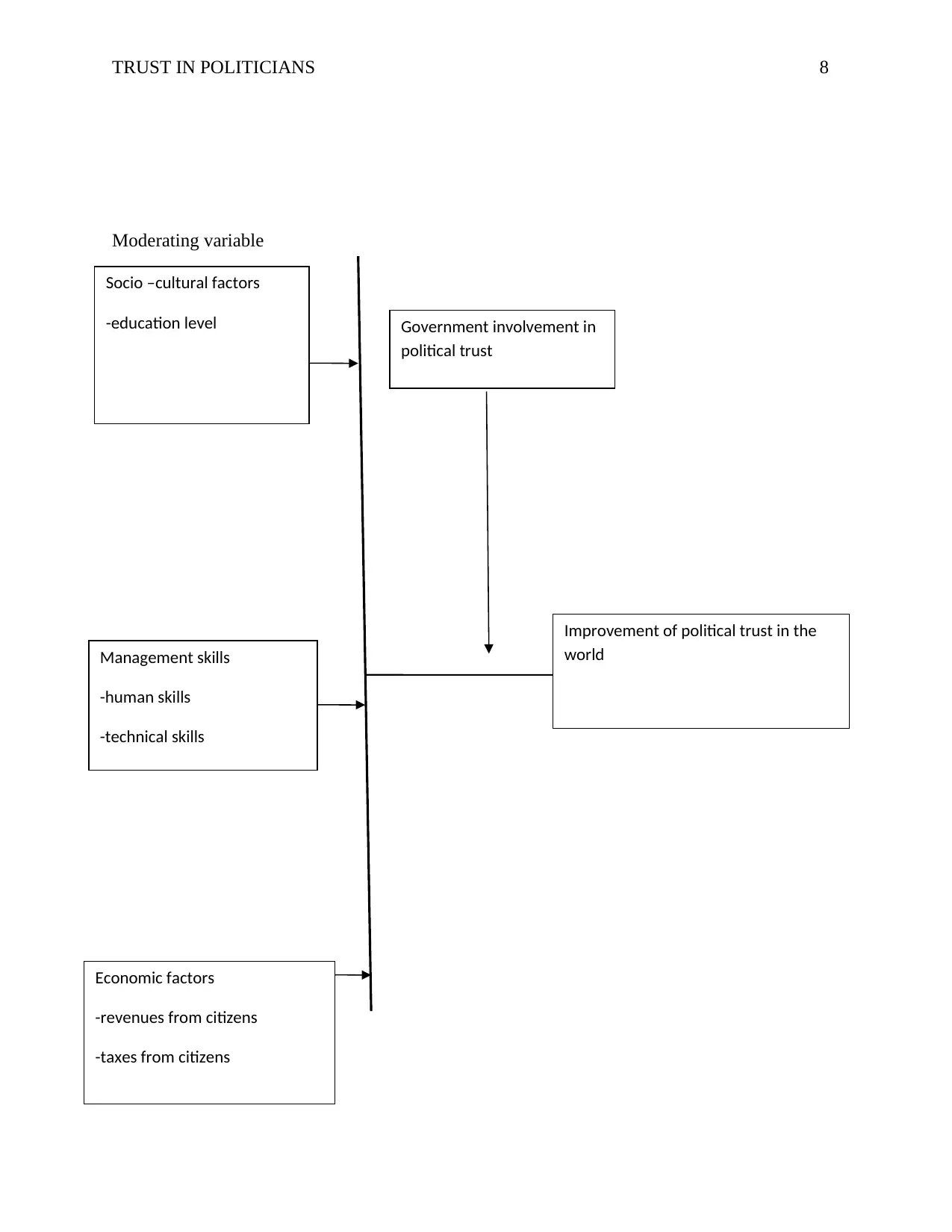
of the relationship between dependent and independent variables. In the study, the dependent
variable was improvement of political trust while independent variables were social/cultural,
economic, institutional factors
and management skills to present the relationship between the government, technology and
various factors that impede full improvement of political trust in the world (Hetherington,
2005).
Below is a chart flow of the conceptual framework Independent variables.
are willingly supporting the government and parliament as well without doubts (Hammar &
Jagers, 2006) .
Rationale
Rationale generally is a belief of a cause of an action or reasons that account for the
occurrence of something. It is believed that citizens of high educational level are more
rational to political trust though it is yet to be tested (Hammar & Jagers, 2006). A study will
be carried out to compare the rationale of political trust between citizens of low education
level and those of high education level in order to prove this believability.
Conceptual framework
A conceptual framework is an element of the scientific research process in which a
specific concept is defined as a measurable occurrence or in measurable terms that give a
clear meaning of the concept (Tolbert & Mossberger, 2006). It is a diagrammatic presentation,
of the relationship between dependent and independent variables. In the study, the dependent
variable was improvement of political trust while independent variables were social/cultural,
economic, institutional factors
and management skills to present the relationship between the government, technology and
various factors that impede full improvement of political trust in the world (Hetherington,
2005).
Below is a chart flow of the conceptual framework Independent variables.
Paraphrase This Document
Need a fresh take? Get an instant paraphrase of this document with our AI Paraphraser
TRUST IN POLITICIANS 8
Moderating variable
tor
Dependent variable
Socio –cultural factors
-education level
Management skills
-human skills
-technical skills
Economic factors
-revenues from citizens
-taxes from citizens
Improvement of political trust in the
world
Government involvement in
political trust
Moderating variable
tor
Dependent variable
Socio –cultural factors
-education level
Management skills
-human skills
-technical skills
Economic factors
-revenues from citizens
-taxes from citizens
Improvement of political trust in the
world
Government involvement in
political trust
TRUST IN POLITICIANS 9
Limitations of the study
Time
It was a great challenge to manage the little time that was allocated for the study. Some
sample information needed more a deeper research and it may take a great deal of time to
interview and survey all the locations.
Money for funding
Being a student, it was a challenge to get enough funds for the research work, or even get
sponsorship for visiting all sampled locations and interact with politicians. The little funding
helped me through the project however inadequate.
Co-operation
Some politicians may be not willing to share accurate information in fear of disclosing
their secrets; this is very common with the old politicians
Misleading information
Some respondents may not be willing, to tell the truth about their day-day activities,
hence they end up giving misleading information, which could jeopardize the whole research
process.
Limitations of the study
Time
It was a great challenge to manage the little time that was allocated for the study. Some
sample information needed more a deeper research and it may take a great deal of time to
interview and survey all the locations.
Money for funding
Being a student, it was a challenge to get enough funds for the research work, or even get
sponsorship for visiting all sampled locations and interact with politicians. The little funding
helped me through the project however inadequate.
Co-operation
Some politicians may be not willing to share accurate information in fear of disclosing
their secrets; this is very common with the old politicians
Misleading information
Some respondents may not be willing, to tell the truth about their day-day activities,
hence they end up giving misleading information, which could jeopardize the whole research
process.
⊘ This is a preview!⊘
Do you want full access?
Subscribe today to unlock all pages.
Trusted by 1+ million students worldwide
TRUST IN POLITICIANS 10
Research methodology
This chapter presents the methodology, which was used to carry out this study. It further
describes the type and source of data, the target population, sampling methods and the techniques
that were used to select the sample size. The chapter further describes how data was collected
and analyzed. The methodology used in the study provided guidelines for information gathering
and information processing (Hough, Jackson, & Bradford, 2013). Different research problems
call for the use of different approaches in design, to conform to the requirements of the research
study at hand.
In this regard, research methodology regards the research approaches that a researcher
uses to explain the relationship and inference of phenomena, for a specific research question.
Therefore, this research study entailed the use of a mixed research design approach, due to the
nature of the research problem, and the need for the establishment of a concrete basis for the
research study (Lindstrom & Mohseni, 2009). A mixed research design entails the use of a
qualitative and quantitative research design.
The mixed method of developing a research study is beneficial to the researcher, as it
helps the researcher to gauge a quick and precise judgment of the research study at hand.
Moreover, the question of trust in politicians need to be addressed at different levels, so that
results taken are easily used for policy making and further development of the research study
(Lindstrom & Mohseni, 2009). Mixed methods majorly employed the integration of both
explorative and transformative approaches to developing the research further.
Research methodology
This chapter presents the methodology, which was used to carry out this study. It further
describes the type and source of data, the target population, sampling methods and the techniques
that were used to select the sample size. The chapter further describes how data was collected
and analyzed. The methodology used in the study provided guidelines for information gathering
and information processing (Hough, Jackson, & Bradford, 2013). Different research problems
call for the use of different approaches in design, to conform to the requirements of the research
study at hand.
In this regard, research methodology regards the research approaches that a researcher
uses to explain the relationship and inference of phenomena, for a specific research question.
Therefore, this research study entailed the use of a mixed research design approach, due to the
nature of the research problem, and the need for the establishment of a concrete basis for the
research study (Lindstrom & Mohseni, 2009). A mixed research design entails the use of a
qualitative and quantitative research design.
The mixed method of developing a research study is beneficial to the researcher, as it
helps the researcher to gauge a quick and precise judgment of the research study at hand.
Moreover, the question of trust in politicians need to be addressed at different levels, so that
results taken are easily used for policy making and further development of the research study
(Lindstrom & Mohseni, 2009). Mixed methods majorly employed the integration of both
explorative and transformative approaches to developing the research further.
Paraphrase This Document
Need a fresh take? Get an instant paraphrase of this document with our AI Paraphraser
TRUST IN POLITICIANS 11
Mixed research design
The problem of this study was studied using a mixed research design. The study was able
to find out about the improvement of political trust, the key constraints to this improvement as
well as how to overcome the constraints. The research design made sure that all elements for the
study were catered for and nothing was left out. The main approach to this study was
quantitative, however, some qualitative research was used in order to gain a better understanding
and possibly enable a better and more insightful interpretation of results that were obtained from
the study.
This design dealt with the intense investigation of problem solving situations in which
underlying problems were relevant to the research problem. The underlying concept for the
descriptive research design is to select several targeted cases where an intensive analysis
identifies the possible alternatives for solving the research questions on the existing solutions
applied in the existing study. The researcher attempts to describe and define the subject often by
creating a group of problems. In accordance with this principle, this was the best deemed
research design to use for the study.
Basic Strengths of the Mixed Design Approach
The mixed design approach has been used by researchers for a long time, due to specific
benefits that the research design has on the justification of the research problem. Despite the
method having received many critics over the last few years, many scholars still find the method
to be reliable, diverse, and easy to use even under the most uncertain circumstances in the
research field.
Mixed research design
The problem of this study was studied using a mixed research design. The study was able
to find out about the improvement of political trust, the key constraints to this improvement as
well as how to overcome the constraints. The research design made sure that all elements for the
study were catered for and nothing was left out. The main approach to this study was
quantitative, however, some qualitative research was used in order to gain a better understanding
and possibly enable a better and more insightful interpretation of results that were obtained from
the study.
This design dealt with the intense investigation of problem solving situations in which
underlying problems were relevant to the research problem. The underlying concept for the
descriptive research design is to select several targeted cases where an intensive analysis
identifies the possible alternatives for solving the research questions on the existing solutions
applied in the existing study. The researcher attempts to describe and define the subject often by
creating a group of problems. In accordance with this principle, this was the best deemed
research design to use for the study.
Basic Strengths of the Mixed Design Approach
The mixed design approach has been used by researchers for a long time, due to specific
benefits that the research design has on the justification of the research problem. Despite the
method having received many critics over the last few years, many scholars still find the method
to be reliable, diverse, and easy to use even under the most uncertain circumstances in the
research field.
TRUST IN POLITICIANS 12
For instance, one of the profound strengths of using a mixed research design approach for
the study political trust in the world included the ability of the research design to conform to
different sample sizes, dependent on the ability of the researcher to cover a certain size of the
population. Other research designs adopted on the singular basis only provide a strict and concise
research sample that the researcher cannot manipulate to fit the requirements of the problem at
hand (Li, 2008). Therefore, the research study was able to uncover information that could only
be achieved through the shrinking or the expansion of the sample size.
Moreover, data collection of ethnographic data, require the researcher to use all the
available methods of collecting data, without necessary restriction to a specific data collection
method. Therefore, data obtained was not confined to only the documented methods of data
collection, but also other methods that were deemed fit for acquiring the required information.
Lastly, the phenomenon surrounding political trust is one that could not be determined on
a one phase one-time basis. Therefore, the study sought to develop a sequential, and continuous
monitoring, which only mixed research design as capable of offering, due to it's qualitative and
quantitative aspects.
Limitations on the Use of Mixed Research Design
Despite having many benefits to the success of the study, the mixed research design
methodology also faced major difficulties, which were its limitations or drawbacks. For example,
the time needed to constitute a successful combination of both qualitative and quantitative
research designs was long (Lindstrom & Mohseni, 2009). The research problem; transformative
and adoptable methods for improving political trust, required a careful basis of both the
qualitative and quantitative variables and how such variables influence political trust. Moreover,
For instance, one of the profound strengths of using a mixed research design approach for
the study political trust in the world included the ability of the research design to conform to
different sample sizes, dependent on the ability of the researcher to cover a certain size of the
population. Other research designs adopted on the singular basis only provide a strict and concise
research sample that the researcher cannot manipulate to fit the requirements of the problem at
hand (Li, 2008). Therefore, the research study was able to uncover information that could only
be achieved through the shrinking or the expansion of the sample size.
Moreover, data collection of ethnographic data, require the researcher to use all the
available methods of collecting data, without necessary restriction to a specific data collection
method. Therefore, data obtained was not confined to only the documented methods of data
collection, but also other methods that were deemed fit for acquiring the required information.
Lastly, the phenomenon surrounding political trust is one that could not be determined on
a one phase one-time basis. Therefore, the study sought to develop a sequential, and continuous
monitoring, which only mixed research design as capable of offering, due to it's qualitative and
quantitative aspects.
Limitations on the Use of Mixed Research Design
Despite having many benefits to the success of the study, the mixed research design
methodology also faced major difficulties, which were its limitations or drawbacks. For example,
the time needed to constitute a successful combination of both qualitative and quantitative
research designs was long (Lindstrom & Mohseni, 2009). The research problem; transformative
and adoptable methods for improving political trust, required a careful basis of both the
qualitative and quantitative variables and how such variables influence political trust. Moreover,
⊘ This is a preview!⊘
Do you want full access?
Subscribe today to unlock all pages.
Trusted by 1+ million students worldwide

1 out of 17


Your All-in-One AI-Powered Toolkit for Academic Success.
+13062052269
info@desklib.com
Available 24*7 on WhatsApp / Email
![[object Object]](/_next/static/media/star-bottom.7253800d.svg)
Unlock your academic potential
Copyright © 2020–2026 A2Z Services. All Rights Reserved. Developed and managed by ZUCOL.