A Detailed Report on iOS and Windows 10 Scheduling Mechanisms

Verified

Added on  2022/10/16

|11
|1936
|236
Report
AI Summary
This report provides a comprehensive comparison of the scheduling mechanisms employed by iOS and Windows 10 operating systems. It delves into the core concepts of scheduling, emphasizing how tasks and resources are managed to optimize performance. The report details the priority-based scheduling algorithm used by Windows 10, including its dispatcher, priority levels, and the use of multilevel feedback queues. In contrast, it explores the microkernel-based scheduling in iOS, focusing on FIFO, Round Robin, and Sporadic scheduling algorithms, and their respective advantages and disadvantages. The report includes illustrative figures and tables to clarify the concepts. The discussion covers the practical implications of each scheduling approach, highlighting how they impact system efficiency and responsiveness. References to relevant research papers are included to support the analysis. This report is a valuable resource for understanding the differences in scheduling strategies between these two major operating systems.
Document Page
Running head: IOS AND WINDOWS 10 SCHEDULING MECHANISMS
iOS and Windows 10 Scheduling Mechanisms
Name of the Student:
Name of the Organization:
Author Note:
tabler-icon-diamond-filled.svg

Paraphrase This Document

Need a fresh take? Get an instant paraphrase of this document with our AI Paraphraser
Document Page
1IOS AND WINDOWS 10 SCHEDULING MECHANISMS
The process of allocating a work and the resources required to complete the task is
termed as scheduling in computing processes. The tasks are generally virtual elements required
to compute like data flow, threads or processes that are scheduled to available hardware
resources that include expansion cards, processors and network links (Gracioli et al. 2013). The
basic tasks of a scheduler include sharing of resources between multiple users, providing better
quality of service and keeping the available computational resources distributed amongst
multiple tasks. The presence of scheduler helps the system to carry out multiple tasks with the
available resources making it easier to keep a single central processing unit.
Scheduling Mechanisms in Windows 10
Apriority based scheduling algorithm is the scheduling mechanism, which is used by
Windows 10. Scheduler’s functioning mechanisms include checking of threads, amongst which
the one with highest priority will be executed at first. Dispatcher handle the part of windows
kernel responsible for scheduling, for which it uses a priority scheme of 32- level for allocating
the order of task in which the thread will be executed (Low, Li and Chang, 2013). Scheduler of
windows 10 is sub-divided into two different classes, the first one is variable class with threads
with priorities from 1 to 15, while the other one, which is the real time class has priorities from
16 to 31. The thread at priority 0 is system reserved and only used for memory management.
These tasks are arranged in a queue by the dispatcher, based on priorities from higher to lower
order till it grasps a thread, which is ready for executing the task. Unavailability of thread makes
execution of a special thread by the dispatcher, which is known as the idle thread. Priorities are
variable for all classes other than the read-time priority class, which signifies that priorities for
these classes, are changeable.
Document Page
2IOS AND WINDOWS 10 SCHEDULING MECHANISMS
Optimum performance is required for running interactive programs in the system for the
required process. Priority of a thread depends on the class priority it is from and relative priority
of a process from the class it belongs.
Processor Scheduling
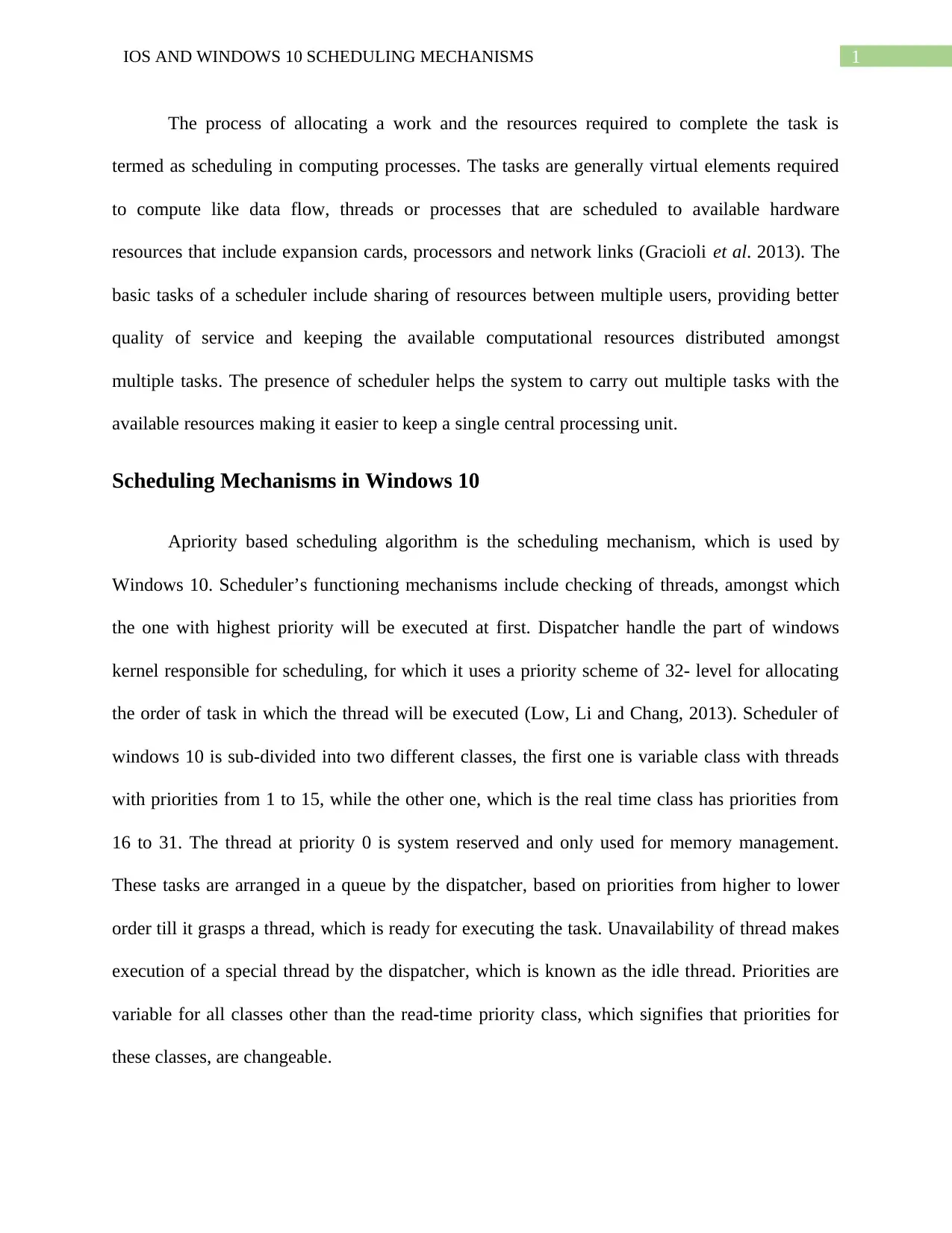
Windows 10 OS (Operating System) has provision for configuring processor scheduling,
based on which it is able to provide optimum performance when a program is executed in the
background or for other processes running in the background, which can be manually configured
from the control panel (Rudek , 2013).
Figure 1: Processor Scheduling
Task Scheduling
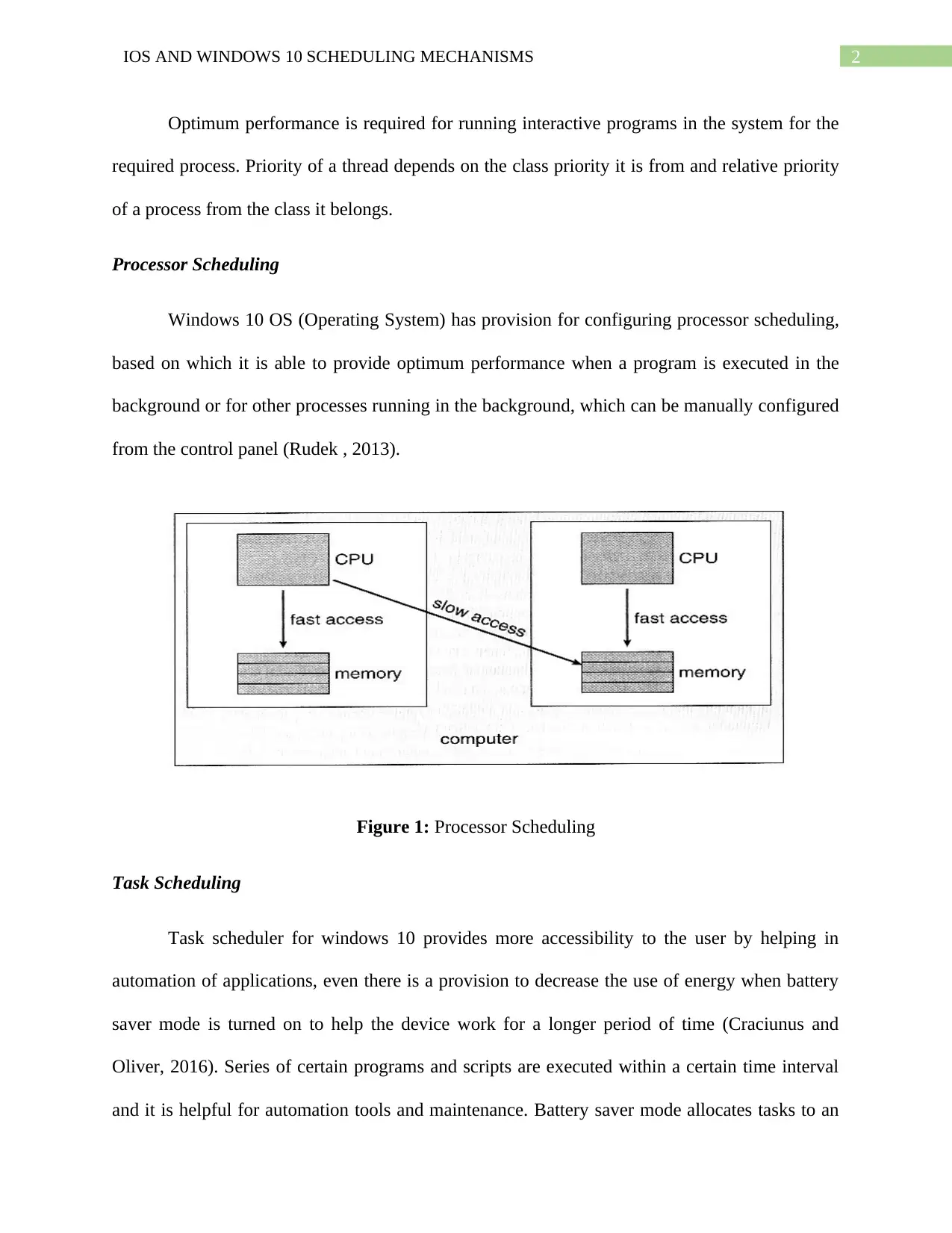
Task scheduler for windows 10 provides more accessibility to the user by helping in
automation of applications, even there is a provision to decrease the use of energy when battery
saver mode is turned on to help the device work for a longer period of time (Craciunus and
Oliver, 2016). Series of certain programs and scripts are executed within a certain time interval
and it is helpful for automation tools and maintenance. Battery saver mode allocates tasks to an
Document Page
3IOS AND WINDOWS 10 SCHEDULING MECHANISMS
idle computer system, the task is allocated to run at the time of automatic maintenance instead of
running the task as soon as the user logs in.
Figure 2: Task Scheduling
Multilevel Feedback Queue
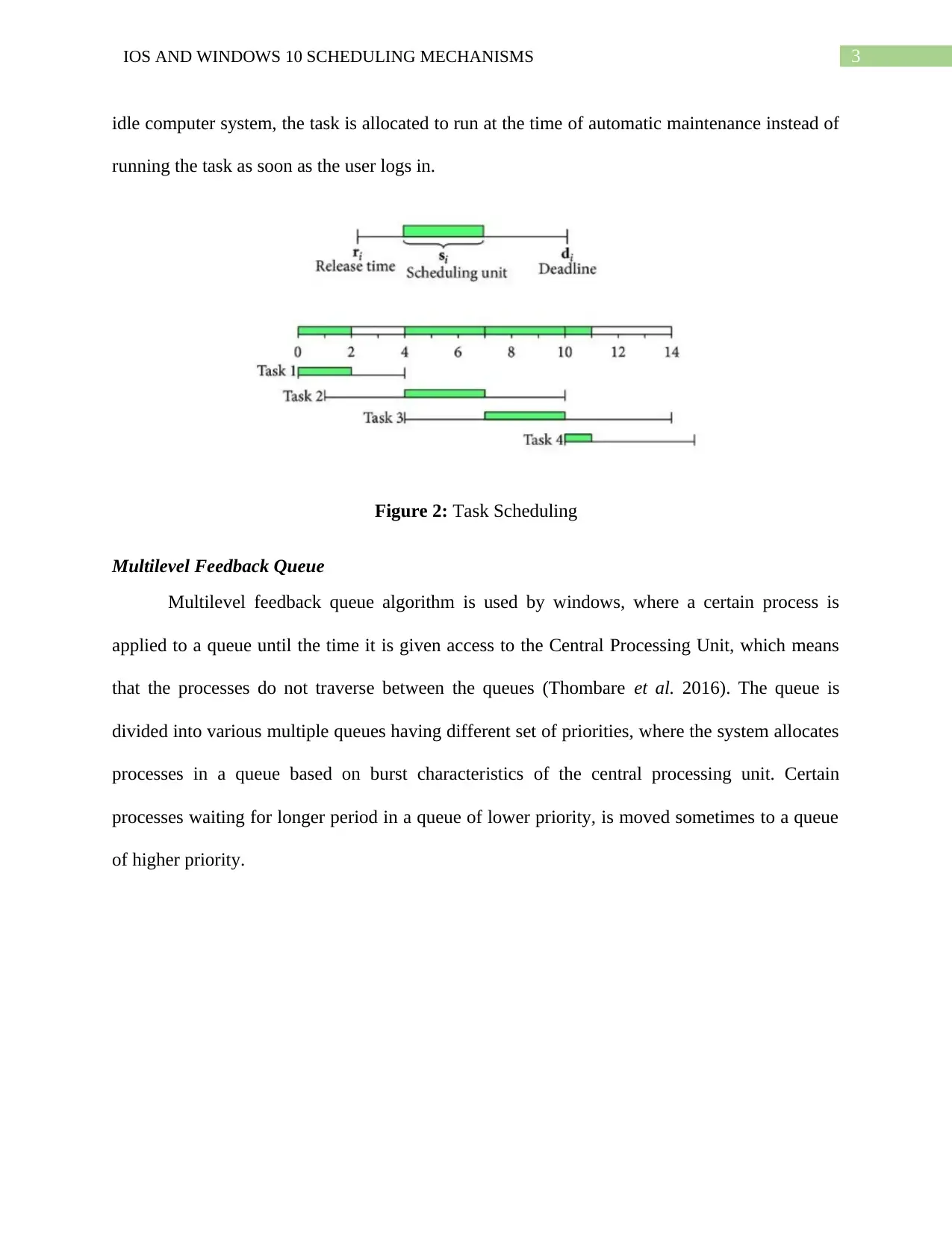
Multilevel feedback queue algorithm is used by windows, where a certain process is
applied to a queue until the time it is given access to the Central Processing Unit, which means
that the processes do not traverse between the queues (Thombare et al. 2016). The queue is
divided into various multiple queues having different set of priorities, where the system allocates
processes in a queue based on burst characteristics of the central processing unit. Certain
processes waiting for longer period in a queue of lower priority, is moved sometimes to a queue
of higher priority.
tabler-icon-diamond-filled.svg

Paraphrase This Document

Need a fresh take? Get an instant paraphrase of this document with our AI Paraphraser
Document Page
4IOS AND WINDOWS 10 SCHEDULING MECHANISMS
Figure 3: Multilevel Feedback Queue
Scheduling Mechanisms in iOS
The microkernel in ios has three different scheduling algorithms, which are used based on
the requirements of a specific task or process. These processes are, FIFO (First In-First Out)
scheduling, Sporadic Scheduling and Round robin scheduling.
FIFO Scheduling
FIFO scheduling has a thread that continues running without any assistance. This takes
control or the process is emptied previously using a thread used for high priority tasks. The Cisco
ios XR, unassigned threads in the kernel use first in first out scheduling. This process is a pre-
emptive, non-preemptive scheduling algorithm, both easier to understand as well as implement.
This uses implementation method, which are based on FIFO queue mechanism. The performance
is poor due to high average wait time (Cerqueira and Brandenburg, 2013). First in first out
Document Page
5IOS AND WINDOWS 10 SCHEDULING MECHANISMS
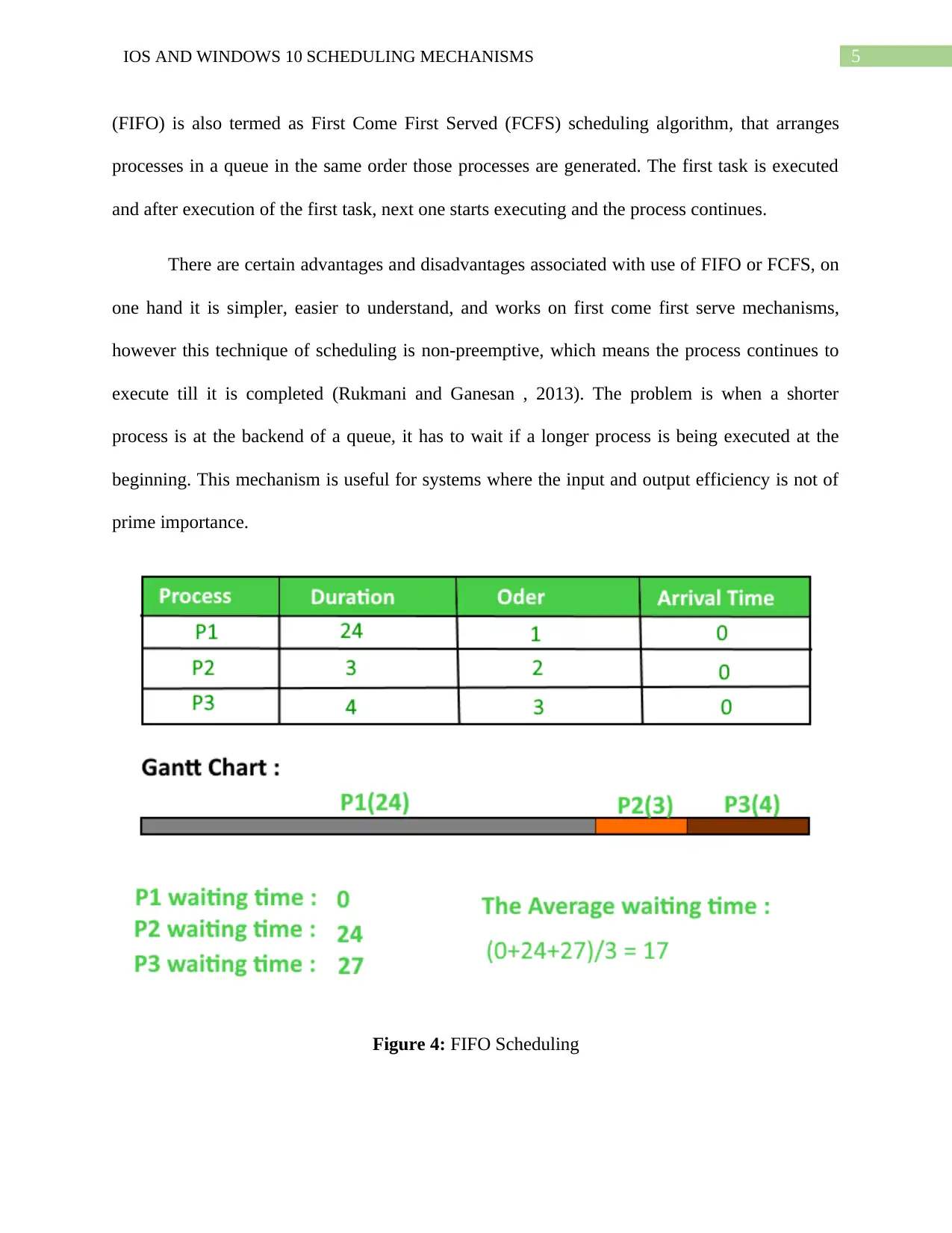
(FIFO) is also termed as First Come First Served (FCFS) scheduling algorithm, that arranges
processes in a queue in the same order those processes are generated. The first task is executed
and after execution of the first task, next one starts executing and the process continues.
There are certain advantages and disadvantages associated with use of FIFO or FCFS, on
one hand it is simpler, easier to understand, and works on first come first serve mechanisms,
however this technique of scheduling is non-preemptive, which means the process continues to
execute till it is completed (Rukmani and Ganesan , 2013). The problem is when a shorter
process is at the backend of a queue, it has to wait if a longer process is being executed at the
beginning. This mechanism is useful for systems where the input and output efficiency is not of
prime importance.
Figure 4: FIFO Scheduling
Document Page
6IOS AND WINDOWS 10 SCHEDULING MECHANISMS
Round- robin scheduling
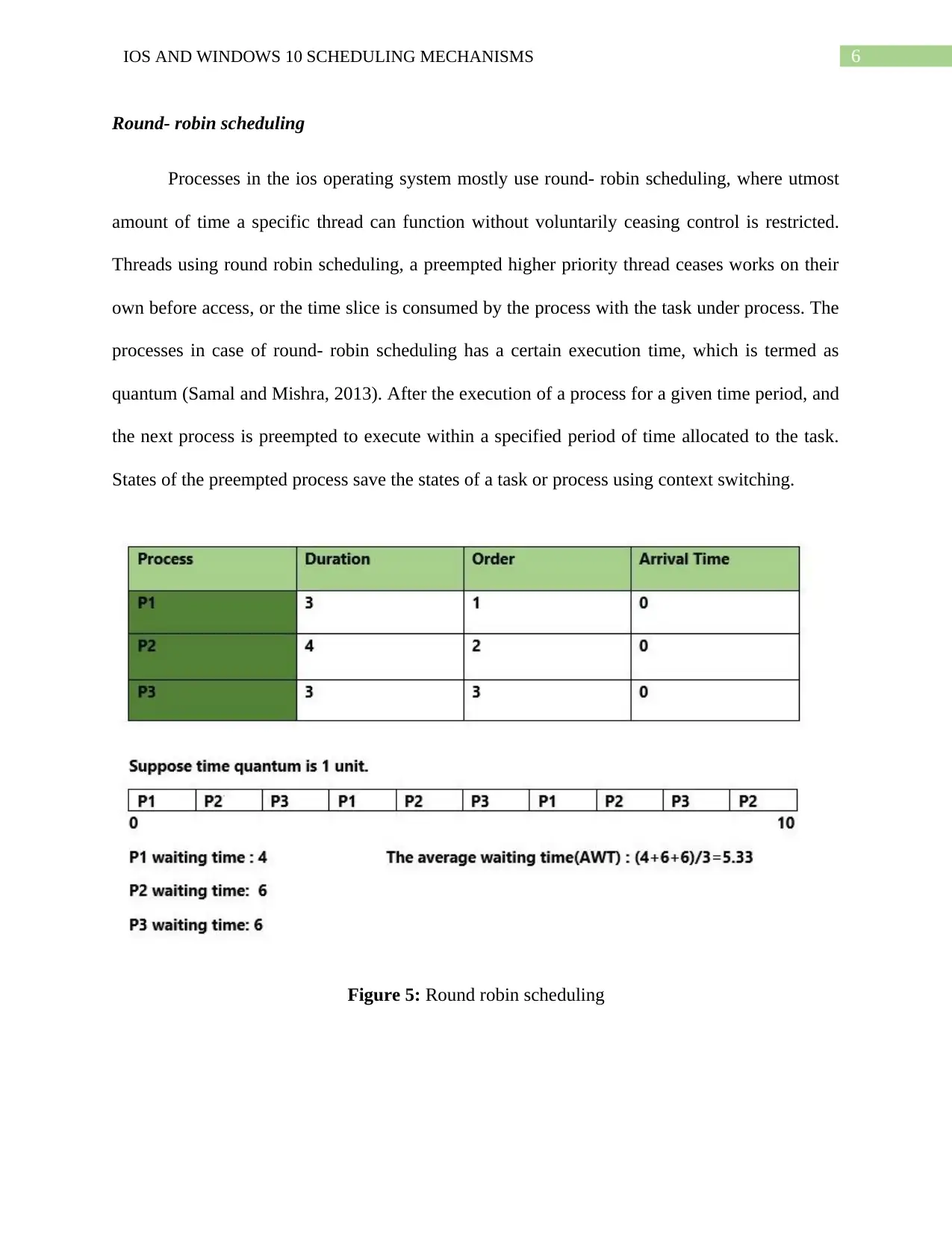
Processes in the ios operating system mostly use round- robin scheduling, where utmost
amount of time a specific thread can function without voluntarily ceasing control is restricted.
Threads using round robin scheduling, a preempted higher priority thread ceases works on their
own before access, or the time slice is consumed by the process with the task under process. The
processes in case of round- robin scheduling has a certain execution time, which is termed as
quantum (Samal and Mishra, 2013). After the execution of a process for a given time period, and
the next process is preempted to execute within a specified period of time allocated to the task.
States of the preempted process save the states of a task or process using context switching.
Figure 5: Round robin scheduling
tabler-icon-diamond-filled.svg

Paraphrase This Document

Need a fresh take? Get an instant paraphrase of this document with our AI Paraphraser
Document Page
7IOS AND WINDOWS 10 SCHEDULING MECHANISMS
Examples of Round robin scheduling:
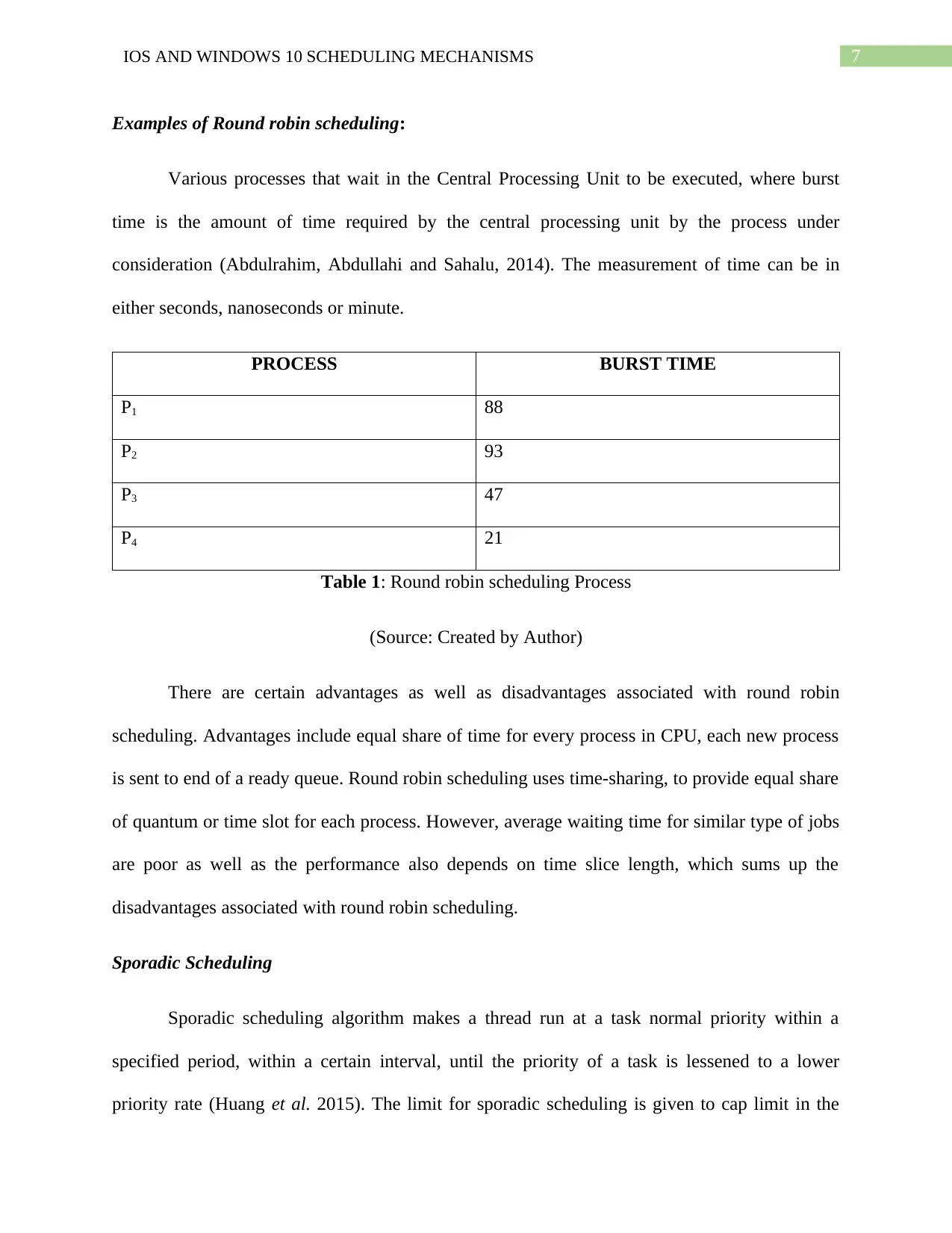
Various processes that wait in the Central Processing Unit to be executed, where burst
time is the amount of time required by the central processing unit by the process under
consideration (Abdulrahim, Abdullahi and Sahalu, 2014). The measurement of time can be in
either seconds, nanoseconds or minute.
PROCESS BURST TIME
P1 88
P2 93
P3 47
P4 21
Table 1: Round robin scheduling Process
(Source: Created by Author)
There are certain advantages as well as disadvantages associated with round robin
scheduling. Advantages include equal share of time for every process in CPU, each new process
is sent to end of a ready queue. Round robin scheduling uses time-sharing, to provide equal share
of quantum or time slot for each process. However, average waiting time for similar type of jobs
are poor as well as the performance also depends on time slice length, which sums up the
disadvantages associated with round robin scheduling.
Sporadic Scheduling
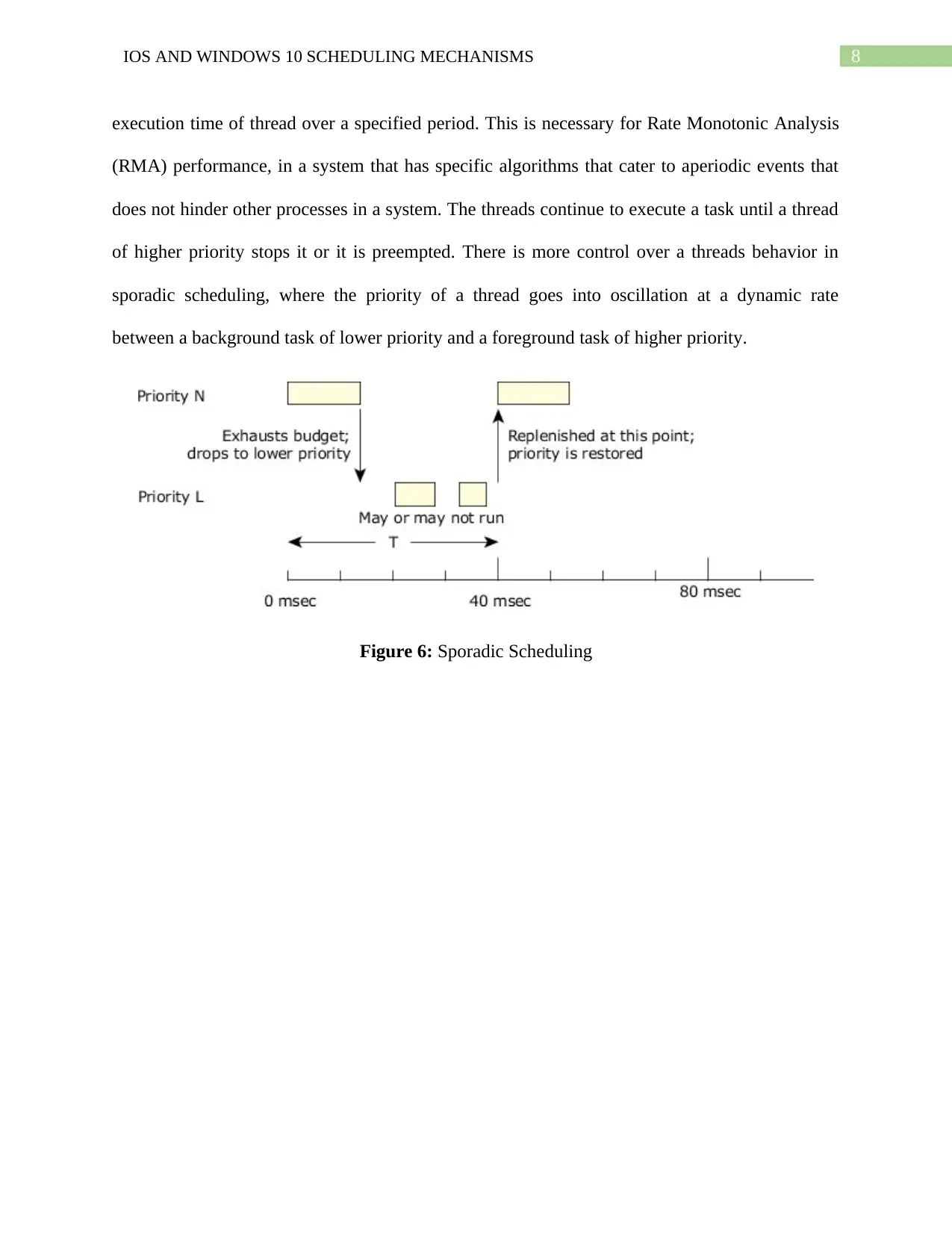
Sporadic scheduling algorithm makes a thread run at a task normal priority within a
specified period, within a certain interval, until the priority of a task is lessened to a lower
priority rate (Huang et al. 2015). The limit for sporadic scheduling is given to cap limit in the
Document Page
8IOS AND WINDOWS 10 SCHEDULING MECHANISMS
execution time of thread over a specified period. This is necessary for Rate Monotonic Analysis
(RMA) performance, in a system that has specific algorithms that cater to aperiodic events that
does not hinder other processes in a system. The threads continue to execute a task until a thread
of higher priority stops it or it is preempted. There is more control over a threads behavior in
sporadic scheduling, where the priority of a thread goes into oscillation at a dynamic rate
between a background task of lower priority and a foreground task of higher priority.
Figure 6: Sporadic Scheduling
Document Page
9IOS AND WINDOWS 10 SCHEDULING MECHANISMS
References
Abdulrahim, A., Abdullahi, S.E. and Sahalu, J.B., 2014. A new improved round robin (NIRR)
CPU scheduling algorithm. International Journal of Computer Applications, 90(4).
Cerqueira, F. and Brandenburg, B., 2013. A comparison of scheduling latency in Linux,
PREEMPT-RT, and LITMUS RT. In 9th Annual Workshop on Operating Systems Platforms for
Embedded Real-Time Applications (pp. 19-29). SYSGO AG.
Craciunas, S.S. and Oliver, R.S., 2016. Combined task-and network-level scheduling for
distributed time-triggered systems. Real-Time Systems, 52(2), pp.161-200.
Gracioli, G., Fröhlich, A.A., Pellizzoni, R. and Fischmeister, S., 2013. Implementation and
evaluation of global and partitioned scheduling in a real-time OS. Real-Time Systems, 49(6),
pp.669-714.
Huang, W.H., Chen, J.J., Zhou, H. and Liu, C., 2015, June. PASS: Priority assignment of real-
time tasks with dynamic suspending behavior under fixed-priority scheduling. In 2015 52nd
ACM/EDAC/IEEE Design Automation Conference (DAC) (pp. 1-6). IEEE.
Low, C., Li, R.K. and Chang, C.M., 2013. Integrated scheduling of production and delivery with
time windows. International Journal of Production Research, 51(3), pp.897-909.
Rudek, R., 2013. On single processor scheduling problems with learning dependent on the
number of processed jobs. Applied Mathematical Modelling, 37(3), pp.1523-1536.
Rukmani, P. and Ganesan, R., 2013. Scheduling algorithm for real time applications in mobile ad
hoc network with opnet modeler. Procedia Engineering, 64, pp.94-103.
tabler-icon-diamond-filled.svg

Paraphrase This Document

Need a fresh take? Get an instant paraphrase of this document with our AI Paraphraser
Document Page
10IOS AND WINDOWS 10 SCHEDULING MECHANISMS
Samal, P. and Mishra, P., 2013. Analysis of variants in Round Robin Algorithms for load
balancing in Cloud Computing. International Journal of computer science and Information
Technologies, 4(3), pp.416-419.
Thombare, M., Sukhwani, R., Shah, P., Chaudhari, S. and Raundale, P., 2016, March. Efficient
implementation of Multilevel Feedback Queue Scheduling. In 2016 International Conference on
Wireless Communications, Signal Processing and Networking (WiSPNET) (pp. 1950-1954).
IEEE.
chevron_up_icon
1 out of 11
circle_padding
hide_on_mobile
zoom_out_icon
[object Object]