Comparing the Indo-Pak and Arab-Israeli Conflicts in History
VerifiedAdded on 2022/08/18
|12
|3228
|9
Essay
AI Summary
This essay undertakes a comparative analysis of the Indo-Pak wars and the Arab-Israeli wars, both rooted in post-independence territorial disputes. The study examines the historical context, causes, and key events of the conflicts, including the role of Kashmir and Palestine as central points of contention. It highlights the similarities between the wars, such as their origins in the partition of territories and the involvement of religious and political factors. The essay also delves into the impact of these conflicts, including wars, insurgencies, and terrorist attacks, and their effect on the stability of the involved nations. The analysis further explores the failures of diplomatic interventions by international bodies and the evolution of these conflicts beyond mere territorial disputes. Ultimately, the essay provides a comprehensive overview of these complex wars and their lasting consequences.
Running head: COMPARISON OF THE INDO-PAK WARS WITH ARAB-ISRAELI WARS
A STUDY TO EXAMINE THE WARS BETWEEN INDIAN AND PAKISTAN AND
COMPARE THEM WITH THE ARAB-ISRAELI WARS
Name of the Student:
Name of the University:
Author’s Note:
A STUDY TO EXAMINE THE WARS BETWEEN INDIAN AND PAKISTAN AND
COMPARE THEM WITH THE ARAB-ISRAELI WARS
Name of the Student:
Name of the University:
Author’s Note:

Paraphrase This Document
Need a fresh take? Get an instant paraphrase of this document with our AI Paraphraser
1COMPARISON OF THE INDO-PAK WARS WITH ARAB-ISRAELI WARS
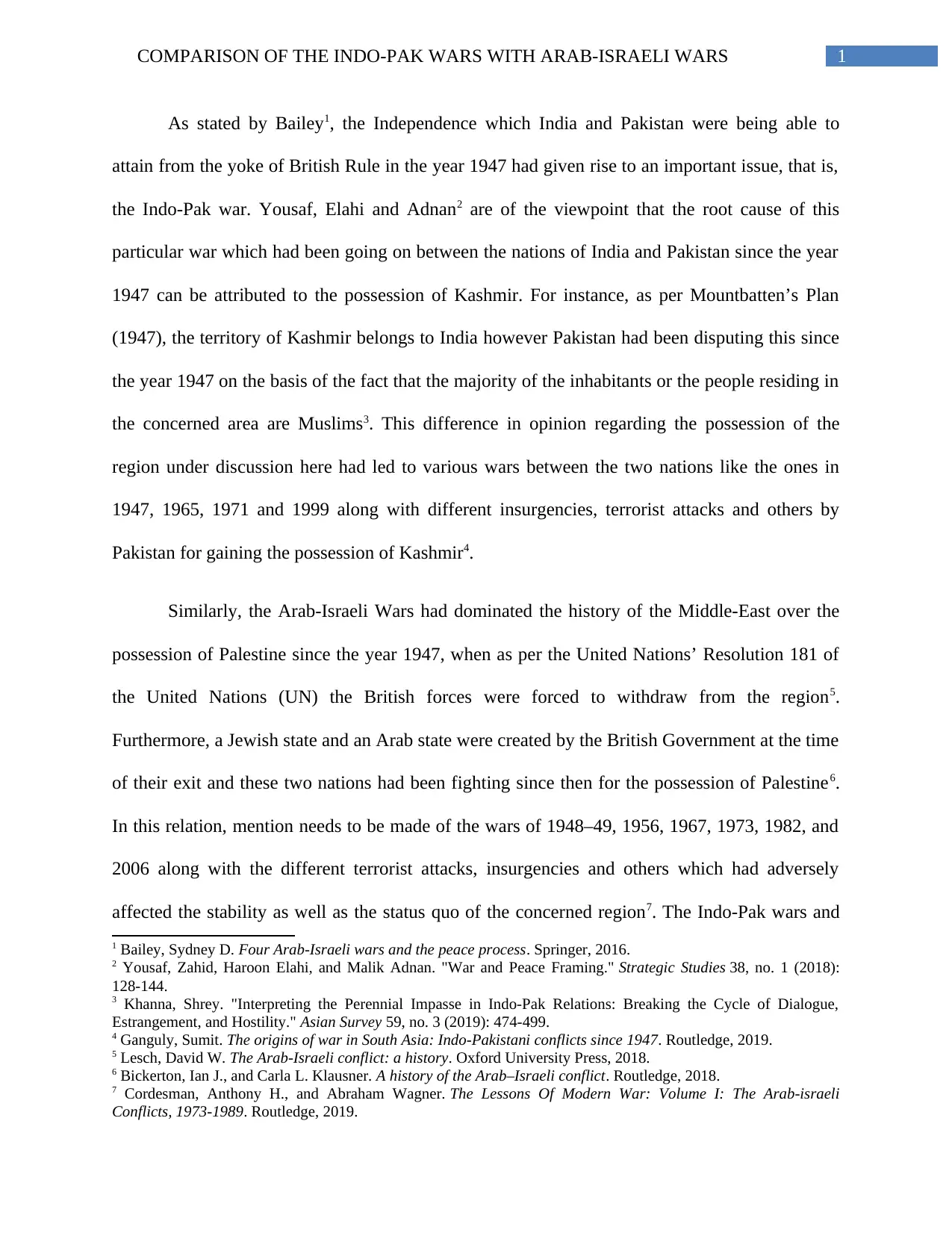
As stated by Bailey1, the Independence which India and Pakistan were being able to
attain from the yoke of British Rule in the year 1947 had given rise to an important issue, that is,
the Indo-Pak war. Yousaf, Elahi and Adnan2 are of the viewpoint that the root cause of this
particular war which had been going on between the nations of India and Pakistan since the year
1947 can be attributed to the possession of Kashmir. For instance, as per Mountbatten’s Plan
(1947), the territory of Kashmir belongs to India however Pakistan had been disputing this since
the year 1947 on the basis of the fact that the majority of the inhabitants or the people residing in
the concerned area are Muslims3. This difference in opinion regarding the possession of the
region under discussion here had led to various wars between the two nations like the ones in
1947, 1965, 1971 and 1999 along with different insurgencies, terrorist attacks and others by
Pakistan for gaining the possession of Kashmir4.
Similarly, the Arab-Israeli Wars had dominated the history of the Middle-East over the
possession of Palestine since the year 1947, when as per the United Nations’ Resolution 181 of
the United Nations (UN) the British forces were forced to withdraw from the region5.
Furthermore, a Jewish state and an Arab state were created by the British Government at the time
of their exit and these two nations had been fighting since then for the possession of Palestine6.
In this relation, mention needs to be made of the wars of 1948–49, 1956, 1967, 1973, 1982, and
2006 along with the different terrorist attacks, insurgencies and others which had adversely
affected the stability as well as the status quo of the concerned region7. The Indo-Pak wars and
1 Bailey, Sydney D. Four Arab-Israeli wars and the peace process. Springer, 2016.
2 Yousaf, Zahid, Haroon Elahi, and Malik Adnan. "War and Peace Framing." Strategic Studies 38, no. 1 (2018):
128-144.
3 Khanna, Shrey. "Interpreting the Perennial Impasse in Indo-Pak Relations: Breaking the Cycle of Dialogue,
Estrangement, and Hostility." Asian Survey 59, no. 3 (2019): 474-499.
4 Ganguly, Sumit. The origins of war in South Asia: Indo-Pakistani conflicts since 1947. Routledge, 2019.
5 Lesch, David W. The Arab-Israeli conflict: a history. Oxford University Press, 2018.
6 Bickerton, Ian J., and Carla L. Klausner. A history of the Arab–Israeli conflict. Routledge, 2018.
7 Cordesman, Anthony H., and Abraham Wagner. The Lessons Of Modern War: Volume I: The Arab-israeli
Conflicts, 1973-1989. Routledge, 2019.
As stated by Bailey1, the Independence which India and Pakistan were being able to
attain from the yoke of British Rule in the year 1947 had given rise to an important issue, that is,
the Indo-Pak war. Yousaf, Elahi and Adnan2 are of the viewpoint that the root cause of this
particular war which had been going on between the nations of India and Pakistan since the year
1947 can be attributed to the possession of Kashmir. For instance, as per Mountbatten’s Plan
(1947), the territory of Kashmir belongs to India however Pakistan had been disputing this since
the year 1947 on the basis of the fact that the majority of the inhabitants or the people residing in
the concerned area are Muslims3. This difference in opinion regarding the possession of the
region under discussion here had led to various wars between the two nations like the ones in
1947, 1965, 1971 and 1999 along with different insurgencies, terrorist attacks and others by
Pakistan for gaining the possession of Kashmir4.
Similarly, the Arab-Israeli Wars had dominated the history of the Middle-East over the
possession of Palestine since the year 1947, when as per the United Nations’ Resolution 181 of
the United Nations (UN) the British forces were forced to withdraw from the region5.
Furthermore, a Jewish state and an Arab state were created by the British Government at the time
of their exit and these two nations had been fighting since then for the possession of Palestine6.
In this relation, mention needs to be made of the wars of 1948–49, 1956, 1967, 1973, 1982, and
2006 along with the different terrorist attacks, insurgencies and others which had adversely
affected the stability as well as the status quo of the concerned region7. The Indo-Pak wars and
1 Bailey, Sydney D. Four Arab-Israeli wars and the peace process. Springer, 2016.
2 Yousaf, Zahid, Haroon Elahi, and Malik Adnan. "War and Peace Framing." Strategic Studies 38, no. 1 (2018):
128-144.
3 Khanna, Shrey. "Interpreting the Perennial Impasse in Indo-Pak Relations: Breaking the Cycle of Dialogue,
Estrangement, and Hostility." Asian Survey 59, no. 3 (2019): 474-499.
4 Ganguly, Sumit. The origins of war in South Asia: Indo-Pakistani conflicts since 1947. Routledge, 2019.
5 Lesch, David W. The Arab-Israeli conflict: a history. Oxford University Press, 2018.
6 Bickerton, Ian J., and Carla L. Klausner. A history of the Arab–Israeli conflict. Routledge, 2018.
7 Cordesman, Anthony H., and Abraham Wagner. The Lessons Of Modern War: Volume I: The Arab-israeli
Conflicts, 1973-1989. Routledge, 2019.
2COMPARISON OF THE INDO-PAK WARS WITH ARAB-ISRAELI WARS
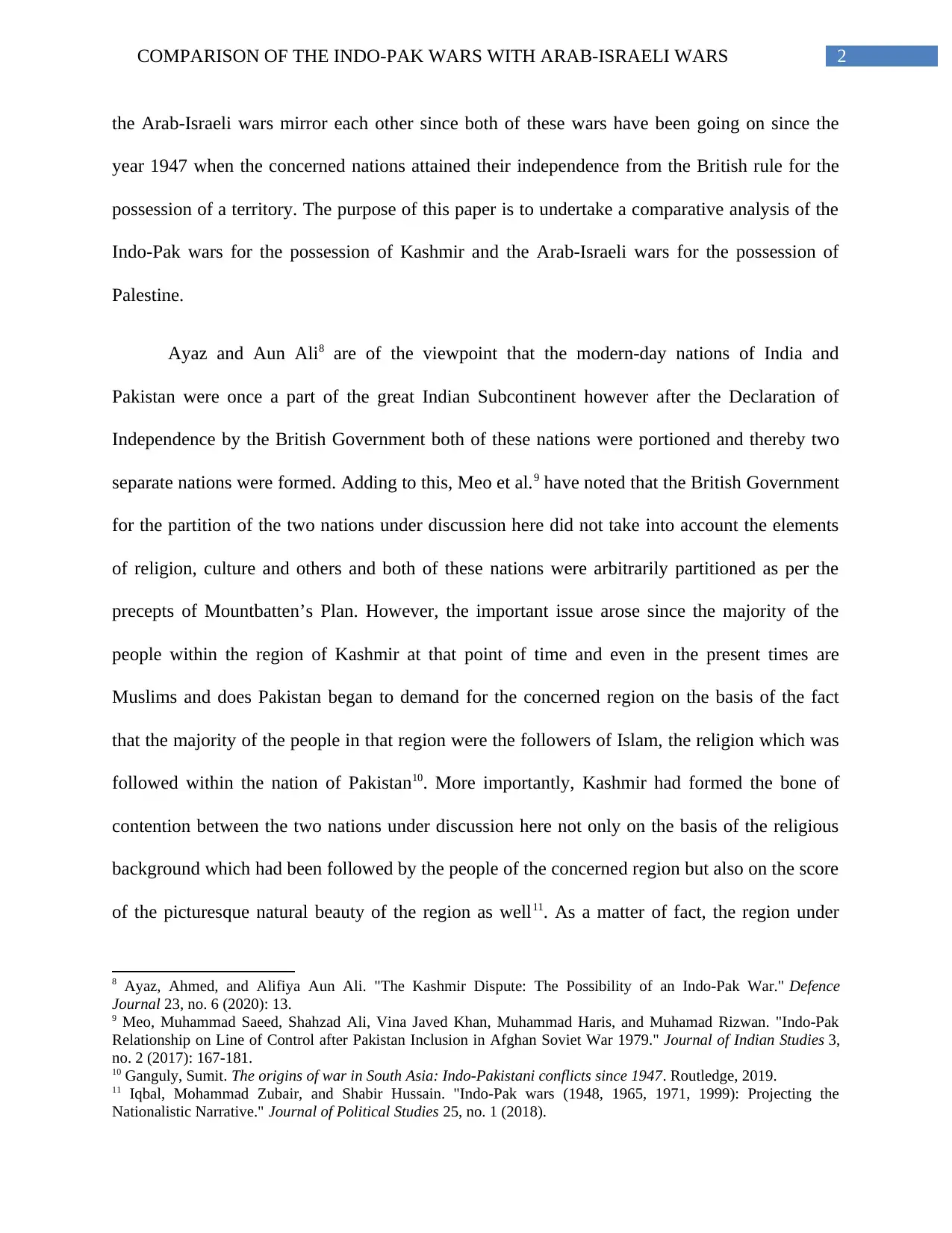
the Arab-Israeli wars mirror each other since both of these wars have been going on since the
year 1947 when the concerned nations attained their independence from the British rule for the
possession of a territory. The purpose of this paper is to undertake a comparative analysis of the
Indo-Pak wars for the possession of Kashmir and the Arab-Israeli wars for the possession of
Palestine.
Ayaz and Aun Ali8 are of the viewpoint that the modern-day nations of India and
Pakistan were once a part of the great Indian Subcontinent however after the Declaration of
Independence by the British Government both of these nations were portioned and thereby two
separate nations were formed. Adding to this, Meo et al.9 have noted that the British Government
for the partition of the two nations under discussion here did not take into account the elements
of religion, culture and others and both of these nations were arbitrarily partitioned as per the
precepts of Mountbatten’s Plan. However, the important issue arose since the majority of the
people within the region of Kashmir at that point of time and even in the present times are
Muslims and does Pakistan began to demand for the concerned region on the basis of the fact
that the majority of the people in that region were the followers of Islam, the religion which was
followed within the nation of Pakistan10. More importantly, Kashmir had formed the bone of
contention between the two nations under discussion here not only on the basis of the religious
background which had been followed by the people of the concerned region but also on the score
of the picturesque natural beauty of the region as well11. As a matter of fact, the region under
8 Ayaz, Ahmed, and Alifiya Aun Ali. "The Kashmir Dispute: The Possibility of an Indo-Pak War." Defence
Journal 23, no. 6 (2020): 13.
9 Meo, Muhammad Saeed, Shahzad Ali, Vina Javed Khan, Muhammad Haris, and Muhamad Rizwan. "Indo-Pak
Relationship on Line of Control after Pakistan Inclusion in Afghan Soviet War 1979." Journal of Indian Studies 3,
no. 2 (2017): 167-181.
10 Ganguly, Sumit. The origins of war in South Asia: Indo-Pakistani conflicts since 1947. Routledge, 2019.
11 Iqbal, Mohammad Zubair, and Shabir Hussain. "Indo-Pak wars (1948, 1965, 1971, 1999): Projecting the
Nationalistic Narrative." Journal of Political Studies 25, no. 1 (2018).
the Arab-Israeli wars mirror each other since both of these wars have been going on since the
year 1947 when the concerned nations attained their independence from the British rule for the
possession of a territory. The purpose of this paper is to undertake a comparative analysis of the
Indo-Pak wars for the possession of Kashmir and the Arab-Israeli wars for the possession of
Palestine.
Ayaz and Aun Ali8 are of the viewpoint that the modern-day nations of India and
Pakistan were once a part of the great Indian Subcontinent however after the Declaration of
Independence by the British Government both of these nations were portioned and thereby two
separate nations were formed. Adding to this, Meo et al.9 have noted that the British Government
for the partition of the two nations under discussion here did not take into account the elements
of religion, culture and others and both of these nations were arbitrarily partitioned as per the
precepts of Mountbatten’s Plan. However, the important issue arose since the majority of the
people within the region of Kashmir at that point of time and even in the present times are
Muslims and does Pakistan began to demand for the concerned region on the basis of the fact
that the majority of the people in that region were the followers of Islam, the religion which was
followed within the nation of Pakistan10. More importantly, Kashmir had formed the bone of
contention between the two nations under discussion here not only on the basis of the religious
background which had been followed by the people of the concerned region but also on the score
of the picturesque natural beauty of the region as well11. As a matter of fact, the region under
8 Ayaz, Ahmed, and Alifiya Aun Ali. "The Kashmir Dispute: The Possibility of an Indo-Pak War." Defence
Journal 23, no. 6 (2020): 13.
9 Meo, Muhammad Saeed, Shahzad Ali, Vina Javed Khan, Muhammad Haris, and Muhamad Rizwan. "Indo-Pak
Relationship on Line of Control after Pakistan Inclusion in Afghan Soviet War 1979." Journal of Indian Studies 3,
no. 2 (2017): 167-181.
10 Ganguly, Sumit. The origins of war in South Asia: Indo-Pakistani conflicts since 1947. Routledge, 2019.
11 Iqbal, Mohammad Zubair, and Shabir Hussain. "Indo-Pak wars (1948, 1965, 1971, 1999): Projecting the
Nationalistic Narrative." Journal of Political Studies 25, no. 1 (2018).
⊘ This is a preview!⊘
Do you want full access?
Subscribe today to unlock all pages.

Trusted by 1+ million students worldwide
3COMPARISON OF THE INDO-PAK WARS WITH ARAB-ISRAELI WARS
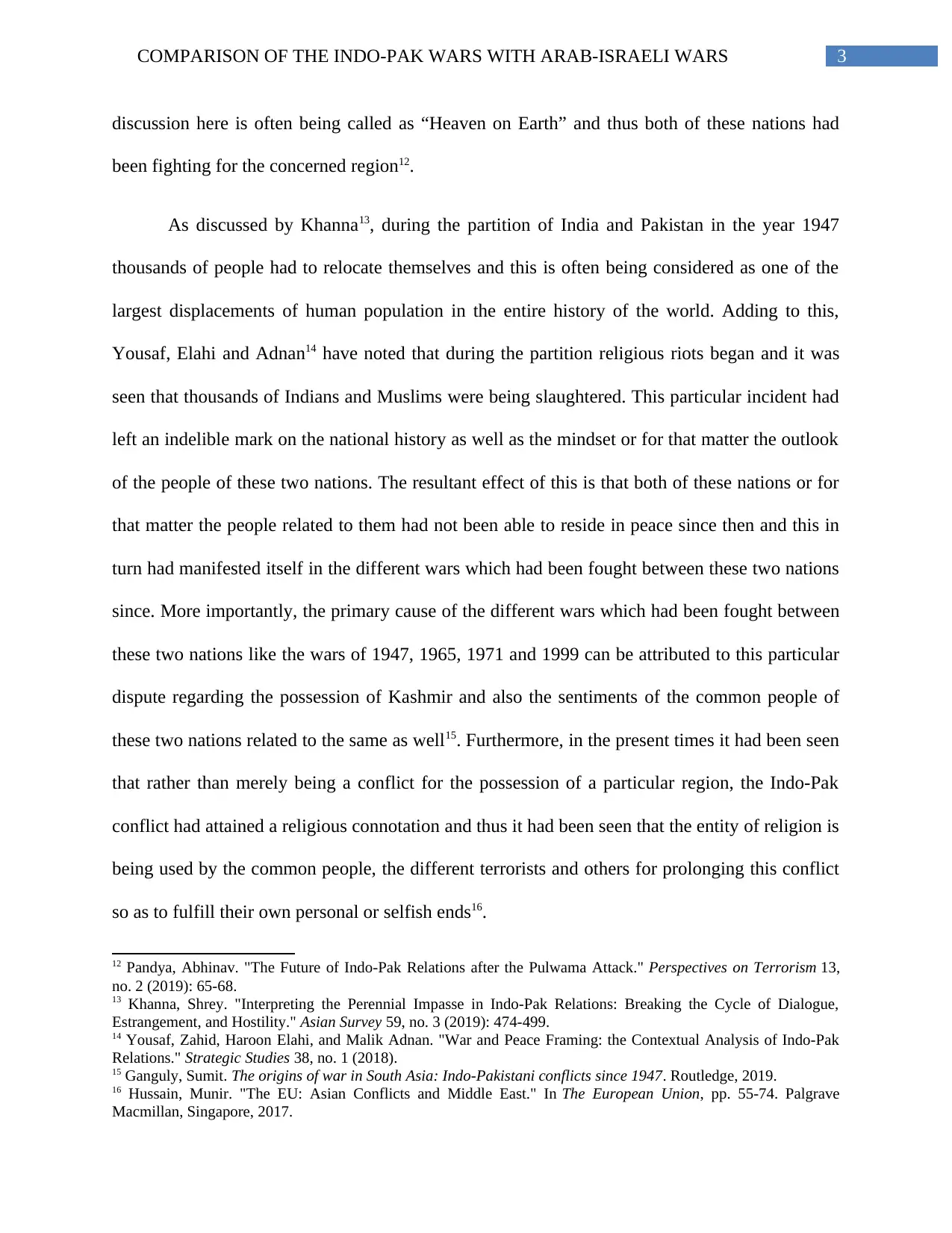
discussion here is often being called as “Heaven on Earth” and thus both of these nations had
been fighting for the concerned region12.
As discussed by Khanna13, during the partition of India and Pakistan in the year 1947
thousands of people had to relocate themselves and this is often being considered as one of the
largest displacements of human population in the entire history of the world. Adding to this,
Yousaf, Elahi and Adnan14 have noted that during the partition religious riots began and it was
seen that thousands of Indians and Muslims were being slaughtered. This particular incident had
left an indelible mark on the national history as well as the mindset or for that matter the outlook
of the people of these two nations. The resultant effect of this is that both of these nations or for
that matter the people related to them had not been able to reside in peace since then and this in
turn had manifested itself in the different wars which had been fought between these two nations
since. More importantly, the primary cause of the different wars which had been fought between
these two nations like the wars of 1947, 1965, 1971 and 1999 can be attributed to this particular
dispute regarding the possession of Kashmir and also the sentiments of the common people of
these two nations related to the same as well15. Furthermore, in the present times it had been seen
that rather than merely being a conflict for the possession of a particular region, the Indo-Pak
conflict had attained a religious connotation and thus it had been seen that the entity of religion is
being used by the common people, the different terrorists and others for prolonging this conflict
so as to fulfill their own personal or selfish ends16.
12 Pandya, Abhinav. "The Future of Indo-Pak Relations after the Pulwama Attack." Perspectives on Terrorism 13,
no. 2 (2019): 65-68.
13 Khanna, Shrey. "Interpreting the Perennial Impasse in Indo-Pak Relations: Breaking the Cycle of Dialogue,
Estrangement, and Hostility." Asian Survey 59, no. 3 (2019): 474-499.
14 Yousaf, Zahid, Haroon Elahi, and Malik Adnan. "War and Peace Framing: the Contextual Analysis of Indo-Pak
Relations." Strategic Studies 38, no. 1 (2018).
15 Ganguly, Sumit. The origins of war in South Asia: Indo-Pakistani conflicts since 1947. Routledge, 2019.
16 Hussain, Munir. "The EU: Asian Conflicts and Middle East." In The European Union, pp. 55-74. Palgrave
Macmillan, Singapore, 2017.
discussion here is often being called as “Heaven on Earth” and thus both of these nations had
been fighting for the concerned region12.
As discussed by Khanna13, during the partition of India and Pakistan in the year 1947
thousands of people had to relocate themselves and this is often being considered as one of the
largest displacements of human population in the entire history of the world. Adding to this,
Yousaf, Elahi and Adnan14 have noted that during the partition religious riots began and it was
seen that thousands of Indians and Muslims were being slaughtered. This particular incident had
left an indelible mark on the national history as well as the mindset or for that matter the outlook
of the people of these two nations. The resultant effect of this is that both of these nations or for
that matter the people related to them had not been able to reside in peace since then and this in
turn had manifested itself in the different wars which had been fought between these two nations
since. More importantly, the primary cause of the different wars which had been fought between
these two nations like the wars of 1947, 1965, 1971 and 1999 can be attributed to this particular
dispute regarding the possession of Kashmir and also the sentiments of the common people of
these two nations related to the same as well15. Furthermore, in the present times it had been seen
that rather than merely being a conflict for the possession of a particular region, the Indo-Pak
conflict had attained a religious connotation and thus it had been seen that the entity of religion is
being used by the common people, the different terrorists and others for prolonging this conflict
so as to fulfill their own personal or selfish ends16.
12 Pandya, Abhinav. "The Future of Indo-Pak Relations after the Pulwama Attack." Perspectives on Terrorism 13,
no. 2 (2019): 65-68.
13 Khanna, Shrey. "Interpreting the Perennial Impasse in Indo-Pak Relations: Breaking the Cycle of Dialogue,
Estrangement, and Hostility." Asian Survey 59, no. 3 (2019): 474-499.
14 Yousaf, Zahid, Haroon Elahi, and Malik Adnan. "War and Peace Framing: the Contextual Analysis of Indo-Pak
Relations." Strategic Studies 38, no. 1 (2018).
15 Ganguly, Sumit. The origins of war in South Asia: Indo-Pakistani conflicts since 1947. Routledge, 2019.
16 Hussain, Munir. "The EU: Asian Conflicts and Middle East." In The European Union, pp. 55-74. Palgrave
Macmillan, Singapore, 2017.
Paraphrase This Document
Need a fresh take? Get an instant paraphrase of this document with our AI Paraphraser
4COMPARISON OF THE INDO-PAK WARS WITH ARAB-ISRAELI WARS
In addition to the different wars mentioned above, it had also been seen that the dispute
related to the possession of Kashmir had also formed the central cause for the various terrorist
attacks, insurgencies and others in the two nations which in turn had adversely affected the status
quo as well as the stability of the two nations17. As a matter of fact, Pakistan presently holds
more than half of the territory of Pakistan and peace or diplomats negotiations of the Indian
government with the Pakistani government had not yield any results. Furthermore, over the years
it had been seen that the United Nations, the UK government, USA government and others have
tried to intervene in the concerned dispute between the two nations under discussion for
resolving the same however any concrete results have failed to emerge from these negotiations18.
The situation had escalated to such an extent that these two nations because of their conflict or
war over Kashmir had failed to establish any effective trade relations, diplomatic relations and
other kinds of relations with each other which in turn had adversely affected the growth of both
of these nations.
The dispute between the Jewish nation and the Arab state just like the Indo-Pak wars
began post the independence which was being granted to them by the British Government in the
year 1947 as per the United Nations’ Resolution 18119. Bickerton and Klausner20 are of the
viewpoint that like the case of the partition of India and Pakistan, in the particular context of the
Arab-Israel also it was seen that effective measures were not being followed for the partition of
these two states and they were arbitrarily partitioned. Adding to this, Cordesman and Wagner21
have noted that the resultant effect of this was the fact that as soon as the British troops left the
17 Pandya, Abhinav. "The Future of Indo-Pak Relations after the Pulwama Attack." Perspectives on Terrorism 13,
no. 2 (2019): 65-68.
18 Ayaz, Ahmed, and Alifiya Aun Ali. "The Kashmir Dispute: The Possibility of an Indo-Pak War." Defence
Journal 23, no. 6 (2020): 13.
19 Bailey, Sydney D. Four Arab-Israeli wars and the peace process. Springer, 2016.
20 Bickerton, Ian J., and Carla L. Klausner. A history of the Arab–Israeli conflict. Routledge, 2018.
21 Cordesman, Anthony H., and Abraham Wagner. The Lessons Of Modern War: Volume I: The Arab-israeli
Conflicts, 1973-1989. Routledge, 2019.
In addition to the different wars mentioned above, it had also been seen that the dispute
related to the possession of Kashmir had also formed the central cause for the various terrorist
attacks, insurgencies and others in the two nations which in turn had adversely affected the status
quo as well as the stability of the two nations17. As a matter of fact, Pakistan presently holds
more than half of the territory of Pakistan and peace or diplomats negotiations of the Indian
government with the Pakistani government had not yield any results. Furthermore, over the years
it had been seen that the United Nations, the UK government, USA government and others have
tried to intervene in the concerned dispute between the two nations under discussion for
resolving the same however any concrete results have failed to emerge from these negotiations18.
The situation had escalated to such an extent that these two nations because of their conflict or
war over Kashmir had failed to establish any effective trade relations, diplomatic relations and
other kinds of relations with each other which in turn had adversely affected the growth of both
of these nations.
The dispute between the Jewish nation and the Arab state just like the Indo-Pak wars
began post the independence which was being granted to them by the British Government in the
year 1947 as per the United Nations’ Resolution 18119. Bickerton and Klausner20 are of the
viewpoint that like the case of the partition of India and Pakistan, in the particular context of the
Arab-Israel also it was seen that effective measures were not being followed for the partition of
these two states and they were arbitrarily partitioned. Adding to this, Cordesman and Wagner21
have noted that the resultant effect of this was the fact that as soon as the British troops left the
17 Pandya, Abhinav. "The Future of Indo-Pak Relations after the Pulwama Attack." Perspectives on Terrorism 13,
no. 2 (2019): 65-68.
18 Ayaz, Ahmed, and Alifiya Aun Ali. "The Kashmir Dispute: The Possibility of an Indo-Pak War." Defence
Journal 23, no. 6 (2020): 13.
19 Bailey, Sydney D. Four Arab-Israeli wars and the peace process. Springer, 2016.
20 Bickerton, Ian J., and Carla L. Klausner. A history of the Arab–Israeli conflict. Routledge, 2018.
21 Cordesman, Anthony H., and Abraham Wagner. The Lessons Of Modern War: Volume I: The Arab-israeli
Conflicts, 1973-1989. Routledge, 2019.
5COMPARISON OF THE INDO-PAK WARS WITH ARAB-ISRAELI WARS
concerned region a war ensued between the Arab and Israel states. More importantly, in the year
1948 the infamous incidents of the attacks of Arab village of Dayr Yāsīn, Hadassah Hospital and
others were undertaken which in turn aggravated the situation even further22. The situation
reached a boiling point when Arab occupied the nations of Egypt, Jordan, Lebanon, Syria, Iraq,
Jerusalem and the majority of the portions of Palestine23. The Jewish state complained that the
region of Palestine was rightfully theirs and this in turn started the Arab-Israeli wars which had
formed an integral part of the history of the Middle-East since then.
Pelcovits24 is of the viewpoint that the culmination point of the Arab-Israeli wars
manifested itself in the wars which were fought in the years 1948–49, 1956, 1967, 1973, 1982,
and 2006. Adding to this, Bailey25 has noted that the conflicts between these two nations under
discussion here had completely polarized the concerned region while giving rise to different
crisis like the Suez Crisis (1956), Six-Day War (1967), Yom Kippur War (1973), Lebanon War
(1982), Second Lebanon War (2006) and others. More importantly, it had been seen that
thousands of people from both the nations have lost their lives along with valuable property on
the score of the conflict that had been going on between the two nations under discussion here
since the time of their independence26. In this relation, it needs to be said that the primary bone of
contention which had directly contributed towards the Arab-Israel conflict can be attributed to
the possession of the region of Palestine that both of the nations had been claiming belongs to
them. Moreover, it had also been seen that rather than merely being limited to a conflict for the
possession of the region of Palestine, the Arab-Israeli conflicts in the recent times had attained a
22 Cordesman, Anthony H. Perilous Prospects: The Peace Process and the Arab-Israeli Military Balance.
Routledge, 2018.
23 Gerges, Fawaz A. "The 1967 Arab-Israeli War: US Actions and Arab Perceptions." In The Middle East and the
United States, pp. 139-157. Routledge, 2018.
24 Pelcovits, Nathan A. The long armistice: UN peacekeeping and the Arab-Israeli conflict, 1948-1960. Routledge,
2019.
25 Bailey, Sydney D. Four Arab-Israeli wars and the peace process. Springer, 2016.
26 Lesch, David W. The Arab-Israeli conflict: a history. Oxford University Press, 2018.
concerned region a war ensued between the Arab and Israel states. More importantly, in the year
1948 the infamous incidents of the attacks of Arab village of Dayr Yāsīn, Hadassah Hospital and
others were undertaken which in turn aggravated the situation even further22. The situation
reached a boiling point when Arab occupied the nations of Egypt, Jordan, Lebanon, Syria, Iraq,
Jerusalem and the majority of the portions of Palestine23. The Jewish state complained that the
region of Palestine was rightfully theirs and this in turn started the Arab-Israeli wars which had
formed an integral part of the history of the Middle-East since then.
Pelcovits24 is of the viewpoint that the culmination point of the Arab-Israeli wars
manifested itself in the wars which were fought in the years 1948–49, 1956, 1967, 1973, 1982,
and 2006. Adding to this, Bailey25 has noted that the conflicts between these two nations under
discussion here had completely polarized the concerned region while giving rise to different
crisis like the Suez Crisis (1956), Six-Day War (1967), Yom Kippur War (1973), Lebanon War
(1982), Second Lebanon War (2006) and others. More importantly, it had been seen that
thousands of people from both the nations have lost their lives along with valuable property on
the score of the conflict that had been going on between the two nations under discussion here
since the time of their independence26. In this relation, it needs to be said that the primary bone of
contention which had directly contributed towards the Arab-Israel conflict can be attributed to
the possession of the region of Palestine that both of the nations had been claiming belongs to
them. Moreover, it had also been seen that rather than merely being limited to a conflict for the
possession of the region of Palestine, the Arab-Israeli conflicts in the recent times had attained a
22 Cordesman, Anthony H. Perilous Prospects: The Peace Process and the Arab-Israeli Military Balance.
Routledge, 2018.
23 Gerges, Fawaz A. "The 1967 Arab-Israeli War: US Actions and Arab Perceptions." In The Middle East and the
United States, pp. 139-157. Routledge, 2018.
24 Pelcovits, Nathan A. The long armistice: UN peacekeeping and the Arab-Israeli conflict, 1948-1960. Routledge,
2019.
25 Bailey, Sydney D. Four Arab-Israeli wars and the peace process. Springer, 2016.
26 Lesch, David W. The Arab-Israeli conflict: a history. Oxford University Press, 2018.
⊘ This is a preview!⊘
Do you want full access?
Subscribe today to unlock all pages.
Trusted by 1+ million students worldwide
6COMPARISON OF THE INDO-PAK WARS WITH ARAB-ISRAELI WARS
new dynamics and thereby both of the nations involved in the conflict are trying to hold as much
power and influence within the Middle-East region as possible27. However, at the same time it
needs to be said that the conflict in which both of these had been engaged since the year 1947
had adversely affected both the status quo and the stability of not only these two nations but also
of the entire region as well. Furthermore, the diplomatic or peaceful negotiations undertaken by
the United Nations, the UK government and others for the resolution of the conflict under
discussion here had failed to yield the desired results which in turn had aggravated the issue even
further28.
An analysis of the Indo-Pak wars and the Arab-Israeli wars clearly reveals the fact that
there are some basic similarities between the two. Choudhary29 is of the viewpoint that both the
Indo-Pak wars and the Arab-Israeli wars started after the nations involved in the conflicts were
granted their independence by the British Government in the year 1947 and were once a part of
the same region. Adding to this, Hussain30 has noted that the conflicts that these nations in both
the cases are presently facing could have been avoided had the British Government refrained
from portioning them while offering them independence in the year 1947 or for that matter
adequately partitioned them taking into account the attributes of religion, culture, economy and
others. More importantly, an analysis of these two conflicts clearly reveals the fact that the
primary bone of contention for the conflicts is the possession of a particular territory of a
geographical piece of land. For instance, in the particular context of the Indo-Pak crisis it is seen
that the root cause of the conflict is the possession of the territory of Kashmir whereas in the
27 Cordesman, Anthony H. Perilous Prospects: The Peace Process and the Arab-Israeli Military Balance.
Routledge, 2018.
28 Pelcovits, Nathan A. The long armistice: UN peacekeeping and the Arab-Israeli conflict, 1948-1960. Routledge,
2019.
29 Choudhary, Sunil K. "Competing Issues of Governance: Israel and India Compared." In The Changing Face of
Parties and Party Systems, pp. 311-341. Palgrave Macmillan, Singapore, 2018.
30 Hussain, Munir. "The EU: Asian Conflicts and Middle East." In The European Union, pp. 55-74. Palgrave
Macmillan, Singapore, 2017.
new dynamics and thereby both of the nations involved in the conflict are trying to hold as much
power and influence within the Middle-East region as possible27. However, at the same time it
needs to be said that the conflict in which both of these had been engaged since the year 1947
had adversely affected both the status quo and the stability of not only these two nations but also
of the entire region as well. Furthermore, the diplomatic or peaceful negotiations undertaken by
the United Nations, the UK government and others for the resolution of the conflict under
discussion here had failed to yield the desired results which in turn had aggravated the issue even
further28.
An analysis of the Indo-Pak wars and the Arab-Israeli wars clearly reveals the fact that
there are some basic similarities between the two. Choudhary29 is of the viewpoint that both the
Indo-Pak wars and the Arab-Israeli wars started after the nations involved in the conflicts were
granted their independence by the British Government in the year 1947 and were once a part of
the same region. Adding to this, Hussain30 has noted that the conflicts that these nations in both
the cases are presently facing could have been avoided had the British Government refrained
from portioning them while offering them independence in the year 1947 or for that matter
adequately partitioned them taking into account the attributes of religion, culture, economy and
others. More importantly, an analysis of these two conflicts clearly reveals the fact that the
primary bone of contention for the conflicts is the possession of a particular territory of a
geographical piece of land. For instance, in the particular context of the Indo-Pak crisis it is seen
that the root cause of the conflict is the possession of the territory of Kashmir whereas in the
27 Cordesman, Anthony H. Perilous Prospects: The Peace Process and the Arab-Israeli Military Balance.
Routledge, 2018.
28 Pelcovits, Nathan A. The long armistice: UN peacekeeping and the Arab-Israeli conflict, 1948-1960. Routledge,
2019.
29 Choudhary, Sunil K. "Competing Issues of Governance: Israel and India Compared." In The Changing Face of
Parties and Party Systems, pp. 311-341. Palgrave Macmillan, Singapore, 2018.
30 Hussain, Munir. "The EU: Asian Conflicts and Middle East." In The European Union, pp. 55-74. Palgrave
Macmillan, Singapore, 2017.
Paraphrase This Document
Need a fresh take? Get an instant paraphrase of this document with our AI Paraphraser
7COMPARISON OF THE INDO-PAK WARS WITH ARAB-ISRAELI WARS
context of the Arab-Israeli crisis it is seen that the root cause of the conflict is the possession
over the region of Palestine31. Furthermore, it had been seen that the crisis or for that matter the
conflicts that these nations have faced since the year 1947 had culminated in various wars
between these nations which had adversely affected the status quo as well as the stability of these
nations. In addition to these, it had also been seen that although both of these conflicts began due
to issues related to territorial possession or territorial possession however over the years they
have acquired religious as well as political connotations. This in turn had enhanced the
complexity as well as the gravity of the conflicts under discussion here.
Khan32 is of the viewpoint that a similarity between the Indo-Pak wars and the Arab-
Israeli wars can be attributed to the fact that the nations involved in these conflicts share a
bloody history which is dominated by various violent crimes, massacres, riots and others. Adding
to this, Iqbal and Hussain33 have noted that this in turn had significantly enhanced the value of
the territory or the region over which these nations had been conflicting. As a matter of fact, it is
seen that the common people of these nations have attached personal emotions, sentiments,
religious values and others to the conflicting territories which in turn had made it almost
impossible for the disputing nations to let go of the concerned regions or territories. More
importantly, in the context of both of the disputes or the conflicts it is seen that peaceful
negotiation, diplomatic discussions and others undertaken by the United Nations, the UK
government and other First World nations of the world have failed to resolve the issue or to yield
the desired results34. Furthermore, the complexity of the crises or the conflicts under discussion
31 Choudhary, Sunil K. "Competing Issues of Governance: Israel and India Compared." In The Changing Face of
Parties and Party Systems, pp. 311-341. Palgrave Macmillan, Singapore, 2018.
32 Khan, Saira. Nuclear Proliferation Dynamics in Protracted Conflict Regions: A Comparative Study of South Asia
and the Middle East. Routledge, 2017.
33 Iqbal, Mohammad Zubair, and Shabir Hussain. "Indo-Pak wars (1948, 1965, 1971, 1999): Projecting the
Nationalistic Narrative." Journal of Political Studies 25, no. 1 (2018).
34 Pelcovits, Nathan A. The long armistice: UN peacekeeping and the Arab-Israeli conflict, 1948-1960. Routledge,
2019.
context of the Arab-Israeli crisis it is seen that the root cause of the conflict is the possession
over the region of Palestine31. Furthermore, it had been seen that the crisis or for that matter the
conflicts that these nations have faced since the year 1947 had culminated in various wars
between these nations which had adversely affected the status quo as well as the stability of these
nations. In addition to these, it had also been seen that although both of these conflicts began due
to issues related to territorial possession or territorial possession however over the years they
have acquired religious as well as political connotations. This in turn had enhanced the
complexity as well as the gravity of the conflicts under discussion here.
Khan32 is of the viewpoint that a similarity between the Indo-Pak wars and the Arab-
Israeli wars can be attributed to the fact that the nations involved in these conflicts share a
bloody history which is dominated by various violent crimes, massacres, riots and others. Adding
to this, Iqbal and Hussain33 have noted that this in turn had significantly enhanced the value of
the territory or the region over which these nations had been conflicting. As a matter of fact, it is
seen that the common people of these nations have attached personal emotions, sentiments,
religious values and others to the conflicting territories which in turn had made it almost
impossible for the disputing nations to let go of the concerned regions or territories. More
importantly, in the context of both of the disputes or the conflicts it is seen that peaceful
negotiation, diplomatic discussions and others undertaken by the United Nations, the UK
government and other First World nations of the world have failed to resolve the issue or to yield
the desired results34. Furthermore, the complexity of the crises or the conflicts under discussion
31 Choudhary, Sunil K. "Competing Issues of Governance: Israel and India Compared." In The Changing Face of
Parties and Party Systems, pp. 311-341. Palgrave Macmillan, Singapore, 2018.
32 Khan, Saira. Nuclear Proliferation Dynamics in Protracted Conflict Regions: A Comparative Study of South Asia
and the Middle East. Routledge, 2017.
33 Iqbal, Mohammad Zubair, and Shabir Hussain. "Indo-Pak wars (1948, 1965, 1971, 1999): Projecting the
Nationalistic Narrative." Journal of Political Studies 25, no. 1 (2018).
34 Pelcovits, Nathan A. The long armistice: UN peacekeeping and the Arab-Israeli conflict, 1948-1960. Routledge,
2019.
8COMPARISON OF THE INDO-PAK WARS WITH ARAB-ISRAELI WARS
here also becomes apparent from the fact that there are no visible solutions in sight for the
effective mitigation or the resolution of the Indo-Pak wars and the Arab-Israeli wars. Thus, it is
likely that just like the past these conflicts or wars are going to continue in future as well. In
addition to these, the nations involved in the conflicts under discussion here had already devoted
a substantial amount of monetary resources, human resources and other kinds of resources in the
different wars which in turn had adversely affected their growth and development. The wars or
the conflicts which these nations had been indulged in had also led to the situation wherein it is
seen that they have failed to develop any trade relation or other kinds of relations with each
which once again had taken a toll on their growth or development.
To conclude, the Indo-Pak wars and the Arab-Israeli wars are two of the most important
issues which the world had been facing since 1947. In this relation, it needs to be said that there
are various similarities between these two wars. For instance, both of these wars had been fought
for the possession of a particular geographical region, had acquired religious and political
connotations in the present times, diplomatic discussions or peaceful negotiations had failed to
resolve the issue and others. More importantly, it had been seen that the conflict that these
nations had indulged in over the years had not only culminated into different wars but also
adversely affected the overall growth or the development of these nations as well. Thus, the
effective resolution of the Indo-Pak wars and the Arab-Israeli wars becomes important from the
perspective of the long-term growth or development of the nations involved in the concerned
conflict. These aspects of the Indo-Pak wars and the Arab-Israeli wars become apparent from the
above comparative analysis of the same.
here also becomes apparent from the fact that there are no visible solutions in sight for the
effective mitigation or the resolution of the Indo-Pak wars and the Arab-Israeli wars. Thus, it is
likely that just like the past these conflicts or wars are going to continue in future as well. In
addition to these, the nations involved in the conflicts under discussion here had already devoted
a substantial amount of monetary resources, human resources and other kinds of resources in the
different wars which in turn had adversely affected their growth and development. The wars or
the conflicts which these nations had been indulged in had also led to the situation wherein it is
seen that they have failed to develop any trade relation or other kinds of relations with each
which once again had taken a toll on their growth or development.
To conclude, the Indo-Pak wars and the Arab-Israeli wars are two of the most important
issues which the world had been facing since 1947. In this relation, it needs to be said that there
are various similarities between these two wars. For instance, both of these wars had been fought
for the possession of a particular geographical region, had acquired religious and political
connotations in the present times, diplomatic discussions or peaceful negotiations had failed to
resolve the issue and others. More importantly, it had been seen that the conflict that these
nations had indulged in over the years had not only culminated into different wars but also
adversely affected the overall growth or the development of these nations as well. Thus, the
effective resolution of the Indo-Pak wars and the Arab-Israeli wars becomes important from the
perspective of the long-term growth or development of the nations involved in the concerned
conflict. These aspects of the Indo-Pak wars and the Arab-Israeli wars become apparent from the
above comparative analysis of the same.
⊘ This is a preview!⊘
Do you want full access?
Subscribe today to unlock all pages.
Trusted by 1+ million students worldwide
9COMPARISON OF THE INDO-PAK WARS WITH ARAB-ISRAELI WARS
References
Awan, Maqbool Ahmad. "Pakistan-Iran Geo-Political Environment and the Discourse of
Relations (1947-2017): A Reappraisal." Pakistan Journal of History and Culture 39, no. 1
(2018).
Ayaz, Ahmed, and Alifiya Aun Ali. "The Kashmir Dispute: The Possibility of an Indo-Pak
War." Defence Journal 23, no. 6 (2020): 13.
Bailey, Sydney D. Four Arab-Israeli wars and the peace process. Springer, 2016.
Bickerton, Ian J., and Carla L. Klausner. A history of the Arab–Israeli conflict. Routledge, 2018.
Choudhary, Sunil K. "Competing Issues of Governance: Israel and India Compared." In The
Changing Face of Parties and Party Systems, pp. 311-341. Palgrave Macmillan, Singapore,
2018.
Cordesman, Anthony H. Perilous Prospects: The Peace Process and the Arab-Israeli Military
Balance. Routledge, 2018.
Cordesman, Anthony H., and Abraham Wagner. The Lessons Of Modern War: Volume I: The
Arab-israeli Conflicts, 1973-1989. Routledge, 2019.
Ganguly, Sumit. The origins of war in South Asia: Indo-Pakistani conflicts since 1947.
Routledge, 2019.
Gerges, Fawaz A. "The 1967 Arab-Israeli War: US Actions and Arab Perceptions." In The
Middle East and the United States, pp. 139-157. Routledge, 2018.
References
Awan, Maqbool Ahmad. "Pakistan-Iran Geo-Political Environment and the Discourse of
Relations (1947-2017): A Reappraisal." Pakistan Journal of History and Culture 39, no. 1
(2018).
Ayaz, Ahmed, and Alifiya Aun Ali. "The Kashmir Dispute: The Possibility of an Indo-Pak
War." Defence Journal 23, no. 6 (2020): 13.
Bailey, Sydney D. Four Arab-Israeli wars and the peace process. Springer, 2016.
Bickerton, Ian J., and Carla L. Klausner. A history of the Arab–Israeli conflict. Routledge, 2018.
Choudhary, Sunil K. "Competing Issues of Governance: Israel and India Compared." In The
Changing Face of Parties and Party Systems, pp. 311-341. Palgrave Macmillan, Singapore,
2018.
Cordesman, Anthony H. Perilous Prospects: The Peace Process and the Arab-Israeli Military
Balance. Routledge, 2018.
Cordesman, Anthony H., and Abraham Wagner. The Lessons Of Modern War: Volume I: The
Arab-israeli Conflicts, 1973-1989. Routledge, 2019.
Ganguly, Sumit. The origins of war in South Asia: Indo-Pakistani conflicts since 1947.
Routledge, 2019.
Gerges, Fawaz A. "The 1967 Arab-Israeli War: US Actions and Arab Perceptions." In The
Middle East and the United States, pp. 139-157. Routledge, 2018.
Paraphrase This Document
Need a fresh take? Get an instant paraphrase of this document with our AI Paraphraser
10COMPARISON OF THE INDO-PAK WARS WITH ARAB-ISRAELI WARS
Hussain, Munir. "The EU: Asian Conflicts and Middle East." In The European Union, pp. 55-74.
Palgrave Macmillan, Singapore, 2017.
Iqbal, Mohammad Zubair, and Shabir Hussain. "Indo-Pak wars (1948, 1965, 1971, 1999):
Projecting the Nationalistic Narrative." Journal of Political Studies 25, no. 1 (2018).
Khan, Saira. Nuclear Proliferation Dynamics in Protracted Conflict Regions: A Comparative
Study of South Asia and the Middle East. Routledge, 2017.
Khanna, Shrey. "Interpreting the Perennial Impasse in Indo-Pak Relations: Breaking the Cycle of
Dialogue, Estrangement, and Hostility." Asian Survey 59, no. 3 (2019): 474-499.
Lesch, David W. The Arab-Israeli conflict: a history. Oxford University Press, 2018.
Meo, Muhammad Saeed, Shahzad Ali, Vina Javed Khan, Muhammad Haris, and Muhamad
Rizwan. "Indo-Pak Relationship on Line of Control after Pakistan Inclusion in Afghan Soviet
War 1979." Journal of Indian Studies 3, no. 2 (2017): 167-181.
Pandya, Abhinav. "The Future of Indo-Pak Relations after the Pulwama Attack." Perspectives on
Terrorism 13, no. 2 (2019): 65-68.
Pelcovits, Nathan A. The long armistice: UN peacekeeping and the Arab-Israeli conflict, 1948-
1960. Routledge, 2019.
Shahzad, S. M. "Arms Control and Disarmament-A Case Study for Pakistan." Int. J. of
Multidisciplinary and Current research 6 (2018).
Yousaf, Zahid, Haroon Elahi, and Malik Adnan. "War and Peace Framing: the Contextual
Analysis of Indo-Pak Relations." Strategic Studies 38, no. 1 (2018).
Hussain, Munir. "The EU: Asian Conflicts and Middle East." In The European Union, pp. 55-74.
Palgrave Macmillan, Singapore, 2017.
Iqbal, Mohammad Zubair, and Shabir Hussain. "Indo-Pak wars (1948, 1965, 1971, 1999):
Projecting the Nationalistic Narrative." Journal of Political Studies 25, no. 1 (2018).
Khan, Saira. Nuclear Proliferation Dynamics in Protracted Conflict Regions: A Comparative
Study of South Asia and the Middle East. Routledge, 2017.
Khanna, Shrey. "Interpreting the Perennial Impasse in Indo-Pak Relations: Breaking the Cycle of
Dialogue, Estrangement, and Hostility." Asian Survey 59, no. 3 (2019): 474-499.
Lesch, David W. The Arab-Israeli conflict: a history. Oxford University Press, 2018.
Meo, Muhammad Saeed, Shahzad Ali, Vina Javed Khan, Muhammad Haris, and Muhamad
Rizwan. "Indo-Pak Relationship on Line of Control after Pakistan Inclusion in Afghan Soviet
War 1979." Journal of Indian Studies 3, no. 2 (2017): 167-181.
Pandya, Abhinav. "The Future of Indo-Pak Relations after the Pulwama Attack." Perspectives on
Terrorism 13, no. 2 (2019): 65-68.
Pelcovits, Nathan A. The long armistice: UN peacekeeping and the Arab-Israeli conflict, 1948-
1960. Routledge, 2019.
Shahzad, S. M. "Arms Control and Disarmament-A Case Study for Pakistan." Int. J. of
Multidisciplinary and Current research 6 (2018).
Yousaf, Zahid, Haroon Elahi, and Malik Adnan. "War and Peace Framing: the Contextual
Analysis of Indo-Pak Relations." Strategic Studies 38, no. 1 (2018).

11COMPARISON OF THE INDO-PAK WARS WITH ARAB-ISRAELI WARS
⊘ This is a preview!⊘
Do you want full access?
Subscribe today to unlock all pages.
Trusted by 1+ million students worldwide

1 out of 12


Related Documents


Your All-in-One AI-Powered Toolkit for Academic Success.
+13062052269
info@desklib.com
Available 24*7 on WhatsApp / Email
![[object Object]](/_next/static/media/star-bottom.7253800d.svg)
Unlock your academic potential
Copyright © 2020–2026 A2Z Services. All Rights Reserved. Developed and managed by ZUCOL.