Case Study on Compensation Strategies for Better Health Pharmacy
VerifiedAdded on 2023/05/30
|12
|2838
|365
Case Study
AI Summary
This case study analyzes the compensation management practices at Better Health Pharmacy, a rapidly growing pharmacy chain. The assignment evaluates the roles of pharmacy manager, pharmacist, registered pharmacist technician, and pharmacy assistant, proposing which positions to retain based on their contribution to the company's growth and employee satisfaction. It delves into job evaluation using the Patterson plan and T.A.S.K. system, outlining job skill requirements and proposed salary ranges for each role. The analysis further explores compensation strategies, including competitive market analysis, base salary structures, and the use of incentives such as bonuses, stock options, and commissions. The case study also provides a compensation mix model and estimations for compensation managers, and discusses the importance of aligning compensation with organizational values and employee performance to attract and retain talent in a competitive market. The assignment also includes a detailed discussion of salary structures, incentives, and the legal aspects of compensation.
Running Head: COMPENSATION MANAGEMENT
COMPENSATION MANAGEMENT
Students ID:
Name of the University
Authors Note:
COMPENSATION MANAGEMENT
Students ID:
Name of the University
Authors Note:

Paraphrase This Document
Need a fresh take? Get an instant paraphrase of this document with our AI Paraphraser
1COMPENSATION MANAGEMENT
1. Pharmacy manager:
Pharmacy manger is necessary for better health pharmacy as the role of the pharmacy
manager is to manage and lead the members of the pharmacy by allocating tasks, monitoring,
and evaluating the work of the employees. They are also responsible for hiring, training and
making schedules for all the working employees. However, since the pharmacy is facing a
challenge due to the rapid growth, the company needs to make proper political ad economical
decisions for managing their companies (Lester et al., 2014). This decisions can be taken
with the help of the pharmacy manager who is responsible for managing the working
operations of the pharmacy.
2. Pharmacist
The pharmacist within the company has an essential role to play whose primary duty
is to handle patient oriented services that are generally committed towards fulfilling the care
requirements of the patients. in this context, since the company is running at an challenging
situation, these position is not adequate. The company in order to sustain this position needs
to have an proper set of compensation strategy that is essential for the business (Mensah,
2015). This will help in enhancing the morale of the employees and to offer them with proper
rewards for the services they provide.
3. Registered pharmacist technician
The major role of the pharmacist technician is to work under supervision of the
pharmacist for dispending the prescription and to check the medication provided to the
customer and the health practitioners. They are also accountable for assembling medicine
prescriptions and for providing information about the medication. However, following the
salary structure and provisions within Better health pharmacy this role is also not adequate, as
1. Pharmacy manager:
Pharmacy manger is necessary for better health pharmacy as the role of the pharmacy
manager is to manage and lead the members of the pharmacy by allocating tasks, monitoring,
and evaluating the work of the employees. They are also responsible for hiring, training and
making schedules for all the working employees. However, since the pharmacy is facing a
challenge due to the rapid growth, the company needs to make proper political ad economical
decisions for managing their companies (Lester et al., 2014). This decisions can be taken
with the help of the pharmacy manager who is responsible for managing the working
operations of the pharmacy.
2. Pharmacist
The pharmacist within the company has an essential role to play whose primary duty
is to handle patient oriented services that are generally committed towards fulfilling the care
requirements of the patients. in this context, since the company is running at an challenging
situation, these position is not adequate. The company in order to sustain this position needs
to have an proper set of compensation strategy that is essential for the business (Mensah,
2015). This will help in enhancing the morale of the employees and to offer them with proper
rewards for the services they provide.
3. Registered pharmacist technician
The major role of the pharmacist technician is to work under supervision of the
pharmacist for dispending the prescription and to check the medication provided to the
customer and the health practitioners. They are also accountable for assembling medicine
prescriptions and for providing information about the medication. However, following the
salary structure and provisions within Better health pharmacy this role is also not adequate, as
2COMPENSATION MANAGEMENT
they do not provide any bonus, they do not have any savings plans and they do not have
training course needed for the employees (Mellahi, Frynas & Collings, 2016).
4. Pharmacy assistant
The main role of the pharmacy assistance is managing the cash register, handling the
transactions of money, answering to phone calls, and manging clerical work within the
pharmacy. The pharmacy assistant is also responsible for managing licenced pharmacist wit
selling and producing medication for the patient within the retail pharmacy store (Nabitz et
al., 2016). Therefore, it is evident from the role, that pharmacy assistant is necessary for
Better health pharmacy for supporting and helping the manager of the company in managing
the financial tasks.
Question 2:
Pharmacy manager, and pharmacy assistant can be included in the company whereas
pharmacist and registered pharmacist technician can be eliminated as they do not provide any
extra wages, or over time bonus for the employees. Moreover, the company do not have any
proper educational course for the individual employees for training them in their work. The
voluntary turnover for the organisation is almost ay a percentage of 4% each of the year and
the termination rate is 2%, following this it is evident that they do not have any proper policy
of compensation to manage so many employees (Peng et al., 2016). For sustaining these
employees and position, the company is required to provide monetary advantages for the
employees for encouraging their knowledge , skills for the job.
Job evaluation analysis
A Patterson plan can be used utilising the system of T.A.S.K that uses a point system
with a number of factors of sub grading consisting of level of skills, knowledge and
complicacy, influence for the addressing the issues of sub grading (Catano & Morrow Hines,
they do not provide any bonus, they do not have any savings plans and they do not have
training course needed for the employees (Mellahi, Frynas & Collings, 2016).
4. Pharmacy assistant
The main role of the pharmacy assistance is managing the cash register, handling the
transactions of money, answering to phone calls, and manging clerical work within the
pharmacy. The pharmacy assistant is also responsible for managing licenced pharmacist wit
selling and producing medication for the patient within the retail pharmacy store (Nabitz et
al., 2016). Therefore, it is evident from the role, that pharmacy assistant is necessary for
Better health pharmacy for supporting and helping the manager of the company in managing
the financial tasks.
Question 2:
Pharmacy manager, and pharmacy assistant can be included in the company whereas
pharmacist and registered pharmacist technician can be eliminated as they do not provide any
extra wages, or over time bonus for the employees. Moreover, the company do not have any
proper educational course for the individual employees for training them in their work. The
voluntary turnover for the organisation is almost ay a percentage of 4% each of the year and
the termination rate is 2%, following this it is evident that they do not have any proper policy
of compensation to manage so many employees (Peng et al., 2016). For sustaining these
employees and position, the company is required to provide monetary advantages for the
employees for encouraging their knowledge , skills for the job.
Job evaluation analysis
A Patterson plan can be used utilising the system of T.A.S.K that uses a point system
with a number of factors of sub grading consisting of level of skills, knowledge and
complicacy, influence for the addressing the issues of sub grading (Catano & Morrow Hines,
⊘ This is a preview!⊘
Do you want full access?
Subscribe today to unlock all pages.

Trusted by 1+ million students worldwide
3COMPENSATION MANAGEMENT
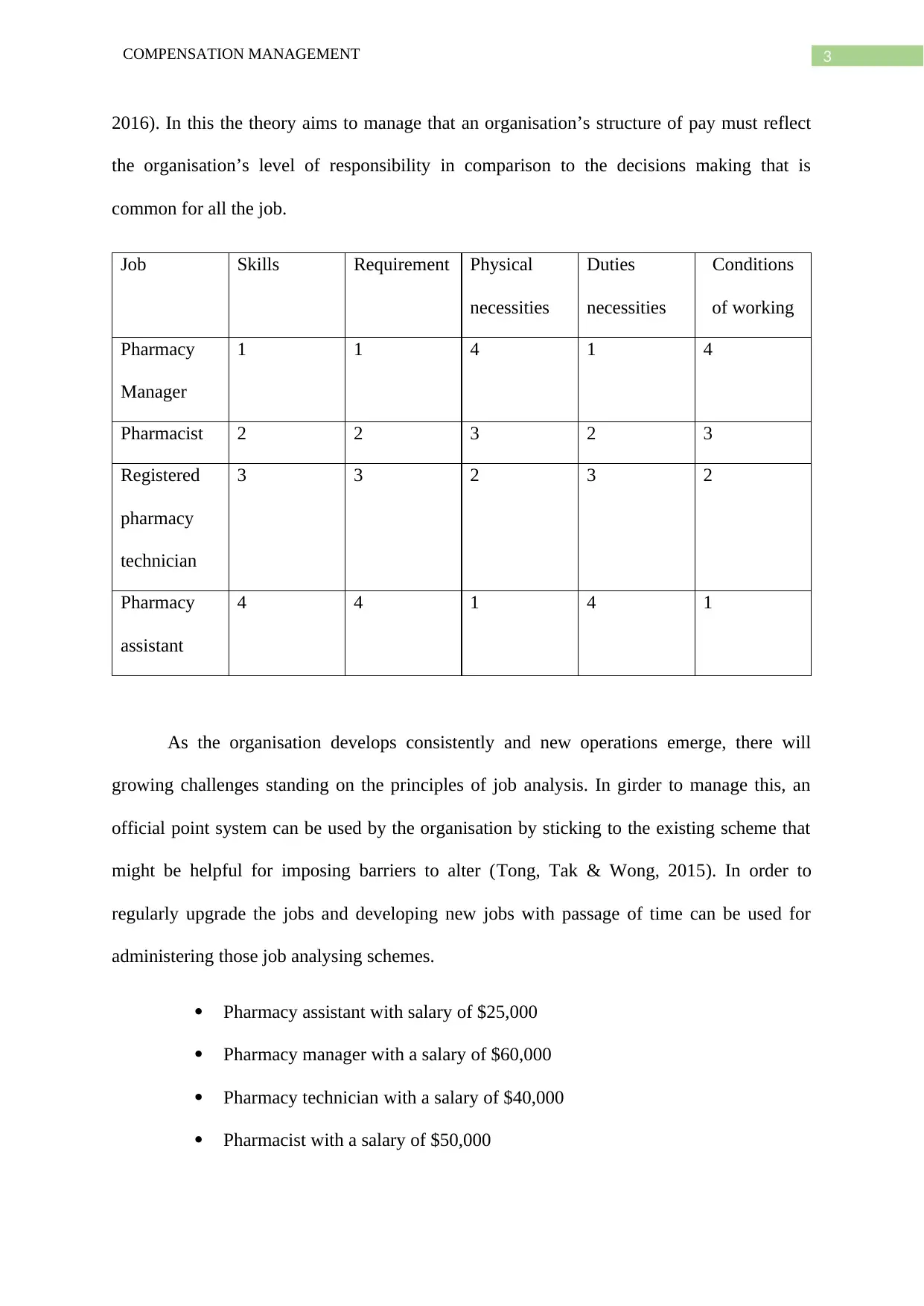
2016). In this the theory aims to manage that an organisation’s structure of pay must reflect
the organisation’s level of responsibility in comparison to the decisions making that is
common for all the job.
Job Skills Requirement Physical
necessities
Duties
necessities
Conditions
of working
Pharmacy
Manager
1 1 4 1 4
Pharmacist 2 2 3 2 3
Registered
pharmacy
technician
3 3 2 3 2
Pharmacy
assistant
4 4 1 4 1
As the organisation develops consistently and new operations emerge, there will
growing challenges standing on the principles of job analysis. In girder to manage this, an
official point system can be used by the organisation by sticking to the existing scheme that
might be helpful for imposing barriers to alter (Tong, Tak & Wong, 2015). In order to
regularly upgrade the jobs and developing new jobs with passage of time can be used for
administering those job analysing schemes.
Pharmacy assistant with salary of $25,000
Pharmacy manager with a salary of $60,000
Pharmacy technician with a salary of $40,000
Pharmacist with a salary of $50,000
2016). In this the theory aims to manage that an organisation’s structure of pay must reflect
the organisation’s level of responsibility in comparison to the decisions making that is
common for all the job.
Job Skills Requirement Physical
necessities
Duties
necessities
Conditions
of working
Pharmacy
Manager
1 1 4 1 4
Pharmacist 2 2 3 2 3
Registered
pharmacy
technician
3 3 2 3 2
Pharmacy
assistant
4 4 1 4 1
As the organisation develops consistently and new operations emerge, there will
growing challenges standing on the principles of job analysis. In girder to manage this, an
official point system can be used by the organisation by sticking to the existing scheme that
might be helpful for imposing barriers to alter (Tong, Tak & Wong, 2015). In order to
regularly upgrade the jobs and developing new jobs with passage of time can be used for
administering those job analysing schemes.
Pharmacy assistant with salary of $25,000
Pharmacy manager with a salary of $60,000
Pharmacy technician with a salary of $40,000
Pharmacist with a salary of $50,000
Paraphrase This Document
Need a fresh take? Get an instant paraphrase of this document with our AI Paraphraser
4COMPENSATION MANAGEMENT
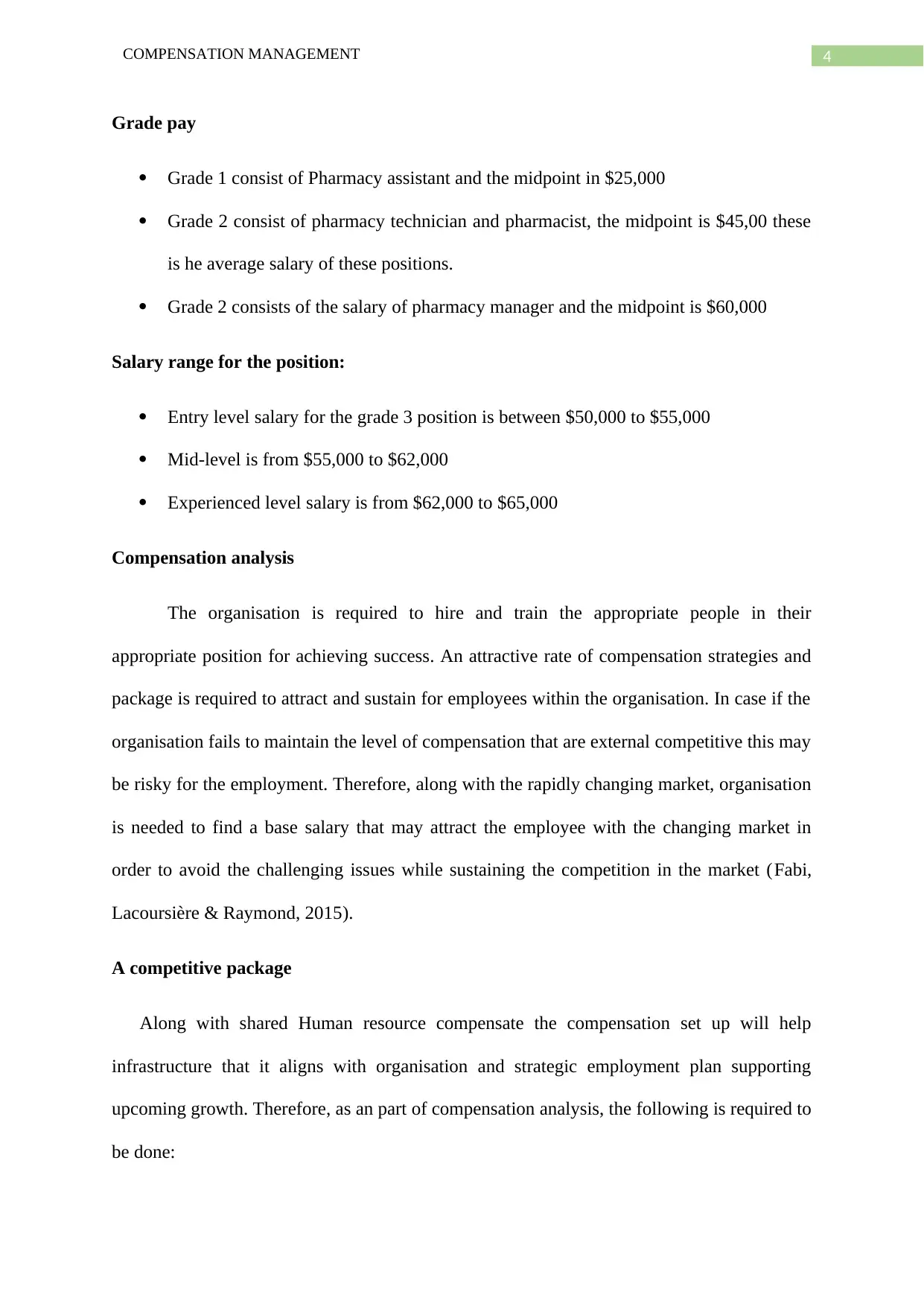
Grade pay
Grade 1 consist of Pharmacy assistant and the midpoint in $25,000
Grade 2 consist of pharmacy technician and pharmacist, the midpoint is $45,00 these
is he average salary of these positions.
Grade 2 consists of the salary of pharmacy manager and the midpoint is $60,000
Salary range for the position:
Entry level salary for the grade 3 position is between $50,000 to $55,000
Mid-level is from $55,000 to $62,000
Experienced level salary is from $62,000 to $65,000
Compensation analysis
The organisation is required to hire and train the appropriate people in their
appropriate position for achieving success. An attractive rate of compensation strategies and
package is required to attract and sustain for employees within the organisation. In case if the
organisation fails to maintain the level of compensation that are external competitive this may
be risky for the employment. Therefore, along with the rapidly changing market, organisation
is needed to find a base salary that may attract the employee with the changing market in
order to avoid the challenging issues while sustaining the competition in the market (Fabi,
Lacoursière & Raymond, 2015).
A competitive package
Along with shared Human resource compensate the compensation set up will help
infrastructure that it aligns with organisation and strategic employment plan supporting
upcoming growth. Therefore, as an part of compensation analysis, the following is required to
be done:
Grade pay
Grade 1 consist of Pharmacy assistant and the midpoint in $25,000
Grade 2 consist of pharmacy technician and pharmacist, the midpoint is $45,00 these
is he average salary of these positions.
Grade 2 consists of the salary of pharmacy manager and the midpoint is $60,000
Salary range for the position:
Entry level salary for the grade 3 position is between $50,000 to $55,000
Mid-level is from $55,000 to $62,000
Experienced level salary is from $62,000 to $65,000
Compensation analysis
The organisation is required to hire and train the appropriate people in their
appropriate position for achieving success. An attractive rate of compensation strategies and
package is required to attract and sustain for employees within the organisation. In case if the
organisation fails to maintain the level of compensation that are external competitive this may
be risky for the employment. Therefore, along with the rapidly changing market, organisation
is needed to find a base salary that may attract the employee with the changing market in
order to avoid the challenging issues while sustaining the competition in the market (Fabi,
Lacoursière & Raymond, 2015).
A competitive package
Along with shared Human resource compensate the compensation set up will help
infrastructure that it aligns with organisation and strategic employment plan supporting
upcoming growth. Therefore, as an part of compensation analysis, the following is required to
be done:
5COMPENSATION MANAGEMENT
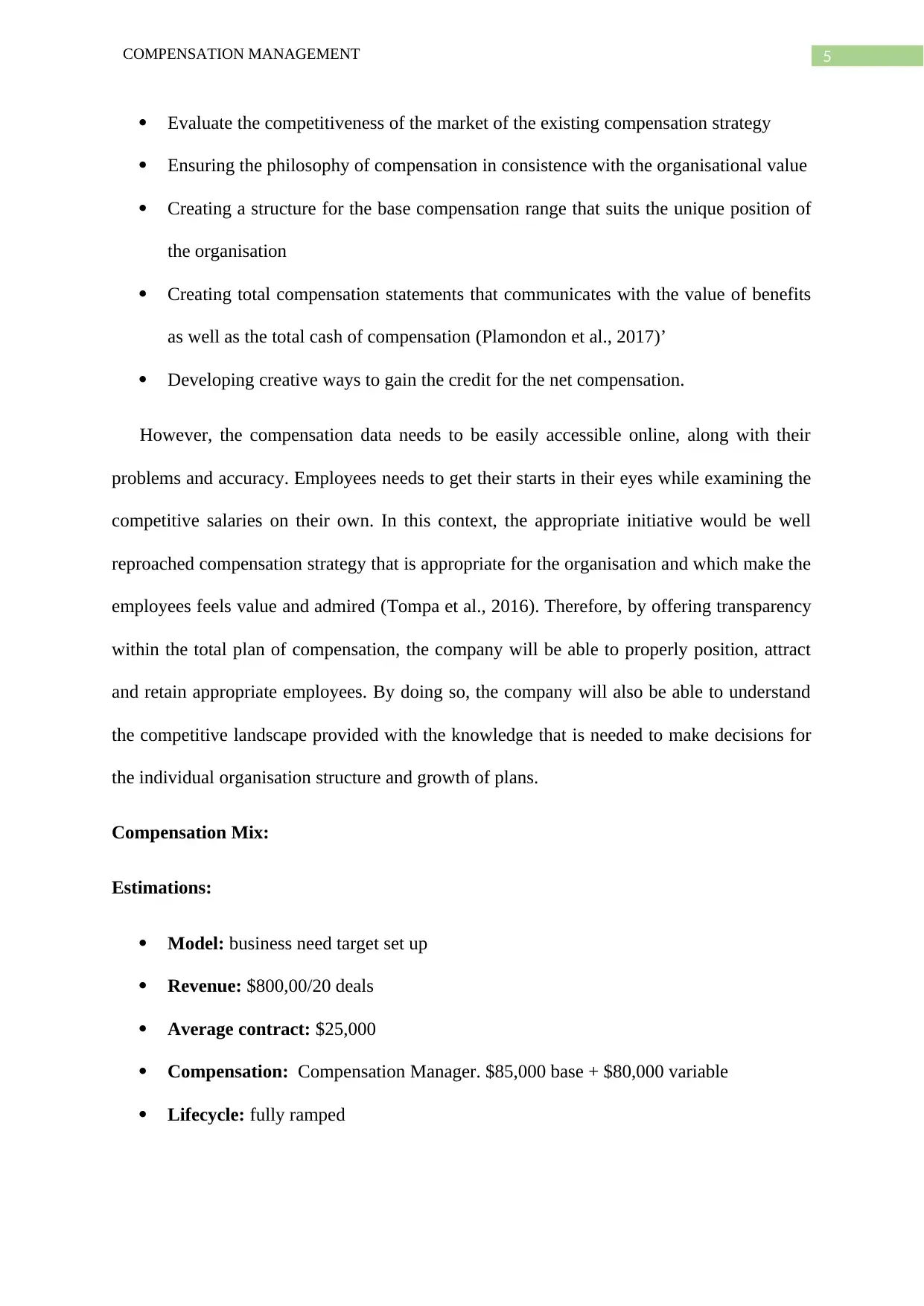
Evaluate the competitiveness of the market of the existing compensation strategy
Ensuring the philosophy of compensation in consistence with the organisational value
Creating a structure for the base compensation range that suits the unique position of
the organisation
Creating total compensation statements that communicates with the value of benefits
as well as the total cash of compensation (Plamondon et al., 2017)’
Developing creative ways to gain the credit for the net compensation.
However, the compensation data needs to be easily accessible online, along with their
problems and accuracy. Employees needs to get their starts in their eyes while examining the
competitive salaries on their own. In this context, the appropriate initiative would be well
reproached compensation strategy that is appropriate for the organisation and which make the
employees feels value and admired (Tompa et al., 2016). Therefore, by offering transparency
within the total plan of compensation, the company will be able to properly position, attract
and retain appropriate employees. By doing so, the company will also be able to understand
the competitive landscape provided with the knowledge that is needed to make decisions for
the individual organisation structure and growth of plans.
Compensation Mix:
Estimations:
Model: business need target set up
Revenue: $800,00/20 deals
Average contract: $25,000
Compensation: Compensation Manager. $85,000 base + $80,000 variable
Lifecycle: fully ramped
Evaluate the competitiveness of the market of the existing compensation strategy
Ensuring the philosophy of compensation in consistence with the organisational value
Creating a structure for the base compensation range that suits the unique position of
the organisation
Creating total compensation statements that communicates with the value of benefits
as well as the total cash of compensation (Plamondon et al., 2017)’
Developing creative ways to gain the credit for the net compensation.
However, the compensation data needs to be easily accessible online, along with their
problems and accuracy. Employees needs to get their starts in their eyes while examining the
competitive salaries on their own. In this context, the appropriate initiative would be well
reproached compensation strategy that is appropriate for the organisation and which make the
employees feels value and admired (Tompa et al., 2016). Therefore, by offering transparency
within the total plan of compensation, the company will be able to properly position, attract
and retain appropriate employees. By doing so, the company will also be able to understand
the competitive landscape provided with the knowledge that is needed to make decisions for
the individual organisation structure and growth of plans.
Compensation Mix:
Estimations:
Model: business need target set up
Revenue: $800,00/20 deals
Average contract: $25,000
Compensation: Compensation Manager. $85,000 base + $80,000 variable
Lifecycle: fully ramped
⊘ This is a preview!⊘
Do you want full access?
Subscribe today to unlock all pages.
Trusted by 1+ million students worldwide
6COMPENSATION MANAGEMENT
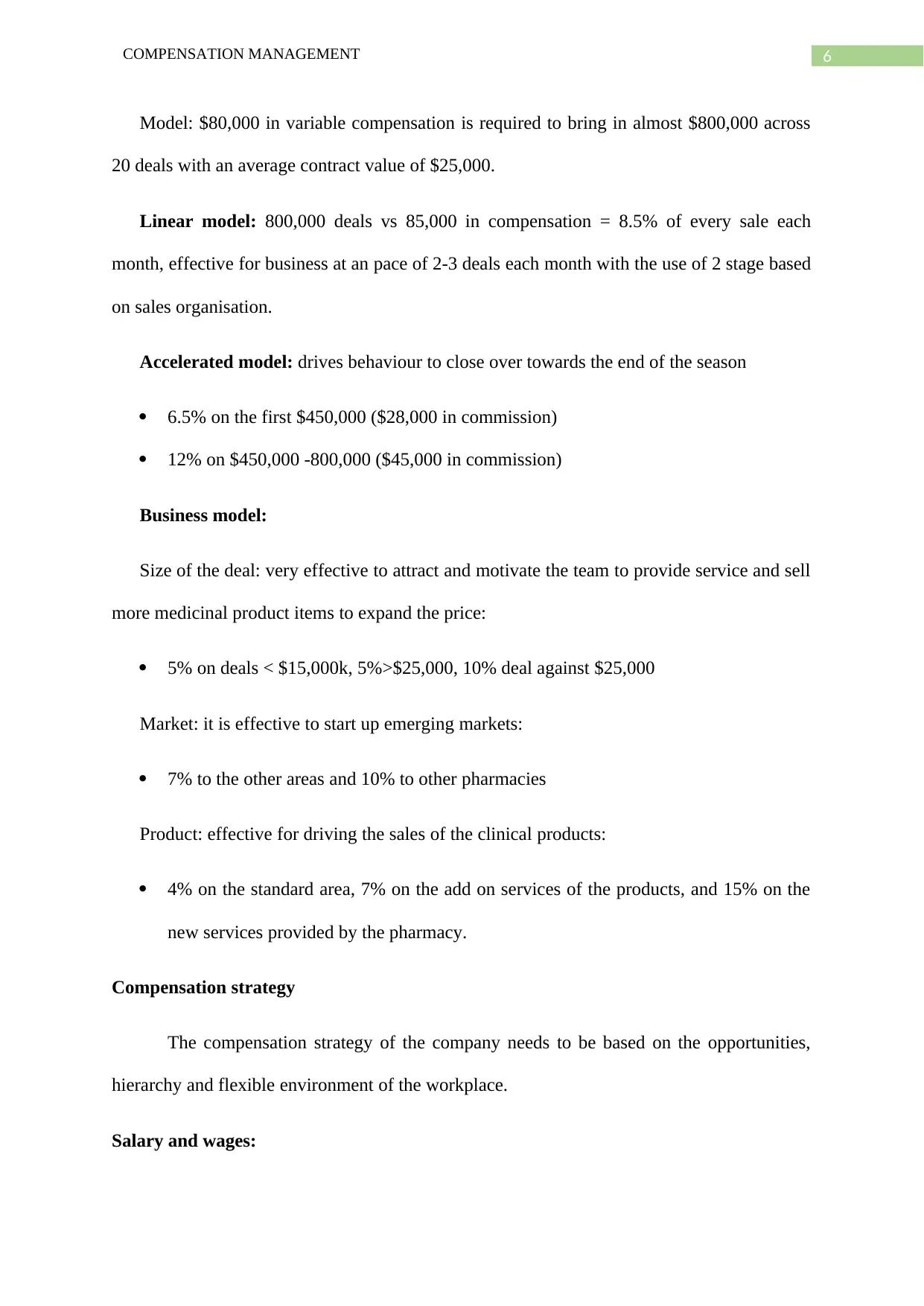
Model: $80,000 in variable compensation is required to bring in almost $800,000 across
20 deals with an average contract value of $25,000.
Linear model: 800,000 deals vs 85,000 in compensation = 8.5% of every sale each
month, effective for business at an pace of 2-3 deals each month with the use of 2 stage based
on sales organisation.
Accelerated model: drives behaviour to close over towards the end of the season
6.5% on the first $450,000 ($28,000 in commission)
12% on $450,000 -800,000 ($45,000 in commission)
Business model:
Size of the deal: very effective to attract and motivate the team to provide service and sell
more medicinal product items to expand the price:
5% on deals < $15,000k, 5%>$25,000, 10% deal against $25,000
Market: it is effective to start up emerging markets:
7% to the other areas and 10% to other pharmacies
Product: effective for driving the sales of the clinical products:
4% on the standard area, 7% on the add on services of the products, and 15% on the
new services provided by the pharmacy.
Compensation strategy
The compensation strategy of the company needs to be based on the opportunities,
hierarchy and flexible environment of the workplace.
Salary and wages:
Model: $80,000 in variable compensation is required to bring in almost $800,000 across
20 deals with an average contract value of $25,000.
Linear model: 800,000 deals vs 85,000 in compensation = 8.5% of every sale each
month, effective for business at an pace of 2-3 deals each month with the use of 2 stage based
on sales organisation.
Accelerated model: drives behaviour to close over towards the end of the season
6.5% on the first $450,000 ($28,000 in commission)
12% on $450,000 -800,000 ($45,000 in commission)
Business model:
Size of the deal: very effective to attract and motivate the team to provide service and sell
more medicinal product items to expand the price:
5% on deals < $15,000k, 5%>$25,000, 10% deal against $25,000
Market: it is effective to start up emerging markets:
7% to the other areas and 10% to other pharmacies
Product: effective for driving the sales of the clinical products:
4% on the standard area, 7% on the add on services of the products, and 15% on the
new services provided by the pharmacy.
Compensation strategy
The compensation strategy of the company needs to be based on the opportunities,
hierarchy and flexible environment of the workplace.
Salary and wages:
Paraphrase This Document
Need a fresh take? Get an instant paraphrase of this document with our AI Paraphraser
7COMPENSATION MANAGEMENT
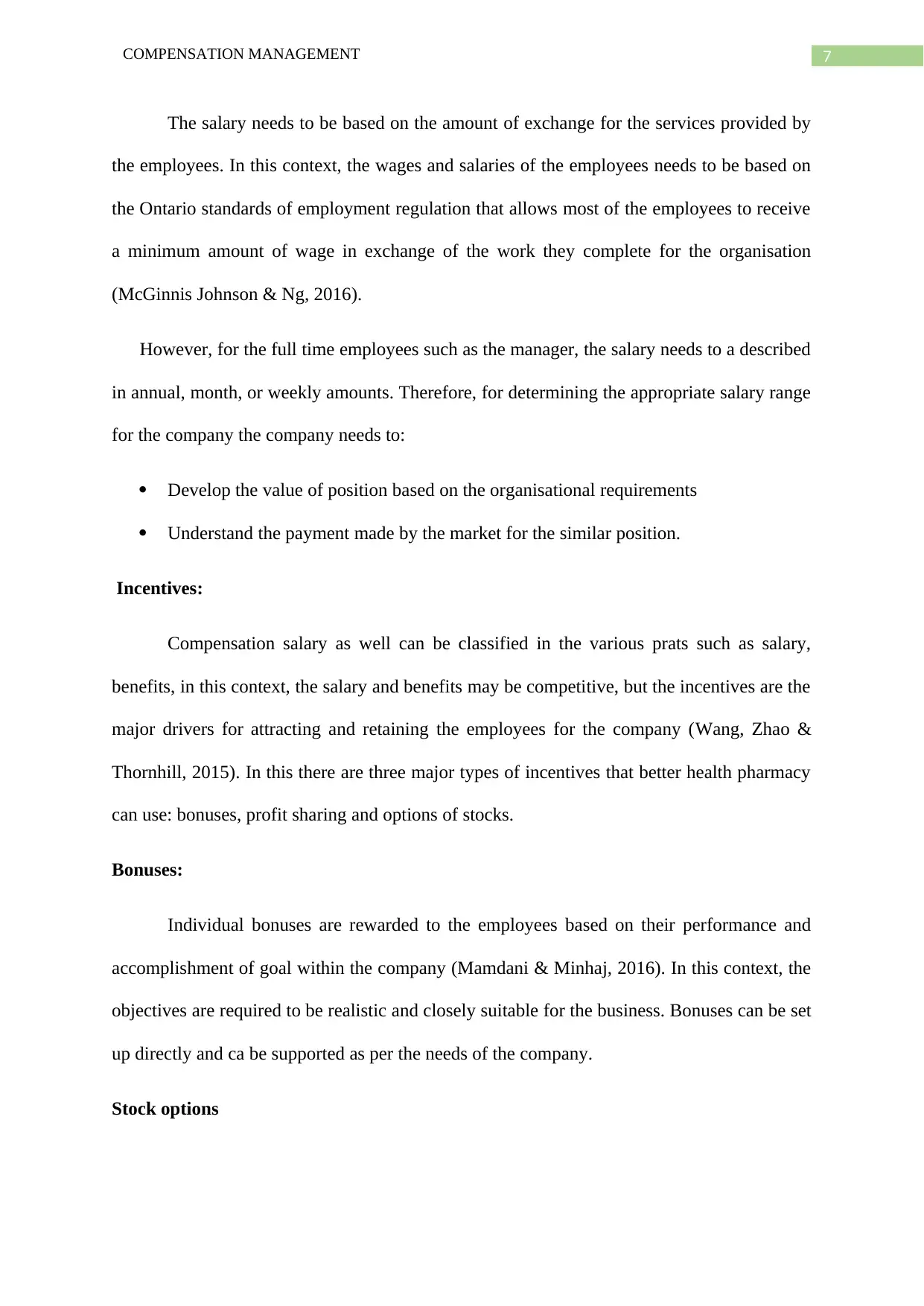
The salary needs to be based on the amount of exchange for the services provided by
the employees. In this context, the wages and salaries of the employees needs to be based on
the Ontario standards of employment regulation that allows most of the employees to receive
a minimum amount of wage in exchange of the work they complete for the organisation
(McGinnis Johnson & Ng, 2016).
However, for the full time employees such as the manager, the salary needs to a described
in annual, month, or weekly amounts. Therefore, for determining the appropriate salary range
for the company the company needs to:
Develop the value of position based on the organisational requirements
Understand the payment made by the market for the similar position.
Incentives:
Compensation salary as well can be classified in the various prats such as salary,
benefits, in this context, the salary and benefits may be competitive, but the incentives are the
major drivers for attracting and retaining the employees for the company (Wang, Zhao &
Thornhill, 2015). In this there are three major types of incentives that better health pharmacy
can use: bonuses, profit sharing and options of stocks.
Bonuses:
Individual bonuses are rewarded to the employees based on their performance and
accomplishment of goal within the company (Mamdani & Minhaj, 2016). In this context, the
objectives are required to be realistic and closely suitable for the business. Bonuses can be set
up directly and ca be supported as per the needs of the company.
Stock options
The salary needs to be based on the amount of exchange for the services provided by
the employees. In this context, the wages and salaries of the employees needs to be based on
the Ontario standards of employment regulation that allows most of the employees to receive
a minimum amount of wage in exchange of the work they complete for the organisation
(McGinnis Johnson & Ng, 2016).
However, for the full time employees such as the manager, the salary needs to a described
in annual, month, or weekly amounts. Therefore, for determining the appropriate salary range
for the company the company needs to:
Develop the value of position based on the organisational requirements
Understand the payment made by the market for the similar position.
Incentives:
Compensation salary as well can be classified in the various prats such as salary,
benefits, in this context, the salary and benefits may be competitive, but the incentives are the
major drivers for attracting and retaining the employees for the company (Wang, Zhao &
Thornhill, 2015). In this there are three major types of incentives that better health pharmacy
can use: bonuses, profit sharing and options of stocks.
Bonuses:
Individual bonuses are rewarded to the employees based on their performance and
accomplishment of goal within the company (Mamdani & Minhaj, 2016). In this context, the
objectives are required to be realistic and closely suitable for the business. Bonuses can be set
up directly and ca be supported as per the needs of the company.
Stock options
8COMPENSATION MANAGEMENT
An individual employee receives an options for stocks for buying the shares of the
company for a price set during a particular time. However, the options of stock are often
managed by the manager and compensator executives in lieu of high salary.
Commissions:
Commissions are normal way of providing renumeration to the employees for
securing the sale of the product. In this the intention is to create a strong amount of incentive
for the individual to invest a maximin effort in their task (Coulmont, Berthelot & Gagné,
2018). Commission are generally calculated in the form of base percentage for the sale of the
product and services, in this the payment can be either straight or the ,mixture of the base
start based on the accomplishment of targets and quotas set by the management and the
employee. These quotas are related to the sales revenue, unit of sales and other volumes
metrics.
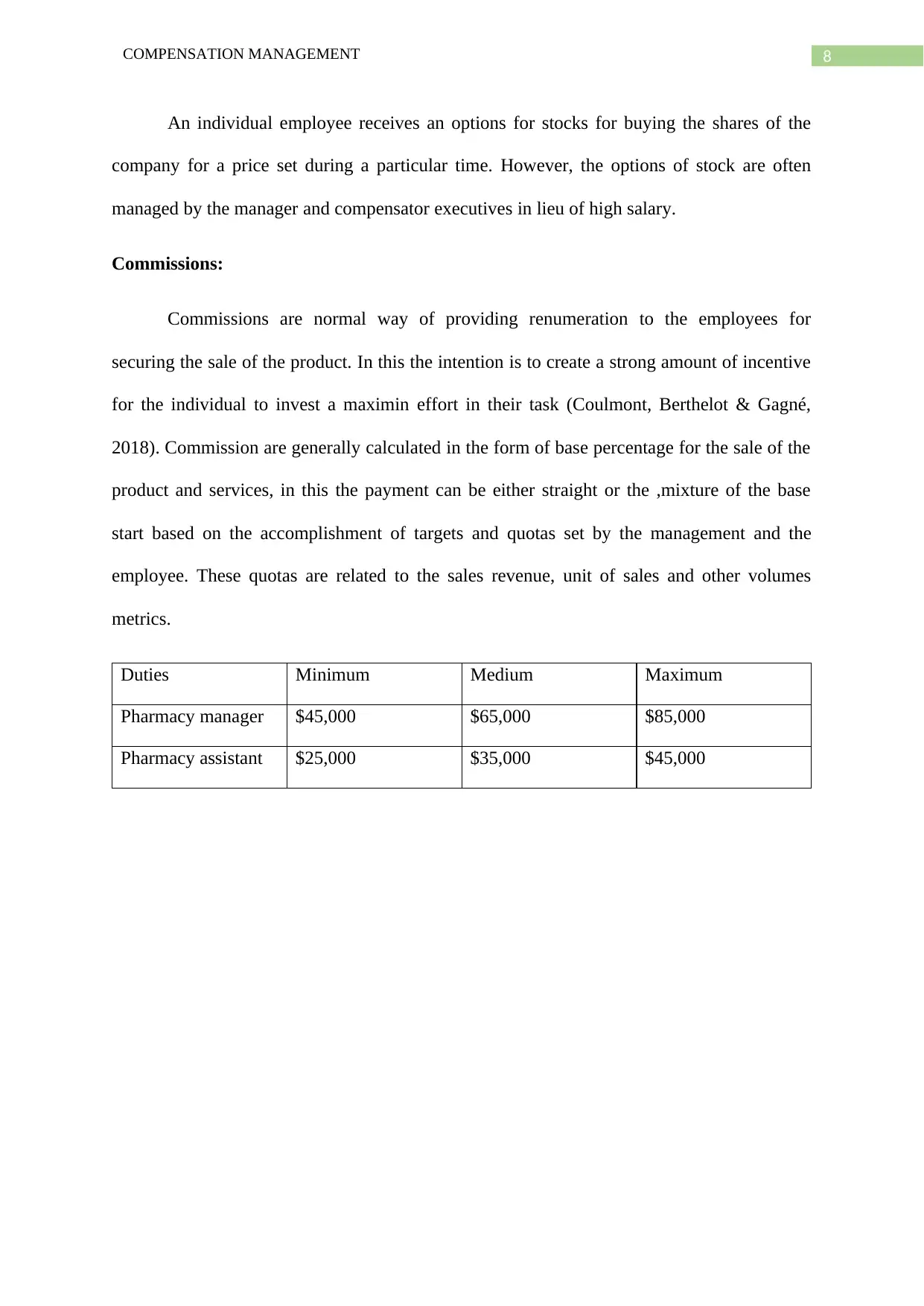
Duties Minimum Medium Maximum
Pharmacy manager $45,000 $65,000 $85,000
Pharmacy assistant $25,000 $35,000 $45,000
An individual employee receives an options for stocks for buying the shares of the
company for a price set during a particular time. However, the options of stock are often
managed by the manager and compensator executives in lieu of high salary.
Commissions:
Commissions are normal way of providing renumeration to the employees for
securing the sale of the product. In this the intention is to create a strong amount of incentive
for the individual to invest a maximin effort in their task (Coulmont, Berthelot & Gagné,
2018). Commission are generally calculated in the form of base percentage for the sale of the
product and services, in this the payment can be either straight or the ,mixture of the base
start based on the accomplishment of targets and quotas set by the management and the
employee. These quotas are related to the sales revenue, unit of sales and other volumes
metrics.
Duties Minimum Medium Maximum
Pharmacy manager $45,000 $65,000 $85,000
Pharmacy assistant $25,000 $35,000 $45,000
⊘ This is a preview!⊘
Do you want full access?
Subscribe today to unlock all pages.
Trusted by 1+ million students worldwide
9COMPENSATION MANAGEMENT
Reference list
Catano, V. M., & Morrow Hines, H. (2016). The influence of corporate social responsibility,
psychologically healthy workplaces, and individual values in attracting millennial job
applicants. Canadian Journal of Behavioural Science/Revue canadienne des sciences du
comportement, 48(2), 142.
Coulmont, M., Berthelot, S., & Gagné, C. (2018). Executive Compensation and Corporate
Income Tax: A Question of Societal Equity. International Journal, 6(1), 42-51.
Fabi, B., Lacoursière, R., & Raymond, L. (2015). Impact of high-performance work systems
on job satisfaction, organizational commitment, and intention to quit in Canadian
organizations. International Journal of Manpower, 36(5), 772-790.
Lester, N. P., Shuter, B. J., Venturelli, P., & Nadeau, D. (2014). Life‐history plasticity and
sustainable exploitation: a theory of growth compensation applied to walleye
management. Ecological Applications, 24(1), 38-54.
Mamdani, K. F., & Minhaj, S. (2016). Effects of motivational incentives on employees’
performance: A case study of banks of Karachi, Pakistan. South East Asia Journal of
Contemporary Business, Economics and Law, 9(2), 32-39.
McGinnis Johnson, J., & Ng, E. S. (2016). Money talks or millennials walk: The effect of
compensation on nonprofit millennial workers sector-switching intentions. Review of Public
Personnel Administration, 36(3), 283-305.
Mellahi, K., Frynas, J. G., & Collings, D. G. (2016). Performance management practices
within emerging market multinational enterprises: the case of Brazilian multinationals. The
International Journal of Human Resource Management, 27(8), 876-905.
Reference list
Catano, V. M., & Morrow Hines, H. (2016). The influence of corporate social responsibility,
psychologically healthy workplaces, and individual values in attracting millennial job
applicants. Canadian Journal of Behavioural Science/Revue canadienne des sciences du
comportement, 48(2), 142.
Coulmont, M., Berthelot, S., & Gagné, C. (2018). Executive Compensation and Corporate
Income Tax: A Question of Societal Equity. International Journal, 6(1), 42-51.
Fabi, B., Lacoursière, R., & Raymond, L. (2015). Impact of high-performance work systems
on job satisfaction, organizational commitment, and intention to quit in Canadian
organizations. International Journal of Manpower, 36(5), 772-790.
Lester, N. P., Shuter, B. J., Venturelli, P., & Nadeau, D. (2014). Life‐history plasticity and
sustainable exploitation: a theory of growth compensation applied to walleye
management. Ecological Applications, 24(1), 38-54.
Mamdani, K. F., & Minhaj, S. (2016). Effects of motivational incentives on employees’
performance: A case study of banks of Karachi, Pakistan. South East Asia Journal of
Contemporary Business, Economics and Law, 9(2), 32-39.
McGinnis Johnson, J., & Ng, E. S. (2016). Money talks or millennials walk: The effect of
compensation on nonprofit millennial workers sector-switching intentions. Review of Public
Personnel Administration, 36(3), 283-305.
Mellahi, K., Frynas, J. G., & Collings, D. G. (2016). Performance management practices
within emerging market multinational enterprises: the case of Brazilian multinationals. The
International Journal of Human Resource Management, 27(8), 876-905.
Paraphrase This Document
Need a fresh take? Get an instant paraphrase of this document with our AI Paraphraser
10COMPENSATION MANAGEMENT
Mensah, J. K. (2015). A “coalesced framework” of talent management and employee
performance: For further research and practice. International Journal of Productivity and
Performance Management, 64(4), 544-566.
Nabitz, L., Hirzel, S., Rohde, C., Wohlfarth, K., Behling, I., & Turner, R. (2016). How can
energy audits and energy management be promoted amongst SMEs? A review of policy
instruments in the EU-28 and beyond. Proceedings of the ECEEE Industrial Summer Study,
401-415.
Peng, J., Li, D., Zhang, Z., Tian, Y., Miao, D., Xiao, W., & Zhang, J. (2016). How can core
self-evaluations influence job burnout? The key roles of organizational commitment and job
satisfaction. Journal of health psychology, 21(1), 50-59.
Plamondon, K., Walters, D., Campbell, S., & Hatfield, J. (2017). Promoting equitable global
health research: a policy analysis of the Canadian funding landscape. Health research policy
and systems, 15(1), 72.
Tompa, E., Dolinschi, R., Alamgir, H., Sarnocinska-Hart, A., & Guzman, J. (2016). A cost-
benefit analysis of peer coaching for overhead lift use in the long-term care sector in
Canada. Occup Environ Med, 73(5), 308-314.
Tong, C., Tak, W. I. W., & Wong, A. (2015). The impact of knowledge sharing on the
relationship between organizational culture and job satisfaction: The perception of
information communication and technology (ICT) practitioners in Hong Kong. International
Journal of Human Resource Studies, 5(1), 19-47.
Wang, T., Zhao, B., & Thornhill, S. (2015). Pay dispersion and organizational innovation:
The mediation effects of employee participation and voluntary turnover. Human
Relations, 68(7), 1155-1181.
Mensah, J. K. (2015). A “coalesced framework” of talent management and employee
performance: For further research and practice. International Journal of Productivity and
Performance Management, 64(4), 544-566.
Nabitz, L., Hirzel, S., Rohde, C., Wohlfarth, K., Behling, I., & Turner, R. (2016). How can
energy audits and energy management be promoted amongst SMEs? A review of policy
instruments in the EU-28 and beyond. Proceedings of the ECEEE Industrial Summer Study,
401-415.
Peng, J., Li, D., Zhang, Z., Tian, Y., Miao, D., Xiao, W., & Zhang, J. (2016). How can core
self-evaluations influence job burnout? The key roles of organizational commitment and job
satisfaction. Journal of health psychology, 21(1), 50-59.
Plamondon, K., Walters, D., Campbell, S., & Hatfield, J. (2017). Promoting equitable global
health research: a policy analysis of the Canadian funding landscape. Health research policy
and systems, 15(1), 72.
Tompa, E., Dolinschi, R., Alamgir, H., Sarnocinska-Hart, A., & Guzman, J. (2016). A cost-
benefit analysis of peer coaching for overhead lift use in the long-term care sector in
Canada. Occup Environ Med, 73(5), 308-314.
Tong, C., Tak, W. I. W., & Wong, A. (2015). The impact of knowledge sharing on the
relationship between organizational culture and job satisfaction: The perception of
information communication and technology (ICT) practitioners in Hong Kong. International
Journal of Human Resource Studies, 5(1), 19-47.
Wang, T., Zhao, B., & Thornhill, S. (2015). Pay dispersion and organizational innovation:
The mediation effects of employee participation and voluntary turnover. Human
Relations, 68(7), 1155-1181.

11COMPENSATION MANAGEMENT
⊘ This is a preview!⊘
Do you want full access?
Subscribe today to unlock all pages.
Trusted by 1+ million students worldwide

1 out of 12


Related Documents


Your All-in-One AI-Powered Toolkit for Academic Success.
+13062052269
info@desklib.com
Available 24*7 on WhatsApp / Email
![[object Object]](/_next/static/media/star-bottom.7253800d.svg)
Unlock your academic potential
Copyright © 2020–2026 A2Z Services. All Rights Reserved. Developed and managed by ZUCOL.