Competitive Strategy Comparison: Alibaba and Dominos Pizza Report

Verified

Added on  2020/03/04

|6
|1331
|104
Report
AI Summary
This report provides a comparative analysis of the competitive strategies employed by Alibaba and Dominos Pizza. The introduction highlights the importance of competitive strategies in gaining a market edge. The report then delves into the business models of both companies, examining how Alibaba utilizes revenue model innovation, organizational flexibility, and cost leadership to dominate the e-commerce market, particularly in China. It also discusses how Dominos Pizza leverages brand recognition, enterprise business models, and differentiating strategies to maintain its market leadership in the restaurant industry, focusing on innovation and customer-centric approaches. The conclusion summarizes the key findings, emphasizing the role of innovation and continuous development in the success of both companies, with references to the business model innovation theory and enterprise business models.
Document Page
Competitive Strategy
tabler-icon-diamond-filled.svg

Paraphrase This Document

Need a fresh take? Get an instant paraphrase of this document with our AI Paraphraser
Document Page
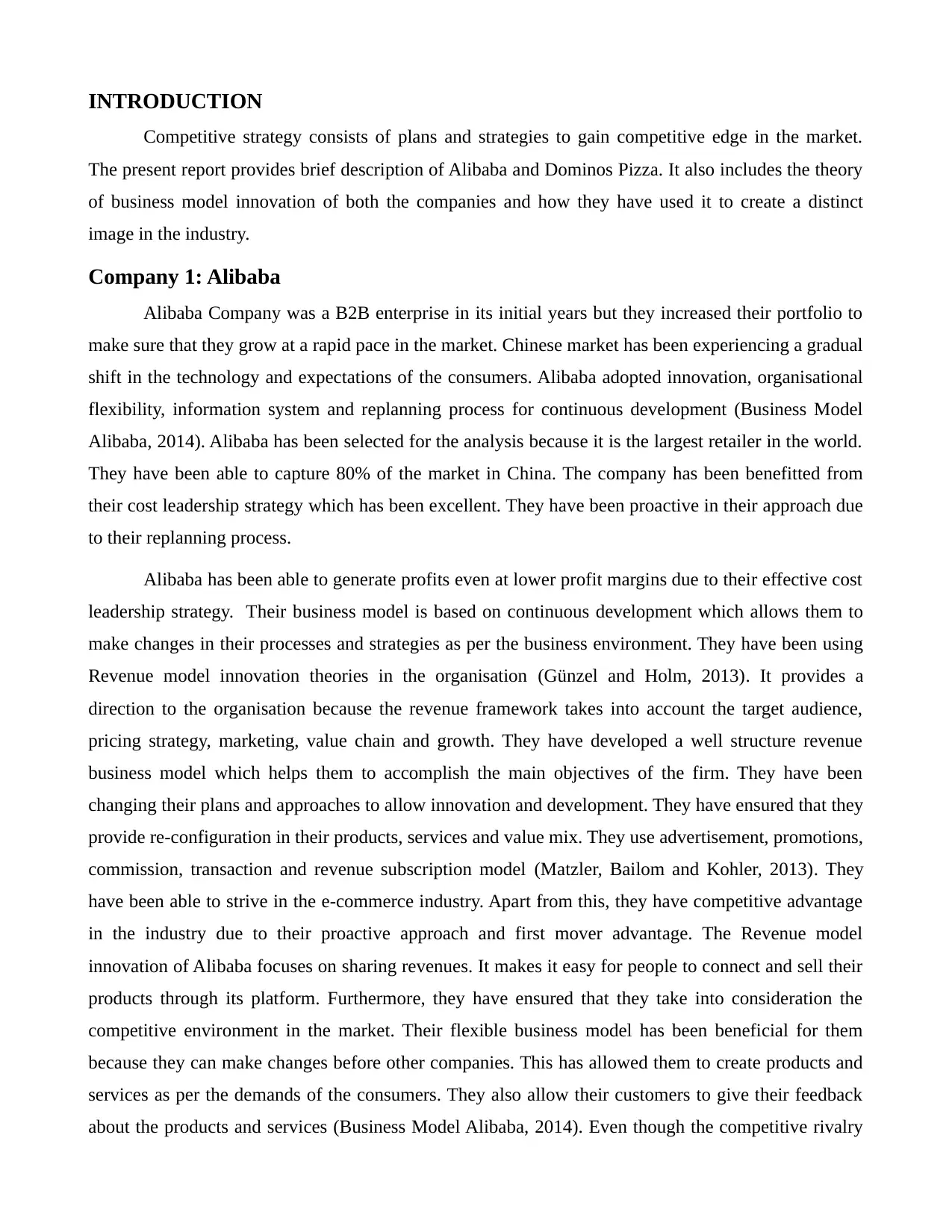
Table of Contents
INTRODUCTION.....................................................................................................................................3
Company 1: Alibaba...................................................................................................................................3
Company 2: Dominos Pizza.......................................................................................................................4
CONCLUSION..........................................................................................................................................5
REFERENCES...........................................................................................................................................6
Document Page
INTRODUCTION
Competitive strategy consists of plans and strategies to gain competitive edge in the market.
The present report provides brief description of Alibaba and Dominos Pizza. It also includes the theory
of business model innovation of both the companies and how they have used it to create a distinct
image in the industry.
Company 1: Alibaba
Alibaba Company was a B2B enterprise in its initial years but they increased their portfolio to
make sure that they grow at a rapid pace in the market. Chinese market has been experiencing a gradual
shift in the technology and expectations of the consumers. Alibaba adopted innovation, organisational
flexibility, information system and replanning process for continuous development (Business Model
Alibaba, 2014). Alibaba has been selected for the analysis because it is the largest retailer in the world.
They have been able to capture 80% of the market in China. The company has been benefitted from
their cost leadership strategy which has been excellent. They have been proactive in their approach due
to their replanning process.
Alibaba has been able to generate profits even at lower profit margins due to their effective cost
leadership strategy. Their business model is based on continuous development which allows them to
make changes in their processes and strategies as per the business environment. They have been using
Revenue model innovation theories in the organisation (Günzel and Holm, 2013). It provides a
direction to the organisation because the revenue framework takes into account the target audience,
pricing strategy, marketing, value chain and growth. They have developed a well structure revenue
business model which helps them to accomplish the main objectives of the firm. They have been
changing their plans and approaches to allow innovation and development. They have ensured that they
provide re-configuration in their products, services and value mix. They use advertisement, promotions,
commission, transaction and revenue subscription model (Matzler, Bailom and Kohler, 2013). They
have been able to strive in the e-commerce industry. Apart from this, they have competitive advantage
in the industry due to their proactive approach and first mover advantage. The Revenue model
innovation of Alibaba focuses on sharing revenues. It makes it easy for people to connect and sell their
products through its platform. Furthermore, they have ensured that they take into consideration the
competitive environment in the market. Their flexible business model has been beneficial for them
because they can make changes before other companies. This has allowed them to create products and
services as per the demands of the consumers. They also allow their customers to give their feedback
about the products and services (Business Model Alibaba, 2014). Even though the competitive rivalry
Document Page
has been strong in China but the business model of Alibaba has allowed them to create a large customer
base. They have been able to outperform in the industry as compared to other rivals. The main
components which have helped them to become a leading online store are competitive prices, high
information density, reliability, latest technology and customised services (Casadesus Masanell and
Zhu, 2013). They have been able to expand their business to any different countries and their revenue
model has given them advantage in the region.
Company 2: Dominos Pizza
Dominos Pizza is restaurant chain which has more than 13,000 outlets in different countries.
They have used brand recognition and innovations to gain strategic competitive advantage in the
industry. They have ensured that they provide high quality products and adapt to the needs and
preferences of the consumers (Dominos Competitive Strategy, 2013). Dominos Pizza have been using
enterprise business model which has been beneficial for them. They have more than 10,000 outlets and
franchises which covers 70 countries. Dominos Pizza has been selected for the analysis because they
have become a market leader. Their business model of franchises and low cost infrastructure has made
it more successful as compared to other competitors (Matzler, Bailom and Kohler, 2013).
Dominos has used differentiating targeting strategy to take advantage of the opportunities in the
market. They have variety of products in their portfolio and they have established the brand with the
help of competitive pricing strategy. Furthermore, they have been able to change the value chain after
the adoption of enterprise business model (Casadesus Masanell and Zhu, 2013). It has allowed them to
improve the efficiency and quality of the products. They have also ensured that their business possesses
deeper knowledge about their customers. It helps the business model of the company to evolve. But it
requires positive organisaitonal culture which has been provided by the management. Their production,
distribution, management, offerings and sales have improved. Their networks have helped them to
expand their reach which has increased their customer base (Günzel and Holm, 2013). Dominos have
used a business model typology to make changes in their existing strategies and plans. It can be used
for reconfiguration and business innovation. It includes assessing the current business model, planning
& implementation and monitoring of new business model. Their supply chain has also been vertically
integrated which has enabled them to reduce the cost and manage their resources (Dominos
Competitive Strategy, 2013). Along with this, the new business model has significantly improved their
distribution system and value delivery process. Their turnaround time has also reduced which has
helped them to increase the satisfaction level of the consumers. Their awareness and innovated
strategies have been beneficial for them. Other competitors such as Papa Jones, Pizza Hut, Greco, etc
tabler-icon-diamond-filled.svg

Paraphrase This Document

Need a fresh take? Get an instant paraphrase of this document with our AI Paraphraser
Document Page
have found it difficult to match up with the services and quality provided by the Dominos. Their model
is difficult to replicate for the new companies and the competitors in the market (Casadesus Masanell
and Zhu, 2013). Dominos has made sure that they continue to grow and adapt to the changing business
environment.
CONCLUSION
It can be concluded from the above that both Alibaba and Dominos have been performing well
in terms of competition and profitability. They have focused on innovation and continuous
development. Alibaba has been following Revenue model innovation theory in the business. On the
other hand, Dominos has been using enterprise business model to take first mover advantage in the
industry.
Document Page
REFERENCES
Business Model Alibaba. 2014. [Online]. Available through:
<http://groupithq.blogspot.in/2014/10/business-model-of-alibaba.html> [Accessed on 15th August
2017]
Casadesus Masanell, R. and Zhu, F., 2013. Business model innovation and competitive imitation: The
case of sponsor based business models. Strategic management journal, 34(4), pp.464-482.
Dominos Competitive Strategy. 2013. [Online]. Available through:
<https://www.forbes.com/sites/halahtouryalai/2013/10/15/technology-not-pizza-helps-dominos-crush-
competitors-and-grow-faster-than-mcdonalds-overseas/#53efdeecfdcf> [Accessed on 15th August 2017]
Günzel, F. and Holm, A.B., 2013. One size does not fit all—understanding the front-end and back-end
of business model innovation. International Journal of Innovation Management, 17(01), p.1340002.
Matzler, K., Bailom, F., Friedrich von den Eichen, S. and Kohler, T., 2013. Business model innovation:
coffee triumphs for Nespresso. Journal of Business Strategy, 34(2), pp.30-37.
chevron_up_icon
1 out of 6
circle_padding
hide_on_mobile
zoom_out_icon
[object Object]