Apple vs. Samsung: A Comparative Analysis of Competitive Strategies

Verified

Added on  2020/03/02

|7
|1498
|156
Report
AI Summary
This report provides a comprehensive analysis of Apple Inc.'s competitive strategy, utilizing Porter's Five Forces framework to evaluate its market position and competitive advantages. The analysis explores the intensity of industry competition, the bargaining power of buyers and suppliers, the threat of new entrants, and the availability of substitute products. The report highlights Apple's innovation-driven approach, brand image, and customer loyalty as key strengths, contrasting these with the strategies of competitors like Samsung. The report examines Samsung's red ocean strategy, its focus on product diversification across price ranges, and its efforts to compete with Apple in the smartphone market. The analysis also considers the challenges faced by both companies, including patent conflicts, the need for continuous innovation, and the importance of maintaining brand image and quality. The report concludes with insights into the strategic implications for both companies in the dynamic technology landscape.
Document Page
Competitive Strategy
tabler-icon-diamond-filled.svg

Paraphrase This Document

Need a fresh take? Get an instant paraphrase of this document with our AI Paraphraser
Document Page
Apple
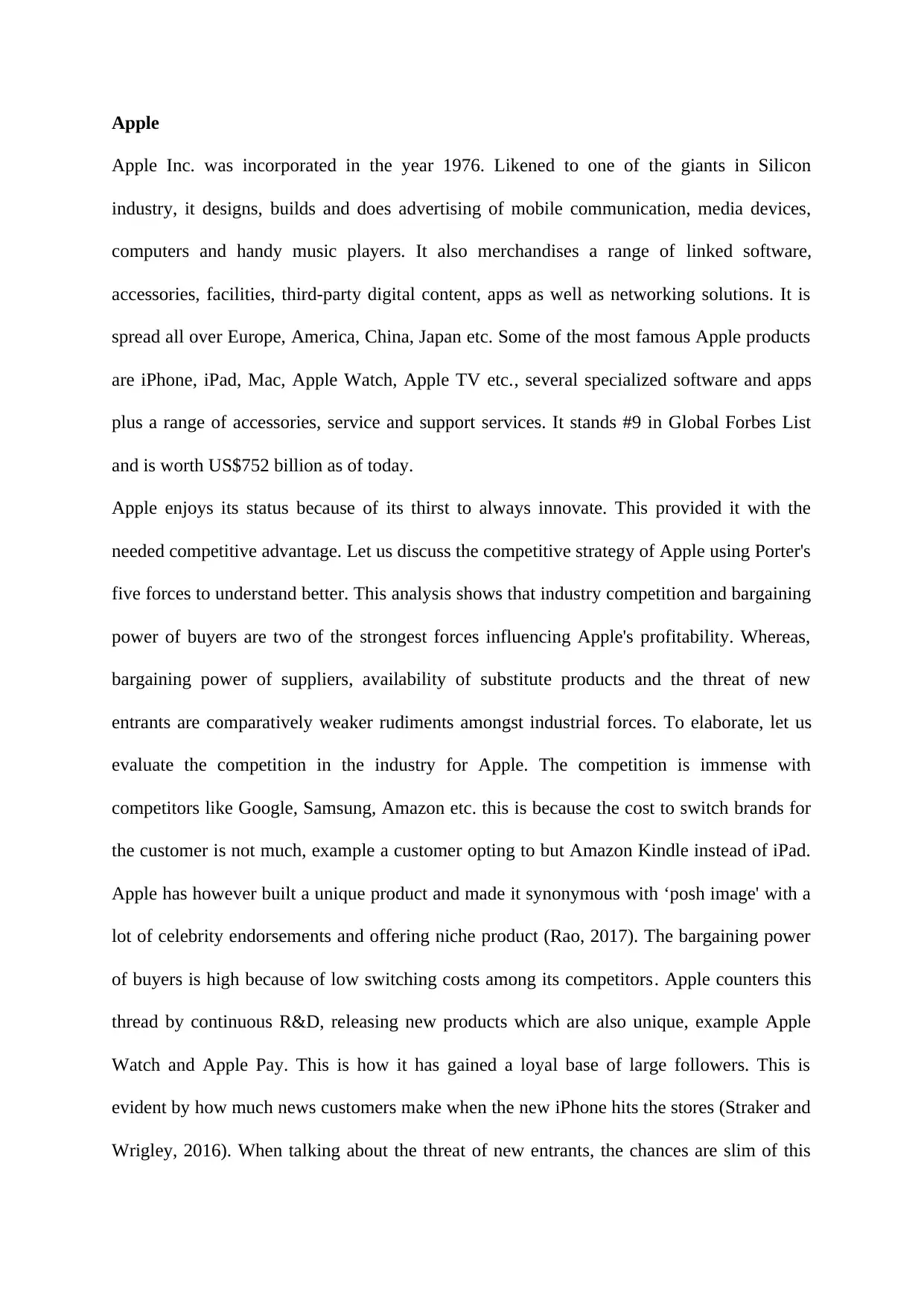
Apple Inc. was incorporated in the year 1976. Likened to one of the giants in Silicon
industry, it designs, builds and does advertising of mobile communication, media devices,
computers and handy music players. It also merchandises a range of linked software,
accessories, facilities, third-party digital content, apps as well as networking solutions. It is
spread all over Europe, America, China, Japan etc. Some of the most famous Apple products
are iPhone, iPad, Mac, Apple Watch, Apple TV etc., several specialized software and apps
plus a range of accessories, service and support services. It stands #9 in Global Forbes List
and is worth US$752 billion as of today.
Apple enjoys its status because of its thirst to always innovate. This provided it with the
needed competitive advantage. Let us discuss the competitive strategy of Apple using Porter's
five forces to understand better. This analysis shows that industry competition and bargaining
power of buyers are two of the strongest forces influencing Apple's profitability. Whereas,
bargaining power of suppliers, availability of substitute products and the threat of new
entrants are comparatively weaker rudiments amongst industrial forces. To elaborate, let us
evaluate the competition in the industry for Apple. The competition is immense with
competitors like Google, Samsung, Amazon etc. this is because the cost to switch brands for
the customer is not much, example a customer opting to but Amazon Kindle instead of iPad.
Apple has however built a unique product and made it synonymous with ‘posh image' with a
lot of celebrity endorsements and offering niche product (Rao, 2017). The bargaining power
of buyers is high because of low switching costs among its competitors. Apple counters this
thread by continuous R&D, releasing new products which are also unique, example Apple
Watch and Apple Pay. This is how it has gained a loyal base of large followers. This is
evident by how much news customers make when the new iPhone hits the stores (Straker and
Wrigley, 2016). When talking about the threat of new entrants, the chances are slim of this
Document Page
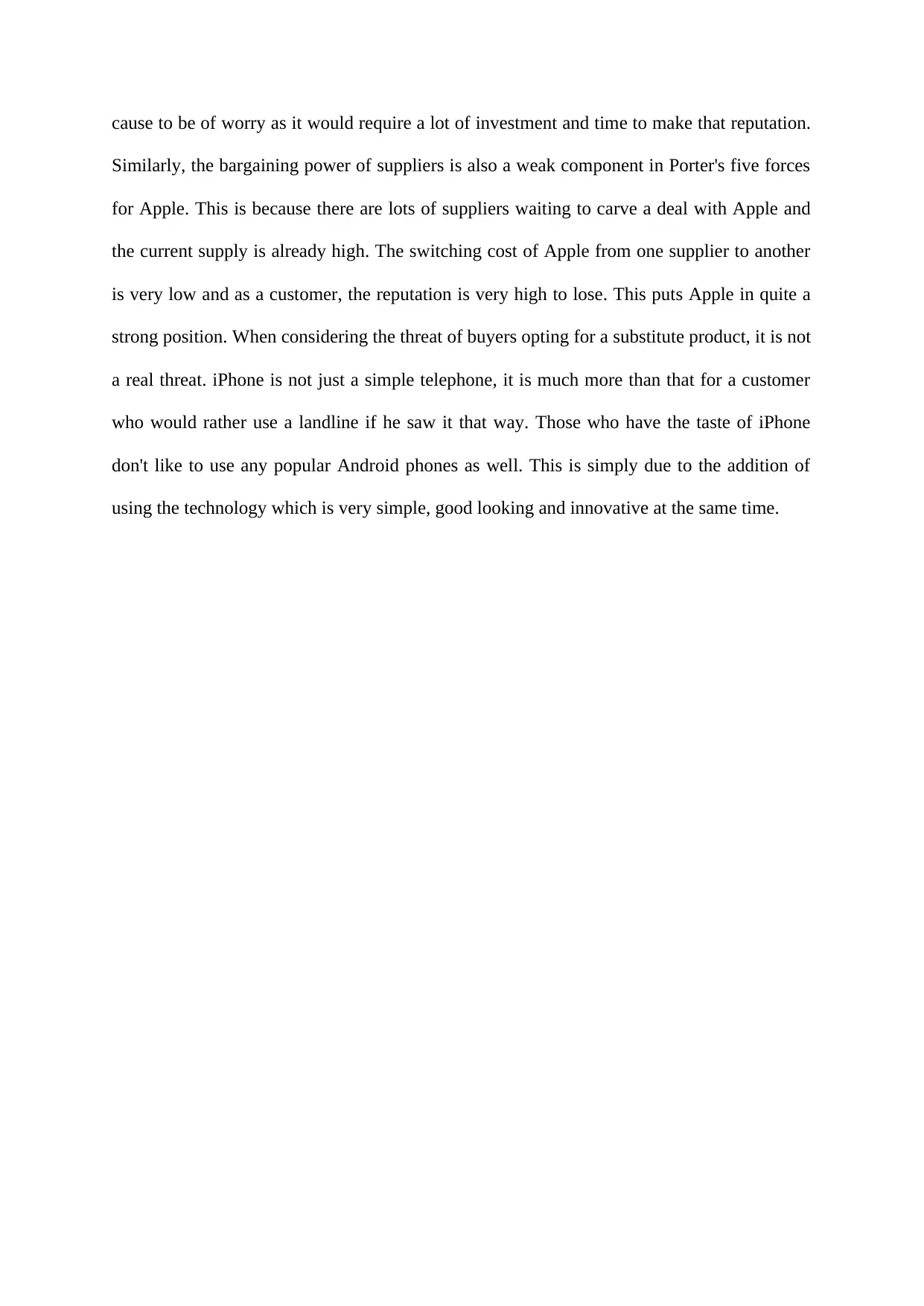
cause to be of worry as it would require a lot of investment and time to make that reputation.
Similarly, the bargaining power of suppliers is also a weak component in Porter's five forces
for Apple. This is because there are lots of suppliers waiting to carve a deal with Apple and
the current supply is already high. The switching cost of Apple from one supplier to another
is very low and as a customer, the reputation is very high to lose. This puts Apple in quite a
strong position. When considering the threat of buyers opting for a substitute product, it is not
a real threat. iPhone is not just a simple telephone, it is much more than that for a customer
who would rather use a landline if he saw it that way. Those who have the taste of iPhone
don't like to use any popular Android phones as well. This is simply due to the addition of
using the technology which is very simple, good looking and innovative at the same time.
Document Page
Samsung
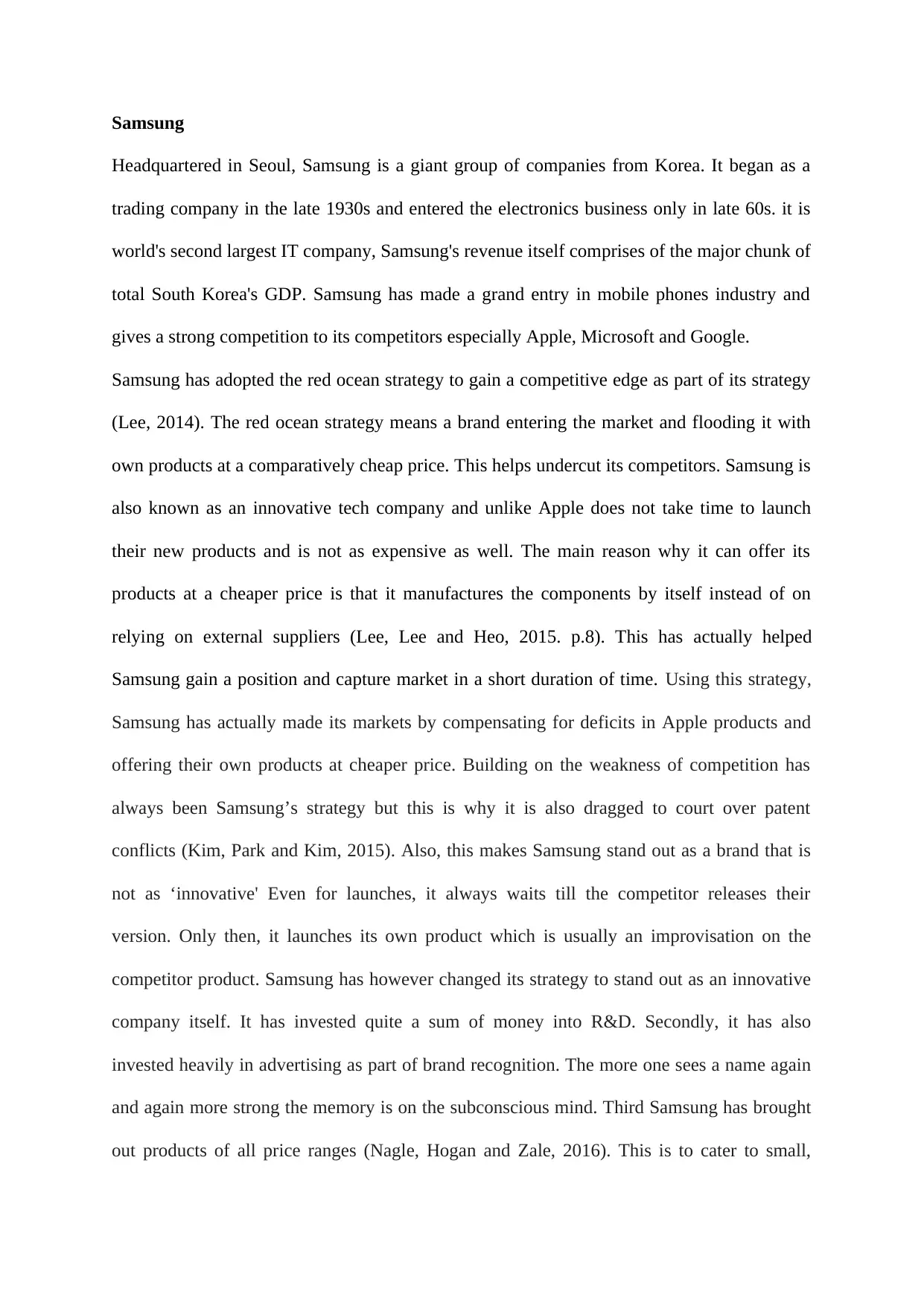
Headquartered in Seoul, Samsung is a giant group of companies from Korea. It began as a
trading company in the late 1930s and entered the electronics business only in late 60s. it is
world's second largest IT company, Samsung's revenue itself comprises of the major chunk of
total South Korea's GDP. Samsung has made a grand entry in mobile phones industry and
gives a strong competition to its competitors especially Apple, Microsoft and Google.
Samsung has adopted the red ocean strategy to gain a competitive edge as part of its strategy
(Lee, 2014). The red ocean strategy means a brand entering the market and flooding it with
own products at a comparatively cheap price. This helps undercut its competitors. Samsung is
also known as an innovative tech company and unlike Apple does not take time to launch
their new products and is not as expensive as well. The main reason why it can offer its
products at a cheaper price is that it manufactures the components by itself instead of on
relying on external suppliers (Lee, Lee and Heo, 2015. p.8). This has actually helped
Samsung gain a position and capture market in a short duration of time. Using this strategy,
Samsung has actually made its markets by compensating for deficits in Apple products and
offering their own products at cheaper price. Building on the weakness of competition has
always been Samsung’s strategy but this is why it is also dragged to court over patent
conflicts (Kim, Park and Kim, 2015). Also, this makes Samsung stand out as a brand that is
not as ‘innovative' Even for launches, it always waits till the competitor releases their
version. Only then, it launches its own product which is usually an improvisation on the
competitor product. Samsung has however changed its strategy to stand out as an innovative
company itself. It has invested quite a sum of money into R&D. Secondly, it has also
invested heavily in advertising as part of brand recognition. The more one sees a name again
and again more strong the memory is on the subconscious mind. Third Samsung has brought
out products of all price ranges (Nagle, Hogan and Zale, 2016). This is to cater to small,
tabler-icon-diamond-filled.svg

Paraphrase This Document

Need a fresh take? Get an instant paraphrase of this document with our AI Paraphraser
Document Page
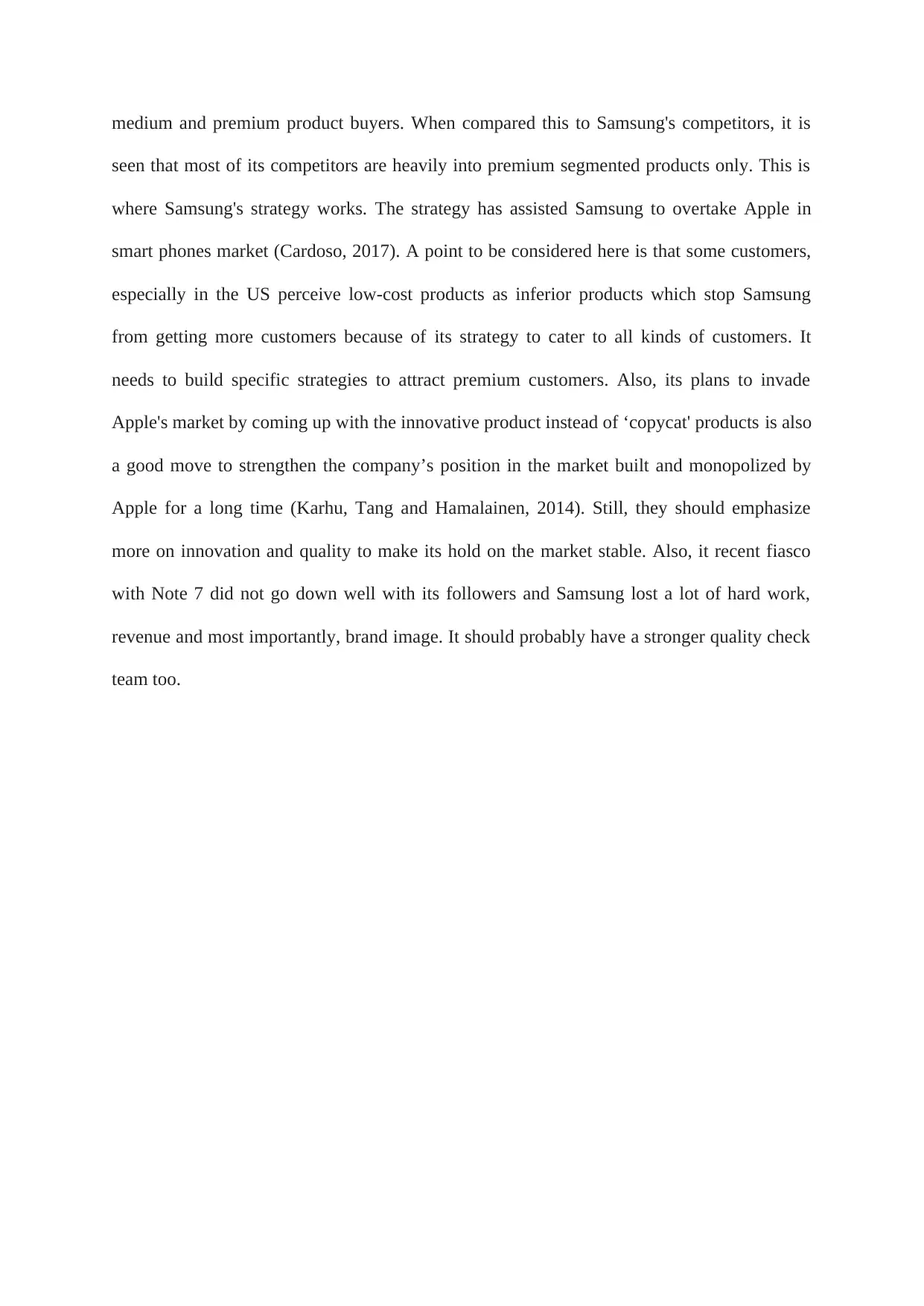
medium and premium product buyers. When compared this to Samsung's competitors, it is
seen that most of its competitors are heavily into premium segmented products only. This is
where Samsung's strategy works. The strategy has assisted Samsung to overtake Apple in
smart phones market (Cardoso, 2017). A point to be considered here is that some customers,
especially in the US perceive low-cost products as inferior products which stop Samsung
from getting more customers because of its strategy to cater to all kinds of customers. It
needs to build specific strategies to attract premium customers. Also, its plans to invade
Apple's market by coming up with the innovative product instead of ‘copycat' products is also
a good move to strengthen the company’s position in the market built and monopolized by
Apple for a long time (Karhu, Tang and Hamalainen, 2014). Still, they should emphasize
more on innovation and quality to make its hold on the market stable. Also, it recent fiasco
with Note 7 did not go down well with its followers and Samsung lost a lot of hard work,
revenue and most importantly, brand image. It should probably have a stronger quality check
team too.
Document Page
References
Books
Rao, C.B., 2017. Competitive strategy. Notion Press.
Nagle, T.T., Hogan, J. and Zale, J., 2016. The Strategy and Tactics of Pricing: New
International Edition. Routledge.
Journals
Lee, F.Y., 2014. Competitive Advantages of Smartphone Industry in 4G Era-A case study of
SAMSUNG and SONY.
Karhu, K., Tang, T. and Hämäläinen, M., 2014. Analyzing competitive and collaborative
differences among mobile ecosystems using abstracted strategy networks. Telematics and
Informatics, 31(2), pp.319-333.
Kim, S.Y., Park, S.T. and Kim, Y.K., 2015. Samsung-Apple patent war case analysis: focus
on the strategy to deal with patent litigation. Journal of digital convergence, 13(3), pp.117-
125.
Lee, J., Lee, K. and Heo, J., 2015. Supplier Partnership Strategy and Global Competitiveness:
A Case of Samsung Electronics. Eurasian Journal of Business and Management, 3(4), pp.1-
12.
Cardoso, E.A.R.P., 2017. Examining the differences of the internationalization strategies of
two of the major brands in the smartphone industry-Apple inc. versus Samsung
electronics (Doctoral dissertation).
Straker, K. and Wrigley, C., 2016. 11. The role of emotion, experience and meaning: the
comparative case of Apple and Samsung. International Perspectives on Business Innovation
and Disruption in Design, p.231.
Document Page
chevron_up_icon
1 out of 7
circle_padding
hide_on_mobile
zoom_out_icon
[object Object]