Theories, Tools & Case Study: Complex Project Management
VerifiedAdded on 2023/06/08
|22
|6578
|306
Essay
AI Summary
This essay provides a comprehensive exploration of complex project management, delving into the various theories, causes, and environments that contribute to project complexity. It differentiates between simple and complex projects, highlighting the key factors such as project size, time constraints, and stakeholder involvement. The essay examines the implications of these complexities, using the PB Deepwater Horizon project as a case study to illustrate the challenges and potential pitfalls. Furthermore, it discusses various tools and techniques, including Gantt charts, PERT charts, and the critical path method, that project managers can utilize to effectively manage complex projects. The degree and nature of project cases are analyzed in the context of established theories and ideas, ultimately emphasizing the importance of understanding complexity for successful project outcomes. Desklib offers a wide range of resources, including past papers and solved assignments, to aid students in their understanding of project management concepts.
Running head: THE CONCEMPT OF COMPLEX PROJECT MANAGEMENT 1
THE THEORIES SURROUNDING THE CONCEPT OF COMPLEX PROJECT
MANAGEMENT
Name
Institution
Course
Date
THE THEORIES SURROUNDING THE CONCEPT OF COMPLEX PROJECT
MANAGEMENT
Name
Institution
Course
Date

Paraphrase This Document
Need a fresh take? Get an instant paraphrase of this document with our AI Paraphraser
Running head: CONCEPT OF COMPLEX PROJECT MANAGEMENT. 2
THE THEORIES SURROUNDING THE CONCEPT OF COMPLEX PROJECT
MANAGEMENT.
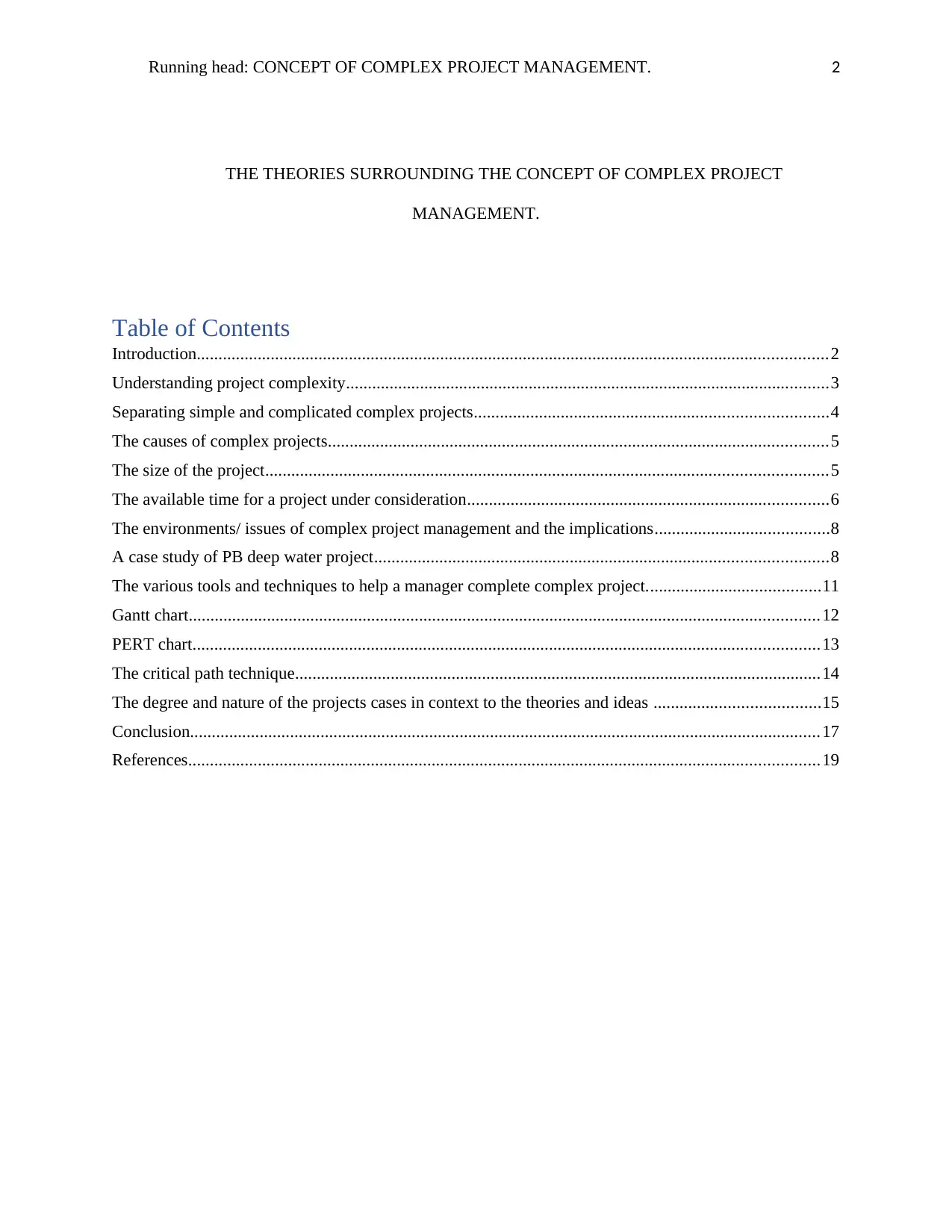
Table of Contents
Introduction.................................................................................................................................................2
Understanding project complexity...............................................................................................................3
Separating simple and complicated complex projects.................................................................................4
The causes of complex projects...................................................................................................................5
The size of the project.................................................................................................................................5
The available time for a project under consideration...................................................................................6
The environments/ issues of complex project management and the implications........................................8
A case study of PB deep water project........................................................................................................8
The various tools and techniques to help a manager complete complex project........................................11
Gantt chart.................................................................................................................................................12
PERT chart................................................................................................................................................13
The critical path technique.........................................................................................................................14
The degree and nature of the projects cases in context to the theories and ideas ......................................15
Conclusion.................................................................................................................................................17
References.................................................................................................................................................19
THE THEORIES SURROUNDING THE CONCEPT OF COMPLEX PROJECT
MANAGEMENT.
Table of Contents
Introduction.................................................................................................................................................2
Understanding project complexity...............................................................................................................3
Separating simple and complicated complex projects.................................................................................4
The causes of complex projects...................................................................................................................5
The size of the project.................................................................................................................................5
The available time for a project under consideration...................................................................................6
The environments/ issues of complex project management and the implications........................................8
A case study of PB deep water project........................................................................................................8
The various tools and techniques to help a manager complete complex project........................................11
Gantt chart.................................................................................................................................................12
PERT chart................................................................................................................................................13
The critical path technique.........................................................................................................................14
The degree and nature of the projects cases in context to the theories and ideas ......................................15
Conclusion.................................................................................................................................................17
References.................................................................................................................................................19
CONCEPT OF COMPLEX PROJECT MANAGEMENT. 3
1)Introduction
In the last few decades, there has been a continuous and persistent increase in the number of
project management activities being undertaken due to the growing popularity and its long-term success
rate in accomplishing projects successfully. The project activities or rather project management has been
adapted in many different industries and professions which require effective planning when undertaking
ventures. Nonetheless, research has indicated that among the many industries that have adopted project
management, the engineering industry still takes the lead, due to the intricacy of its activities. In the
engineering sector, projects like constructions software development/ information technology projects are
the are the dominate project related activities. It is however important to note that different projects
require different level of effort for its successful completion. Some may require less resources, efforts and
skills while others may need extra-ordinary commitment, resources, skills and time for it to be
successfully executed or rather completed. This brings an insight in the level of complexity of project.
Project management requires careful application of skills and practices for effective integration of the
several sub-projects. Additionally, project management requires interpersonal communication skills by
the project manager. Additionally, there is need for additional skills like conflict resolution and
communication techniques. All these variables Due to the difference in the degree of difficulty among
projects, attentions have been directed towards simplifying the project execution. This is evidenced by the
argument put forth by Cooke-Davies (2011), managing projects in a complex world. It is noted that the
development of modern project management techniques are specifically geared towards the reduction or
simplification of project complexities especially for projects involving the integration of many sub-projects,
which in most cases been referred to as complex projects (p.3).
complexity of different projects may vary from one project manager to another basing on their
perception and skills in handling projects. It should therefore be noted that a project being hard does not
necessarily mean it is complex. According to Jeff Worley, former VP of the Boeing company there are
mostly four kinds of complexities in project management; technical complexity, cost complexity,
1)Introduction
In the last few decades, there has been a continuous and persistent increase in the number of
project management activities being undertaken due to the growing popularity and its long-term success
rate in accomplishing projects successfully. The project activities or rather project management has been
adapted in many different industries and professions which require effective planning when undertaking
ventures. Nonetheless, research has indicated that among the many industries that have adopted project
management, the engineering industry still takes the lead, due to the intricacy of its activities. In the
engineering sector, projects like constructions software development/ information technology projects are
the are the dominate project related activities. It is however important to note that different projects
require different level of effort for its successful completion. Some may require less resources, efforts and
skills while others may need extra-ordinary commitment, resources, skills and time for it to be
successfully executed or rather completed. This brings an insight in the level of complexity of project.
Project management requires careful application of skills and practices for effective integration of the
several sub-projects. Additionally, project management requires interpersonal communication skills by
the project manager. Additionally, there is need for additional skills like conflict resolution and
communication techniques. All these variables Due to the difference in the degree of difficulty among
projects, attentions have been directed towards simplifying the project execution. This is evidenced by the
argument put forth by Cooke-Davies (2011), managing projects in a complex world. It is noted that the
development of modern project management techniques are specifically geared towards the reduction or
simplification of project complexities especially for projects involving the integration of many sub-projects,
which in most cases been referred to as complex projects (p.3).
complexity of different projects may vary from one project manager to another basing on their
perception and skills in handling projects. It should therefore be noted that a project being hard does not
necessarily mean it is complex. According to Jeff Worley, former VP of the Boeing company there are
mostly four kinds of complexities in project management; technical complexity, cost complexity,
⊘ This is a preview!⊘
Do you want full access?
Subscribe today to unlock all pages.

Trusted by 1+ million students worldwide
CONCEPT OF COMPLEX PROJECT MANAGEMENT. 4
schedule complexity and political complexity. Terry-cook chapter one, it was highlighted that a project
becomes complex when the manager’s effects are difficult to predict or unexpected. A project usually
becomes complex when it results into a combination of three effects; lots of interconnections, highly to be
lots of changes with high levels of uncertainty and time constraint. The key for a project manager to
manage complexity is by analyzing at the early stages, understands the origin of the complexity and
ensuring proper strategy is put in place. The concept of complexity has various theories, causes and
situations/ environment and there are many schools of thought to this with the most common being by
Terry Cooke-Davies’ (Aspects of complexity). The strain, exertion and difficulty of different projects
may be referred to as the level of project complexity in a law man’s understanding. However, different
project specialist has defined project complexity in different way.
2)Understanding project complexity
From the insight in the introductory section, we understand that complexity or the
complicatedness of different projects vary. Complexity has been defined in many different ways by
different scholars. Some researchers like terry-cook, in his book of “aspects of complexity: managing
projects on complex world chapter one, he defined project complexity as the type of project that involves
the integration of many sub-parts and hard to analyze, evaluate, understand and deal with. In other words,
the degree of difficulty and exertion of a project is referred to as project complexity. Different field have
different projects and the completes also varies. One of the fields that have been recognized as
encompassing complex projects include the construction industry due to the increasing innovation and
integration of many subprojects (Cooke-Davies, T. (2011, p.2)
Lalonde, Bourgault & Findeli (2010, p.21) highlighted that all projects are complex, however, the
level of complexity matters. they based complexity on the size of the project, the degree of technicality/
difficulty, and the level of uncertainty of a project. Projects that tend to be more technical and highly
uncertain are regarded as complex in reference to this study. It was anchored by Beringer, Jonas, & Georg
schedule complexity and political complexity. Terry-cook chapter one, it was highlighted that a project
becomes complex when the manager’s effects are difficult to predict or unexpected. A project usually
becomes complex when it results into a combination of three effects; lots of interconnections, highly to be
lots of changes with high levels of uncertainty and time constraint. The key for a project manager to
manage complexity is by analyzing at the early stages, understands the origin of the complexity and
ensuring proper strategy is put in place. The concept of complexity has various theories, causes and
situations/ environment and there are many schools of thought to this with the most common being by
Terry Cooke-Davies’ (Aspects of complexity). The strain, exertion and difficulty of different projects
may be referred to as the level of project complexity in a law man’s understanding. However, different
project specialist has defined project complexity in different way.
2)Understanding project complexity
From the insight in the introductory section, we understand that complexity or the
complicatedness of different projects vary. Complexity has been defined in many different ways by
different scholars. Some researchers like terry-cook, in his book of “aspects of complexity: managing
projects on complex world chapter one, he defined project complexity as the type of project that involves
the integration of many sub-parts and hard to analyze, evaluate, understand and deal with. In other words,
the degree of difficulty and exertion of a project is referred to as project complexity. Different field have
different projects and the completes also varies. One of the fields that have been recognized as
encompassing complex projects include the construction industry due to the increasing innovation and
integration of many subprojects (Cooke-Davies, T. (2011, p.2)
Lalonde, Bourgault & Findeli (2010, p.21) highlighted that all projects are complex, however, the
level of complexity matters. they based complexity on the size of the project, the degree of technicality/
difficulty, and the level of uncertainty of a project. Projects that tend to be more technical and highly
uncertain are regarded as complex in reference to this study. It was anchored by Beringer, Jonas, & Georg
Paraphrase This Document
Need a fresh take? Get an instant paraphrase of this document with our AI Paraphraser
CONCEPT OF COMPLEX PROJECT MANAGEMENT. 5
(2012, p.32) who recommended that for a project to be tagged complex, it must ascertain certain attributes
which include technical complexity, schedule complexity, cost complexity and political complexity. To
him, to him, complexity or complicatedness solely depend on the four variables. Some complex projects
may not have all the four. This implies that the degree of complexity increases with increase in the
variables as well as the strength of the variables. A study by Rolstadås, et al. also regarded a project to be
complex when it is highly uncertain to predict the possible outcomes, highly interdependent/
interconnected, and has a high degree of time constraint.
On the other hand, theories may primarily and typically be understood as the norms or principles
associated to a particular topic or project. In reference to this, it is important to note that the theories
surrounding the concept of complex project managements are simply norms and believes that people
(project managers) uphold in relation to complex projects. The complexity of different projects may be
perceived in different ways according to different project managers. In other words,
3)Separating simple and complicated complex projects
From the definitions of complex projects according to Worley, it is imperative to understand
that simple projects are those that do not have the four variables as listed in the introductory section
i.e. time technicality, schedule, political and cost technicality (Saviano, & Di, 2011, p.199). This is
simply the reverse of his definition. From a general perspective, simple projects refer to the ones that
do not have many interdependent subprojects, manageable in relationships to the cost and time
4)The causes of complex projects
In regard to the introduction, it was noted that the issue of complexity is caused by various
questions and based on different perceptions. this variation is due to a feedback loop in which case the
effect is itself a root cause. The most frequent causes of project complexity are known to be the changes
in variables like project size, location, the team experience or expertise, interfaces within the project,
(2012, p.32) who recommended that for a project to be tagged complex, it must ascertain certain attributes
which include technical complexity, schedule complexity, cost complexity and political complexity. To
him, to him, complexity or complicatedness solely depend on the four variables. Some complex projects
may not have all the four. This implies that the degree of complexity increases with increase in the
variables as well as the strength of the variables. A study by Rolstadås, et al. also regarded a project to be
complex when it is highly uncertain to predict the possible outcomes, highly interdependent/
interconnected, and has a high degree of time constraint.
On the other hand, theories may primarily and typically be understood as the norms or principles
associated to a particular topic or project. In reference to this, it is important to note that the theories
surrounding the concept of complex project managements are simply norms and believes that people
(project managers) uphold in relation to complex projects. The complexity of different projects may be
perceived in different ways according to different project managers. In other words,
3)Separating simple and complicated complex projects
From the definitions of complex projects according to Worley, it is imperative to understand
that simple projects are those that do not have the four variables as listed in the introductory section
i.e. time technicality, schedule, political and cost technicality (Saviano, & Di, 2011, p.199). This is
simply the reverse of his definition. From a general perspective, simple projects refer to the ones that
do not have many interdependent subprojects, manageable in relationships to the cost and time
4)The causes of complex projects
In regard to the introduction, it was noted that the issue of complexity is caused by various
questions and based on different perceptions. this variation is due to a feedback loop in which case the
effect is itself a root cause. The most frequent causes of project complexity are known to be the changes
in variables like project size, location, the team experience or expertise, interfaces within the project,
CONCEPT OF COMPLEX PROJECT MANAGEMENT. 6
logistics, political influences, permits and approvals there isn’t much difference between complexity and
the achievement aspects of the scheme. The biggest issues that influence the effect on the success of the
project are production time and cost. When this complexity is not fully understood by the managers,
failure of projects becomes the order of the day.
(Pauget, & Wald (2013, p.200) showed that complex projects possess various characteristics
which makes it hard to predict the project outcomes. The relationship that exist between project interfaces
and attributes induces complex projects and their subsequent significant influence on the functionality and
predictability. With the preceding note, we can draw an insight that, although complexities vary from
project managers to other project managers, there are basic general perceptions and issues that may make
a project to be regarded as complex. These complexities arise from the number of variables and project
size under execution. The causes of complex projects can be identified as follows;
a) The size of the project
When a project involves a large number of stakeholders, it is typically true that the management
of various stakeholders involved in the project will be complex. It anchors on the principle/ norm that the
higher the number of stakeholders, the complex a project is regarded. Additionally, large projects require
extraordinary skills when it comes to the allocation of resources to the many various subprojects in the
project. A failure or misconception during resource allocation consequently leads to large costs and
expenses undertaken which is results into losses and project failures in general. Risk management and
assessment is yet another issue that is associated with large projects. The larger a project is, the higher the
risks involved which requires a more integrative skills of assessing the various project fields and
structures. This subsequently increases the level of complexity of a given project.
With the prior knowledge in this section, it becomes inevitable that bigger projects are more
complex as compared to the small ones. Increasing the number of stakeholder and resources leads to
complexity as it hampers project effectivity and outcomes. Customer satisfaction has a lot to do with the
logistics, political influences, permits and approvals there isn’t much difference between complexity and
the achievement aspects of the scheme. The biggest issues that influence the effect on the success of the
project are production time and cost. When this complexity is not fully understood by the managers,
failure of projects becomes the order of the day.
(Pauget, & Wald (2013, p.200) showed that complex projects possess various characteristics
which makes it hard to predict the project outcomes. The relationship that exist between project interfaces
and attributes induces complex projects and their subsequent significant influence on the functionality and
predictability. With the preceding note, we can draw an insight that, although complexities vary from
project managers to other project managers, there are basic general perceptions and issues that may make
a project to be regarded as complex. These complexities arise from the number of variables and project
size under execution. The causes of complex projects can be identified as follows;
a) The size of the project
When a project involves a large number of stakeholders, it is typically true that the management
of various stakeholders involved in the project will be complex. It anchors on the principle/ norm that the
higher the number of stakeholders, the complex a project is regarded. Additionally, large projects require
extraordinary skills when it comes to the allocation of resources to the many various subprojects in the
project. A failure or misconception during resource allocation consequently leads to large costs and
expenses undertaken which is results into losses and project failures in general. Risk management and
assessment is yet another issue that is associated with large projects. The larger a project is, the higher the
risks involved which requires a more integrative skills of assessing the various project fields and
structures. This subsequently increases the level of complexity of a given project.
With the prior knowledge in this section, it becomes inevitable that bigger projects are more
complex as compared to the small ones. Increasing the number of stakeholder and resources leads to
complexity as it hampers project effectivity and outcomes. Customer satisfaction has a lot to do with the
⊘ This is a preview!⊘
Do you want full access?
Subscribe today to unlock all pages.
Trusted by 1+ million students worldwide
CONCEPT OF COMPLEX PROJECT MANAGEMENT. 7
success and failure of the project and it does matters whether the project outcomes are in line with the
project expected deliverables or requirements.
b)The available time for a project under consideration
Today, change management has yet become another important factor when it comes to project
management. Change management refers to the ways in which an organization or a project manager
prepares and acquaint his team with the necessary skills for change management. While taking a critical
analysis of change management in projects, the ability of project managers to efficiently and correctly
disseminate skills among the team members of a project to enhance the success rate of a project is yet
another factor that complicates projects. This is evident in Hu, Chan, Le, & Jin (2013, vol.3). Projects
with much activities and stages involved yet has a short deadline consequently becomes complex. This is
because it requires a close attention accompanied with high level of flexibility to changes. Being able to
fix schedules and competently redistributing resources in a short time period can be challenging and
frustrating to the managers. In other words, the process of managing projects with shorter deadline
requires a high degree of competence in relation to time and change management. Research studies
reported by a series of project managers in different fields have indicated that one of the main reasons for
shadow work in project management fields are a result of poor change management and time allocation.
The tendencies of project managers to work under pressure due to deadline period as dictated by the
project timeline makes project outcomes to be of substandard. In reference to this, it is important to note
that time management as well as change management should be offered a great attention
A recommendation by Larson et al., (2014, vol.6) put it clear that projects would rather miss the
deadline as shown in the project timeline than meeting deadline and making substandard outcome. They
capitalized in successfully managing project portfolios. It was note that structural alignment in project
management helps in defining all the relevant activities to be involved during the project management
processes while appropriately and efficiently managing time. This can only be achieved through having a
success and failure of the project and it does matters whether the project outcomes are in line with the
project expected deliverables or requirements.
b)The available time for a project under consideration
Today, change management has yet become another important factor when it comes to project
management. Change management refers to the ways in which an organization or a project manager
prepares and acquaint his team with the necessary skills for change management. While taking a critical
analysis of change management in projects, the ability of project managers to efficiently and correctly
disseminate skills among the team members of a project to enhance the success rate of a project is yet
another factor that complicates projects. This is evident in Hu, Chan, Le, & Jin (2013, vol.3). Projects
with much activities and stages involved yet has a short deadline consequently becomes complex. This is
because it requires a close attention accompanied with high level of flexibility to changes. Being able to
fix schedules and competently redistributing resources in a short time period can be challenging and
frustrating to the managers. In other words, the process of managing projects with shorter deadline
requires a high degree of competence in relation to time and change management. Research studies
reported by a series of project managers in different fields have indicated that one of the main reasons for
shadow work in project management fields are a result of poor change management and time allocation.
The tendencies of project managers to work under pressure due to deadline period as dictated by the
project timeline makes project outcomes to be of substandard. In reference to this, it is important to note
that time management as well as change management should be offered a great attention
A recommendation by Larson et al., (2014, vol.6) put it clear that projects would rather miss the
deadline as shown in the project timeline than meeting deadline and making substandard outcome. They
capitalized in successfully managing project portfolios. It was note that structural alignment in project
management helps in defining all the relevant activities to be involved during the project management
processes while appropriately and efficiently managing time. This can only be achieved through having a
Paraphrase This Document
Need a fresh take? Get an instant paraphrase of this document with our AI Paraphraser
CONCEPT OF COMPLEX PROJECT MANAGEMENT. 8
thorough understanding of the role of structural alignment in aligning the several project activities. This
report positively correlated to the view and idea of many other scholars like. It was noted that
understanding complexity of a project helps in appropriate planning and thus increasing the project
success rate. In other words, it is like mitigating the project activities that are likely to by critically
diagnosing the possible weak points of the project and hence putting forth the possible solutions or rather
remedies for the weak points, in turn helping in improving project success rates within the required time
bound and within the budget as anticipated in the project charter and timeline
In a sense of wiping up and summarizing the causes of project complexity, it is typical to center
on some specific factors that can be additives of making a project complex. These factors include but not
limited to;
Poor working relationship and collaboration among the project stakeholders
Poorly defining and allocating of project roles to unqualified or uncommitted
project stakeholders or rather stakeholders having divergent interest from what is expected
Ambiguity and unclearness of the client needs in the project outcomes or
deliveries
Poor communication between and among different stakeholders.
Poor decision making among the involved stakeholders mostly due to low
expertise
Doloi (2011, p. 636) reported that complex projects in most cases have multiple values or
variations. Successful management of these complexities and properties calls for; delivery leadership
ability to go through uncertainty to achieve the projects vision, collaboration or working as one team in
harmony, benefits realization, understanding and delivering value, effective communication and being
responsible
thorough understanding of the role of structural alignment in aligning the several project activities. This
report positively correlated to the view and idea of many other scholars like. It was noted that
understanding complexity of a project helps in appropriate planning and thus increasing the project
success rate. In other words, it is like mitigating the project activities that are likely to by critically
diagnosing the possible weak points of the project and hence putting forth the possible solutions or rather
remedies for the weak points, in turn helping in improving project success rates within the required time
bound and within the budget as anticipated in the project charter and timeline
In a sense of wiping up and summarizing the causes of project complexity, it is typical to center
on some specific factors that can be additives of making a project complex. These factors include but not
limited to;
Poor working relationship and collaboration among the project stakeholders
Poorly defining and allocating of project roles to unqualified or uncommitted
project stakeholders or rather stakeholders having divergent interest from what is expected
Ambiguity and unclearness of the client needs in the project outcomes or
deliveries
Poor communication between and among different stakeholders.
Poor decision making among the involved stakeholders mostly due to low
expertise
Doloi (2011, p. 636) reported that complex projects in most cases have multiple values or
variations. Successful management of these complexities and properties calls for; delivery leadership
ability to go through uncertainty to achieve the projects vision, collaboration or working as one team in
harmony, benefits realization, understanding and delivering value, effective communication and being
responsible
CONCEPT OF COMPLEX PROJECT MANAGEMENT. 9
5)The environments/ issues of complex project
management and the implications
When it comes to environment of complex projects, it basically refers to the prevailing conditions
and contexts in which complex projects are executed in. This implies the contexts to which complex
projects are performed or implemented. As it was noted earlier, complex projects involve the integration
of many sub-projects with high level of difficulty in understanding. It therefore implies there is need for
careful analytical skills in order to successfully understand execute the project activities as required or
rather as expected. In addition, there is need to detect the eco-friendly consciousness needed or required
by the project manager in complex situations (Bryde, Broquetas, & Volm, 2013, p. 980). The factors
vary; that is to say, the internal factors and the external factors. These are the main drivers of project/
business outcomes and may also be affected by the internal culture of how the firm reacts to a shift in
change management and project engagement.
A case study of PB deep water project
Taking a critical review of the BP deep water project it is justifiable that complex projects are
much more difficult to handle. It requires the integration and execution of many complicated sub systems.
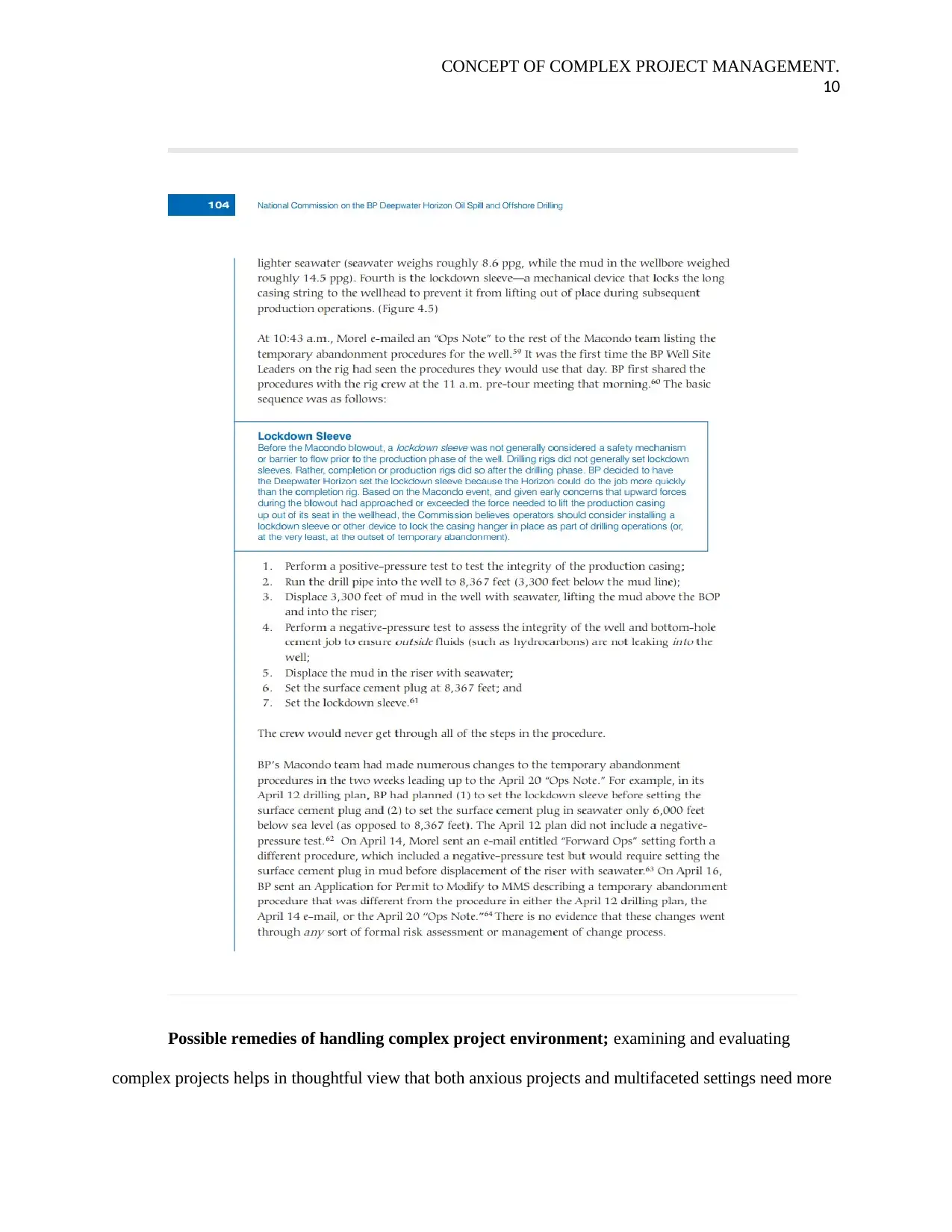
The level of uncertainties and risks are significantly high. For example, in the report compiled by the
National Commission on the BP Deep Water Horizon oil spill and offshore chapter four, (p.94-104), it
was illustrated that, the exertion of pipes into deep water, thousands of feet’s underneath involves a high
degree of complexity accompanied by numerous uncertainties. Keeping in mind that pipe exertion is just
a micro (small sub structure) of the big BP deep water construction. Analyzing the complexity and risks
of only the pipe exertion as a case study, then reflecting it on the whole BP project which has hundreds of
such projects, it typically becomes extra-complicated/ complex (Water, 2011)
5)The environments/ issues of complex project
management and the implications
When it comes to environment of complex projects, it basically refers to the prevailing conditions
and contexts in which complex projects are executed in. This implies the contexts to which complex
projects are performed or implemented. As it was noted earlier, complex projects involve the integration
of many sub-projects with high level of difficulty in understanding. It therefore implies there is need for
careful analytical skills in order to successfully understand execute the project activities as required or
rather as expected. In addition, there is need to detect the eco-friendly consciousness needed or required
by the project manager in complex situations (Bryde, Broquetas, & Volm, 2013, p. 980). The factors
vary; that is to say, the internal factors and the external factors. These are the main drivers of project/
business outcomes and may also be affected by the internal culture of how the firm reacts to a shift in
change management and project engagement.
A case study of PB deep water project
Taking a critical review of the BP deep water project it is justifiable that complex projects are
much more difficult to handle. It requires the integration and execution of many complicated sub systems.
The level of uncertainties and risks are significantly high. For example, in the report compiled by the
National Commission on the BP Deep Water Horizon oil spill and offshore chapter four, (p.94-104), it
was illustrated that, the exertion of pipes into deep water, thousands of feet’s underneath involves a high
degree of complexity accompanied by numerous uncertainties. Keeping in mind that pipe exertion is just
a micro (small sub structure) of the big BP deep water construction. Analyzing the complexity and risks
of only the pipe exertion as a case study, then reflecting it on the whole BP project which has hundreds of
such projects, it typically becomes extra-complicated/ complex (Water, 2011)
⊘ This is a preview!⊘
Do you want full access?
Subscribe today to unlock all pages.
Trusted by 1+ million students worldwide
CONCEPT OF COMPLEX PROJECT MANAGEMENT.
10
Possible remedies of handling complex project environment; examining and evaluating
complex projects helps in thoughtful view that both anxious projects and multifaceted settings need more
10
Possible remedies of handling complex project environment; examining and evaluating
complex projects helps in thoughtful view that both anxious projects and multifaceted settings need more
Paraphrase This Document
Need a fresh take? Get an instant paraphrase of this document with our AI Paraphraser
CONCEPT OF COMPLEX PROJECT MANAGEMENT.
11
or less similar approaches to attain the deserved success. Some areas are beyond the project managers
control when toiling to ensure success of a project such as; competing stakeholder interests, lack of
commitment by the stakeholders and the nature of the project’s business benefit. The commercial setting
in which the project team members and its prospect of success before it even commences. it mainly
concerns the way in which the project’s manager exerts influence through experience, knowledge and
determination to assist in project execution. Recovery or troubled projects display similar kinds of
environment. In this essence, it is the responsibility of the project manager to streamline and strategically
align the available resources while using the most appropriate techniques to structure an environment
favorable for the complex project. These can be achieved by the manager through;
Employing the most effective and updated technology in the project execution
Arousing the zeal and passion of the project stakeholders to put more effort and
strengthening their effort
Employing best conflict management and resolution methods to help in
harmonious working
Ensuring effective communication and engagement among the stakeholders
Improving on the risk mitigation through improved risk assessment and analysis
Environment of the business is broken down into mostly the context of business projects
whether its government or for-profit firms. Poor and lack of process and documentation are indicators of a
poor complex project environment and this subsequently increases the degree of failure in a project. The
external and internal environment should be well gauged as argued in Environmental scan by Michael E.
Porter. He proposed the five forces model as a way of determining the competitive forces that define
industry profitability. Other important external factors are the political and regulatory environments. This
always comes with new views and new priorities for government portfolios as does a change of
government. The employment of porter’s five forces can further help in advancing the project success
more especially for business-oriented projects established in a competitive market or industry. The
11
or less similar approaches to attain the deserved success. Some areas are beyond the project managers
control when toiling to ensure success of a project such as; competing stakeholder interests, lack of
commitment by the stakeholders and the nature of the project’s business benefit. The commercial setting
in which the project team members and its prospect of success before it even commences. it mainly
concerns the way in which the project’s manager exerts influence through experience, knowledge and
determination to assist in project execution. Recovery or troubled projects display similar kinds of
environment. In this essence, it is the responsibility of the project manager to streamline and strategically
align the available resources while using the most appropriate techniques to structure an environment
favorable for the complex project. These can be achieved by the manager through;
Employing the most effective and updated technology in the project execution
Arousing the zeal and passion of the project stakeholders to put more effort and
strengthening their effort
Employing best conflict management and resolution methods to help in
harmonious working
Ensuring effective communication and engagement among the stakeholders
Improving on the risk mitigation through improved risk assessment and analysis
Environment of the business is broken down into mostly the context of business projects
whether its government or for-profit firms. Poor and lack of process and documentation are indicators of a
poor complex project environment and this subsequently increases the degree of failure in a project. The
external and internal environment should be well gauged as argued in Environmental scan by Michael E.
Porter. He proposed the five forces model as a way of determining the competitive forces that define
industry profitability. Other important external factors are the political and regulatory environments. This
always comes with new views and new priorities for government portfolios as does a change of
government. The employment of porter’s five forces can further help in advancing the project success
more especially for business-oriented projects established in a competitive market or industry. The
CONCEPT OF COMPLEX PROJECT MANAGEMENT.
12
standard portfolio management-second edition cascaded that planning from strategy, portfolio, and
operational planning helps to ensure the firm’s success and improve the project’s prospect of
accomplishment. Mir, & Pinnington (2014, p.217) evaluated and found that there is a difference between
complex environments and troubled projects, but there are similarities that both can be handled in similar
ways. In simple terms, all projects are planned and implemented in social, political, international and
environmental context. International and political environment; this requires knowledge on national,
international or local laws and customs, time zones, technology levels and use, logistics requirements and
favorable means of travel.
Physical environment; knowledge about local ecology and physical geography that could affect or
be affected by the project. Cultural and social environment; it’s mostly about how a project affects the
people and how they affect it in return. It’s very sensitive and requires understanding of the
demographics, ethical, cultural and religious backgrounds.
6)The various tools and techniques to help a manager
complete complex project.
From time to time, there has been a continuous innovation of existing knowledge as well as the
invention of new and more improved mechanism of handling tasks with in a project. It is therefore
important to note that complex projects to adopt to such change management for a successful completion
of the project. It was noted in the earlier section that change management is an important aspect of project
success and improvement as it can be noted in Pitsis et al. (2014, p. 1290). The changes in the era has
therefore led to the development of new tools and techniques directed towards improving and simplifying
the tasks associated with complex project management. This has been evident in the consistent and
persistent development of computerized project management applications. This include but not limited to
Microsoft visuals, Microsoft project manager among many others.
12
standard portfolio management-second edition cascaded that planning from strategy, portfolio, and
operational planning helps to ensure the firm’s success and improve the project’s prospect of
accomplishment. Mir, & Pinnington (2014, p.217) evaluated and found that there is a difference between
complex environments and troubled projects, but there are similarities that both can be handled in similar
ways. In simple terms, all projects are planned and implemented in social, political, international and
environmental context. International and political environment; this requires knowledge on national,
international or local laws and customs, time zones, technology levels and use, logistics requirements and
favorable means of travel.
Physical environment; knowledge about local ecology and physical geography that could affect or
be affected by the project. Cultural and social environment; it’s mostly about how a project affects the
people and how they affect it in return. It’s very sensitive and requires understanding of the
demographics, ethical, cultural and religious backgrounds.
6)The various tools and techniques to help a manager
complete complex project.
From time to time, there has been a continuous innovation of existing knowledge as well as the
invention of new and more improved mechanism of handling tasks with in a project. It is therefore
important to note that complex projects to adopt to such change management for a successful completion
of the project. It was noted in the earlier section that change management is an important aspect of project
success and improvement as it can be noted in Pitsis et al. (2014, p. 1290). The changes in the era has
therefore led to the development of new tools and techniques directed towards improving and simplifying
the tasks associated with complex project management. This has been evident in the consistent and
persistent development of computerized project management applications. This include but not limited to
Microsoft visuals, Microsoft project manager among many others.
⊘ This is a preview!⊘
Do you want full access?
Subscribe today to unlock all pages.
Trusted by 1+ million students worldwide

1 out of 22


Related Documents


Your All-in-One AI-Powered Toolkit for Academic Success.
+13062052269
info@desklib.com
Available 24*7 on WhatsApp / Email
![[object Object]](/_next/static/media/star-bottom.7253800d.svg)
Unlock your academic potential
Copyright © 2020–2026 A2Z Services. All Rights Reserved. Developed and managed by ZUCOL.