Complex System Analysis: Cynefin Framework and Risk Management
VerifiedAdded on 2022/09/29
|16
|4003
|25
Report
AI Summary
This report delves into the analysis of complex systems, emphasizing the Cynefin framework as a tool for understanding and managing intricate project environments. It begins by defining complex systems and highlighting the uncertainties inherent in their management. The report then explores the Cynefin framework, detailing its four domains (obvious, complicated, complex, and chaotic) and how they apply to problem-solving. Sense-making is discussed as a method for gathering and interpreting data within these complex systems, using international trade corruption as an example. The report further examines systemic risks in complex system management, particularly within the context of the stock market, and identifies initiating events that can lead to market fluctuations. The report concludes with recommendations for effective complex system engineering practices, underscoring the importance of understanding problem domains, verification, and validation in the system development process. The report stresses the need for clear communication, emergent behavior analysis, and adaptable strategies for successful project management. The report is a student submission available on Desklib, a platform offering AI-based study tools.

Running head: ANALYSIS OF COMPLEX SYSTEM
Analysis of complex system
Name of the Student
Name of the University
Author Note
Analysis of complex system
Name of the Student
Name of the University
Author Note

Paraphrase This Document
Need a fresh take? Get an instant paraphrase of this document with our AI Paraphraser
1ANALYSIS OF COMPLEX SYSTEM
Abstract
In the present time, different methods are available for complex system engineering and
management. The most common method is to divide the systems into subsystems and analyse the
problem domain. However, sometimes analysing a system on a macroscopic level does not help
in understanding the problem domain in the microscopic level. Since the subsystems are
internally correlated with each other, failing a subsystem can lead to failure in the system.
Choosing a perfect methodology for system development is a challenging task. This report deals
with analysis complex system management with the Cynefin framework of identifying problem
domain. Later the sense-making tool is used for defining the problems and their solution. In later
sections of the report, systemic risks management handling is discussed with the example of the
stock market and recognising the initiating events of the reduction in stock prices.
Abstract
In the present time, different methods are available for complex system engineering and
management. The most common method is to divide the systems into subsystems and analyse the
problem domain. However, sometimes analysing a system on a macroscopic level does not help
in understanding the problem domain in the microscopic level. Since the subsystems are
internally correlated with each other, failing a subsystem can lead to failure in the system.
Choosing a perfect methodology for system development is a challenging task. This report deals
with analysis complex system management with the Cynefin framework of identifying problem
domain. Later the sense-making tool is used for defining the problems and their solution. In later
sections of the report, systemic risks management handling is discussed with the example of the
stock market and recognising the initiating events of the reduction in stock prices.
2ANALYSIS OF COMPLEX SYSTEM
Table of Contents
Introduction......................................................................................................................................3
Complex system...............................................................................................................................4
Cynefin framework in complex systems.........................................................................................5
Sense-making using Cynefin model............................................................................................6
Systemic risks in complex system management..............................................................................8
Complex System Engineering.........................................................................................................9
Initiating events in complex systems (stock market).......................................................................9
Recommendation...........................................................................................................................10
Conclusion.....................................................................................................................................11
References......................................................................................................................................13
Table of Contents
Introduction......................................................................................................................................3
Complex system...............................................................................................................................4
Cynefin framework in complex systems.........................................................................................5
Sense-making using Cynefin model............................................................................................6
Systemic risks in complex system management..............................................................................8
Complex System Engineering.........................................................................................................9
Initiating events in complex systems (stock market).......................................................................9
Recommendation...........................................................................................................................10
Conclusion.....................................................................................................................................11
References......................................................................................................................................13
⊘ This is a preview!⊘
Do you want full access?
Subscribe today to unlock all pages.

Trusted by 1+ million students worldwide
3ANALYSIS OF COMPLEX SYSTEM
Introduction
Complexity in complex system can be referred as detailed study of the system of
subsystems. Uncertainty arise when someone deals about complexity. In any project
management of system engineering any kind of uncertainty can leads toward the system failure
(Locatelli, Mancini and Romano 2014). Basically, the complex system means there are so many
systems present in a system, and they work collaboratively. These multiple systems are called
subsystems which interact non-linearly and independently. Dealing with a complex system can
grow risks for any larger system where the size of the complexity increases with the time. The
interactions are large in number due to the components are also large in numbers. There are
many different goal-oriented, and functional oriented components can be present in a complex
system. The main idea of the handling complex systems are self-organisation and emergence
(Dörnyei 2014). In a cmplex system, there are several multiple components are presents and
work together in a complex system. If the whole system is seen together the problems on the core
layer of the components cannot be resolved. Another idea of complex systems is self-
organisation. It means that self-observation in the system behaviour or structure is necessary as
the development progresses of any system. It is always misunderstood with the emergence. In
this report, the project management practices of system engineering are discussed and how to
handle a complex system. The complex systems have a different level of complexity. First, the
type and level of complexity are needed to be defined so that anyone can act on those complex
problems. The analysis of the problem domain or say these complexities cannot be done using
traditional methods of project management (Highsmith 2013). The Cynefin framework is known
as a great method to handle complex systems project management. As moving further in this
Introduction
Complexity in complex system can be referred as detailed study of the system of
subsystems. Uncertainty arise when someone deals about complexity. In any project
management of system engineering any kind of uncertainty can leads toward the system failure
(Locatelli, Mancini and Romano 2014). Basically, the complex system means there are so many
systems present in a system, and they work collaboratively. These multiple systems are called
subsystems which interact non-linearly and independently. Dealing with a complex system can
grow risks for any larger system where the size of the complexity increases with the time. The
interactions are large in number due to the components are also large in numbers. There are
many different goal-oriented, and functional oriented components can be present in a complex
system. The main idea of the handling complex systems are self-organisation and emergence
(Dörnyei 2014). In a cmplex system, there are several multiple components are presents and
work together in a complex system. If the whole system is seen together the problems on the core
layer of the components cannot be resolved. Another idea of complex systems is self-
organisation. It means that self-observation in the system behaviour or structure is necessary as
the development progresses of any system. It is always misunderstood with the emergence. In
this report, the project management practices of system engineering are discussed and how to
handle a complex system. The complex systems have a different level of complexity. First, the
type and level of complexity are needed to be defined so that anyone can act on those complex
problems. The analysis of the problem domain or say these complexities cannot be done using
traditional methods of project management (Highsmith 2013). The Cynefin framework is known
as a great method to handle complex systems project management. As moving further in this
Paraphrase This Document
Need a fresh take? Get an instant paraphrase of this document with our AI Paraphraser

4ANALYSIS OF COMPLEX SYSTEM
report, Cynefin analysis of international trade corruption is discussed with the sense-making tool
of its framework.
Complex system
A complex system has a large-scale production, enormous size and long-chain
organisational operations. Today most of the systems are distributed and developed to solve real-
life challenges or to make life easier. These conceptual systems are even more complex than
real-world challenges. There functions and operation may differ from each other. Complexities
in a system lead to risks, ambiguity and uncertainty during the project management (Browning
2014). The complexity of a complex system increases along with the time, size and cost. There
are so many microscopic decisions to be made to make them work as a system. To avoid cost
increment and complexity of the project, the system should be tested its missing parameters,
links and interconnecting points (Sturmberg, Martin and Katerndahl 2017). The complexity of
the system should consider the following points:
i. The benefit from the complex system engineering is clearly defined before
investing in it. These benefits are needed to communicate throughout the
organization with the board of members and the employees.
ii. The emergent behaviour of the system should be analysed by the best core team
to work on the project. Allowing the best people to manage the complex project
will make less vulnerable system.
iii. The full strategy for the real time development is needed to be split up as the
complex systems carry many systems in it, the results may come to existence in
different stages (Fradkov, Miroshnik and Nikiforov 2013). The main goal of the
system should be clear.
report, Cynefin analysis of international trade corruption is discussed with the sense-making tool
of its framework.
Complex system
A complex system has a large-scale production, enormous size and long-chain
organisational operations. Today most of the systems are distributed and developed to solve real-
life challenges or to make life easier. These conceptual systems are even more complex than
real-world challenges. There functions and operation may differ from each other. Complexities
in a system lead to risks, ambiguity and uncertainty during the project management (Browning
2014). The complexity of a complex system increases along with the time, size and cost. There
are so many microscopic decisions to be made to make them work as a system. To avoid cost
increment and complexity of the project, the system should be tested its missing parameters,
links and interconnecting points (Sturmberg, Martin and Katerndahl 2017). The complexity of
the system should consider the following points:
i. The benefit from the complex system engineering is clearly defined before
investing in it. These benefits are needed to communicate throughout the
organization with the board of members and the employees.
ii. The emergent behaviour of the system should be analysed by the best core team
to work on the project. Allowing the best people to manage the complex project
will make less vulnerable system.
iii. The full strategy for the real time development is needed to be split up as the
complex systems carry many systems in it, the results may come to existence in
different stages (Fradkov, Miroshnik and Nikiforov 2013). The main goal of the
system should be clear.

5ANALYSIS OF COMPLEX SYSTEM
iv. The project manager has to be a strong and consistent effective leader to achieve
the goal of the system. The leader is need to be technically good also.
Cynefin framework
Originally Cynefin model is established as a sense-making framework in complex
systems. It helps in recognising that all problems do not have the same level of complexity.
Hence for a different domain of problems need to tackle with a different type of approach. It is
created by Dave Snowden as a tool for helping in making a decision while managing complex
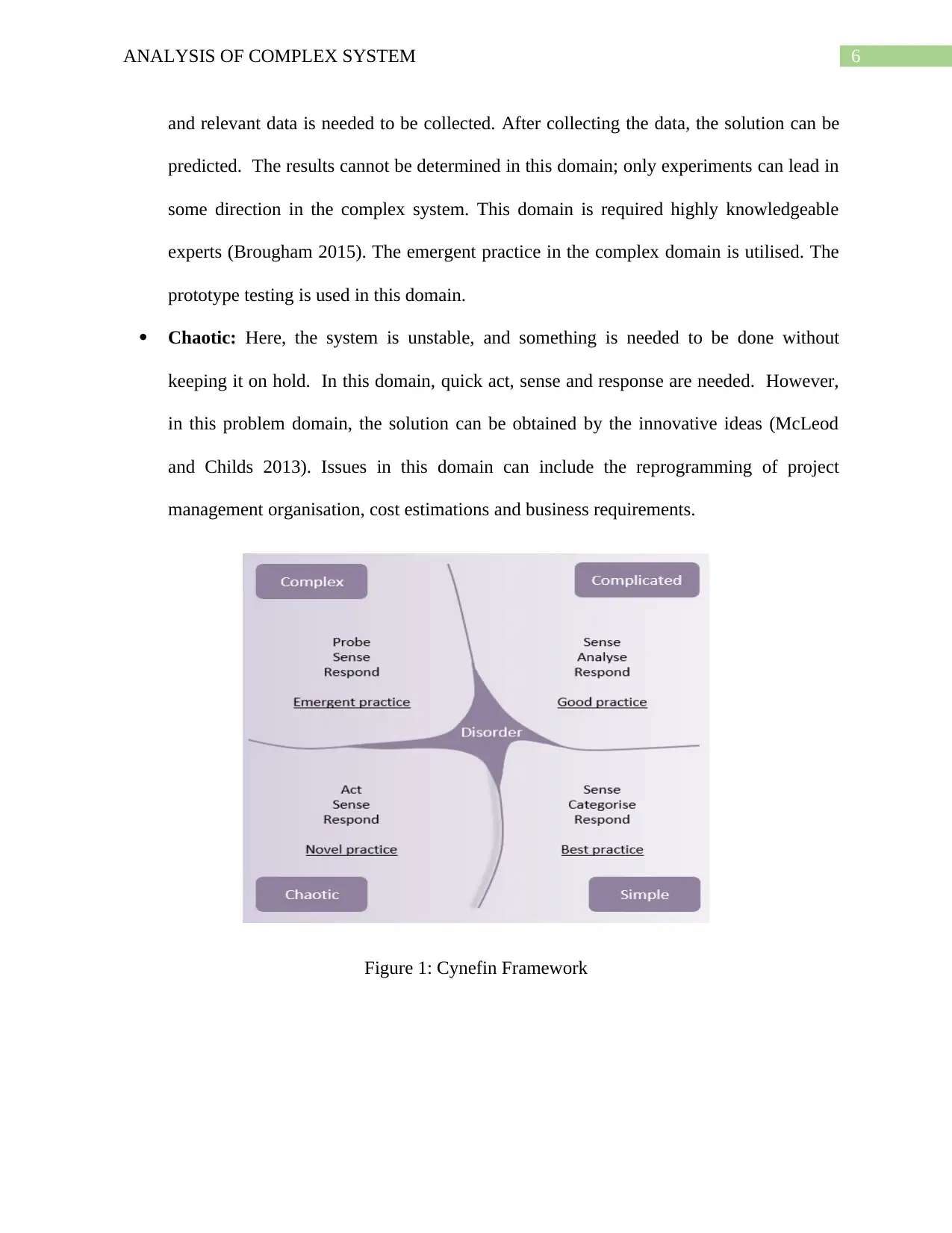
system environments. It consists of a total of four domains, which are obvious, complicated,
complex and chaos (Hasan and Kazlauskas 2014). The obvious domain refers to the simple
domain sometimes. These domains should not be referred to as a category. The domains just
represent the level of problems. The domains are discussed in brief below:
Obvious: Here, the level of problems are ones that can be solved easily or simple in
nature. The problems are first easily identified, and the solution is also known in this
domain. This domain is the best fit for project management practices (Ramalingam, Laric
and Primrose 2014). The waterfall model comes in this domain that is a widely used
method for project management.
Complicated: When the problem is complicated; however, the analysis of the problem
can provide the solution, then the domain can be said complicated. In this domain, the
expert is used here for analysing and provide a decision (Comes and Cavallo 2013). This
domain is a good practice for project management. The agile projects are usually
managed in this domain.
Complex: In this domain, the problems are unknown unknowns means the problem is not
known, and the solution also cannot be obtained. For solving these domains, the correct
iv. The project manager has to be a strong and consistent effective leader to achieve
the goal of the system. The leader is need to be technically good also.
Cynefin framework
Originally Cynefin model is established as a sense-making framework in complex
systems. It helps in recognising that all problems do not have the same level of complexity.
Hence for a different domain of problems need to tackle with a different type of approach. It is
created by Dave Snowden as a tool for helping in making a decision while managing complex
system environments. It consists of a total of four domains, which are obvious, complicated,
complex and chaos (Hasan and Kazlauskas 2014). The obvious domain refers to the simple
domain sometimes. These domains should not be referred to as a category. The domains just
represent the level of problems. The domains are discussed in brief below:
Obvious: Here, the level of problems are ones that can be solved easily or simple in
nature. The problems are first easily identified, and the solution is also known in this
domain. This domain is the best fit for project management practices (Ramalingam, Laric
and Primrose 2014). The waterfall model comes in this domain that is a widely used
method for project management.
Complicated: When the problem is complicated; however, the analysis of the problem
can provide the solution, then the domain can be said complicated. In this domain, the
expert is used here for analysing and provide a decision (Comes and Cavallo 2013). This
domain is a good practice for project management. The agile projects are usually
managed in this domain.
Complex: In this domain, the problems are unknown unknowns means the problem is not
known, and the solution also cannot be obtained. For solving these domains, the correct
⊘ This is a preview!⊘
Do you want full access?
Subscribe today to unlock all pages.
Trusted by 1+ million students worldwide
6ANALYSIS OF COMPLEX SYSTEM
and relevant data is needed to be collected. After collecting the data, the solution can be
predicted. The results cannot be determined in this domain; only experiments can lead in
some direction in the complex system. This domain is required highly knowledgeable
experts (Brougham 2015). The emergent practice in the complex domain is utilised. The
prototype testing is used in this domain.
Chaotic: Here, the system is unstable, and something is needed to be done without
keeping it on hold. In this domain, quick act, sense and response are needed. However,
in this problem domain, the solution can be obtained by the innovative ideas (McLeod
and Childs 2013). Issues in this domain can include the reprogramming of project
management organisation, cost estimations and business requirements.
Figure 1: Cynefin Framework
and relevant data is needed to be collected. After collecting the data, the solution can be
predicted. The results cannot be determined in this domain; only experiments can lead in
some direction in the complex system. This domain is required highly knowledgeable
experts (Brougham 2015). The emergent practice in the complex domain is utilised. The
prototype testing is used in this domain.
Chaotic: Here, the system is unstable, and something is needed to be done without
keeping it on hold. In this domain, quick act, sense and response are needed. However,
in this problem domain, the solution can be obtained by the innovative ideas (McLeod
and Childs 2013). Issues in this domain can include the reprogramming of project
management organisation, cost estimations and business requirements.
Figure 1: Cynefin Framework
Paraphrase This Document
Need a fresh take? Get an instant paraphrase of this document with our AI Paraphraser

7ANALYSIS OF COMPLEX SYSTEM
Sense-making using Cynefin model
Sense-making is a tool and method both, for collective data gathering about perceptions,
reflection and experiences of the people. In complex systems, there are many instances where
some decision has to make. The decisions can directly affect the main goal of the system
(Gorzeń-Mitka and Okręglicka 2014). Hence the sense-making is used to collect data and act in a
way that it can make sense. For example, corruption in the trade on the borders of the countries
where lacking coordination and information is making the system complex. The system should
have a behavioural pattern, and the best way to recognise is the self-observation. This system
behaviour is made of flows and stocks where stocks are the measurable items and flows are the
actions that change over time. The trading system on the border have very dynamic patterns of
occurrence, and it has too many elements and relationships to understand (Wen et al. 2013).
Hence it can be said that information is required to solve the problem domains, and it can be
placed in complex system domains. To reduce the complexity in the system or corruption in a
trade. Parameters and numbers are useful in determining the change required in the flow with
having less effect. Most of all, policymakers change the parameters. The system should have the
power to adapt and shift from the complex domain to the simpler one. The adaptation will surely
take some time. To a limited extent, it should be increased; otherwise, the system can become
inflexible. In this system, physical structures are important; however, identifying a leverage point
in changing structure is an easy task. Negative feedback should be taken more seriously. Any
delay in feedback processing are the major reasons for complexity (Franklin, Powell and Emami-
Naeini 2014). It is true that positive feedback is more dangerous than a negative one; hence,
decrement in gain by positive feedback should be helpful. Adding new data and resources to the
Sense-making using Cynefin model
Sense-making is a tool and method both, for collective data gathering about perceptions,
reflection and experiences of the people. In complex systems, there are many instances where
some decision has to make. The decisions can directly affect the main goal of the system
(Gorzeń-Mitka and Okręglicka 2014). Hence the sense-making is used to collect data and act in a
way that it can make sense. For example, corruption in the trade on the borders of the countries
where lacking coordination and information is making the system complex. The system should
have a behavioural pattern, and the best way to recognise is the self-observation. This system
behaviour is made of flows and stocks where stocks are the measurable items and flows are the
actions that change over time. The trading system on the border have very dynamic patterns of
occurrence, and it has too many elements and relationships to understand (Wen et al. 2013).
Hence it can be said that information is required to solve the problem domains, and it can be
placed in complex system domains. To reduce the complexity in the system or corruption in a
trade. Parameters and numbers are useful in determining the change required in the flow with
having less effect. Most of all, policymakers change the parameters. The system should have the
power to adapt and shift from the complex domain to the simpler one. The adaptation will surely
take some time. To a limited extent, it should be increased; otherwise, the system can become
inflexible. In this system, physical structures are important; however, identifying a leverage point
in changing structure is an easy task. Negative feedback should be taken more seriously. Any
delay in feedback processing are the major reasons for complexity (Franklin, Powell and Emami-
Naeini 2014). It is true that positive feedback is more dangerous than a negative one; hence,
decrement in gain by positive feedback should be helpful. Adding new data and resources to the

8ANALYSIS OF COMPLEX SYSTEM
system will provide the system more identity as the information. Rules are helpful in
constructing a system’s goals, limitations and freedom.
Systemic risks in complex system management
The trade studies and observations are generally decision making methods. The economic
markets are observed by cynefin analysis and some choices are made to resolve the conflicts
between the subsystems. The trade system itself can be referred as very complex systems since
there are multiple dependent and independent components both. By doing this, the relationship
between one entity to another entity in a complex system is observed and understood (Anderson
2018). For example, a stock can be referred as complex system due to its large number of
components. Systemic risks are basically the risks that occurs due to the one or many initiating
events that effects the system badly. The financial crisis is the major results of systemic risks.
The studies in these markets helps in identifying the realistic options among the design, schedule
and requirements. (Furtado, Sakowski and Tóvolli 2015). However, more often, the government
does not choose to, due to at the time of crisis, the situation can become worse. Heavy fall in
prices in a stock market affects economic wealth. However, these price falls come under
systemic events. After this price falls, most investors withdraw their investments. Reducing in
investments results in less number of participants in the market for some amount of time (Gao,
Small and Kurths 2017). The fewer participations then helps in reducing the complexity of the
market and identifying the new prices and risks. The main approach in macroeconomics and
large numbers implies the heterogeneous behaviour of larger independent causes (Hommes
2013). The assumption is that an independent agent allows the economics to run in a complex
adaptive system.
system will provide the system more identity as the information. Rules are helpful in
constructing a system’s goals, limitations and freedom.
Systemic risks in complex system management
The trade studies and observations are generally decision making methods. The economic
markets are observed by cynefin analysis and some choices are made to resolve the conflicts
between the subsystems. The trade system itself can be referred as very complex systems since
there are multiple dependent and independent components both. By doing this, the relationship
between one entity to another entity in a complex system is observed and understood (Anderson
2018). For example, a stock can be referred as complex system due to its large number of
components. Systemic risks are basically the risks that occurs due to the one or many initiating
events that effects the system badly. The financial crisis is the major results of systemic risks.
The studies in these markets helps in identifying the realistic options among the design, schedule
and requirements. (Furtado, Sakowski and Tóvolli 2015). However, more often, the government
does not choose to, due to at the time of crisis, the situation can become worse. Heavy fall in
prices in a stock market affects economic wealth. However, these price falls come under
systemic events. After this price falls, most investors withdraw their investments. Reducing in
investments results in less number of participants in the market for some amount of time (Gao,
Small and Kurths 2017). The fewer participations then helps in reducing the complexity of the
market and identifying the new prices and risks. The main approach in macroeconomics and
large numbers implies the heterogeneous behaviour of larger independent causes (Hommes
2013). The assumption is that an independent agent allows the economics to run in a complex
adaptive system.
⊘ This is a preview!⊘
Do you want full access?
Subscribe today to unlock all pages.
Trusted by 1+ million students worldwide
9ANALYSIS OF COMPLEX SYSTEM
Complex System Engineering
The large organizations have more complexities in their systems as they contains more
numbers of the components (Gates and Rocha 2016). During the development the cynefin
methodology is used to evaluate the cost optimization, schedule of the project, risk analysis and
benefits from the project. By defining the problem domains including all the constraints are done
with the extra care. Without having an understandable problem the right solution cannot be
obtained. System engineering for complex system follows the basically follows the v-model
(verification and validation). Verification refers to the requirement analysis phase where the
collected data is needed to be verified that it is correct or not (Vermesan and Coenen 2013).
Incorrect data may lead to a system failure; hence, the data should be checked strictly. Next is
validation, where the newly discovered data should be validated in the system. Every new
problem will provide new data after it is solved. The new information regarding the solution will
help the system to move towards the simple domain where the best system engineering practices
can be achieved. Verification and validation can be don stage by stage. The alternative designs
and architectures may be used to obtain preferred type of processes for some products. The
cynefin reduces the life cycle of the cost, components and services to meet the usability
requirements.
Initiating events in complex systems (stock market)
A complex system is a group of many small subsystems that works independently and
collaboratively both. In the whole system, there is numerous process, and events of processes
take place in order to work as a whole system. Though the individual subsystem in the complex
Complex System Engineering
The large organizations have more complexities in their systems as they contains more
numbers of the components (Gates and Rocha 2016). During the development the cynefin
methodology is used to evaluate the cost optimization, schedule of the project, risk analysis and
benefits from the project. By defining the problem domains including all the constraints are done
with the extra care. Without having an understandable problem the right solution cannot be
obtained. System engineering for complex system follows the basically follows the v-model
(verification and validation). Verification refers to the requirement analysis phase where the
collected data is needed to be verified that it is correct or not (Vermesan and Coenen 2013).
Incorrect data may lead to a system failure; hence, the data should be checked strictly. Next is
validation, where the newly discovered data should be validated in the system. Every new
problem will provide new data after it is solved. The new information regarding the solution will
help the system to move towards the simple domain where the best system engineering practices
can be achieved. Verification and validation can be don stage by stage. The alternative designs
and architectures may be used to obtain preferred type of processes for some products. The
cynefin reduces the life cycle of the cost, components and services to meet the usability
requirements.
Initiating events in complex systems (stock market)
A complex system is a group of many small subsystems that works independently and
collaboratively both. In the whole system, there is numerous process, and events of processes
take place in order to work as a whole system. Though the individual subsystem in the complex
Paraphrase This Document
Need a fresh take? Get an instant paraphrase of this document with our AI Paraphraser
10ANALYSIS OF COMPLEX SYSTEM
systems is internally connected, they share most of the functionality of the building blocks. An
initiative event is when an event generates a disturbance in the system that leads to system failure
(Sornette 2017). System failure is part of complex system’s life cycle. After collapse, the stock
market become less complex as the most of the investors withdraw their investments. Less
participation in stock market provide the market time to recover the balance. It also means that
there are lesser number of components are dependent with each other or working in the full
system. After the initiating events and the market's adaptability process, then the market moves
toward critical point of restoration (Liang and Huang 2013). It means that the small level of
problems can cause a series of failures and that makes the market to crash. The started events are
basically very smaller one in comparison to the whole system. However, one failure is enough
for considering malfunction in the system. The basic difference between the effects of initiating
events on a single system and the complex system is those complex systems are basically groups
of single systems.
Recommendation
Cynefin model is all about to sense the complexity then react, and first, it is analysed that
where the problem domain lies. The analysis of the problem domain is a structural approach
during project management. In the complex domain, the solution s are unpredictable. Hence
different experiments are to be done in the findings of a solution. During these experiments,
many times, the situation demands few changes to be made in the system (McGinnis and Ostrom
2014). This emergence of the changes should be considered, that could be a process change, tool
change or change of people. First, the processes in a system program, levels are properly defined
in the management. These definitions help in mapping complex systems, and practices will
become easier than the previous practices. Again, the planning process should have a distinct
systems is internally connected, they share most of the functionality of the building blocks. An
initiative event is when an event generates a disturbance in the system that leads to system failure
(Sornette 2017). System failure is part of complex system’s life cycle. After collapse, the stock
market become less complex as the most of the investors withdraw their investments. Less
participation in stock market provide the market time to recover the balance. It also means that
there are lesser number of components are dependent with each other or working in the full
system. After the initiating events and the market's adaptability process, then the market moves
toward critical point of restoration (Liang and Huang 2013). It means that the small level of
problems can cause a series of failures and that makes the market to crash. The started events are
basically very smaller one in comparison to the whole system. However, one failure is enough
for considering malfunction in the system. The basic difference between the effects of initiating
events on a single system and the complex system is those complex systems are basically groups
of single systems.
Recommendation
Cynefin model is all about to sense the complexity then react, and first, it is analysed that
where the problem domain lies. The analysis of the problem domain is a structural approach
during project management. In the complex domain, the solution s are unpredictable. Hence
different experiments are to be done in the findings of a solution. During these experiments,
many times, the situation demands few changes to be made in the system (McGinnis and Ostrom
2014). This emergence of the changes should be considered, that could be a process change, tool
change or change of people. First, the processes in a system program, levels are properly defined
in the management. These definitions help in mapping complex systems, and practices will
become easier than the previous practices. Again, the planning process should have a distinct
11ANALYSIS OF COMPLEX SYSTEM
level of plans and integration. This helps in accelerating the project management process.
Second, the user requirements for the system and the design according to the demand is
considered to avail the usability of the system. Analysing the requirements always saves the time
and cost in a project management. Since the complex systems are handled by the concept of
emergence, if a new requirement of the component arise then the new project team is assigned
for each individual parts of the system. The individual tasks are assigned to the experts. The
program manager, project managers, quality assurance, etc. will distribute the tasks according to
the life cycle and related phases (Zhu and Mostafavi 2014). Third, the selection of tool for
handling the complexity of the system needs to be decided. As per moving further in the
development, it may require to introduce new tools according to the problem domain. The
SenseMaking tool is used widely for managing and making a decision in complex system
development. SenseMaking is basically based on the Cynefin framework (Paull, Boudville and
Sitlington 2013). The data-gathering phase in the complex domain needs to identify the correct
data for the system. Then the team goes for the designs of the system. Next, the training should
be provided about how to handle complex system engineering and problems.
Conclusion
Most of the time, engineering complex systems with traditional management methods
lead to the failure of the project. The problems on a complex system are in very microscopic
levels. The complex system needs to be handled in an ordered way to achieve the goal of the
product. To keep the parameters in order according to the problem domain, the unknown
unknowns are needed to be discovered. This report discussed that many systems which have
multiple subsystems require a complex system perspective of engineering. The complex system
needs emergent problems to be discovered and solved. Also, the changes in the requirements can
level of plans and integration. This helps in accelerating the project management process.
Second, the user requirements for the system and the design according to the demand is
considered to avail the usability of the system. Analysing the requirements always saves the time
and cost in a project management. Since the complex systems are handled by the concept of
emergence, if a new requirement of the component arise then the new project team is assigned
for each individual parts of the system. The individual tasks are assigned to the experts. The
program manager, project managers, quality assurance, etc. will distribute the tasks according to
the life cycle and related phases (Zhu and Mostafavi 2014). Third, the selection of tool for
handling the complexity of the system needs to be decided. As per moving further in the
development, it may require to introduce new tools according to the problem domain. The
SenseMaking tool is used widely for managing and making a decision in complex system
development. SenseMaking is basically based on the Cynefin framework (Paull, Boudville and
Sitlington 2013). The data-gathering phase in the complex domain needs to identify the correct
data for the system. Then the team goes for the designs of the system. Next, the training should
be provided about how to handle complex system engineering and problems.
Conclusion
Most of the time, engineering complex systems with traditional management methods
lead to the failure of the project. The problems on a complex system are in very microscopic
levels. The complex system needs to be handled in an ordered way to achieve the goal of the
product. To keep the parameters in order according to the problem domain, the unknown
unknowns are needed to be discovered. This report discussed that many systems which have
multiple subsystems require a complex system perspective of engineering. The complex system
needs emergent problems to be discovered and solved. Also, the changes in the requirements can
⊘ This is a preview!⊘
Do you want full access?
Subscribe today to unlock all pages.
Trusted by 1+ million students worldwide

1 out of 16


Related Documents


Your All-in-One AI-Powered Toolkit for Academic Success.
+13062052269
info@desklib.com
Available 24*7 on WhatsApp / Email
![[object Object]](/_next/static/media/star-bottom.7253800d.svg)
Unlock your academic potential
Copyright © 2020–2026 A2Z Services. All Rights Reserved. Developed and managed by ZUCOL.