Complex System Analysis: System Engineering, Risks and Recommendations
VerifiedAdded on 2022/09/26
|17
|4193
|32
Report
AI Summary
This report provides a comprehensive analysis of complex systems, exploring their characteristics and the challenges they present. It begins with an introduction to complex systems, defining their key components and behaviors, and then delves into the Cynefin model as a framework for understanding and managing complexity. The report examines decision-making processes within complex systems, emphasizing the importance of adapting strategies to different problem domains. It further discusses system engineering principles applied to complex environments, including process validation, resource allocation, and the management of systemic risks. The report concludes with recommendations for managing complex systems, addressing changes in processes, user interactions, and the utilization of tools. Overall, the report offers valuable insights into the intricacies of complex systems and provides practical approaches for effective management and analysis.

Running head: COMPLEX SYSTEM
Complex System Analysis
Name of the Student
Name of the University
Author Note
Complex System Analysis
Name of the Student
Name of the University
Author Note

Paraphrase This Document
Need a fresh take? Get an instant paraphrase of this document with our AI Paraphraser
1COMPLEX SYSTEM
Table of Contents
Introduction......................................................................................................................................2
Complex system...............................................................................................................................3
Cynefin model.............................................................................................................................4
Decision making..........................................................................................................................6
System Engineering.........................................................................................................................7
Systemic risks..................................................................................................................................8
Initiating events.............................................................................................................................10
Recommendation...........................................................................................................................11
Change in process......................................................................................................................11
Change in users..........................................................................................................................11
Changes in tools.........................................................................................................................11
Conclusion.....................................................................................................................................12
Reference.......................................................................................................................................14
Table of Contents
Introduction......................................................................................................................................2
Complex system...............................................................................................................................3
Cynefin model.............................................................................................................................4
Decision making..........................................................................................................................6
System Engineering.........................................................................................................................7
Systemic risks..................................................................................................................................8
Initiating events.............................................................................................................................10
Recommendation...........................................................................................................................11
Change in process......................................................................................................................11
Change in users..........................................................................................................................11
Changes in tools.........................................................................................................................11
Conclusion.....................................................................................................................................12
Reference.......................................................................................................................................14
2COMPLEX SYSTEM
Introduction
Complex systems are defined as a system network. It consists with multiple large number
of components or subsystems which interact with each other non-linearly (Sage and Rouse
2014). complex systems usually arise and grow along with time and affect the production and
development on a large scale. There are several definitions are present for complex systems. On
ignoring others definition and following only any one of the definitions, the main thing is found
common that the interaction between the components of the system is very large. Due to the
presence of several multiple components, the interactions are also large in number. There are
many different functional oriented and goal-oriented components presents in a complex system.
The main ideology of the concepts of the complex systems are emergence and self-organisation
(Hensel, Menges and Weinstock 2013). The concept of emergence is used from more than a
century. There are several subsystems in a system where the analysis on the macroscopic level
cannot reduce the problems on the basic level of management. For example, it can be said that if
an animal is moving around, then it is alive. However, the microscopic biological activities in his
body cannot be explained that is making the animal alive. Another concept of complex systems
is there that is self-organisation. Self-organisation usually confused with the emergence
sometimes (Jacobson 2013). It means that spontaneous self-observation in the system behaviour
or structure is necessary as the development progresses. The report intends to discuss, the
working methodology of a complex system and "how can any system be defined as complex" is
the main domain of discussion. It also discusses that large-scale complexity of a network can be
reduced with the help of the Cynefin framework. In later sections, the report follows the
approaches to manage the complex systems with types of emergence and uncertainty, tiny
initiating events, sense-making and systemic risk management of the complex system.
Introduction
Complex systems are defined as a system network. It consists with multiple large number
of components or subsystems which interact with each other non-linearly (Sage and Rouse
2014). complex systems usually arise and grow along with time and affect the production and
development on a large scale. There are several definitions are present for complex systems. On
ignoring others definition and following only any one of the definitions, the main thing is found
common that the interaction between the components of the system is very large. Due to the
presence of several multiple components, the interactions are also large in number. There are
many different functional oriented and goal-oriented components presents in a complex system.
The main ideology of the concepts of the complex systems are emergence and self-organisation
(Hensel, Menges and Weinstock 2013). The concept of emergence is used from more than a
century. There are several subsystems in a system where the analysis on the macroscopic level
cannot reduce the problems on the basic level of management. For example, it can be said that if
an animal is moving around, then it is alive. However, the microscopic biological activities in his
body cannot be explained that is making the animal alive. Another concept of complex systems
is there that is self-organisation. Self-organisation usually confused with the emergence
sometimes (Jacobson 2013). It means that spontaneous self-observation in the system behaviour
or structure is necessary as the development progresses. The report intends to discuss, the
working methodology of a complex system and "how can any system be defined as complex" is
the main domain of discussion. It also discusses that large-scale complexity of a network can be
reduced with the help of the Cynefin framework. In later sections, the report follows the
approaches to manage the complex systems with types of emergence and uncertainty, tiny
initiating events, sense-making and systemic risk management of the complex system.
⊘ This is a preview!⊘
Do you want full access?
Subscribe today to unlock all pages.

Trusted by 1+ million students worldwide

3COMPLEX SYSTEM
Complex system
Today, all the modern world's systems are becoming complex. Their behavioural and
operational functionalities may change in unpredictable cycles. A complex system can have a
very large-scale production, long-chain organisational operations and enormous size. These
complexities can lead to various kind of risks, uncertainty and ambiguity during the project
management. It is known fact that the complexity of a complex system grows along with the
time, size and cost (Sturmberg, Martin and Katerndahl 2014). To avoid increment in cost and
complexity of the project, the system should be tested its missing parameters, links and
interconnecting points. For these new types of complex systems, the traditional approaches of
project management may not be helpful to reduce problem domains. However, it helps to
understand the individual subsystems of the system. To understand the complexity of the system,
following points should be considered:
i. The flow of the behavioural changes in the system must be analysed, which is
required when the solution is placed between the interconnection of two
individual parts of the system to work as a whole.
ii. The main aim of the system should be well defined. The goal can be in phases as
the complex system contains many different working modules (Qin 2018).
iii. The emergent behaviour of the system is also analysed as it can make the system
more vulnerable if any unwanted interaction happens among the different
subsystems (Hensel, Menges and Weinstock 2013).
iv. The context of the system should also be clear that specifies the scope of the
project, which is the main aim for any project.
Complex system
Today, all the modern world's systems are becoming complex. Their behavioural and
operational functionalities may change in unpredictable cycles. A complex system can have a
very large-scale production, long-chain organisational operations and enormous size. These
complexities can lead to various kind of risks, uncertainty and ambiguity during the project
management. It is known fact that the complexity of a complex system grows along with the
time, size and cost (Sturmberg, Martin and Katerndahl 2014). To avoid increment in cost and
complexity of the project, the system should be tested its missing parameters, links and
interconnecting points. For these new types of complex systems, the traditional approaches of
project management may not be helpful to reduce problem domains. However, it helps to
understand the individual subsystems of the system. To understand the complexity of the system,
following points should be considered:
i. The flow of the behavioural changes in the system must be analysed, which is
required when the solution is placed between the interconnection of two
individual parts of the system to work as a whole.
ii. The main aim of the system should be well defined. The goal can be in phases as
the complex system contains many different working modules (Qin 2018).
iii. The emergent behaviour of the system is also analysed as it can make the system
more vulnerable if any unwanted interaction happens among the different
subsystems (Hensel, Menges and Weinstock 2013).
iv. The context of the system should also be clear that specifies the scope of the
project, which is the main aim for any project.
Paraphrase This Document
Need a fresh take? Get an instant paraphrase of this document with our AI Paraphraser

4COMPLEX SYSTEM
Cynefin model in complex systems
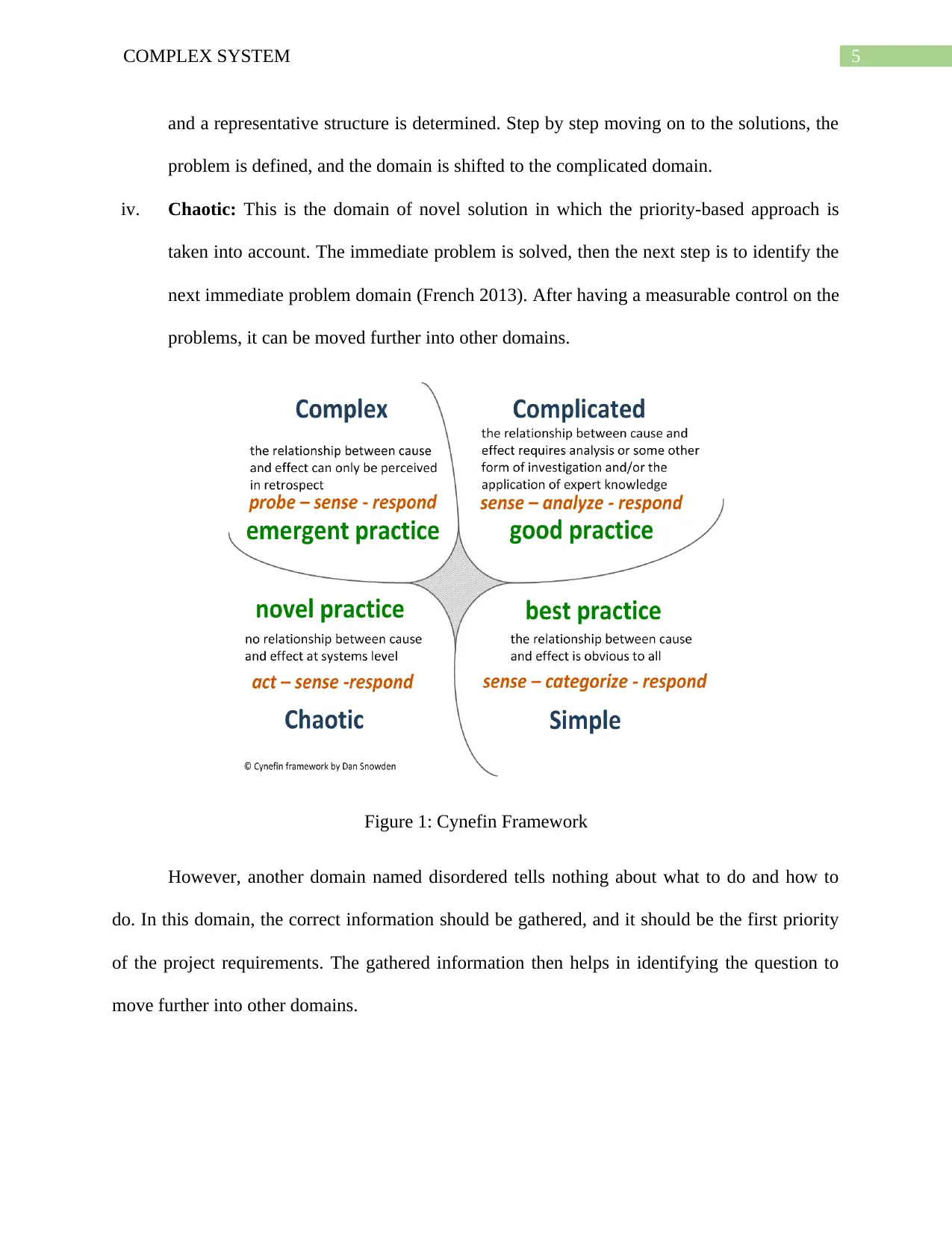
Cynefin model is a more common approach in project management where the knowledge
management theory is used to identify the complex areas and simplified areas of any systems.
The interaction between the system-human experience, is analysed in this system by decision
making (O'Connor and Lepmets 2015). This framework is commonly used in product
development, market creation, branding and policymaking. It is developed by the Snowden and
Kurtz in between 1999 to 2003. This framework is generally interpretative and iterative in nature
on the very different levels of management. It has basically five domains which are: simple,
complicated, complex and chaotic. It is a sense-making tool and model which uses the existing
data and then builds a representative model of that data. The problem domains are briefly
described below:
i. Simple: It is a perfect domain to have best practices in project management. In this
domain, the problems are well defined and understood. Also, the solution is required less
effort. Many customer services are placed in this domain. They know how to handle their
customer (Lepmets et al. 2014). Hence the correct approach is selected and can be
categorised into known problems.
ii. Complicated: The complicated is domain promotes good practices where the problems
are interestingly defined, and the solution requires the excellent level of expertise.The
perfect approach is desirable to achieve the goal in these domains.
iii. Complex: This domain deals with the emergence of a solution where the problem
domain is not well understood and unknown unknowns are discovered after the discovery
of the perfect and right solution. In this approach, the knowledge base data is required,
Cynefin model in complex systems
Cynefin model is a more common approach in project management where the knowledge
management theory is used to identify the complex areas and simplified areas of any systems.
The interaction between the system-human experience, is analysed in this system by decision
making (O'Connor and Lepmets 2015). This framework is commonly used in product
development, market creation, branding and policymaking. It is developed by the Snowden and
Kurtz in between 1999 to 2003. This framework is generally interpretative and iterative in nature
on the very different levels of management. It has basically five domains which are: simple,
complicated, complex and chaotic. It is a sense-making tool and model which uses the existing
data and then builds a representative model of that data. The problem domains are briefly
described below:
i. Simple: It is a perfect domain to have best practices in project management. In this
domain, the problems are well defined and understood. Also, the solution is required less
effort. Many customer services are placed in this domain. They know how to handle their
customer (Lepmets et al. 2014). Hence the correct approach is selected and can be
categorised into known problems.
ii. Complicated: The complicated is domain promotes good practices where the problems
are interestingly defined, and the solution requires the excellent level of expertise.The
perfect approach is desirable to achieve the goal in these domains.
iii. Complex: This domain deals with the emergence of a solution where the problem
domain is not well understood and unknown unknowns are discovered after the discovery
of the perfect and right solution. In this approach, the knowledge base data is required,
5COMPLEX SYSTEM
and a representative structure is determined. Step by step moving on to the solutions, the
problem is defined, and the domain is shifted to the complicated domain.
iv. Chaotic: This is the domain of novel solution in which the priority-based approach is
taken into account. The immediate problem is solved, then the next step is to identify the
next immediate problem domain (French 2013). After having a measurable control on the
problems, it can be moved further into other domains.
Figure 1: Cynefin Framework
However, another domain named disordered tells nothing about what to do and how to
do. In this domain, the correct information should be gathered, and it should be the first priority
of the project requirements. The gathered information then helps in identifying the question to
move further into other domains.
and a representative structure is determined. Step by step moving on to the solutions, the
problem is defined, and the domain is shifted to the complicated domain.
iv. Chaotic: This is the domain of novel solution in which the priority-based approach is
taken into account. The immediate problem is solved, then the next step is to identify the
next immediate problem domain (French 2013). After having a measurable control on the
problems, it can be moved further into other domains.
Figure 1: Cynefin Framework
However, another domain named disordered tells nothing about what to do and how to
do. In this domain, the correct information should be gathered, and it should be the first priority
of the project requirements. The gathered information then helps in identifying the question to
move further into other domains.
⊘ This is a preview!⊘
Do you want full access?
Subscribe today to unlock all pages.
Trusted by 1+ million students worldwide
6COMPLEX SYSTEM
Decision making
The use of Cynefin model requires the analysis of the inter-relationships of the problem
domains and their effects. If the relationship is found linear, then the problem domain can be
moved into a simple domain. For one example, corruption in trade can be analysed as a complex
system using the Cynefin model. Lacking of coordination and information are causing corruption
in the trade on the borders of the countries (Stein 2013). There is two problem space in the
present system. First, the system needs to describe well the existing system of workings. Second,
which security agency or organisation are helping in the system. This may be the cause of poor
unity efforts. Hence the level of cooperation is needed to testify nationally and internationally.
The system is supposed to produce a behavioural pattern, and the best way to recognise is the
observation. This system behaviour is made of flows and stocks where stocks are the measurable
items and flows are the actions that change over time. Feedback system helps in maintaining the
stocks and flows. The trading system on the border have very dynamic patterns of occurrence,
and it has too many elements and relationships to understand (Franklin, Powell and Emami-
Naeini 2014). Hence it can be said that information is required to solve the problem domains,
and it can be placed in complex system domains. To reduce the complexity in the system or
corruption in a trade, some points are listed below to help in a logical way of decision making:
Parameters and numbers are useful in determining the change required in the flow with
having less effect. Most of all policymakers change the parameters.
Buffers provide the stabilising effect on the system. To a limited extent, it should be
increased; otherwise the system can become inflexible.
Decision making
The use of Cynefin model requires the analysis of the inter-relationships of the problem
domains and their effects. If the relationship is found linear, then the problem domain can be
moved into a simple domain. For one example, corruption in trade can be analysed as a complex
system using the Cynefin model. Lacking of coordination and information are causing corruption
in the trade on the borders of the countries (Stein 2013). There is two problem space in the
present system. First, the system needs to describe well the existing system of workings. Second,
which security agency or organisation are helping in the system. This may be the cause of poor
unity efforts. Hence the level of cooperation is needed to testify nationally and internationally.
The system is supposed to produce a behavioural pattern, and the best way to recognise is the
observation. This system behaviour is made of flows and stocks where stocks are the measurable
items and flows are the actions that change over time. Feedback system helps in maintaining the
stocks and flows. The trading system on the border have very dynamic patterns of occurrence,
and it has too many elements and relationships to understand (Franklin, Powell and Emami-
Naeini 2014). Hence it can be said that information is required to solve the problem domains,
and it can be placed in complex system domains. To reduce the complexity in the system or
corruption in a trade, some points are listed below to help in a logical way of decision making:
Parameters and numbers are useful in determining the change required in the flow with
having less effect. Most of all policymakers change the parameters.
Buffers provide the stabilising effect on the system. To a limited extent, it should be
increased; otherwise the system can become inflexible.
Paraphrase This Document
Need a fresh take? Get an instant paraphrase of this document with our AI Paraphraser
7COMPLEX SYSTEM
In this system, physical structures are important; however, identifying a leverage point in
changing structure is an easy task. Negative feedback should be taken more seriously.
Any delay in feedback processing are the major reasons for complexity.
It is true that positive feedback is more dangerous than a negative one; hence, decrement
in gain by positive feedback should be helpful.
Adding new data and resources to the system will provide the system more identity as the
information. Rules are helpful in constructing a system’s goals, limitations and freedom.
The system should have the power to adapt and shift from the complex domain to the
simpler one. The adaptation will surely take some time (Anderson 2018).
System Engineering
System engineering for a complex system needs the requirements of the stakeholders
with considering their organisation structure. Organisations that have a complex structure and
large-scale production need the design for facilitating and development (Williams 2013). The
development is consisting of multiple stages depending on the final goal of the company. For
example, the interactions between different segments of their company cost evaluation and time
management. The communication between these segments or departments can be direct or
indirect. Direct communication takes place just between those two departments (Turk, France
and Rumpe 2014). Whereas indirect can be the instructions followed by different groups. The
requirements are usually found by top to bottom or bottom to top approaches. Complex system
engineering has the key points theta the interaction can not be reduced between the components.
Traditional system engineering is most effectful till now in the simpler systems to identify the
interactions between the components. However, the whole environment of the system based on
the design can be improved (Conforto et al. 2014). It is necessary to the engineering process in
In this system, physical structures are important; however, identifying a leverage point in
changing structure is an easy task. Negative feedback should be taken more seriously.
Any delay in feedback processing are the major reasons for complexity.
It is true that positive feedback is more dangerous than a negative one; hence, decrement
in gain by positive feedback should be helpful.
Adding new data and resources to the system will provide the system more identity as the
information. Rules are helpful in constructing a system’s goals, limitations and freedom.
The system should have the power to adapt and shift from the complex domain to the
simpler one. The adaptation will surely take some time (Anderson 2018).
System Engineering
System engineering for a complex system needs the requirements of the stakeholders
with considering their organisation structure. Organisations that have a complex structure and
large-scale production need the design for facilitating and development (Williams 2013). The
development is consisting of multiple stages depending on the final goal of the company. For
example, the interactions between different segments of their company cost evaluation and time
management. The communication between these segments or departments can be direct or
indirect. Direct communication takes place just between those two departments (Turk, France
and Rumpe 2014). Whereas indirect can be the instructions followed by different groups. The
requirements are usually found by top to bottom or bottom to top approaches. Complex system
engineering has the key points theta the interaction can not be reduced between the components.
Traditional system engineering is most effectful till now in the simpler systems to identify the
interactions between the components. However, the whole environment of the system based on
the design can be improved (Conforto et al. 2014). It is necessary to the engineering process in

8COMPLEX SYSTEM
order to deal with the complex systems. Complex system engineering can be done in the
following phases:
1. Process validation and verification: This Process is identified that their expected
outcome is produced or not. The measurement of the factors affecting or contributing to
the system is verified. Every single process is as an equation where the final output is
produced of that particular process. Every process can have a large number of factors
affecting, to reduce the size complexity the data collection or the information will be
required to gather in a place (De Lemos et al. 2013). After the information is collected,
the factors will automatically lead to the problems that can be handled in a complex
system. On the other hand, the data validation should be check with the results expected
from the building period. Evidence that helps in satisfying the factors ensures that the
product will be completed within the duration and budget. In larger complex systems
many smaller systems will be integrated later.
2. Resources allocation: In the present time, it has become a frequent mistake in
understanding the responsibilities within a complex system. The stakeholders and the
contractors often have a poor understanding about the goals (Ponsteen and Kusters 2015).
Systemic risks
In economics, the markets are observed by using complex system theories to understand
the dynamic behaviours of the market. As the market can be said, a very much complex system
due to the huge number of interactions between many bodies (Roukny et al. 2013). In this way,
the relationship between one complex system towards other complex systems can be understood.
For example, in the stock market, a huge number of elements are presently leading in to more
complex interactions. Systemic risks are basically the risks that can arise when an event can
order to deal with the complex systems. Complex system engineering can be done in the
following phases:
1. Process validation and verification: This Process is identified that their expected
outcome is produced or not. The measurement of the factors affecting or contributing to
the system is verified. Every single process is as an equation where the final output is
produced of that particular process. Every process can have a large number of factors
affecting, to reduce the size complexity the data collection or the information will be
required to gather in a place (De Lemos et al. 2013). After the information is collected,
the factors will automatically lead to the problems that can be handled in a complex
system. On the other hand, the data validation should be check with the results expected
from the building period. Evidence that helps in satisfying the factors ensures that the
product will be completed within the duration and budget. In larger complex systems
many smaller systems will be integrated later.
2. Resources allocation: In the present time, it has become a frequent mistake in
understanding the responsibilities within a complex system. The stakeholders and the
contractors often have a poor understanding about the goals (Ponsteen and Kusters 2015).
Systemic risks
In economics, the markets are observed by using complex system theories to understand
the dynamic behaviours of the market. As the market can be said, a very much complex system
due to the huge number of interactions between many bodies (Roukny et al. 2013). In this way,
the relationship between one complex system towards other complex systems can be understood.
For example, in the stock market, a huge number of elements are presently leading in to more
complex interactions. Systemic risks are basically the risks that can arise when an event can
⊘ This is a preview!⊘
Do you want full access?
Subscribe today to unlock all pages.
Trusted by 1+ million students worldwide

9COMPLEX SYSTEM
cause instability or collapse by a trigger in a company (Reason 2016). The financial crisis is the
major results of systemic risks. Companies call the systemic risks "too big to fail". The study in
finance is one type of complex systems where empirical facts and policies are found to be limited
in crisis situations. In systemic risk analysis, there are three major policy institutions available
BIS, FSB, and IMF. The measures in any stock market are done by the fluctuating return values
of the market. The governments apply the systemic risks as correct justification to the company.
The majority believes that the government will be able to reduce the effects of the crisis.
However, more often, the government does not choose to, due to at the time of crisis, the
situation can become worse (Sornette 2017).
Figure 2: Stock market Risks
Heavy fall in prices in a stock market affects economic wealth. However, these price falls
come under systemic events. After this price falls, most investors withdraw their investments.
Reducing in investments results in less number of participants in the market for some amount of
time. The fewer participations then helps in reducing the complexity of the market and
cause instability or collapse by a trigger in a company (Reason 2016). The financial crisis is the
major results of systemic risks. Companies call the systemic risks "too big to fail". The study in
finance is one type of complex systems where empirical facts and policies are found to be limited
in crisis situations. In systemic risk analysis, there are three major policy institutions available
BIS, FSB, and IMF. The measures in any stock market are done by the fluctuating return values
of the market. The governments apply the systemic risks as correct justification to the company.
The majority believes that the government will be able to reduce the effects of the crisis.
However, more often, the government does not choose to, due to at the time of crisis, the
situation can become worse (Sornette 2017).
Figure 2: Stock market Risks
Heavy fall in prices in a stock market affects economic wealth. However, these price falls
come under systemic events. After this price falls, most investors withdraw their investments.
Reducing in investments results in less number of participants in the market for some amount of
time. The fewer participations then helps in reducing the complexity of the market and
Paraphrase This Document
Need a fresh take? Get an instant paraphrase of this document with our AI Paraphraser
10COMPLEX SYSTEM
identifying the new prices and risks. The main approach in macroeconomics and large numbers
implies the heterogeneous behaviour of larger independent causes (Hommes 2013). The
assumption is that an independent agent allows the economics to run in a complex adaptive
system.
Initiating events
An initiative event happens when an event generates a disturbance in the system that
leads to the system failure (Modarres 2016). Systemic risks are mainly caused or say triggered by
small initiating events. Identification of individual trader behaviour can affect in the stock
distribution, and it may start as tiny imitating events. These initiating events could be new rules
in trading, trading methods, or developing a new product. Independent institutes learn and adapt
these initiating events. Many types of initiating events come in the financial services from
different directions. For example, a small change in any country's economic condition affects the
whole financial network from which it is connected. These services can start financial bubbles
and instantly gets deflated (Brunnermeier and Oehmke 2013). Bubbles occur where noise and
risk in trades have increased in the trades (for example new technology or new gadgets). It can
be observed that these events can be insignificant and random. After the initiating events and the
market's adaptability process, the market may restore and moves to the triple point or critical
point of the bubble. The market crashes are generally seen on the critical points due to the
dynamic behaviour of the stock markets at a small level. The basic difference between the effects
of initiating events on a single system and the complex system is those complex systems are
basically groups of single systems. Though the individual subsystem in the complex systems is
internally connected, they share most of the functionality of the building blocks.
identifying the new prices and risks. The main approach in macroeconomics and large numbers
implies the heterogeneous behaviour of larger independent causes (Hommes 2013). The
assumption is that an independent agent allows the economics to run in a complex adaptive
system.
Initiating events
An initiative event happens when an event generates a disturbance in the system that
leads to the system failure (Modarres 2016). Systemic risks are mainly caused or say triggered by
small initiating events. Identification of individual trader behaviour can affect in the stock
distribution, and it may start as tiny imitating events. These initiating events could be new rules
in trading, trading methods, or developing a new product. Independent institutes learn and adapt
these initiating events. Many types of initiating events come in the financial services from
different directions. For example, a small change in any country's economic condition affects the
whole financial network from which it is connected. These services can start financial bubbles
and instantly gets deflated (Brunnermeier and Oehmke 2013). Bubbles occur where noise and
risk in trades have increased in the trades (for example new technology or new gadgets). It can
be observed that these events can be insignificant and random. After the initiating events and the
market's adaptability process, the market may restore and moves to the triple point or critical
point of the bubble. The market crashes are generally seen on the critical points due to the
dynamic behaviour of the stock markets at a small level. The basic difference between the effects
of initiating events on a single system and the complex system is those complex systems are
basically groups of single systems. Though the individual subsystem in the complex systems is
internally connected, they share most of the functionality of the building blocks.
11COMPLEX SYSTEM
Recommendation
The recommendations in engineering complex systems are to use the Cynefin model to
analyse the system first that it is complex or not. The methodology for evaluation should be
structured for the management of complex systems project, and the emergence of changes should
be followed. The changes could be in process, uses and usable tools.
Change in process
First, the program levels are properly defined in the management. This will be followed
in the full timeline of the development. With the help of definitions, complex systems can be
easily mapped, and practices will become easier than the previous practices. On another hand,
the planning process have distinct level of integration and development. This will help in
accelerating the project management of the complex system.
Change in users
The implementation and design levels of the project should consider the usability of the
system to accelerate the requirement phase in the project management (Dwivedi, Wastell and
Henriksen 2015). The new program will need a new management team for the development, and
each individual needs to assign per his/her expertise. The program manager, project managers,
quality assurance, etc. will distribute the tasks according to the timeline and related phases.
Changes in tools
The fully capable tool for handling the complexity of the system needs to be selected
first. As per moving further in the development will require to introduce new tools according to
the problem domain. Cynefin framework method is meant to be best for developing complex
systems. The SenseMaking tool is used widely for managing and making a decision in a complex
Recommendation
The recommendations in engineering complex systems are to use the Cynefin model to
analyse the system first that it is complex or not. The methodology for evaluation should be
structured for the management of complex systems project, and the emergence of changes should
be followed. The changes could be in process, uses and usable tools.
Change in process
First, the program levels are properly defined in the management. This will be followed
in the full timeline of the development. With the help of definitions, complex systems can be
easily mapped, and practices will become easier than the previous practices. On another hand,
the planning process have distinct level of integration and development. This will help in
accelerating the project management of the complex system.
Change in users
The implementation and design levels of the project should consider the usability of the
system to accelerate the requirement phase in the project management (Dwivedi, Wastell and
Henriksen 2015). The new program will need a new management team for the development, and
each individual needs to assign per his/her expertise. The program manager, project managers,
quality assurance, etc. will distribute the tasks according to the timeline and related phases.
Changes in tools
The fully capable tool for handling the complexity of the system needs to be selected
first. As per moving further in the development will require to introduce new tools according to
the problem domain. Cynefin framework method is meant to be best for developing complex
systems. The SenseMaking tool is used widely for managing and making a decision in a complex
⊘ This is a preview!⊘
Do you want full access?
Subscribe today to unlock all pages.
Trusted by 1+ million students worldwide

1 out of 17


Your All-in-One AI-Powered Toolkit for Academic Success.
+13062052269
info@desklib.com
Available 24*7 on WhatsApp / Email
![[object Object]](/_next/static/media/star-bottom.7253800d.svg)
Unlock your academic potential
Copyright © 2020–2026 A2Z Services. All Rights Reserved. Developed and managed by ZUCOL.