Analyzing the Complexities of Climate Change: PPMP20014 Assignment

Verified

Added on  2023/01/23

|9
|1563
|70
Discussion Board Post
AI Summary
This assignment delves into the multifaceted complexities of climate change, examining it through the lens of project management tools and concepts, as outlined in the PPMP20014 course. The student explores the structural, technical, directional, and temporal complexities inherent in addressing climate change, identifying key indicators such as stakeholder involvement, innovation, and resource allocation. The analysis includes a survey and interview questions to assess the public's perception of climate change. Furthermore, the assignment applies Ashby's law of requisite variety to understand the diverse factors influencing climate change and suggests actions based on this understanding. The work references several academic sources to support the arguments and findings, providing a comprehensive overview of the challenges and complexities associated with climate change management.
Document Page
Complexity of climate change
Student’s name
Institution Affiliation(s)
tabler-icon-diamond-filled.svg

Paraphrase This Document

Need a fresh take? Get an instant paraphrase of this document with our AI Paraphraser
Document Page
Table of Contents
Introduction......................................................................................................................................2
Type of complexity in climate change.............................................................................................2
Structural complexity...................................................................................................................2
Technical complexity...................................................................................................................2
Directional complexity.................................................................................................................2
Temporal complexity...................................................................................................................3
Main complexity indicators involved in climate change.................................................................3
Climate Change Interview Questions..............................................................................................4
Type of varieties that lead to climate change (Ashby law concept)................................................5
References........................................................................................................................................7
Document Page
Introduction
The behaviours related to climate change are many and quite complex referring to
various human activities such as car use, energy use, purchase decisions and voting behaviour
among others. On the other hand, human behaviours related to climate change can be quite
complex a problem involving also in organizations (Steeves & Filgueira, 2019, p. 125). The key
characteristics of climate change are the following include uncertainty, complexity and potential
for dangerous consequences. In a report published by the Parliament, House of Commons
(Britain) it is noted that ‘the timescales of climate change is long and its extent is
uncertain’(Park, Lim, & Lim, 2019, p. 84). In practice, it seems that high-emitting countries are
likely to face more challenges when trying to control the effects of climate change. At the same
time, not all countries worldwide are adequately prepared for handling emergencies related to
climate change.
Type of complexity in climate change
Structural complexity
Climate change has very many interconnecting parts, for instance there are many stakeholders
involved and as the number of stakeholders increase, so does the complexity of climate change.
Technical complexity
In this type of complexity, climate change possess a major challenge in managing the
expectations of key stakeholders (Werndl, 2016, p. 340).
Directional complexity
Climate change has numerous stakeholders as this is an issue that concerns everyone worldwide.
Every stakeholder has their own goals and objectives on how they want the problem of climate
change handled. Therefore different and varying goals arise when managing climate change.
Document Page
Temporal complexity
Climate change is an ever-changing aspect of our environment. Right now there could be an
issue with lack of rains or inadequate rainfall in a country and the next month the nation could be
dealing with flooding issues due to excess rains. These drastic changes in the environment cause
a temporal complexity in the management of climate change (Ciarli & Savona, 2019, p. 58).
Main complexity indicators involved in climate change
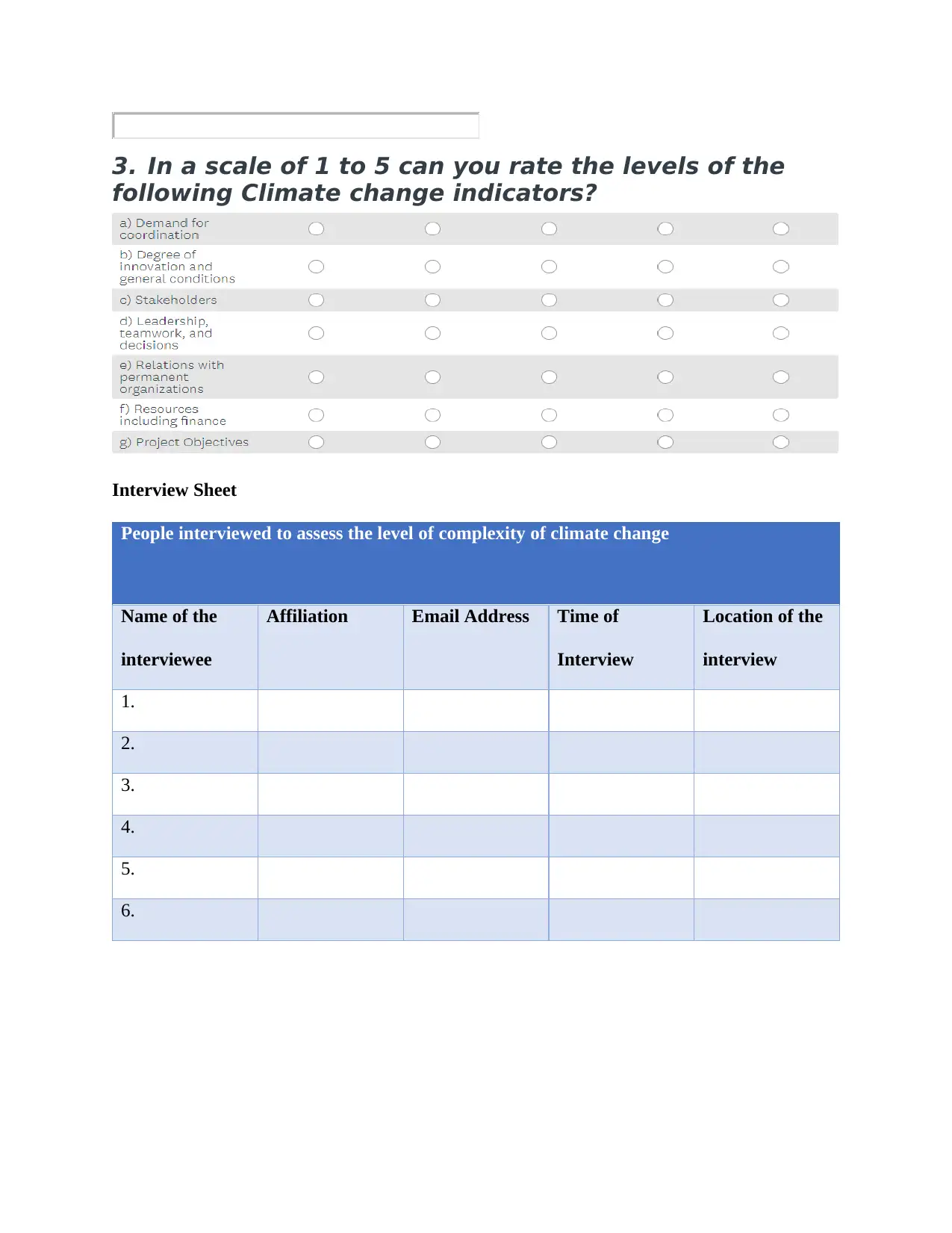
a) Demand for coordination: Climate change has all types of complexities because it is a
complex project involving various cross-border stakeholders. There is demand for
coordination, communication and collaboration of all stakeholders involved with those
leading the climate change program (Zhang et al., 2019, p. 269).
b) Degree of innovation and general conditions :This indicator covers climate change
complexity originating form technical innovation, portfolio and programs
c) Stakeholders: This indicator covers the influence of formal strategy from the sponsoring
organization(s) and the standards, regulations, informal strategies, politics which may
influence the project, program, or portfolio (Franchini & Mannucci, 2015, p. 3). Climate
change has influence from International bodies, the government, local citizens,
Environmental lobbyist, and the media among others.
d) Leadership, teamwork, and decisions: “This indicator focuses on the complexity
originating from the relationship with the team(s) and their maturity and hence the vision,
guidance, and steering the team requires to deliver” (Jost, Dale, & Schwebel, 2019, p.
29). The management team and bodies working in a climate change program need to
have effective leadership and cohesive teams working together.
tabler-icon-diamond-filled.svg

Paraphrase This Document

Need a fresh take? Get an instant paraphrase of this document with our AI Paraphraser
Document Page
e) Relations with permanent organizations: this indicator covers the amount and
interrelatedness of the climate change project leaders, international bodies, the
government and other key stakeholders (Barrage & Furst, 2019, p. 106).
f) Resources including finance: this indicator covers complexities relating to acquiring
and funding the necessary budgets & sources necessary for climate change management.
Implementation of the project is fund –intensive and requires the cooperation of
governments, NGOs and sponsors (Azuz & Yañez, 2019, p. 230).
g) Project Objectives: this indicator covers the complexity originating from vague,
exacting, and mutually conflicting goals, objectives, requirements, and expectations as
climate change has various stakeholders all with their own agendas (Matsumoto, 2019, p.
530).
Climate Change Interview Questions
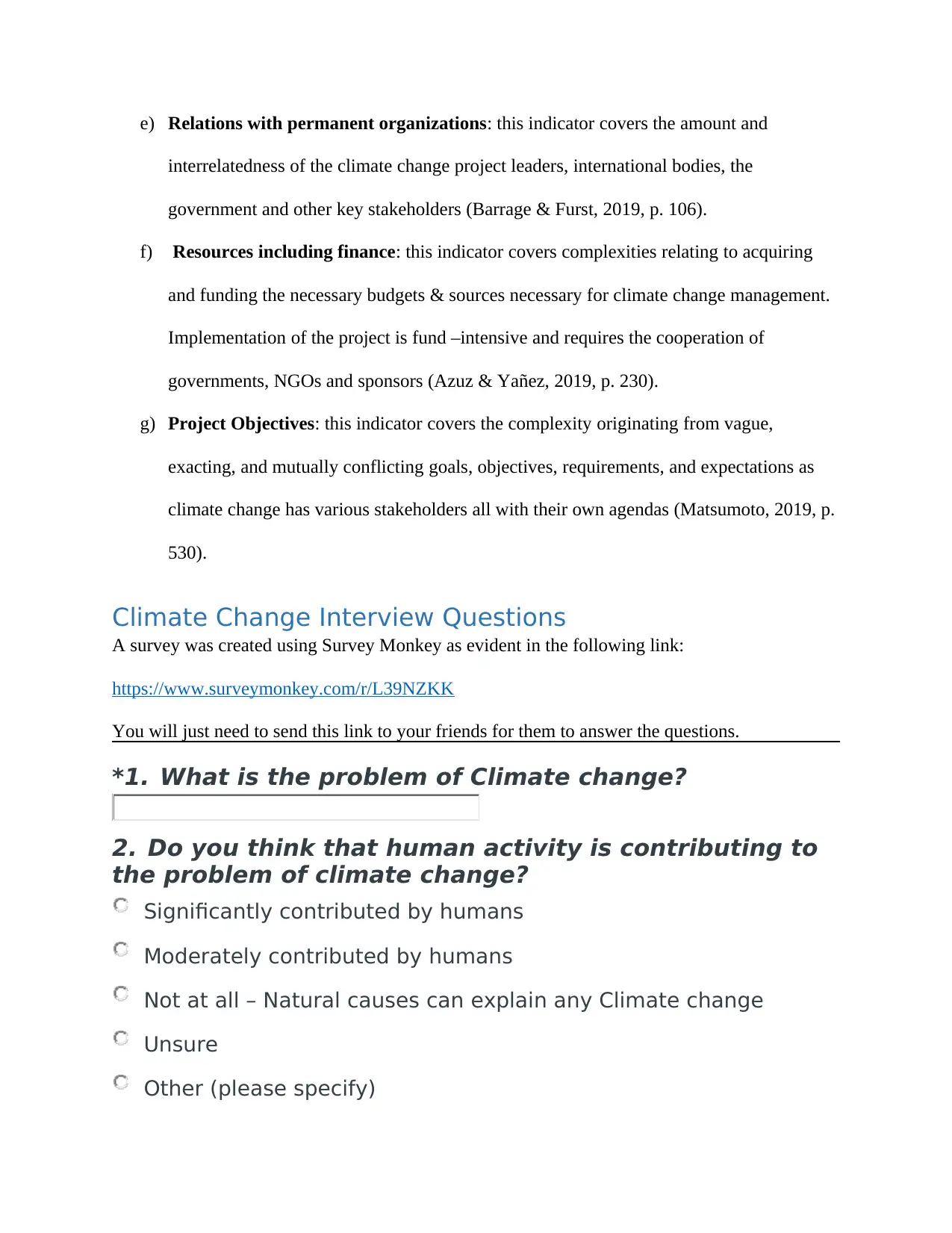
A survey was created using Survey Monkey as evident in the following link:
https://www.surveymonkey.com/r/L39NZKK
You will just need to send this link to your friends for them to answer the questions.
*1. What is the problem of Climate change?
2. Do you think that human activity is contributing to
the problem of climate change?
Significantly contributed by humans
Moderately contributed by humans
Not at all – Natural causes can explain any Climate change
Unsure
Other (please specify)
Document Page
3. In a scale of 1 to 5 can you rate the levels of the
following Climate change indicators?
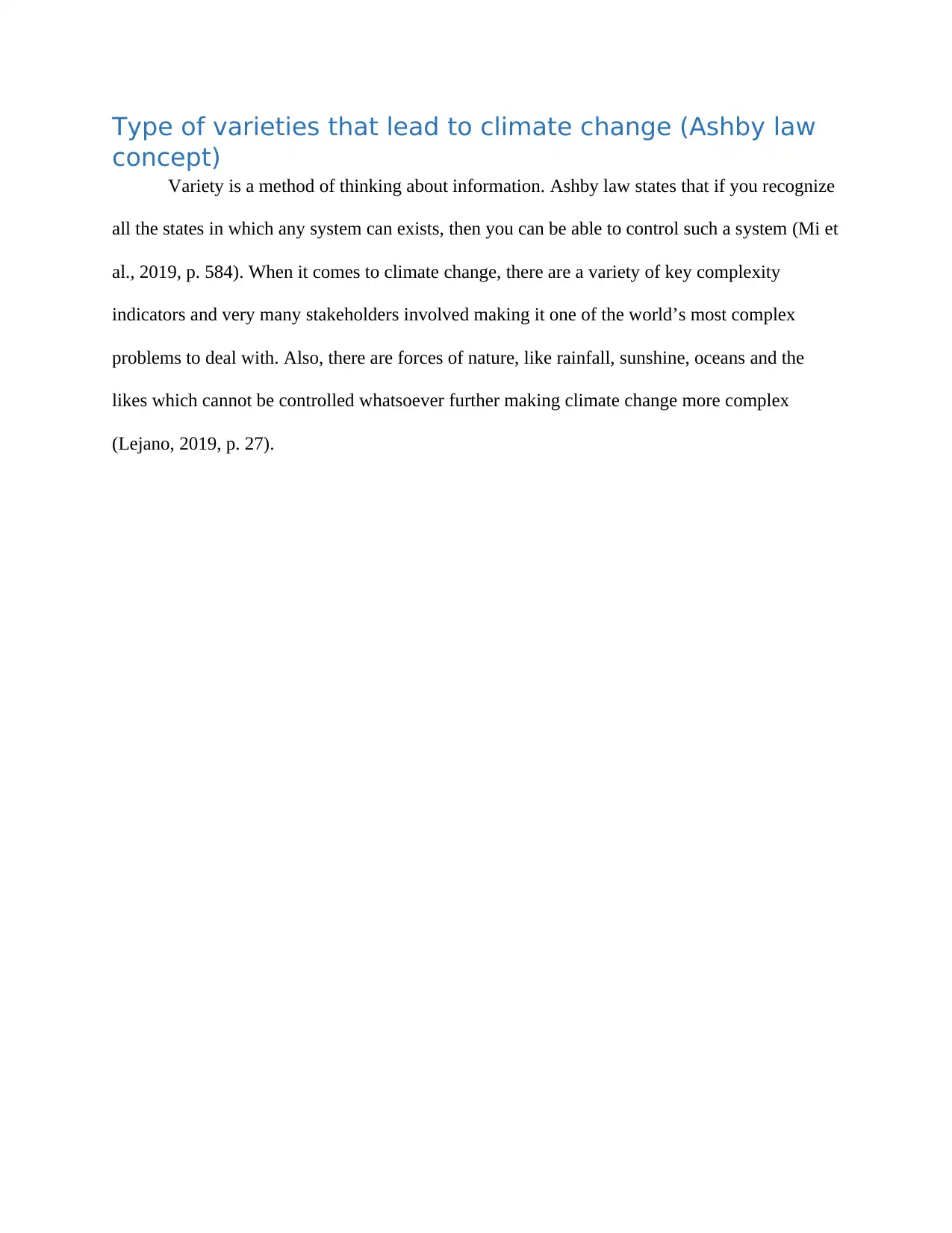
Interview Sheet
People interviewed to assess the level of complexity of climate change
Name of the
interviewee
Affiliation Email Address Time of
Interview
Location of the
interview
1.
2.
3.
4.
5.
6.
Document Page
Type of varieties that lead to climate change (Ashby law
concept)
Variety is a method of thinking about information. Ashby law states that if you recognize
all the states in which any system can exists, then you can be able to control such a system (Mi et
al., 2019, p. 584). When it comes to climate change, there are a variety of key complexity
indicators and very many stakeholders involved making it one of the world’s most complex
problems to deal with. Also, there are forces of nature, like rainfall, sunshine, oceans and the
likes which cannot be controlled whatsoever further making climate change more complex
(Lejano, 2019, p. 27).
tabler-icon-diamond-filled.svg

Paraphrase This Document

Need a fresh take? Get an instant paraphrase of this document with our AI Paraphraser
Document Page
References
Azuz, I., & Yañez, A. (2019). Climate Change: Ecological and socio economic dimensions in the
coastal zone. Ecological Engineering, 130, 228–232.
https://doi.org/10.1016/j.ecoleng.2018.01.013
Barrage, L., & Furst, J. (2019). Housing investment, sea level rise, and climate change beliefs.
Economics Letters, 177, 105–108. https://doi.org/10.1016/j.econlet.2019.01.023
Ciarli, T., & Savona, M. (2019). Modelling the Evolution of Economic Structure and Climate
Change: A Review. Ecological Economics, 158, 51–64.
https://doi.org/10.1016/j.ecolecon.2018.12.008
Franchini, M., & Mannucci, P. M. (2015). Impact on human health of climate changes.
European Journal of Internal Medicine, 26(1), 1–5.
https://doi.org/10.1016/j.ejim.2014.12.008
Jost, F., Dale, A., & Schwebel, S. (2019). How positive is “change” in climate change? A
sentiment analysis. Environmental Science & Policy, 96, 27–36.
https://doi.org/10.1016/j.envsci.2019.02.007
Lejano, R. P. (2019). Climate change and the relational city. Cities, 85, 25–29.
https://doi.org/10.1016/j.cities.2018.12.001
Matsumoto, K. (2019). Climate change impacts on socioeconomic activities through labor
productivity changes considering interactions between socioeconomic and climate
systems. Journal of Cleaner Production, 216, 528–541.
https://doi.org/10.1016/j.jclepro.2018.12.127
Document Page
Mi, Z., Guan, D., Liu, Z., Liu, J., Viguié, V., Fromer, N., & Wang, Y. (2019). Cities: The core of
climate change mitigation. Journal of Cleaner Production, 207, 582–589.
https://doi.org/10.1016/j.jclepro.2018.10.034
Park, S., Lim, J., & Lim, H. S. (2019). Past climate changes over South Korea during MIS3 and
MIS1 and their links to regional and global climate changes. Quaternary International,
20, 82–89. https://doi.org/10.1016/j.quaint.2019.04.004
Steeves, L., & Filgueira, R. (2019). Stakeholder perceptions of climate change in the context of
bivalve aquaculture. Marine Policy, 103, 121–129.
https://doi.org/10.1016/j.marpol.2019.02.024
Werndl, C. (2016). On Defining Climate and Climate Change. The British Journal for the
Philosophy of Science, 67(2), 337–364. https://doi.org/10.1093/bjps/axu048
Zhang, S., Zhang, J., Yue, T., & Jing, X. (2019). Impacts of climate change on urban rainwater
harvesting systems. Science of The Total Environment, 665, 262–274.
https://doi.org/10.1016/j.scitotenv.2019.02.135
chevron_up_icon
1 out of 9
circle_padding
hide_on_mobile
zoom_out_icon
[object Object]