Requirement Engineering for Component-Based Software System Research
VerifiedAdded on 2022/10/09
|10
|2906
|18
Report
AI Summary
This research paper delves into the realm of component-based software systems, emphasizing the critical aspects of requirement engineering, system security, and software architecture. The paper begins with a literature review, exploring the significance of component-based software in enhancing software quality and system stability, highlighting key research findings and perspectives from various scholars. It then details the research methodology, including the research design, approach, and strategy, which includes the use of qualitative analysis and literature reviews to gather and analyze data. The paper discusses the importance of component-based software in the context of software engineering, emphasizing compositional reuse and the use of security tools such as JavaBeans, COM+ models, and CORBA to mitigate security threats and enhance the quality of developed software. The paper concludes by highlighting the essential components of software development, including software architectures, component frameworks, and product lines, and suggesting that companies should provide proper information about component-based software and aware of the employees about security risks and attacks associated with the systems.
RESEARCH PAPER 0
Requirement Engineering for Component-Based Software System
Requirement Engineering for Component-Based Software System

Paraphrase This Document
Need a fresh take? Get an instant paraphrase of this document with our AI Paraphraser
RESEARCH PAPER 1
Table of Contents
Literature review.........................................................................................................................................2
Research methodology................................................................................................................................4
Research design.......................................................................................................................................5
Research approach...................................................................................................................................5
Research strategy.....................................................................................................................................6
Data collection.........................................................................................................................................6
Data analysis...........................................................................................................................................6
References...................................................................................................................................................8
Table of Contents
Literature review.........................................................................................................................................2
Research methodology................................................................................................................................4
Research design.......................................................................................................................................5
Research approach...................................................................................................................................5
Research strategy.....................................................................................................................................6
Data collection.........................................................................................................................................6
Data analysis...........................................................................................................................................6
References...................................................................................................................................................8
RESEARCH PAPER 2
Literature review
Component-based software is a branch of software engineering that emphasizes the separation of
concerns in the context of wide-ranging functionality obtainable throughout a provided software-
based network. It helps the companies for developing effective software in the workplace and
enhances the quality of the developed software. The major focus of this literature review is to
explore the importance of component-based software systems and evaluate the opinions of the
researchers based on the component-based software.
Abdellatief, Sultan, Ghani, and Jabar, (2013) identified that the term component-based software
is a kind of system which is mainly used for controlling and improving the effectiveness of the
systems [1]. It is able to provide better services to the companies and maintain the stability of the
systems in an appropriate manner. It is examined that component-based development is a process
that accentuates the development and design of computing based networks using reusable
software networks and servers. With the help of component-based software, developers can
enhance the quality of the developed networks and software. From the recent article, it is
examined that the state of the art is an effective process that can be used in the component-based
software in order to reuse and produce effective software and computer-based servers [13].
According to Bruyninckx, et al., (2013) component-based software is a kind of programming
code that provides an executable through specified interfaces and provides a platform to improve
the reliability of the systems in the companies [2]. Compositional reuse is an effective approach
that can be used in the development of software in order to develop effective software networks
and servers. In order to reduce security issues and risks, the developers should avoid
unauthorized access occurred in the systems and use encrypted systems for protecting data
against data breach [9]. It is examined that the utilization of component-based software can help
the companies for improving the quality of the software and handle the issues faced by the
consumers.
From recent literature provided by Hristov, et al., (2012) it is identified that in order to create a
basic component-based network the developers can utilize long-run investment because of their
capability to provide effective services and enhance the profits in the business communities [3].
It is true that the development of effective strategies and approaches in the component-based
Literature review
Component-based software is a branch of software engineering that emphasizes the separation of
concerns in the context of wide-ranging functionality obtainable throughout a provided software-
based network. It helps the companies for developing effective software in the workplace and
enhances the quality of the developed software. The major focus of this literature review is to
explore the importance of component-based software systems and evaluate the opinions of the
researchers based on the component-based software.
Abdellatief, Sultan, Ghani, and Jabar, (2013) identified that the term component-based software
is a kind of system which is mainly used for controlling and improving the effectiveness of the
systems [1]. It is able to provide better services to the companies and maintain the stability of the
systems in an appropriate manner. It is examined that component-based development is a process
that accentuates the development and design of computing based networks using reusable
software networks and servers. With the help of component-based software, developers can
enhance the quality of the developed networks and software. From the recent article, it is
examined that the state of the art is an effective process that can be used in the component-based
software in order to reuse and produce effective software and computer-based servers [13].
According to Bruyninckx, et al., (2013) component-based software is a kind of programming
code that provides an executable through specified interfaces and provides a platform to improve
the reliability of the systems in the companies [2]. Compositional reuse is an effective approach
that can be used in the development of software in order to develop effective software networks
and servers. In order to reduce security issues and risks, the developers should avoid
unauthorized access occurred in the systems and use encrypted systems for protecting data
against data breach [9]. It is examined that the utilization of component-based software can help
the companies for improving the quality of the software and handle the issues faced by the
consumers.
From recent literature provided by Hristov, et al., (2012) it is identified that in order to create a
basic component-based network the developers can utilize long-run investment because of their
capability to provide effective services and enhance the profits in the business communities [3].
It is true that the development of effective strategies and approaches in the component-based
⊘ This is a preview!⊘
Do you want full access?
Subscribe today to unlock all pages.

Trusted by 1+ million students worldwide
RESEARCH PAPER 3
software can help for enhancing software quality and reducing the problems related to the
software [14]. Component-based techniques include processes for developing and implementing
software-based networks by selecting ideal off the shelf components and executing them on
reliable software architecture. Jha, et al., (2014) supported this argument and identified that long
run architecture is the best way for developing component-based software and managing the
performance of the software architectures effectively [4]. It is argued that long-run investment
mainly focuses on the effectiveness of the architecture and helps for reducing the security issues
that occurred in the software-based systems.
The security of the developed software can be enhanced using effective networks and
encryption-related techniques that identify the risk factors from the systems and reduce the
unwanted signals from the software. In this generation, the use of information technology is
rising day by day and security is the biggest problem suffered by the companies. For handling
data breach and security threats from the component-based software, the developers can design
effective strategies and provide real-time communication to the consumers. According to
Kahtan, Bakar, and Nordin, (2012) for enhancing the quality and security of component-based
software the companies can use various security tools including JavaBeans, COM+ models and
CORBA [5]. In which COM+ model is the effective software that has the capability to identify
the malware signals or viruses from the systems and help the consumers to secure personal
information against security threats and attacks [15].
By handling the quality of the software systems the flexibility of the networks can be enhanced
and the companies can easily enhance organizational performance. Mir and Quadri, (2012)
provided their views on component-based software and examined that the implanting
component-based software is a crucial part of software engineering which requires more effort
and time. The use of component-based software can be maintained if the developers provide
reliable services to the consumers and the cost of the systems can be managed by using effective
communication systems and networks. It is suggested that companies should provide the proper
information about component-based software and aware of the employees about security risks
and attacks associated with the systems [16].
The developed software requires a platform to handle and address the risk factors that impact on
the quality and security of the systems and the software construction approach has the capability
software can help for enhancing software quality and reducing the problems related to the
software [14]. Component-based techniques include processes for developing and implementing
software-based networks by selecting ideal off the shelf components and executing them on
reliable software architecture. Jha, et al., (2014) supported this argument and identified that long
run architecture is the best way for developing component-based software and managing the
performance of the software architectures effectively [4]. It is argued that long-run investment
mainly focuses on the effectiveness of the architecture and helps for reducing the security issues
that occurred in the software-based systems.
The security of the developed software can be enhanced using effective networks and
encryption-related techniques that identify the risk factors from the systems and reduce the
unwanted signals from the software. In this generation, the use of information technology is
rising day by day and security is the biggest problem suffered by the companies. For handling
data breach and security threats from the component-based software, the developers can design
effective strategies and provide real-time communication to the consumers. According to
Kahtan, Bakar, and Nordin, (2012) for enhancing the quality and security of component-based
software the companies can use various security tools including JavaBeans, COM+ models and
CORBA [5]. In which COM+ model is the effective software that has the capability to identify
the malware signals or viruses from the systems and help the consumers to secure personal
information against security threats and attacks [15].
By handling the quality of the software systems the flexibility of the networks can be enhanced
and the companies can easily enhance organizational performance. Mir and Quadri, (2012)
provided their views on component-based software and examined that the implanting
component-based software is a crucial part of software engineering which requires more effort
and time. The use of component-based software can be maintained if the developers provide
reliable services to the consumers and the cost of the systems can be managed by using effective
communication systems and networks. It is suggested that companies should provide the proper
information about component-based software and aware of the employees about security risks
and attacks associated with the systems [16].
The developed software requires a platform to handle and address the risk factors that impact on
the quality and security of the systems and the software construction approach has the capability
Paraphrase This Document
Need a fresh take? Get an instant paraphrase of this document with our AI Paraphraser
RESEARCH PAPER 4
to handle such kinds of issues and manage the effectiveness of the systems. Narwal, (2012)
suggested that companies can use JavaBeans tools while developing component-based systems
because of their capability to identify the problems and facts that lead to security-related issues
in the software [7].
As compared with the recent studies the chosen article provided depth examination about
component-based software and recommended effective strategies in order to enhance the quality
of the software. It is found that there are major three components of the software development
system including software architectures, component frameworks, and product lines. Therefore,
managing these points can reduce costs and issues related to the software and help the developers
for providing effective software and servers to the consumers [8]. Therefore, it is suggested that
consumers should use authentic networks and secured systems while accessing component-based
software and provide limited access to the software in order to protect data against security
attacks. The selected articles in the literature provided reliable data about component-based
software and also suggested effective tools and techniques for enhancing the quality and security
of the developed software.
Research methodology
It is a specific process that is utilized in the investigation for finding, selecting and analyzing the
facts related to the research questions. In the context of the research article, the term
methodology is defined as a process that allows the readers to evaluate and demonstrate their
skills in the research topic [7]. There are major five methodologies will be used in these
dissertations which are highlighted below:
Research design
Research approach
Strategy
Data collection
Data analysis
Using these methods the investigator will enhance the effectiveness and relevancy of the
research and also provide depth examination about component-based software. The purpose of
to handle such kinds of issues and manage the effectiveness of the systems. Narwal, (2012)
suggested that companies can use JavaBeans tools while developing component-based systems
because of their capability to identify the problems and facts that lead to security-related issues
in the software [7].
As compared with the recent studies the chosen article provided depth examination about
component-based software and recommended effective strategies in order to enhance the quality
of the software. It is found that there are major three components of the software development
system including software architectures, component frameworks, and product lines. Therefore,
managing these points can reduce costs and issues related to the software and help the developers
for providing effective software and servers to the consumers [8]. Therefore, it is suggested that
consumers should use authentic networks and secured systems while accessing component-based
software and provide limited access to the software in order to protect data against security
attacks. The selected articles in the literature provided reliable data about component-based
software and also suggested effective tools and techniques for enhancing the quality and security
of the developed software.
Research methodology
It is a specific process that is utilized in the investigation for finding, selecting and analyzing the
facts related to the research questions. In the context of the research article, the term
methodology is defined as a process that allows the readers to evaluate and demonstrate their
skills in the research topic [7]. There are major five methodologies will be used in these
dissertations which are highlighted below:
Research design
Research approach
Strategy
Data collection
Data analysis
Using these methods the investigator will enhance the effectiveness and relevancy of the
research and also provide depth examination about component-based software. The purpose of
RESEARCH PAPER 5
this research is to solve the security and quality-related issues that occur in the computing
software and evaluate the concept behind component-based software.
Research design
It is argued that study design is the essential technique that is able to provide an effective
framework of the research and reduce the problems faced by the researchers. By including this
type of technique the researchers can receive appropriate direction of the investigation and obtain
reliable information about component-based software. Such kind of methodology also aids the
writers to plan the process of investigation and allows them to produce effective arguments in the
investigation. There are several techniques involve in the study design including qualitative and
quantitative. It is described that the major difference between these designs is that qualitative
provide subjective information but quantitative design delivers numerical data relevant to the
research questions [9].
For this paper, the qualitative design will be included due to their larger capability to provide
effective points about component-based software and control the gaps between the research
questions and gathered information. In this way, the adopted methodology will identify the
reliable points about software systems and manage the flow of facts in the research that may
resolve the queries of the readers.
Research approach
It is defined as a process that is utilized in the investigation for identifying the key points related
to the research concerns. The main reason for using the research approach in the paper is that it is
capable to evaluate the causes for using the specific processes and methods in the investigation
[10]. From the previous articles, it is found that there are major three approaches used in the
paper for example deductive, inductive and abductive. In the deductive approach, the researchers
can receive better outcomes but it is limited for the research while the inductive process is
capable to deliver the sensitive data and depth examination about research questions. In the
abductive approach, the researchers can gather facts from the phenomenon and themes and it is
suitable for the statistical data.
For this paper, the writer will include an inductive approach as it provides depth observation
about research and generalizing form the specific process. Moreover, the researchers will be
this research is to solve the security and quality-related issues that occur in the computing
software and evaluate the concept behind component-based software.
Research design
It is argued that study design is the essential technique that is able to provide an effective
framework of the research and reduce the problems faced by the researchers. By including this
type of technique the researchers can receive appropriate direction of the investigation and obtain
reliable information about component-based software. Such kind of methodology also aids the
writers to plan the process of investigation and allows them to produce effective arguments in the
investigation. There are several techniques involve in the study design including qualitative and
quantitative. It is described that the major difference between these designs is that qualitative
provide subjective information but quantitative design delivers numerical data relevant to the
research questions [9].
For this paper, the qualitative design will be included due to their larger capability to provide
effective points about component-based software and control the gaps between the research
questions and gathered information. In this way, the adopted methodology will identify the
reliable points about software systems and manage the flow of facts in the research that may
resolve the queries of the readers.
Research approach
It is defined as a process that is utilized in the investigation for identifying the key points related
to the research concerns. The main reason for using the research approach in the paper is that it is
capable to evaluate the causes for using the specific processes and methods in the investigation
[10]. From the previous articles, it is found that there are major three approaches used in the
paper for example deductive, inductive and abductive. In the deductive approach, the researchers
can receive better outcomes but it is limited for the research while the inductive process is
capable to deliver the sensitive data and depth examination about research questions. In the
abductive approach, the researchers can gather facts from the phenomenon and themes and it is
suitable for the statistical data.
For this paper, the writer will include an inductive approach as it provides depth observation
about research and generalizing form the specific process. Moreover, the researchers will be
⊘ This is a preview!⊘
Do you want full access?
Subscribe today to unlock all pages.
Trusted by 1+ million students worldwide
RESEARCH PAPER 6
capable to achieve the developed goals while including inductive methodology. It is examined
that there is no need to design and implement hypotheses in this dissertation because the
inductive approach provides a platform to produce effective research and solve the queries
produced by the readers. Therefore, including such an approach the writer can pool the large data
or facts linked with the component-based software and handle the quality-related issues.
Research strategy
It is described as a process that provides step by step plan of actions to the researchers and
enables to conduct an investigation in the right direction. The appropriate strategies can reduce
the conflicts and other issues form the paper and support for completing the research in schedule
time [11]. There are numerous processes and strategies involve in this section including survey,
observation, and literature research and so on. In this article, the investigator will conduct
systematic literature in order to obtain the facts about component-based software and explore the
outcomes of the previous papers. For the literature review, the researcher uses various resources,
for example, peer-reviewed articles, online books, websites, and journals. Therefore, these
strategies will help for obtaining reliable points about component-based software and reduce the
conflicts from the investigation. Moreover, the researchers will use only qualitative study and
collect data from previous studies and websites.
Data collection
It is a process of obtaining and measuring data on targeted variables used in the research for
gathering appropriate information. It is explored that data gathering has the potential to attain the
key objectives of the investigation and conclude effective points about research concerns.
Primary and secondary both are common techniques used in the data collection methods [12]. In
which, primary data can be obtained using focus groups, observation, survey and so on but
secondary data may be gathered through previous investigations based on the research topic. For
this study, the secondary data gathering process will be adopted as it provides a number of facts
and points that can solve research questions and conclude reliable points about component-based
software. For adopting secondary kinds of data the researcher will include major three sources
such as literature review, peer-reviewed papers, and online websites. Therefore, using these types
of sources the investigator can gather reliable points and solve the security and quality-related
problems linked with the developed software systems.
capable to achieve the developed goals while including inductive methodology. It is examined
that there is no need to design and implement hypotheses in this dissertation because the
inductive approach provides a platform to produce effective research and solve the queries
produced by the readers. Therefore, including such an approach the writer can pool the large data
or facts linked with the component-based software and handle the quality-related issues.
Research strategy
It is described as a process that provides step by step plan of actions to the researchers and
enables to conduct an investigation in the right direction. The appropriate strategies can reduce
the conflicts and other issues form the paper and support for completing the research in schedule
time [11]. There are numerous processes and strategies involve in this section including survey,
observation, and literature research and so on. In this article, the investigator will conduct
systematic literature in order to obtain the facts about component-based software and explore the
outcomes of the previous papers. For the literature review, the researcher uses various resources,
for example, peer-reviewed articles, online books, websites, and journals. Therefore, these
strategies will help for obtaining reliable points about component-based software and reduce the
conflicts from the investigation. Moreover, the researchers will use only qualitative study and
collect data from previous studies and websites.
Data collection
It is a process of obtaining and measuring data on targeted variables used in the research for
gathering appropriate information. It is explored that data gathering has the potential to attain the
key objectives of the investigation and conclude effective points about research concerns.
Primary and secondary both are common techniques used in the data collection methods [12]. In
which, primary data can be obtained using focus groups, observation, survey and so on but
secondary data may be gathered through previous investigations based on the research topic. For
this study, the secondary data gathering process will be adopted as it provides a number of facts
and points that can solve research questions and conclude reliable points about component-based
software. For adopting secondary kinds of data the researcher will include major three sources
such as literature review, peer-reviewed papers, and online websites. Therefore, using these types
of sources the investigator can gather reliable points and solve the security and quality-related
problems linked with the developed software systems.
Paraphrase This Document
Need a fresh take? Get an instant paraphrase of this document with our AI Paraphraser
RESEARCH PAPER 7
Data analysis
It provides a platform to obtain effective points and findings at the end of the research and
resolve the research questions. The researchers will use descriptive content analysis in order to
evaluate and analyze the facts and information about component-based software [13]. Moreover,
the writer will contain Microsoft Word in order to develop a research paper in their own words.
Therefore, using such methods the researchers can solve research questions and obtain the
effective points for concluding the entire research. Furthermore, the developed literature review
will provide depth analysis about component-based software.
Data analysis
It provides a platform to obtain effective points and findings at the end of the research and
resolve the research questions. The researchers will use descriptive content analysis in order to
evaluate and analyze the facts and information about component-based software [13]. Moreover,
the writer will contain Microsoft Word in order to develop a research paper in their own words.
Therefore, using such methods the researchers can solve research questions and obtain the
effective points for concluding the entire research. Furthermore, the developed literature review
will provide depth analysis about component-based software.
RESEARCH PAPER 8
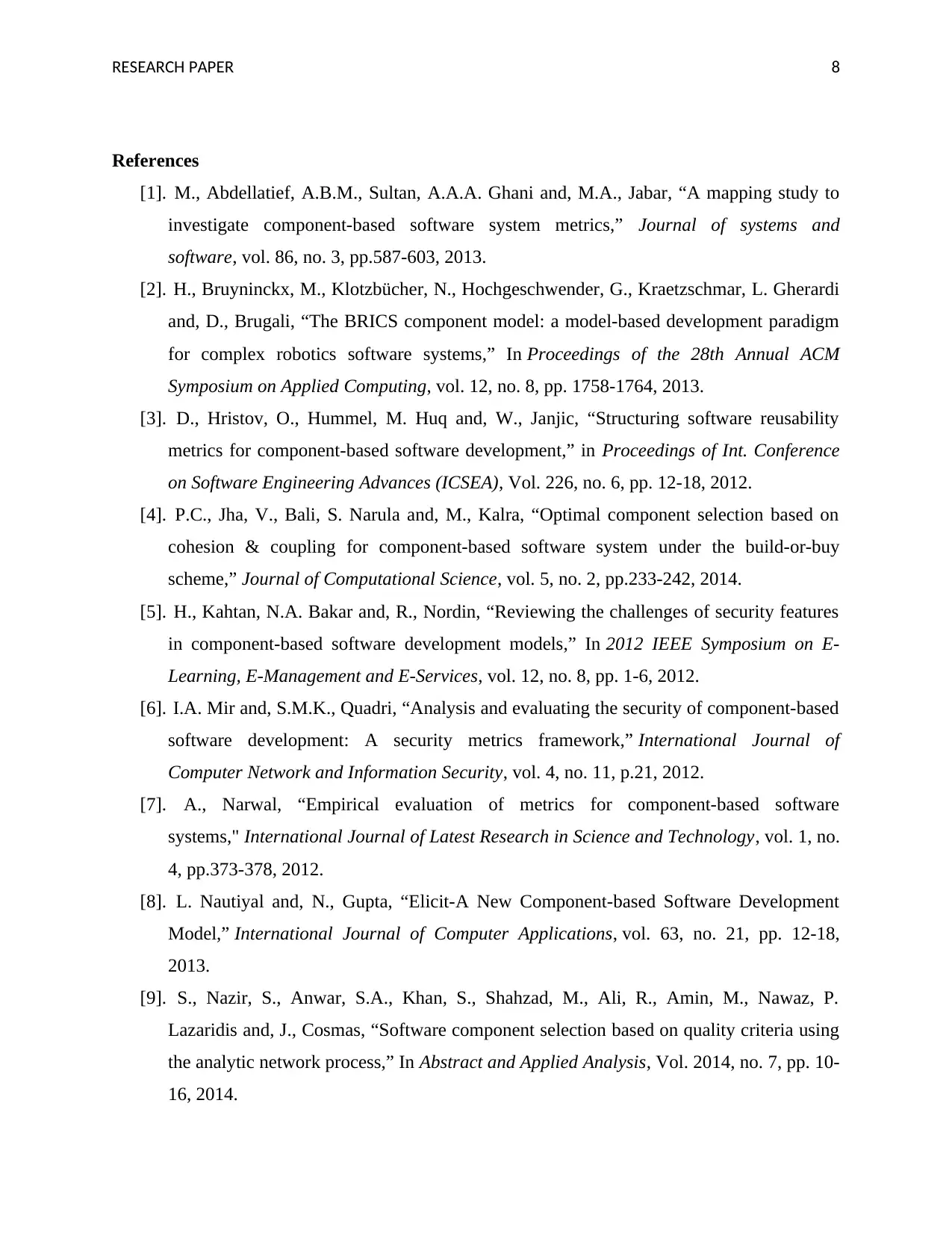
References
[1]. M., Abdellatief, A.B.M., Sultan, A.A.A. Ghani and, M.A., Jabar, “A mapping study to
investigate component-based software system metrics,” Journal of systems and
software, vol. 86, no. 3, pp.587-603, 2013.
[2]. H., Bruyninckx, M., Klotzbücher, N., Hochgeschwender, G., Kraetzschmar, L. Gherardi
and, D., Brugali, “The BRICS component model: a model-based development paradigm
for complex robotics software systems,” In Proceedings of the 28th Annual ACM
Symposium on Applied Computing, vol. 12, no. 8, pp. 1758-1764, 2013.
[3]. D., Hristov, O., Hummel, M. Huq and, W., Janjic, “Structuring software reusability
metrics for component-based software development,” in Proceedings of Int. Conference
on Software Engineering Advances (ICSEA), Vol. 226, no. 6, pp. 12-18, 2012.
[4]. P.C., Jha, V., Bali, S. Narula and, M., Kalra, “Optimal component selection based on
cohesion & coupling for component-based software system under the build-or-buy
scheme,” Journal of Computational Science, vol. 5, no. 2, pp.233-242, 2014.
[5]. H., Kahtan, N.A. Bakar and, R., Nordin, “Reviewing the challenges of security features
in component-based software development models,” In 2012 IEEE Symposium on E-
Learning, E-Management and E-Services, vol. 12, no. 8, pp. 1-6, 2012.
[6]. I.A. Mir and, S.M.K., Quadri, “Analysis and evaluating the security of component-based
software development: A security metrics framework,” International Journal of
Computer Network and Information Security, vol. 4, no. 11, p.21, 2012.
[7]. A., Narwal, “Empirical evaluation of metrics for component-based software
systems," International Journal of Latest Research in Science and Technology, vol. 1, no.
4, pp.373-378, 2012.
[8]. L. Nautiyal and, N., Gupta, “Elicit-A New Component-based Software Development
Model,” International Journal of Computer Applications, vol. 63, no. 21, pp. 12-18,
2013.
[9]. S., Nazir, S., Anwar, S.A., Khan, S., Shahzad, M., Ali, R., Amin, M., Nawaz, P.
Lazaridis and, J., Cosmas, “Software component selection based on quality criteria using
the analytic network process,” In Abstract and Applied Analysis, Vol. 2014, no. 7, pp. 10-
16, 2014.
References
[1]. M., Abdellatief, A.B.M., Sultan, A.A.A. Ghani and, M.A., Jabar, “A mapping study to
investigate component-based software system metrics,” Journal of systems and
software, vol. 86, no. 3, pp.587-603, 2013.
[2]. H., Bruyninckx, M., Klotzbücher, N., Hochgeschwender, G., Kraetzschmar, L. Gherardi
and, D., Brugali, “The BRICS component model: a model-based development paradigm
for complex robotics software systems,” In Proceedings of the 28th Annual ACM
Symposium on Applied Computing, vol. 12, no. 8, pp. 1758-1764, 2013.
[3]. D., Hristov, O., Hummel, M. Huq and, W., Janjic, “Structuring software reusability
metrics for component-based software development,” in Proceedings of Int. Conference
on Software Engineering Advances (ICSEA), Vol. 226, no. 6, pp. 12-18, 2012.
[4]. P.C., Jha, V., Bali, S. Narula and, M., Kalra, “Optimal component selection based on
cohesion & coupling for component-based software system under the build-or-buy
scheme,” Journal of Computational Science, vol. 5, no. 2, pp.233-242, 2014.
[5]. H., Kahtan, N.A. Bakar and, R., Nordin, “Reviewing the challenges of security features
in component-based software development models,” In 2012 IEEE Symposium on E-
Learning, E-Management and E-Services, vol. 12, no. 8, pp. 1-6, 2012.
[6]. I.A. Mir and, S.M.K., Quadri, “Analysis and evaluating the security of component-based
software development: A security metrics framework,” International Journal of
Computer Network and Information Security, vol. 4, no. 11, p.21, 2012.
[7]. A., Narwal, “Empirical evaluation of metrics for component-based software
systems," International Journal of Latest Research in Science and Technology, vol. 1, no.
4, pp.373-378, 2012.
[8]. L. Nautiyal and, N., Gupta, “Elicit-A New Component-based Software Development
Model,” International Journal of Computer Applications, vol. 63, no. 21, pp. 12-18,
2013.
[9]. S., Nazir, S., Anwar, S.A., Khan, S., Shahzad, M., Ali, R., Amin, M., Nawaz, P.
Lazaridis and, J., Cosmas, “Software component selection based on quality criteria using
the analytic network process,” In Abstract and Applied Analysis, Vol. 2014, no. 7, pp. 10-
16, 2014.
⊘ This is a preview!⊘
Do you want full access?
Subscribe today to unlock all pages.
Trusted by 1+ million students worldwide
RESEARCH PAPER 9
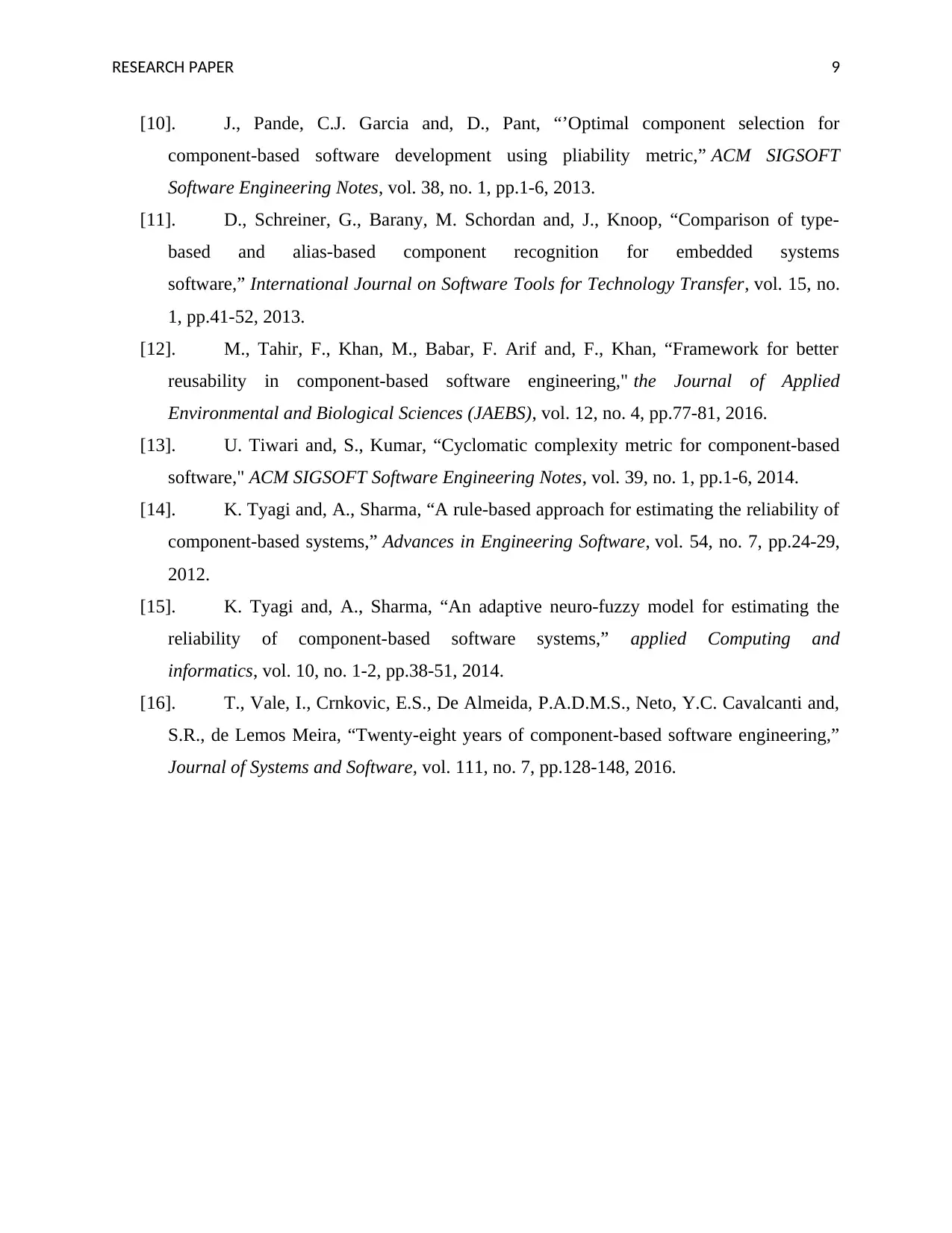
[10]. J., Pande, C.J. Garcia and, D., Pant, “’Optimal component selection for
component-based software development using pliability metric,” ACM SIGSOFT
Software Engineering Notes, vol. 38, no. 1, pp.1-6, 2013.
[11]. D., Schreiner, G., Barany, M. Schordan and, J., Knoop, “Comparison of type-
based and alias-based component recognition for embedded systems
software,” International Journal on Software Tools for Technology Transfer, vol. 15, no.
1, pp.41-52, 2013.
[12]. M., Tahir, F., Khan, M., Babar, F. Arif and, F., Khan, “Framework for better
reusability in component-based software engineering," the Journal of Applied
Environmental and Biological Sciences (JAEBS), vol. 12, no. 4, pp.77-81, 2016.
[13]. U. Tiwari and, S., Kumar, “Cyclomatic complexity metric for component-based
software," ACM SIGSOFT Software Engineering Notes, vol. 39, no. 1, pp.1-6, 2014.
[14]. K. Tyagi and, A., Sharma, “A rule-based approach for estimating the reliability of
component-based systems,” Advances in Engineering Software, vol. 54, no. 7, pp.24-29,
2012.
[15]. K. Tyagi and, A., Sharma, “An adaptive neuro-fuzzy model for estimating the
reliability of component-based software systems,” applied Computing and
informatics, vol. 10, no. 1-2, pp.38-51, 2014.
[16]. T., Vale, I., Crnkovic, E.S., De Almeida, P.A.D.M.S., Neto, Y.C. Cavalcanti and,
S.R., de Lemos Meira, “Twenty-eight years of component-based software engineering,”
Journal of Systems and Software, vol. 111, no. 7, pp.128-148, 2016.
[10]. J., Pande, C.J. Garcia and, D., Pant, “’Optimal component selection for
component-based software development using pliability metric,” ACM SIGSOFT
Software Engineering Notes, vol. 38, no. 1, pp.1-6, 2013.
[11]. D., Schreiner, G., Barany, M. Schordan and, J., Knoop, “Comparison of type-
based and alias-based component recognition for embedded systems
software,” International Journal on Software Tools for Technology Transfer, vol. 15, no.
1, pp.41-52, 2013.
[12]. M., Tahir, F., Khan, M., Babar, F. Arif and, F., Khan, “Framework for better
reusability in component-based software engineering," the Journal of Applied
Environmental and Biological Sciences (JAEBS), vol. 12, no. 4, pp.77-81, 2016.
[13]. U. Tiwari and, S., Kumar, “Cyclomatic complexity metric for component-based
software," ACM SIGSOFT Software Engineering Notes, vol. 39, no. 1, pp.1-6, 2014.
[14]. K. Tyagi and, A., Sharma, “A rule-based approach for estimating the reliability of
component-based systems,” Advances in Engineering Software, vol. 54, no. 7, pp.24-29,
2012.
[15]. K. Tyagi and, A., Sharma, “An adaptive neuro-fuzzy model for estimating the
reliability of component-based software systems,” applied Computing and
informatics, vol. 10, no. 1-2, pp.38-51, 2014.
[16]. T., Vale, I., Crnkovic, E.S., De Almeida, P.A.D.M.S., Neto, Y.C. Cavalcanti and,
S.R., de Lemos Meira, “Twenty-eight years of component-based software engineering,”
Journal of Systems and Software, vol. 111, no. 7, pp.128-148, 2016.

1 out of 10


Related Documents


Your All-in-One AI-Powered Toolkit for Academic Success.
+13062052269
info@desklib.com
Available 24*7 on WhatsApp / Email
![[object Object]](/_next/static/media/star-bottom.7253800d.svg)
Unlock your academic potential
Copyright © 2020–2026 A2Z Services. All Rights Reserved. Developed and managed by ZUCOL.