Comprehensive Analysis of Burn Injury Research Chapters
VerifiedAdded on 2022/08/13
|7
|1657
|10
Report
AI Summary
This report provides a critical analysis of burn injury research, focusing on wound management strategies and the comparison of Dressilk and Biobrane treatments. The analysis examines the limitations of previous studies, such as small sample sizes and limited generalizability, and proposes solutions to improve the validity and reliability of future research. The report also details plans for disseminating research findings, including publication in journals, presentations to stakeholders, and community outreach programs. The goal is to integrate evidence-based practices into clinical settings and enhance healthcare professionals' knowledge of burn injury management, ultimately improving patient outcomes and addressing the global burden of burn injuries. The report emphasizes the importance of addressing limitations and implementing effective dissemination strategies to advance burn injury care.
Running head: CHAPTER ANALYSIS
Chapter 4
Name of the Student
Name of the University
Author Note
Chapter 4
Name of the Student
Name of the University
Author Note
Paraphrase This Document
Need a fresh take? Get an instant paraphrase of this document with our AI Paraphraser

CHAPTER ANALYSIS
Chapter 4
Conclusion of the First Three Chapters
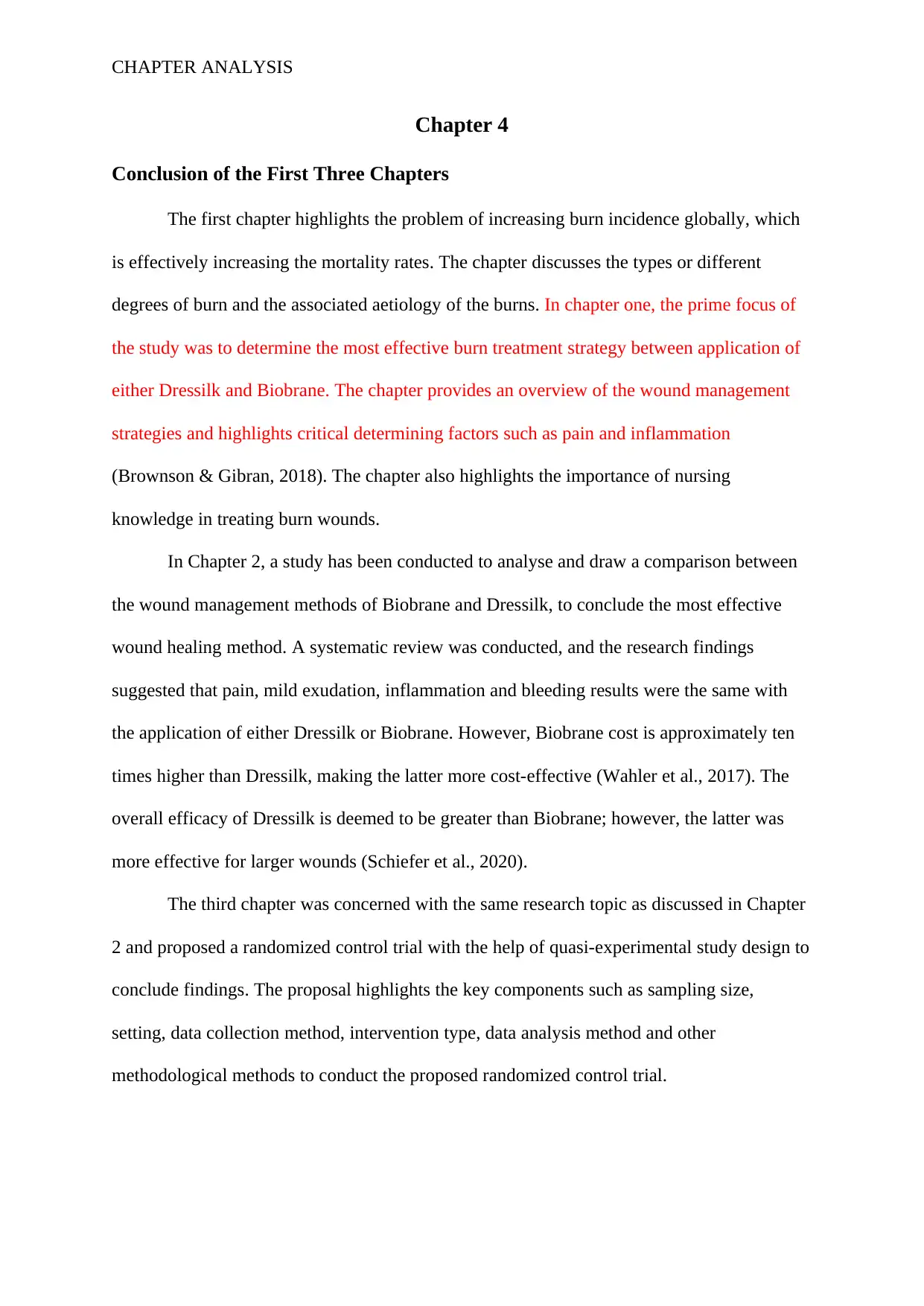
The first chapter highlights the problem of increasing burn incidence globally, which
is effectively increasing the mortality rates. The chapter discusses the types or different
degrees of burn and the associated aetiology of the burns. In chapter one, the prime focus of
the study was to determine the most effective burn treatment strategy between application of
either Dressilk and Biobrane. The chapter provides an overview of the wound management
strategies and highlights critical determining factors such as pain and inflammation
(Brownson & Gibran, 2018). The chapter also highlights the importance of nursing
knowledge in treating burn wounds.
In Chapter 2, a study has been conducted to analyse and draw a comparison between
the wound management methods of Biobrane and Dressilk, to conclude the most effective
wound healing method. A systematic review was conducted, and the research findings
suggested that pain, mild exudation, inflammation and bleeding results were the same with
the application of either Dressilk or Biobrane. However, Biobrane cost is approximately ten
times higher than Dressilk, making the latter more cost-effective (Wahler et al., 2017). The
overall efficacy of Dressilk is deemed to be greater than Biobrane; however, the latter was
more effective for larger wounds (Schiefer et al., 2020).
The third chapter was concerned with the same research topic as discussed in Chapter
2 and proposed a randomized control trial with the help of quasi-experimental study design to
conclude findings. The proposal highlights the key components such as sampling size,
setting, data collection method, intervention type, data analysis method and other
methodological methods to conduct the proposed randomized control trial.
Chapter 4
Conclusion of the First Three Chapters
The first chapter highlights the problem of increasing burn incidence globally, which
is effectively increasing the mortality rates. The chapter discusses the types or different
degrees of burn and the associated aetiology of the burns. In chapter one, the prime focus of
the study was to determine the most effective burn treatment strategy between application of
either Dressilk and Biobrane. The chapter provides an overview of the wound management
strategies and highlights critical determining factors such as pain and inflammation
(Brownson & Gibran, 2018). The chapter also highlights the importance of nursing
knowledge in treating burn wounds.
In Chapter 2, a study has been conducted to analyse and draw a comparison between
the wound management methods of Biobrane and Dressilk, to conclude the most effective
wound healing method. A systematic review was conducted, and the research findings
suggested that pain, mild exudation, inflammation and bleeding results were the same with
the application of either Dressilk or Biobrane. However, Biobrane cost is approximately ten
times higher than Dressilk, making the latter more cost-effective (Wahler et al., 2017). The
overall efficacy of Dressilk is deemed to be greater than Biobrane; however, the latter was
more effective for larger wounds (Schiefer et al., 2020).
The third chapter was concerned with the same research topic as discussed in Chapter
2 and proposed a randomized control trial with the help of quasi-experimental study design to
conclude findings. The proposal highlights the key components such as sampling size,
setting, data collection method, intervention type, data analysis method and other
methodological methods to conduct the proposed randomized control trial.

CHAPTER ANALYSIS
Introduction of Chapter 4
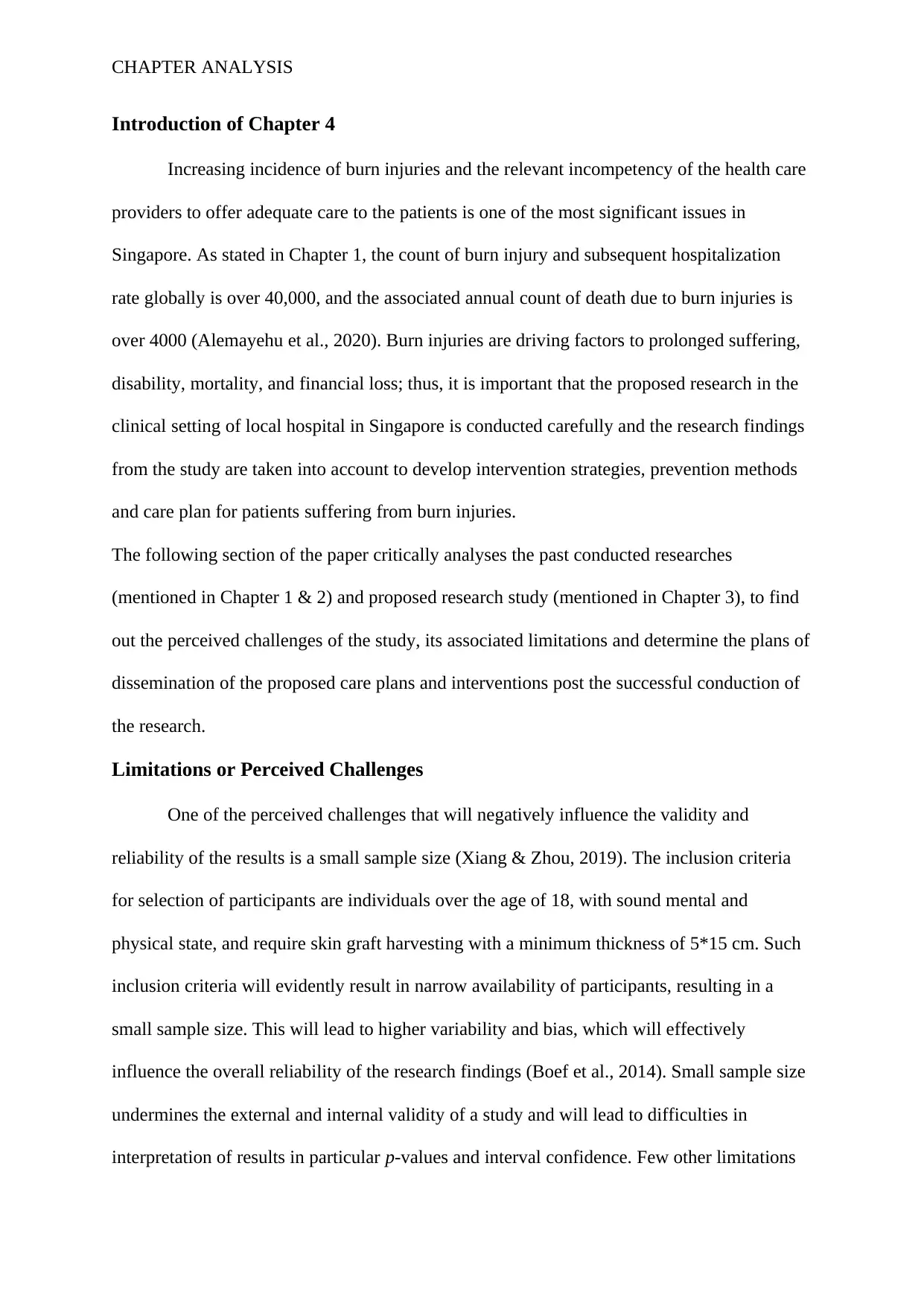
Increasing incidence of burn injuries and the relevant incompetency of the health care
providers to offer adequate care to the patients is one of the most significant issues in
Singapore. As stated in Chapter 1, the count of burn injury and subsequent hospitalization
rate globally is over 40,000, and the associated annual count of death due to burn injuries is
over 4000 (Alemayehu et al., 2020). Burn injuries are driving factors to prolonged suffering,
disability, mortality, and financial loss; thus, it is important that the proposed research in the
clinical setting of local hospital in Singapore is conducted carefully and the research findings
from the study are taken into account to develop intervention strategies, prevention methods
and care plan for patients suffering from burn injuries.
The following section of the paper critically analyses the past conducted researches
(mentioned in Chapter 1 & 2) and proposed research study (mentioned in Chapter 3), to find
out the perceived challenges of the study, its associated limitations and determine the plans of
dissemination of the proposed care plans and interventions post the successful conduction of
the research.
Limitations or Perceived Challenges
One of the perceived challenges that will negatively influence the validity and
reliability of the results is a small sample size (Xiang & Zhou, 2019). The inclusion criteria
for selection of participants are individuals over the age of 18, with sound mental and
physical state, and require skin graft harvesting with a minimum thickness of 5*15 cm. Such
inclusion criteria will evidently result in narrow availability of participants, resulting in a
small sample size. This will lead to higher variability and bias, which will effectively
influence the overall reliability of the research findings (Boef et al., 2014). Small sample size
undermines the external and internal validity of a study and will lead to difficulties in
interpretation of results in particular p-values and interval confidence. Few other limitations
Introduction of Chapter 4
Increasing incidence of burn injuries and the relevant incompetency of the health care
providers to offer adequate care to the patients is one of the most significant issues in
Singapore. As stated in Chapter 1, the count of burn injury and subsequent hospitalization
rate globally is over 40,000, and the associated annual count of death due to burn injuries is
over 4000 (Alemayehu et al., 2020). Burn injuries are driving factors to prolonged suffering,
disability, mortality, and financial loss; thus, it is important that the proposed research in the
clinical setting of local hospital in Singapore is conducted carefully and the research findings
from the study are taken into account to develop intervention strategies, prevention methods
and care plan for patients suffering from burn injuries.
The following section of the paper critically analyses the past conducted researches
(mentioned in Chapter 1 & 2) and proposed research study (mentioned in Chapter 3), to find
out the perceived challenges of the study, its associated limitations and determine the plans of
dissemination of the proposed care plans and interventions post the successful conduction of
the research.
Limitations or Perceived Challenges
One of the perceived challenges that will negatively influence the validity and
reliability of the results is a small sample size (Xiang & Zhou, 2019). The inclusion criteria
for selection of participants are individuals over the age of 18, with sound mental and
physical state, and require skin graft harvesting with a minimum thickness of 5*15 cm. Such
inclusion criteria will evidently result in narrow availability of participants, resulting in a
small sample size. This will lead to higher variability and bias, which will effectively
influence the overall reliability of the research findings (Boef et al., 2014). Small sample size
undermines the external and internal validity of a study and will lead to difficulties in
interpretation of results in particular p-values and interval confidence. Few other limitations
⊘ This is a preview!⊘
Do you want full access?
Subscribe today to unlock all pages.

Trusted by 1+ million students worldwide

CHAPTER ANALYSIS
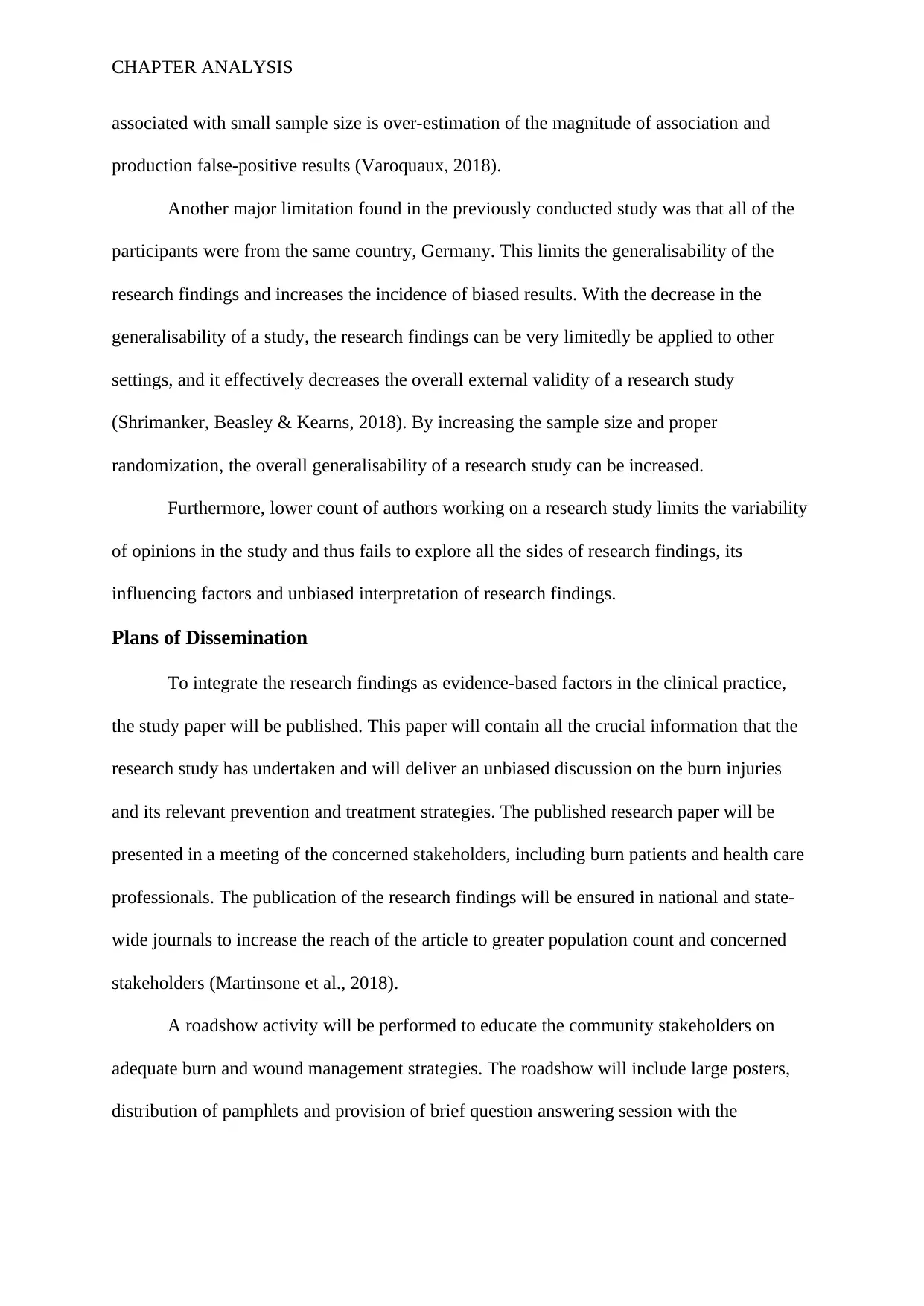
associated with small sample size is over-estimation of the magnitude of association and
production false-positive results (Varoquaux, 2018).
Another major limitation found in the previously conducted study was that all of the
participants were from the same country, Germany. This limits the generalisability of the
research findings and increases the incidence of biased results. With the decrease in the
generalisability of a study, the research findings can be very limitedly be applied to other
settings, and it effectively decreases the overall external validity of a research study
(Shrimanker, Beasley & Kearns, 2018). By increasing the sample size and proper
randomization, the overall generalisability of a research study can be increased.
Furthermore, lower count of authors working on a research study limits the variability
of opinions in the study and thus fails to explore all the sides of research findings, its
influencing factors and unbiased interpretation of research findings.
Plans of Dissemination
To integrate the research findings as evidence-based factors in the clinical practice,
the study paper will be published. This paper will contain all the crucial information that the
research study has undertaken and will deliver an unbiased discussion on the burn injuries
and its relevant prevention and treatment strategies. The published research paper will be
presented in a meeting of the concerned stakeholders, including burn patients and health care
professionals. The publication of the research findings will be ensured in national and state-
wide journals to increase the reach of the article to greater population count and concerned
stakeholders (Martinsone et al., 2018).
A roadshow activity will be performed to educate the community stakeholders on
adequate burn and wound management strategies. The roadshow will include large posters,
distribution of pamphlets and provision of brief question answering session with the
associated with small sample size is over-estimation of the magnitude of association and
production false-positive results (Varoquaux, 2018).
Another major limitation found in the previously conducted study was that all of the
participants were from the same country, Germany. This limits the generalisability of the
research findings and increases the incidence of biased results. With the decrease in the
generalisability of a study, the research findings can be very limitedly be applied to other
settings, and it effectively decreases the overall external validity of a research study
(Shrimanker, Beasley & Kearns, 2018). By increasing the sample size and proper
randomization, the overall generalisability of a research study can be increased.
Furthermore, lower count of authors working on a research study limits the variability
of opinions in the study and thus fails to explore all the sides of research findings, its
influencing factors and unbiased interpretation of research findings.
Plans of Dissemination
To integrate the research findings as evidence-based factors in the clinical practice,
the study paper will be published. This paper will contain all the crucial information that the
research study has undertaken and will deliver an unbiased discussion on the burn injuries
and its relevant prevention and treatment strategies. The published research paper will be
presented in a meeting of the concerned stakeholders, including burn patients and health care
professionals. The publication of the research findings will be ensured in national and state-
wide journals to increase the reach of the article to greater population count and concerned
stakeholders (Martinsone et al., 2018).
A roadshow activity will be performed to educate the community stakeholders on
adequate burn and wound management strategies. The roadshow will include large posters,
distribution of pamphlets and provision of brief question answering session with the
Paraphrase This Document
Need a fresh take? Get an instant paraphrase of this document with our AI Paraphraser

CHAPTER ANALYSIS
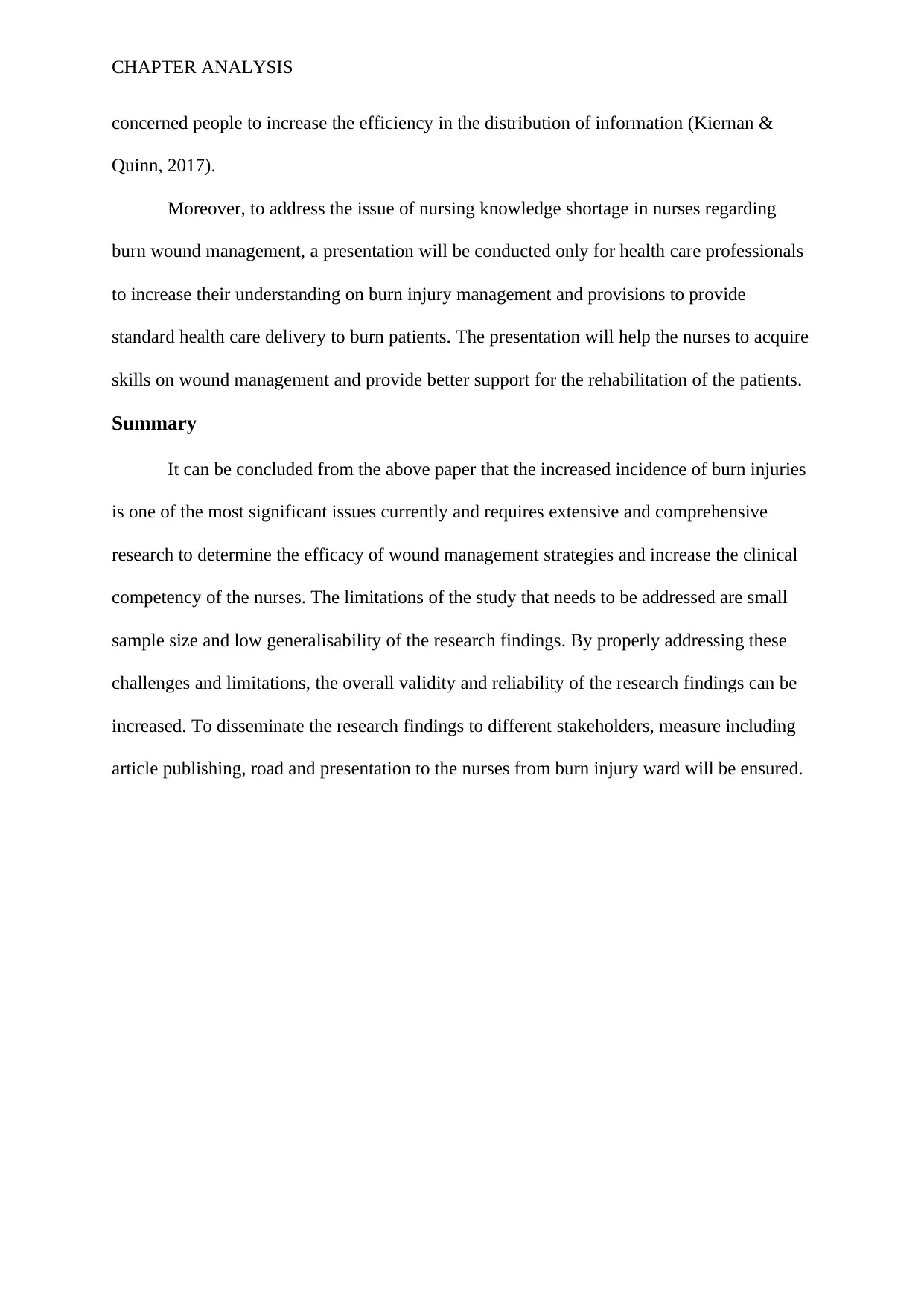
concerned people to increase the efficiency in the distribution of information (Kiernan &
Quinn, 2017).
Moreover, to address the issue of nursing knowledge shortage in nurses regarding
burn wound management, a presentation will be conducted only for health care professionals
to increase their understanding on burn injury management and provisions to provide
standard health care delivery to burn patients. The presentation will help the nurses to acquire
skills on wound management and provide better support for the rehabilitation of the patients.
Summary
It can be concluded from the above paper that the increased incidence of burn injuries
is one of the most significant issues currently and requires extensive and comprehensive
research to determine the efficacy of wound management strategies and increase the clinical
competency of the nurses. The limitations of the study that needs to be addressed are small
sample size and low generalisability of the research findings. By properly addressing these
challenges and limitations, the overall validity and reliability of the research findings can be
increased. To disseminate the research findings to different stakeholders, measure including
article publishing, road and presentation to the nurses from burn injury ward will be ensured.
concerned people to increase the efficiency in the distribution of information (Kiernan &
Quinn, 2017).
Moreover, to address the issue of nursing knowledge shortage in nurses regarding
burn wound management, a presentation will be conducted only for health care professionals
to increase their understanding on burn injury management and provisions to provide
standard health care delivery to burn patients. The presentation will help the nurses to acquire
skills on wound management and provide better support for the rehabilitation of the patients.
Summary
It can be concluded from the above paper that the increased incidence of burn injuries
is one of the most significant issues currently and requires extensive and comprehensive
research to determine the efficacy of wound management strategies and increase the clinical
competency of the nurses. The limitations of the study that needs to be addressed are small
sample size and low generalisability of the research findings. By properly addressing these
challenges and limitations, the overall validity and reliability of the research findings can be
increased. To disseminate the research findings to different stakeholders, measure including
article publishing, road and presentation to the nurses from burn injury ward will be ensured.

CHAPTER ANALYSIS
References
Alemayehu, S., Afera, B., Kidanu, K., & Belete, T. (2020). Management Outcome of Burn
Injury and Associated Factors among Hospitalized Children at Ayder Referral
Hospital, Tigray, Ethiopia. International Journal of Pediatrics, 2020.
Boef, A. G., Dekkers, O. M., Vandenbroucke, J. P., & le Cessie, S. (2014). Sample size
importantly limits the usefulness of instrumental variable methods, depending on
instrument strength and level of confounding. Journal of clinical
epidemiology, 67(11), 1258-1264.
Brownson, E. G., & Gibran, N. S. (2018). Evaluation of the burn wound: management
decisions. In Total Burn Care (pp. 87-92). Elsevier.
Kiernan, G., & Quinn, M. (2017). Community-based dissemination of research findings.
In Research and Evaluation in Community, Health and Social Care Settings (pp. 124-
137). Routledge.
Martinsone, K., Pipere, A., Berkis, U., Dambrova, M., Gobina, I., Martinsone, K., &
Mihailovs, I. J. (2018). Scientific writing and dissemination of research findings.
Schiefer, J. L., Daniels, M., Grigutsch, D., Fuchs, P. C., & Schulz, A. (2020). Feasibility of
Pure Silk for the Treatment of Large Superficial Burn Wounds Covering Over 10% of
the Total Body Surface. Journal of Burn Care & Research, 41(1), 131-140.
Shrimanker, R., Beasley, R., & Kearns, C. (2018). Letting the right one in: evaluating the
generalisability of clinical trials.
Sengoelge, M., El-Khatib, Z., & Laflamme, L. (2017). The global burden of child burn
injuries in light of country level economic development and income
inequality. Preventive medicine reports, 6, 115-120.
Varoquaux, G. (2018). Cross-validation failure: small sample sizes lead to large error
bars. Neuroimage, 180, 68-77.
References
Alemayehu, S., Afera, B., Kidanu, K., & Belete, T. (2020). Management Outcome of Burn
Injury and Associated Factors among Hospitalized Children at Ayder Referral
Hospital, Tigray, Ethiopia. International Journal of Pediatrics, 2020.
Boef, A. G., Dekkers, O. M., Vandenbroucke, J. P., & le Cessie, S. (2014). Sample size
importantly limits the usefulness of instrumental variable methods, depending on
instrument strength and level of confounding. Journal of clinical
epidemiology, 67(11), 1258-1264.
Brownson, E. G., & Gibran, N. S. (2018). Evaluation of the burn wound: management
decisions. In Total Burn Care (pp. 87-92). Elsevier.
Kiernan, G., & Quinn, M. (2017). Community-based dissemination of research findings.
In Research and Evaluation in Community, Health and Social Care Settings (pp. 124-
137). Routledge.
Martinsone, K., Pipere, A., Berkis, U., Dambrova, M., Gobina, I., Martinsone, K., &
Mihailovs, I. J. (2018). Scientific writing and dissemination of research findings.
Schiefer, J. L., Daniels, M., Grigutsch, D., Fuchs, P. C., & Schulz, A. (2020). Feasibility of
Pure Silk for the Treatment of Large Superficial Burn Wounds Covering Over 10% of
the Total Body Surface. Journal of Burn Care & Research, 41(1), 131-140.
Shrimanker, R., Beasley, R., & Kearns, C. (2018). Letting the right one in: evaluating the
generalisability of clinical trials.
Sengoelge, M., El-Khatib, Z., & Laflamme, L. (2017). The global burden of child burn
injuries in light of country level economic development and income
inequality. Preventive medicine reports, 6, 115-120.
Varoquaux, G. (2018). Cross-validation failure: small sample sizes lead to large error
bars. Neuroimage, 180, 68-77.
⊘ This is a preview!⊘
Do you want full access?
Subscribe today to unlock all pages.

Trusted by 1+ million students worldwide

CHAPTER ANALYSIS
Wahler, S., Wurzer, P., Kamolz, L., & Müller, A. (2017). Cost-Effectiveness Comparison
Between Biobrane and Suprathel for Partial Thickness Burn Treatment for
Austria. Value in Health, 20(9), A802.
Xiang, W., & Zhou, W. (2019). Optimal Sample Size Determination based on Bayesian
Reliability and Value of Information.
Wahler, S., Wurzer, P., Kamolz, L., & Müller, A. (2017). Cost-Effectiveness Comparison
Between Biobrane and Suprathel for Partial Thickness Burn Treatment for
Austria. Value in Health, 20(9), A802.
Xiang, W., & Zhou, W. (2019). Optimal Sample Size Determination based on Bayesian
Reliability and Value of Information.
1 out of 7
Related Documents
Your All-in-One AI-Powered Toolkit for Academic Success.
+13062052269
info@desklib.com
Available 24*7 on WhatsApp / Email
Unlock your academic potential
Copyright © 2020–2026 A2Z Services. All Rights Reserved. Developed and managed by ZUCOL.