Mental Health Program: A Comprehensive Project Proposal
VerifiedAdded on 2022/10/09
|12
|2065
|42
Project
AI Summary
This project proposal outlines a comprehensive mental health program designed to address the prevalence of mental disorders within a community. The proposal details the rationale for the program, emphasizing its alignment with Sustainable Development Goals and the need to address social disadvantage and inadequate funding. It describes the program's implementation strategy, which involves collaboration with various stakeholders such as community elders, health institutions, and schools, to gather data and provide mental health support through online platforms and designated centers. The proposal includes a project timeline, stakeholder analysis, risk analysis with mitigation strategies, and a sustainability plan. The project aims to increase financing mechanisms, raise awareness, develop policies, and improve the quality of mental health initiatives, ultimately leading to economic and social benefits such as lower healthcare costs, improved quality of life, and increased productivity. The project management section details the roles and responsibilities of key partners, including the World Health Organization, and the monitoring process through weekly and quarterly reports. Annexes provide a results framework, timeline, and risk analysis.

ASSESSMENT COVER SHEET
Family Name: Given Name(s):
Student ID: Course:
Unit Code: Unit Name:
Lecturer: Assessment Number/Title:
Semester/Trimester and Year: Word Count: 1500
Family Name: Given Name(s):
Student ID: Course:
Unit Code: Unit Name:
Lecturer: Assessment Number/Title:
Semester/Trimester and Year: Word Count: 1500
Paraphrase This Document
Need a fresh take? Get an instant paraphrase of this document with our AI Paraphraser

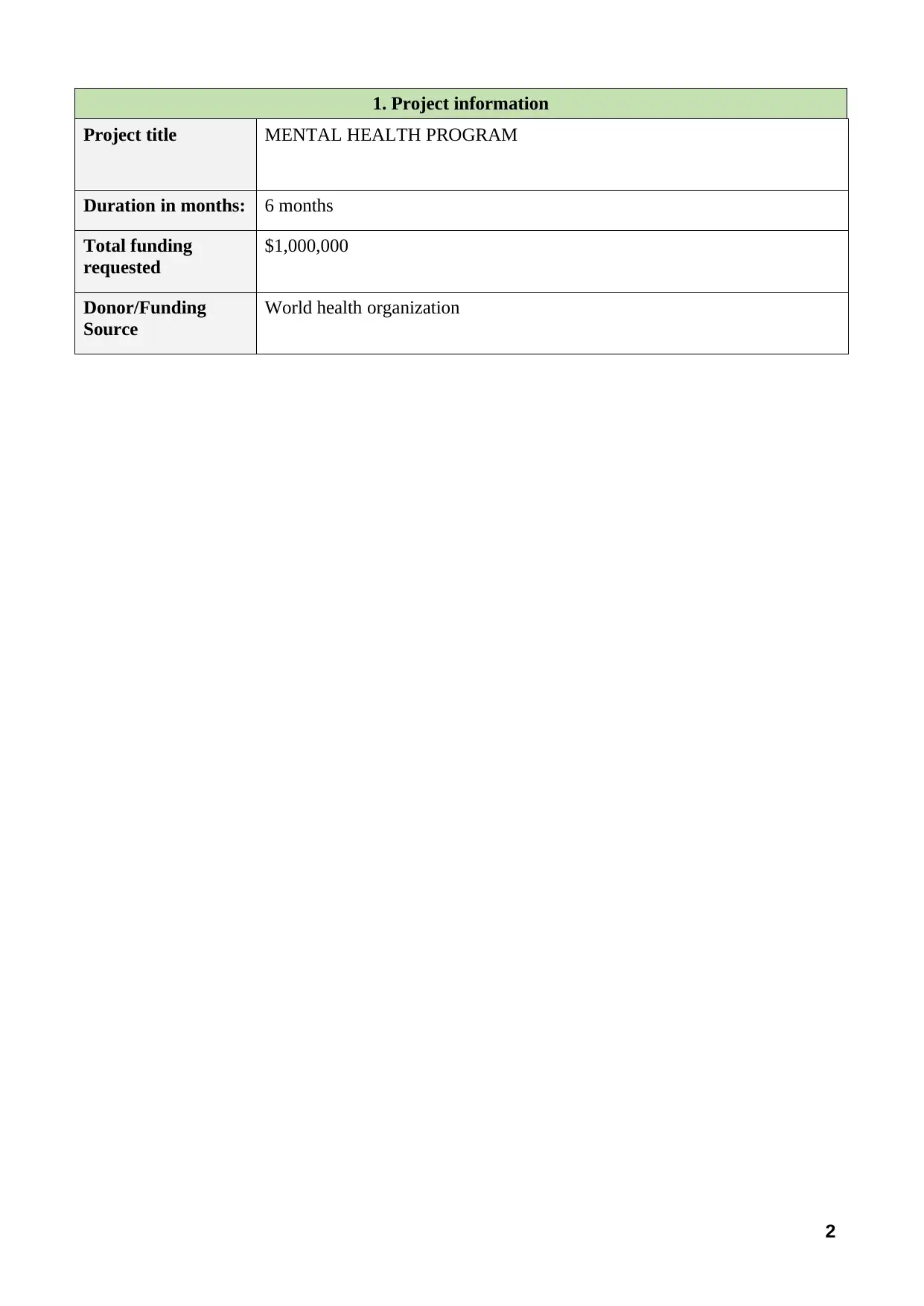
1. Project information
Project title MENTAL HEALTH PROGRAM
Duration in months: 6 months
Total funding
requested
$1,000,000
Donor/Funding
Source
World health organization
2
Project title MENTAL HEALTH PROGRAM
Duration in months: 6 months
Total funding
requested
$1,000,000
Donor/Funding
Source
World health organization
2

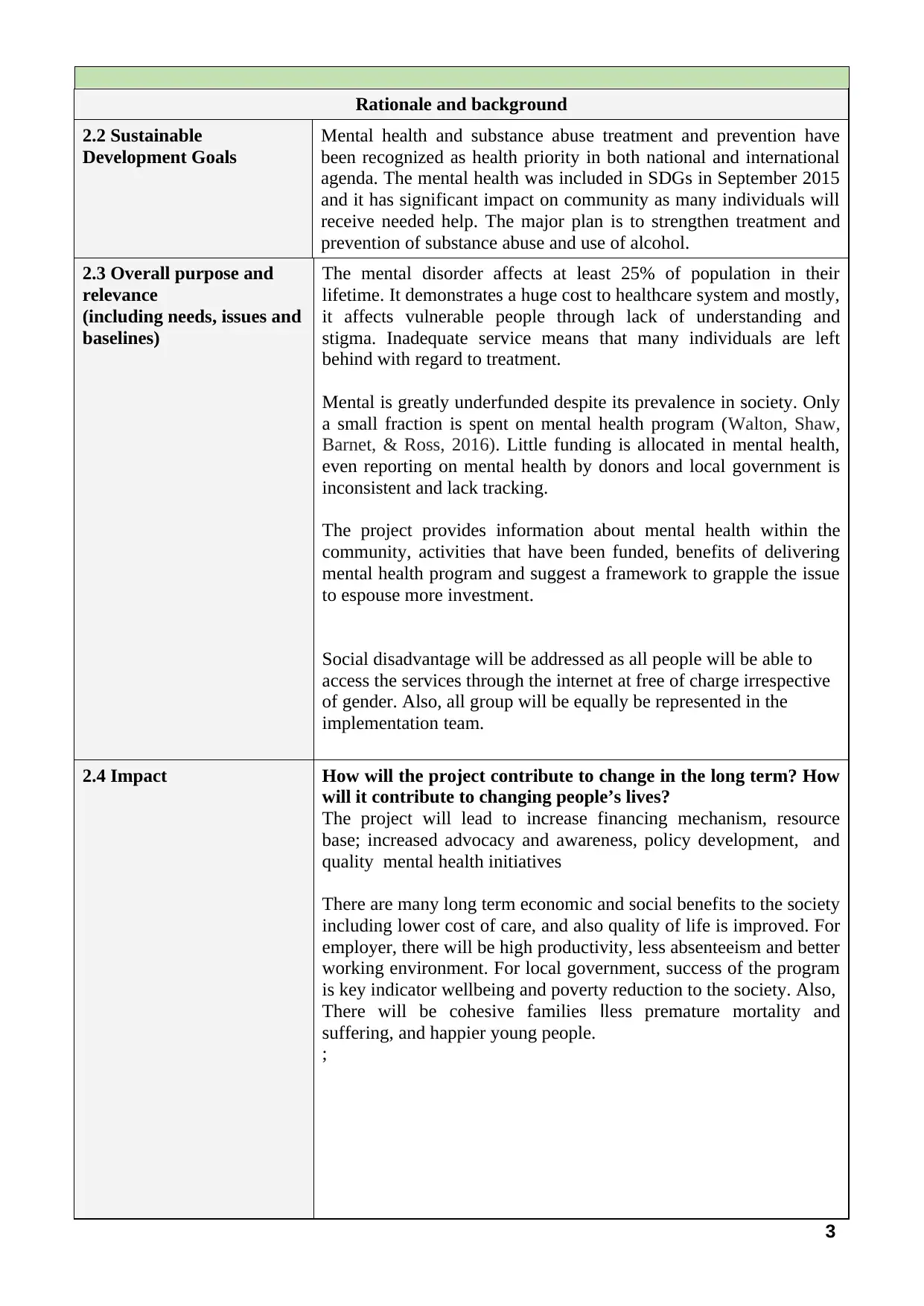
Rationale and background
2.2 Sustainable
Development Goals
Mental health and substance abuse treatment and prevention have
been recognized as health priority in both national and international
agenda. The mental health was included in SDGs in September 2015
and it has significant impact on community as many individuals will
receive needed help. The major plan is to strengthen treatment and
prevention of substance abuse and use of alcohol.
2.3 Overall purpose and
relevance
(including needs, issues and
baselines)
The mental disorder affects at least 25% of population in their
lifetime. It demonstrates a huge cost to healthcare system and mostly,
it affects vulnerable people through lack of understanding and
stigma. Inadequate service means that many individuals are left
behind with regard to treatment.
Mental is greatly underfunded despite its prevalence in society. Only
a small fraction is spent on mental health program (Walton, Shaw,
Barnet, & Ross, 2016). Little funding is allocated in mental health,
even reporting on mental health by donors and local government is
inconsistent and lack tracking.
The project provides information about mental health within the
community, activities that have been funded, benefits of delivering
mental health program and suggest a framework to grapple the issue
to espouse more investment.
Social disadvantage will be addressed as all people will be able to
access the services through the internet at free of charge irrespective
of gender. Also, all group will be equally be represented in the
implementation team.
2.4 Impact How will the project contribute to change in the long term? How
will it contribute to changing people’s lives?
The project will lead to increase financing mechanism, resource
base; increased advocacy and awareness, policy development, and
quality mental health initiatives
There are many long term economic and social benefits to the society
including lower cost of care, and also quality of life is improved. For
employer, there will be high productivity, less absenteeism and better
working environment. For local government, success of the program
is key indicator wellbeing and poverty reduction to the society. Also,
There will be cohesive families lless premature mortality and
suffering, and happier young people.
;
3
2.2 Sustainable
Development Goals
Mental health and substance abuse treatment and prevention have
been recognized as health priority in both national and international
agenda. The mental health was included in SDGs in September 2015
and it has significant impact on community as many individuals will
receive needed help. The major plan is to strengthen treatment and
prevention of substance abuse and use of alcohol.
2.3 Overall purpose and
relevance
(including needs, issues and
baselines)
The mental disorder affects at least 25% of population in their
lifetime. It demonstrates a huge cost to healthcare system and mostly,
it affects vulnerable people through lack of understanding and
stigma. Inadequate service means that many individuals are left
behind with regard to treatment.
Mental is greatly underfunded despite its prevalence in society. Only
a small fraction is spent on mental health program (Walton, Shaw,
Barnet, & Ross, 2016). Little funding is allocated in mental health,
even reporting on mental health by donors and local government is
inconsistent and lack tracking.
The project provides information about mental health within the
community, activities that have been funded, benefits of delivering
mental health program and suggest a framework to grapple the issue
to espouse more investment.
Social disadvantage will be addressed as all people will be able to
access the services through the internet at free of charge irrespective
of gender. Also, all group will be equally be represented in the
implementation team.
2.4 Impact How will the project contribute to change in the long term? How
will it contribute to changing people’s lives?
The project will lead to increase financing mechanism, resource
base; increased advocacy and awareness, policy development, and
quality mental health initiatives
There are many long term economic and social benefits to the society
including lower cost of care, and also quality of life is improved. For
employer, there will be high productivity, less absenteeism and better
working environment. For local government, success of the program
is key indicator wellbeing and poverty reduction to the society. Also,
There will be cohesive families lless premature mortality and
suffering, and happier young people.
;
3
⊘ This is a preview!⊘
Do you want full access?
Subscribe today to unlock all pages.

Trusted by 1+ million students worldwide

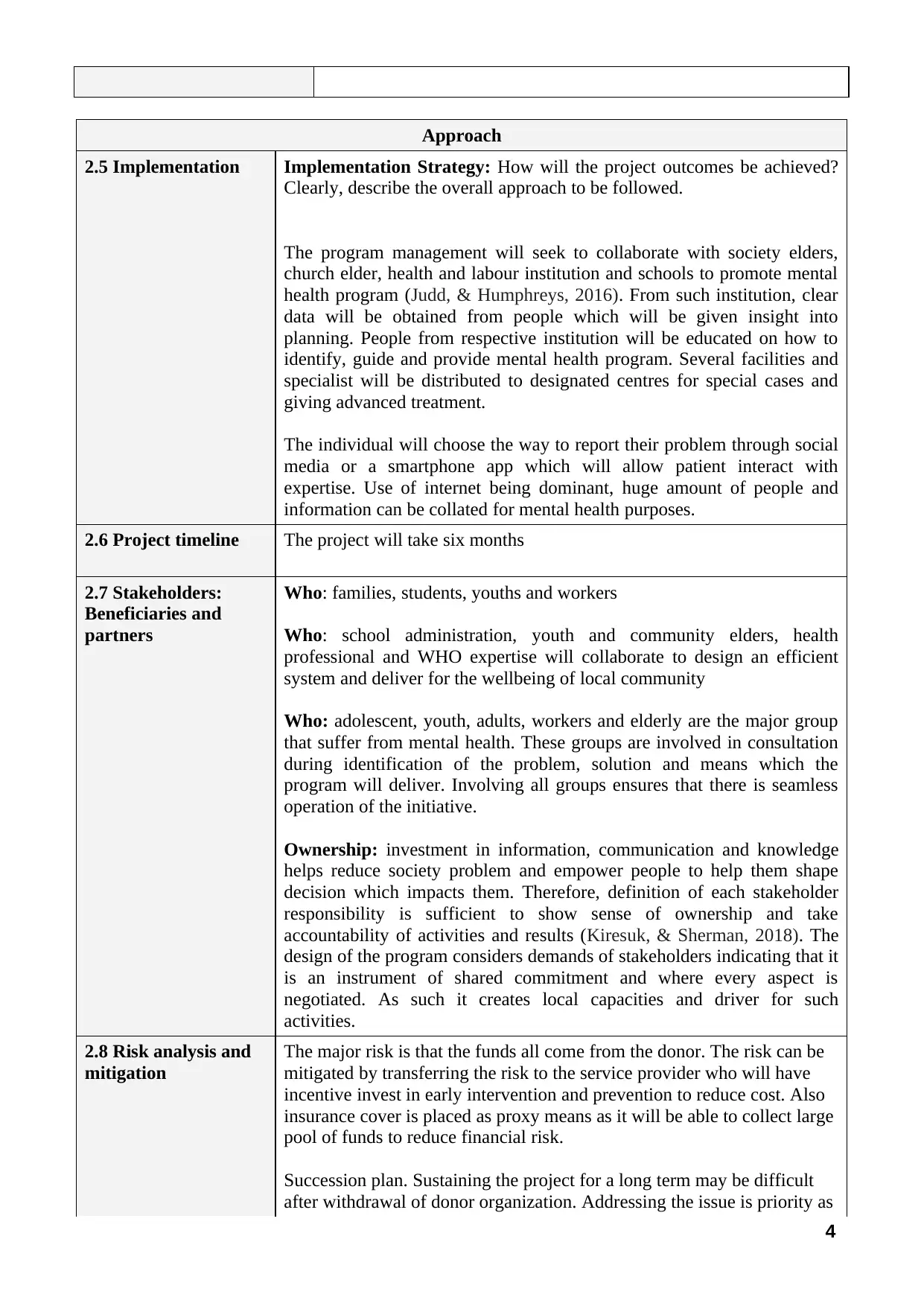
Approach
2.5 Implementation Implementation Strategy: How will the project outcomes be achieved?
Clearly, describe the overall approach to be followed.
The program management will seek to collaborate with society elders,
church elder, health and labour institution and schools to promote mental
health program (Judd, & Humphreys, 2016). From such institution, clear
data will be obtained from people which will be given insight into
planning. People from respective institution will be educated on how to
identify, guide and provide mental health program. Several facilities and
specialist will be distributed to designated centres for special cases and
giving advanced treatment.
The individual will choose the way to report their problem through social
media or a smartphone app which will allow patient interact with
expertise. Use of internet being dominant, huge amount of people and
information can be collated for mental health purposes.
2.6 Project timeline The project will take six months
2.7 Stakeholders:
Beneficiaries and
partners
Who: families, students, youths and workers
Who: school administration, youth and community elders, health
professional and WHO expertise will collaborate to design an efficient
system and deliver for the wellbeing of local community
Who: adolescent, youth, adults, workers and elderly are the major group
that suffer from mental health. These groups are involved in consultation
during identification of the problem, solution and means which the
program will deliver. Involving all groups ensures that there is seamless
operation of the initiative.
Ownership: investment in information, communication and knowledge
helps reduce society problem and empower people to help them shape
decision which impacts them. Therefore, definition of each stakeholder
responsibility is sufficient to show sense of ownership and take
accountability of activities and results (Kiresuk, & Sherman, 2018). The
design of the program considers demands of stakeholders indicating that it
is an instrument of shared commitment and where every aspect is
negotiated. As such it creates local capacities and driver for such
activities.
2.8 Risk analysis and
mitigation
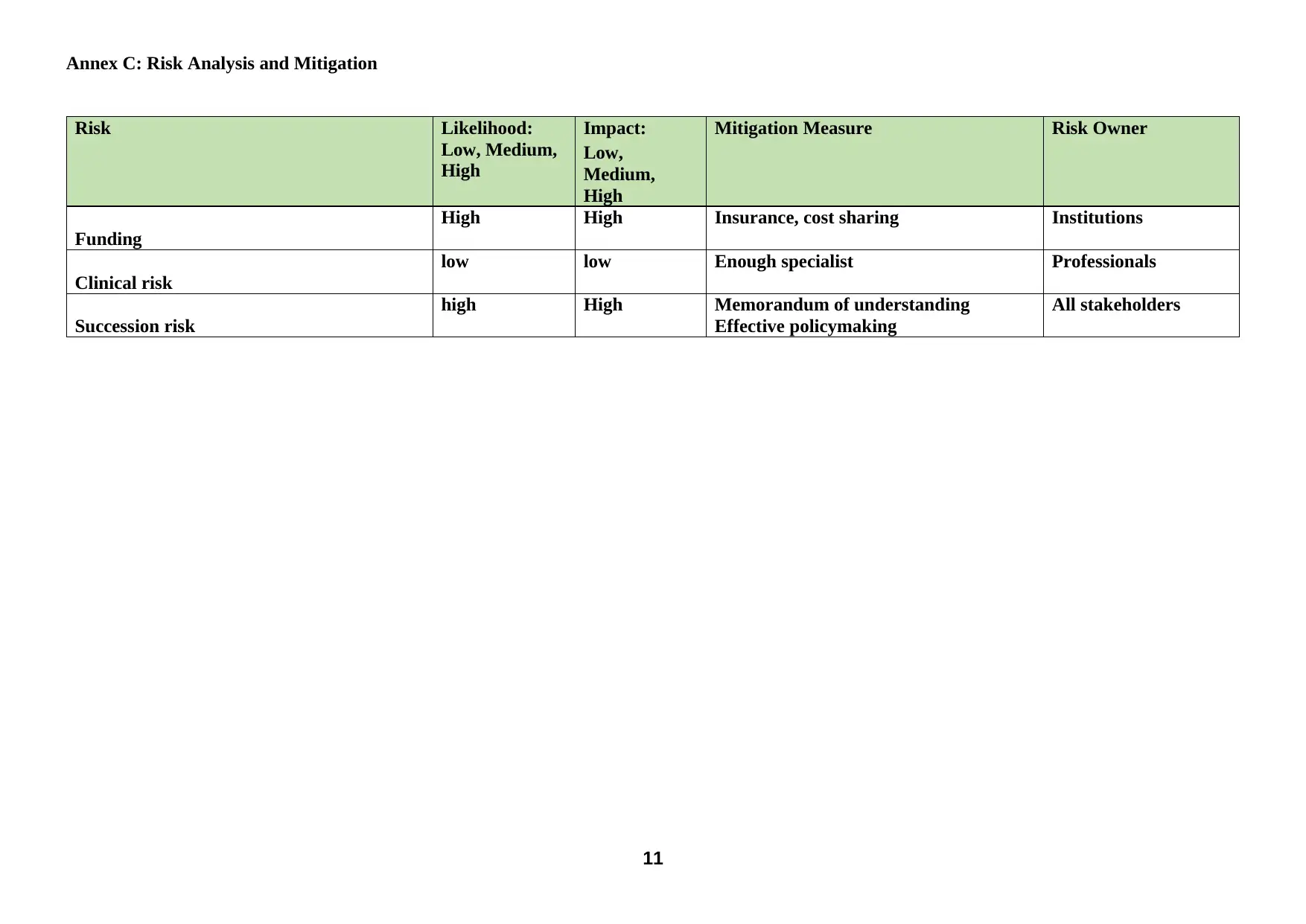
The major risk is that the funds all come from the donor. The risk can be
mitigated by transferring the risk to the service provider who will have
incentive invest in early intervention and prevention to reduce cost. Also
insurance cover is placed as proxy means as it will be able to collect large
pool of funds to reduce financial risk.
Succession plan. Sustaining the project for a long term may be difficult
after withdrawal of donor organization. Addressing the issue is priority as
4
2.5 Implementation Implementation Strategy: How will the project outcomes be achieved?
Clearly, describe the overall approach to be followed.
The program management will seek to collaborate with society elders,
church elder, health and labour institution and schools to promote mental
health program (Judd, & Humphreys, 2016). From such institution, clear
data will be obtained from people which will be given insight into
planning. People from respective institution will be educated on how to
identify, guide and provide mental health program. Several facilities and
specialist will be distributed to designated centres for special cases and
giving advanced treatment.
The individual will choose the way to report their problem through social
media or a smartphone app which will allow patient interact with
expertise. Use of internet being dominant, huge amount of people and
information can be collated for mental health purposes.
2.6 Project timeline The project will take six months
2.7 Stakeholders:
Beneficiaries and
partners
Who: families, students, youths and workers
Who: school administration, youth and community elders, health
professional and WHO expertise will collaborate to design an efficient
system and deliver for the wellbeing of local community
Who: adolescent, youth, adults, workers and elderly are the major group
that suffer from mental health. These groups are involved in consultation
during identification of the problem, solution and means which the
program will deliver. Involving all groups ensures that there is seamless
operation of the initiative.
Ownership: investment in information, communication and knowledge
helps reduce society problem and empower people to help them shape
decision which impacts them. Therefore, definition of each stakeholder
responsibility is sufficient to show sense of ownership and take
accountability of activities and results (Kiresuk, & Sherman, 2018). The
design of the program considers demands of stakeholders indicating that it
is an instrument of shared commitment and where every aspect is
negotiated. As such it creates local capacities and driver for such
activities.
2.8 Risk analysis and
mitigation
The major risk is that the funds all come from the donor. The risk can be
mitigated by transferring the risk to the service provider who will have
incentive invest in early intervention and prevention to reduce cost. Also
insurance cover is placed as proxy means as it will be able to collect large
pool of funds to reduce financial risk.
Succession plan. Sustaining the project for a long term may be difficult
after withdrawal of donor organization. Addressing the issue is priority as
4
Paraphrase This Document
Need a fresh take? Get an instant paraphrase of this document with our AI Paraphraser

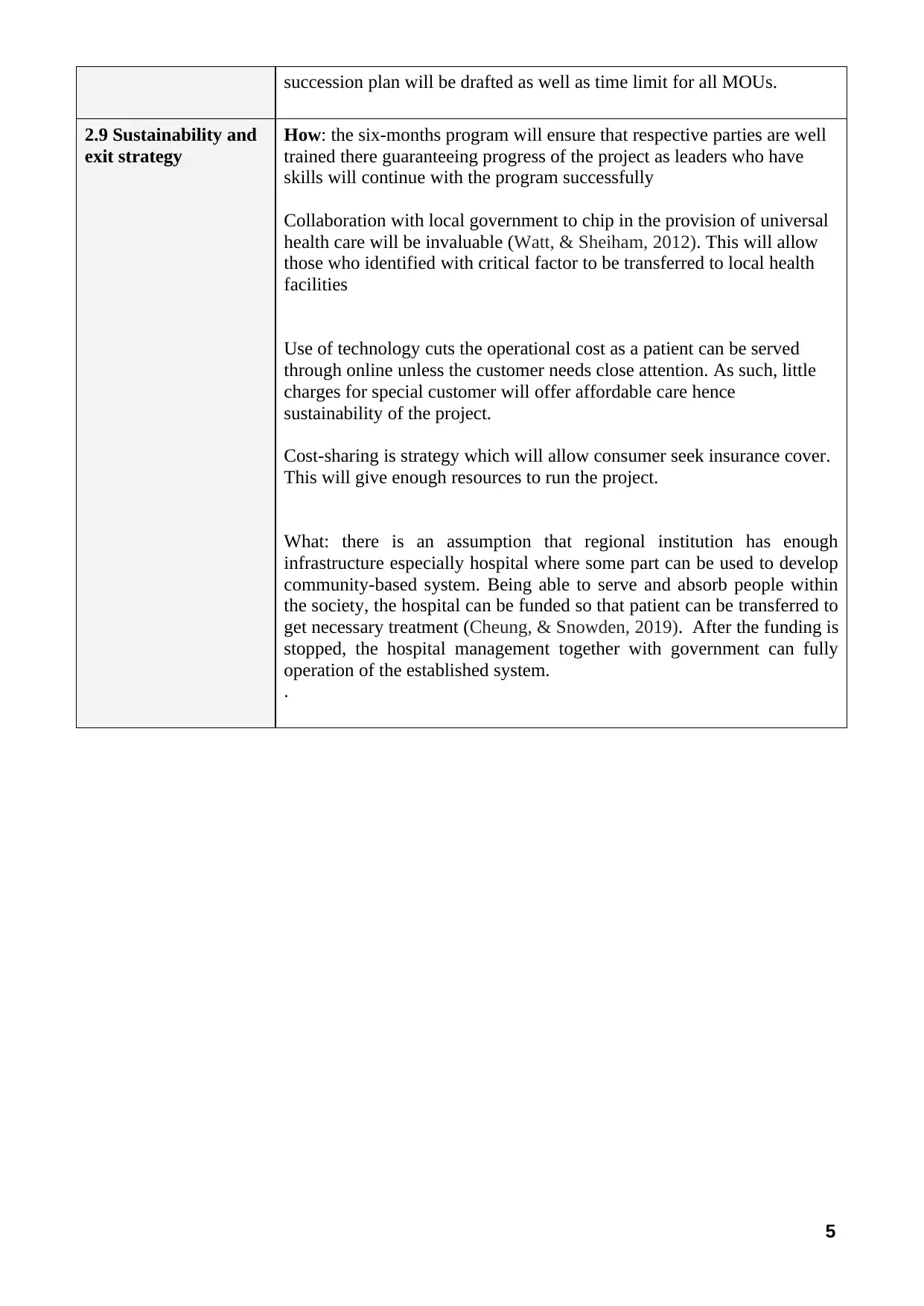
succession plan will be drafted as well as time limit for all MOUs.
2.9 Sustainability and
exit strategy
How: the six-months program will ensure that respective parties are well
trained there guaranteeing progress of the project as leaders who have
skills will continue with the program successfully
Collaboration with local government to chip in the provision of universal
health care will be invaluable (Watt, & Sheiham, 2012). This will allow
those who identified with critical factor to be transferred to local health
facilities
Use of technology cuts the operational cost as a patient can be served
through online unless the customer needs close attention. As such, little
charges for special customer will offer affordable care hence
sustainability of the project.
Cost-sharing is strategy which will allow consumer seek insurance cover.
This will give enough resources to run the project.
What: there is an assumption that regional institution has enough
infrastructure especially hospital where some part can be used to develop
community-based system. Being able to serve and absorb people within
the society, the hospital can be funded so that patient can be transferred to
get necessary treatment (Cheung, & Snowden, 2019). After the funding is
stopped, the hospital management together with government can fully
operation of the established system.
.
5
2.9 Sustainability and
exit strategy
How: the six-months program will ensure that respective parties are well
trained there guaranteeing progress of the project as leaders who have
skills will continue with the program successfully
Collaboration with local government to chip in the provision of universal
health care will be invaluable (Watt, & Sheiham, 2012). This will allow
those who identified with critical factor to be transferred to local health
facilities
Use of technology cuts the operational cost as a patient can be served
through online unless the customer needs close attention. As such, little
charges for special customer will offer affordable care hence
sustainability of the project.
Cost-sharing is strategy which will allow consumer seek insurance cover.
This will give enough resources to run the project.
What: there is an assumption that regional institution has enough
infrastructure especially hospital where some part can be used to develop
community-based system. Being able to serve and absorb people within
the society, the hospital can be funded so that patient can be transferred to
get necessary treatment (Cheung, & Snowden, 2019). After the funding is
stopped, the hospital management together with government can fully
operation of the established system.
.
5

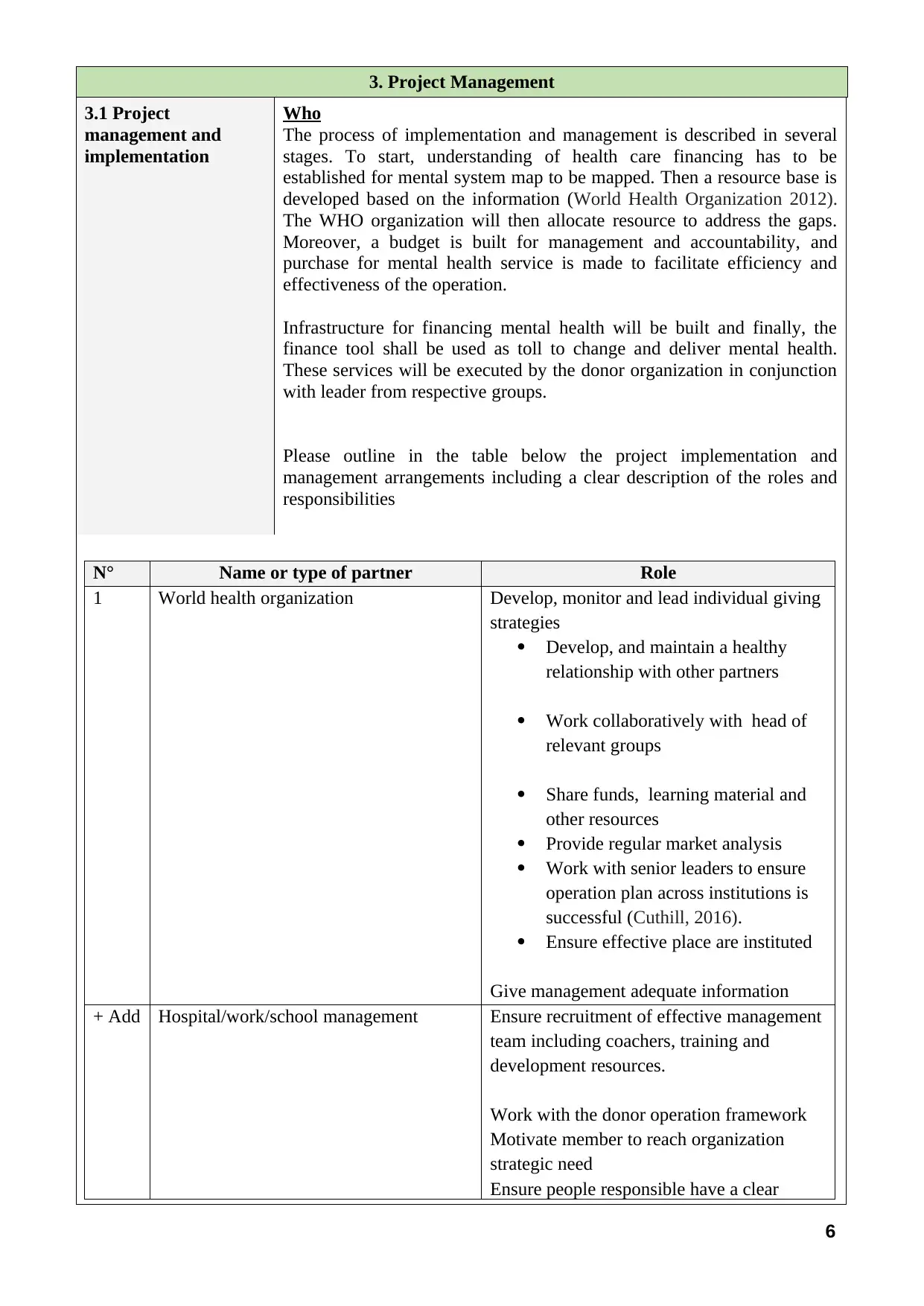
3. Project Management
3.1 Project
management and
implementation
Who
The process of implementation and management is described in several
stages. To start, understanding of health care financing has to be
established for mental system map to be mapped. Then a resource base is
developed based on the information (World Health Organization 2012).
The WHO organization will then allocate resource to address the gaps.
Moreover, a budget is built for management and accountability, and
purchase for mental health service is made to facilitate efficiency and
effectiveness of the operation.
Infrastructure for financing mental health will be built and finally, the
finance tool shall be used as toll to change and deliver mental health.
These services will be executed by the donor organization in conjunction
with leader from respective groups.
Please outline in the table below the project implementation and
management arrangements including a clear description of the roles and
responsibilities
N° Name or type of partner Role
1 World health organization Develop, monitor and lead individual giving
strategies
Develop, and maintain a healthy
relationship with other partners
Work collaboratively with head of
relevant groups
Share funds, learning material and
other resources
Provide regular market analysis
Work with senior leaders to ensure
operation plan across institutions is
successful (Cuthill, 2016).
Ensure effective place are instituted
Give management adequate information
+ Add Hospital/work/school management Ensure recruitment of effective management
team including coachers, training and
development resources.
Work with the donor operation framework
Motivate member to reach organization
strategic need
Ensure people responsible have a clear
6
3.1 Project
management and
implementation
Who
The process of implementation and management is described in several
stages. To start, understanding of health care financing has to be
established for mental system map to be mapped. Then a resource base is
developed based on the information (World Health Organization 2012).
The WHO organization will then allocate resource to address the gaps.
Moreover, a budget is built for management and accountability, and
purchase for mental health service is made to facilitate efficiency and
effectiveness of the operation.
Infrastructure for financing mental health will be built and finally, the
finance tool shall be used as toll to change and deliver mental health.
These services will be executed by the donor organization in conjunction
with leader from respective groups.
Please outline in the table below the project implementation and
management arrangements including a clear description of the roles and
responsibilities
N° Name or type of partner Role
1 World health organization Develop, monitor and lead individual giving
strategies
Develop, and maintain a healthy
relationship with other partners
Work collaboratively with head of
relevant groups
Share funds, learning material and
other resources
Provide regular market analysis
Work with senior leaders to ensure
operation plan across institutions is
successful (Cuthill, 2016).
Ensure effective place are instituted
Give management adequate information
+ Add Hospital/work/school management Ensure recruitment of effective management
team including coachers, training and
development resources.
Work with the donor operation framework
Motivate member to reach organization
strategic need
Ensure people responsible have a clear
6
⊘ This is a preview!⊘
Do you want full access?
Subscribe today to unlock all pages.

Trusted by 1+ million students worldwide

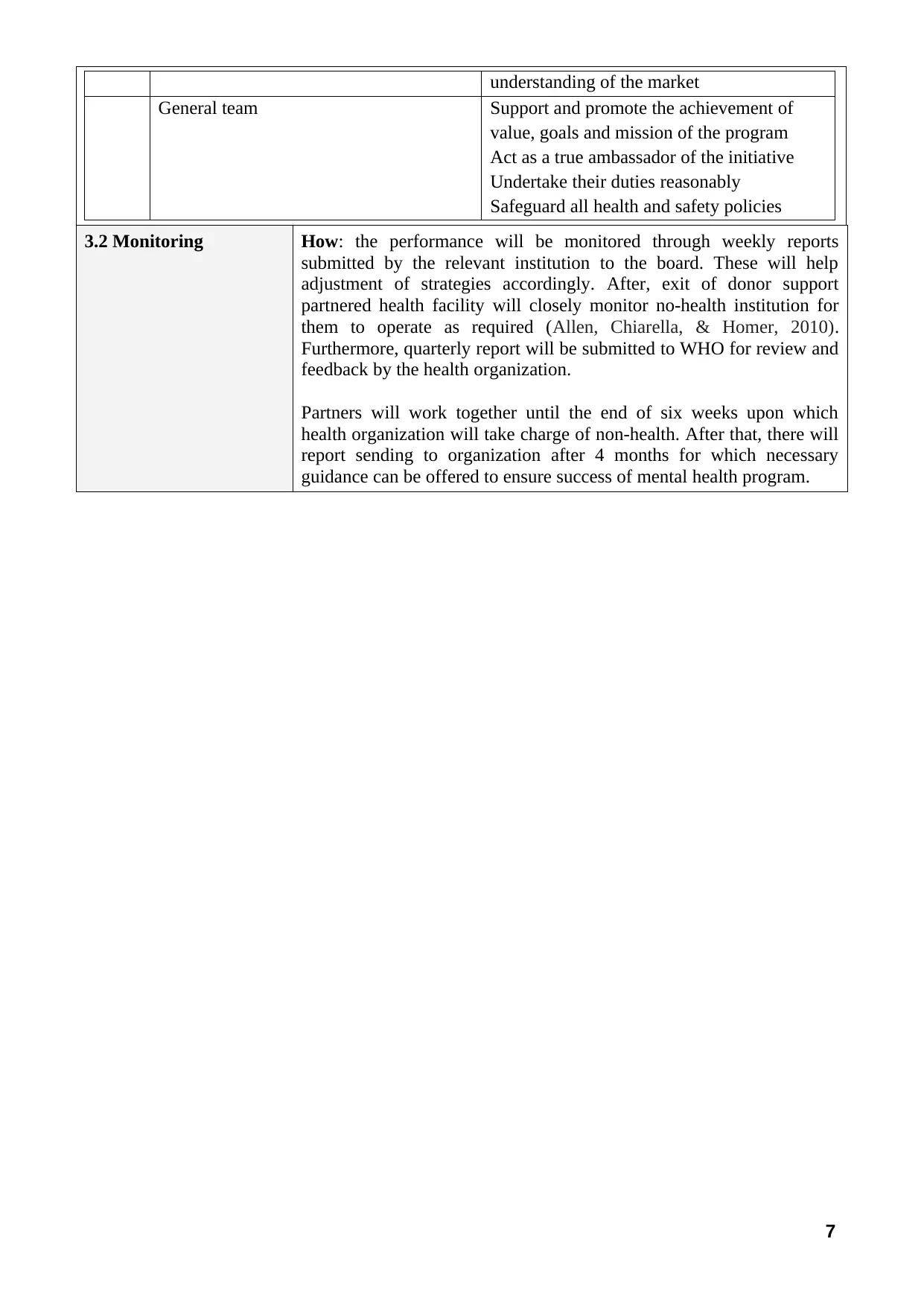
understanding of the market
General team Support and promote the achievement of
value, goals and mission of the program
Act as a true ambassador of the initiative
Undertake their duties reasonably
Safeguard all health and safety policies
3.2 Monitoring How: the performance will be monitored through weekly reports
submitted by the relevant institution to the board. These will help
adjustment of strategies accordingly. After, exit of donor support
partnered health facility will closely monitor no-health institution for
them to operate as required (Allen, Chiarella, & Homer, 2010).
Furthermore, quarterly report will be submitted to WHO for review and
feedback by the health organization.
Partners will work together until the end of six weeks upon which
health organization will take charge of non-health. After that, there will
report sending to organization after 4 months for which necessary
guidance can be offered to ensure success of mental health program.
7
General team Support and promote the achievement of
value, goals and mission of the program
Act as a true ambassador of the initiative
Undertake their duties reasonably
Safeguard all health and safety policies
3.2 Monitoring How: the performance will be monitored through weekly reports
submitted by the relevant institution to the board. These will help
adjustment of strategies accordingly. After, exit of donor support
partnered health facility will closely monitor no-health institution for
them to operate as required (Allen, Chiarella, & Homer, 2010).
Furthermore, quarterly report will be submitted to WHO for review and
feedback by the health organization.
Partners will work together until the end of six weeks upon which
health organization will take charge of non-health. After that, there will
report sending to organization after 4 months for which necessary
guidance can be offered to ensure success of mental health program.
7
Paraphrase This Document
Need a fresh take? Get an instant paraphrase of this document with our AI Paraphraser

8

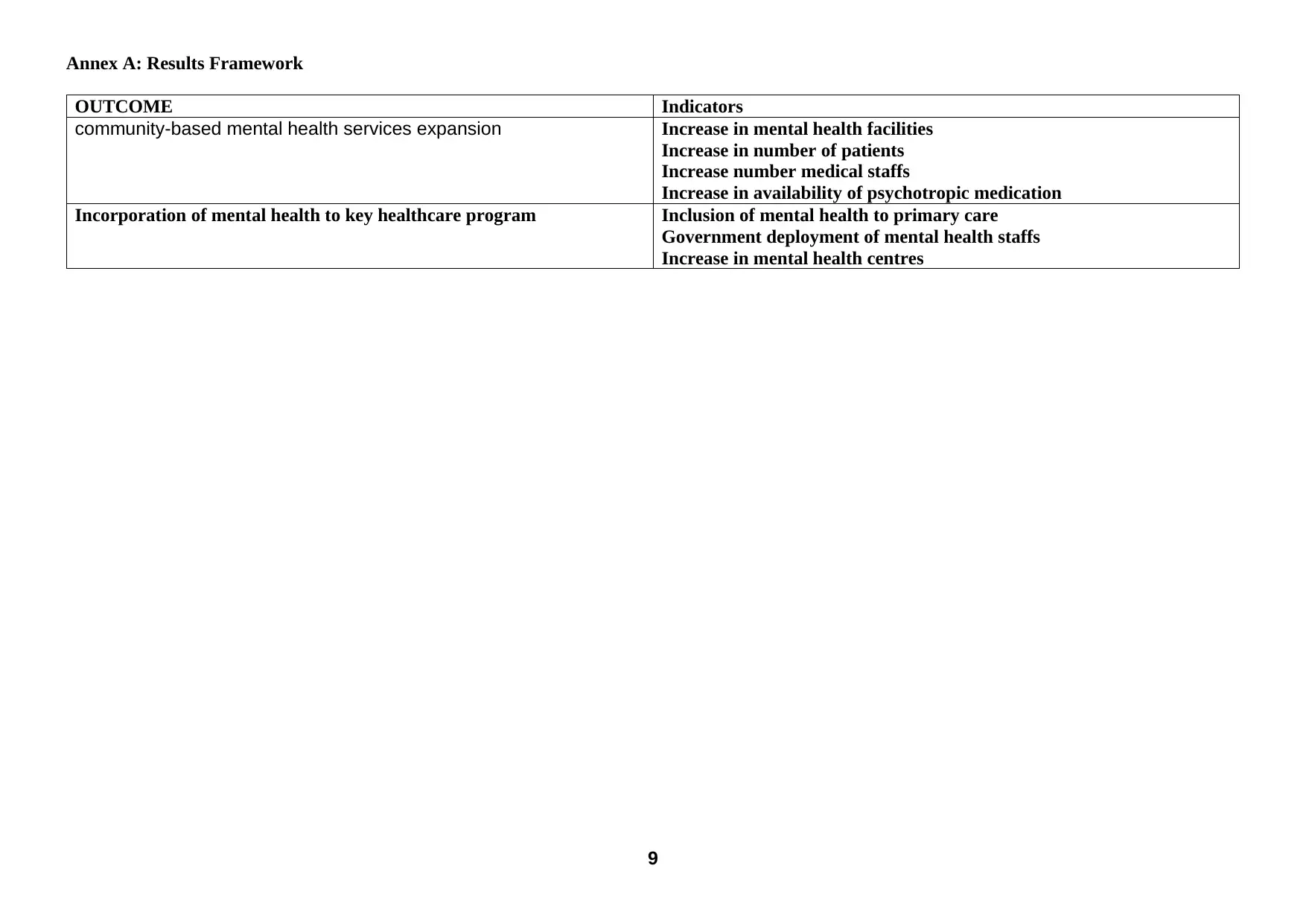
Annex A: Results Framework
OUTCOME Indicators
community-based mental health services expansion Increase in mental health facilities
Increase in number of patients
Increase number medical staffs
Increase in availability of psychotropic medication
Incorporation of mental health to key healthcare program Inclusion of mental health to primary care
Government deployment of mental health staffs
Increase in mental health centres
9
OUTCOME Indicators
community-based mental health services expansion Increase in mental health facilities
Increase in number of patients
Increase number medical staffs
Increase in availability of psychotropic medication
Incorporation of mental health to key healthcare program Inclusion of mental health to primary care
Government deployment of mental health staffs
Increase in mental health centres
9
⊘ This is a preview!⊘
Do you want full access?
Subscribe today to unlock all pages.

Trusted by 1+ million students worldwide

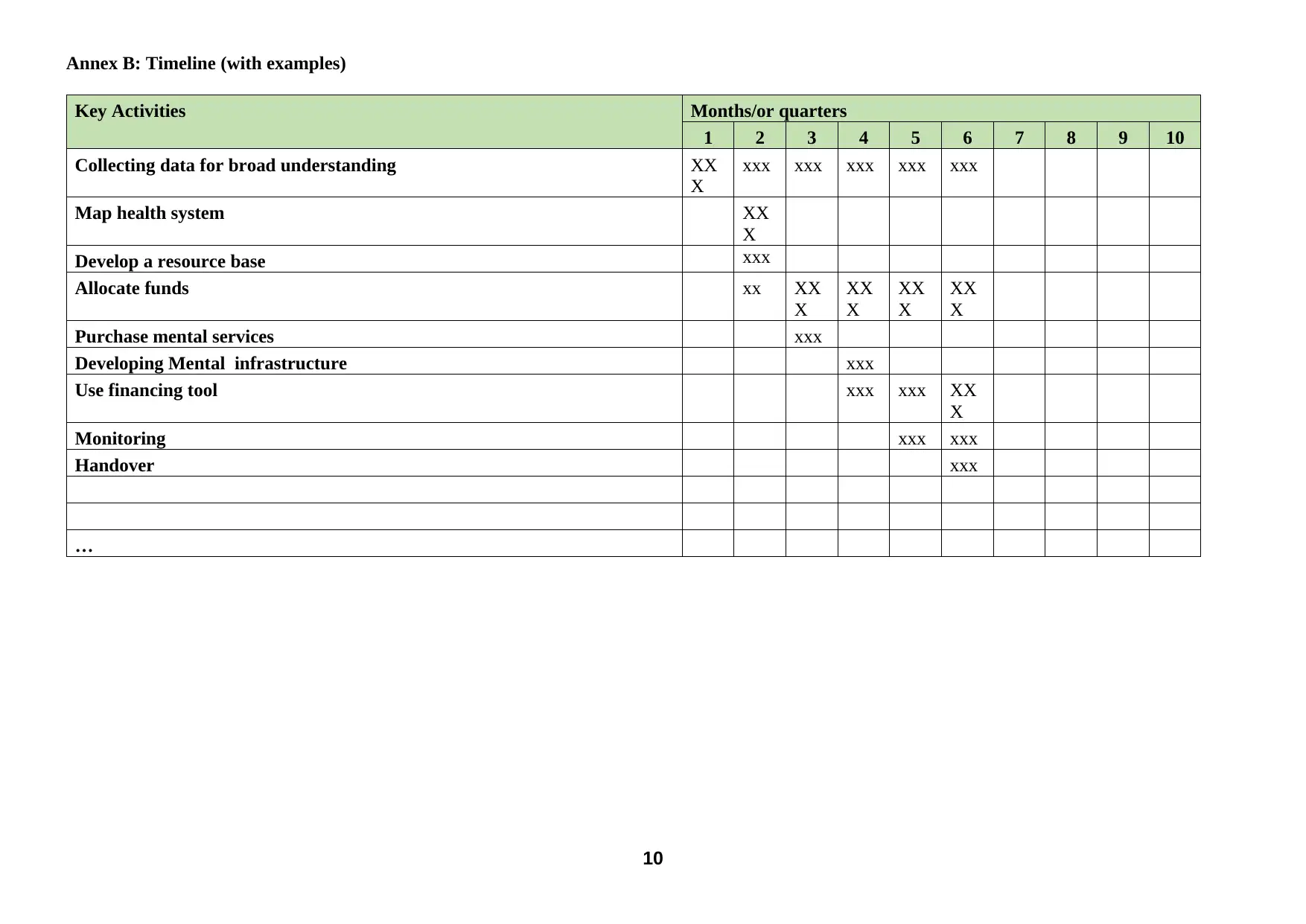
Annex B: Timeline (with examples)
Key Activities Months/or quarters
1 2 3 4 5 6 7 8 9 10
Collecting data for broad understanding XX
X
xxx xxx xxx xxx xxx
Map health system XX
X
Develop a resource base xxx
Allocate funds xx XX
X
XX
X
XX
X
XX
X
Purchase mental services xxx
Developing Mental infrastructure xxx
Use financing tool xxx xxx XX
X
Monitoring xxx xxx
Handover xxx
…
10
Key Activities Months/or quarters
1 2 3 4 5 6 7 8 9 10
Collecting data for broad understanding XX
X
xxx xxx xxx xxx xxx
Map health system XX
X
Develop a resource base xxx
Allocate funds xx XX
X
XX
X
XX
X
XX
X
Purchase mental services xxx
Developing Mental infrastructure xxx
Use financing tool xxx xxx XX
X
Monitoring xxx xxx
Handover xxx
…
10
Paraphrase This Document
Need a fresh take? Get an instant paraphrase of this document with our AI Paraphraser

Annex C: Risk Analysis and Mitigation
Risk Likelihood:
Low, Medium,
High
Impact:
Low,
Medium,
High
Mitigation Measure Risk Owner
Funding
High High Insurance, cost sharing Institutions
Clinical risk
low low Enough specialist Professionals
Succession risk
high High Memorandum of understanding
Effective policymaking
All stakeholders
11
Risk Likelihood:
Low, Medium,
High
Impact:
Low,
Medium,
High
Mitigation Measure Risk Owner
Funding
High High Insurance, cost sharing Institutions
Clinical risk
low low Enough specialist Professionals
Succession risk
high High Memorandum of understanding
Effective policymaking
All stakeholders
11

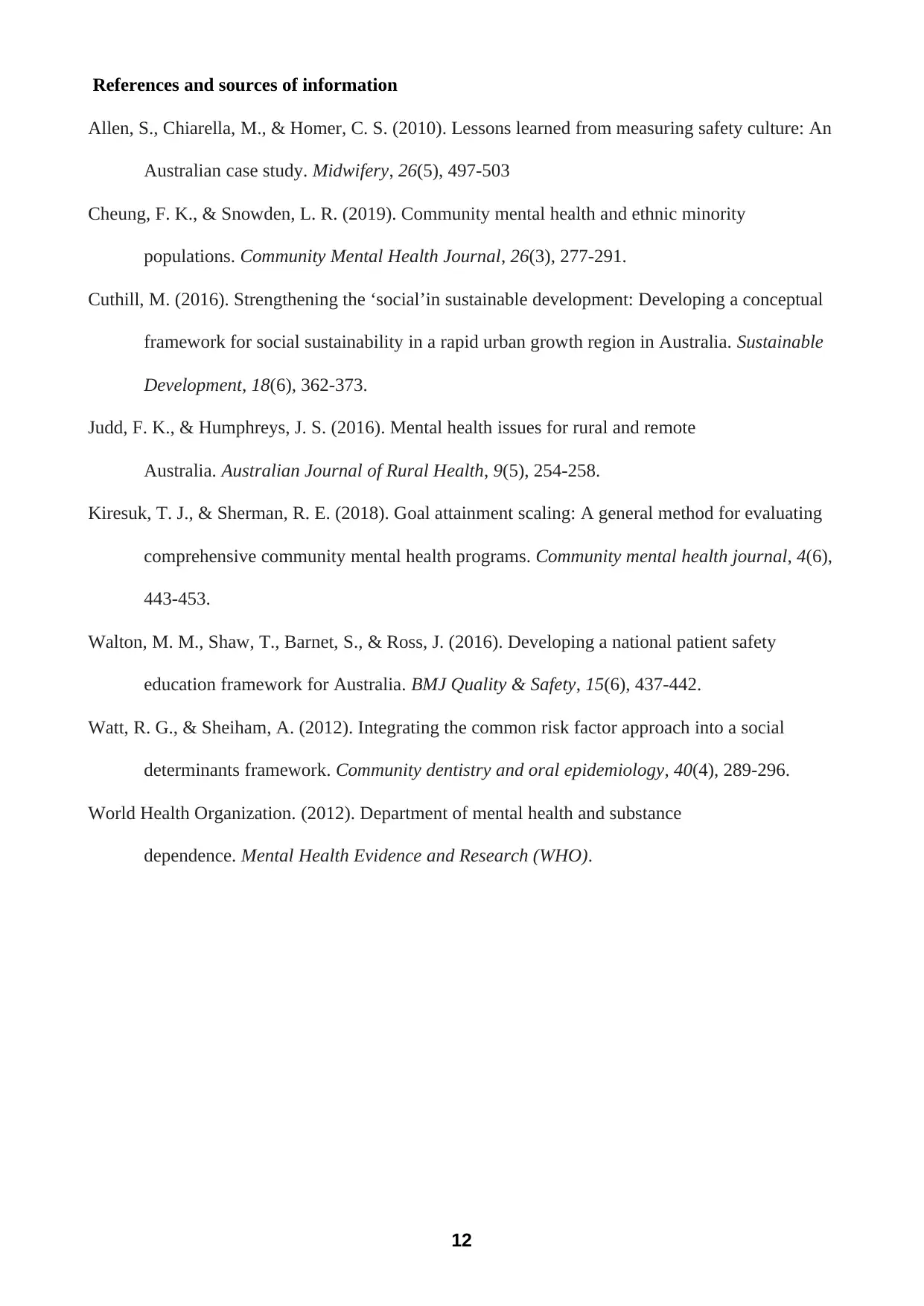
References and sources of information
Allen, S., Chiarella, M., & Homer, C. S. (2010). Lessons learned from measuring safety culture: An
Australian case study. Midwifery, 26(5), 497-503
Cheung, F. K., & Snowden, L. R. (2019). Community mental health and ethnic minority
populations. Community Mental Health Journal, 26(3), 277-291.
Cuthill, M. (2016). Strengthening the ‘social’in sustainable development: Developing a conceptual
framework for social sustainability in a rapid urban growth region in Australia. Sustainable
Development, 18(6), 362-373.
Judd, F. K., & Humphreys, J. S. (2016). Mental health issues for rural and remote
Australia. Australian Journal of Rural Health, 9(5), 254-258.
Kiresuk, T. J., & Sherman, R. E. (2018). Goal attainment scaling: A general method for evaluating
comprehensive community mental health programs. Community mental health journal, 4(6),
443-453.
Walton, M. M., Shaw, T., Barnet, S., & Ross, J. (2016). Developing a national patient safety
education framework for Australia. BMJ Quality & Safety, 15(6), 437-442.
Watt, R. G., & Sheiham, A. (2012). Integrating the common risk factor approach into a social
determinants framework. Community dentistry and oral epidemiology, 40(4), 289-296.
World Health Organization. (2012). Department of mental health and substance
dependence. Mental Health Evidence and Research (WHO).
12
Allen, S., Chiarella, M., & Homer, C. S. (2010). Lessons learned from measuring safety culture: An
Australian case study. Midwifery, 26(5), 497-503
Cheung, F. K., & Snowden, L. R. (2019). Community mental health and ethnic minority
populations. Community Mental Health Journal, 26(3), 277-291.
Cuthill, M. (2016). Strengthening the ‘social’in sustainable development: Developing a conceptual
framework for social sustainability in a rapid urban growth region in Australia. Sustainable
Development, 18(6), 362-373.
Judd, F. K., & Humphreys, J. S. (2016). Mental health issues for rural and remote
Australia. Australian Journal of Rural Health, 9(5), 254-258.
Kiresuk, T. J., & Sherman, R. E. (2018). Goal attainment scaling: A general method for evaluating
comprehensive community mental health programs. Community mental health journal, 4(6),
443-453.
Walton, M. M., Shaw, T., Barnet, S., & Ross, J. (2016). Developing a national patient safety
education framework for Australia. BMJ Quality & Safety, 15(6), 437-442.
Watt, R. G., & Sheiham, A. (2012). Integrating the common risk factor approach into a social
determinants framework. Community dentistry and oral epidemiology, 40(4), 289-296.
World Health Organization. (2012). Department of mental health and substance
dependence. Mental Health Evidence and Research (WHO).
12
⊘ This is a preview!⊘
Do you want full access?
Subscribe today to unlock all pages.

Trusted by 1+ million students worldwide
1 out of 12
Related Documents
Your All-in-One AI-Powered Toolkit for Academic Success.
+13062052269
info@desklib.com
Available 24*7 on WhatsApp / Email
Unlock your academic potential
Copyright © 2020–2025 A2Z Services. All Rights Reserved. Developed and managed by ZUCOL.