Comprehensive IT Project: Mobile Application for Employee Management
VerifiedAdded on 2022/10/12
|10
|1518
|300
Project
AI Summary
This project details the development of a mobile application for ZXC Company, aimed at coordinating and maintaining records of employee professional development. The project encompasses various stages, from initial planning and requirements gathering to design, software development (both frontend and backend for Android and iOS), testing, deployment, and ongoing maintenance. Key components include technical and design documentation, such as user stories, wireframes, style guides, and images. The project involves stakeholders like the ZXC Company's administrative team, project manager, employees, and resource supporters. A detailed schedule, including a Gantt chart and work breakdown structure, outlines the timeline and tasks involved. User requirements are categorized into features for account management, administrator functions, and affiliate access to system data. The project's success depends on effective stakeholder management, adherence to the schedule, and the successful implementation of the mobile application to enhance employee interaction and professional growth.
Running head: COMPREHENSIVE IT PROJECT 1
Comprehensive IT Project
Student’s Name
Institutional Affiliation
Comprehensive IT Project
Student’s Name
Institutional Affiliation
Paraphrase This Document
Need a fresh take? Get an instant paraphrase of this document with our AI Paraphraser

COMPREHENSIVE IT PROJECT 2
Comprehensive IT Project
Introduction
The primary goal of this project is to develop a mobile application system for ZXC
Company to help it in coordinating as well as maintaining its records of the professional progress
of its staffs. The mobile app should allow the company workforces to locate and schedule
professional development undertakings that are appropriate to their posts such as supporting
social networking to allow the company to determine which employees are representing it in
professional events and conferences. In regard to the company needs, this mobile app will enable
the company to manage its employees, its business operations (Kristiansen, & Ritala, 2018). The
project manager reached a consensus with the stakeholders to develop a mobile application to
allow for easy access to information among companies employees and different departments.
The mobile application system is suitable to ZXC Company because it will enable its distributed
operations and large employee population to actively interact. The application will be equipped
with an automatic support notification that will automatically notify workers about their
timelines to complete approaching professional development deadlines (Abushova, Burova, &
Suloeva, 2016). The project manager has picked on a mobile app because it is easy to customize
in employees cellphones. Therefore for an employee to access the company’s events and
activities they will only be required to have access to the internet.
Critical components related to the project
The scope of the project will be to advance a mobile application that ZXC Company to
will use to manage its staff work besides the social life connected to the business. The mobile
application will be designed by the project leader because project information will be easily
Comprehensive IT Project
Introduction
The primary goal of this project is to develop a mobile application system for ZXC
Company to help it in coordinating as well as maintaining its records of the professional progress
of its staffs. The mobile app should allow the company workforces to locate and schedule
professional development undertakings that are appropriate to their posts such as supporting
social networking to allow the company to determine which employees are representing it in
professional events and conferences. In regard to the company needs, this mobile app will enable
the company to manage its employees, its business operations (Kristiansen, & Ritala, 2018). The
project manager reached a consensus with the stakeholders to develop a mobile application to
allow for easy access to information among companies employees and different departments.
The mobile application system is suitable to ZXC Company because it will enable its distributed
operations and large employee population to actively interact. The application will be equipped
with an automatic support notification that will automatically notify workers about their
timelines to complete approaching professional development deadlines (Abushova, Burova, &
Suloeva, 2016). The project manager has picked on a mobile app because it is easy to customize
in employees cellphones. Therefore for an employee to access the company’s events and
activities they will only be required to have access to the internet.
Critical components related to the project
The scope of the project will be to advance a mobile application that ZXC Company to
will use to manage its staff work besides the social life connected to the business. The mobile
application will be designed by the project leader because project information will be easily

COMPREHENSIVE IT PROJECT 3
acquired from the business employees (Todorović et al., 2015). The mobile application systems
will be an app for both Androids and iPhones based systems. The user interface will be designed
as part of the project.
Deliverables: In regard to the mobile application system, the deliverables will include
technical documentation and design documentation. The technical documentation will consists of
a log of user stories that explain how the end user is supposed to use the application in general
and each of its features specifically. User stories are directives in the development process of the
application. Access to live source code, “read me” file and running code both for Android and
iOS, documentation and bug issues and host server login credentials (Paz, & Pow-Sang, 2016).
The design documentation will consists of wireframes-a blueprint of an app illustrating its
structure and how all its components work together. The wireframe will help the project manager
to determine the cost of developing the mobile app since it visually outline the app’s technical
and functionality needs. Other design documentation deliverable include style guide and images.
Style guide provide directive on how to use fonts, colors, and graphical features of the app
design while images shows the app logos, and icons.
Stakeholders: The main stakeholders to this project will comprise ZXC Company
administrative team, project manager, employees and resource supporters for the application.
The stakeholders will play a very crucial part toward the project success. The mobile application
development involve a range of stakeholders to offer the project expertise, enhance project
success, reduce and disclose risks and grant project acceptance (Eskerod, Huemann, &
Ringhofer, 2015). Indeed, stakeholders are a wealth of knowledge to this project since they have
historical information and industry insights that are used by the project manager to understand
the risks and constraints that are likely to be faced during project development lifecycle. The
acquired from the business employees (Todorović et al., 2015). The mobile application systems
will be an app for both Androids and iPhones based systems. The user interface will be designed
as part of the project.
Deliverables: In regard to the mobile application system, the deliverables will include
technical documentation and design documentation. The technical documentation will consists of
a log of user stories that explain how the end user is supposed to use the application in general
and each of its features specifically. User stories are directives in the development process of the
application. Access to live source code, “read me” file and running code both for Android and
iOS, documentation and bug issues and host server login credentials (Paz, & Pow-Sang, 2016).
The design documentation will consists of wireframes-a blueprint of an app illustrating its
structure and how all its components work together. The wireframe will help the project manager
to determine the cost of developing the mobile app since it visually outline the app’s technical
and functionality needs. Other design documentation deliverable include style guide and images.
Style guide provide directive on how to use fonts, colors, and graphical features of the app
design while images shows the app logos, and icons.
Stakeholders: The main stakeholders to this project will comprise ZXC Company
administrative team, project manager, employees and resource supporters for the application.
The stakeholders will play a very crucial part toward the project success. The mobile application
development involve a range of stakeholders to offer the project expertise, enhance project
success, reduce and disclose risks and grant project acceptance (Eskerod, Huemann, &
Ringhofer, 2015). Indeed, stakeholders are a wealth of knowledge to this project since they have
historical information and industry insights that are used by the project manager to understand
the risks and constraints that are likely to be faced during project development lifecycle. The
⊘ This is a preview!⊘
Do you want full access?
Subscribe today to unlock all pages.

Trusted by 1+ million students worldwide

COMPREHENSIVE IT PROJECT 4
stakeholders are core to the project since they will help in reducing as well as uncovering risks
thus increase their buy-in. The project manager to this project will charged with the
responsibility of managing all the project resources and time constraints given by project owner.
On the other hand, company employee task will be actual development of the application thus
they play a very influential part to the project success.
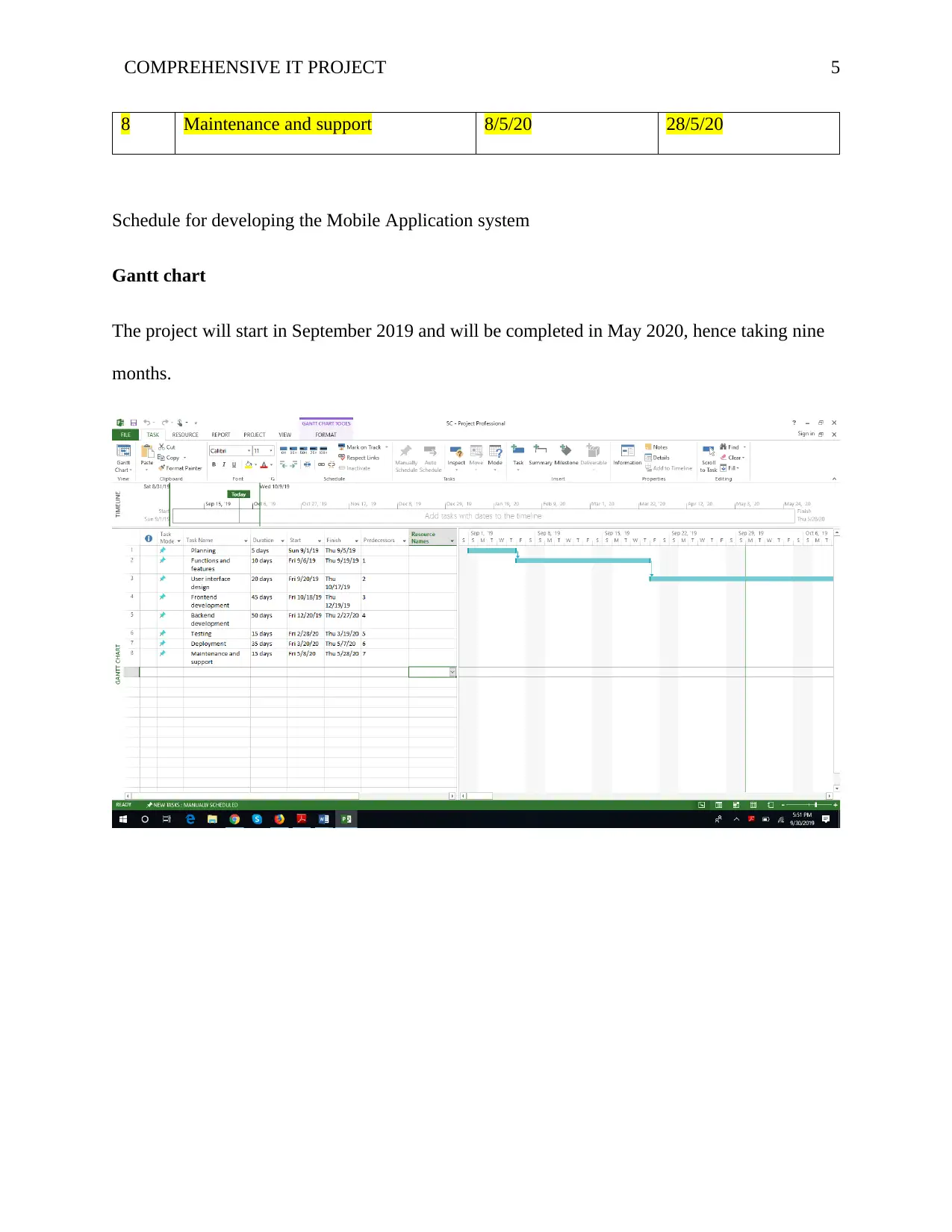
Schedule: Each project should have a start data and completion date. The schedule is
used to ensure that the mobile app development team do not missed out activity to successfully
deliver the product (Kerzner, 2017). The app development will take nine months to deliver the
mobile application system. Therefore, the project manager is required to ensure that they strictly
observe the timeline so that to avoid delivery the product late. While it may not be easy to keep
to the initial schedule because of certain unavoidable circumstances, the project manager is
supposed to evaluate the project progress consistently against the initial timeline (Joslin, &
Müller, 2016). To avoid missing the schedule the project manager will have to give a report
about project progress after each phase to the senior stakeholders. To ease the work the manager
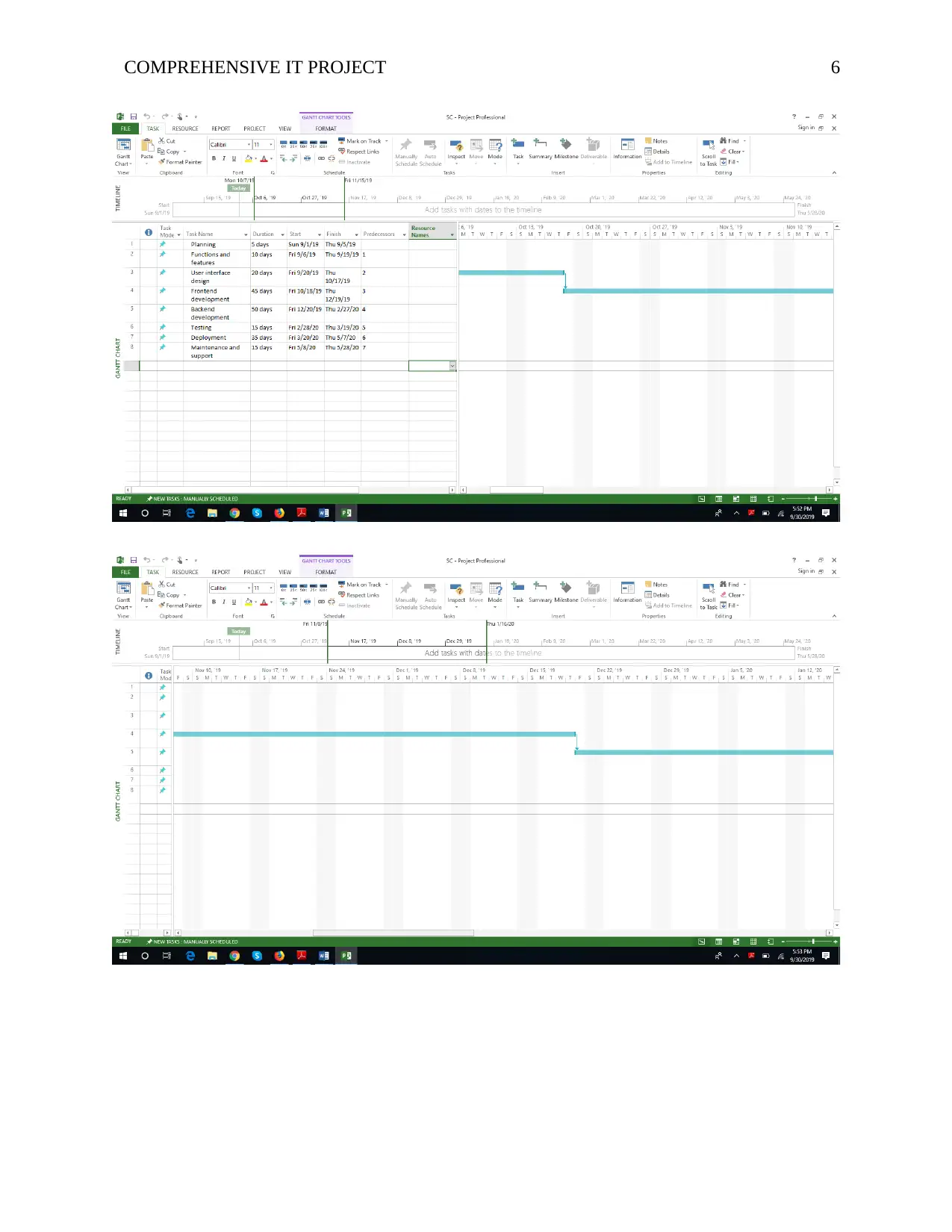
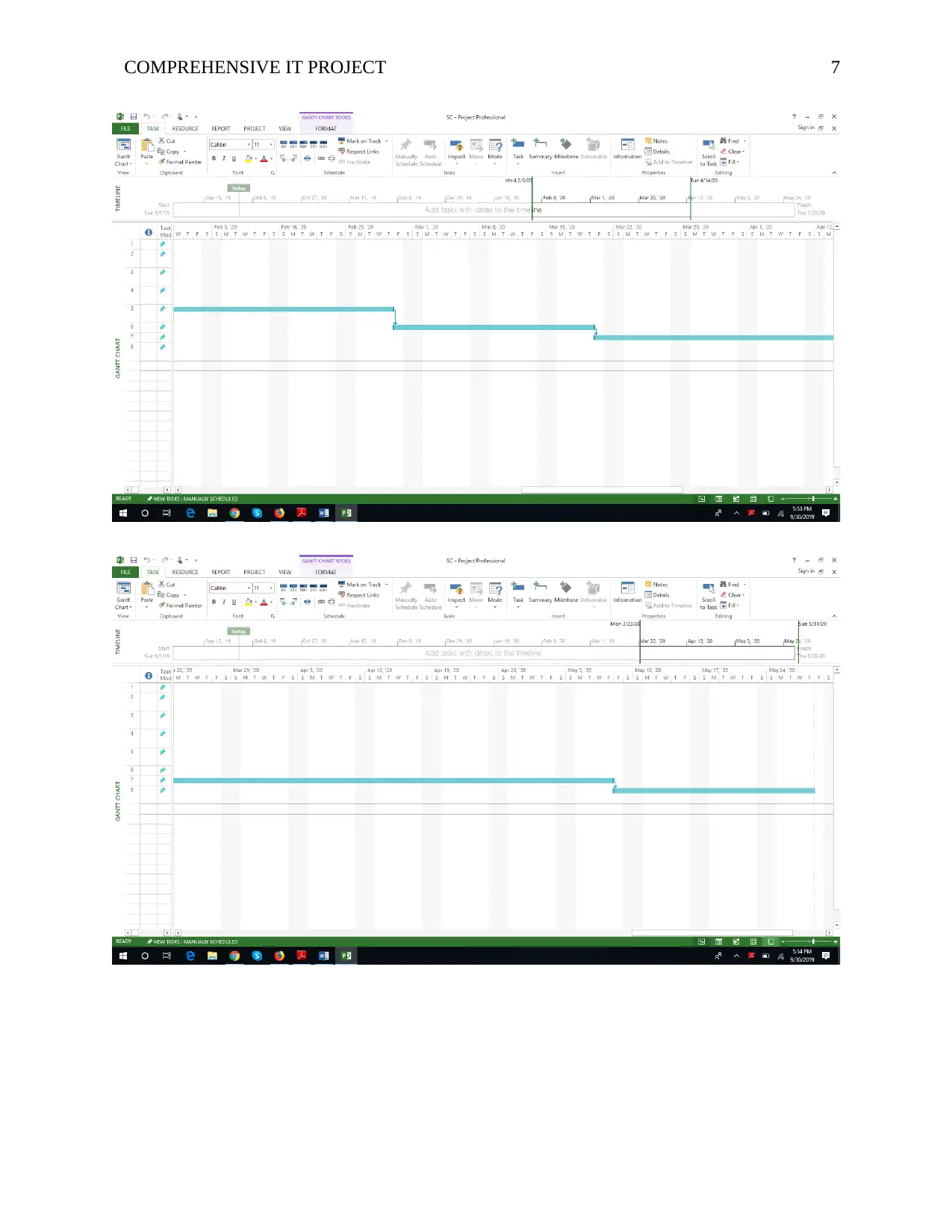
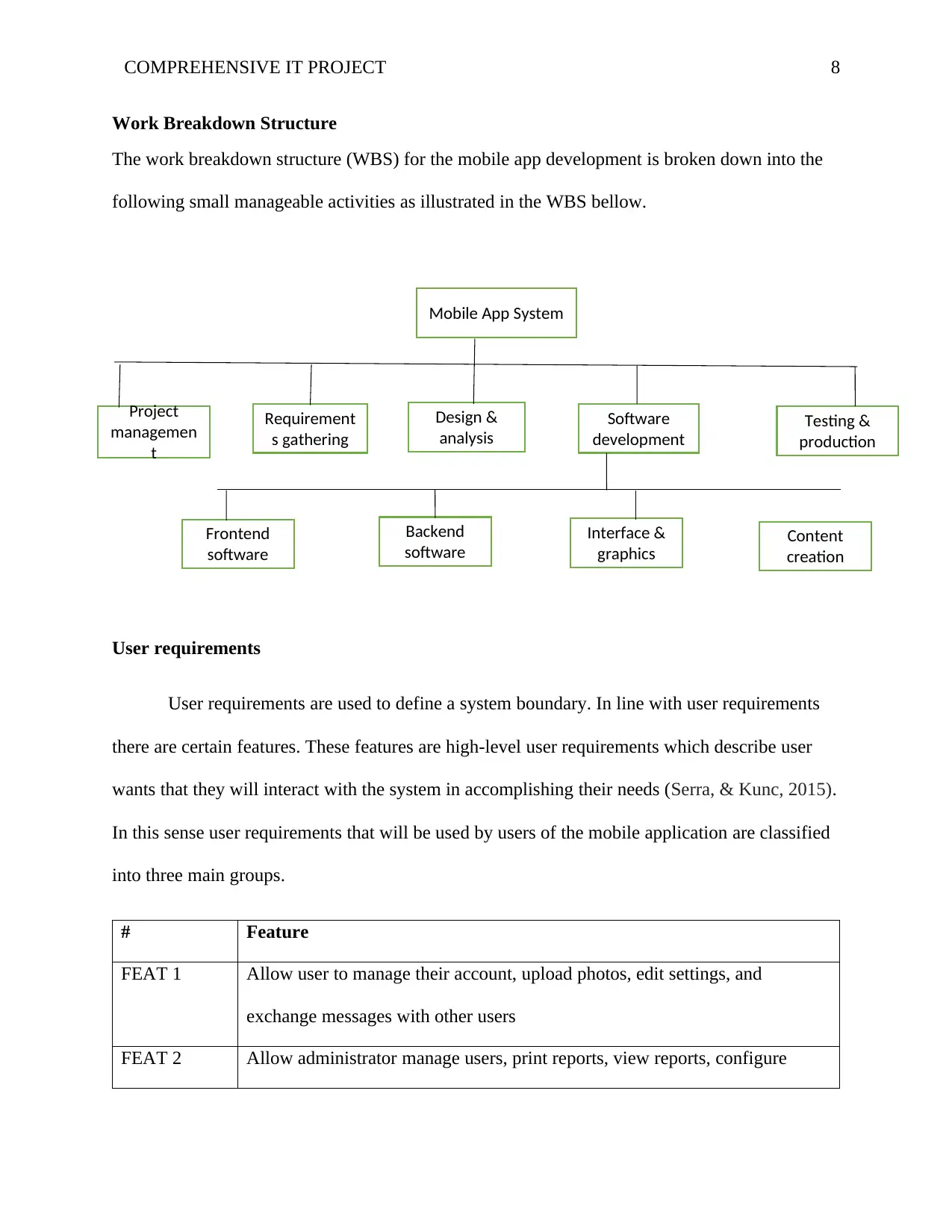
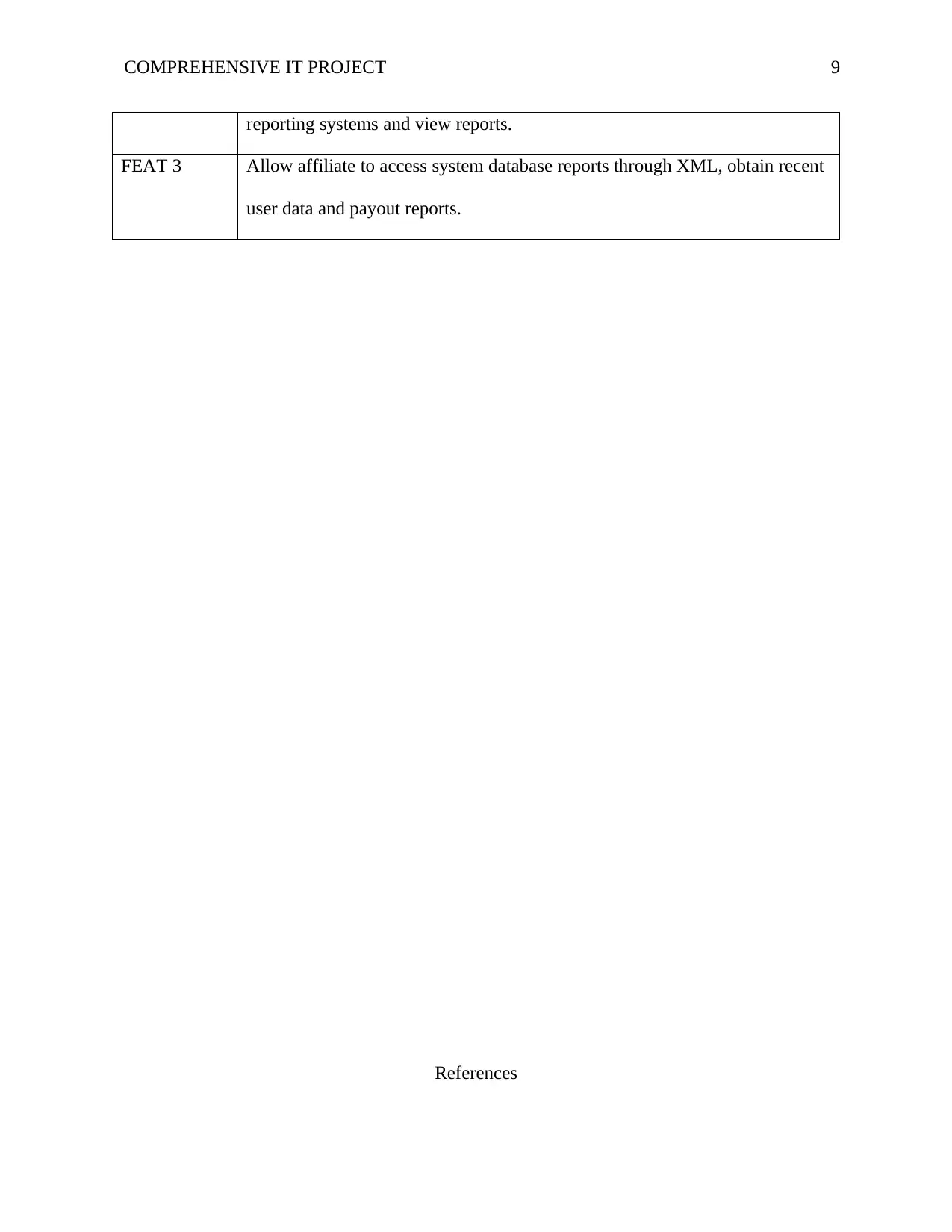
will develop use an online Gantt chart where the deadline for every activity will be made visual.
ID Task Start date End date
1 Planning 1/19/19 5/9/19
2 Functions and features 6/9/19 19/9/19
3 User interface design 20/9/19 17/10/19
4 Fronted development 18/10/19 19/12/19
5 Backend development 20/12/19 27/2/20
6 Testing 28/2/20 19/3/20
7 Deployment 20/3/20 7/5/20
stakeholders are core to the project since they will help in reducing as well as uncovering risks
thus increase their buy-in. The project manager to this project will charged with the
responsibility of managing all the project resources and time constraints given by project owner.
On the other hand, company employee task will be actual development of the application thus
they play a very influential part to the project success.
Schedule: Each project should have a start data and completion date. The schedule is
used to ensure that the mobile app development team do not missed out activity to successfully
deliver the product (Kerzner, 2017). The app development will take nine months to deliver the
mobile application system. Therefore, the project manager is required to ensure that they strictly
observe the timeline so that to avoid delivery the product late. While it may not be easy to keep
to the initial schedule because of certain unavoidable circumstances, the project manager is
supposed to evaluate the project progress consistently against the initial timeline (Joslin, &
Müller, 2016). To avoid missing the schedule the project manager will have to give a report
about project progress after each phase to the senior stakeholders. To ease the work the manager
will develop use an online Gantt chart where the deadline for every activity will be made visual.
ID Task Start date End date
1 Planning 1/19/19 5/9/19
2 Functions and features 6/9/19 19/9/19
3 User interface design 20/9/19 17/10/19
4 Fronted development 18/10/19 19/12/19
5 Backend development 20/12/19 27/2/20
6 Testing 28/2/20 19/3/20
7 Deployment 20/3/20 7/5/20
Paraphrase This Document
Need a fresh take? Get an instant paraphrase of this document with our AI Paraphraser

COMPREHENSIVE IT PROJECT 5
8 Maintenance and support 8/5/20 28/5/20
Schedule for developing the Mobile Application system
Gantt chart
The project will start in September 2019 and will be completed in May 2020, hence taking nine
months.
8 Maintenance and support 8/5/20 28/5/20
Schedule for developing the Mobile Application system
Gantt chart
The project will start in September 2019 and will be completed in May 2020, hence taking nine
months.

COMPREHENSIVE IT PROJECT 6
⊘ This is a preview!⊘
Do you want full access?
Subscribe today to unlock all pages.

Trusted by 1+ million students worldwide

COMPREHENSIVE IT PROJECT 7
Paraphrase This Document
Need a fresh take? Get an instant paraphrase of this document with our AI Paraphraser

COMPREHENSIVE IT PROJECT 8
Work Breakdown Structure
The work breakdown structure (WBS) for the mobile app development is broken down into the
following small manageable activities as illustrated in the WBS bellow.
User requirements
User requirements are used to define a system boundary. In line with user requirements
there are certain features. These features are high-level user requirements which describe user
wants that they will interact with the system in accomplishing their needs (Serra, & Kunc, 2015).
In this sense user requirements that will be used by users of the mobile application are classified
into three main groups.
# Feature
FEAT 1 Allow user to manage their account, upload photos, edit settings, and
exchange messages with other users
FEAT 2 Allow administrator manage users, print reports, view reports, configure
Requirement
s gathering
Mobile App System
Project
managemen
t
Design &
analysis
Software
development
Testing &
production
Frontend
software
Content
creation
Backend
software
Interface &
graphics
Work Breakdown Structure
The work breakdown structure (WBS) for the mobile app development is broken down into the
following small manageable activities as illustrated in the WBS bellow.
User requirements
User requirements are used to define a system boundary. In line with user requirements
there are certain features. These features are high-level user requirements which describe user
wants that they will interact with the system in accomplishing their needs (Serra, & Kunc, 2015).
In this sense user requirements that will be used by users of the mobile application are classified
into three main groups.
# Feature
FEAT 1 Allow user to manage their account, upload photos, edit settings, and
exchange messages with other users
FEAT 2 Allow administrator manage users, print reports, view reports, configure
Requirement
s gathering
Mobile App System
Project
managemen
t
Design &
analysis
Software
development
Testing &
production
Frontend
software
Content
creation
Backend
software
Interface &
graphics

COMPREHENSIVE IT PROJECT 9
reporting systems and view reports.
FEAT 3 Allow affiliate to access system database reports through XML, obtain recent
user data and payout reports.
References
reporting systems and view reports.
FEAT 3 Allow affiliate to access system database reports through XML, obtain recent
user data and payout reports.
References
⊘ This is a preview!⊘
Do you want full access?
Subscribe today to unlock all pages.

Trusted by 1+ million students worldwide

COMPREHENSIVE IT PROJECT 10
Abushova, E., Burova, E., & Suloeva, S. (2016). Strategic analysis in telecommunication project
management system. In Internet of Things, Smart Spaces, and Next Generation Networks
and Systems (pp. 76-84). Springer, Cham.
Eskerod, P., Huemann, M., & Ringhofer, C. (2015). Stakeholder Inclusiveness: Enriching Project
Management with General Stakeholder Theory1. Project Management Journal, 46(6),
42-53.
Joslin, R., & Müller, R. (2016). The relationship between project governance and project
success. International Journal of Project Management, 34(4), 613-626.
Kerzner, H. (2017). Project management: a systems approach to planning, scheduling, and
controlling. John Wiley & Sons.
Kristiansen, J. N., & Ritala, P. (2018). Measuring radical innovation project success: typical
metrics don’t work. Journal of Business Strategy, 39(4), 34-41.
Paz, F., & Pow-Sang, J. A. (2016). A systematic mapping review of usability evaluation methods
for software development process. International Journal of Software Engineering and Its
Applications, 10(1), 165-178.
Serra, C. E. M., & Kunc, M. (2015). Benefits realization management and its influence on
project success and on the execution of
Todorović, M. L., Petrović, D. Č., Mihić, M. M., Obradović, V. L., & Bushuyev, S. D. (2015).
Project success analysis framework: A knowledge-based approach in project
management. International Journal of Project Management, 33(4), 772-783.
Abushova, E., Burova, E., & Suloeva, S. (2016). Strategic analysis in telecommunication project
management system. In Internet of Things, Smart Spaces, and Next Generation Networks
and Systems (pp. 76-84). Springer, Cham.
Eskerod, P., Huemann, M., & Ringhofer, C. (2015). Stakeholder Inclusiveness: Enriching Project
Management with General Stakeholder Theory1. Project Management Journal, 46(6),
42-53.
Joslin, R., & Müller, R. (2016). The relationship between project governance and project
success. International Journal of Project Management, 34(4), 613-626.
Kerzner, H. (2017). Project management: a systems approach to planning, scheduling, and
controlling. John Wiley & Sons.
Kristiansen, J. N., & Ritala, P. (2018). Measuring radical innovation project success: typical
metrics don’t work. Journal of Business Strategy, 39(4), 34-41.
Paz, F., & Pow-Sang, J. A. (2016). A systematic mapping review of usability evaluation methods
for software development process. International Journal of Software Engineering and Its
Applications, 10(1), 165-178.
Serra, C. E. M., & Kunc, M. (2015). Benefits realization management and its influence on
project success and on the execution of
Todorović, M. L., Petrović, D. Č., Mihić, M. M., Obradović, V. L., & Bushuyev, S. D. (2015).
Project success analysis framework: A knowledge-based approach in project
management. International Journal of Project Management, 33(4), 772-783.
1 out of 10
Related Documents
Your All-in-One AI-Powered Toolkit for Academic Success.
+13062052269
info@desklib.com
Available 24*7 on WhatsApp / Email
Unlock your academic potential
Copyright © 2020–2026 A2Z Services. All Rights Reserved. Developed and managed by ZUCOL.