NRS30001 Research Report: Compression Stockings for Pressure Ulcers
VerifiedAdded on 2023/04/22
|24
|4032
|342
Report
AI Summary
This report evaluates the effectiveness of compression stockings therapy in managing pressure ulcers among older adults, addressing a significant issue in clinical settings. The study follows a structured methodology, including a PICO question (effectiveness of compressed stockings in older adults with pressure ulcers), a literature search using databases like CINAHL and PubMed, and critical appraisal using the CASP tool. The selected research paper, a randomized clinical trial, is summarized and its relevance to the PICO question is discussed. The report analyzes the study design, sample selection, data collection, and data analysis methods, highlighting the use of statistical tools for rigorous evaluation. Findings indicate patient comfort levels with different types of compression stockings and the absence of thrombosis in the study groups. The discussion section assesses the study's validity, significance, strengths, and limitations, emphasizing its clinical relevance to pressure ulcer management. Desklib provides access to this and similar solved assignments.

Running head: PRESSURE ULCER (DEEP VEIN THROMBOSIS)
Name of the student;
Name of the university:
Author’s note:
Name of the student;
Name of the university:
Author’s note:

Paraphrase This Document
Need a fresh take? Get an instant paraphrase of this document with our AI Paraphraser
1
PRESSURE ULCER (DEEP VEIN THROMBOSIS)
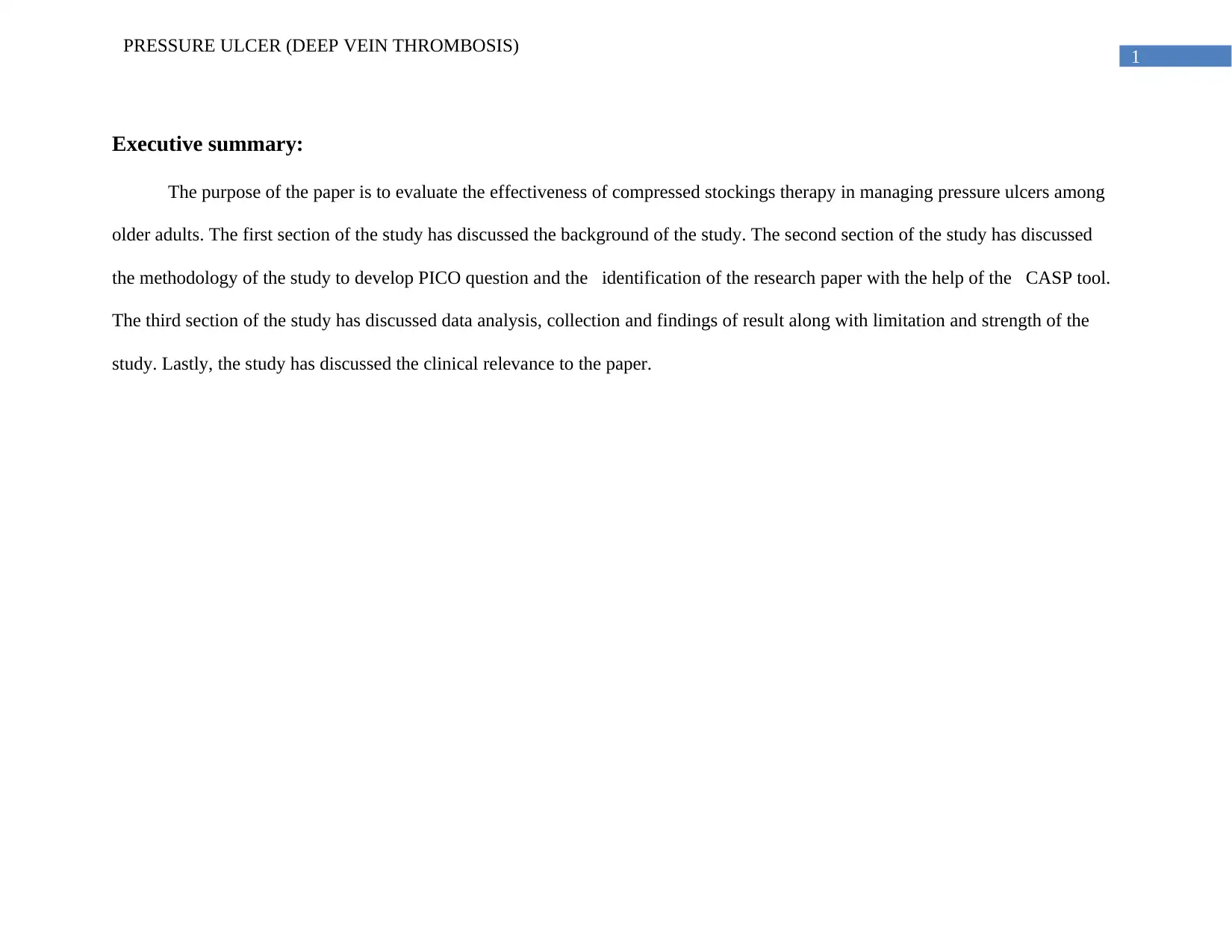
Executive summary:
The purpose of the paper is to evaluate the effectiveness of compressed stockings therapy in managing pressure ulcers among
older adults. The first section of the study has discussed the background of the study. The second section of the study has discussed
the methodology of the study to develop PICO question and the identification of the research paper with the help of the CASP tool.
The third section of the study has discussed data analysis, collection and findings of result along with limitation and strength of the
study. Lastly, the study has discussed the clinical relevance to the paper.
PRESSURE ULCER (DEEP VEIN THROMBOSIS)
Executive summary:
The purpose of the paper is to evaluate the effectiveness of compressed stockings therapy in managing pressure ulcers among
older adults. The first section of the study has discussed the background of the study. The second section of the study has discussed
the methodology of the study to develop PICO question and the identification of the research paper with the help of the CASP tool.
The third section of the study has discussed data analysis, collection and findings of result along with limitation and strength of the
study. Lastly, the study has discussed the clinical relevance to the paper.
2
PRESSURE ULCER (DEEP VEIN THROMBOSIS)
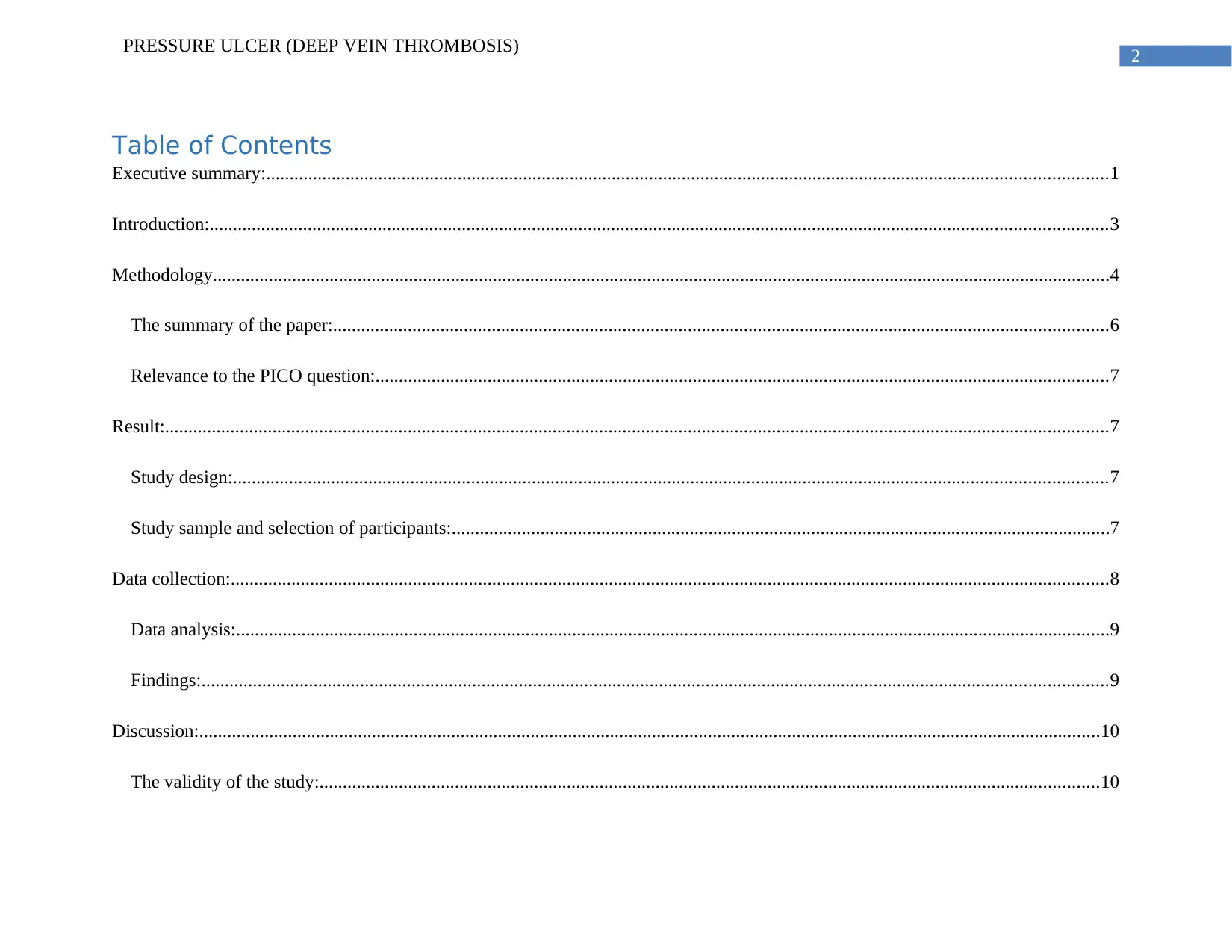
Table of Contents
Executive summary:....................................................................................................................................................................................1
Introduction:................................................................................................................................................................................................3
Methodology................................................................................................................................................................................................4
The summary of the paper:......................................................................................................................................................................6
Relevance to the PICO question:.............................................................................................................................................................7
Result:..........................................................................................................................................................................................................7
Study design:...........................................................................................................................................................................................7
Study sample and selection of participants:.............................................................................................................................................7
Data collection:............................................................................................................................................................................................8
Data analysis:...........................................................................................................................................................................................9
Findings:..................................................................................................................................................................................................9
Discussion:.................................................................................................................................................................................................10
The validity of the study:.......................................................................................................................................................................10
PRESSURE ULCER (DEEP VEIN THROMBOSIS)
Table of Contents
Executive summary:....................................................................................................................................................................................1
Introduction:................................................................................................................................................................................................3
Methodology................................................................................................................................................................................................4
The summary of the paper:......................................................................................................................................................................6
Relevance to the PICO question:.............................................................................................................................................................7
Result:..........................................................................................................................................................................................................7
Study design:...........................................................................................................................................................................................7
Study sample and selection of participants:.............................................................................................................................................7
Data collection:............................................................................................................................................................................................8
Data analysis:...........................................................................................................................................................................................9
Findings:..................................................................................................................................................................................................9
Discussion:.................................................................................................................................................................................................10
The validity of the study:.......................................................................................................................................................................10
⊘ This is a preview!⊘
Do you want full access?
Subscribe today to unlock all pages.

Trusted by 1+ million students worldwide
3
PRESSURE ULCER (DEEP VEIN THROMBOSIS)
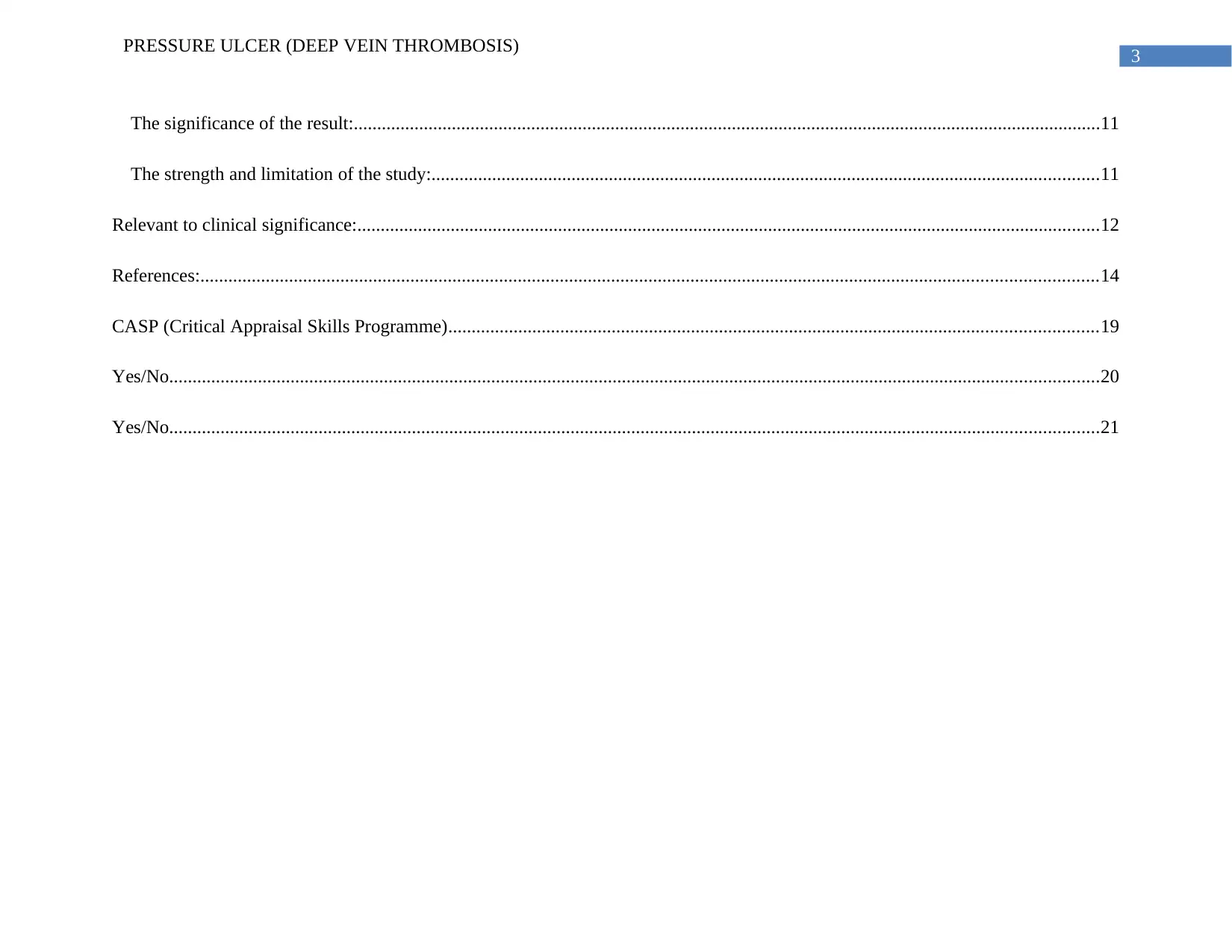
The significance of the result:................................................................................................................................................................11
The strength and limitation of the study:...............................................................................................................................................11
Relevant to clinical significance:...............................................................................................................................................................12
References:................................................................................................................................................................................................14
CASP (Critical Appraisal Skills Programme)...........................................................................................................................................19
Yes/No.......................................................................................................................................................................................................20
Yes/No.......................................................................................................................................................................................................21
PRESSURE ULCER (DEEP VEIN THROMBOSIS)
The significance of the result:................................................................................................................................................................11
The strength and limitation of the study:...............................................................................................................................................11
Relevant to clinical significance:...............................................................................................................................................................12
References:................................................................................................................................................................................................14
CASP (Critical Appraisal Skills Programme)...........................................................................................................................................19
Yes/No.......................................................................................................................................................................................................20
Yes/No.......................................................................................................................................................................................................21
Paraphrase This Document
Need a fresh take? Get an instant paraphrase of this document with our AI Paraphraser
4
PRESSURE ULCER (DEEP VEIN THROMBOSIS)
Introduction:
With the growing population of older adults, wound care management is highlighted as a significant issue in the clinical setting
(Demarre et al., 2015). In the hospital setting, Pressure ulcer is identified as one of the chronic issues, especially, Lower extremity
deep vein thrombosis which breaks down the skin and underlying issue when an area is placed under constant pressure older adults.
As reported by Demarré et al. (2015), the estimated pressure injury prevalence in Australia in the hospital is from 9.5% to 17.6%. In
2015 in New South Wales 1, 195 individuals were with pressure injury was a diagnosis, highlighting one per 10 people in the
population was affected (Qaseem et al., 2015). Out of all pressure injury, the incidents of deep vein thrombosis in Australia is high ,
approximately 160 per 100000 and 14,000 new cases are diagnosed every year (Edsberg et al., 2016). The purpose of the paper is to
evaluate the effectiveness of compressed stockings therapy in managing pressure ulcers among older adults. This paper will illustrate
the search methodology of paper, a summary of the paper, critically appraise the paper and lastly, the relevance of paper in clinical
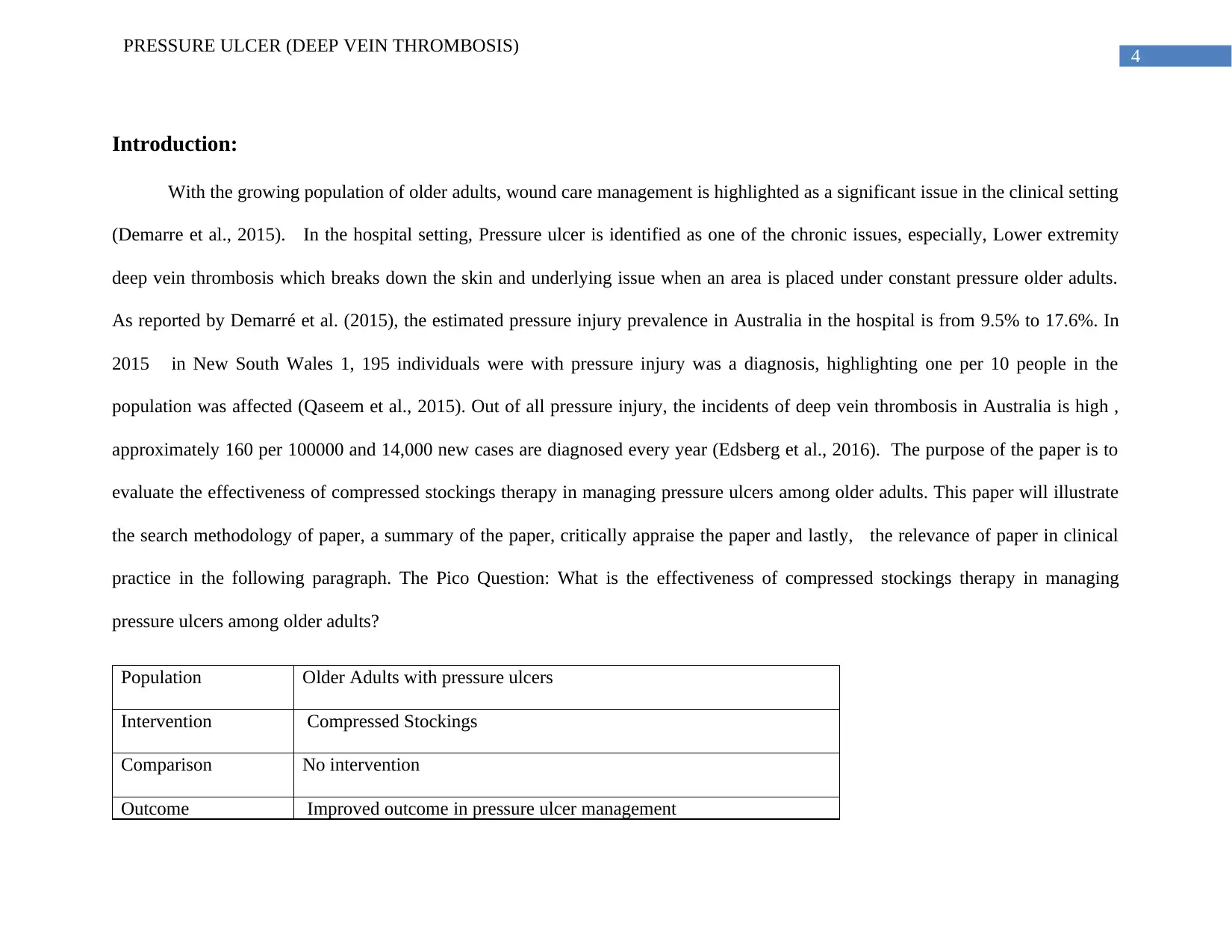
practice in the following paragraph. The Pico Question: What is the effectiveness of compressed stockings therapy in managing
pressure ulcers among older adults?
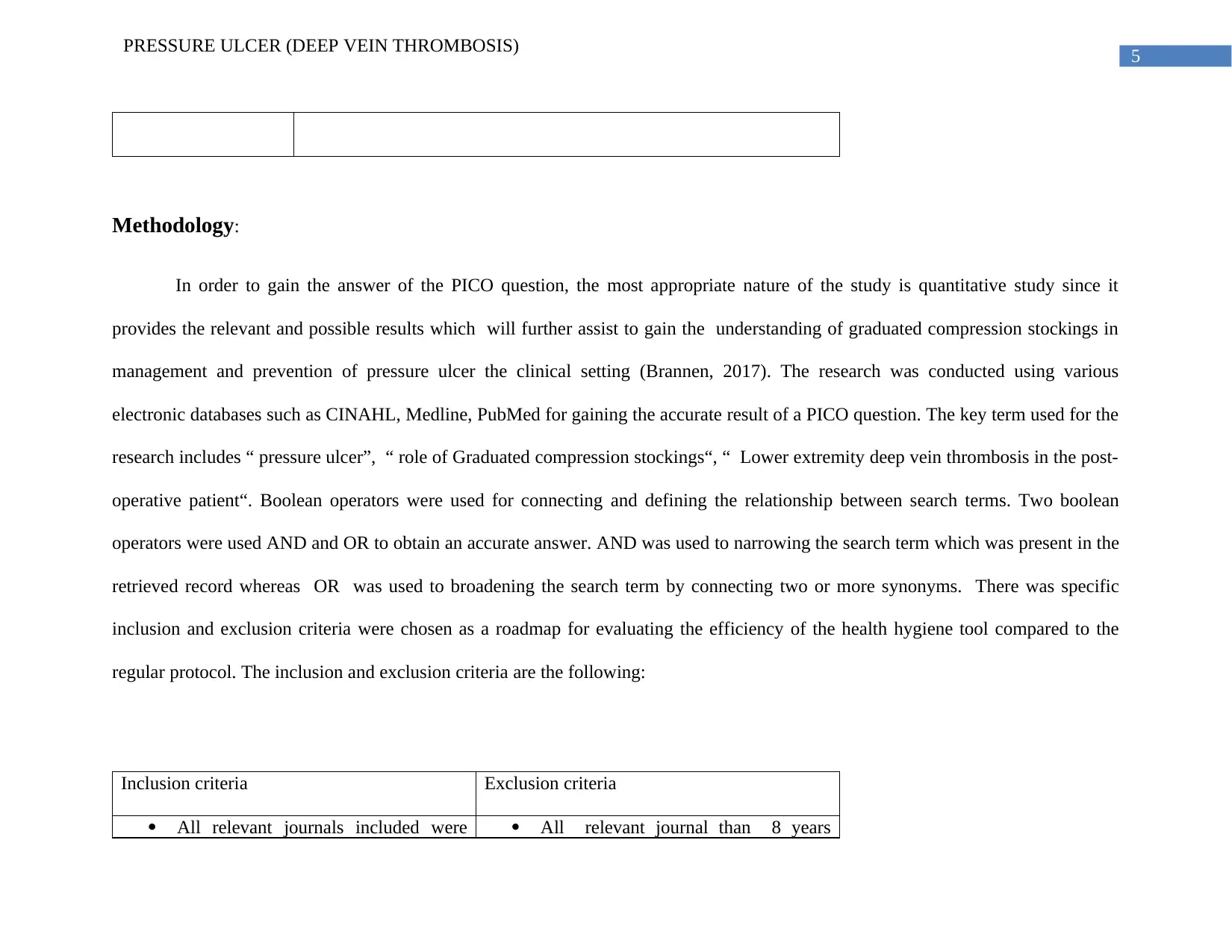
Population Older Adults with pressure ulcers
Intervention Compressed Stockings
Comparison No intervention
Outcome Improved outcome in pressure ulcer management
PRESSURE ULCER (DEEP VEIN THROMBOSIS)
Introduction:
With the growing population of older adults, wound care management is highlighted as a significant issue in the clinical setting
(Demarre et al., 2015). In the hospital setting, Pressure ulcer is identified as one of the chronic issues, especially, Lower extremity
deep vein thrombosis which breaks down the skin and underlying issue when an area is placed under constant pressure older adults.
As reported by Demarré et al. (2015), the estimated pressure injury prevalence in Australia in the hospital is from 9.5% to 17.6%. In
2015 in New South Wales 1, 195 individuals were with pressure injury was a diagnosis, highlighting one per 10 people in the
population was affected (Qaseem et al., 2015). Out of all pressure injury, the incidents of deep vein thrombosis in Australia is high ,
approximately 160 per 100000 and 14,000 new cases are diagnosed every year (Edsberg et al., 2016). The purpose of the paper is to
evaluate the effectiveness of compressed stockings therapy in managing pressure ulcers among older adults. This paper will illustrate
the search methodology of paper, a summary of the paper, critically appraise the paper and lastly, the relevance of paper in clinical
practice in the following paragraph. The Pico Question: What is the effectiveness of compressed stockings therapy in managing
pressure ulcers among older adults?
Population Older Adults with pressure ulcers
Intervention Compressed Stockings
Comparison No intervention
Outcome Improved outcome in pressure ulcer management
5
PRESSURE ULCER (DEEP VEIN THROMBOSIS)
Methodology:
In order to gain the answer of the PICO question, the most appropriate nature of the study is quantitative study since it
provides the relevant and possible results which will further assist to gain the understanding of graduated compression stockings in
management and prevention of pressure ulcer the clinical setting (Brannen, 2017). The research was conducted using various
electronic databases such as CINAHL, Medline, PubMed for gaining the accurate result of a PICO question. The key term used for the
research includes “ pressure ulcer”, “ role of Graduated compression stockings“, “ Lower extremity deep vein thrombosis in the post-
operative patient“. Boolean operators were used for connecting and defining the relationship between search terms. Two boolean
operators were used AND and OR to obtain an accurate answer. AND was used to narrowing the search term which was present in the
retrieved record whereas OR was used to broadening the search term by connecting two or more synonyms. There was specific
inclusion and exclusion criteria were chosen as a roadmap for evaluating the efficiency of the health hygiene tool compared to the
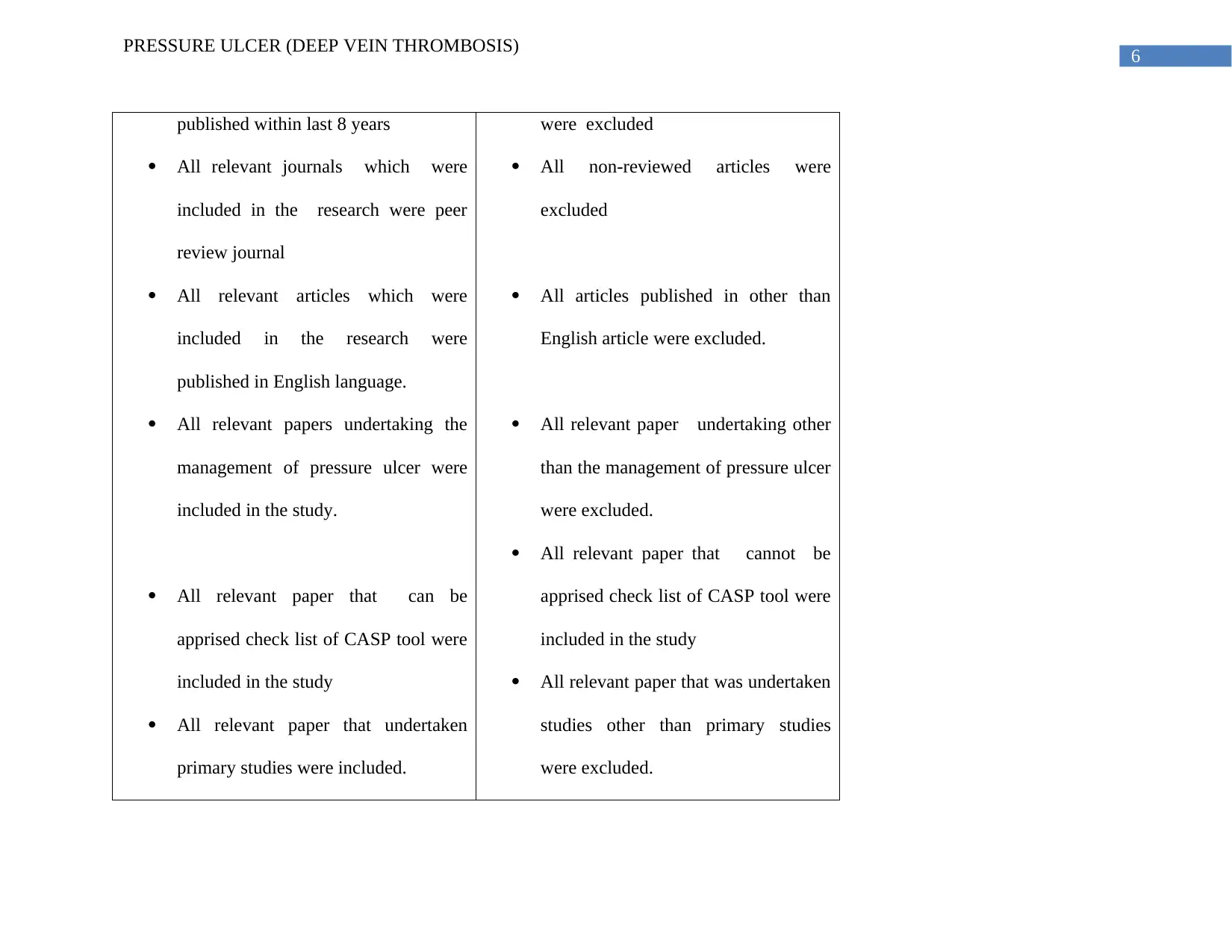
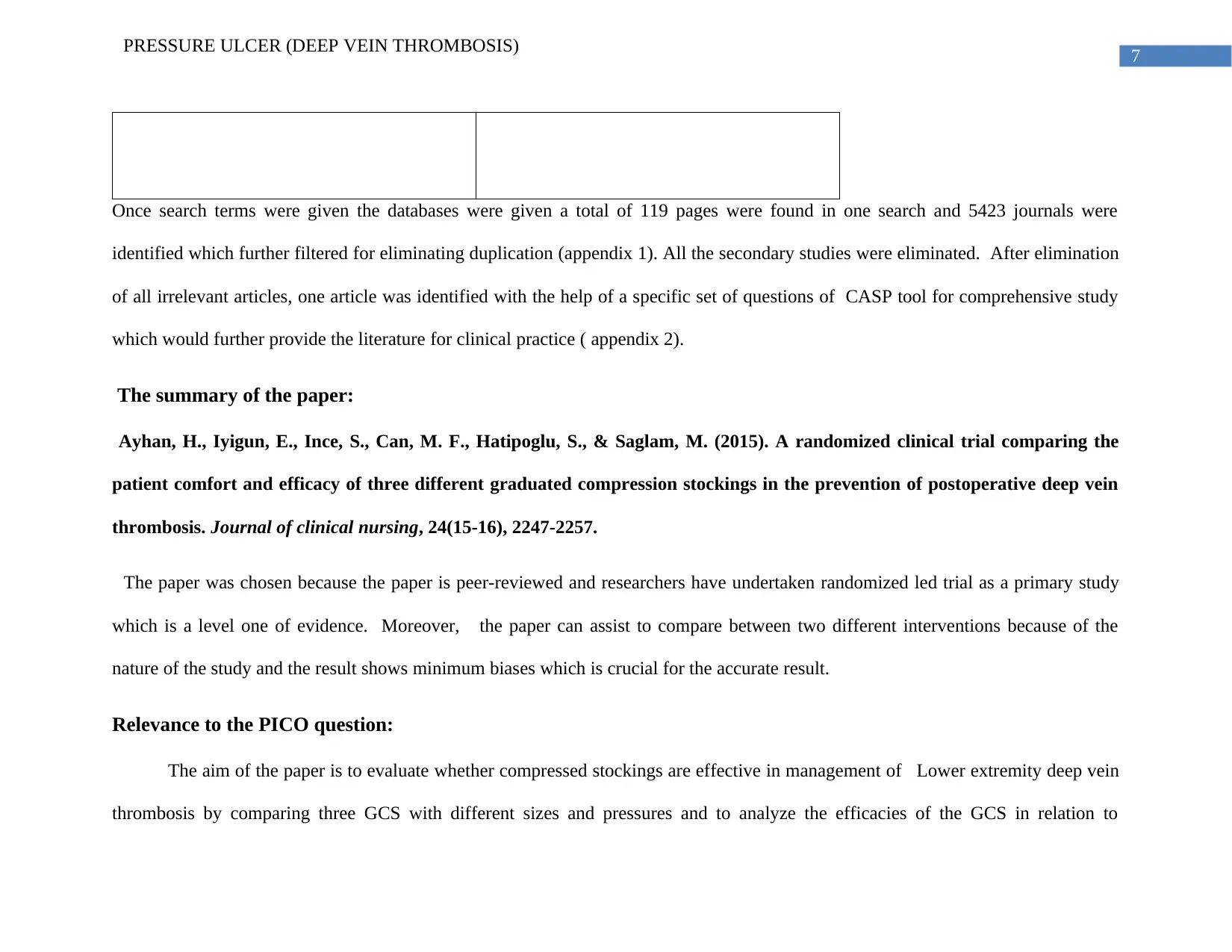
regular protocol. The inclusion and exclusion criteria are the following:
Inclusion criteria Exclusion criteria
All relevant journals included were All relevant journal than 8 years
PRESSURE ULCER (DEEP VEIN THROMBOSIS)
Methodology:
In order to gain the answer of the PICO question, the most appropriate nature of the study is quantitative study since it
provides the relevant and possible results which will further assist to gain the understanding of graduated compression stockings in
management and prevention of pressure ulcer the clinical setting (Brannen, 2017). The research was conducted using various
electronic databases such as CINAHL, Medline, PubMed for gaining the accurate result of a PICO question. The key term used for the
research includes “ pressure ulcer”, “ role of Graduated compression stockings“, “ Lower extremity deep vein thrombosis in the post-
operative patient“. Boolean operators were used for connecting and defining the relationship between search terms. Two boolean
operators were used AND and OR to obtain an accurate answer. AND was used to narrowing the search term which was present in the
retrieved record whereas OR was used to broadening the search term by connecting two or more synonyms. There was specific
inclusion and exclusion criteria were chosen as a roadmap for evaluating the efficiency of the health hygiene tool compared to the
regular protocol. The inclusion and exclusion criteria are the following:
Inclusion criteria Exclusion criteria
All relevant journals included were All relevant journal than 8 years
⊘ This is a preview!⊘
Do you want full access?
Subscribe today to unlock all pages.
Trusted by 1+ million students worldwide
6
PRESSURE ULCER (DEEP VEIN THROMBOSIS)
published within last 8 years
All relevant journals which were
included in the research were peer
review journal
All relevant articles which were
included in the research were
published in English language.
All relevant papers undertaking the
management of pressure ulcer were
included in the study.
All relevant paper that can be
apprised check list of CASP tool were
included in the study
All relevant paper that undertaken
primary studies were included.
were excluded
All non-reviewed articles were
excluded
All articles published in other than
English article were excluded.
All relevant paper undertaking other
than the management of pressure ulcer
were excluded.
All relevant paper that cannot be
apprised check list of CASP tool were
included in the study
All relevant paper that was undertaken
studies other than primary studies
were excluded.
PRESSURE ULCER (DEEP VEIN THROMBOSIS)
published within last 8 years
All relevant journals which were
included in the research were peer
review journal
All relevant articles which were
included in the research were
published in English language.
All relevant papers undertaking the
management of pressure ulcer were
included in the study.
All relevant paper that can be
apprised check list of CASP tool were
included in the study
All relevant paper that undertaken
primary studies were included.
were excluded
All non-reviewed articles were
excluded
All articles published in other than
English article were excluded.
All relevant paper undertaking other
than the management of pressure ulcer
were excluded.
All relevant paper that cannot be
apprised check list of CASP tool were
included in the study
All relevant paper that was undertaken
studies other than primary studies
were excluded.
Paraphrase This Document
Need a fresh take? Get an instant paraphrase of this document with our AI Paraphraser
7
PRESSURE ULCER (DEEP VEIN THROMBOSIS)
Once search terms were given the databases were given a total of 119 pages were found in one search and 5423 journals were
identified which further filtered for eliminating duplication (appendix 1). All the secondary studies were eliminated. After elimination
of all irrelevant articles, one article was identified with the help of a specific set of questions of CASP tool for comprehensive study
which would further provide the literature for clinical practice ( appendix 2).
The summary of the paper:
Ayhan, H., Iyigun, E., Ince, S., Can, M. F., Hatipoglu, S., & Saglam, M. (2015). A randomized clinical trial comparing the
patient comfort and efficacy of three different graduated compression stockings in the prevention of postoperative deep vein
thrombosis. Journal of clinical nursing, 24(15-16), 2247-2257.
The paper was chosen because the paper is peer-reviewed and researchers have undertaken randomized led trial as a primary study
which is a level one of evidence. Moreover, the paper can assist to compare between two different interventions because of the
nature of the study and the result shows minimum biases which is crucial for the accurate result.
Relevance to the PICO question:
The aim of the paper is to evaluate whether compressed stockings are effective in management of Lower extremity deep vein
thrombosis by comparing three GCS with different sizes and pressures and to analyze the efficacies of the GCS in relation to
PRESSURE ULCER (DEEP VEIN THROMBOSIS)
Once search terms were given the databases were given a total of 119 pages were found in one search and 5423 journals were
identified which further filtered for eliminating duplication (appendix 1). All the secondary studies were eliminated. After elimination
of all irrelevant articles, one article was identified with the help of a specific set of questions of CASP tool for comprehensive study
which would further provide the literature for clinical practice ( appendix 2).
The summary of the paper:
Ayhan, H., Iyigun, E., Ince, S., Can, M. F., Hatipoglu, S., & Saglam, M. (2015). A randomized clinical trial comparing the
patient comfort and efficacy of three different graduated compression stockings in the prevention of postoperative deep vein
thrombosis. Journal of clinical nursing, 24(15-16), 2247-2257.
The paper was chosen because the paper is peer-reviewed and researchers have undertaken randomized led trial as a primary study
which is a level one of evidence. Moreover, the paper can assist to compare between two different interventions because of the
nature of the study and the result shows minimum biases which is crucial for the accurate result.
Relevance to the PICO question:
The aim of the paper is to evaluate whether compressed stockings are effective in management of Lower extremity deep vein
thrombosis by comparing three GCS with different sizes and pressures and to analyze the efficacies of the GCS in relation to
8
PRESSURE ULCER (DEEP VEIN THROMBOSIS)
postoperative patient which further will help to address the PICO question (What is the effectiveness of compressed stockings therapy
in managing pressure ulcers among older adults?).
Result:
The research question of the paper is what is the effectiveness of three different groups of graduated compression stockings
management of postoperative DVT?
Study design:
Ayhan et al. (2015), conducted a randomized control trial as a quantitative study to identify the efficiency of the graduated
compression stockings in the management of postoperative DVT. As discussed by McCusker and Gunaydin (2015), Quantitative
study provides systematic empirical investigations of the observational phenomena via statistical mathematical or computation
technique. Hence, the study design was appropriate for the study.
Study sample and selection of participants:
219 post-operative patients were randomized into three groups each with 73 participants. Group I was provided with knee-
length graduated compression stockings of low-pressure, group II provided with thigh-length graduated compression stockings of low-
pressure, and group III was provided with knee-length graduated compression stocking of moderate-pressure,. Ayhan et al. (2015),
conducted the study general surgery obstetrics, urology units and gynecology of a training and research hospital in Ankara, Turkey.
The selection criteria for the study are the following:
PRESSURE ULCER (DEEP VEIN THROMBOSIS)
postoperative patient which further will help to address the PICO question (What is the effectiveness of compressed stockings therapy
in managing pressure ulcers among older adults?).
Result:
The research question of the paper is what is the effectiveness of three different groups of graduated compression stockings
management of postoperative DVT?
Study design:
Ayhan et al. (2015), conducted a randomized control trial as a quantitative study to identify the efficiency of the graduated
compression stockings in the management of postoperative DVT. As discussed by McCusker and Gunaydin (2015), Quantitative
study provides systematic empirical investigations of the observational phenomena via statistical mathematical or computation
technique. Hence, the study design was appropriate for the study.
Study sample and selection of participants:
219 post-operative patients were randomized into three groups each with 73 participants. Group I was provided with knee-
length graduated compression stockings of low-pressure, group II provided with thigh-length graduated compression stockings of low-
pressure, and group III was provided with knee-length graduated compression stocking of moderate-pressure,. Ayhan et al. (2015),
conducted the study general surgery obstetrics, urology units and gynecology of a training and research hospital in Ankara, Turkey.
The selection criteria for the study are the following:
⊘ This is a preview!⊘
Do you want full access?
Subscribe today to unlock all pages.
Trusted by 1+ million students worldwide
9
PRESSURE ULCER (DEEP VEIN THROMBOSIS)
• 18 years of age
• No history of preoperative anticoagulation
• undergoing abdominal–pelvic surgery
• having high risk factors of development of postoperative DVT
To conduct research adequately, 219 individuals are an inadequate sample size to compare the effectiveness of the different
graduated compression stockings.
Data collection:
Initially, the DVT risk of the patients and sociodemographic data were collected and the result was collected based on the
primary and secondary outcome. To evaluate the comfort level and efficacy of the graduated compression stocking in post-operative
patients, the researcher analyzed every morning for each participant whether there was any problem of roll down, redness, edema or
pressure ulcer in the toes during neurovascular assessment and if any problem observed when the data was recorded in the collection
form. Moreover, the patients were enquired they had any problems with the GCS, these problems were recorded if patient stated any
problem. The GSC comfort level measurement was collected based on the four points scale. Since researchers undertook both verbal
inquiry and the evaluation through the assessment tool, it is an appropriate way of collecting data without any potential bias (Barnham,
2015).
PRESSURE ULCER (DEEP VEIN THROMBOSIS)
• 18 years of age
• No history of preoperative anticoagulation
• undergoing abdominal–pelvic surgery
• having high risk factors of development of postoperative DVT
To conduct research adequately, 219 individuals are an inadequate sample size to compare the effectiveness of the different
graduated compression stockings.
Data collection:
Initially, the DVT risk of the patients and sociodemographic data were collected and the result was collected based on the
primary and secondary outcome. To evaluate the comfort level and efficacy of the graduated compression stocking in post-operative
patients, the researcher analyzed every morning for each participant whether there was any problem of roll down, redness, edema or
pressure ulcer in the toes during neurovascular assessment and if any problem observed when the data was recorded in the collection
form. Moreover, the patients were enquired they had any problems with the GCS, these problems were recorded if patient stated any
problem. The GSC comfort level measurement was collected based on the four points scale. Since researchers undertook both verbal
inquiry and the evaluation through the assessment tool, it is an appropriate way of collecting data without any potential bias (Barnham,
2015).
Paraphrase This Document
Need a fresh take? Get an instant paraphrase of this document with our AI Paraphraser
10
PRESSURE ULCER (DEEP VEIN THROMBOSIS)
Data analysis:
The data analysis was sufficiently rigorous for the in-depth research for obtaining an accurate result from the study. Ayhan et
al. (2015), used the Statistical Package of Social Sciences version 15.0 package program for data analysis which includes numerical
variables which were expressed as percentage and numbers and quantitative variables are used as the mean median and mode. The
consistency of the calculated data was compared with the normal range with the help of one sample Kolmogorov–Smirnov test. The
mean age between three groups was evaluated using one way ANOVA and to compare between other parameters and the health
Kruskal–Wallis test. Lastly, to determine the correlation between the numerical variables the chi-square test was used.
Findings:
In the study conducted by Ayhan et al. (2015),, the parameter of the evaluation was the level of patients comfort regarding the
graduated compression stockings and the occurrence of deep vein thrombosis was examined. The result suggested that 79.9 % of the
post-operative patient who wore group III using compression stocking low-pressure, knee-length graduated compression stockings and
52.1 % of the patient in the group using low-pressure, graduated compression stockings of thigh-length were feeling uncomfortable.
The level of significance for both the group III and II was p < 0•001 whereas p-value <0. 05 are accepted as a level of statistical
significance. The patient of group I wearing low-pressure, knee-length graduated compression stocking stated that it was very
comfortable. However, no thrombosis was found in any of the groups. In group II, by the 95% confidence intervals problem relative
risk was found to be 2.9 times more whereas in group III risk was found to be 4. 4 times more compared to the group I.
PRESSURE ULCER (DEEP VEIN THROMBOSIS)
Data analysis:
The data analysis was sufficiently rigorous for the in-depth research for obtaining an accurate result from the study. Ayhan et
al. (2015), used the Statistical Package of Social Sciences version 15.0 package program for data analysis which includes numerical
variables which were expressed as percentage and numbers and quantitative variables are used as the mean median and mode. The
consistency of the calculated data was compared with the normal range with the help of one sample Kolmogorov–Smirnov test. The
mean age between three groups was evaluated using one way ANOVA and to compare between other parameters and the health
Kruskal–Wallis test. Lastly, to determine the correlation between the numerical variables the chi-square test was used.
Findings:
In the study conducted by Ayhan et al. (2015),, the parameter of the evaluation was the level of patients comfort regarding the
graduated compression stockings and the occurrence of deep vein thrombosis was examined. The result suggested that 79.9 % of the
post-operative patient who wore group III using compression stocking low-pressure, knee-length graduated compression stockings and
52.1 % of the patient in the group using low-pressure, graduated compression stockings of thigh-length were feeling uncomfortable.
The level of significance for both the group III and II was p < 0•001 whereas p-value <0. 05 are accepted as a level of statistical
significance. The patient of group I wearing low-pressure, knee-length graduated compression stocking stated that it was very
comfortable. However, no thrombosis was found in any of the groups. In group II, by the 95% confidence intervals problem relative
risk was found to be 2.9 times more whereas in group III risk was found to be 4. 4 times more compared to the group I.
11
PRESSURE ULCER (DEEP VEIN THROMBOSIS)
Discussion:
The validity of the study:
The validity of the study defined as the indication of how sound research is, especially in terms of research method and study
design (McNabb, 2015). In the current context, the study conducted by Ayhan et al. (2015) is internally valid since the researchers
have taken into consideration randomized control trial which is a level one of evidence to minimize the potential biases and the data
collection of the research was adequate where statistical analysis was undertaken for analysis of the patient. However, only patients
with moderate risk of deep vein thrombosis and post-operative patient abdominal and pelvic surgery were taken into consideration.
This characteristics further showed the selection bias of the researchers. Besides, the larger sample size is required with different
characteristics of the post-operative patients to evaluate whether graduated compression stocking is effective in management or
prevention of pressure ulcer or not (Hartas, 2015). The study is externally valid since the risk of the deep vein thrombosis in the study
participants is similar for all the participants and length of hospital stays was not significantly different among groups. Since, the
pressure injury such as deep vein thrombosis does not depend on the demographic, ethnicity and qualification of the participants, the
graduated compression stocking, as intervention is effective for other post-operative patients.
PRESSURE ULCER (DEEP VEIN THROMBOSIS)
Discussion:
The validity of the study:
The validity of the study defined as the indication of how sound research is, especially in terms of research method and study
design (McNabb, 2015). In the current context, the study conducted by Ayhan et al. (2015) is internally valid since the researchers
have taken into consideration randomized control trial which is a level one of evidence to minimize the potential biases and the data
collection of the research was adequate where statistical analysis was undertaken for analysis of the patient. However, only patients
with moderate risk of deep vein thrombosis and post-operative patient abdominal and pelvic surgery were taken into consideration.
This characteristics further showed the selection bias of the researchers. Besides, the larger sample size is required with different
characteristics of the post-operative patients to evaluate whether graduated compression stocking is effective in management or
prevention of pressure ulcer or not (Hartas, 2015). The study is externally valid since the risk of the deep vein thrombosis in the study
participants is similar for all the participants and length of hospital stays was not significantly different among groups. Since, the
pressure injury such as deep vein thrombosis does not depend on the demographic, ethnicity and qualification of the participants, the
graduated compression stocking, as intervention is effective for other post-operative patients.
⊘ This is a preview!⊘
Do you want full access?
Subscribe today to unlock all pages.
Trusted by 1+ million students worldwide

1 out of 24


Related Documents


Your All-in-One AI-Powered Toolkit for Academic Success.
+13062052269
info@desklib.com
Available 24*7 on WhatsApp / Email
![[object Object]](/_next/static/media/star-bottom.7253800d.svg)
Unlock your academic potential
Copyright © 2020–2026 A2Z Services. All Rights Reserved. Developed and managed by ZUCOL.