Compressive Strength: Size and Shape Effects on High Strength Concrete
VerifiedAdded on 2022/12/09
|16
|3296
|247
Report
AI Summary
This report, submitted by Gurloveleen Singh for the ENGIN3001 Engineering Research Methodology and Management course, investigates the effects of size and shape on the compressive strength of high-strength concrete. The research is motivated by the growing need for aesthetically pleasing and structurally sound buildings, exploring how variations in concrete element shapes can meet these demands. The report reviews literature from Tokyay & Ozdemiry (1997), Zabihi (2012), and Abd & Habeeb (2014), focusing on experimental analyses of concrete cubes and cylinders, the impact of water-to-cement ratios, and the properties of self-compacting concrete. Key findings include the influence of specimen size and shape on compressive strength, with deviations from standard sizes often leading to strength reductions. The report also identifies research gaps, particularly a lack of conclusive evidence regarding the impact of size and shape changes on concrete properties like compressive strength, workability, and slump flow, as well as the need for further exploration of the underlying characteristics influencing these differences. The report outlines the scope of the research, including the use of high-strength concrete, and concludes with a discussion of the resources required, and likely outputs of the research.
Size And Shape Effects On The Compressive Strength Of High Strength Concrete.
Name of Student: Gurloveleen Singh
Institutional Affiliations: Master of Civil engineering
Supervisor’s name: Dr. Manoj Khandelwal
Supervisor’s contact details: 0353279821
Name of Student: Gurloveleen Singh
Institutional Affiliations: Master of Civil engineering
Supervisor’s name: Dr. Manoj Khandelwal
Supervisor’s contact details: 0353279821

Paraphrase This Document
Need a fresh take? Get an instant paraphrase of this document with our AI Paraphraser
The motivation for the Research
There is an increasing urgency to develop aesthetically pleasing buildings without
necessarily compromising on the structural strength. This is mainly due to the growing
population and the fact that land is becoming scarcer and scarcer with each passing day. Cement
has been the predominant material used in construction, most notably in reinforced concrete.
However, due to the reasons above, there is a need to modify the overall shape of the concrete
elements to fit into the decreasing global space. This, as such, is one of the motivating for this
research: aiming to identify the compliance of various cement structural elements to the
structural requirements of buildings.
Moreover, there is the aspect of interest on my part. This is mainly because of my
extensive knowledge in the research of concrete tube tests. My recent work experience has
involved the study of concrete cube tests of which I have had tremendous joy in the work. I have
been involved in the research of the flexural and compressive strengths of concrete cubes for the
standard periods of between 7 days and 14 days. In this regard, undertaking this research is a
major benefit for me as I aim to increase my awareness of concrete cube tests. In this regard, I
am yet to master all the skills in concrete cube tests, especially cubes that may be of cylindrical.
Therefore, undertaking this project provides an opportunity for me to improve my awareness of
concrete testing. This, as may be assumed, will involve the understanding of the functionality of
different machines and software. It may also provide an opportunity for me to expand my
awareness regarding how different shapes and sizes of concrete elements may be used in the
building industry.
There is an increasing urgency to develop aesthetically pleasing buildings without
necessarily compromising on the structural strength. This is mainly due to the growing
population and the fact that land is becoming scarcer and scarcer with each passing day. Cement
has been the predominant material used in construction, most notably in reinforced concrete.
However, due to the reasons above, there is a need to modify the overall shape of the concrete
elements to fit into the decreasing global space. This, as such, is one of the motivating for this
research: aiming to identify the compliance of various cement structural elements to the
structural requirements of buildings.
Moreover, there is the aspect of interest on my part. This is mainly because of my
extensive knowledge in the research of concrete tube tests. My recent work experience has
involved the study of concrete cube tests of which I have had tremendous joy in the work. I have
been involved in the research of the flexural and compressive strengths of concrete cubes for the
standard periods of between 7 days and 14 days. In this regard, undertaking this research is a
major benefit for me as I aim to increase my awareness of concrete cube tests. In this regard, I
am yet to master all the skills in concrete cube tests, especially cubes that may be of cylindrical.
Therefore, undertaking this project provides an opportunity for me to improve my awareness of
concrete testing. This, as may be assumed, will involve the understanding of the functionality of
different machines and software. It may also provide an opportunity for me to expand my
awareness regarding how different shapes and sizes of concrete elements may be used in the
building industry.
Finally, there is a bridge in knowledge in the field of engineering regarding the use of
various shapes and sizes of concrete forms, especially in high strength cement. This is another
primary motivation for me since it provides an opportunity to contribute to the field of
engineering. One of the most essential and essential areas in engineering that may require such
knowledge is concrete nanotechnology. The technology has been indicated as one of the core
elements when it comes to concrete engineering. At its basic level, the technology is involved
with the construction of the most beautiful and durable concrete structures. However,
nanotechnology in concrete elements ensures that they are smart, recyclable, can be easily
fabricated and as such, may be extensively used in the construction industry (Ding et al., 2018).
In such regard, identifying the properties of concrete elements that may have varying shapes as
well as sizes may be a major step towards such technology. This is because the identification of
the two properties provides a platform from where the change in flexural strength and
compressive strength may be easily understood. Moreover, it may provide a platform into
understanding the energy consumption during concrete fabrication, the composition structure,
and the cost implications, among other factors that may be important in building and structural
design. With such technologies, I find it highly motivating to engage in such as research.
various shapes and sizes of concrete forms, especially in high strength cement. This is another
primary motivation for me since it provides an opportunity to contribute to the field of
engineering. One of the most essential and essential areas in engineering that may require such
knowledge is concrete nanotechnology. The technology has been indicated as one of the core
elements when it comes to concrete engineering. At its basic level, the technology is involved
with the construction of the most beautiful and durable concrete structures. However,
nanotechnology in concrete elements ensures that they are smart, recyclable, can be easily
fabricated and as such, may be extensively used in the construction industry (Ding et al., 2018).
In such regard, identifying the properties of concrete elements that may have varying shapes as
well as sizes may be a major step towards such technology. This is because the identification of
the two properties provides a platform from where the change in flexural strength and
compressive strength may be easily understood. Moreover, it may provide a platform into
understanding the energy consumption during concrete fabrication, the composition structure,
and the cost implications, among other factors that may be important in building and structural
design. With such technologies, I find it highly motivating to engage in such as research.
⊘ This is a preview!⊘
Do you want full access?
Subscribe today to unlock all pages.

Trusted by 1+ million students worldwide
Keywords
Standard Specimens
Specimen Size
Specimen Shape
Self-compacting concrete
Ground granulated blasted slag furnace
High strength concrete
Normal strength concrete
Compression strength
Flexural strength
Workability
Standard Specimens
Specimen Size
Specimen Shape
Self-compacting concrete
Ground granulated blasted slag furnace
High strength concrete
Normal strength concrete
Compression strength
Flexural strength
Workability
Paraphrase This Document
Need a fresh take? Get an instant paraphrase of this document with our AI Paraphraser
Sources of Literature
This essay has been based on three sources of literature. The first source by Tokyay &
Ozdemiry( 1997) focuses on the change in the compression strength of cement as a result of the
change in shape and size of the concrete. In this regard, the specimens that have been used are
either cylindrical or cubical. Nevertheless, the experimental results discussed in this text are
important when it comes to an understanding of the advantages and disadvantages that may be
associated with the different sizes of the specimens. Furthermore, the book is important when it
comes to an understanding of how the shape and size change some of the cylindrical and cubical
specimens.
The second article by Zabihi (2012) is based on the ideology behind changes in shape and
size and the overall effect on the concrete element. However, the concrete that has been used in
this case is ground granulated blasted slag furnace. The experimental analysis, nevertheless,
focuses on the compressive strength, the tensile strength and the workability of the concrete,
among other factors. The equipment used in the investigation, in this case includes the Schmidt
hammer and the PUNDIT test, among others.
The third text focuses on the three types of concrete and their overall change as a result of
the change in shape and size. However, the main emphasis is on the changes in compressive
strength as a result of the change in the shape and size of the self-compacting concrete.
This essay has been based on three sources of literature. The first source by Tokyay &
Ozdemiry( 1997) focuses on the change in the compression strength of cement as a result of the
change in shape and size of the concrete. In this regard, the specimens that have been used are
either cylindrical or cubical. Nevertheless, the experimental results discussed in this text are
important when it comes to an understanding of the advantages and disadvantages that may be
associated with the different sizes of the specimens. Furthermore, the book is important when it
comes to an understanding of how the shape and size change some of the cylindrical and cubical
specimens.
The second article by Zabihi (2012) is based on the ideology behind changes in shape and
size and the overall effect on the concrete element. However, the concrete that has been used in
this case is ground granulated blasted slag furnace. The experimental analysis, nevertheless,
focuses on the compressive strength, the tensile strength and the workability of the concrete,
among other factors. The equipment used in the investigation, in this case includes the Schmidt
hammer and the PUNDIT test, among others.
The third text focuses on the three types of concrete and their overall change as a result of
the change in shape and size. However, the main emphasis is on the changes in compressive
strength as a result of the change in the shape and size of the self-compacting concrete.
Key Findings from the Literature Review
Experimental analysis 1
It has come to be understood that the standard shapes of concrete cubes vary from one
region to another and from one country to another. This is the same case when it comes to sizes,
but the most common size when it comes to cylindrical specimen is 150mm while concrete cubes
usually have the 150mm length and 30mm breadth (Tokyay & Ozdemiry, 1997). However, the
major aspect that is of concern is the fact that there have been only few studies when it comes to
the investigation of size and shape strength of high strength concrete. It has been indicated that
concrete testing for standard strengths has been extensively investigated.
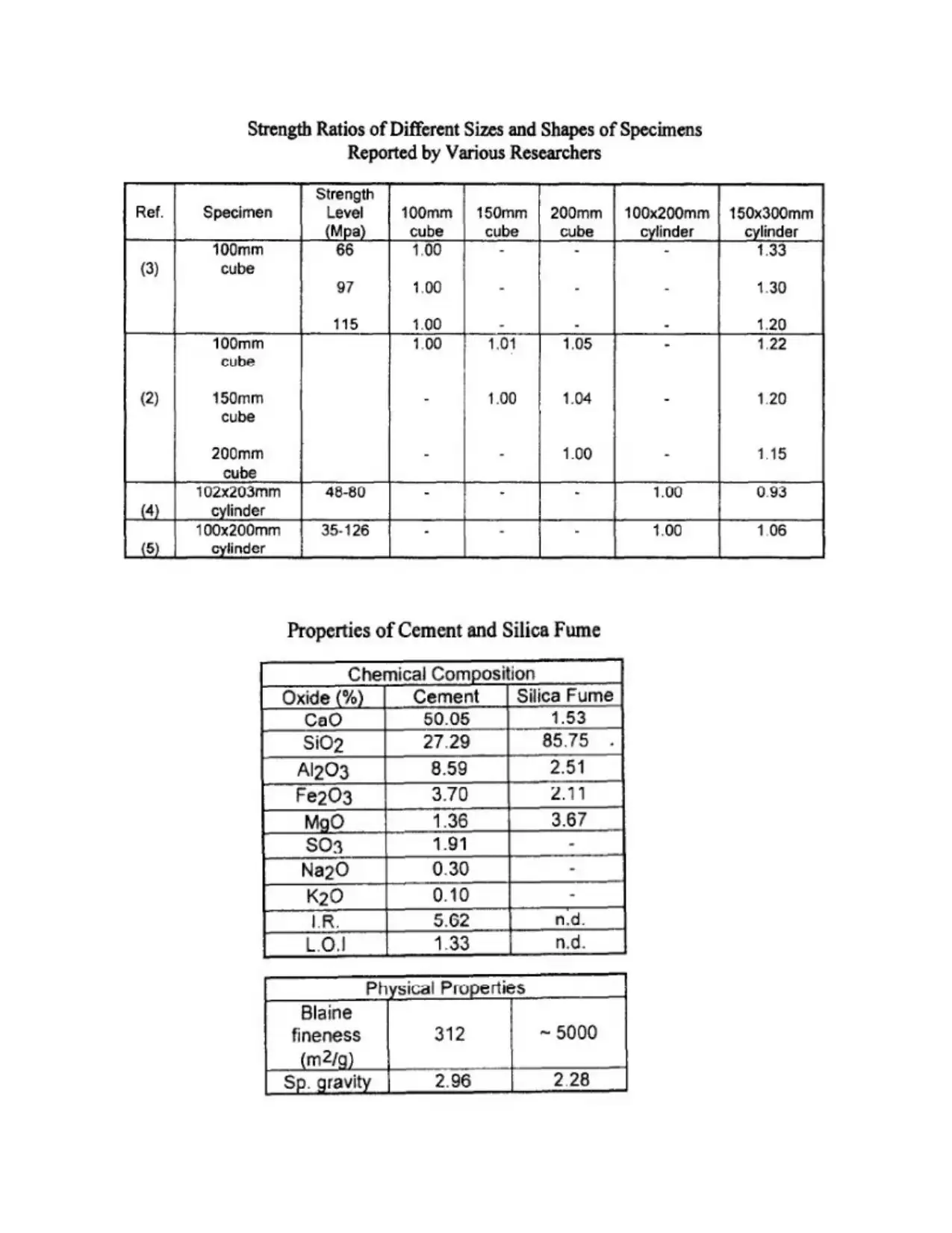
In order to investigate specific properties of cylindrical concrete, it has been understood
that there is need to ensure that there is a correction factor for cylinders that may have a length to
diameter ratio of less than 2. Nevertheless, in such a case, a correction factor is usually
dependent on the conditions under which the testing is done. In such regard one of the research
conducted focused on the flexural results of high strength concrete after 28 days. This was done
on concrete cylindrical specimens with flexural strengths of 40MPs, 60Mpa, and 75 Mpa
(Tokyay & Ozdemiry, 1997). In such regard, the properties of the materials used are as indicated
in the tables below.
Experimental analysis 1
It has come to be understood that the standard shapes of concrete cubes vary from one
region to another and from one country to another. This is the same case when it comes to sizes,
but the most common size when it comes to cylindrical specimen is 150mm while concrete cubes
usually have the 150mm length and 30mm breadth (Tokyay & Ozdemiry, 1997). However, the
major aspect that is of concern is the fact that there have been only few studies when it comes to
the investigation of size and shape strength of high strength concrete. It has been indicated that
concrete testing for standard strengths has been extensively investigated.
In order to investigate specific properties of cylindrical concrete, it has been understood
that there is need to ensure that there is a correction factor for cylinders that may have a length to
diameter ratio of less than 2. Nevertheless, in such a case, a correction factor is usually
dependent on the conditions under which the testing is done. In such regard one of the research
conducted focused on the flexural results of high strength concrete after 28 days. This was done
on concrete cylindrical specimens with flexural strengths of 40MPs, 60Mpa, and 75 Mpa
(Tokyay & Ozdemiry, 1997). In such regard, the properties of the materials used are as indicated
in the tables below.
⊘ This is a preview!⊘
Do you want full access?
Subscribe today to unlock all pages.
Trusted by 1+ million students worldwide
Paraphrase This Document
Need a fresh take? Get an instant paraphrase of this document with our AI Paraphraser
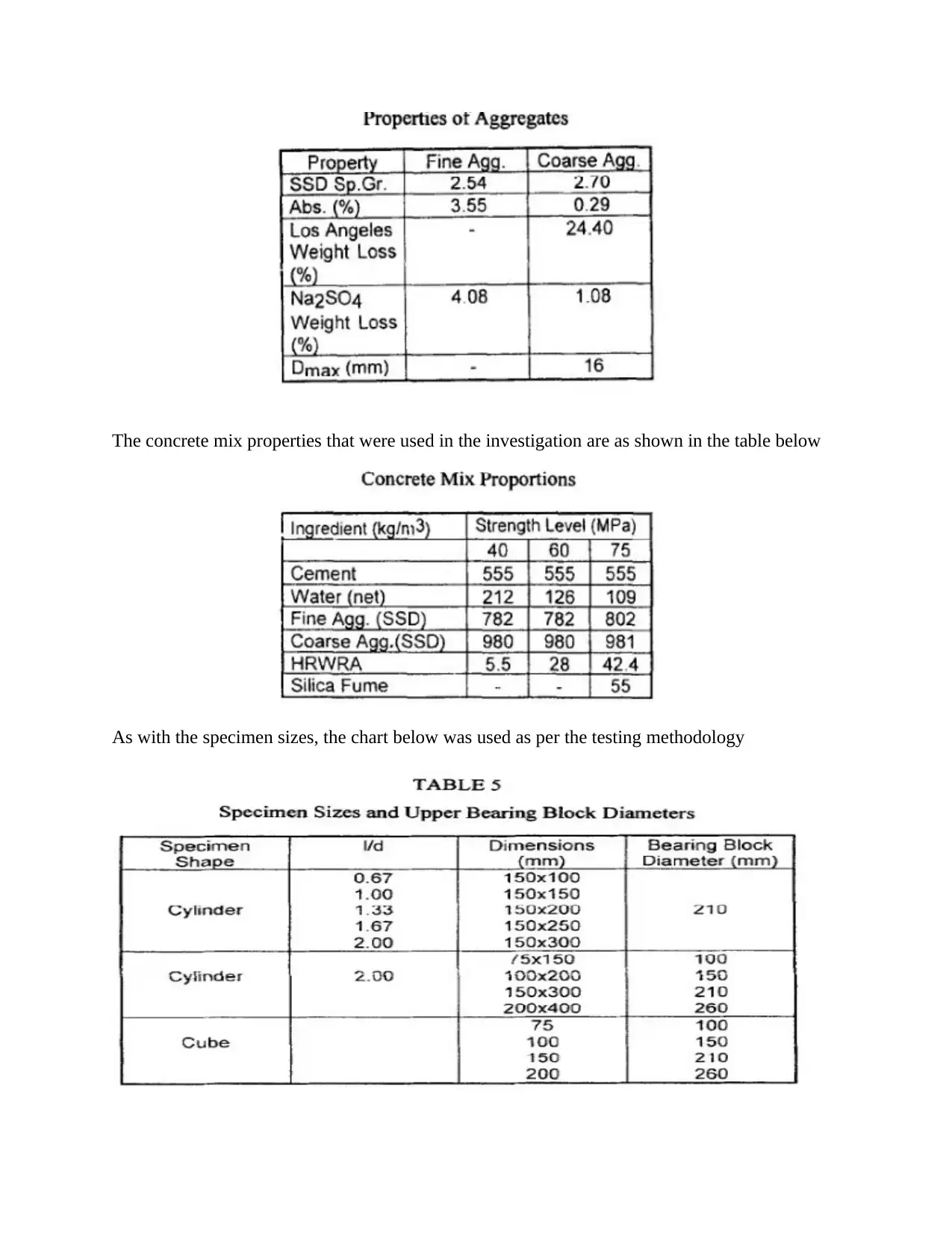
The concrete mix properties that were used in the investigation are as shown in the table below
As with the specimen sizes, the chart below was used as per the testing methodology
As with the specimen sizes, the chart below was used as per the testing methodology
The testing methodology, in this case, involved the use of testing machine was tonnage
capacity was 200. Moreover, the testing involved a uniform loading rate of 0.2Mpa/s. This was
done for all the specimens accustomed to ensure that there was uniformity in the result analysis
methodology. All this was following the testing procedure that has been outlined in ASTM C39-
86 (Tokyay & Ozdemiry, 1997). In that regard, the results indicated that the highest strengths
were obtained from cubical specimens that had the 100 by 200 mm size while cylindrical
specimens with a capacity of 150mm had the most upper power. A deviation from these sizes
showed that there was a decrease in strength. This was on both the larger specimens and the
smaller specimens. As it was indicated, the standard deviation was dependent on the strength
level with an increase in the latter increasing the former. As the results indicated, there was
consistency with previous literature which suggested that an increase in the volume of the
cement results to an increase in the level of stress. A larger capacity, as such, tends to have lower
strength. As with the case of the smaller, specimens, it was indicated that the decrease in strength
is mainly attributed to the ‘well effect (Tokyay & Ozdemiry, 1997). However, as the research
indicated, there was a change in the surface area to volume ratio with the change in the size of
the specimen.
Experimental Analysis 2
In another experimental work, the investigation mainly focused on the variable factors
which impact the conversion factor for high strength concrete. As such, the tests revolved around
concrete mix designs of different composition results. Nevertheless, ground granulated blast slag
was used in the experimental design. Various experimental designs were considered but what
may be more important in this analysis is the compressive results. In this regard, the compressive
analysis was done as per the specifications of each concrete specimen. This was based on the
capacity was 200. Moreover, the testing involved a uniform loading rate of 0.2Mpa/s. This was
done for all the specimens accustomed to ensure that there was uniformity in the result analysis
methodology. All this was following the testing procedure that has been outlined in ASTM C39-
86 (Tokyay & Ozdemiry, 1997). In that regard, the results indicated that the highest strengths
were obtained from cubical specimens that had the 100 by 200 mm size while cylindrical
specimens with a capacity of 150mm had the most upper power. A deviation from these sizes
showed that there was a decrease in strength. This was on both the larger specimens and the
smaller specimens. As it was indicated, the standard deviation was dependent on the strength
level with an increase in the latter increasing the former. As the results indicated, there was
consistency with previous literature which suggested that an increase in the volume of the
cement results to an increase in the level of stress. A larger capacity, as such, tends to have lower
strength. As with the case of the smaller, specimens, it was indicated that the decrease in strength
is mainly attributed to the ‘well effect (Tokyay & Ozdemiry, 1997). However, as the research
indicated, there was a change in the surface area to volume ratio with the change in the size of
the specimen.
Experimental Analysis 2
In another experimental work, the investigation mainly focused on the variable factors
which impact the conversion factor for high strength concrete. As such, the tests revolved around
concrete mix designs of different composition results. Nevertheless, ground granulated blast slag
was used in the experimental design. Various experimental designs were considered but what
may be more important in this analysis is the compressive results. In this regard, the compressive
analysis was done as per the specifications of each concrete specimen. This was based on the
⊘ This is a preview!⊘
Do you want full access?
Subscribe today to unlock all pages.
Trusted by 1+ million students worldwide
standards outlined by BS EN 12390-3:2009 (Zabihi, 2012). In this regard, the loading speed on
the specimen was adjusted as per the specimen dimensions, but the standard speed was
0.4Mpa/s. On the other hand, the loading was estimated as 0.6+0.2Mpa (Zabihi, 2012). In such a
regard, the compressive strength was plotted against the lateral surface of the cube. As per the
results, the lowest compressive strength was found out to occur in the sample with the highest
water to cement ratio. In this regard it may be indicated that the ratio of water to cement plays a
fundamental role in the overall compressive strength of the concrete samples. This is regardless
of the shape or size. However, in order to ensure uniformity, concrete of the same sizes was
measured against each other as per the changes in the water to cement ratio.
Experiment 3
The Third experiment of concern was centered on self-compacting concrete. The
comparison, results, however, also focuses on high strength concrete. In this regard, some of the
experimental studies that were done focused on the slump of normal concrete and high strength
self-compacting concrete. In this result, it was discovered that the slump results for the normal
concrete and the high strength concrete were indicated to be in the range of 90mm and 105 mm
(Abd & Habeeb, 2014). This was regardless of the mix design. On the other hand, the slump
flow experimental result indicated that the value for the high strength concrete and the self-
compacting concrete was between 695 and 705 mm.
Looking at the compression results for the concrete samples, it was discovered that one of
the factors to take into consideration was the ratio of the strength of the cylinder to the strength
of the cube. In this regard, the cube strength was discovered to be higher than the strength of the
cylinder. In such regard, the main contributing factor to the difference in the strength of the
the specimen was adjusted as per the specimen dimensions, but the standard speed was
0.4Mpa/s. On the other hand, the loading was estimated as 0.6+0.2Mpa (Zabihi, 2012). In such a
regard, the compressive strength was plotted against the lateral surface of the cube. As per the
results, the lowest compressive strength was found out to occur in the sample with the highest
water to cement ratio. In this regard it may be indicated that the ratio of water to cement plays a
fundamental role in the overall compressive strength of the concrete samples. This is regardless
of the shape or size. However, in order to ensure uniformity, concrete of the same sizes was
measured against each other as per the changes in the water to cement ratio.
Experiment 3
The Third experiment of concern was centered on self-compacting concrete. The
comparison, results, however, also focuses on high strength concrete. In this regard, some of the
experimental studies that were done focused on the slump of normal concrete and high strength
self-compacting concrete. In this result, it was discovered that the slump results for the normal
concrete and the high strength concrete were indicated to be in the range of 90mm and 105 mm
(Abd & Habeeb, 2014). This was regardless of the mix design. On the other hand, the slump
flow experimental result indicated that the value for the high strength concrete and the self-
compacting concrete was between 695 and 705 mm.
Looking at the compression results for the concrete samples, it was discovered that one of
the factors to take into consideration was the ratio of the strength of the cylinder to the strength
of the cube. In this regard, the cube strength was discovered to be higher than the strength of the
cylinder. In such regard, the main contributing factor to the difference in the strength of the
Paraphrase This Document
Need a fresh take? Get an instant paraphrase of this document with our AI Paraphraser
specimen was indicated as the frictional loading. In this regard, the main take away was the
analysis that showed that a decrease in the space of the specimen increased the compressive
strength. Another factor that was taken into consideration was the effect of the Colum height on
the compressive strength of the concrete. However, change in strength was discovered to be
negligible when there was a change in vita (Abd & Habeeb, 2014)l. It was also discovered that
sizes which may be smaller as compared to the standard shape tend to have a higher compressive
strength than the specimens which may be larger than the standard specimen. Finally,
considering that the study was aimed at understanding the change in properties of self-
compacting concrete with the change in specimen shape, it was discovered that any shape that
may focus on the self compacting concrete tends to have better and desirable properties.
Key Research Gaps
The major research gap identified in the study is the lack of a conclusive indication of the
change in properties due to the change in the size and shape of the specimen. According to the
study, the properties that have been identified include the compressive strength, the workability,
and the slump flow (Abd & Habeeb, 2014). In this regard, it may be considered that the inherent
characteristics that have led to these differences have not be fully explored. This may pose a
great challenge in identifying other properties of cement and concrete that may be affected by the
change in shape and size.
Scope of the research
The main objective of the research is to identify the change in cement properties due to
the change in shape and size. As has been indicated in the literature review, there is a change in
the properties of cement due to the change in the shape and size of the specimens. The standard
analysis that showed that a decrease in the space of the specimen increased the compressive
strength. Another factor that was taken into consideration was the effect of the Colum height on
the compressive strength of the concrete. However, change in strength was discovered to be
negligible when there was a change in vita (Abd & Habeeb, 2014)l. It was also discovered that
sizes which may be smaller as compared to the standard shape tend to have a higher compressive
strength than the specimens which may be larger than the standard specimen. Finally,
considering that the study was aimed at understanding the change in properties of self-
compacting concrete with the change in specimen shape, it was discovered that any shape that
may focus on the self compacting concrete tends to have better and desirable properties.
Key Research Gaps
The major research gap identified in the study is the lack of a conclusive indication of the
change in properties due to the change in the size and shape of the specimen. According to the
study, the properties that have been identified include the compressive strength, the workability,
and the slump flow (Abd & Habeeb, 2014). In this regard, it may be considered that the inherent
characteristics that have led to these differences have not be fully explored. This may pose a
great challenge in identifying other properties of cement and concrete that may be affected by the
change in shape and size.
Scope of the research
The main objective of the research is to identify the change in cement properties due to
the change in shape and size. As has been indicated in the literature review, there is a change in
the properties of cement due to the change in the shape and size of the specimens. The standard
size of the specimens, as has been indicated from the research, maintains the highest strength
regardless of the shape. In such regard, it has been indicated any deviation from the standard
specimen results to a change in the strength of the cement. Furthermore, it has been indicated
that the specimens that are of a smaller size tend to have greater strength as compared to
specimens that may be bigger (Abd & Habeeb, 2014). Regardless, their structural strength is
smaller compared to the standard specimen. The reduction in strength for the larger specimen has
mainly been attributed to the increase in the surface area. This increases the stress levels within
such molds \. On the other hand, it has been discovered that the smaller specimens tend to have
less strength as compared to the standard specimen due to the well effect. In this regard, the main
objective is to identify how such factors tend to affect the strength of the concrete
As per the study, it has also been indicated that self-compacting concrete tends to be
adaptive of the different shapes and sizes of the concrete. On this note, research has indicated
that self-compacting concrete does not present any variance regardless of the shape and the size
(Abd & Habeeb, 2014). This presents an intriguing point of view on the change in properties
when the shape and size of the concrete are altered. This, as such, forms another objective of the
research, it is aimed at improving an understanding of the concepts surrounding the various
changes in shape and size and their overall impact on the various types of cement. The high
strength cement, normal cement, and the self-compacting concrete, as such, are essential in the
study.
Flow chart of the research
In order to fully understand the impact of shape and size on the properties of cement, the
first step in the analysis is the use of various sources of literature on the topic. There are several
regardless of the shape. In such regard, it has been indicated any deviation from the standard
specimen results to a change in the strength of the cement. Furthermore, it has been indicated
that the specimens that are of a smaller size tend to have greater strength as compared to
specimens that may be bigger (Abd & Habeeb, 2014). Regardless, their structural strength is
smaller compared to the standard specimen. The reduction in strength for the larger specimen has
mainly been attributed to the increase in the surface area. This increases the stress levels within
such molds \. On the other hand, it has been discovered that the smaller specimens tend to have
less strength as compared to the standard specimen due to the well effect. In this regard, the main
objective is to identify how such factors tend to affect the strength of the concrete
As per the study, it has also been indicated that self-compacting concrete tends to be
adaptive of the different shapes and sizes of the concrete. On this note, research has indicated
that self-compacting concrete does not present any variance regardless of the shape and the size
(Abd & Habeeb, 2014). This presents an intriguing point of view on the change in properties
when the shape and size of the concrete are altered. This, as such, forms another objective of the
research, it is aimed at improving an understanding of the concepts surrounding the various
changes in shape and size and their overall impact on the various types of cement. The high
strength cement, normal cement, and the self-compacting concrete, as such, are essential in the
study.
Flow chart of the research
In order to fully understand the impact of shape and size on the properties of cement, the
first step in the analysis is the use of various sources of literature on the topic. There are several
⊘ This is a preview!⊘
Do you want full access?
Subscribe today to unlock all pages.
Trusted by 1+ million students worldwide

1 out of 16


Related Documents


Your All-in-One AI-Powered Toolkit for Academic Success.
+13062052269
info@desklib.com
Available 24*7 on WhatsApp / Email
![[object Object]](/_next/static/media/star-bottom.7253800d.svg)
Unlock your academic potential
Copyright © 2020–2026 A2Z Services. All Rights Reserved. Developed and managed by ZUCOL.