Causes and Computational Analysis of Perovskite Solar Cell Degradation
VerifiedAdded on 2022/11/14
|8
|3053
|360
Report
AI Summary
This report delves into the degradation mechanisms of perovskite solar cells, a promising photovoltaic technology. It investigates the factors contributing to the instability of these cells, distinguishing between alien and intrinsic causes. The report examines the application of computational design to analyze and potentially mitigate degradation, focusing on the complex nanostructure of perovskite solar cells. It explores the causes of degradation, including ion migration and the de-stoning of organic cations, and reviews the methodology of the research, including the use of computational methods to understand the functional element of digital framework and load transport characteristics of 2D peravskites. The report also includes a case study examining the computational design of two-dimensional perovskites. The report concludes by highlighting the challenges and potential solutions for enhancing the stability and durability of perovskite solar cells, suggesting avenues for future research, including the use of solar concentrators. The document is contributed by a student to be published on the website Desklib. Desklib is a platform which provides all the necessary AI based study tools for students.
Computational Design Degraded
Perovskite Solar Cell
Student name
course
Email
Abstract
There are various aspects to be considered in
defining degradation of perovskite solar cell.
This paper will discuss the factors which causes
solar cell degradation. Computational design is
the analytical technique of viewing the cell and
using the analysis to see the outcomes like how
to make it more efficient or how to remove the
degradation in this technology. Bio magnetic
perovskite solar photovoltaic cells have shown
an efficiency of power conversion comparable
with known photovoltaic innovations, but low
operating stability inhibits their marketing and
pervasive use. There are many possible
degradation pathways, most of them being
poorly defined on the nanoscale, because of the
complexity in characterizing the complex
nanostructure of a perovskite solar cell. The
study examines the application of on-site and
operating electron microscopy to visualize
dynamic processes occurring in perovskite solar
cells as a microscope column contains various
stimuli.
1.0 Introduction
The first step to enhancing the stabilization of
the perovskite cells is to understand the actual
cause. Much can lead to degradation of
perovskite crystal, and such aspects can be split
in two different categories, alien and intrinsic.
The following are both discussed. Since the next
generation of PSCs attract a lot of attention.
Despite their relatively short development
period, this is because of their efficiency with
which they convert power, in relation to its low
cost. A range of halide perovskites with ABX3
stoichiometry that are used as photo absorbers
are essential components of PSCs. Due to their
remarkable optoelectronic characteristics,
photovoltaic technology has made progress.
However, these materials must be further
enhanced to improve their functionality and be
highly efficient and stable for commercialization
for the coming generations. Solar cells, devised
in the 1960's, are without a doubt most efficient
instruments for the collection of solar energy.
Solar cells directly use the photovoltaic (PV)
effect to turn solar light. Several solar cell types
have been developed so far and placed on the
market; the market share for single-crystalline
pc-Si was 69.5% by 2015, for polycrystalline
pc-Si 23.9% and for thin-film pc-CdTe solar pc-
Si 6.6% by 2015[3]. Indeed, power
transformation (PME), manufacturing cost and
device stability are the most important factors
deciding the competence of solar cells on the
market (Doityourself.com, 2019).
The research questions will help in formulating
the area to be researched. These questions have
been highlighted below.
RQ1: What are the causes that result in
degradation of Perovskite Solar Cell?
RQ2: what exactly is perovskite solar cell
RQ3: what are computation methods that can be
used to analyze Perovskite Solar Cell
Perovskite Solar Cell
Student name
course
Abstract
There are various aspects to be considered in
defining degradation of perovskite solar cell.
This paper will discuss the factors which causes
solar cell degradation. Computational design is
the analytical technique of viewing the cell and
using the analysis to see the outcomes like how
to make it more efficient or how to remove the
degradation in this technology. Bio magnetic
perovskite solar photovoltaic cells have shown
an efficiency of power conversion comparable
with known photovoltaic innovations, but low
operating stability inhibits their marketing and
pervasive use. There are many possible
degradation pathways, most of them being
poorly defined on the nanoscale, because of the
complexity in characterizing the complex
nanostructure of a perovskite solar cell. The
study examines the application of on-site and
operating electron microscopy to visualize
dynamic processes occurring in perovskite solar
cells as a microscope column contains various
stimuli.
1.0 Introduction
The first step to enhancing the stabilization of
the perovskite cells is to understand the actual
cause. Much can lead to degradation of
perovskite crystal, and such aspects can be split
in two different categories, alien and intrinsic.
The following are both discussed. Since the next
generation of PSCs attract a lot of attention.
Despite their relatively short development
period, this is because of their efficiency with
which they convert power, in relation to its low
cost. A range of halide perovskites with ABX3
stoichiometry that are used as photo absorbers
are essential components of PSCs. Due to their
remarkable optoelectronic characteristics,
photovoltaic technology has made progress.
However, these materials must be further
enhanced to improve their functionality and be
highly efficient and stable for commercialization
for the coming generations. Solar cells, devised
in the 1960's, are without a doubt most efficient
instruments for the collection of solar energy.
Solar cells directly use the photovoltaic (PV)
effect to turn solar light. Several solar cell types
have been developed so far and placed on the
market; the market share for single-crystalline
pc-Si was 69.5% by 2015, for polycrystalline
pc-Si 23.9% and for thin-film pc-CdTe solar pc-
Si 6.6% by 2015[3]. Indeed, power
transformation (PME), manufacturing cost and
device stability are the most important factors
deciding the competence of solar cells on the
market (Doityourself.com, 2019).
The research questions will help in formulating
the area to be researched. These questions have
been highlighted below.
RQ1: What are the causes that result in
degradation of Perovskite Solar Cell?
RQ2: what exactly is perovskite solar cell
RQ3: what are computation methods that can be
used to analyze Perovskite Solar Cell

Paraphrase This Document
Need a fresh take? Get an instant paraphrase of this document with our AI Paraphraser
2.0 Literature review
The fast rise in effectiveness of many Solar Cell
scientists has become a warm place for the
studies of hybrid organic inorganic metal halides
perovskite solar batteries (PSCs) over the last
few years. The use of perovskite components in
solar panels has progressed quickly due to the
outstanding heat consumption, load carrier
mobility, and service life of the material, which
have resulted in the efficiency of the unit,
offering important possibilities for low cost
industrial scalability. This low price and
scalability potential involve overcoming
obstacles to stabilization and compatibility with
the environment. However, a perovskite-based
technique offers transformative opportunities for
fast terawatt solar implementation, if these
issues are resolved. The perovskite fabrics
demonstrate different benefits, such as lengthy
propagation distances, a widely tunable belt gap
with a large capacity for light consumption. The
cheap manufacturing methods and elevated
effectiveness make PSCs similar to Si-based
solar cells. However, disadvantages such as
system instability, JV hysteresis, and toxicity
decrease further development and potential
marketing of PSCs.
This evaluation starts on the basis of latest study
results with regard to the crystal and electronic
structure of perovskite. More information on
every part, system buildings, significant
production techniques of devices and the
efficiency of the PSCs obtained using each
technique is used to analyze the development of
PSCs. The following section of this analysis
discusses significant obstacles to the marketing
of PSCs. The impact on the stability of PSCs of
the crystal structure, manufacturing temperature,
humidity, oxygen and UV are discussed. There
is also discussion of the stabilization of other
elements in the PSCs (Hallam et al., 2017).
The meaning of the first term "perovskite"
related to the microstructure of calcium titanate
uncovered by the German mineralogist Gustav
Rose in 1839 on which it was named after Lev
Perovski of Russian mineralogy. Ever since, all
elements of the same crystal composition as
calcium titanate have been referred to as
perovskites. The general formula of ABX3 is the
perovskite light absorption layer where A is
organically cated (eg, CH3NH3 +
methylammonium), B is metallic (e.g., Pb2 +),
and X is halide anion.
The fast rise in effectiveness of many Solar Cell
scientists has become a warm place for the
studies of hybrid organic inorganic metal halides
perovskite solar batteries (PSCs) over the last
few years. The use of perovskite components in
solar panels has progressed quickly due to the
outstanding heat consumption, load carrier
mobility, and service life of the material, which
have resulted in the efficiency of the unit,
offering important possibilities for low cost
industrial scalability. This low price and
scalability potential involve overcoming
obstacles to stabilization and compatibility with
the environment. However, a perovskite-based
technique offers transformative opportunities for
fast terawatt solar implementation, if these
issues are resolved. The perovskite fabrics
demonstrate different benefits, such as lengthy
propagation distances, a widely tunable belt gap
with a large capacity for light consumption. The
cheap manufacturing methods and elevated
effectiveness make PSCs similar to Si-based
solar cells. However, disadvantages such as
system instability, JV hysteresis, and toxicity
decrease further development and potential
marketing of PSCs.
This evaluation starts on the basis of latest study
results with regard to the crystal and electronic
structure of perovskite. More information on
every part, system buildings, significant
production techniques of devices and the
efficiency of the PSCs obtained using each
technique is used to analyze the development of
PSCs. The following section of this analysis
discusses significant obstacles to the marketing
of PSCs. The impact on the stability of PSCs of
the crystal structure, manufacturing temperature,
humidity, oxygen and UV are discussed. There
is also discussion of the stabilization of other
elements in the PSCs (Hallam et al., 2017).
The meaning of the first term "perovskite"
related to the microstructure of calcium titanate
uncovered by the German mineralogist Gustav
Rose in 1839 on which it was named after Lev
Perovski of Russian mineralogy. Ever since, all
elements of the same crystal composition as
calcium titanate have been referred to as
perovskites. The general formula of ABX3 is the
perovskite light absorption layer where A is
organically cated (eg, CH3NH3 +
methylammonium), B is metallic (e.g., Pb2 +),
and X is halide anion.
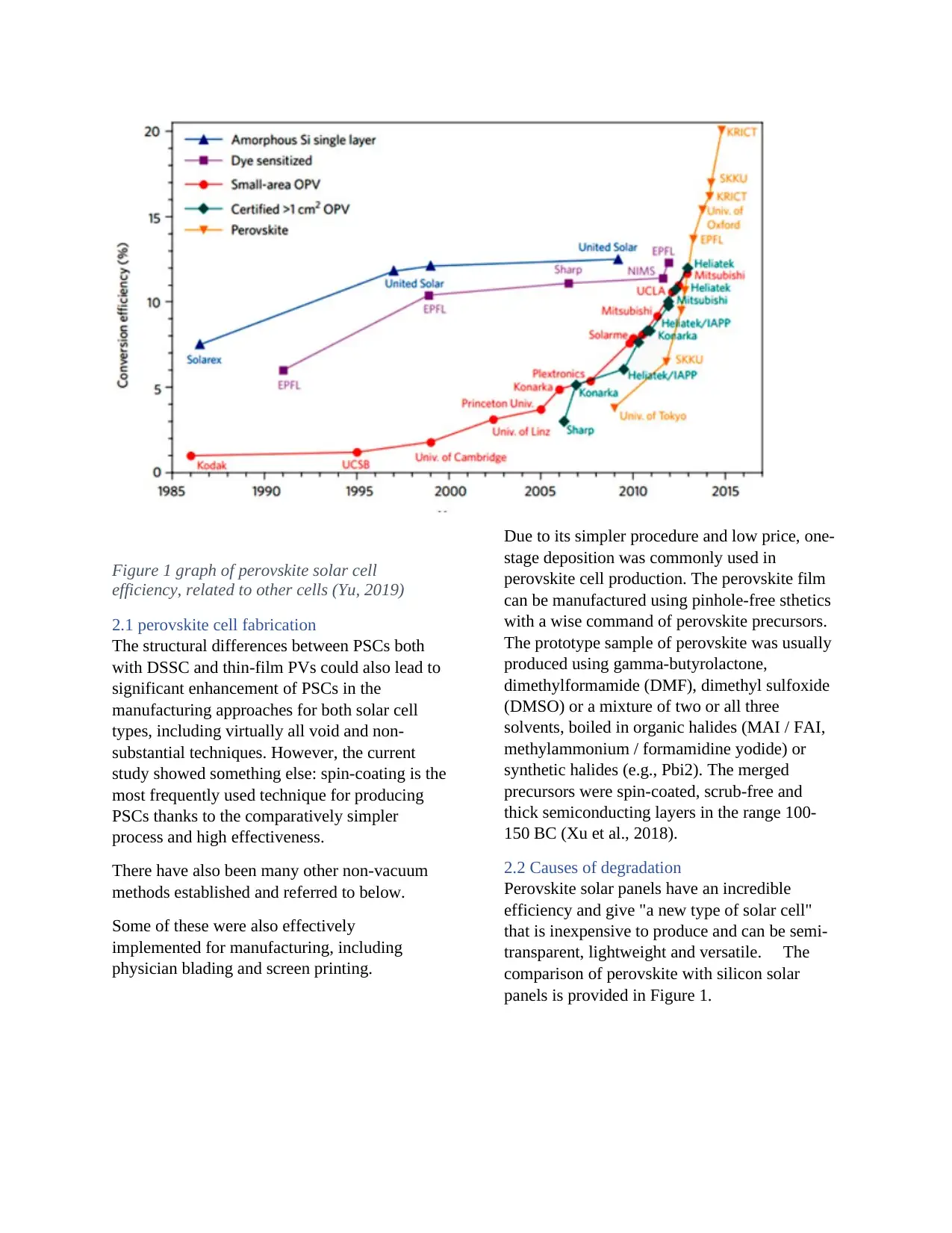
Figure 1 graph of perovskite solar cell
efficiency, related to other cells (Yu, 2019)
2.1 perovskite cell fabrication
The structural differences between PSCs both
with DSSC and thin-film PVs could also lead to
significant enhancement of PSCs in the
manufacturing approaches for both solar cell
types, including virtually all void and non-
substantial techniques. However, the current
study showed something else: spin-coating is the
most frequently used technique for producing
PSCs thanks to the comparatively simpler
process and high effectiveness.
There have also been many other non-vacuum
methods established and referred to below.
Some of these were also effectively
implemented for manufacturing, including
physician blading and screen printing.
Due to its simpler procedure and low price, one-
stage deposition was commonly used in
perovskite cell production. The perovskite film
can be manufactured using pinhole-free sthetics
with a wise command of perovskite precursors.
The prototype sample of perovskite was usually
produced using gamma-butyrolactone,
dimethylformamide (DMF), dimethyl sulfoxide
(DMSO) or a mixture of two or all three
solvents, boiled in organic halides (MAI / FAI,
methylammonium / formamidine yodide) or
synthetic halides (e.g., Pbi2). The merged
precursors were spin-coated, scrub-free and
thick semiconducting layers in the range 100-
150 BC (Xu et al., 2018).
2.2 Causes of degradation
Perovskite solar panels have an incredible
efficiency and give "a new type of solar cell"
that is inexpensive to produce and can be semi-
transparent, lightweight and versatile. ⠀ The
comparison of perovskite with silicon solar
panels is provided in Figure 1.
efficiency, related to other cells (Yu, 2019)
2.1 perovskite cell fabrication
The structural differences between PSCs both
with DSSC and thin-film PVs could also lead to
significant enhancement of PSCs in the
manufacturing approaches for both solar cell
types, including virtually all void and non-
substantial techniques. However, the current
study showed something else: spin-coating is the
most frequently used technique for producing
PSCs thanks to the comparatively simpler
process and high effectiveness.
There have also been many other non-vacuum
methods established and referred to below.
Some of these were also effectively
implemented for manufacturing, including
physician blading and screen printing.
Due to its simpler procedure and low price, one-
stage deposition was commonly used in
perovskite cell production. The perovskite film
can be manufactured using pinhole-free sthetics
with a wise command of perovskite precursors.
The prototype sample of perovskite was usually
produced using gamma-butyrolactone,
dimethylformamide (DMF), dimethyl sulfoxide
(DMSO) or a mixture of two or all three
solvents, boiled in organic halides (MAI / FAI,
methylammonium / formamidine yodide) or
synthetic halides (e.g., Pbi2). The merged
precursors were spin-coated, scrub-free and
thick semiconducting layers in the range 100-
150 BC (Xu et al., 2018).
2.2 Causes of degradation
Perovskite solar panels have an incredible
efficiency and give "a new type of solar cell"
that is inexpensive to produce and can be semi-
transparent, lightweight and versatile. ⠀ The
comparison of perovskite with silicon solar
panels is provided in Figure 1.
⊘ This is a preview!⊘
Do you want full access?
Subscribe today to unlock all pages.

Trusted by 1+ million students worldwide
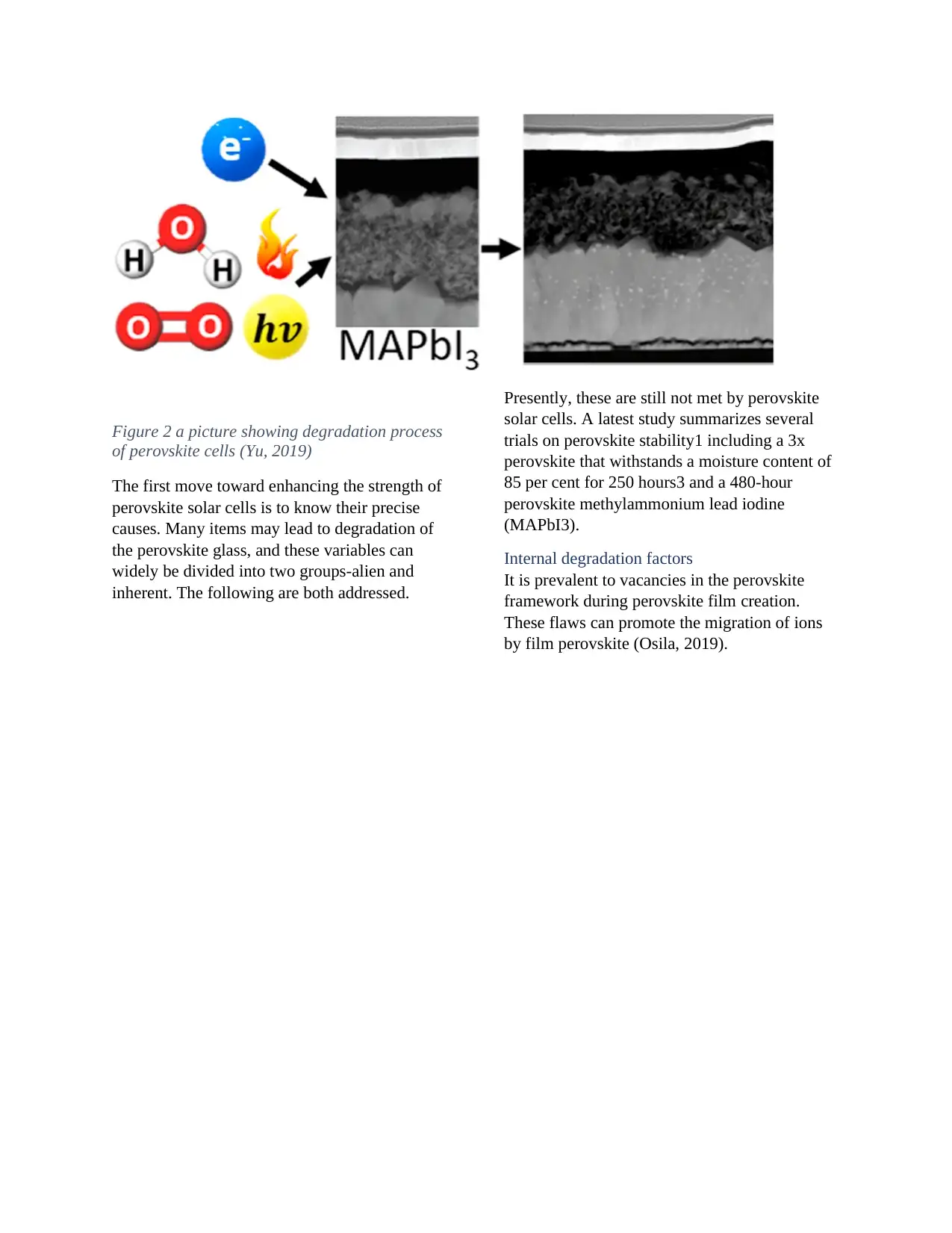
Figure 2 a picture showing degradation process
of perovskite cells (Yu, 2019)
The first move toward enhancing the strength of
perovskite solar cells is to know their precise
causes. Many items may lead to degradation of
the perovskite glass, and these variables can
widely be divided into two groups-alien and
inherent. The following are both addressed.
Presently, these are still not met by perovskite
solar cells. A latest study summarizes several
trials on perovskite stability1 including a 3x
perovskite that withstands a moisture content of
85 per cent for 250 hours3 and a 480-hour
perovskite methylammonium lead iodine
(MAPbI3).
Internal degradation factors
It is prevalent to vacancies in the perovskite
framework during perovskite film creation.
These flaws can promote the migration of ions
by film perovskite (Osila, 2019).
of perovskite cells (Yu, 2019)
The first move toward enhancing the strength of
perovskite solar cells is to know their precise
causes. Many items may lead to degradation of
the perovskite glass, and these variables can
widely be divided into two groups-alien and
inherent. The following are both addressed.
Presently, these are still not met by perovskite
solar cells. A latest study summarizes several
trials on perovskite stability1 including a 3x
perovskite that withstands a moisture content of
85 per cent for 250 hours3 and a 480-hour
perovskite methylammonium lead iodine
(MAPbI3).
Internal degradation factors
It is prevalent to vacancies in the perovskite
framework during perovskite film creation.
These flaws can promote the migration of ions
by film perovskite (Osila, 2019).
Paraphrase This Document
Need a fresh take? Get an instant paraphrase of this document with our AI Paraphraser
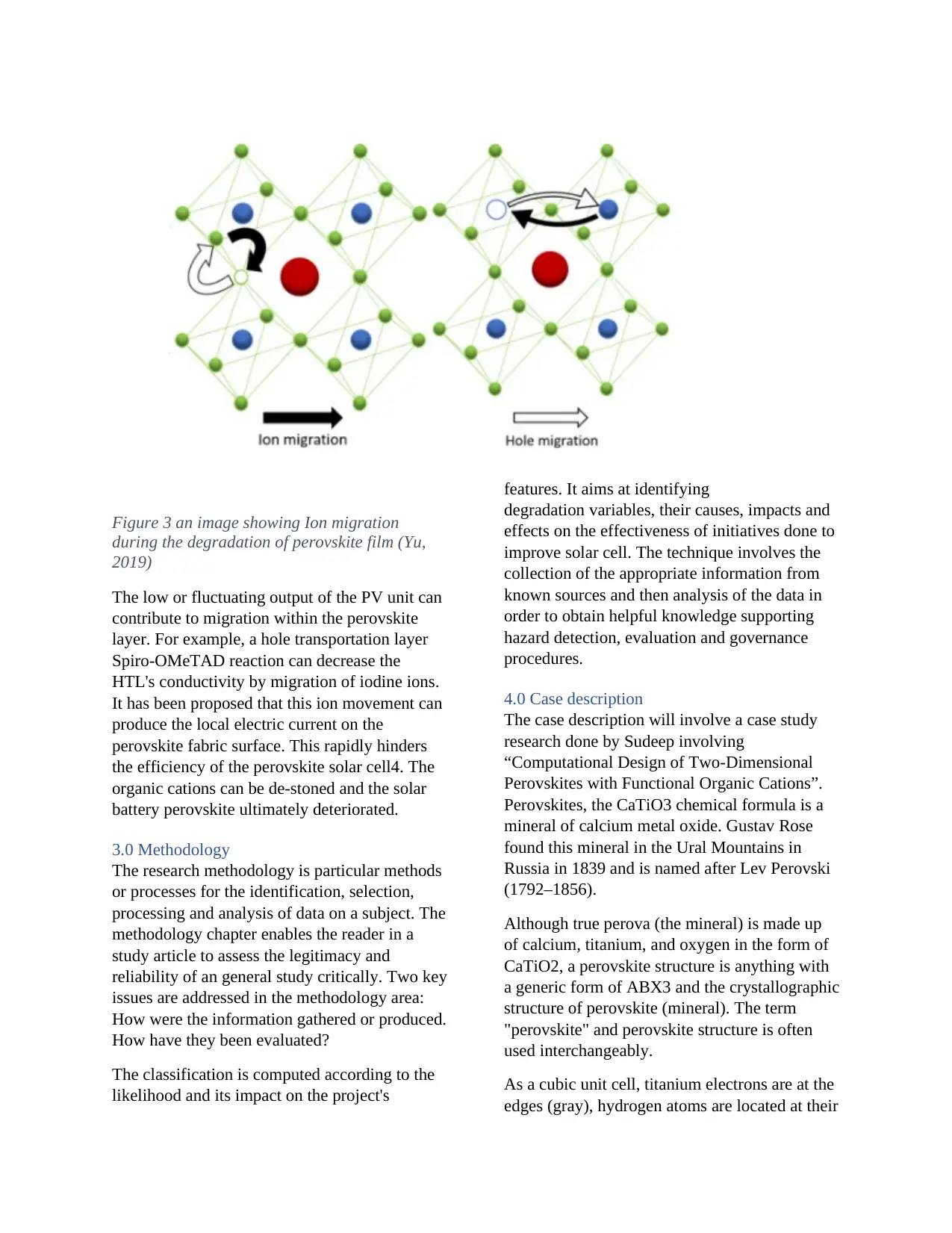
Figure 3 an image showing Ion migration
during the degradation of perovskite film (Yu,
2019)
The low or fluctuating output of the PV unit can
contribute to migration within the perovskite
layer. For example, a hole transportation layer
Spiro-OMeTAD reaction can decrease the
HTL's conductivity by migration of iodine ions.
It has been proposed that this ion movement can
produce the local electric current on the
perovskite fabric surface. This rapidly hinders
the efficiency of the perovskite solar cell4. The
organic cations can be de-stoned and the solar
battery perovskite ultimately deteriorated.
3.0 Methodology
The research methodology is particular methods
or processes for the identification, selection,
processing and analysis of data on a subject. The
methodology chapter enables the reader in a
study article to assess the legitimacy and
reliability of an general study critically. Two key
issues are addressed in the methodology area:
How were the information gathered or produced.
How have they been evaluated?
The classification is computed according to the
likelihood and its impact on the project's
features. It aims at identifying
degradation variables, their causes, impacts and
effects on the effectiveness of initiatives done to
improve solar cell. The technique involves the
collection of the appropriate information from
known sources and then analysis of the data in
order to obtain helpful knowledge supporting
hazard detection, evaluation and governance
procedures.
4.0 Case description
The case description will involve a case study
research done by Sudeep involving
“Computational Design of Two-Dimensional
Perovskites with Functional Organic Cations”.
Perovskites, the CaTiO3 chemical formula is a
mineral of calcium metal oxide. Gustav Rose
found this mineral in the Ural Mountains in
Russia in 1839 and is named after Lev Perovski
(1792–1856).
Although true perova (the mineral) is made up
of calcium, titanium, and oxygen in the form of
CaTiO2, a perovskite structure is anything with
a generic form of ABX3 and the crystallographic
structure of perovskite (mineral). The term
"perovskite" and perovskite structure is often
used interchangeably.
As a cubic unit cell, titanium electrons are at the
edges (gray), hydrogen atoms are located at their
during the degradation of perovskite film (Yu,
2019)
The low or fluctuating output of the PV unit can
contribute to migration within the perovskite
layer. For example, a hole transportation layer
Spiro-OMeTAD reaction can decrease the
HTL's conductivity by migration of iodine ions.
It has been proposed that this ion movement can
produce the local electric current on the
perovskite fabric surface. This rapidly hinders
the efficiency of the perovskite solar cell4. The
organic cations can be de-stoned and the solar
battery perovskite ultimately deteriorated.
3.0 Methodology
The research methodology is particular methods
or processes for the identification, selection,
processing and analysis of data on a subject. The
methodology chapter enables the reader in a
study article to assess the legitimacy and
reliability of an general study critically. Two key
issues are addressed in the methodology area:
How were the information gathered or produced.
How have they been evaluated?
The classification is computed according to the
likelihood and its impact on the project's
features. It aims at identifying
degradation variables, their causes, impacts and
effects on the effectiveness of initiatives done to
improve solar cell. The technique involves the
collection of the appropriate information from
known sources and then analysis of the data in
order to obtain helpful knowledge supporting
hazard detection, evaluation and governance
procedures.
4.0 Case description
The case description will involve a case study
research done by Sudeep involving
“Computational Design of Two-Dimensional
Perovskites with Functional Organic Cations”.
Perovskites, the CaTiO3 chemical formula is a
mineral of calcium metal oxide. Gustav Rose
found this mineral in the Ural Mountains in
Russia in 1839 and is named after Lev Perovski
(1792–1856).
Although true perova (the mineral) is made up
of calcium, titanium, and oxygen in the form of
CaTiO2, a perovskite structure is anything with
a generic form of ABX3 and the crystallographic
structure of perovskite (mineral). The term
"perovskite" and perovskite structure is often
used interchangeably.
As a cubic unit cell, titanium electrons are at the
edges (gray), hydrogen atoms are located at their
centers, a simple way to define a pervskite
framework.
4.1 Computational methods
In this case study, they have examined the
functional element of digital framework and
load transport characteristics of 2D peravskites
where the biological cation includes 2.7-
dibutylammonium [ 1]benzothienon [ 3,2-b]-
[1]benzothiophen (BTBT), N, N-bis(N-
butylammonium)-perylene-3,4,9,10-
tetracarboxylic diimide (PDI) (Maheshwari et
al., 2018).
The optimization of the structure of the X−PbI4
was done using the projector enhanced wave
pseudopotentials, and the
Perdew−Burke−Ernzerhof−sol correlation was
corrected using the VASP 5.4.1.25−30 Relativist
effects were fully included for each atom in the
core electrons and the scalar relativistic
estimation was applied to the valence electrons.
The computations were carried out using an
electrical cut-off of 500 eV and a gamma-
centered Brillouin area sampling array of 4 to 4
para 2.
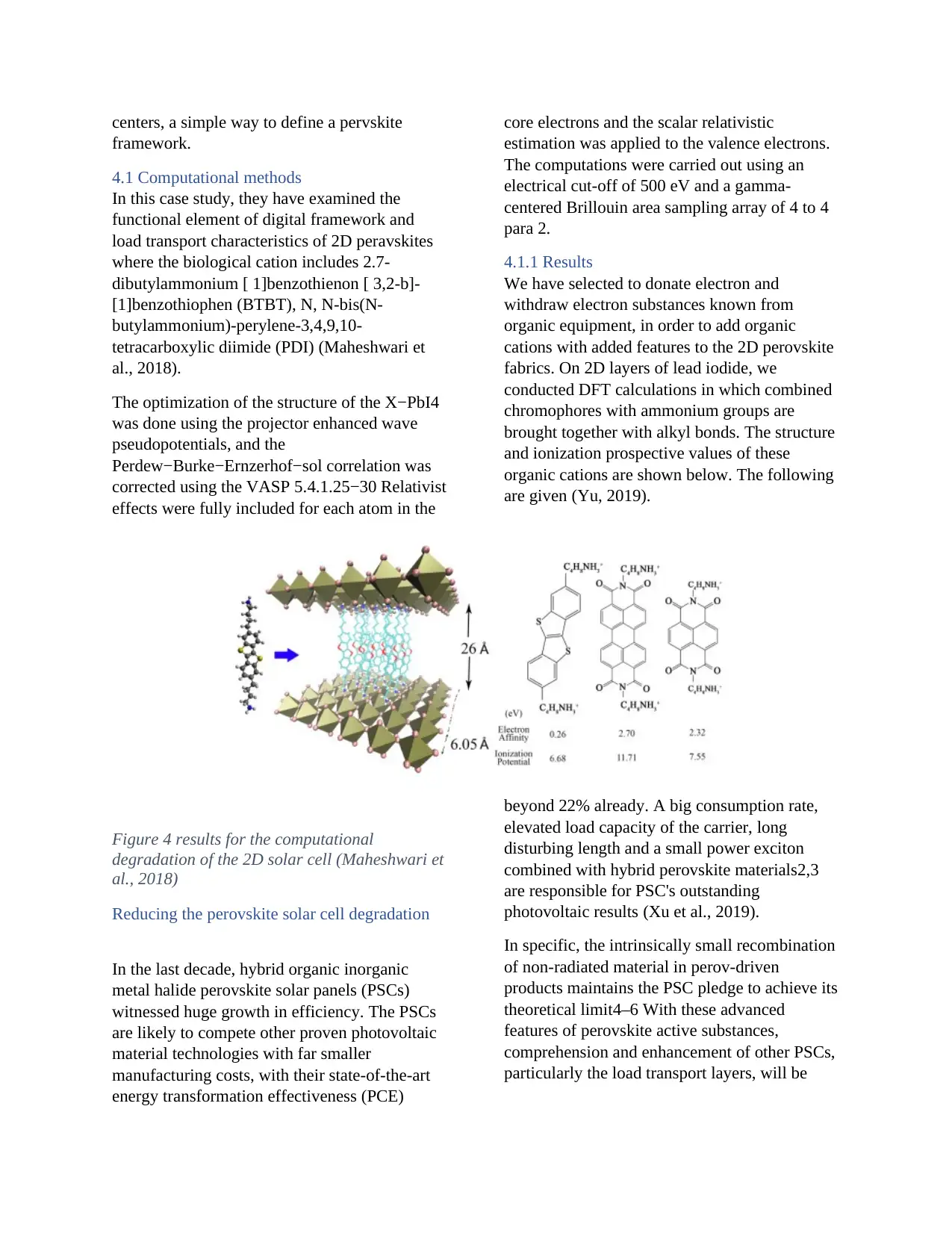
4.1.1 Results
We have selected to donate electron and
withdraw electron substances known from
organic equipment, in order to add organic
cations with added features to the 2D perovskite
fabrics. On 2D layers of lead iodide, we
conducted DFT calculations in which combined
chromophores with ammonium groups are
brought together with alkyl bonds. The structure
and ionization prospective values of these
organic cations are shown below. The following
are given (Yu, 2019).
Figure 4 results for the computational
degradation of the 2D solar cell (Maheshwari et
al., 2018)
Reducing the perovskite solar cell degradation
In the last decade, hybrid organic inorganic
metal halide perovskite solar panels (PSCs)
witnessed huge growth in efficiency. The PSCs
are likely to compete other proven photovoltaic
material technologies with far smaller
manufacturing costs, with their state-of-the-art
energy transformation effectiveness (PCE)
beyond 22% already. A big consumption rate,
elevated load capacity of the carrier, long
disturbing length and a small power exciton
combined with hybrid perovskite materials2,3
are responsible for PSC's outstanding
photovoltaic results (Xu et al., 2019).
In specific, the intrinsically small recombination
of non-radiated material in perov-driven
products maintains the PSC pledge to achieve its
theoretical limit4–6 With these advanced
features of perovskite active substances,
comprehension and enhancement of other PSCs,
particularly the load transport layers, will be
framework.
4.1 Computational methods
In this case study, they have examined the
functional element of digital framework and
load transport characteristics of 2D peravskites
where the biological cation includes 2.7-
dibutylammonium [ 1]benzothienon [ 3,2-b]-
[1]benzothiophen (BTBT), N, N-bis(N-
butylammonium)-perylene-3,4,9,10-
tetracarboxylic diimide (PDI) (Maheshwari et
al., 2018).
The optimization of the structure of the X−PbI4
was done using the projector enhanced wave
pseudopotentials, and the
Perdew−Burke−Ernzerhof−sol correlation was
corrected using the VASP 5.4.1.25−30 Relativist
effects were fully included for each atom in the
core electrons and the scalar relativistic
estimation was applied to the valence electrons.
The computations were carried out using an
electrical cut-off of 500 eV and a gamma-
centered Brillouin area sampling array of 4 to 4
para 2.
4.1.1 Results
We have selected to donate electron and
withdraw electron substances known from
organic equipment, in order to add organic
cations with added features to the 2D perovskite
fabrics. On 2D layers of lead iodide, we
conducted DFT calculations in which combined
chromophores with ammonium groups are
brought together with alkyl bonds. The structure
and ionization prospective values of these
organic cations are shown below. The following
are given (Yu, 2019).
Figure 4 results for the computational
degradation of the 2D solar cell (Maheshwari et
al., 2018)
Reducing the perovskite solar cell degradation
In the last decade, hybrid organic inorganic
metal halide perovskite solar panels (PSCs)
witnessed huge growth in efficiency. The PSCs
are likely to compete other proven photovoltaic
material technologies with far smaller
manufacturing costs, with their state-of-the-art
energy transformation effectiveness (PCE)
beyond 22% already. A big consumption rate,
elevated load capacity of the carrier, long
disturbing length and a small power exciton
combined with hybrid perovskite materials2,3
are responsible for PSC's outstanding
photovoltaic results (Xu et al., 2019).
In specific, the intrinsically small recombination
of non-radiated material in perov-driven
products maintains the PSC pledge to achieve its
theoretical limit4–6 With these advanced
features of perovskite active substances,
comprehension and enhancement of other PSCs,
particularly the load transport layers, will be
⊘ This is a preview!⊘
Do you want full access?
Subscribe today to unlock all pages.
Trusted by 1+ million students worldwide
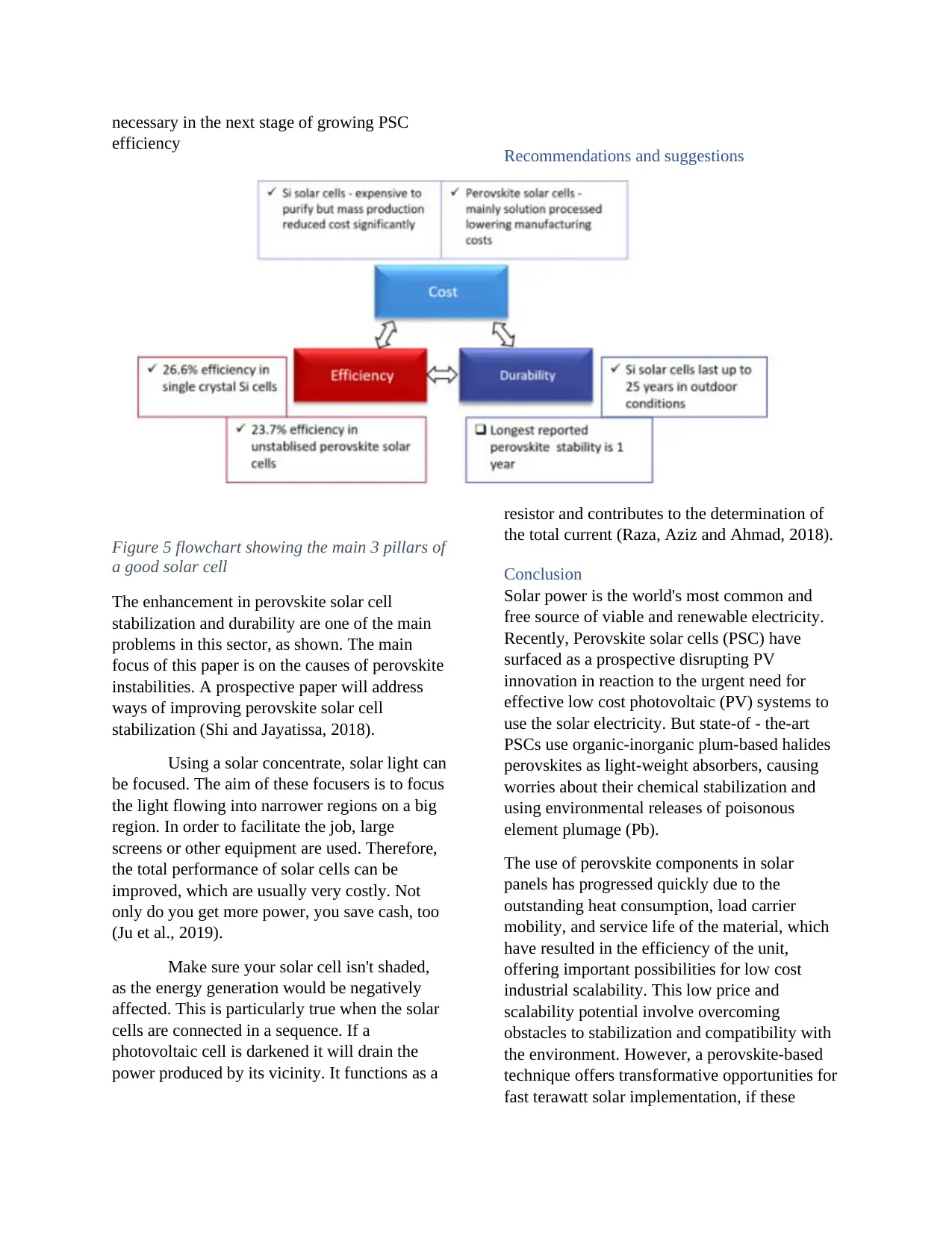
necessary in the next stage of growing PSC
efficiency Recommendations and suggestions
Figure 5 flowchart showing the main 3 pillars of
a good solar cell
The enhancement in perovskite solar cell
stabilization and durability are one of the main
problems in this sector, as shown. The main
focus of this paper is on the causes of perovskite
instabilities. A prospective paper will address
ways of improving perovskite solar cell
stabilization (Shi and Jayatissa, 2018).
Using a solar concentrate, solar light can
be focused. The aim of these focusers is to focus
the light flowing into narrower regions on a big
region. In order to facilitate the job, large
screens or other equipment are used. Therefore,
the total performance of solar cells can be
improved, which are usually very costly. Not
only do you get more power, you save cash, too
(Ju et al., 2019).
Make sure your solar cell isn't shaded,
as the energy generation would be negatively
affected. This is particularly true when the solar
cells are connected in a sequence. If a
photovoltaic cell is darkened it will drain the
power produced by its vicinity. It functions as a
resistor and contributes to the determination of
the total current (Raza, Aziz and Ahmad, 2018).
Conclusion
Solar power is the world's most common and
free source of viable and renewable electricity.
Recently, Perovskite solar cells (PSC) have
surfaced as a prospective disrupting PV
innovation in reaction to the urgent need for
effective low cost photovoltaic (PV) systems to
use the solar electricity. But state-of - the-art
PSCs use organic-inorganic plum-based halides
perovskites as light-weight absorbers, causing
worries about their chemical stabilization and
using environmental releases of poisonous
element plumage (Pb).
The use of perovskite components in solar
panels has progressed quickly due to the
outstanding heat consumption, load carrier
mobility, and service life of the material, which
have resulted in the efficiency of the unit,
offering important possibilities for low cost
industrial scalability. This low price and
scalability potential involve overcoming
obstacles to stabilization and compatibility with
the environment. However, a perovskite-based
technique offers transformative opportunities for
fast terawatt solar implementation, if these
efficiency Recommendations and suggestions
Figure 5 flowchart showing the main 3 pillars of
a good solar cell
The enhancement in perovskite solar cell
stabilization and durability are one of the main
problems in this sector, as shown. The main
focus of this paper is on the causes of perovskite
instabilities. A prospective paper will address
ways of improving perovskite solar cell
stabilization (Shi and Jayatissa, 2018).
Using a solar concentrate, solar light can
be focused. The aim of these focusers is to focus
the light flowing into narrower regions on a big
region. In order to facilitate the job, large
screens or other equipment are used. Therefore,
the total performance of solar cells can be
improved, which are usually very costly. Not
only do you get more power, you save cash, too
(Ju et al., 2019).
Make sure your solar cell isn't shaded,
as the energy generation would be negatively
affected. This is particularly true when the solar
cells are connected in a sequence. If a
photovoltaic cell is darkened it will drain the
power produced by its vicinity. It functions as a
resistor and contributes to the determination of
the total current (Raza, Aziz and Ahmad, 2018).
Conclusion
Solar power is the world's most common and
free source of viable and renewable electricity.
Recently, Perovskite solar cells (PSC) have
surfaced as a prospective disrupting PV
innovation in reaction to the urgent need for
effective low cost photovoltaic (PV) systems to
use the solar electricity. But state-of - the-art
PSCs use organic-inorganic plum-based halides
perovskites as light-weight absorbers, causing
worries about their chemical stabilization and
using environmental releases of poisonous
element plumage (Pb).
The use of perovskite components in solar
panels has progressed quickly due to the
outstanding heat consumption, load carrier
mobility, and service life of the material, which
have resulted in the efficiency of the unit,
offering important possibilities for low cost
industrial scalability. This low price and
scalability potential involve overcoming
obstacles to stabilization and compatibility with
the environment. However, a perovskite-based
technique offers transformative opportunities for
fast terawatt solar implementation, if these
Paraphrase This Document
Need a fresh take? Get an instant paraphrase of this document with our AI Paraphraser
issues are resolved. The fundamental
characteristics of metals have also stimulated
interest in a wider category of use of hybrid
perovskite semiconductors (Ke et al., 2016).
References
Doityourself.com. (2019). 6 Ways to Improve
Solar Cell Efficiency | DoItYourself.com.
[online] Available at:
https://www.doityourself.com/stry/6-ways-
to-improve-solar-cell-efficiency [Accessed
23 May 2019].
Hallam, B., Herguth, A., Hamer, P., Nampalli,
N., Wilking, S., Abbott, M., Wenham, S.
and Hahn, G. (2017). Eliminating Light-
Induced Degradation in Commercial p-
Type Czochralski Silicon Solar
Cells. Applied Sciences, 8(1), p.10.
Ju, M., Chen, M., Zhou, Y., Dai, J., Ma, L.,
Padture, N. and Zeng, X. (2019). Toward
Eco-friendly and Stable Perovskite
Materials for Photovoltaics.
Ke, W., Xiao, C., Wang, C., Saparov, B., Duan,
H., Zhao, D., Xiao, Z., Schulz, P., Harvey,
S., Liao, W., Meng, W., Yu, Y., Cimaroli,
A., Jiang, C., Zhu, K., Al-Jassim, M., Fang,
G., Mitzi, D. and Yan, Y. (2016).
Employing Lead Thiocyanate Additive to
Reduce the Hysteresis and Boost the Fill
Factor of Planar Perovskite Solar
Cells. Advanced Materials, 28(26),
pp.5214-5221.
Maheshwari, S., Savenije, T., Renaud, N. and
Grozema, F. (2018). Computational Design
of Two-Dimensional Perovskites with
Functional Organic Cations. The Journal of
Physical Chemistry C, 122(30), pp.17118-
17122.
Osila (2019). Perovskite Solar Cells: Causes of
Degradation. [online] Ossila. Available at:
https://www.ossila.com/pages/perovskite-
solar-cell-degradation-causes [Accessed 23
May 2019].
Raza, E., Aziz, F. and Ahmad, Z. (2018).
Stability of organometal halide perovskite
solar cells and role of HTMs: recent
developments and future directions. RSC
Advances, 8(37), pp.20952-20967.
Shi, Z. and Jayatissa, A. (2018). Perovskites-
Based Solar Cells: A Review of Recent
Progress, Materials and Processing
Methods. Materials, 11(5), p.729.
Xu, L., Molaei Imenabadi, R., Vandenberghe,
W. and Hsu, J. (2019). Minimizing
performance degradation induced by
interfacial recombination in perovskite
solar cells through tailoring of the
transport layer electronic properties.
Xu, L., Molaei Imenabadi, R., Vandenberghe,
W. and Hsu, J. (2018). Minimizing
performance degradation induced by
interfacial recombination in perovskite
solar cells through tailoring of the transport
layer electronic properties. APL Materials,
6(3), p.036104.
Yu, C. (2019). Advances in modelling and
simulation of halide perovskites for solar
cell applications. Journal of Physics:
Energy, 1(2), p.022001.
characteristics of metals have also stimulated
interest in a wider category of use of hybrid
perovskite semiconductors (Ke et al., 2016).
References
Doityourself.com. (2019). 6 Ways to Improve
Solar Cell Efficiency | DoItYourself.com.
[online] Available at:
https://www.doityourself.com/stry/6-ways-
to-improve-solar-cell-efficiency [Accessed
23 May 2019].
Hallam, B., Herguth, A., Hamer, P., Nampalli,
N., Wilking, S., Abbott, M., Wenham, S.
and Hahn, G. (2017). Eliminating Light-
Induced Degradation in Commercial p-
Type Czochralski Silicon Solar
Cells. Applied Sciences, 8(1), p.10.
Ju, M., Chen, M., Zhou, Y., Dai, J., Ma, L.,
Padture, N. and Zeng, X. (2019). Toward
Eco-friendly and Stable Perovskite
Materials for Photovoltaics.
Ke, W., Xiao, C., Wang, C., Saparov, B., Duan,
H., Zhao, D., Xiao, Z., Schulz, P., Harvey,
S., Liao, W., Meng, W., Yu, Y., Cimaroli,
A., Jiang, C., Zhu, K., Al-Jassim, M., Fang,
G., Mitzi, D. and Yan, Y. (2016).
Employing Lead Thiocyanate Additive to
Reduce the Hysteresis and Boost the Fill
Factor of Planar Perovskite Solar
Cells. Advanced Materials, 28(26),
pp.5214-5221.
Maheshwari, S., Savenije, T., Renaud, N. and
Grozema, F. (2018). Computational Design
of Two-Dimensional Perovskites with
Functional Organic Cations. The Journal of
Physical Chemistry C, 122(30), pp.17118-
17122.
Osila (2019). Perovskite Solar Cells: Causes of
Degradation. [online] Ossila. Available at:
https://www.ossila.com/pages/perovskite-
solar-cell-degradation-causes [Accessed 23
May 2019].
Raza, E., Aziz, F. and Ahmad, Z. (2018).
Stability of organometal halide perovskite
solar cells and role of HTMs: recent
developments and future directions. RSC
Advances, 8(37), pp.20952-20967.
Shi, Z. and Jayatissa, A. (2018). Perovskites-
Based Solar Cells: A Review of Recent
Progress, Materials and Processing
Methods. Materials, 11(5), p.729.
Xu, L., Molaei Imenabadi, R., Vandenberghe,
W. and Hsu, J. (2019). Minimizing
performance degradation induced by
interfacial recombination in perovskite
solar cells through tailoring of the
transport layer electronic properties.
Xu, L., Molaei Imenabadi, R., Vandenberghe,
W. and Hsu, J. (2018). Minimizing
performance degradation induced by
interfacial recombination in perovskite
solar cells through tailoring of the transport
layer electronic properties. APL Materials,
6(3), p.036104.
Yu, C. (2019). Advances in modelling and
simulation of halide perovskites for solar
cell applications. Journal of Physics:
Energy, 1(2), p.022001.

1 out of 8


Your All-in-One AI-Powered Toolkit for Academic Success.
+13062052269
info@desklib.com
Available 24*7 on WhatsApp / Email
![[object Object]](/_next/static/media/star-bottom.7253800d.svg)
Unlock your academic potential
Copyright © 2020–2026 A2Z Services. All Rights Reserved. Developed and managed by ZUCOL.