KOI ICT201: Computer Organization and Architecture Deadlock Analysis
VerifiedAdded on 2022/09/27
|9
|1651
|25
Homework Assignment
AI Summary
This assignment delves into the critical aspects of computer organization and architecture, specifically focusing on the concept of deadlocks. It explores various strategies for handling deadlocks, including detection, prevention, and avoidance, detailing how these methods are applied in different contexts such as CPU, main memory, and file management systems. The assignment analyzes the banking algorithm to illustrate deadlock prevention and discusses key metrics like turnaround time and waiting time in the context of scheduling algorithms. Several scheduling algorithms, including First Come First Serve (FCFS), Shortest Job Next (SJN), Shortest Remaining Time (SRT), and Round Robin, are examined with their timelines and characteristics. Furthermore, the assignment includes an analysis of a directed resource graph to demonstrate deadlock situations. The document also provides references to relevant research papers.
Computer Architecture 1
Computer Organization and Architecture
By (Name)
The Name of the Class (Course)
Professor (Tutor)
The Name of the School (University)
The City and State where it is located
The Date
Computer Organization and Architecture
By (Name)
The Name of the Class (Course)
Professor (Tutor)
The Name of the School (University)
The City and State where it is located
The Date
Paraphrase This Document
Need a fresh take? Get an instant paraphrase of this document with our AI Paraphraser

Computer Architecture 2
Computer Organization and Architecture
1) Handling and managing deadlocks
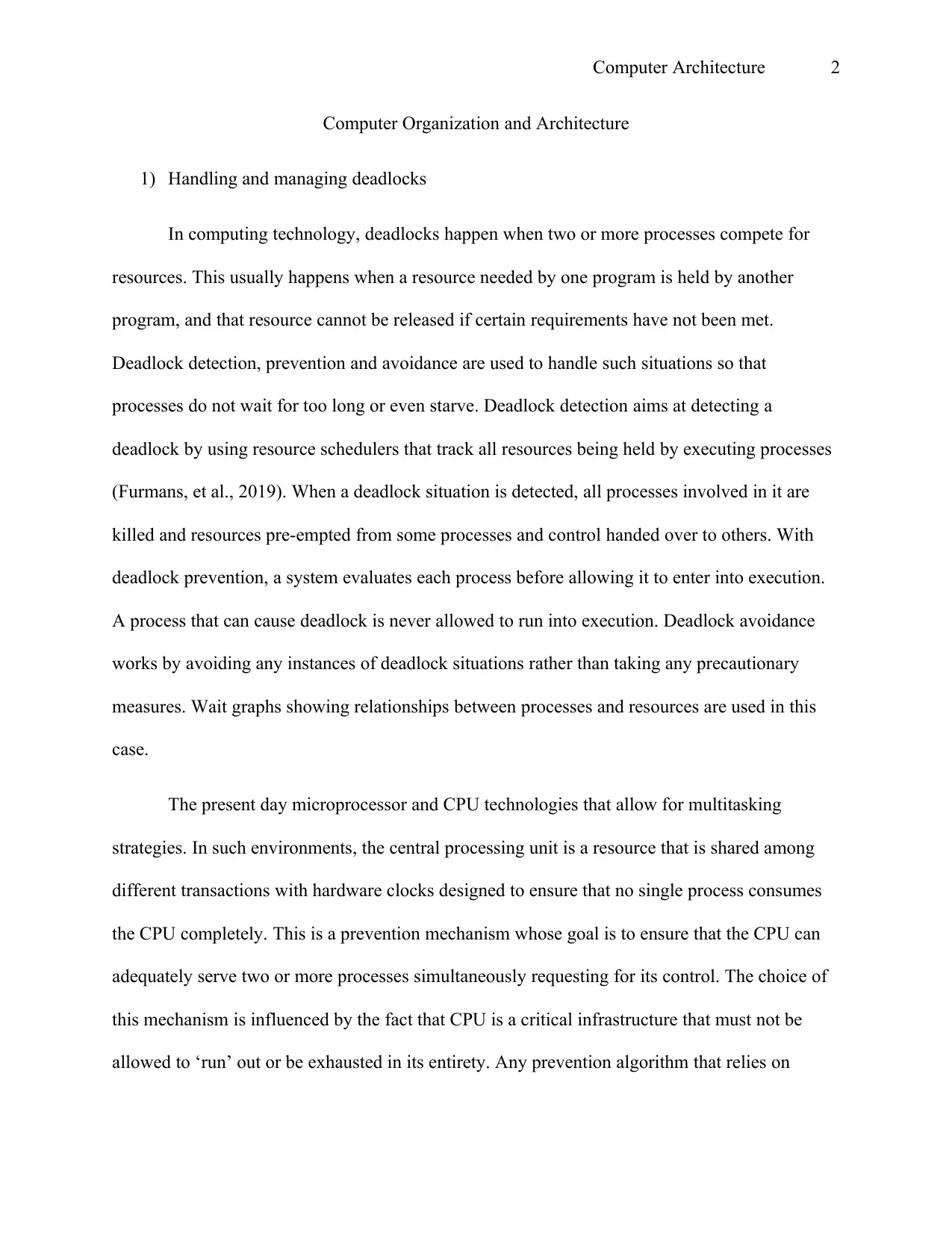
In computing technology, deadlocks happen when two or more processes compete for
resources. This usually happens when a resource needed by one program is held by another
program, and that resource cannot be released if certain requirements have not been met.
Deadlock detection, prevention and avoidance are used to handle such situations so that
processes do not wait for too long or even starve. Deadlock detection aims at detecting a
deadlock by using resource schedulers that track all resources being held by executing processes
(Furmans, et al., 2019). When a deadlock situation is detected, all processes involved in it are
killed and resources pre-empted from some processes and control handed over to others. With
deadlock prevention, a system evaluates each process before allowing it to enter into execution.
A process that can cause deadlock is never allowed to run into execution. Deadlock avoidance
works by avoiding any instances of deadlock situations rather than taking any precautionary
measures. Wait graphs showing relationships between processes and resources are used in this
case.
The present day microprocessor and CPU technologies that allow for multitasking
strategies. In such environments, the central processing unit is a resource that is shared among
different transactions with hardware clocks designed to ensure that no single process consumes
the CPU completely. This is a prevention mechanism whose goal is to ensure that the CPU can
adequately serve two or more processes simultaneously requesting for its control. The choice of
this mechanism is influenced by the fact that CPU is a critical infrastructure that must not be
allowed to ‘run’ out or be exhausted in its entirety. Any prevention algorithm that relies on
Computer Organization and Architecture
1) Handling and managing deadlocks
In computing technology, deadlocks happen when two or more processes compete for
resources. This usually happens when a resource needed by one program is held by another
program, and that resource cannot be released if certain requirements have not been met.
Deadlock detection, prevention and avoidance are used to handle such situations so that
processes do not wait for too long or even starve. Deadlock detection aims at detecting a
deadlock by using resource schedulers that track all resources being held by executing processes
(Furmans, et al., 2019). When a deadlock situation is detected, all processes involved in it are
killed and resources pre-empted from some processes and control handed over to others. With
deadlock prevention, a system evaluates each process before allowing it to enter into execution.
A process that can cause deadlock is never allowed to run into execution. Deadlock avoidance
works by avoiding any instances of deadlock situations rather than taking any precautionary
measures. Wait graphs showing relationships between processes and resources are used in this
case.
The present day microprocessor and CPU technologies that allow for multitasking
strategies. In such environments, the central processing unit is a resource that is shared among
different transactions with hardware clocks designed to ensure that no single process consumes
the CPU completely. This is a prevention mechanism whose goal is to ensure that the CPU can
adequately serve two or more processes simultaneously requesting for its control. The choice of
this mechanism is influenced by the fact that CPU is a critical infrastructure that must not be
allowed to ‘run’ out or be exhausted in its entirety. Any prevention algorithm that relies on

Computer Architecture 3
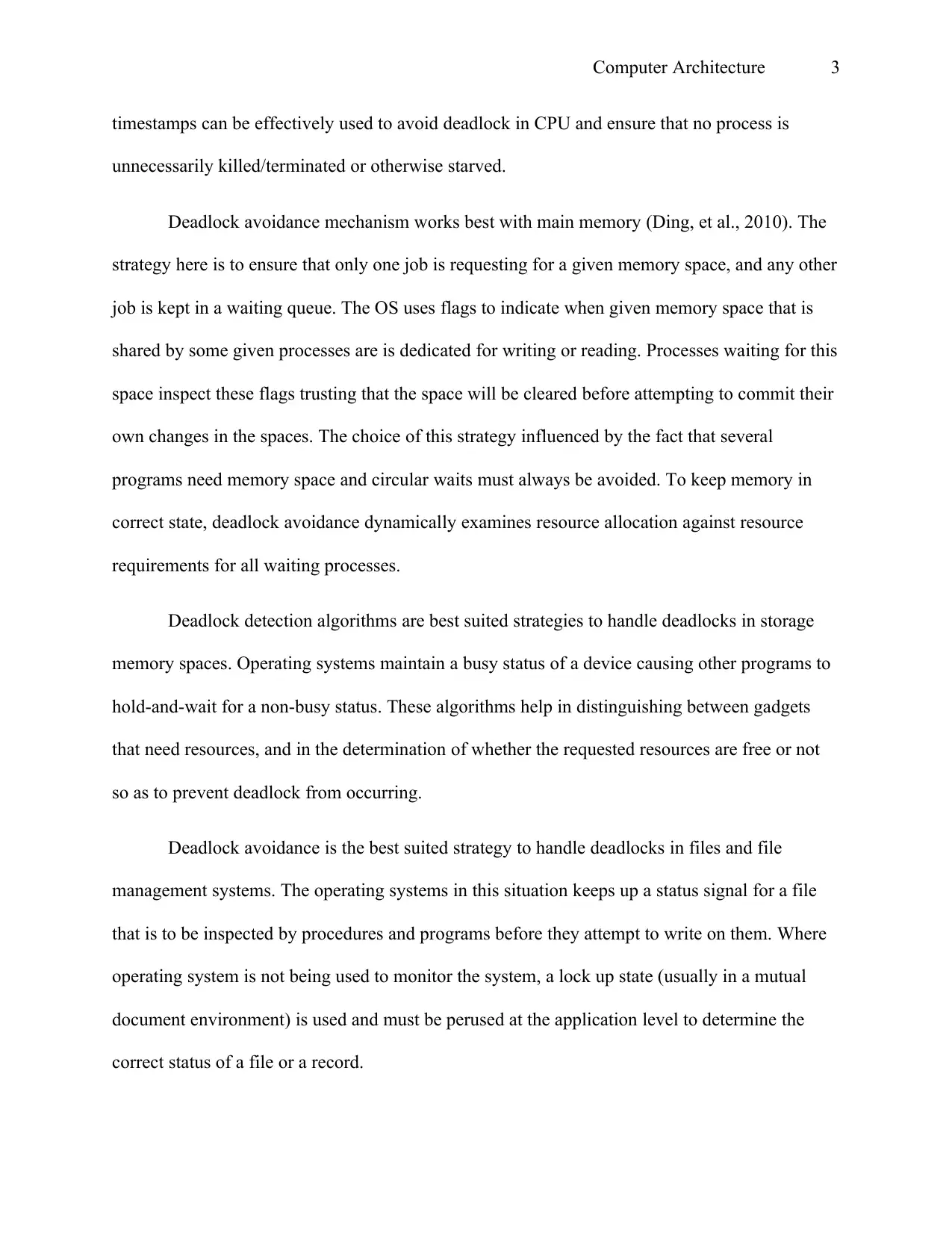
timestamps can be effectively used to avoid deadlock in CPU and ensure that no process is
unnecessarily killed/terminated or otherwise starved.
Deadlock avoidance mechanism works best with main memory (Ding, et al., 2010). The
strategy here is to ensure that only one job is requesting for a given memory space, and any other
job is kept in a waiting queue. The OS uses flags to indicate when given memory space that is
shared by some given processes are is dedicated for writing or reading. Processes waiting for this
space inspect these flags trusting that the space will be cleared before attempting to commit their
own changes in the spaces. The choice of this strategy influenced by the fact that several
programs need memory space and circular waits must always be avoided. To keep memory in
correct state, deadlock avoidance dynamically examines resource allocation against resource
requirements for all waiting processes.
Deadlock detection algorithms are best suited strategies to handle deadlocks in storage
memory spaces. Operating systems maintain a busy status of a device causing other programs to
hold-and-wait for a non-busy status. These algorithms help in distinguishing between gadgets
that need resources, and in the determination of whether the requested resources are free or not
so as to prevent deadlock from occurring.
Deadlock avoidance is the best suited strategy to handle deadlocks in files and file
management systems. The operating systems in this situation keeps up a status signal for a file
that is to be inspected by procedures and programs before they attempt to write on them. Where
operating system is not being used to monitor the system, a lock up state (usually in a mutual
document environment) is used and must be perused at the application level to determine the
correct status of a file or a record.
timestamps can be effectively used to avoid deadlock in CPU and ensure that no process is
unnecessarily killed/terminated or otherwise starved.
Deadlock avoidance mechanism works best with main memory (Ding, et al., 2010). The
strategy here is to ensure that only one job is requesting for a given memory space, and any other
job is kept in a waiting queue. The OS uses flags to indicate when given memory space that is
shared by some given processes are is dedicated for writing or reading. Processes waiting for this
space inspect these flags trusting that the space will be cleared before attempting to commit their
own changes in the spaces. The choice of this strategy influenced by the fact that several
programs need memory space and circular waits must always be avoided. To keep memory in
correct state, deadlock avoidance dynamically examines resource allocation against resource
requirements for all waiting processes.
Deadlock detection algorithms are best suited strategies to handle deadlocks in storage
memory spaces. Operating systems maintain a busy status of a device causing other programs to
hold-and-wait for a non-busy status. These algorithms help in distinguishing between gadgets
that need resources, and in the determination of whether the requested resources are free or not
so as to prevent deadlock from occurring.
Deadlock avoidance is the best suited strategy to handle deadlocks in files and file
management systems. The operating systems in this situation keeps up a status signal for a file
that is to be inspected by procedures and programs before they attempt to write on them. Where
operating system is not being used to monitor the system, a lock up state (usually in a mutual
document environment) is used and must be perused at the application level to determine the
correct status of a file or a record.
⊘ This is a preview!⊘
Do you want full access?
Subscribe today to unlock all pages.

Trusted by 1+ million students worldwide

Computer Architecture 4
2) Banking algorithm
a) The banking system described in this scenario is not deadlocked. Since the two
accounts are being simultaneously updated, the possibility of deadlock occurring is
successfully avoided when one becomes thorough about each step in the algorithm by
locking, updating and unlocking each account. The assumption being made here is that
the computing resources effectively function with the two accounts being in locked
state.
b) If the banking system has the capability of accomondating all the locked accounts, and
the thorough approach of locking, updating and unlocking, deadlock occurrences
would be successfully prevented regardless of processing order. As such, the
numbering policy implemented would not affect the outcome.
3) Waiting and turnaround time.
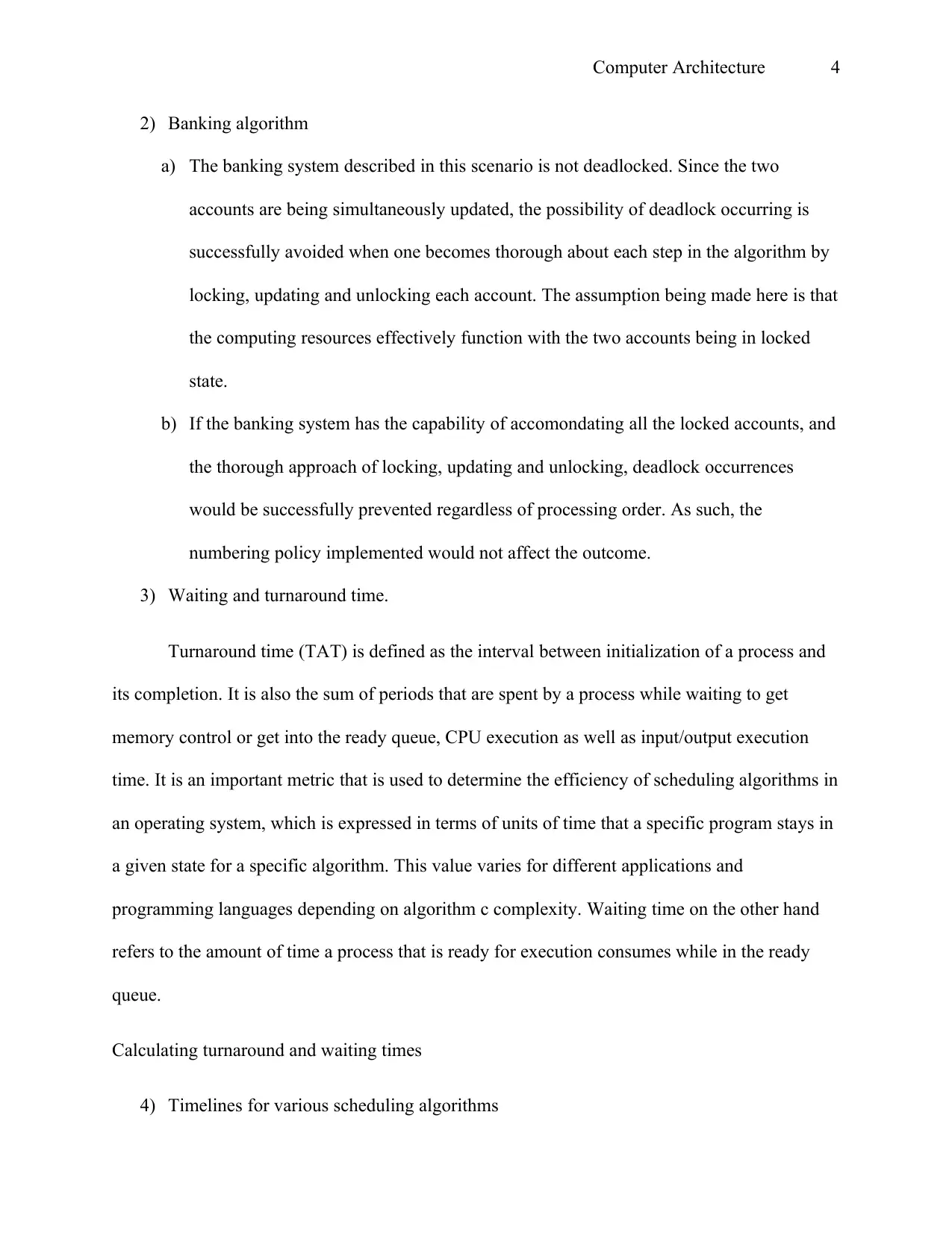
Turnaround time (TAT) is defined as the interval between initialization of a process and
its completion. It is also the sum of periods that are spent by a process while waiting to get
memory control or get into the ready queue, CPU execution as well as input/output execution
time. It is an important metric that is used to determine the efficiency of scheduling algorithms in
an operating system, which is expressed in terms of units of time that a specific program stays in
a given state for a specific algorithm. This value varies for different applications and
programming languages depending on algorithm c complexity. Waiting time on the other hand
refers to the amount of time a process that is ready for execution consumes while in the ready
queue.
Calculating turnaround and waiting times
4) Timelines for various scheduling algorithms
2) Banking algorithm
a) The banking system described in this scenario is not deadlocked. Since the two
accounts are being simultaneously updated, the possibility of deadlock occurring is
successfully avoided when one becomes thorough about each step in the algorithm by
locking, updating and unlocking each account. The assumption being made here is that
the computing resources effectively function with the two accounts being in locked
state.
b) If the banking system has the capability of accomondating all the locked accounts, and
the thorough approach of locking, updating and unlocking, deadlock occurrences
would be successfully prevented regardless of processing order. As such, the
numbering policy implemented would not affect the outcome.
3) Waiting and turnaround time.
Turnaround time (TAT) is defined as the interval between initialization of a process and
its completion. It is also the sum of periods that are spent by a process while waiting to get
memory control or get into the ready queue, CPU execution as well as input/output execution
time. It is an important metric that is used to determine the efficiency of scheduling algorithms in
an operating system, which is expressed in terms of units of time that a specific program stays in
a given state for a specific algorithm. This value varies for different applications and
programming languages depending on algorithm c complexity. Waiting time on the other hand
refers to the amount of time a process that is ready for execution consumes while in the ready
queue.
Calculating turnaround and waiting times
4) Timelines for various scheduling algorithms
Paraphrase This Document
Need a fresh take? Get an instant paraphrase of this document with our AI Paraphraser

Computer Architecture 5
i) First come firs serve algorithm
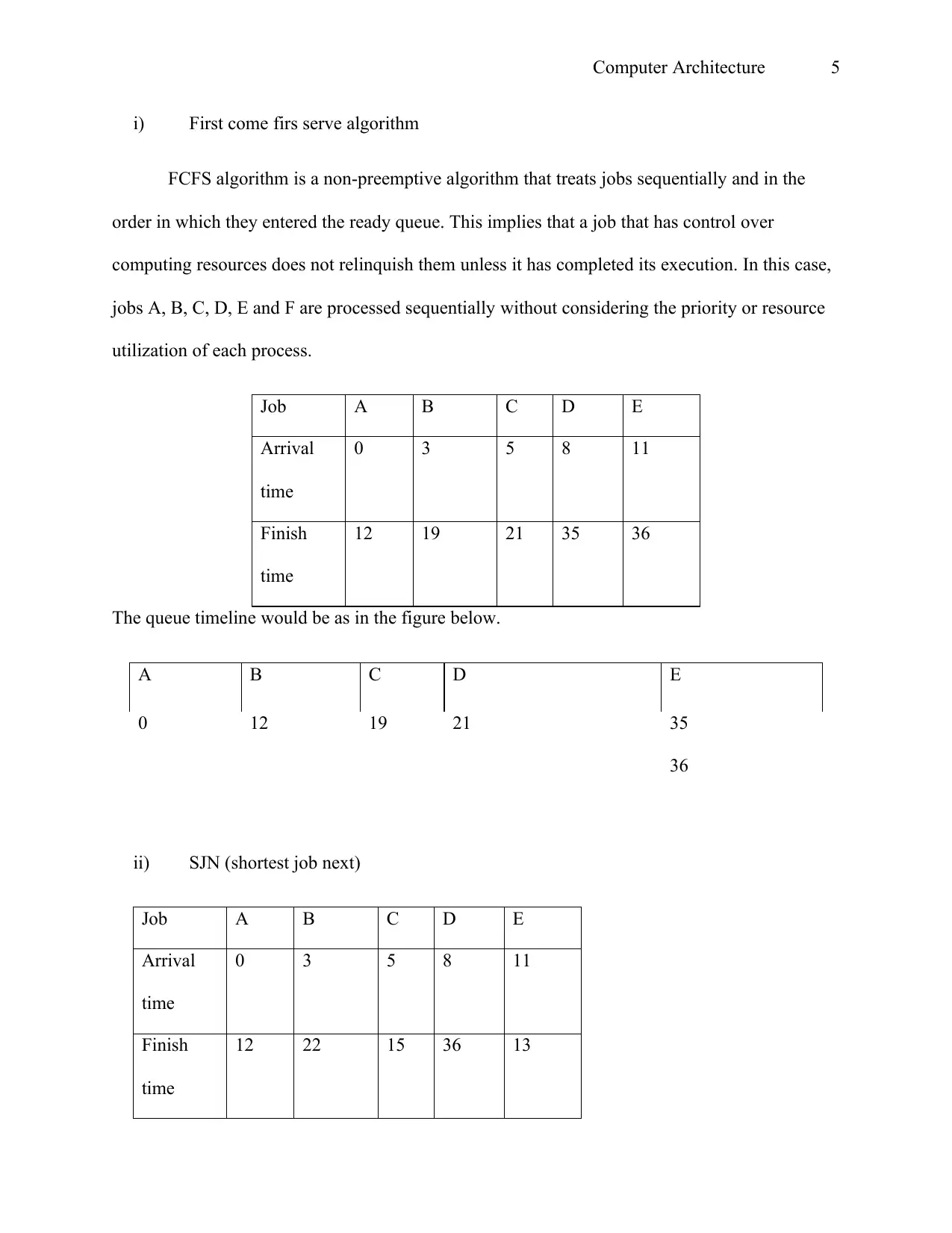
FCFS algorithm is a non-preemptive algorithm that treats jobs sequentially and in the
order in which they entered the ready queue. This implies that a job that has control over
computing resources does not relinquish them unless it has completed its execution. In this case,
jobs A, B, C, D, E and F are processed sequentially without considering the priority or resource
utilization of each process.
Job A B C D E
Arrival
time
0 3 5 8 11
Finish
time
12 19 21 35 36
The queue timeline would be as in the figure below.
A B C D E
0 12 19 21 35
36
ii) SJN (shortest job next)
Job A B C D E
Arrival
time
0 3 5 8 11
Finish
time
12 22 15 36 13
i) First come firs serve algorithm
FCFS algorithm is a non-preemptive algorithm that treats jobs sequentially and in the
order in which they entered the ready queue. This implies that a job that has control over
computing resources does not relinquish them unless it has completed its execution. In this case,
jobs A, B, C, D, E and F are processed sequentially without considering the priority or resource
utilization of each process.
Job A B C D E
Arrival
time
0 3 5 8 11
Finish
time
12 19 21 35 36
The queue timeline would be as in the figure below.
A B C D E
0 12 19 21 35
36
ii) SJN (shortest job next)
Job A B C D E
Arrival
time
0 3 5 8 11
Finish
time
12 22 15 36 13

Computer Architecture 6
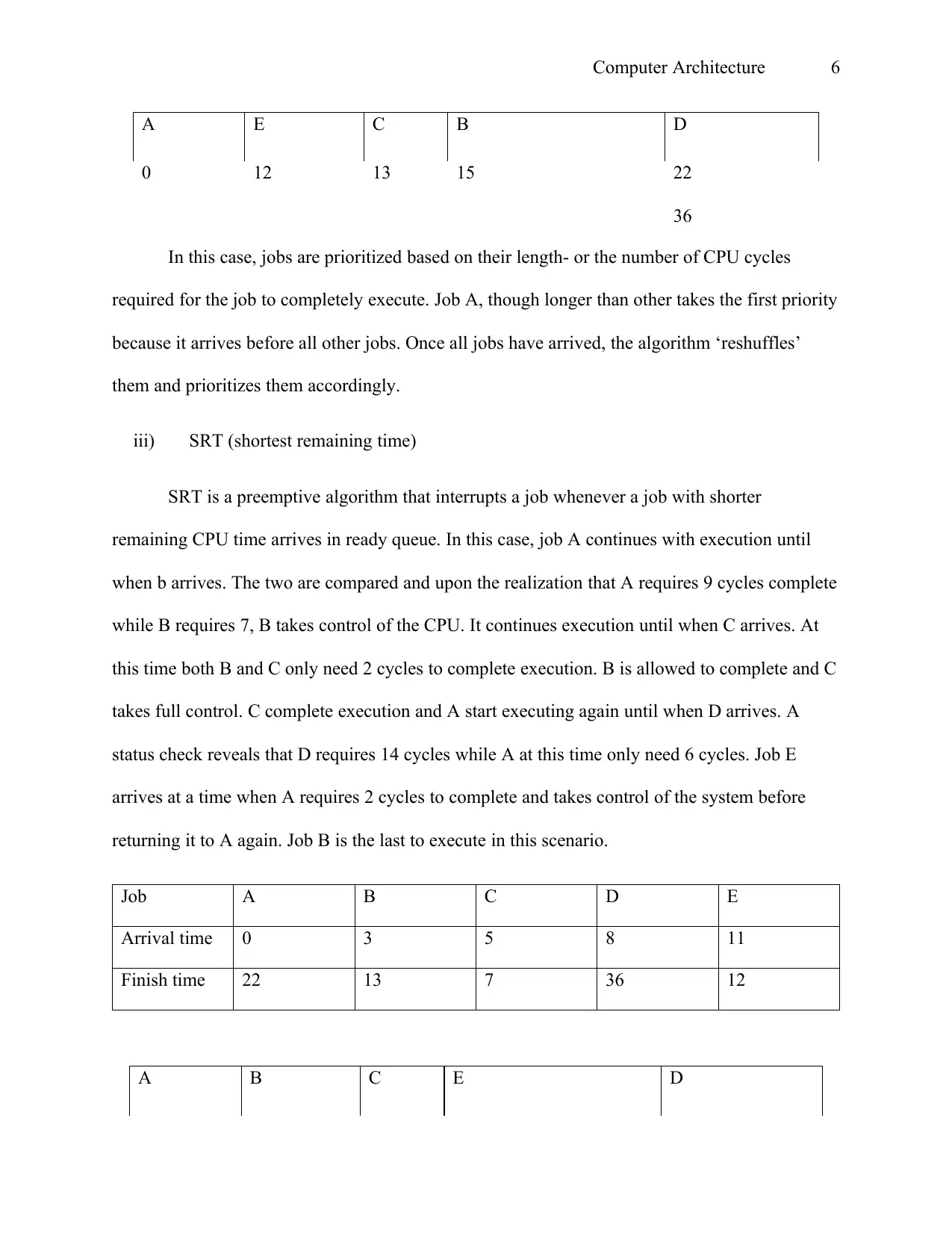
A E C B D
0 12 13 15 22
36
In this case, jobs are prioritized based on their length- or the number of CPU cycles
required for the job to completely execute. Job A, though longer than other takes the first priority
because it arrives before all other jobs. Once all jobs have arrived, the algorithm ‘reshuffles’
them and prioritizes them accordingly.
iii) SRT (shortest remaining time)
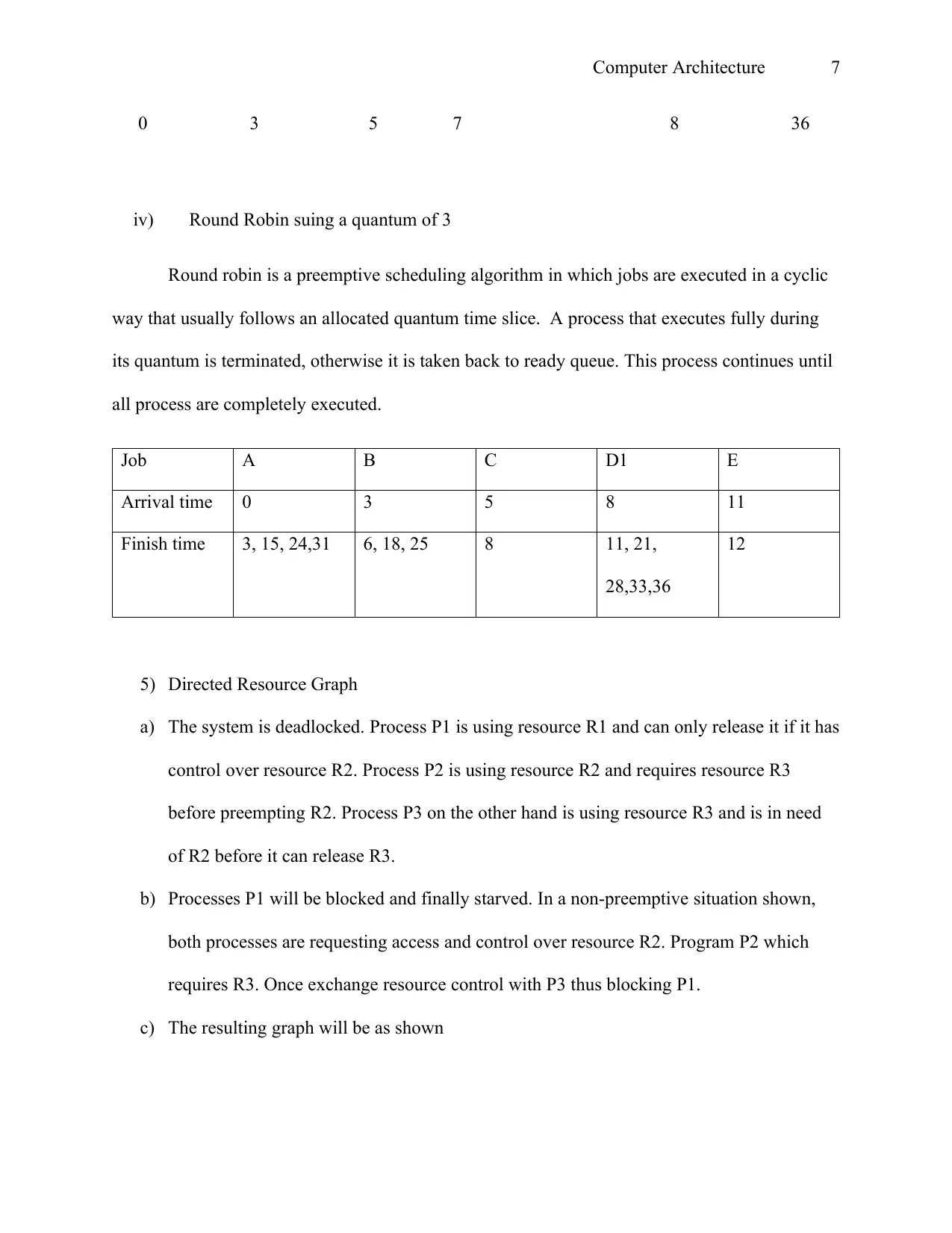
SRT is a preemptive algorithm that interrupts a job whenever a job with shorter
remaining CPU time arrives in ready queue. In this case, job A continues with execution until
when b arrives. The two are compared and upon the realization that A requires 9 cycles complete
while B requires 7, B takes control of the CPU. It continues execution until when C arrives. At
this time both B and C only need 2 cycles to complete execution. B is allowed to complete and C
takes full control. C complete execution and A start executing again until when D arrives. A
status check reveals that D requires 14 cycles while A at this time only need 6 cycles. Job E
arrives at a time when A requires 2 cycles to complete and takes control of the system before
returning it to A again. Job B is the last to execute in this scenario.
Job A B C D E
Arrival time 0 3 5 8 11
Finish time 22 13 7 36 12
A B C E D
A E C B D
0 12 13 15 22
36
In this case, jobs are prioritized based on their length- or the number of CPU cycles
required for the job to completely execute. Job A, though longer than other takes the first priority
because it arrives before all other jobs. Once all jobs have arrived, the algorithm ‘reshuffles’
them and prioritizes them accordingly.
iii) SRT (shortest remaining time)
SRT is a preemptive algorithm that interrupts a job whenever a job with shorter
remaining CPU time arrives in ready queue. In this case, job A continues with execution until
when b arrives. The two are compared and upon the realization that A requires 9 cycles complete
while B requires 7, B takes control of the CPU. It continues execution until when C arrives. At
this time both B and C only need 2 cycles to complete execution. B is allowed to complete and C
takes full control. C complete execution and A start executing again until when D arrives. A
status check reveals that D requires 14 cycles while A at this time only need 6 cycles. Job E
arrives at a time when A requires 2 cycles to complete and takes control of the system before
returning it to A again. Job B is the last to execute in this scenario.
Job A B C D E
Arrival time 0 3 5 8 11
Finish time 22 13 7 36 12
A B C E D
⊘ This is a preview!⊘
Do you want full access?
Subscribe today to unlock all pages.

Trusted by 1+ million students worldwide

Computer Architecture 7
0 3 5 7 8 36
iv) Round Robin suing a quantum of 3
Round robin is a preemptive scheduling algorithm in which jobs are executed in a cyclic
way that usually follows an allocated quantum time slice. A process that executes fully during
its quantum is terminated, otherwise it is taken back to ready queue. This process continues until
all process are completely executed.
Job A B C D1 E
Arrival time 0 3 5 8 11
Finish time 3, 15, 24,31 6, 18, 25 8 11, 21,
28,33,36
12
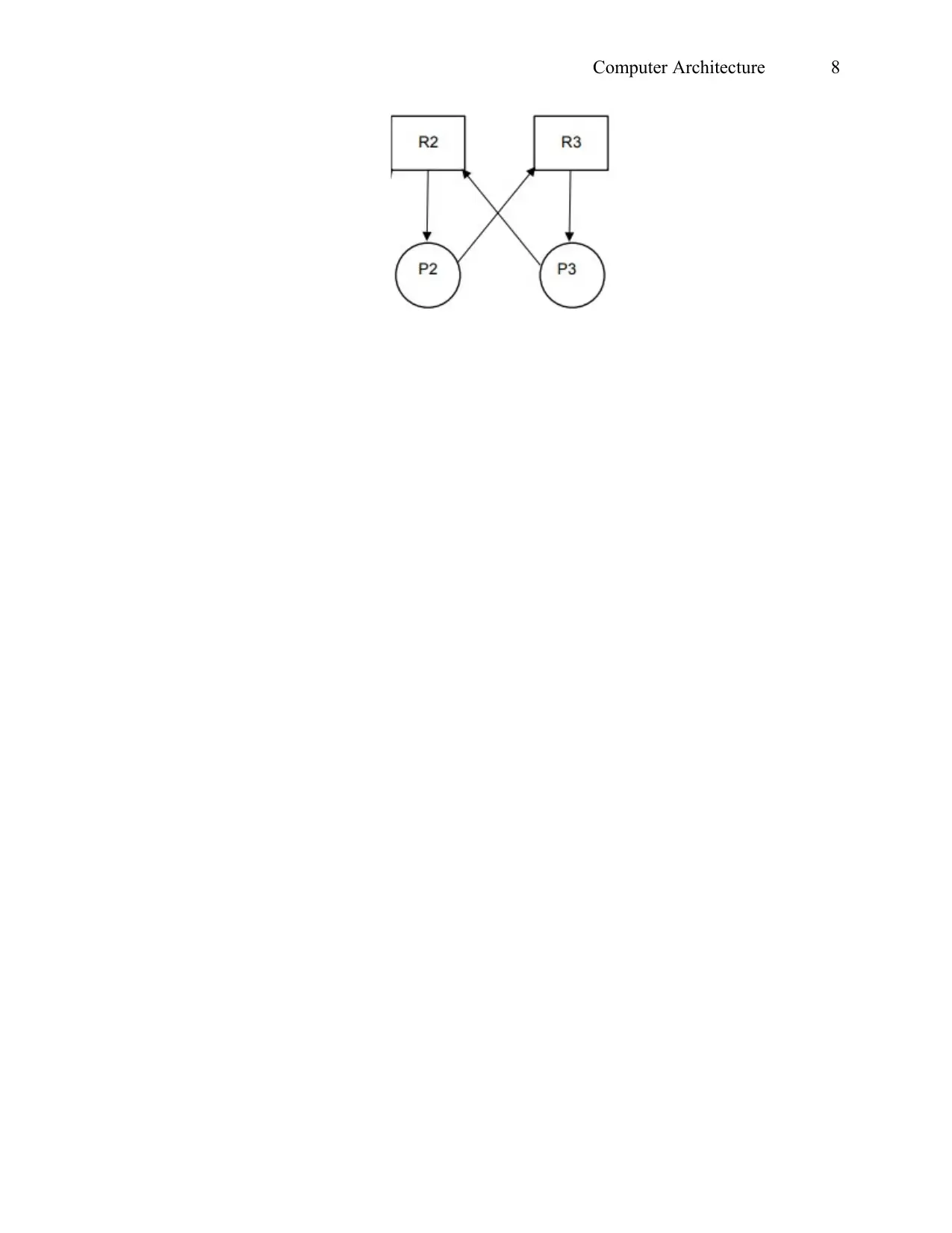
5) Directed Resource Graph
a) The system is deadlocked. Process P1 is using resource R1 and can only release it if it has
control over resource R2. Process P2 is using resource R2 and requires resource R3
before preempting R2. Process P3 on the other hand is using resource R3 and is in need
of R2 before it can release R3.
b) Processes P1 will be blocked and finally starved. In a non-preemptive situation shown,
both processes are requesting access and control over resource R2. Program P2 which
requires R3. Once exchange resource control with P3 thus blocking P1.
c) The resulting graph will be as shown
0 3 5 7 8 36
iv) Round Robin suing a quantum of 3
Round robin is a preemptive scheduling algorithm in which jobs are executed in a cyclic
way that usually follows an allocated quantum time slice. A process that executes fully during
its quantum is terminated, otherwise it is taken back to ready queue. This process continues until
all process are completely executed.
Job A B C D1 E
Arrival time 0 3 5 8 11
Finish time 3, 15, 24,31 6, 18, 25 8 11, 21,
28,33,36
12
5) Directed Resource Graph
a) The system is deadlocked. Process P1 is using resource R1 and can only release it if it has
control over resource R2. Process P2 is using resource R2 and requires resource R3
before preempting R2. Process P3 on the other hand is using resource R3 and is in need
of R2 before it can release R3.
b) Processes P1 will be blocked and finally starved. In a non-preemptive situation shown,
both processes are requesting access and control over resource R2. Program P2 which
requires R3. Once exchange resource control with P3 thus blocking P1.
c) The resulting graph will be as shown
Paraphrase This Document
Need a fresh take? Get an instant paraphrase of this document with our AI Paraphraser

Computer Architecture 8

Computer Architecture 9
Bibliography
Ding, J., Zhu, H., Zhu, H. & Li, Q., 2010. Formal modeling and verifications of deadlock
prevention solutions in web service oriented system. s.l., IEEE, pp. 335-343.
Furmans, K., Zäzilia, S. & Andreas, T., 2019. Future Technologies in Intralogistics and Material
Handling. In: Operations, Logistics and Supply Chain Management. Cham: Springer, pp. 545-
574.
Bibliography
Ding, J., Zhu, H., Zhu, H. & Li, Q., 2010. Formal modeling and verifications of deadlock
prevention solutions in web service oriented system. s.l., IEEE, pp. 335-343.
Furmans, K., Zäzilia, S. & Andreas, T., 2019. Future Technologies in Intralogistics and Material
Handling. In: Operations, Logistics and Supply Chain Management. Cham: Springer, pp. 545-
574.
⊘ This is a preview!⊘
Do you want full access?
Subscribe today to unlock all pages.

Trusted by 1+ million students worldwide
1 out of 9
Related Documents
Your All-in-One AI-Powered Toolkit for Academic Success.
+13062052269
info@desklib.com
Available 24*7 on WhatsApp / Email
Unlock your academic potential
Copyright © 2020–2025 A2Z Services. All Rights Reserved. Developed and managed by ZUCOL.