Computer Networks: TCP/UDP Quiz Solutions, Analysis and Answers

Verified

Added on  2022/08/22

|4
|846
|33
Homework Assignment
AI Summary
This document presents the solutions to a TCP/UDP quiz, covering various aspects of computer networks and network protocols. The quiz assesses understanding of TCP and UDP headers, error detection, and flow control mechanisms. It includes true/false questions, multiple-choice questions, and problem-solving scenarios related to sequence numbers, acknowledgement numbers, congestion control, and retransmission strategies. The solutions provide detailed explanations for each question, clarifying concepts such as fast retransmit, slow start, and congestion avoidance. The document also analyzes a scenario involving a TCP connection with multiple segments and acknowledgments, as well as the behavior of TCP Reno in the face of packet loss, including the impact on congestion window size and threshold values. The document covers various aspects of the TCP protocol and its functions. The solutions enable students to comprehend the functioning of TCP and UDP protocols, and how they handle data transmission, error detection, and congestion control.
Document Page
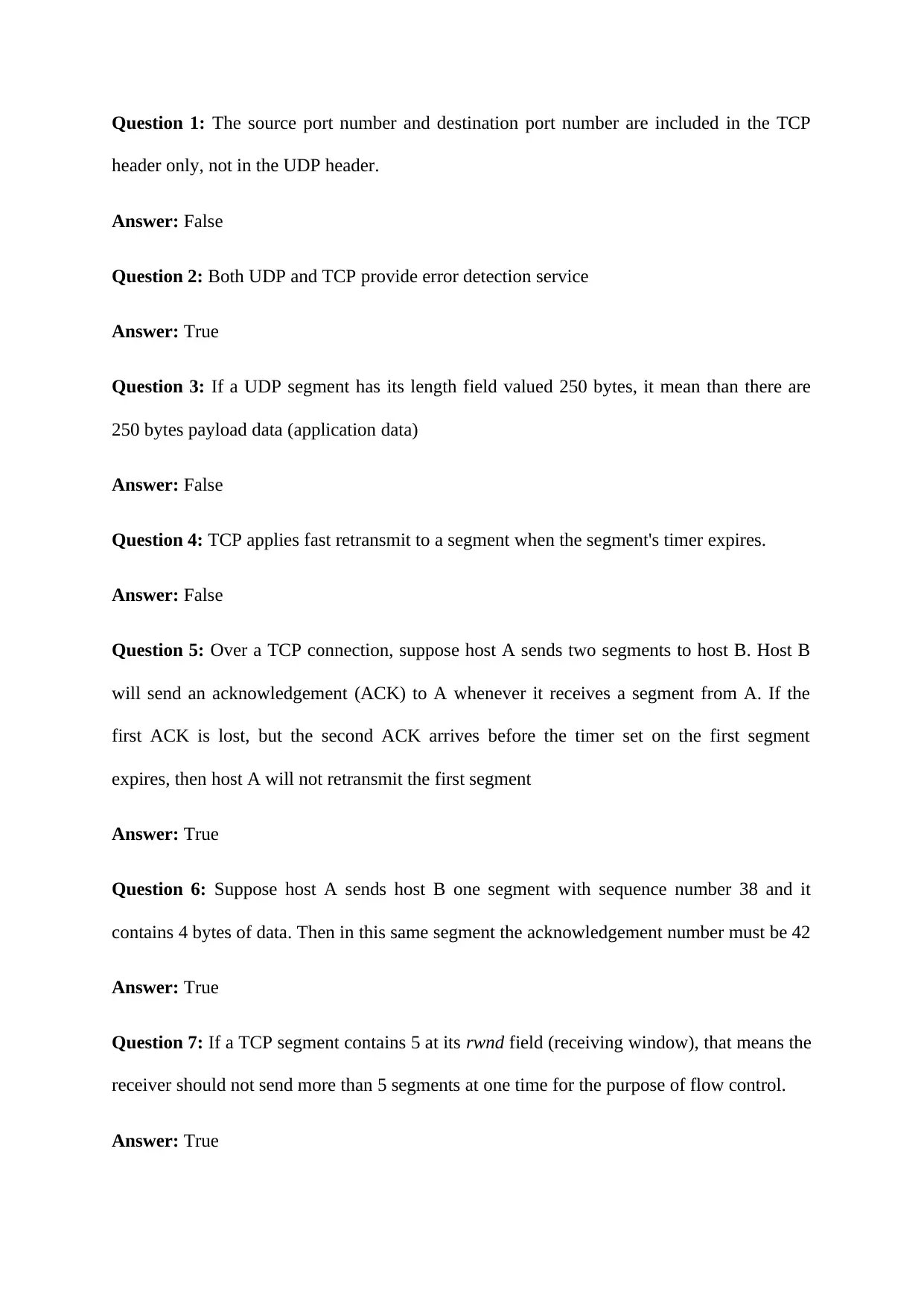
Question 1: The source port number and destination port number are included in the TCP
header only, not in the UDP header.
Answer: False
Question 2: Both UDP and TCP provide error detection service
Answer: True
Question 3: If a UDP segment has its length field valued 250 bytes, it mean than there are
250 bytes payload data (application data)
Answer: False
Question 4: TCP applies fast retransmit to a segment when the segment's timer expires.
Answer: False
Question 5: Over a TCP connection, suppose host A sends two segments to host B. Host B
will send an acknowledgement (ACK) to A whenever it receives a segment from A. If the
first ACK is lost, but the second ACK arrives before the timer set on the first segment
expires, then host A will not retransmit the first segment
Answer: True
Question 6: Suppose host A sends host B one segment with sequence number 38 and it
contains 4 bytes of data. Then in this same segment the acknowledgement number must be 42
Answer: True
Question 7: If a TCP segment contains 5 at its rwnd field (receiving window), that means the
receiver should not send more than 5 segments at one time for the purpose of flow control.
Answer: True
tabler-icon-diamond-filled.svg

Paraphrase This Document

Need a fresh take? Get an instant paraphrase of this document with our AI Paraphraser
Document Page
Question 8: Which of the following application layer protocol using TCP?
Answer: HTTP
Question 9: Suppose you have the following two data sequences: 1101110101100110, and
0101010101010011. What is the value you should put in the checksum field if those are the
only data you have
Answer: 1100110101000101
Question 10: Which of the following service is not provided by TCP?
Answer: identify end hosts
Question 11: The following questions are based on the condition described below:
Suppose Host A sends four TCP segments to Host B over a TCP connection. The first
segment has sequence number 0; the second has sequence number 120, the third has sequence
number 170 and the last one has sequence number 245. Assume sequence number used by B
starts at 0 and the messages sent from B to A contains 10 bytes of data each.
How much data is in the last segment?
Answer: cannot determine.
Question 12: Suppose the window size is 1. That is, A will wait for an ACK for its last sent
segment before it sends another. Assume all four segments arrives B and all four ACKs sent
back to A are received successfully. What is the acknowledge number of the third ACK sent
back from B to A?
Answer: 245
Question 13: Suppose that the first and second segments are received by B and the ACK of
those two segments sent from B is received by A. If the third segment A sends to B get lost
Document Page
but the last segment arrives at B. In the next acknowledgment that Host B sends to Host A,
what will be the sequence number and acknowledgment number, respectively?
Answer: 30, 245
Question 14: If all segments are received by Host B, and the last segment contains 80 bytes
of data, what is the sequence number and acknowledgment number contained in the last ACK
message sent from B to A, respectively?
Answer: 30, 325
Question 15: If the second segment arrives before the first segment, what is the
acknowledgment number in the first acknowledgment segment sent from B to A?
Answer: 10
Question 16: If all four segments arrives B, the first three acknowledge segments sent by B
to A were lost, but the last ACK segment sent by B to A arrives A before the timer expires.
Host A have to retransmit all three segments because it does not get ACK confirmations on
those segments from B.
Answer: True
Question 17: Consider the following Figure. Assuming TCP Reno is the protocol
experiencing the behaviour shown below, answer the questions.
At the 19th transmission round, what happened?
Answer: packet loss is detected by timeout.
Question 18: What is the value of thresh at the 7th transmission round?
Answer: 19
Question 19: What is the value of thresh at the 18th transmission round?
Document Page
Answer: 8
Question 20: During what transmission round is the 60th segment sent?
Answer: 6
Question 21: Assuming transmission is good for the 23rd and 24th round. But packet loss is
detected after the 25th round by the receipt of a triple duplicate ACK, what will be the values
of the congestion window size at the 26th round?
Answer: 1
chevron_up_icon
1 out of 4
circle_padding
hide_on_mobile
zoom_out_icon
[object Object]