King's Own Institute ICT201: COA Report on Operating Systems
VerifiedAdded on 2022/08/27
|16
|2994
|19
Report
AI Summary
This report provides a comprehensive overview of computer organization and architecture, focusing on operating systems and job scheduling. It delves into the concept of starvation detection, deadlock scenarios within a banking system, and the implementation of a numbering request policy to prevent deadlocks. The report analyzes waiting time and turnaround time using numerical examples and illustrates the performance of different scheduling algorithms, including FCFS, Round Robin, SRT, and HRRN. Furthermore, it discusses resource graphs, identifies reasons for system deadlocks, and describes blocked processes, concluding with an analysis of a resulting graph after reduction. The report aims to provide a thorough understanding of resource allocation and process management in computer systems.
Running head: COMPUTER ORGANIZATION AND ARCHITECTURE
Computer Organization and Architecture
Name of the Student:
Name of the University:
Author Note
Computer Organization and Architecture
Name of the Student:
Name of the University:
Author Note

Paraphrase This Document
Need a fresh take? Get an instant paraphrase of this document with our AI Paraphraser
1
COMPUTER ORGANIZATION AND ARCHITECTURE
Executive Summary:
The report is on the subject computer organizations and architecture. In addition to this, the
information about the operating systems and the different type of factors in the job scheduling
for jobs that are stacked up in the memory of the system. The concepts of deadlocking and
process rescheduling have also been discussed in this report. The discussions in this report have
been aided with the help of some numerical problems related to these topics. The answers for the
problems have also been addressed with the help of proper illustration. This would be helpful for
the readers to understand the concepts of deadlocking and resource management in computer
system very easily,
COMPUTER ORGANIZATION AND ARCHITECTURE
Executive Summary:
The report is on the subject computer organizations and architecture. In addition to this, the
information about the operating systems and the different type of factors in the job scheduling
for jobs that are stacked up in the memory of the system. The concepts of deadlocking and
process rescheduling have also been discussed in this report. The discussions in this report have
been aided with the help of some numerical problems related to these topics. The answers for the
problems have also been addressed with the help of proper illustration. This would be helpful for
the readers to understand the concepts of deadlocking and resource management in computer
system very easily,
2
COMPUTER ORGANIZATION AND ARCHITECTURE
Table of Contents
Introduction......................................................................................................................................3
Design and implementation of a mechanism to allow the operating system to detect which if any
processes are starving......................................................................................................................3
Consider a banking system with 15 accounts. Funds may be transferred between two of those
accounts by following these steps:..................................................................................................4
Deadlock for the system and explanation....................................................................................4
The numbering request policy (presented in the chapter discussion about detection)
be implemented to prevent deadlock if the number of accounts is dynamic and explanation....5
The concepts of waiting time and turnaround time.........................................................................5
The given table is provided below:..............................................................................................5
Draw a timeline for each of the following scheduling algorithms and also show the details of
the ready queue formation during the timeline............................................................................6
Resource graph related discussions:..............................................................................................10
Reason for the system deadlock................................................................................................11
Description of the blocked processes........................................................................................11
Resulting graph after reduction.................................................................................................11
Conclusion.....................................................................................................................................12
Bibliography..................................................................................................................................13
COMPUTER ORGANIZATION AND ARCHITECTURE
Table of Contents
Introduction......................................................................................................................................3
Design and implementation of a mechanism to allow the operating system to detect which if any
processes are starving......................................................................................................................3
Consider a banking system with 15 accounts. Funds may be transferred between two of those
accounts by following these steps:..................................................................................................4
Deadlock for the system and explanation....................................................................................4
The numbering request policy (presented in the chapter discussion about detection)
be implemented to prevent deadlock if the number of accounts is dynamic and explanation....5
The concepts of waiting time and turnaround time.........................................................................5
The given table is provided below:..............................................................................................5
Draw a timeline for each of the following scheduling algorithms and also show the details of
the ready queue formation during the timeline............................................................................6
Resource graph related discussions:..............................................................................................10
Reason for the system deadlock................................................................................................11
Description of the blocked processes........................................................................................11
Resulting graph after reduction.................................................................................................11
Conclusion.....................................................................................................................................12
Bibliography..................................................................................................................................13
⊘ This is a preview!⊘
Do you want full access?
Subscribe today to unlock all pages.

Trusted by 1+ million students worldwide

3
COMPUTER ORGANIZATION AND ARCHITECTURE
COMPUTER ORGANIZATION AND ARCHITECTURE
Paraphrase This Document
Need a fresh take? Get an instant paraphrase of this document with our AI Paraphraser
4
COMPUTER ORGANIZATION AND ARCHITECTURE
Introduction
The report has been used for the Operating Systems and the Computer Organizations
related discussions. The discussions involve the staring mechanism and also various type of
problems regarding the operating systems and job scheduling process for the organizations
(Korir 2018). The report includes the discussions on the job scheduling problems and the
illustrations of the understanding of the problems.
Design and implementation of a mechanism to allow the operating system to
detect which if any processes are starving
The report has been used here for the description of the problems related to the computer
organization and architecture completed (Onarlioglu, Robertson and Kirda 2016). Additional
information on the operating systems have also been developed in this report. The problem that
hand is currently detecting the processes in the system that are starving of the resources of the
system. A linked list of the waiting processes can be created to queue the process that are current
starving (Yanover and Ziv 2016). The interrupts are used as a function for the detection of the
processes which are starving. But if processes are still running there's always the chance that they
release their resources so it is very important to make other processes progress, and avoid their
starvation.
There are also methods in the OS like windows 10, use a scheduling algorithm with
priority queue that also uses the aging technique (Onarlioglu, Robertson and Kirda 2016). It this
type of technique there is gradual increase in the priority of the procedures that the system has to
wait for a considerable amount of time. The timings can be easily improved with the increase in
COMPUTER ORGANIZATION AND ARCHITECTURE
Introduction
The report has been used for the Operating Systems and the Computer Organizations
related discussions. The discussions involve the staring mechanism and also various type of
problems regarding the operating systems and job scheduling process for the organizations
(Korir 2018). The report includes the discussions on the job scheduling problems and the
illustrations of the understanding of the problems.
Design and implementation of a mechanism to allow the operating system to
detect which if any processes are starving
The report has been used here for the description of the problems related to the computer
organization and architecture completed (Onarlioglu, Robertson and Kirda 2016). Additional
information on the operating systems have also been developed in this report. The problem that
hand is currently detecting the processes in the system that are starving of the resources of the
system. A linked list of the waiting processes can be created to queue the process that are current
starving (Yanover and Ziv 2016). The interrupts are used as a function for the detection of the
processes which are starving. But if processes are still running there's always the chance that they
release their resources so it is very important to make other processes progress, and avoid their
starvation.
There are also methods in the OS like windows 10, use a scheduling algorithm with
priority queue that also uses the aging technique (Onarlioglu, Robertson and Kirda 2016). It this
type of technique there is gradual increase in the priority of the procedures that the system has to
wait for a considerable amount of time. The timings can be easily improved with the increase in
5
COMPUTER ORGANIZATION AND ARCHITECTURE
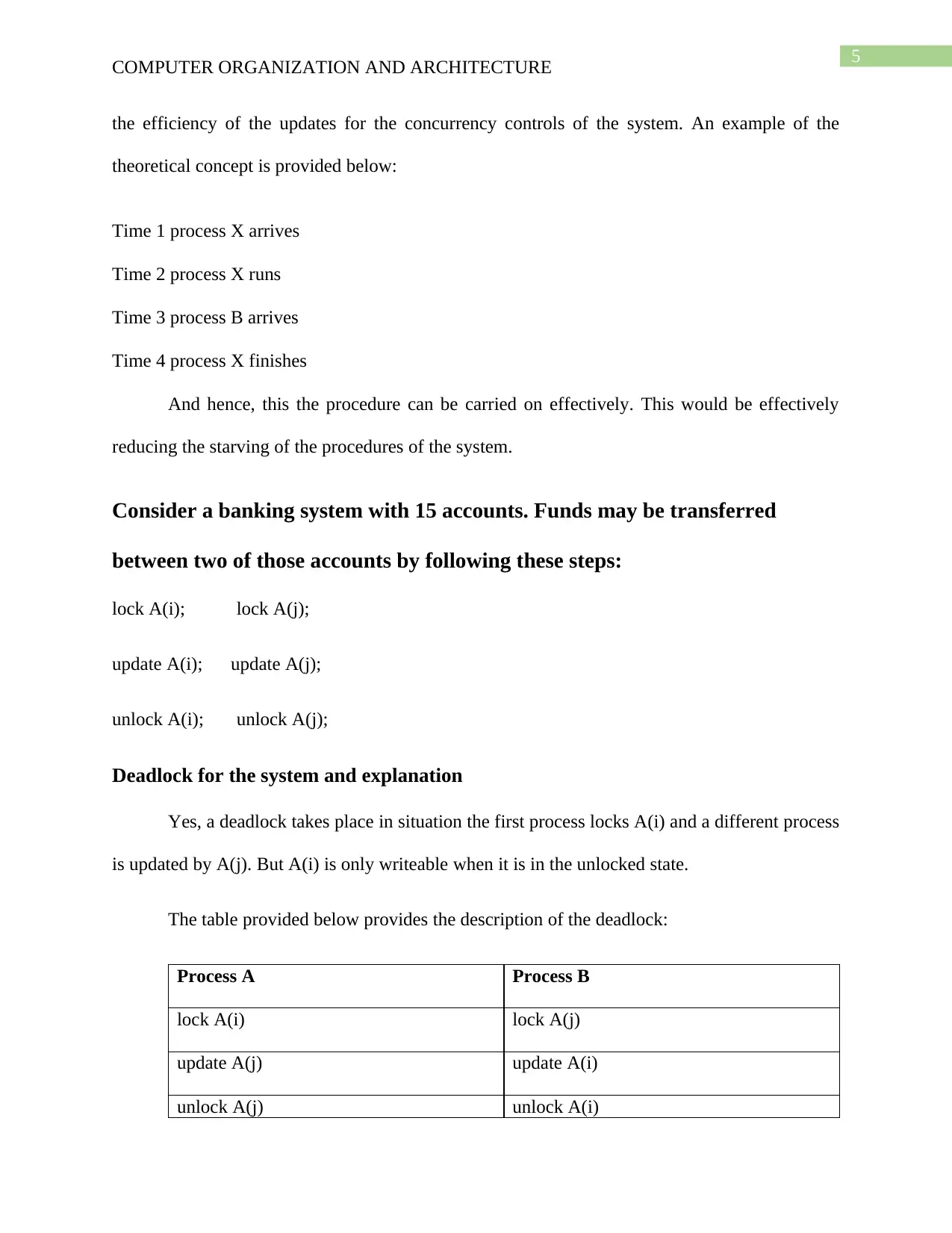
the efficiency of the updates for the concurrency controls of the system. An example of the
theoretical concept is provided below:
Time 1 process X arrives
Time 2 process X runs
Time 3 process B arrives
Time 4 process X finishes
And hence, this the procedure can be carried on effectively. This would be effectively
reducing the starving of the procedures of the system.
Consider a banking system with 15 accounts. Funds may be transferred
between two of those accounts by following these steps:
lock A(i); lock A(j);
update A(i); update A(j);
unlock A(i); unlock A(j);
Deadlock for the system and explanation
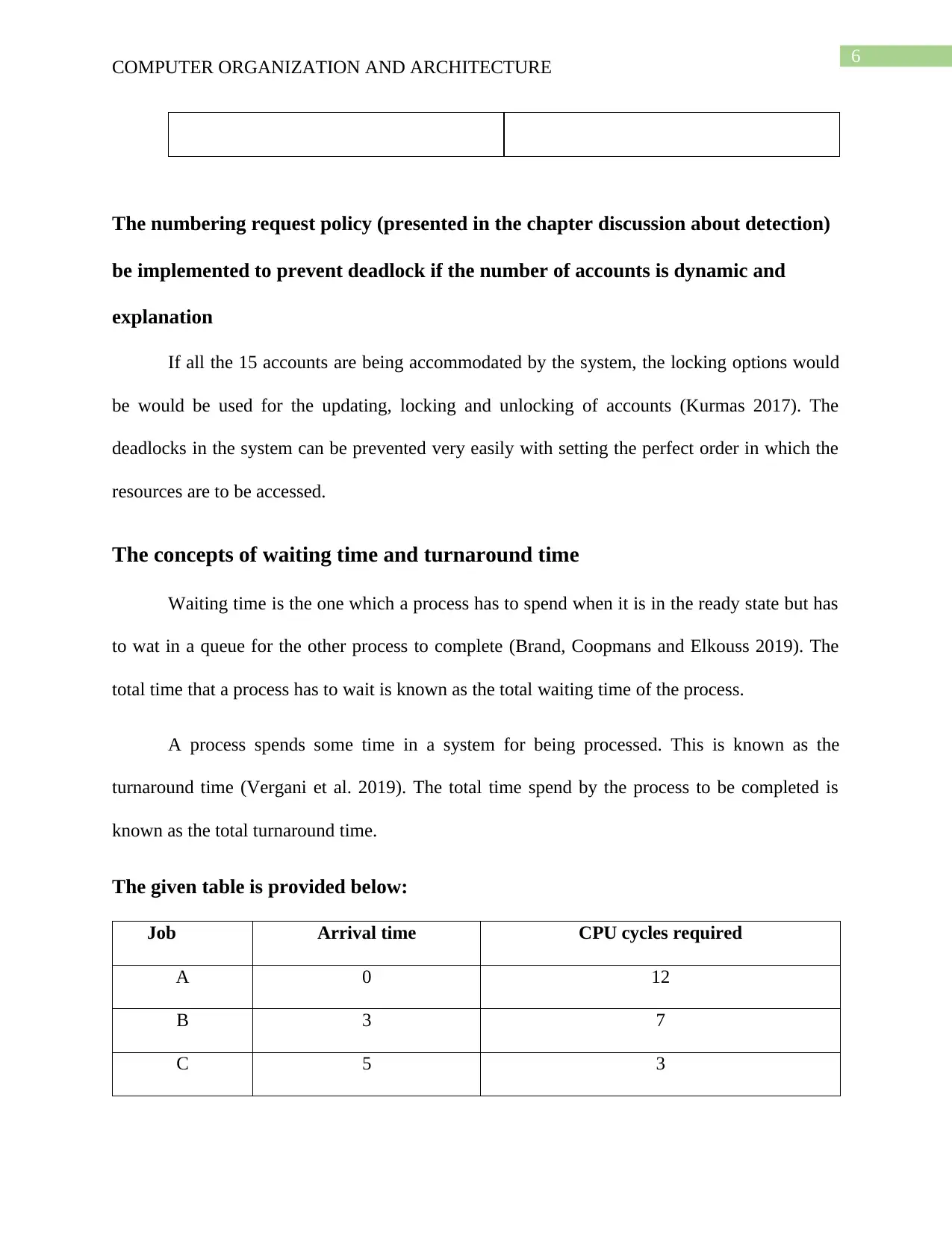
Yes, a deadlock takes place in situation the first process locks A(i) and a different process
is updated by A(j). But A(i) is only writeable when it is in the unlocked state.
The table provided below provides the description of the deadlock:
Process A Process B
lock A(i) lock A(j)
update A(j) update A(i)
unlock A(j) unlock A(i)
COMPUTER ORGANIZATION AND ARCHITECTURE
the efficiency of the updates for the concurrency controls of the system. An example of the
theoretical concept is provided below:
Time 1 process X arrives
Time 2 process X runs
Time 3 process B arrives
Time 4 process X finishes
And hence, this the procedure can be carried on effectively. This would be effectively
reducing the starving of the procedures of the system.
Consider a banking system with 15 accounts. Funds may be transferred
between two of those accounts by following these steps:
lock A(i); lock A(j);
update A(i); update A(j);
unlock A(i); unlock A(j);
Deadlock for the system and explanation
Yes, a deadlock takes place in situation the first process locks A(i) and a different process
is updated by A(j). But A(i) is only writeable when it is in the unlocked state.
The table provided below provides the description of the deadlock:
Process A Process B
lock A(i) lock A(j)
update A(j) update A(i)
unlock A(j) unlock A(i)
⊘ This is a preview!⊘
Do you want full access?
Subscribe today to unlock all pages.
Trusted by 1+ million students worldwide
6
COMPUTER ORGANIZATION AND ARCHITECTURE
The numbering request policy (presented in the chapter discussion about detection)
be implemented to prevent deadlock if the number of accounts is dynamic and
explanation
If all the 15 accounts are being accommodated by the system, the locking options would
be would be used for the updating, locking and unlocking of accounts (Kurmas 2017). The
deadlocks in the system can be prevented very easily with setting the perfect order in which the
resources are to be accessed.
The concepts of waiting time and turnaround time
Waiting time is the one which a process has to spend when it is in the ready state but has
to wat in a queue for the other process to complete (Brand, Coopmans and Elkouss 2019). The
total time that a process has to wait is known as the total waiting time of the process.
A process spends some time in a system for being processed. This is known as the
turnaround time (Vergani et al. 2019). The total time spend by the process to be completed is
known as the total turnaround time.
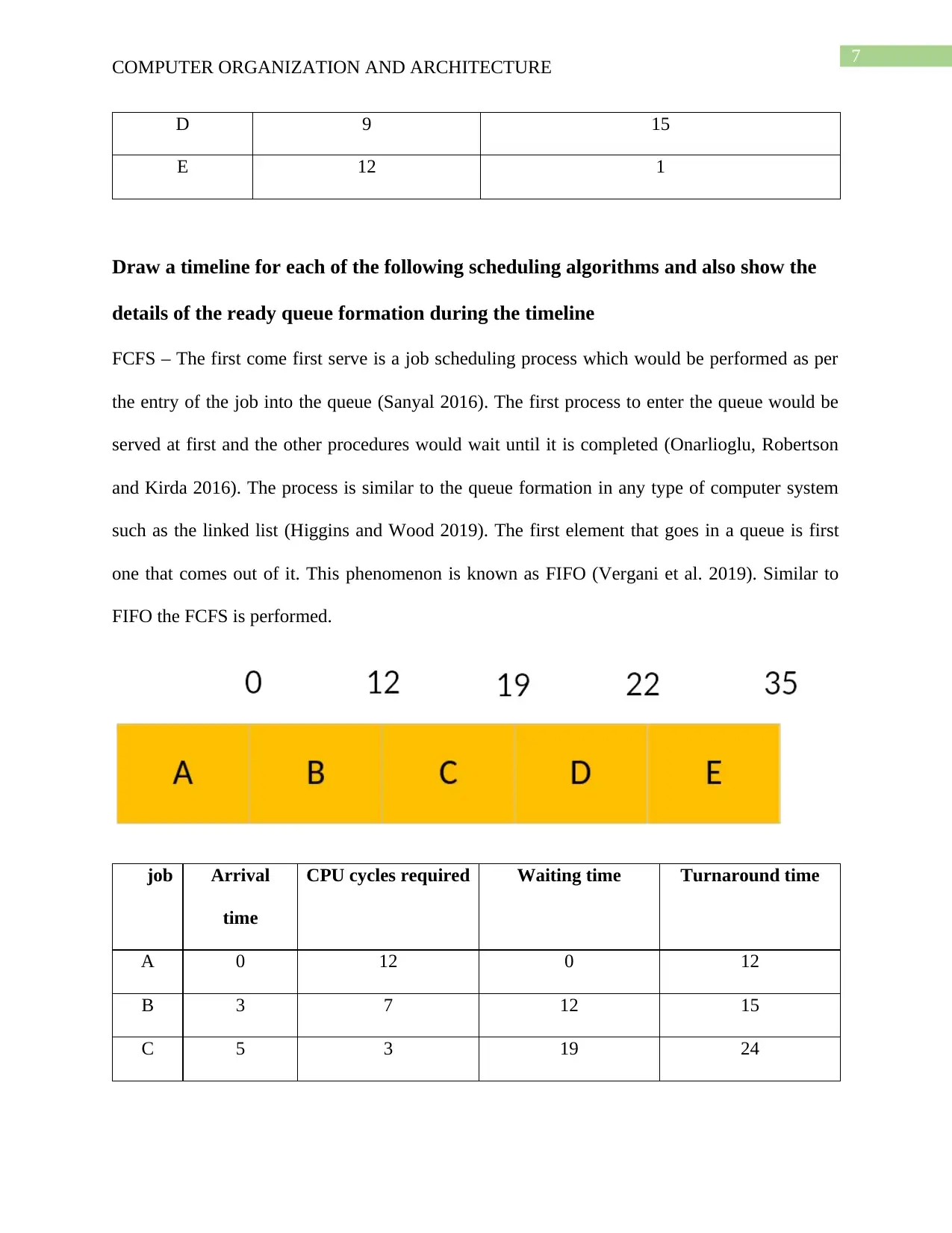
The given table is provided below:
Job Arrival time CPU cycles required
A 0 12
B 3 7
C 5 3
COMPUTER ORGANIZATION AND ARCHITECTURE
The numbering request policy (presented in the chapter discussion about detection)
be implemented to prevent deadlock if the number of accounts is dynamic and
explanation
If all the 15 accounts are being accommodated by the system, the locking options would
be would be used for the updating, locking and unlocking of accounts (Kurmas 2017). The
deadlocks in the system can be prevented very easily with setting the perfect order in which the
resources are to be accessed.
The concepts of waiting time and turnaround time
Waiting time is the one which a process has to spend when it is in the ready state but has
to wat in a queue for the other process to complete (Brand, Coopmans and Elkouss 2019). The
total time that a process has to wait is known as the total waiting time of the process.
A process spends some time in a system for being processed. This is known as the
turnaround time (Vergani et al. 2019). The total time spend by the process to be completed is
known as the total turnaround time.
The given table is provided below:
Job Arrival time CPU cycles required
A 0 12
B 3 7
C 5 3
Paraphrase This Document
Need a fresh take? Get an instant paraphrase of this document with our AI Paraphraser
7
COMPUTER ORGANIZATION AND ARCHITECTURE
D 9 15
E 12 1
Draw a timeline for each of the following scheduling algorithms and also show the
details of the ready queue formation during the timeline
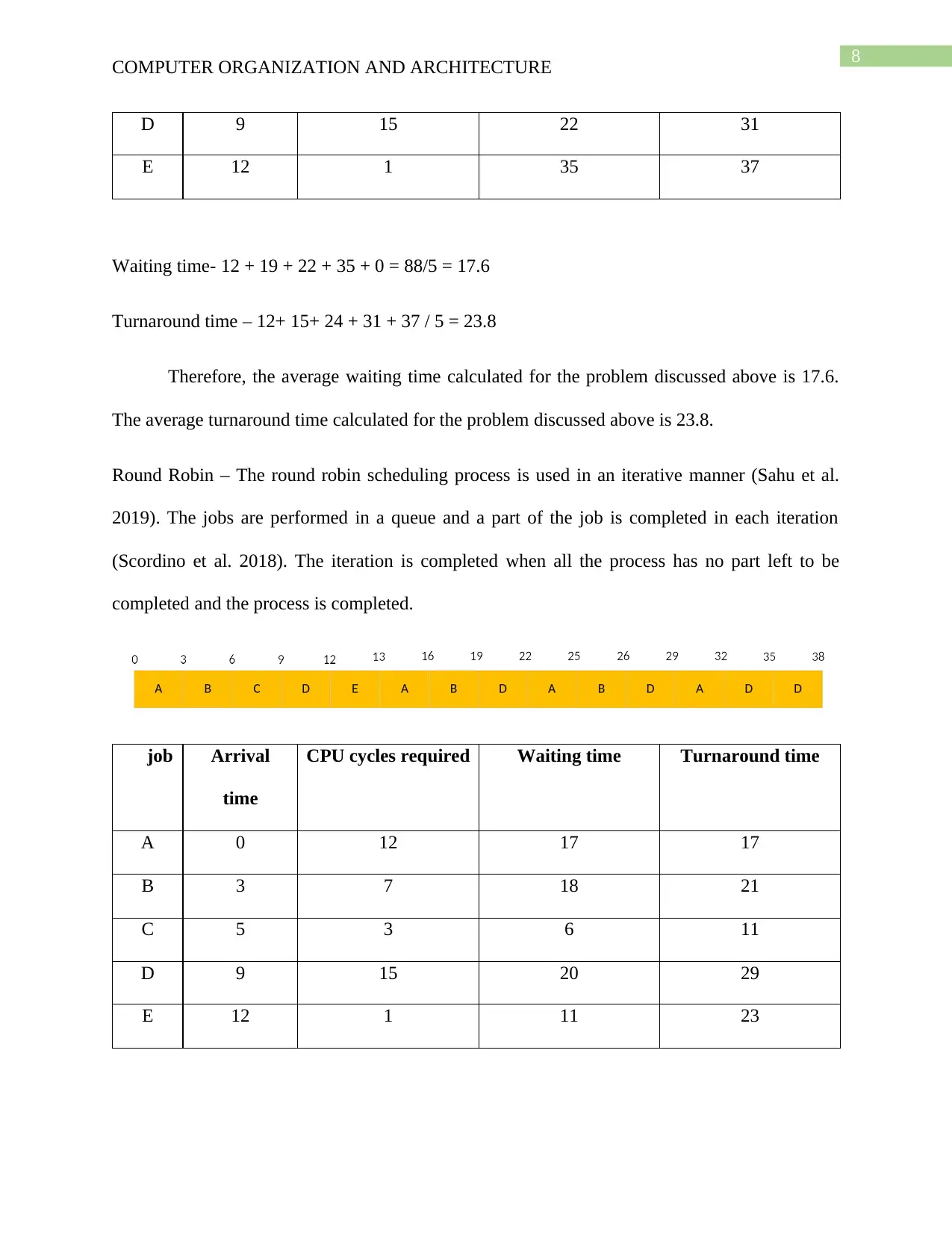
FCFS – The first come first serve is a job scheduling process which would be performed as per
the entry of the job into the queue (Sanyal 2016). The first process to enter the queue would be
served at first and the other procedures would wait until it is completed (Onarlioglu, Robertson
and Kirda 2016). The process is similar to the queue formation in any type of computer system
such as the linked list (Higgins and Wood 2019). The first element that goes in a queue is first
one that comes out of it. This phenomenon is known as FIFO (Vergani et al. 2019). Similar to
FIFO the FCFS is performed.
job Arrival
time
CPU cycles required Waiting time Turnaround time
A 0 12 0 12
B 3 7 12 15
C 5 3 19 24
COMPUTER ORGANIZATION AND ARCHITECTURE
D 9 15
E 12 1
Draw a timeline for each of the following scheduling algorithms and also show the
details of the ready queue formation during the timeline
FCFS – The first come first serve is a job scheduling process which would be performed as per
the entry of the job into the queue (Sanyal 2016). The first process to enter the queue would be
served at first and the other procedures would wait until it is completed (Onarlioglu, Robertson
and Kirda 2016). The process is similar to the queue formation in any type of computer system
such as the linked list (Higgins and Wood 2019). The first element that goes in a queue is first
one that comes out of it. This phenomenon is known as FIFO (Vergani et al. 2019). Similar to
FIFO the FCFS is performed.
job Arrival
time
CPU cycles required Waiting time Turnaround time
A 0 12 0 12
B 3 7 12 15
C 5 3 19 24
8
COMPUTER ORGANIZATION AND ARCHITECTURE
D 9 15 22 31
E 12 1 35 37
Waiting time- 12 + 19 + 22 + 35 + 0 = 88/5 = 17.6
Turnaround time – 12+ 15+ 24 + 31 + 37 / 5 = 23.8
Therefore, the average waiting time calculated for the problem discussed above is 17.6.
The average turnaround time calculated for the problem discussed above is 23.8.
Round Robin – The round robin scheduling process is used in an iterative manner (Sahu et al.
2019). The jobs are performed in a queue and a part of the job is completed in each iteration
(Scordino et al. 2018). The iteration is completed when all the process has no part left to be
completed and the process is completed.
job Arrival
time
CPU cycles required Waiting time Turnaround time
A 0 12 17 17
B 3 7 18 21
C 5 3 6 11
D 9 15 20 29
E 12 1 11 23
COMPUTER ORGANIZATION AND ARCHITECTURE
D 9 15 22 31
E 12 1 35 37
Waiting time- 12 + 19 + 22 + 35 + 0 = 88/5 = 17.6
Turnaround time – 12+ 15+ 24 + 31 + 37 / 5 = 23.8
Therefore, the average waiting time calculated for the problem discussed above is 17.6.
The average turnaround time calculated for the problem discussed above is 23.8.
Round Robin – The round robin scheduling process is used in an iterative manner (Sahu et al.
2019). The jobs are performed in a queue and a part of the job is completed in each iteration
(Scordino et al. 2018). The iteration is completed when all the process has no part left to be
completed and the process is completed.
job Arrival
time
CPU cycles required Waiting time Turnaround time
A 0 12 17 17
B 3 7 18 21
C 5 3 6 11
D 9 15 20 29
E 12 1 11 23
⊘ This is a preview!⊘
Do you want full access?
Subscribe today to unlock all pages.
Trusted by 1+ million students worldwide
9
COMPUTER ORGANIZATION AND ARCHITECTURE
Waiting time – 17 + 18 + 6 + 20 + 11 / 5 = 14.4
Turnaround time – 17 + 21 + 11 + 29 + 23 / 5 = 20.2
Therefore, the average waiting time calculated for the problem discussed above is 14.4.
The average turnaround time calculated for the problem discussed above is 20.2.
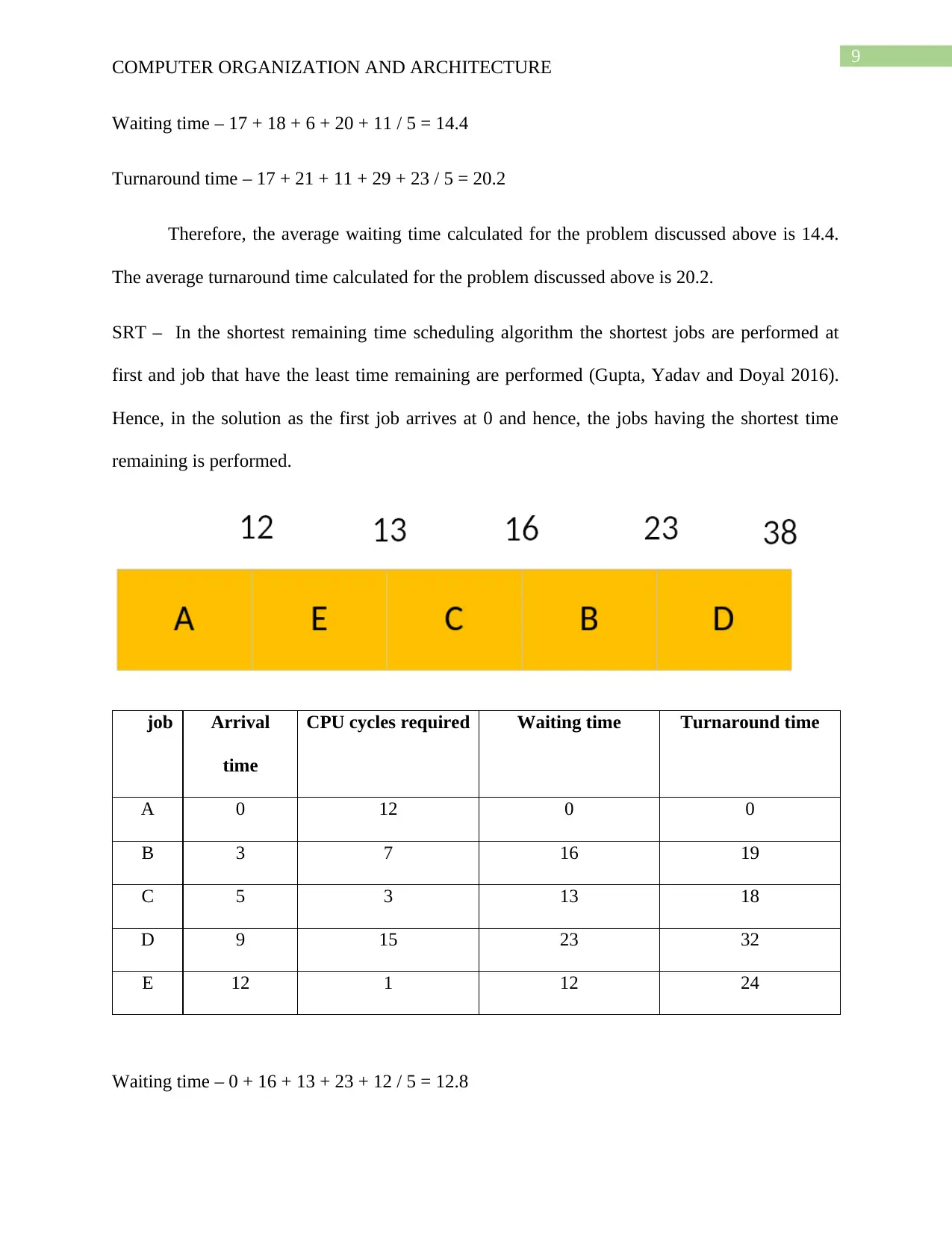
SRT – In the shortest remaining time scheduling algorithm the shortest jobs are performed at
first and job that have the least time remaining are performed (Gupta, Yadav and Doyal 2016).
Hence, in the solution as the first job arrives at 0 and hence, the jobs having the shortest time
remaining is performed.
job Arrival
time
CPU cycles required Waiting time Turnaround time
A 0 12 0 0
B 3 7 16 19
C 5 3 13 18
D 9 15 23 32
E 12 1 12 24
Waiting time – 0 + 16 + 13 + 23 + 12 / 5 = 12.8
COMPUTER ORGANIZATION AND ARCHITECTURE
Waiting time – 17 + 18 + 6 + 20 + 11 / 5 = 14.4
Turnaround time – 17 + 21 + 11 + 29 + 23 / 5 = 20.2
Therefore, the average waiting time calculated for the problem discussed above is 14.4.
The average turnaround time calculated for the problem discussed above is 20.2.
SRT – In the shortest remaining time scheduling algorithm the shortest jobs are performed at
first and job that have the least time remaining are performed (Gupta, Yadav and Doyal 2016).
Hence, in the solution as the first job arrives at 0 and hence, the jobs having the shortest time
remaining is performed.
job Arrival
time
CPU cycles required Waiting time Turnaround time
A 0 12 0 0
B 3 7 16 19
C 5 3 13 18
D 9 15 23 32
E 12 1 12 24
Waiting time – 0 + 16 + 13 + 23 + 12 / 5 = 12.8
Paraphrase This Document
Need a fresh take? Get an instant paraphrase of this document with our AI Paraphraser
10
COMPUTER ORGANIZATION AND ARCHITECTURE
Turnaround time – 0 + 18 + 18 + 26 + 23 / 5 = 17
Therefore, the average waiting time calculated for the problem discussed above is 12.8.
The average turnaround time calculated for the problem discussed above is 17.
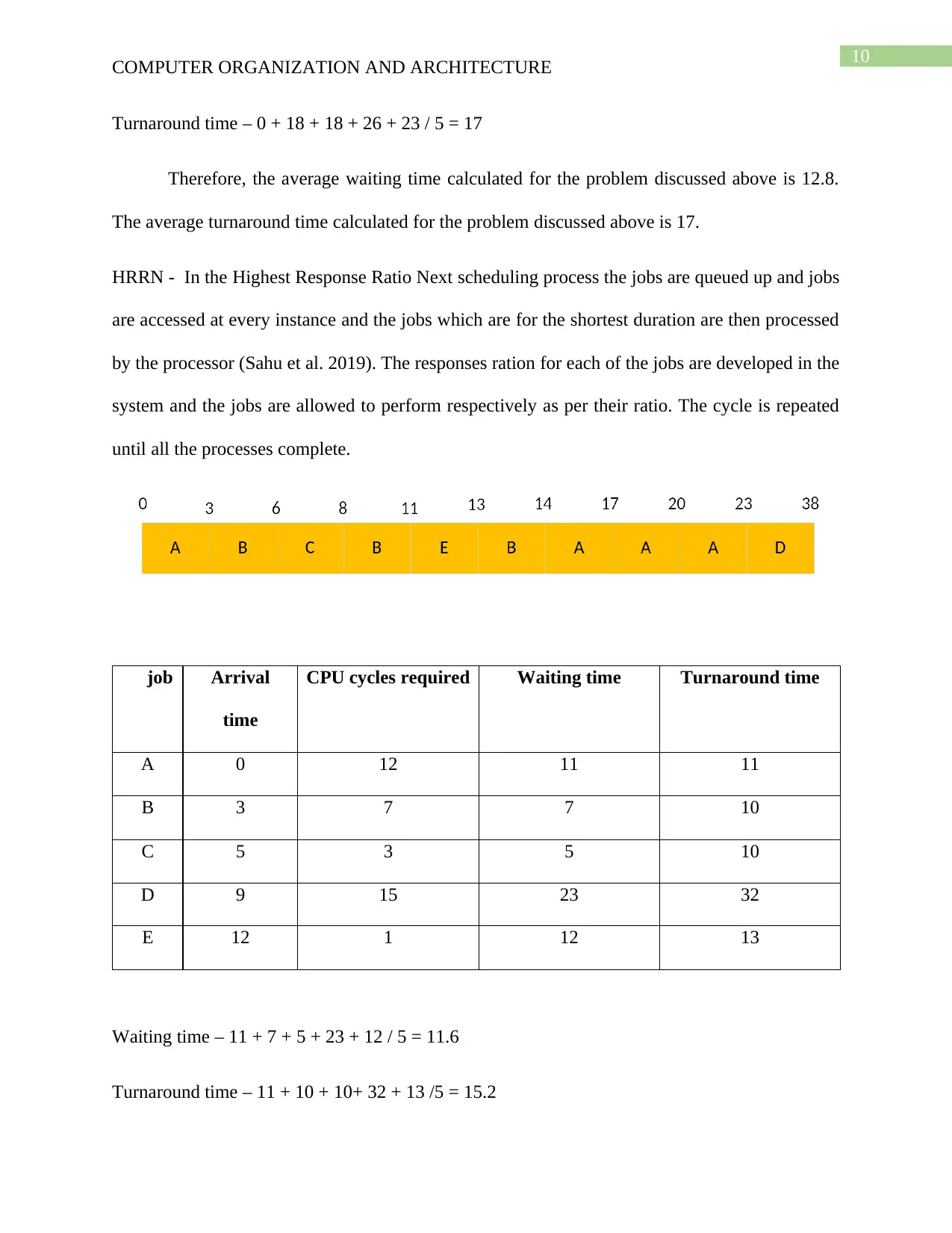
HRRN - In the Highest Response Ratio Next scheduling process the jobs are queued up and jobs
are accessed at every instance and the jobs which are for the shortest duration are then processed
by the processor (Sahu et al. 2019). The responses ration for each of the jobs are developed in the
system and the jobs are allowed to perform respectively as per their ratio. The cycle is repeated
until all the processes complete.
job Arrival
time
CPU cycles required Waiting time Turnaround time
A 0 12 11 11
B 3 7 7 10
C 5 3 5 10
D 9 15 23 32
E 12 1 12 13
Waiting time – 11 + 7 + 5 + 23 + 12 / 5 = 11.6
Turnaround time – 11 + 10 + 10+ 32 + 13 /5 = 15.2
COMPUTER ORGANIZATION AND ARCHITECTURE
Turnaround time – 0 + 18 + 18 + 26 + 23 / 5 = 17
Therefore, the average waiting time calculated for the problem discussed above is 12.8.
The average turnaround time calculated for the problem discussed above is 17.
HRRN - In the Highest Response Ratio Next scheduling process the jobs are queued up and jobs
are accessed at every instance and the jobs which are for the shortest duration are then processed
by the processor (Sahu et al. 2019). The responses ration for each of the jobs are developed in the
system and the jobs are allowed to perform respectively as per their ratio. The cycle is repeated
until all the processes complete.
job Arrival
time
CPU cycles required Waiting time Turnaround time
A 0 12 11 11
B 3 7 7 10
C 5 3 5 10
D 9 15 23 32
E 12 1 12 13
Waiting time – 11 + 7 + 5 + 23 + 12 / 5 = 11.6
Turnaround time – 11 + 10 + 10+ 32 + 13 /5 = 15.2
11
COMPUTER ORGANIZATION AND ARCHITECTURE
Therefore, the average waiting time calculated for the problem discussed above is 11.6.
The average turnaround time calculated for the problem discussed above is 15.2.
Resource graph related discussions:
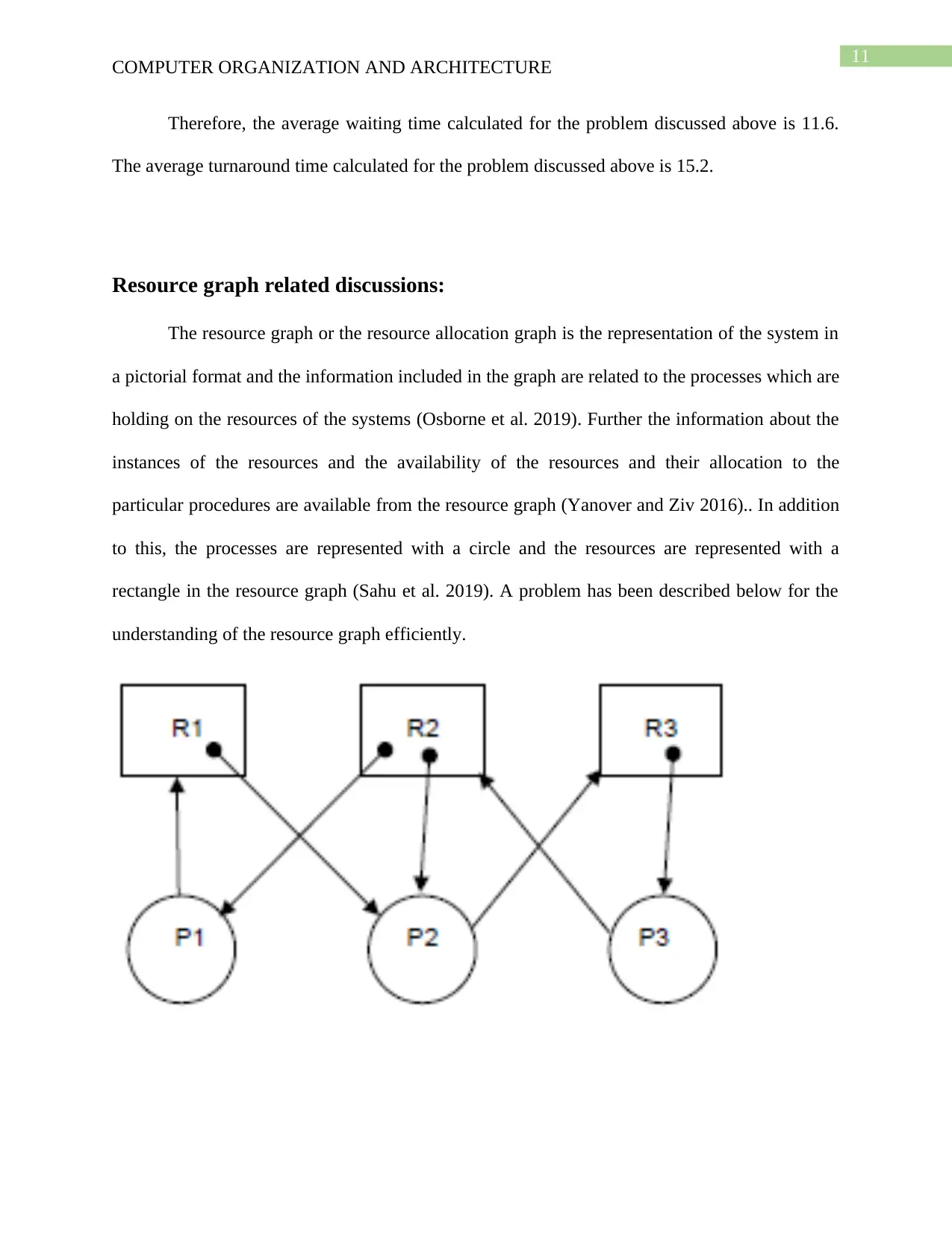
The resource graph or the resource allocation graph is the representation of the system in
a pictorial format and the information included in the graph are related to the processes which are
holding on the resources of the systems (Osborne et al. 2019). Further the information about the
instances of the resources and the availability of the resources and their allocation to the
particular procedures are available from the resource graph (Yanover and Ziv 2016).. In addition
to this, the processes are represented with a circle and the resources are represented with a
rectangle in the resource graph (Sahu et al. 2019). A problem has been described below for the
understanding of the resource graph efficiently.
COMPUTER ORGANIZATION AND ARCHITECTURE
Therefore, the average waiting time calculated for the problem discussed above is 11.6.
The average turnaround time calculated for the problem discussed above is 15.2.
Resource graph related discussions:
The resource graph or the resource allocation graph is the representation of the system in
a pictorial format and the information included in the graph are related to the processes which are
holding on the resources of the systems (Osborne et al. 2019). Further the information about the
instances of the resources and the availability of the resources and their allocation to the
particular procedures are available from the resource graph (Yanover and Ziv 2016).. In addition
to this, the processes are represented with a circle and the resources are represented with a
rectangle in the resource graph (Sahu et al. 2019). A problem has been described below for the
understanding of the resource graph efficiently.
⊘ This is a preview!⊘
Do you want full access?
Subscribe today to unlock all pages.
Trusted by 1+ million students worldwide

1 out of 16


Related Documents


Your All-in-One AI-Powered Toolkit for Academic Success.
+13062052269
info@desklib.com
Available 24*7 on WhatsApp / Email
![[object Object]](/_next/static/media/star-bottom.7253800d.svg)
Unlock your academic potential
Copyright © 2020–2026 A2Z Services. All Rights Reserved. Developed and managed by ZUCOL.