Impact of Computer Technology on Accounting System: An Armco Study
VerifiedAdded on 2023/06/12
|30
|7398
|220
Project
AI Summary
This project examines the impact of computer technology on accounting systems, focusing on its effects on employment at Armco, a global packaging company in Melbourne. It begins with an introduction to accounting and the transformative role of technology, particularly automation, in modernizing accounting practices. The research objectives include assessing the specific impacts of computer technology on accounting systems, exploring its influence on employment within the accounting profession, and identifying factors that limit the adoption of technology in this field. The methodology involves a descriptive survey and a mixed-methods approach, utilizing questionnaires and secondary data from literature reviews and company documents to gather insights from a sample of 100 employees in Armco's finance department. Data analysis will be conducted using SPSS, employing both descriptive and inferential statistics to address the research questions and objectives. The study also considers ethical issues related to data collection and participant privacy.
Computer Technology 1
Impact of Computer Technology in Accounting System and Its Effects on Employment: A
Case Study of Armco, Melbourne.
by
Course:
Tutor:
University:
Department:
Date:
Impact of Computer Technology in Accounting System and Its Effects on Employment: A
Case Study of Armco, Melbourne.
by
Course:
Tutor:
University:
Department:
Date:

Paraphrase This Document
Need a fresh take? Get an instant paraphrase of this document with our AI Paraphraser
Computer Technology 2
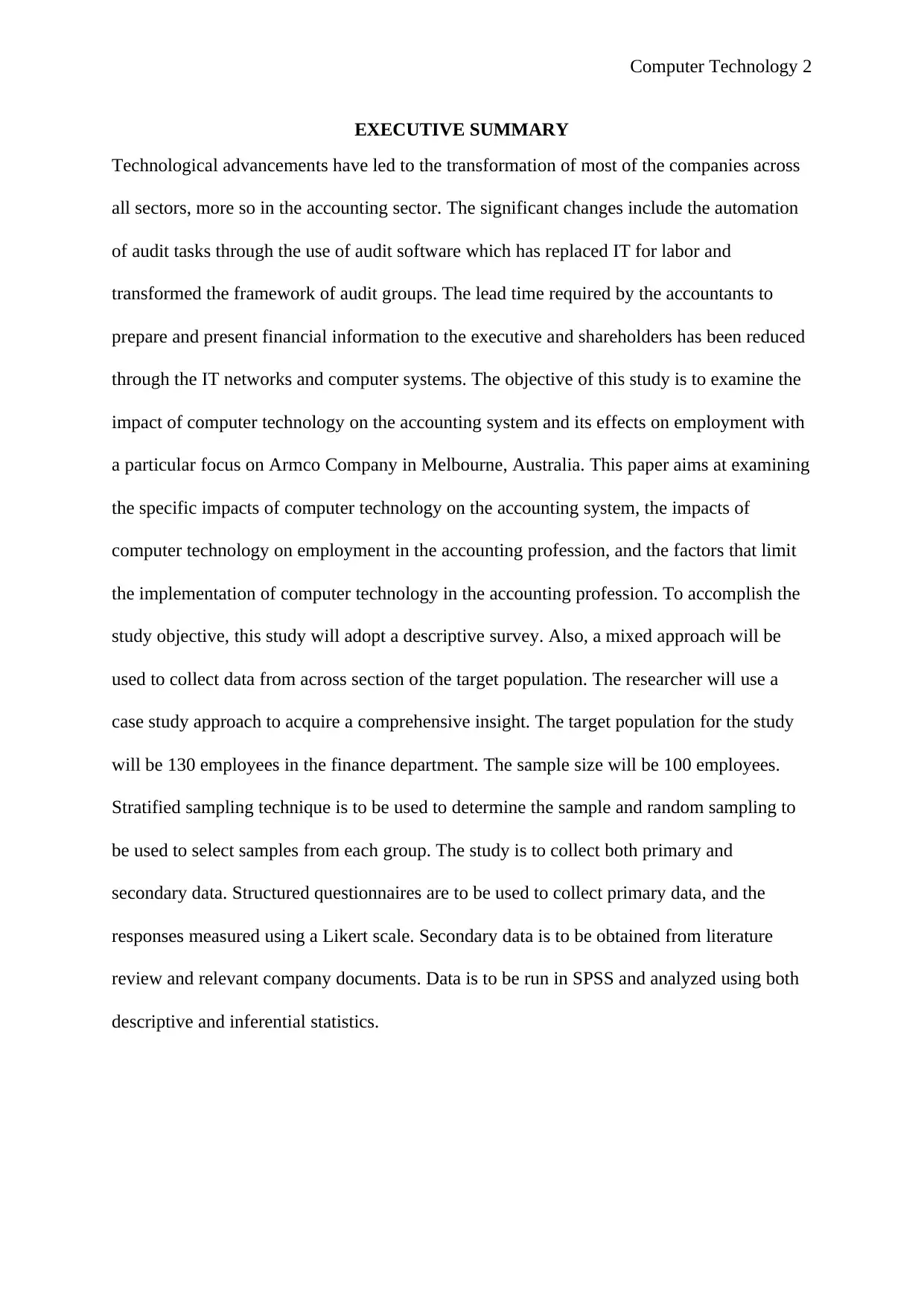
EXECUTIVE SUMMARY
Technological advancements have led to the transformation of most of the companies across
all sectors, more so in the accounting sector. The significant changes include the automation
of audit tasks through the use of audit software which has replaced IT for labor and
transformed the framework of audit groups. The lead time required by the accountants to
prepare and present financial information to the executive and shareholders has been reduced
through the IT networks and computer systems. The objective of this study is to examine the
impact of computer technology on the accounting system and its effects on employment with
a particular focus on Armco Company in Melbourne, Australia. This paper aims at examining
the specific impacts of computer technology on the accounting system, the impacts of
computer technology on employment in the accounting profession, and the factors that limit
the implementation of computer technology in the accounting profession. To accomplish the
study objective, this study will adopt a descriptive survey. Also, a mixed approach will be
used to collect data from across section of the target population. The researcher will use a
case study approach to acquire a comprehensive insight. The target population for the study
will be 130 employees in the finance department. The sample size will be 100 employees.
Stratified sampling technique is to be used to determine the sample and random sampling to
be used to select samples from each group. The study is to collect both primary and
secondary data. Structured questionnaires are to be used to collect primary data, and the
responses measured using a Likert scale. Secondary data is to be obtained from literature
review and relevant company documents. Data is to be run in SPSS and analyzed using both
descriptive and inferential statistics.
EXECUTIVE SUMMARY
Technological advancements have led to the transformation of most of the companies across
all sectors, more so in the accounting sector. The significant changes include the automation
of audit tasks through the use of audit software which has replaced IT for labor and
transformed the framework of audit groups. The lead time required by the accountants to
prepare and present financial information to the executive and shareholders has been reduced
through the IT networks and computer systems. The objective of this study is to examine the
impact of computer technology on the accounting system and its effects on employment with
a particular focus on Armco Company in Melbourne, Australia. This paper aims at examining
the specific impacts of computer technology on the accounting system, the impacts of
computer technology on employment in the accounting profession, and the factors that limit
the implementation of computer technology in the accounting profession. To accomplish the
study objective, this study will adopt a descriptive survey. Also, a mixed approach will be
used to collect data from across section of the target population. The researcher will use a
case study approach to acquire a comprehensive insight. The target population for the study
will be 130 employees in the finance department. The sample size will be 100 employees.
Stratified sampling technique is to be used to determine the sample and random sampling to
be used to select samples from each group. The study is to collect both primary and
secondary data. Structured questionnaires are to be used to collect primary data, and the
responses measured using a Likert scale. Secondary data is to be obtained from literature
review and relevant company documents. Data is to be run in SPSS and analyzed using both
descriptive and inferential statistics.
Computer Technology 3
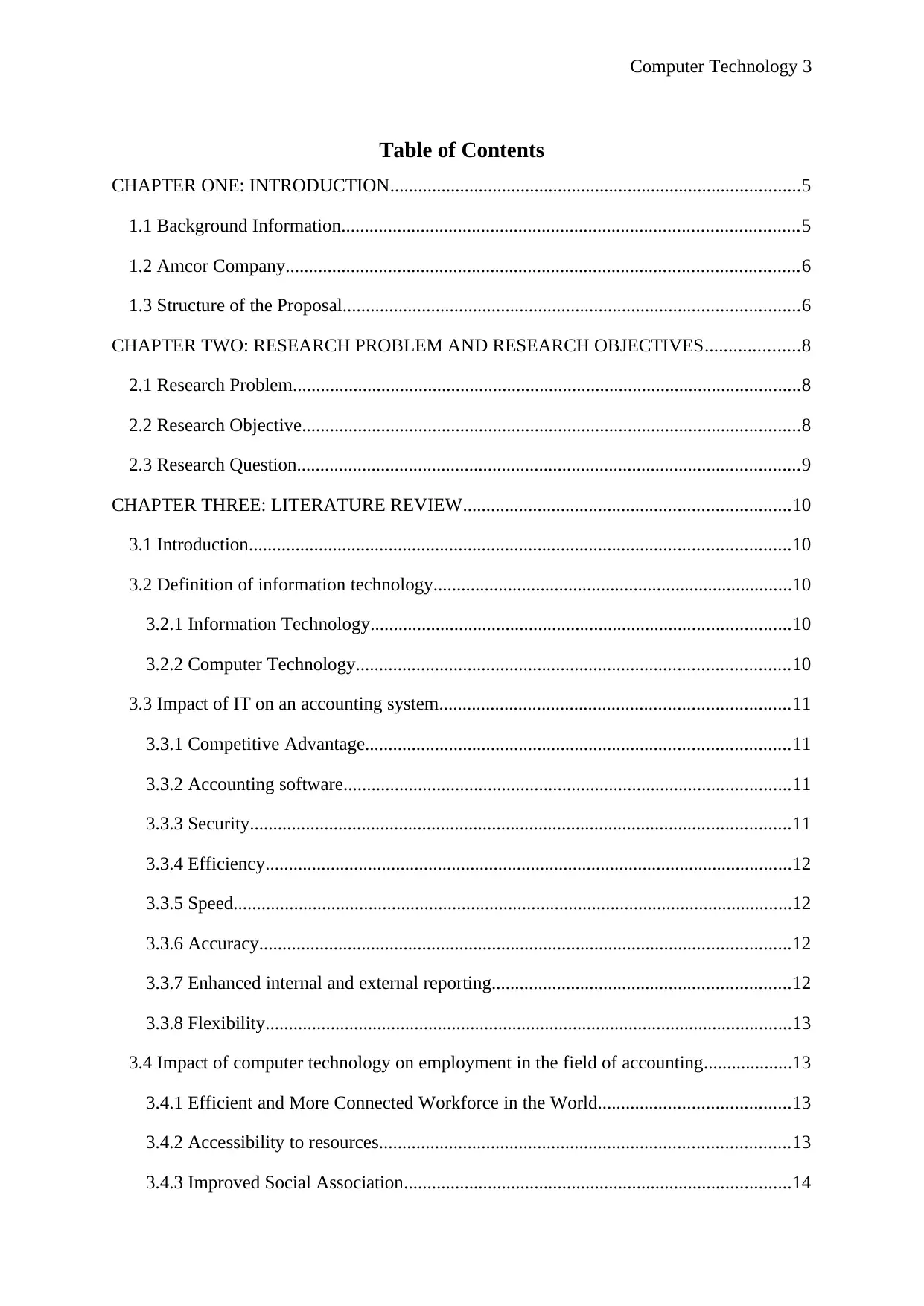
Table of Contents
CHAPTER ONE: INTRODUCTION........................................................................................5
1.1 Background Information..................................................................................................5
1.2 Amcor Company..............................................................................................................6
1.3 Structure of the Proposal..................................................................................................6
CHAPTER TWO: RESEARCH PROBLEM AND RESEARCH OBJECTIVES....................8
2.1 Research Problem.............................................................................................................8
2.2 Research Objective...........................................................................................................8
2.3 Research Question............................................................................................................9
CHAPTER THREE: LITERATURE REVIEW......................................................................10
3.1 Introduction....................................................................................................................10
3.2 Definition of information technology.............................................................................10
3.2.1 Information Technology..........................................................................................10
3.2.2 Computer Technology.............................................................................................10
3.3 Impact of IT on an accounting system...........................................................................11
3.3.1 Competitive Advantage...........................................................................................11
3.3.2 Accounting software................................................................................................11
3.3.3 Security....................................................................................................................11
3.3.4 Efficiency.................................................................................................................12
3.3.5 Speed........................................................................................................................12
3.3.6 Accuracy..................................................................................................................12
3.3.7 Enhanced internal and external reporting................................................................12
3.3.8 Flexibility.................................................................................................................13
3.4 Impact of computer technology on employment in the field of accounting...................13
3.4.1 Efficient and More Connected Workforce in the World.........................................13
3.4.2 Accessibility to resources........................................................................................13
3.4.3 Improved Social Association...................................................................................14
Table of Contents
CHAPTER ONE: INTRODUCTION........................................................................................5
1.1 Background Information..................................................................................................5
1.2 Amcor Company..............................................................................................................6
1.3 Structure of the Proposal..................................................................................................6
CHAPTER TWO: RESEARCH PROBLEM AND RESEARCH OBJECTIVES....................8
2.1 Research Problem.............................................................................................................8
2.2 Research Objective...........................................................................................................8
2.3 Research Question............................................................................................................9
CHAPTER THREE: LITERATURE REVIEW......................................................................10
3.1 Introduction....................................................................................................................10
3.2 Definition of information technology.............................................................................10
3.2.1 Information Technology..........................................................................................10
3.2.2 Computer Technology.............................................................................................10
3.3 Impact of IT on an accounting system...........................................................................11
3.3.1 Competitive Advantage...........................................................................................11
3.3.2 Accounting software................................................................................................11
3.3.3 Security....................................................................................................................11
3.3.4 Efficiency.................................................................................................................12
3.3.5 Speed........................................................................................................................12
3.3.6 Accuracy..................................................................................................................12
3.3.7 Enhanced internal and external reporting................................................................12
3.3.8 Flexibility.................................................................................................................13
3.4 Impact of computer technology on employment in the field of accounting...................13
3.4.1 Efficient and More Connected Workforce in the World.........................................13
3.4.2 Accessibility to resources........................................................................................13
3.4.3 Improved Social Association...................................................................................14
⊘ This is a preview!⊘
Do you want full access?
Subscribe today to unlock all pages.

Trusted by 1+ million students worldwide
Computer Technology 4
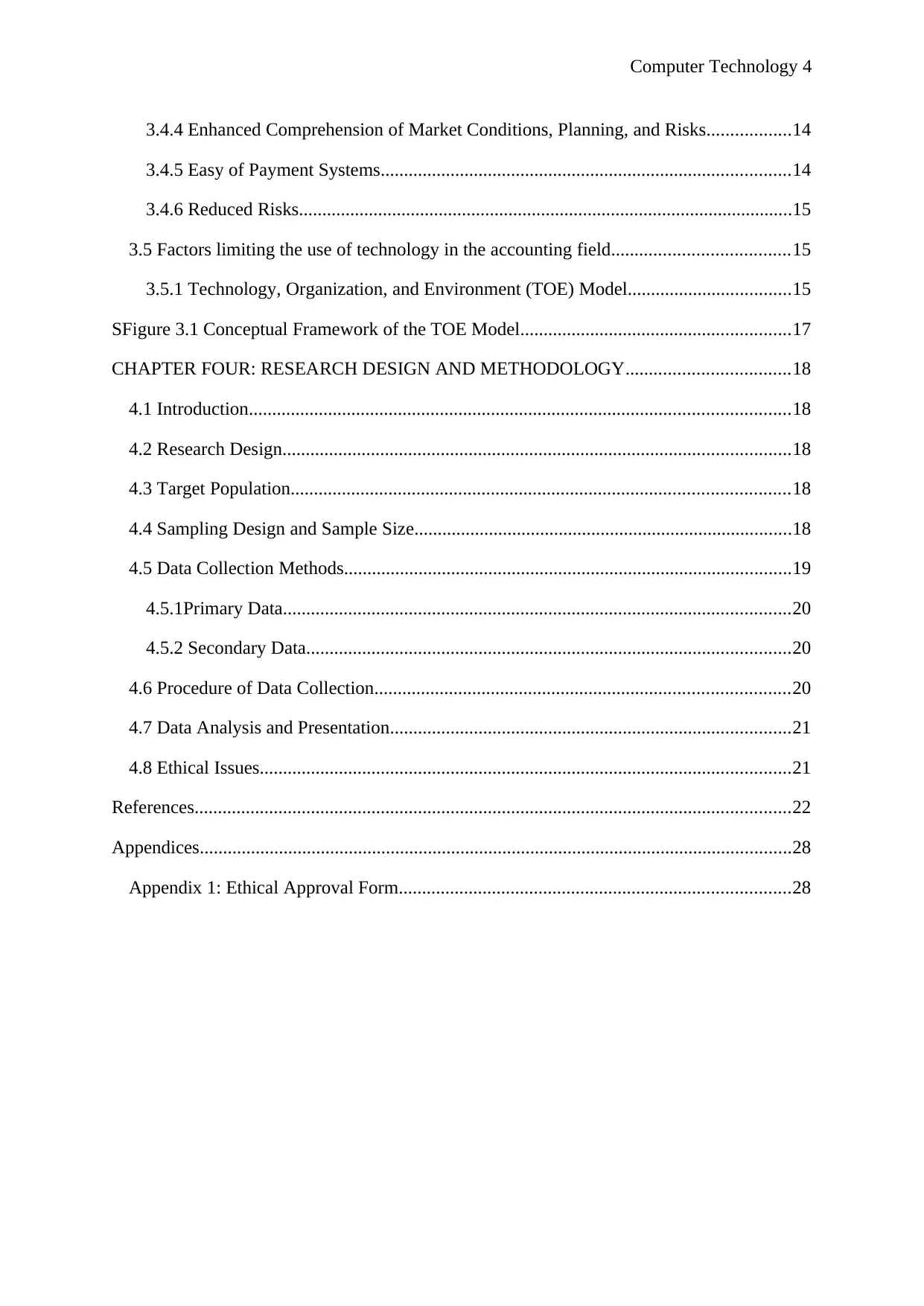
3.4.4 Enhanced Comprehension of Market Conditions, Planning, and Risks..................14
3.4.5 Easy of Payment Systems........................................................................................14
3.4.6 Reduced Risks..........................................................................................................15
3.5 Factors limiting the use of technology in the accounting field......................................15
3.5.1 Technology, Organization, and Environment (TOE) Model...................................15
SFigure 3.1 Conceptual Framework of the TOE Model..........................................................17
CHAPTER FOUR: RESEARCH DESIGN AND METHODOLOGY...................................18
4.1 Introduction....................................................................................................................18
4.2 Research Design.............................................................................................................18
4.3 Target Population...........................................................................................................18
4.4 Sampling Design and Sample Size.................................................................................18
4.5 Data Collection Methods................................................................................................19
4.5.1Primary Data.............................................................................................................20
4.5.2 Secondary Data........................................................................................................20
4.6 Procedure of Data Collection.........................................................................................20
4.7 Data Analysis and Presentation......................................................................................21
4.8 Ethical Issues..................................................................................................................21
References................................................................................................................................22
Appendices...............................................................................................................................28
Appendix 1: Ethical Approval Form....................................................................................28
3.4.4 Enhanced Comprehension of Market Conditions, Planning, and Risks..................14
3.4.5 Easy of Payment Systems........................................................................................14
3.4.6 Reduced Risks..........................................................................................................15
3.5 Factors limiting the use of technology in the accounting field......................................15
3.5.1 Technology, Organization, and Environment (TOE) Model...................................15
SFigure 3.1 Conceptual Framework of the TOE Model..........................................................17
CHAPTER FOUR: RESEARCH DESIGN AND METHODOLOGY...................................18
4.1 Introduction....................................................................................................................18
4.2 Research Design.............................................................................................................18
4.3 Target Population...........................................................................................................18
4.4 Sampling Design and Sample Size.................................................................................18
4.5 Data Collection Methods................................................................................................19
4.5.1Primary Data.............................................................................................................20
4.5.2 Secondary Data........................................................................................................20
4.6 Procedure of Data Collection.........................................................................................20
4.7 Data Analysis and Presentation......................................................................................21
4.8 Ethical Issues..................................................................................................................21
References................................................................................................................................22
Appendices...............................................................................................................................28
Appendix 1: Ethical Approval Form....................................................................................28
Paraphrase This Document
Need a fresh take? Get an instant paraphrase of this document with our AI Paraphraser
Computer Technology 5
CHAPTER ONE: INTRODUCTION
1.1 Background Information
Accounting is the system an organization uses to measure its financial performance by
recording and grouping all the transactions such as assets, liabilities, purchases, and sales in
accordance to the accepted standard layouts (Zimmerman and Yahya-Zadeh, 2011). It assists
in assessing a firm’s past performance, current condition, and future expectations.
Accounting can formally be defined as the art of recording, classifying, and summarizing
essential transactions and activities which are to some extent monetary and inferring the
outcomes thereof (Weygandt et al., 2010). Technological advancements have led to the
transformation of most of the companies in professional services sectors, especially those in
the public accounting sector. The significant changes include the automation of audit tasks
through the use of audit software which has replaced IT for labor and transformed the
framework of audit groups (Cordella and Iannacci, 2010).
Business operations have generally been transformed by computers, the internet, wireless,
servers and individual technical devices. The software packages have also advanced the
conventional business activities. The general paper ledgers and accounting records have been
automated through the use of accounting software. Information technology has brought
critical advantages for accounting departments. The lead time required by the accountants to
prepare and present financial information to the executive and shareholders has been reduced
through the IT networks and computer systems. Additionally, it has enhanced the general
efficiency and accuracy of the submitted information. The most significant impact of IT on
accounting is the ability of firms to cultivate and use computerized systems to trail and note
financial transactions. Manual spreadsheets, paper ledgers, financial statements in hard copy
have all been transformed into computer systems that can show personal sales and financial
reports.
CHAPTER ONE: INTRODUCTION
1.1 Background Information
Accounting is the system an organization uses to measure its financial performance by
recording and grouping all the transactions such as assets, liabilities, purchases, and sales in
accordance to the accepted standard layouts (Zimmerman and Yahya-Zadeh, 2011). It assists
in assessing a firm’s past performance, current condition, and future expectations.
Accounting can formally be defined as the art of recording, classifying, and summarizing
essential transactions and activities which are to some extent monetary and inferring the
outcomes thereof (Weygandt et al., 2010). Technological advancements have led to the
transformation of most of the companies in professional services sectors, especially those in
the public accounting sector. The significant changes include the automation of audit tasks
through the use of audit software which has replaced IT for labor and transformed the
framework of audit groups (Cordella and Iannacci, 2010).
Business operations have generally been transformed by computers, the internet, wireless,
servers and individual technical devices. The software packages have also advanced the
conventional business activities. The general paper ledgers and accounting records have been
automated through the use of accounting software. Information technology has brought
critical advantages for accounting departments. The lead time required by the accountants to
prepare and present financial information to the executive and shareholders has been reduced
through the IT networks and computer systems. Additionally, it has enhanced the general
efficiency and accuracy of the submitted information. The most significant impact of IT on
accounting is the ability of firms to cultivate and use computerized systems to trail and note
financial transactions. Manual spreadsheets, paper ledgers, financial statements in hard copy
have all been transformed into computer systems that can show personal sales and financial
reports.
Computer Technology 6
1.2 Amcor Company
Amcor is a global leader in developing and producing the best quality, ethical packaging for
multiple types of food, beverage, pharmacological, and other products. The organization has
35,000 employees distributed in 43 countries. Samuel Ramsden founded Armco in the 1860s.
The company. Armco has an ultra-modern and functional electronic data processing center in
Melbourne city which houses and processes most of the firms’ data. Other computer
terminals are located in each subsidiary. The organization has automated almost all of its
operations. More specifically, the accounting system of the company is fully automated, for
example, the accounts receivable, all ledgers and inventory. There is a payroll system for all
the employees in the Amcor Company in Melbourne city which is computerized. Computer
application has also been used in inventory, billing, and registration of shares (Amcor, no
date).
1.3 Structure of the Proposal
For clarity, orderliness and useful flow, reading and understanding of the research project,
this study have been structured and sectioned into four chapters with each addressing specific
elements of the topic under investigation. The first chapter comprises of the project proposal
and background information regarding the research. It includes the overall introduction and
background knowledge of the study, and overview of the client organization. Chapter two
involves the research problem, research objectives, and research questions. Section three
provides a review of literature relevant to the study topic with the aim of placing the study
within existing studies and searches existing knowledge in the area of study. Chapter four
presents a detailed plan of research methodology and design. The chapter shows the type of
research and research approach to be undertaken in the actual research. It also describes the
type of data to be used and the procedure of data collection. The proposed sample, sampling
frame, methods and approach to be used in addition to the characteristics of the sample and
1.2 Amcor Company
Amcor is a global leader in developing and producing the best quality, ethical packaging for
multiple types of food, beverage, pharmacological, and other products. The organization has
35,000 employees distributed in 43 countries. Samuel Ramsden founded Armco in the 1860s.
The company. Armco has an ultra-modern and functional electronic data processing center in
Melbourne city which houses and processes most of the firms’ data. Other computer
terminals are located in each subsidiary. The organization has automated almost all of its
operations. More specifically, the accounting system of the company is fully automated, for
example, the accounts receivable, all ledgers and inventory. There is a payroll system for all
the employees in the Amcor Company in Melbourne city which is computerized. Computer
application has also been used in inventory, billing, and registration of shares (Amcor, no
date).
1.3 Structure of the Proposal
For clarity, orderliness and useful flow, reading and understanding of the research project,
this study have been structured and sectioned into four chapters with each addressing specific
elements of the topic under investigation. The first chapter comprises of the project proposal
and background information regarding the research. It includes the overall introduction and
background knowledge of the study, and overview of the client organization. Chapter two
involves the research problem, research objectives, and research questions. Section three
provides a review of literature relevant to the study topic with the aim of placing the study
within existing studies and searches existing knowledge in the area of study. Chapter four
presents a detailed plan of research methodology and design. The chapter shows the type of
research and research approach to be undertaken in the actual research. It also describes the
type of data to be used and the procedure of data collection. The proposed sample, sampling
frame, methods and approach to be used in addition to the characteristics of the sample and
⊘ This is a preview!⊘
Do you want full access?
Subscribe today to unlock all pages.
Trusted by 1+ million students worldwide
Computer Technology 7
its size are all included in chapter three. The chapter also informs on the data analysis
technique and any ethical issues associated with the proposed study.
its size are all included in chapter three. The chapter also informs on the data analysis
technique and any ethical issues associated with the proposed study.
Paraphrase This Document
Need a fresh take? Get an instant paraphrase of this document with our AI Paraphraser
Computer Technology 8
CHAPTER TWO: RESEARCH PROBLEM AND RESEARCH OBJECTIVES
2.1 Research Problem
Organizations in almost all industries have adopted information technology in most of their
operations, and the advantages associated with it are undoubted. Generally, there is more
efficient and effectiveness in business operations and customer management leading to
increased productivity as a result of the integration of information technology (Bayo-
Moriones et al., 2013; Abubakar and Tasmin, 2012). The service sector, which is one of the
driving force in the economy of Australia, appears to have been left behind in the exploration
of IT operations. Most of the existing studies have focused on the impact of IT on the
banking industry (Osabuohien, 2008; Aduda and Kingoo, 2012), and on accounting system
(Ghasemi et al., 2011; Kim et al., 2009). But very few studies have assessed the impact of
computer technology on accounting system in connection with its effect on employment in
the Australian context. This, therefore, makes-up a research gap, and it is the objective of this
study to fill it. Thus, this research seeks to ascertain the impact of computer technology on
the accounting system and its effect on employee engagement using Amcor in Melbourne
city, Australia as a case study.
2.2 Research Objective
The general objective of this research is to ascertain the impact of computer technology on
the accounting system and its effect on employment of Amcor Company in Melbourne,
Australia.
The specific objectives include:
1. To examine the impact of computer technology on Accounting System.
2. To explore the impact of computer technology on employment in the field of
accounting.
3. To identify the factors limiting the use of technology in the accounting field
CHAPTER TWO: RESEARCH PROBLEM AND RESEARCH OBJECTIVES
2.1 Research Problem
Organizations in almost all industries have adopted information technology in most of their
operations, and the advantages associated with it are undoubted. Generally, there is more
efficient and effectiveness in business operations and customer management leading to
increased productivity as a result of the integration of information technology (Bayo-
Moriones et al., 2013; Abubakar and Tasmin, 2012). The service sector, which is one of the
driving force in the economy of Australia, appears to have been left behind in the exploration
of IT operations. Most of the existing studies have focused on the impact of IT on the
banking industry (Osabuohien, 2008; Aduda and Kingoo, 2012), and on accounting system
(Ghasemi et al., 2011; Kim et al., 2009). But very few studies have assessed the impact of
computer technology on accounting system in connection with its effect on employment in
the Australian context. This, therefore, makes-up a research gap, and it is the objective of this
study to fill it. Thus, this research seeks to ascertain the impact of computer technology on
the accounting system and its effect on employee engagement using Amcor in Melbourne
city, Australia as a case study.
2.2 Research Objective
The general objective of this research is to ascertain the impact of computer technology on
the accounting system and its effect on employment of Amcor Company in Melbourne,
Australia.
The specific objectives include:
1. To examine the impact of computer technology on Accounting System.
2. To explore the impact of computer technology on employment in the field of
accounting.
3. To identify the factors limiting the use of technology in the accounting field
Computer Technology 9
2.3 Research Question
The general research question for this study is: what is the impact of computer technology on
accounting system and its effect on employment?
The specific research questions are:
1. What is the impact of computer technology on Accounting System?
2. What are the factors limiting the use of technology in accounting field?
3. What is the impact of computer technology on employment in the field of accounting?
2.3 Research Question
The general research question for this study is: what is the impact of computer technology on
accounting system and its effect on employment?
The specific research questions are:
1. What is the impact of computer technology on Accounting System?
2. What are the factors limiting the use of technology in accounting field?
3. What is the impact of computer technology on employment in the field of accounting?
⊘ This is a preview!⊘
Do you want full access?
Subscribe today to unlock all pages.
Trusted by 1+ million students worldwide
Computer Technology 10
CHAPTER THREE: LITERATURE REVIEW
3.1 Introduction
The study conducted a literature review relevant to computer technology, accounting system,
and its effect on employment. Various empirical literature sources and theories were
reviewed. A theoretical and conceptual framework was also provided.
3.2 Definition of information technology
3.2.1 Information Technology
IT is the part of technology management and includes some areas that partly include things
like processes, computer software, computer hardware, data constructs and programming
languages. In other words, IT is anything that extracts data, facts or supposed knowledge in a
visual format, through any multimedia. Schwalbe (2015) defines IT as a broad term that
includes the procurement, processing, storage, and distribution of information. It is the
application of computers and communication technology in the handling of data, the flow of
information from the level of generation utilization. According to Buntin et al. (2011)
information technology covers the hardware and software items, information system
processes and administration practices, IT regulation structures, and the workforce skills
necessary for the use, development, and management of these products and processes to
produce the vital information. Holtshouse (2013) defined IT has computer software and
hardware solutions that assist the administration, activities, and procedures in organizations.
Hence, all the above definitions show that information technology is a generic term with
various meanings depending on the context of the application.
3.2.2 Computer Technology
A computer is an electronic device that can store and process information based on the
combination of instructions. Computer technology is an element of IT defined as the practice
of formulating and making and programming computers. The use of equipment across all
CHAPTER THREE: LITERATURE REVIEW
3.1 Introduction
The study conducted a literature review relevant to computer technology, accounting system,
and its effect on employment. Various empirical literature sources and theories were
reviewed. A theoretical and conceptual framework was also provided.
3.2 Definition of information technology
3.2.1 Information Technology
IT is the part of technology management and includes some areas that partly include things
like processes, computer software, computer hardware, data constructs and programming
languages. In other words, IT is anything that extracts data, facts or supposed knowledge in a
visual format, through any multimedia. Schwalbe (2015) defines IT as a broad term that
includes the procurement, processing, storage, and distribution of information. It is the
application of computers and communication technology in the handling of data, the flow of
information from the level of generation utilization. According to Buntin et al. (2011)
information technology covers the hardware and software items, information system
processes and administration practices, IT regulation structures, and the workforce skills
necessary for the use, development, and management of these products and processes to
produce the vital information. Holtshouse (2013) defined IT has computer software and
hardware solutions that assist the administration, activities, and procedures in organizations.
Hence, all the above definitions show that information technology is a generic term with
various meanings depending on the context of the application.
3.2.2 Computer Technology
A computer is an electronic device that can store and process information based on the
combination of instructions. Computer technology is an element of IT defined as the practice
of formulating and making and programming computers. The use of equipment across all
Paraphrase This Document
Need a fresh take? Get an instant paraphrase of this document with our AI Paraphraser
Computer Technology 11
sectors is generally associated with accuracy, precision and data efficiency (Rajaraman,
2018).
3.3 Impact of IT on an accounting system
Computers, internet, software including individual digital items have transformed the manner
of business operations. The advancement in technology also enhanced the accounting field.
Because accounting system encompasses business information, any improvement in this
sector will positively influence the entire accounting sector (Hurt and Zhen, 2008).
3.3.1 Competitive Advantage
Abadi et al. (2013) observe that the adoption of information technology resources enables
organizations to achieve and retain a competitive edge over other competitors. IT can be
applied in the production of new and enhanced products which will differentiate them from
those currently in the market. The adoption of information technology reduces costs while
offering solutions in business. Coman and Coman (2016) found out that organizations that
have adopted IT in their accounting systems benefit from efficiency in customer relationships
makes the work of employees manageable thus increasing their job satisfaction.
3.3.2 Accounting software
Accounting software is an application that tracks and processes accounting operations with
efficient components like accounts payable, payroll, accounts receivable, etc. An empirical
study by Urquía Grande et al. (2011) on Spanish SMEs revealed that accounting software
programs replaced the manual operations and enabled data centralization. Thus increasing
accessibility to information and quick generation of reports.
3.3.3 Security
Information technology is broadly applied in accounting security. Sajady et al. (2012) found
out that Passwords and identifications provide a reliable control in accessing private
information concerning financial transactions of the company. This dramatically enhances
sectors is generally associated with accuracy, precision and data efficiency (Rajaraman,
2018).
3.3 Impact of IT on an accounting system
Computers, internet, software including individual digital items have transformed the manner
of business operations. The advancement in technology also enhanced the accounting field.
Because accounting system encompasses business information, any improvement in this
sector will positively influence the entire accounting sector (Hurt and Zhen, 2008).
3.3.1 Competitive Advantage
Abadi et al. (2013) observe that the adoption of information technology resources enables
organizations to achieve and retain a competitive edge over other competitors. IT can be
applied in the production of new and enhanced products which will differentiate them from
those currently in the market. The adoption of information technology reduces costs while
offering solutions in business. Coman and Coman (2016) found out that organizations that
have adopted IT in their accounting systems benefit from efficiency in customer relationships
makes the work of employees manageable thus increasing their job satisfaction.
3.3.2 Accounting software
Accounting software is an application that tracks and processes accounting operations with
efficient components like accounts payable, payroll, accounts receivable, etc. An empirical
study by Urquía Grande et al. (2011) on Spanish SMEs revealed that accounting software
programs replaced the manual operations and enabled data centralization. Thus increasing
accessibility to information and quick generation of reports.
3.3.3 Security
Information technology is broadly applied in accounting security. Sajady et al. (2012) found
out that Passwords and identifications provide a reliable control in accessing private
information concerning financial transactions of the company. This dramatically enhances
Computer Technology 12
security by replacing the use of papers with computer programs to store confidential
information. Accounting information can be encrypted only to allow authorized access.
3.3.4 Efficiency
Any system is primarily gauged on the basis of its efficiency (Lim, 2013). Efficiency implies
attaining the best attainable outcomes while using minimal resources. With regard to the
accounting system, efficiency is enhanced through streamlined workflow systems, shared
storage and joint work (Klovienė and Gimzauskiene, 2015). This also enables the staff to
accomplish multiple tasks within a shorter time. Information technology can also be used in
automation of daily duties so as to make it easy to analyze data and access it from a central
place.
3.3.5 Speed
Speed is the trademark of IT. According to Ghasemi and Shafeiepour (2011), the use of
numerous technologies leads to faster processes and outcomes. The integration of information
technology has enabled the performance of several calculations within seconds, thus speeding
up of the generation of information by the system
3.3.6 Accuracy
Computer technology aid in computations. The accounting process is very comprehensive
and therefore meticulous recording and reporting are highly esteemed. Computer technology
minimizes the likelihood of experiencing computational errors which is rampant in the
manual system (Ghasemi and Shafeiepour, 2011).
3.3.7 Enhanced internal and external reporting
Owing to improved speed and accuracy in the processing of information, it is possible to
promptly produce and submit financial reports to internal and external stakeholders. The
external shareholders can make use of the reports to evaluate the condition of the enterprise
(Au and Kauffman, 2008). The management which makes up the internal users can use this
improvement to make economic decisions. Lu and Ramamurthy (2011) found out that most
security by replacing the use of papers with computer programs to store confidential
information. Accounting information can be encrypted only to allow authorized access.
3.3.4 Efficiency
Any system is primarily gauged on the basis of its efficiency (Lim, 2013). Efficiency implies
attaining the best attainable outcomes while using minimal resources. With regard to the
accounting system, efficiency is enhanced through streamlined workflow systems, shared
storage and joint work (Klovienė and Gimzauskiene, 2015). This also enables the staff to
accomplish multiple tasks within a shorter time. Information technology can also be used in
automation of daily duties so as to make it easy to analyze data and access it from a central
place.
3.3.5 Speed
Speed is the trademark of IT. According to Ghasemi and Shafeiepour (2011), the use of
numerous technologies leads to faster processes and outcomes. The integration of information
technology has enabled the performance of several calculations within seconds, thus speeding
up of the generation of information by the system
3.3.6 Accuracy
Computer technology aid in computations. The accounting process is very comprehensive
and therefore meticulous recording and reporting are highly esteemed. Computer technology
minimizes the likelihood of experiencing computational errors which is rampant in the
manual system (Ghasemi and Shafeiepour, 2011).
3.3.7 Enhanced internal and external reporting
Owing to improved speed and accuracy in the processing of information, it is possible to
promptly produce and submit financial reports to internal and external stakeholders. The
external shareholders can make use of the reports to evaluate the condition of the enterprise
(Au and Kauffman, 2008). The management which makes up the internal users can use this
improvement to make economic decisions. Lu and Ramamurthy (2011) found out that most
⊘ This is a preview!⊘
Do you want full access?
Subscribe today to unlock all pages.
Trusted by 1+ million students worldwide

1 out of 30


Related Documents


Your All-in-One AI-Powered Toolkit for Academic Success.
+13062052269
info@desklib.com
Available 24*7 on WhatsApp / Email
![[object Object]](/_next/static/media/star-bottom.7253800d.svg)
Unlock your academic potential
Copyright © 2020–2026 A2Z Services. All Rights Reserved. Developed and managed by ZUCOL.