Epidemiology Project on Computer Use and Back Pain: Analysis

Verified

Added on  2022/09/08

|7
|1544
|20
Project
AI Summary
This epidemiology project investigates the correlation between prolonged computer use and back pain among university students aged 20-30. The study employs a cross-sectional design using an emailed survey to collect self-reported data on computer usage habits and back pain incidence. The research question focuses on whether extended computer screen time is associated with back pain. The project analyzes a sample of 10 participants, comparing the prevalence of back pain between those who use computers for more than 4 hours daily and those who use them for less. Results reveal a positive association, with a significant portion of participants reporting back pain. The study acknowledges limitations, including a small sample size and potential recall bias. The project concludes that frequent and prolonged computer use is an independent risk factor for back pain, emphasizing the need for ergonomic interventions and further research to mitigate associated health risks.

Document Page
Assessment
Epidemiology Project
tabler-icon-diamond-filled.svg

Paraphrase This Document

Need a fresh take? Get an instant paraphrase of this document with our AI Paraphraser
Document Page
2
INTRODUCTION
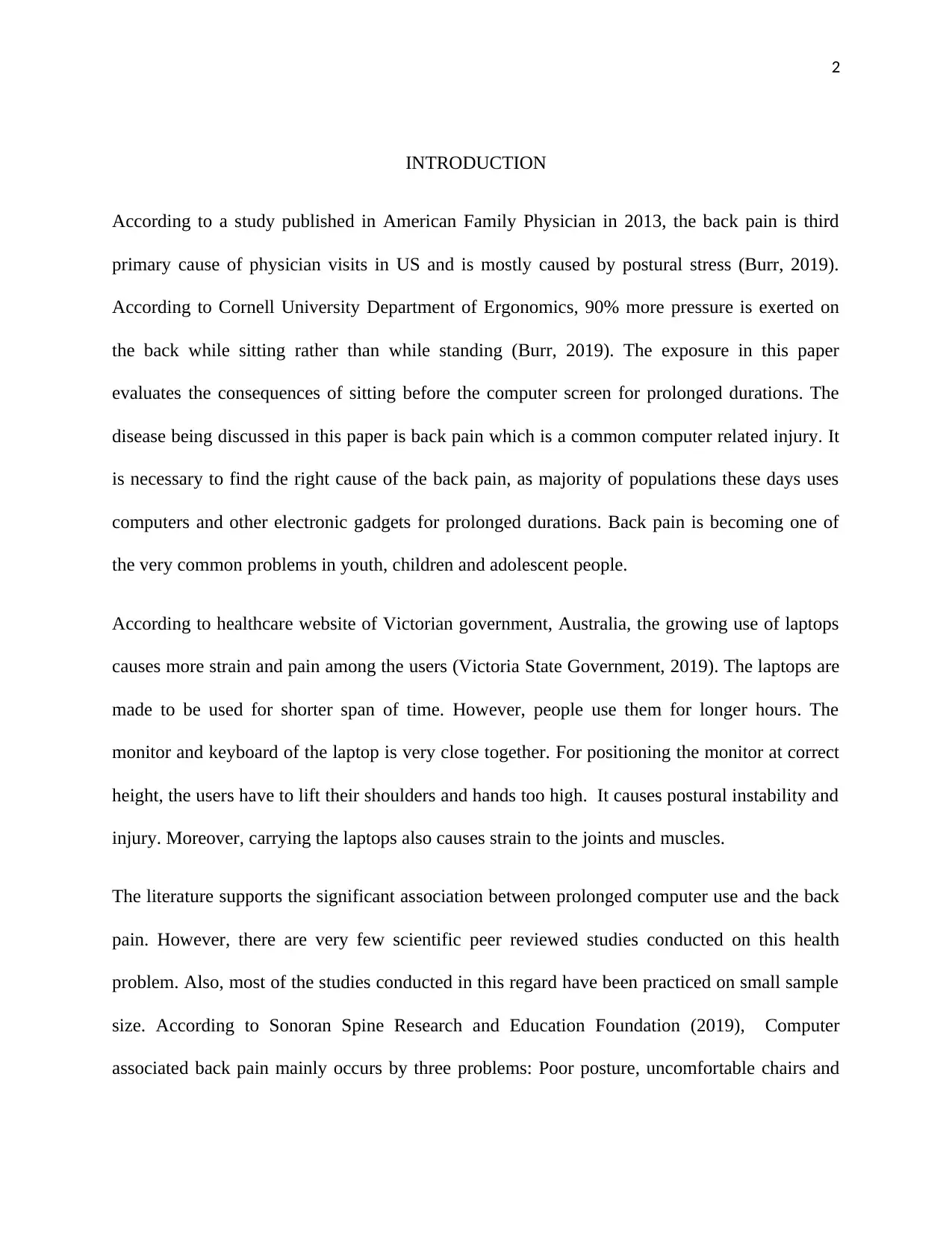
According to a study published in American Family Physician in 2013, the back pain is third
primary cause of physician visits in US and is mostly caused by postural stress (Burr, 2019).
According to Cornell University Department of Ergonomics, 90% more pressure is exerted on
the back while sitting rather than while standing (Burr, 2019). The exposure in this paper
evaluates the consequences of sitting before the computer screen for prolonged durations. The
disease being discussed in this paper is back pain which is a common computer related injury. It
is necessary to find the right cause of the back pain, as majority of populations these days uses
computers and other electronic gadgets for prolonged durations. Back pain is becoming one of
the very common problems in youth, children and adolescent people.
According to healthcare website of Victorian government, Australia, the growing use of laptops
causes more strain and pain among the users (Victoria State Government, 2019). The laptops are
made to be used for shorter span of time. However, people use them for longer hours. The
monitor and keyboard of the laptop is very close together. For positioning the monitor at correct
height, the users have to lift their shoulders and hands too high. It causes postural instability and
injury. Moreover, carrying the laptops also causes strain to the joints and muscles.
The literature supports the significant association between prolonged computer use and the back
pain. However, there are very few scientific peer reviewed studies conducted on this health
problem. Also, most of the studies conducted in this regard have been practiced on small sample
size. According to Sonoran Spine Research and Education Foundation (2019), Computer
associated back pain mainly occurs by three problems: Poor posture, uncomfortable chairs and
Document Page
3
inactivity. Higher than 80% of the adults using computers continuously for more than 4 hours,
suffer from back pain (Shete, Suryawanshi & Gandhi, 2012). Using computer for more than 3
hours is a threshold for Neck Shoulder pain (NSP) and greater than 5 hours results into Lower
back pain (LBP) (Hakala,Rimpela, Saarni & Salminen, 2006).
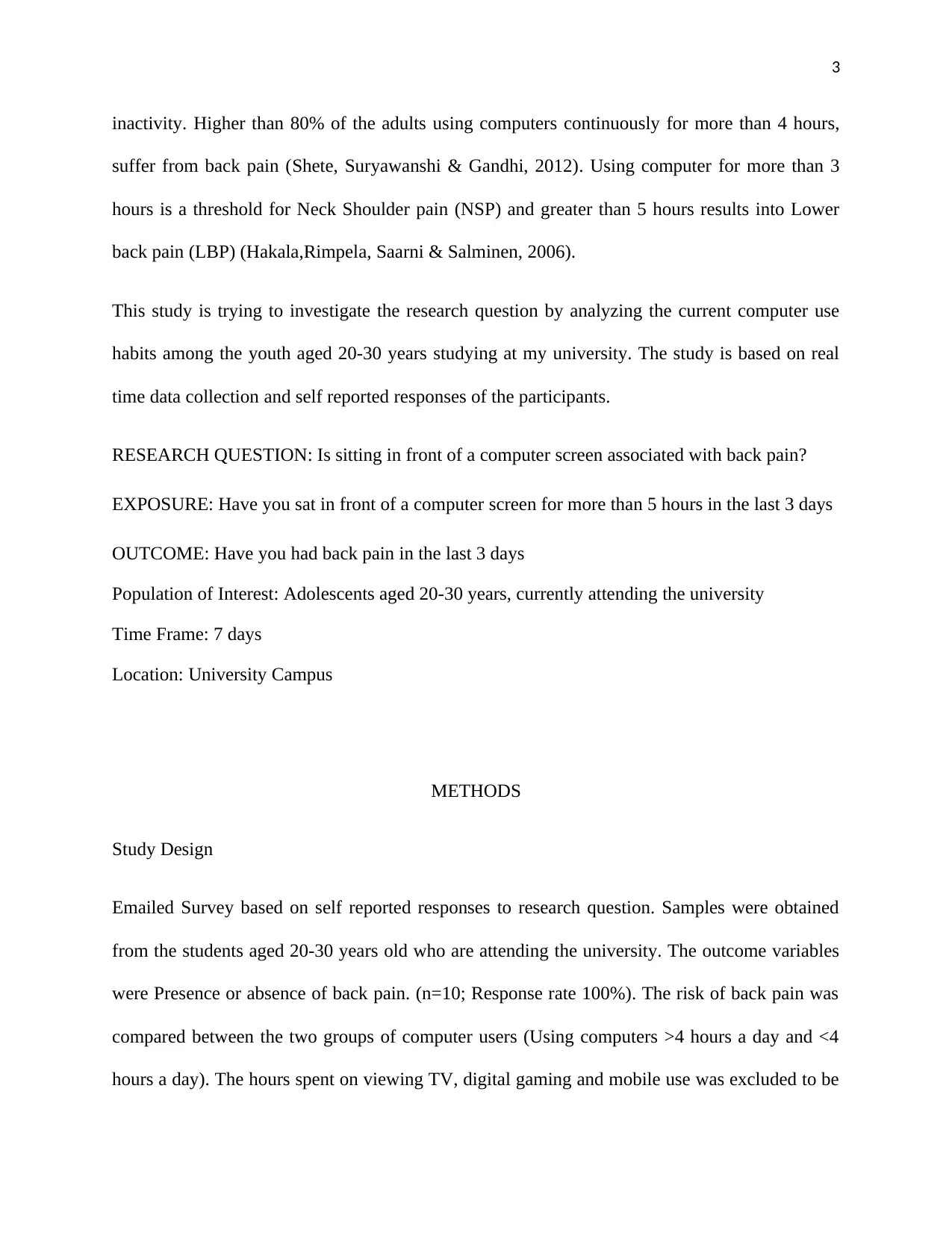
This study is trying to investigate the research question by analyzing the current computer use
habits among the youth aged 20-30 years studying at my university. The study is based on real
time data collection and self reported responses of the participants.
RESEARCH QUESTION: Is sitting in front of a computer screen associated with back pain?
EXPOSURE: Have you sat in front of a computer screen for more than 5 hours in the last 3 days
OUTCOME: Have you had back pain in the last 3 days
Population of Interest: Adolescents aged 20-30 years, currently attending the university
Time Frame: 7 days
Location: University Campus
METHODS
Study Design
Emailed Survey based on self reported responses to research question. Samples were obtained
from the students aged 20-30 years old who are attending the university. The outcome variables
were Presence or absence of back pain. (n=10; Response rate 100%). The risk of back pain was
compared between the two groups of computer users (Using computers >4 hours a day and <4
hours a day). The hours spent on viewing TV, digital gaming and mobile use was excluded to be
Document Page
4
associated with back pain. These variables were sufficient to explain the back pain associated
with high computer use. All the participants were informed about the nature and outcome of the
study and the consent forms were signed by them.
RESULTS
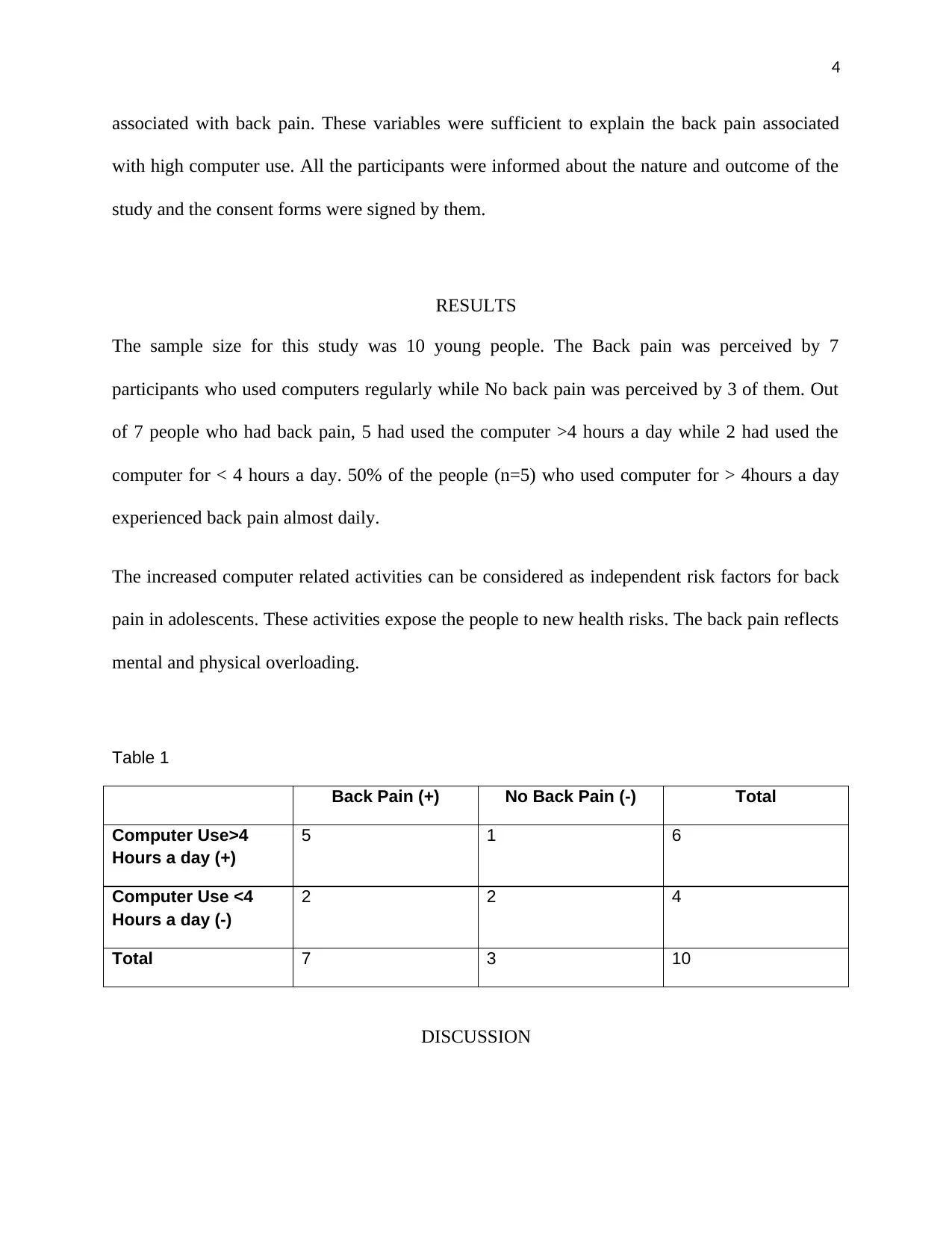
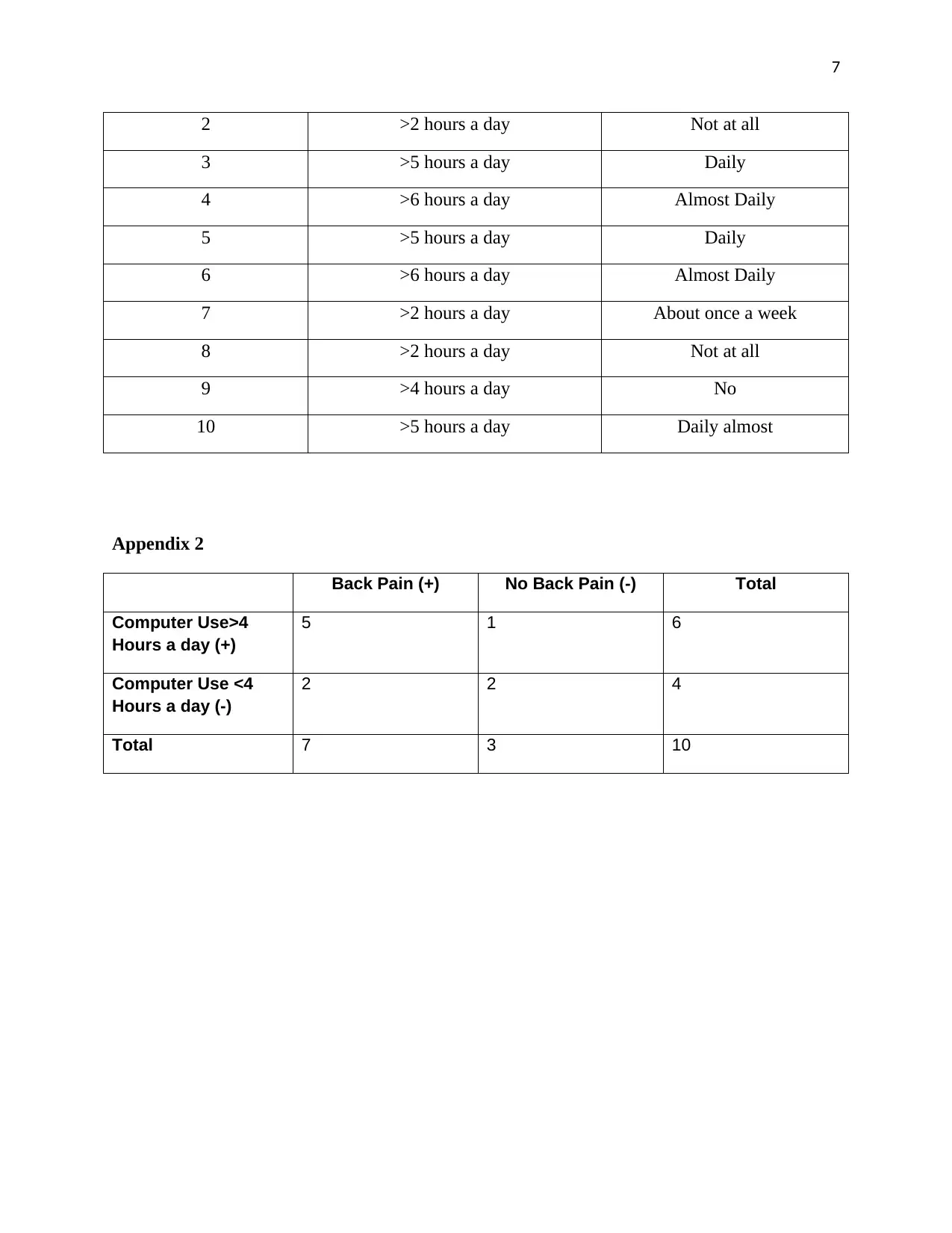
The sample size for this study was 10 young people. The Back pain was perceived by 7
participants who used computers regularly while No back pain was perceived by 3 of them. Out
of 7 people who had back pain, 5 had used the computer >4 hours a day while 2 had used the
computer for < 4 hours a day. 50% of the people (n=5) who used computer for > 4hours a day
experienced back pain almost daily.
The increased computer related activities can be considered as independent risk factors for back
pain in adolescents. These activities expose the people to new health risks. The back pain reflects
mental and physical overloading.
Table 1
Back Pain (+) No Back Pain (-) Total
Computer Use>4
Hours a day (+)
5 1 6
Computer Use <4
Hours a day (-)
2 2 4
Total 7 3 10
DISCUSSION
tabler-icon-diamond-filled.svg

Paraphrase This Document

Need a fresh take? Get an instant paraphrase of this document with our AI Paraphraser
Document Page
5
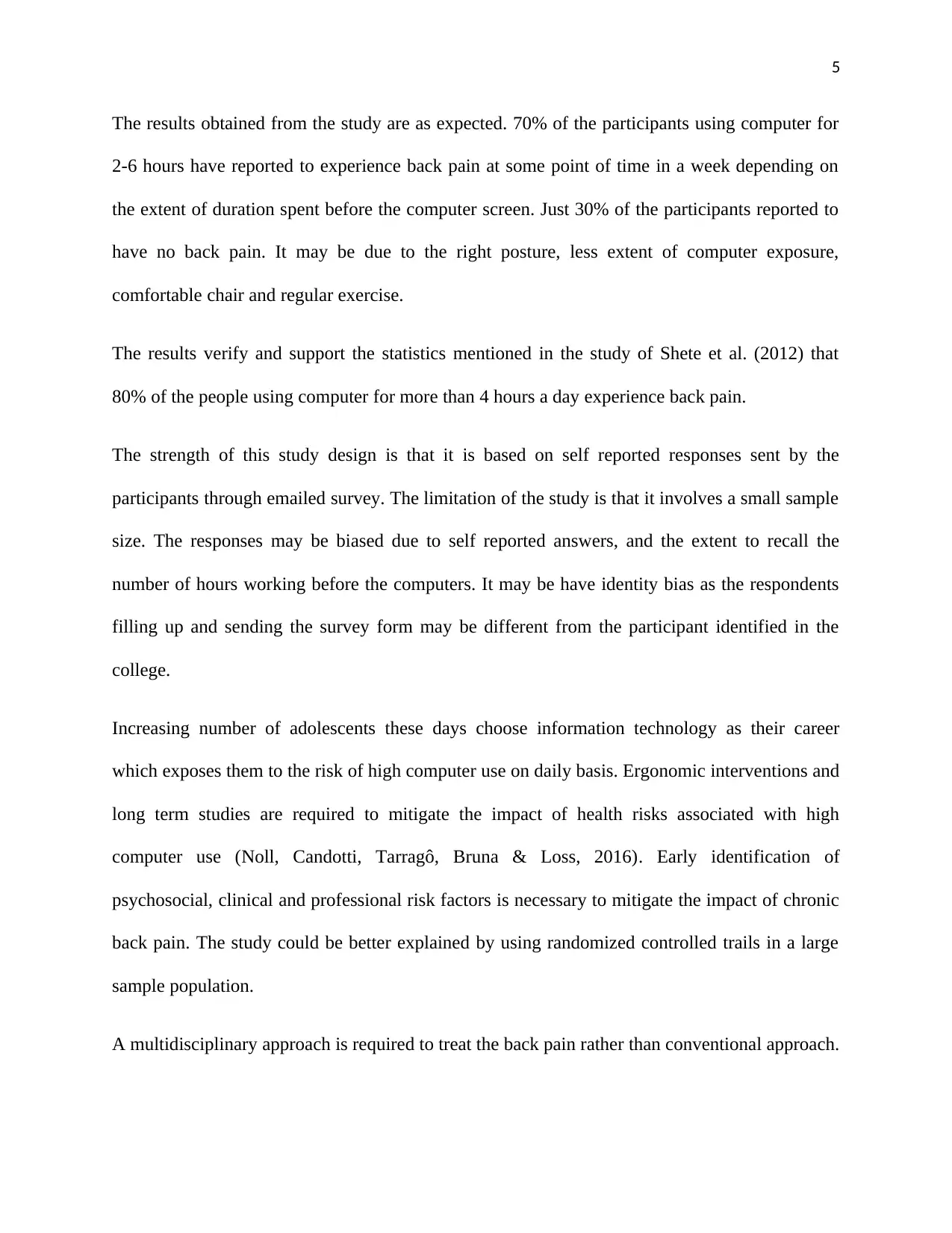
The results obtained from the study are as expected. 70% of the participants using computer for
2-6 hours have reported to experience back pain at some point of time in a week depending on
the extent of duration spent before the computer screen. Just 30% of the participants reported to
have no back pain. It may be due to the right posture, less extent of computer exposure,
comfortable chair and regular exercise.
The results verify and support the statistics mentioned in the study of Shete et al. (2012) that
80% of the people using computer for more than 4 hours a day experience back pain.
The strength of this study design is that it is based on self reported responses sent by the
participants through emailed survey. The limitation of the study is that it involves a small sample
size. The responses may be biased due to self reported answers, and the extent to recall the
number of hours working before the computers. It may be have identity bias as the respondents
filling up and sending the survey form may be different from the participant identified in the
college.
Increasing number of adolescents these days choose information technology as their career
which exposes them to the risk of high computer use on daily basis. Ergonomic interventions and
long term studies are required to mitigate the impact of health risks associated with high
computer use (Noll, Candotti, Tarragô, Bruna & Loss, 2016). Early identification of
psychosocial, clinical and professional risk factors is necessary to mitigate the impact of chronic
back pain. The study could be better explained by using randomized controlled trails in a large
sample population.
A multidisciplinary approach is required to treat the back pain rather than conventional approach.
Document Page
6
In conclusion, frequent and prolonged computer use is independent risk factors for the back pain.
Regular use of computers for >2 hours a day, especially exceeding the limit of 4 hours a day,
may act as a threshold for back pain in adults or adolescents.
BIBLIOGRAPHY
Burr,R.J. How sitting causes back pain. 2019. Retrieved from
https://www.startstanding.org/sitting-back-pain/#
Noll, M., Candotti, C., Tarragô, R., Bruna N., & Loss, J. Back pain prevalence and associated
factors in children and adolescents: an epidemiological population study. 2016. Revista de
Saúde Pública, 50, 31. Epub June 10, 2016.https://dx.doi.org/10.1590/S1518-
8787.2016050006175
Paula T. Hakala, Arja H. Rimpelä, Lea A. Saarni, Jouko J. Salminen, Frequent computer-related
activities increase the risk of neck–shoulder and low back pain in adolescents, European Journal
of Public Health, Volume 16, Issue 5, October 2006, Pages 536–
541, https://doi.org/10.1093/eurpub/ckl025
Shete KM, Suryawanshi P, Gandhi N. Management of low back pain in computer users: A
multidisciplinary approach. J Craniovertebr Junction Spine. 2012;3(1):7–10. doi:10.4103/0974-
8237.110117
Sonoran Spine Research and Education Foundation. Is your computer causes back
problems.2019. Retrieved from https://www.sonoranspine.com/blog/item/is-your-computer-causing-
back-problems
Victoria State Government. Computer related Injuries. 2019. Retrieved from
https://www.betterhealth.vic.gov.au/health/healthyliving/computer-related-injuries#lp-h-0
Appendix 1
Participant ID Exposure (Use of computer) Disease (Back Pain)
1 >3 hours a day About once a week
Document Page
7
2 >2 hours a day Not at all
3 >5 hours a day Daily
4 >6 hours a day Almost Daily
5 >5 hours a day Daily
6 >6 hours a day Almost Daily
7 >2 hours a day About once a week
8 >2 hours a day Not at all
9 >4 hours a day No
10 >5 hours a day Daily almost
Appendix 2
Back Pain (+) No Back Pain (-) Total
Computer Use>4
Hours a day (+)
5 1 6
Computer Use <4
Hours a day (-)
2 2 4
Total 7 3 10
chevron_up_icon
1 out of 7
circle_padding
hide_on_mobile
zoom_out_icon
[object Object]