Computerised Accounting Systems: Financial Reporting Impact on SMEs
VerifiedAdded on 2023/06/15
|80
|18849
|104
Report
AI Summary
This report investigates the impact of Computerised Accounting Systems (CAS) on financial reporting among Small and Medium Enterprises (SMEs) in Maldives. It explores how CAS, as a new technology, aids businesses in improving their financial operations, creating accurate financial statements, tracking transactions, and supporting decision-making processes. The study involved data collection and analysis to understand the correlation between CAS implementation and financial reporting quality. The findings suggest a positive impact of CAS on financial reporting within Maldivian SMEs, emphasizing that effective supervision and maintenance can further enhance these benefits across various industries in Maldives. The research covers background information on computerized accounting systems, the quality of financial reports, and the effect of these systems on financial report quality, providing a comprehensive overview supported by literature review, research methodology, data analysis, and recommendations for future work.
Running head: THE IMPACT OF COMPUTERISED ACCOUNTING SYSTEMS (CAS) IN
THE FINANCIAL REPORTING AMONG SMES IN MALDIVES
The impact of using computerised accounting systems (CAS) in financial reporting among SMEs
in Maldives
Name of the Student:
Name of the University:
Author’s Note:
THE FINANCIAL REPORTING AMONG SMES IN MALDIVES
The impact of using computerised accounting systems (CAS) in financial reporting among SMEs
in Maldives
Name of the Student:
Name of the University:
Author’s Note:

Paraphrase This Document
Need a fresh take? Get an instant paraphrase of this document with our AI Paraphraser
1
THE IMPACT OF COMPUTERISED ACCOUNTING SYSTEMS (CAS) IN THE
FINANCIAL REPORTING AMONG SMES IN MALDIVES
Abstract
This paper is related to having an understanding of the impact of “Computerised Accounting
Systems” in the financial documentation among the SMEs in Maldives. Computerised
Accounting Systems are a new tool and technology that are available to the organizations with
the help of which companies are able operate their business in a much better way create financial
statements that are ideal for the companies in order to keep track of all their records and
transactions and assist in the process decision making for the business. The objective of the paper
has been fundamental in understanding the aspects with regards to which the results will be
attained. In the same manner, data has been collected and thereafter data analysis process has
been undertaken with the help of which effective level of results are obtained for this paper. The
results that have been obtained expresses that “Computerised Accounting System” has a positive
effect on the financial reporting of the SMEs in Maldives and effective supervision and
maintenance can enhance the activities of the process in the SMEs as well as in the other
industries in Maldives in the future.
THE IMPACT OF COMPUTERISED ACCOUNTING SYSTEMS (CAS) IN THE
FINANCIAL REPORTING AMONG SMES IN MALDIVES
Abstract
This paper is related to having an understanding of the impact of “Computerised Accounting
Systems” in the financial documentation among the SMEs in Maldives. Computerised
Accounting Systems are a new tool and technology that are available to the organizations with
the help of which companies are able operate their business in a much better way create financial
statements that are ideal for the companies in order to keep track of all their records and
transactions and assist in the process decision making for the business. The objective of the paper
has been fundamental in understanding the aspects with regards to which the results will be
attained. In the same manner, data has been collected and thereafter data analysis process has
been undertaken with the help of which effective level of results are obtained for this paper. The
results that have been obtained expresses that “Computerised Accounting System” has a positive
effect on the financial reporting of the SMEs in Maldives and effective supervision and
maintenance can enhance the activities of the process in the SMEs as well as in the other
industries in Maldives in the future.
2
THE IMPACT OF COMPUTERISED ACCOUNTING SYSTEMS (CAS) IN THE
FINANCIAL REPORTING AMONG SMES IN MALDIVES
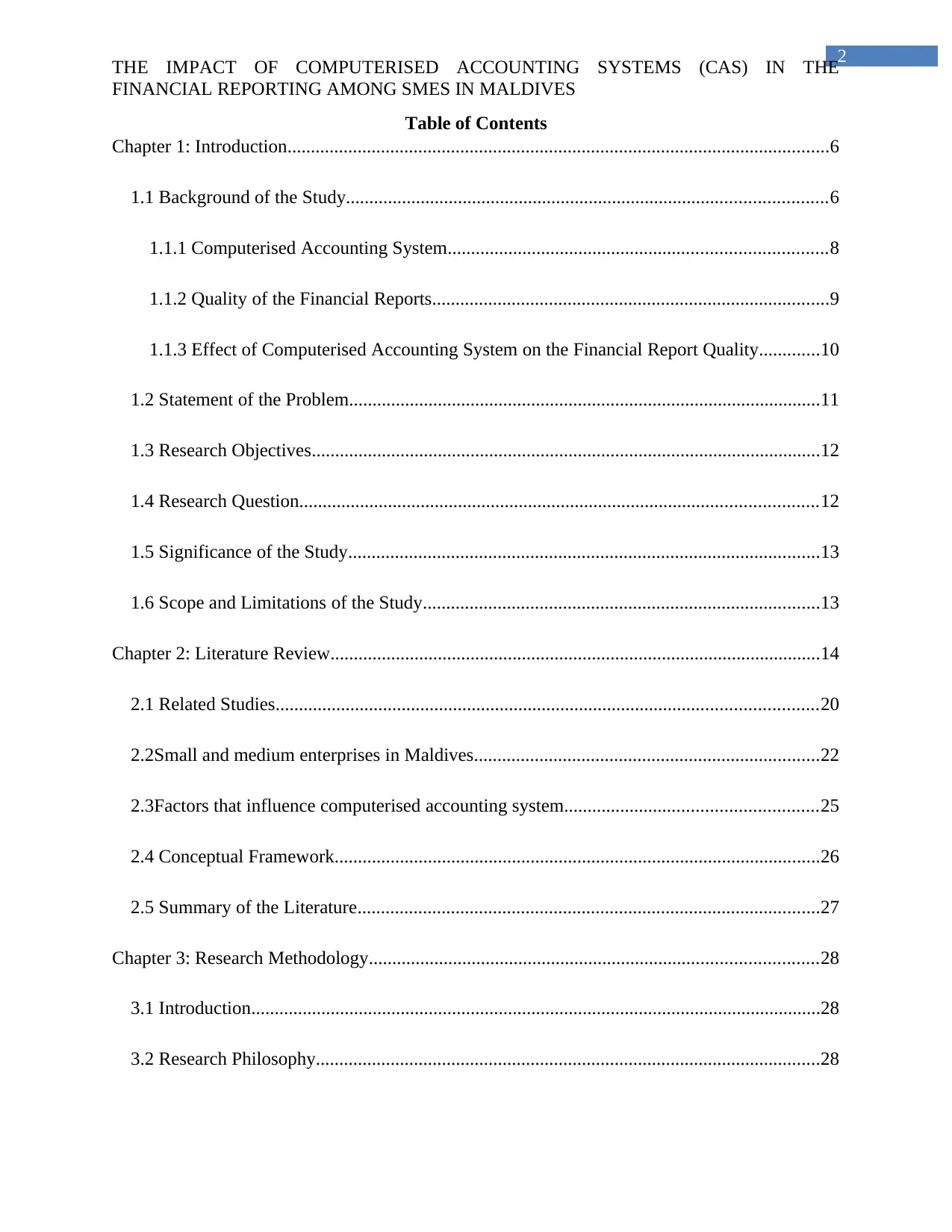
Table of Contents
Chapter 1: Introduction....................................................................................................................6
1.1 Background of the Study.......................................................................................................6
1.1.1 Computerised Accounting System.................................................................................8
1.1.2 Quality of the Financial Reports.....................................................................................9
1.1.3 Effect of Computerised Accounting System on the Financial Report Quality.............10
1.2 Statement of the Problem.....................................................................................................11
1.3 Research Objectives.............................................................................................................12
1.4 Research Question...............................................................................................................12
1.5 Significance of the Study.....................................................................................................13
1.6 Scope and Limitations of the Study.....................................................................................13
Chapter 2: Literature Review.........................................................................................................14
2.1 Related Studies....................................................................................................................20
2.2Small and medium enterprises in Maldives..........................................................................22
2.3Factors that influence computerised accounting system......................................................25
2.4 Conceptual Framework........................................................................................................26
2.5 Summary of the Literature...................................................................................................27
Chapter 3: Research Methodology................................................................................................28
3.1 Introduction..........................................................................................................................28
3.2 Research Philosophy............................................................................................................28
THE IMPACT OF COMPUTERISED ACCOUNTING SYSTEMS (CAS) IN THE
FINANCIAL REPORTING AMONG SMES IN MALDIVES
Table of Contents
Chapter 1: Introduction....................................................................................................................6
1.1 Background of the Study.......................................................................................................6
1.1.1 Computerised Accounting System.................................................................................8
1.1.2 Quality of the Financial Reports.....................................................................................9
1.1.3 Effect of Computerised Accounting System on the Financial Report Quality.............10
1.2 Statement of the Problem.....................................................................................................11
1.3 Research Objectives.............................................................................................................12
1.4 Research Question...............................................................................................................12
1.5 Significance of the Study.....................................................................................................13
1.6 Scope and Limitations of the Study.....................................................................................13
Chapter 2: Literature Review.........................................................................................................14
2.1 Related Studies....................................................................................................................20
2.2Small and medium enterprises in Maldives..........................................................................22
2.3Factors that influence computerised accounting system......................................................25
2.4 Conceptual Framework........................................................................................................26
2.5 Summary of the Literature...................................................................................................27
Chapter 3: Research Methodology................................................................................................28
3.1 Introduction..........................................................................................................................28
3.2 Research Philosophy............................................................................................................28
⊘ This is a preview!⊘
Do you want full access?
Subscribe today to unlock all pages.

Trusted by 1+ million students worldwide
3
THE IMPACT OF COMPUTERISED ACCOUNTING SYSTEMS (CAS) IN THE
FINANCIAL REPORTING AMONG SMES IN MALDIVES
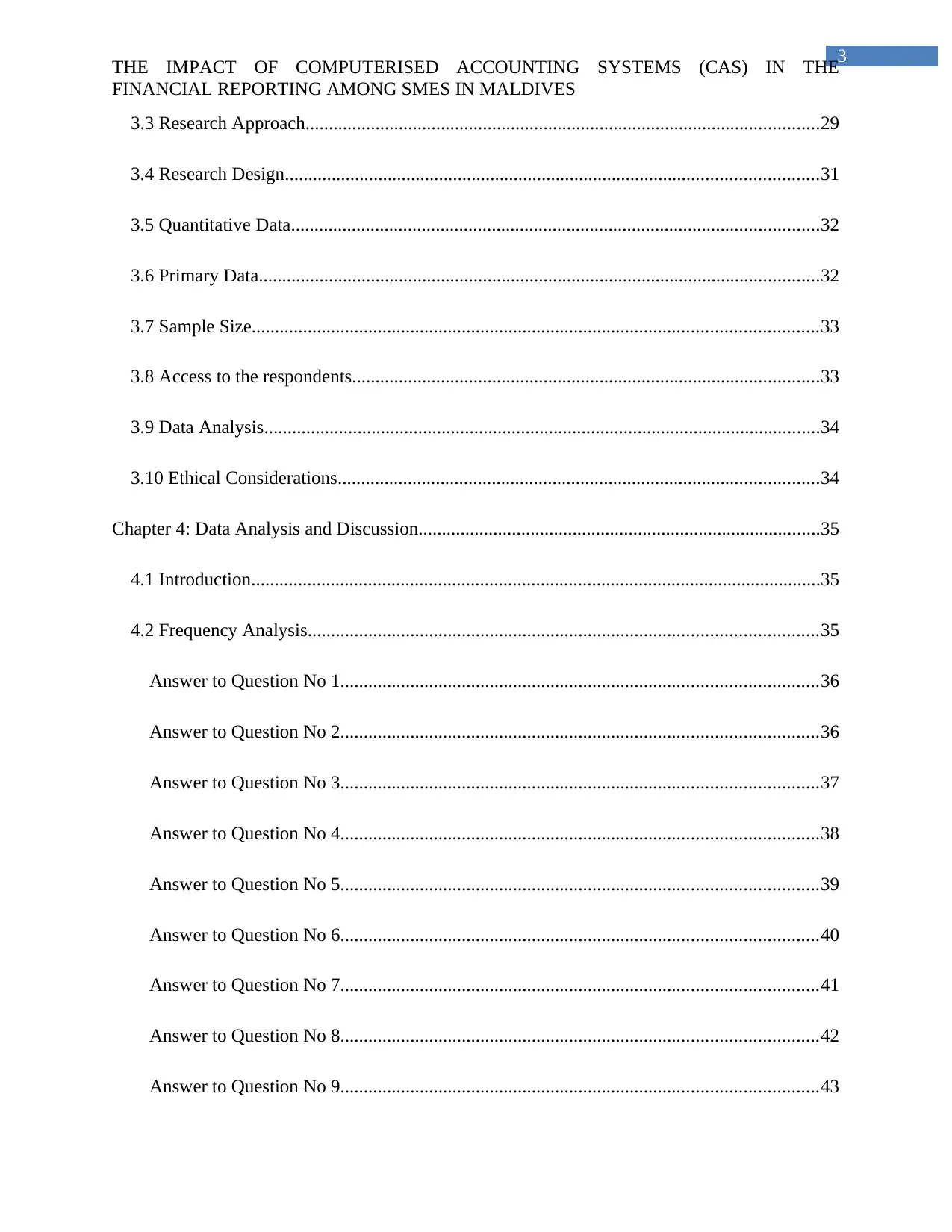
3.3 Research Approach..............................................................................................................29
3.4 Research Design..................................................................................................................31
3.5 Quantitative Data.................................................................................................................32
3.6 Primary Data........................................................................................................................32
3.7 Sample Size.........................................................................................................................33
3.8 Access to the respondents....................................................................................................33
3.9 Data Analysis.......................................................................................................................34
3.10 Ethical Considerations.......................................................................................................34
Chapter 4: Data Analysis and Discussion......................................................................................35
4.1 Introduction..........................................................................................................................35
4.2 Frequency Analysis.............................................................................................................35
Answer to Question No 1......................................................................................................36
Answer to Question No 2......................................................................................................36
Answer to Question No 3......................................................................................................37
Answer to Question No 4......................................................................................................38
Answer to Question No 5......................................................................................................39
Answer to Question No 6......................................................................................................40
Answer to Question No 7......................................................................................................41
Answer to Question No 8......................................................................................................42
Answer to Question No 9......................................................................................................43
THE IMPACT OF COMPUTERISED ACCOUNTING SYSTEMS (CAS) IN THE
FINANCIAL REPORTING AMONG SMES IN MALDIVES
3.3 Research Approach..............................................................................................................29
3.4 Research Design..................................................................................................................31
3.5 Quantitative Data.................................................................................................................32
3.6 Primary Data........................................................................................................................32
3.7 Sample Size.........................................................................................................................33
3.8 Access to the respondents....................................................................................................33
3.9 Data Analysis.......................................................................................................................34
3.10 Ethical Considerations.......................................................................................................34
Chapter 4: Data Analysis and Discussion......................................................................................35
4.1 Introduction..........................................................................................................................35
4.2 Frequency Analysis.............................................................................................................35
Answer to Question No 1......................................................................................................36
Answer to Question No 2......................................................................................................36
Answer to Question No 3......................................................................................................37
Answer to Question No 4......................................................................................................38
Answer to Question No 5......................................................................................................39
Answer to Question No 6......................................................................................................40
Answer to Question No 7......................................................................................................41
Answer to Question No 8......................................................................................................42
Answer to Question No 9......................................................................................................43
Paraphrase This Document
Need a fresh take? Get an instant paraphrase of this document with our AI Paraphraser
4
THE IMPACT OF COMPUTERISED ACCOUNTING SYSTEMS (CAS) IN THE
FINANCIAL REPORTING AMONG SMES IN MALDIVES
Answer to Question No 10....................................................................................................44
Answer to Question No 11....................................................................................................45
Answer to Question No 12....................................................................................................46
Answer to Question No 13....................................................................................................47
Answer to Question No 14....................................................................................................48
Answer to Question No 15....................................................................................................49
Answer to Question No 16....................................................................................................50
Answer to Question No 17....................................................................................................51
Answer to Question No 18....................................................................................................52
Answer to Question No 19....................................................................................................53
4.3 Descriptive Statistics...........................................................................................................54
4.4 Correlation...........................................................................................................................57
4.5 Discussion............................................................................................................................59
Chapter 5: Conclusion, Recommendation and Future Work.........................................................61
5.1 Conclusion...........................................................................................................................61
5.2 Addressing the Objective.....................................................................................................62
5.3 Recommendation.................................................................................................................63
5.4 Future Work.........................................................................................................................63
Reference List................................................................................................................................64
Questionnaire.................................................................................................................................73
THE IMPACT OF COMPUTERISED ACCOUNTING SYSTEMS (CAS) IN THE
FINANCIAL REPORTING AMONG SMES IN MALDIVES
Answer to Question No 10....................................................................................................44
Answer to Question No 11....................................................................................................45
Answer to Question No 12....................................................................................................46
Answer to Question No 13....................................................................................................47
Answer to Question No 14....................................................................................................48
Answer to Question No 15....................................................................................................49
Answer to Question No 16....................................................................................................50
Answer to Question No 17....................................................................................................51
Answer to Question No 18....................................................................................................52
Answer to Question No 19....................................................................................................53
4.3 Descriptive Statistics...........................................................................................................54
4.4 Correlation...........................................................................................................................57
4.5 Discussion............................................................................................................................59
Chapter 5: Conclusion, Recommendation and Future Work.........................................................61
5.1 Conclusion...........................................................................................................................61
5.2 Addressing the Objective.....................................................................................................62
5.3 Recommendation.................................................................................................................63
5.4 Future Work.........................................................................................................................63
Reference List................................................................................................................................64
Questionnaire.................................................................................................................................73

5
THE IMPACT OF COMPUTERISED ACCOUNTING SYSTEMS (CAS) IN THE
FINANCIAL REPORTING AMONG SMES IN MALDIVES
Section A...................................................................................................................................74
Section B....................................................................................................................................75
Section C....................................................................................................................................78
THE IMPACT OF COMPUTERISED ACCOUNTING SYSTEMS (CAS) IN THE
FINANCIAL REPORTING AMONG SMES IN MALDIVES
Section A...................................................................................................................................74
Section B....................................................................................................................................75
Section C....................................................................................................................................78
⊘ This is a preview!⊘
Do you want full access?
Subscribe today to unlock all pages.
Trusted by 1+ million students worldwide
6
THE IMPACT OF COMPUTERISED ACCOUNTING SYSTEMS (CAS) IN THE
FINANCIAL REPORTING AMONG SMES IN MALDIVES
Chapter 1: Introduction
The changes that are taking place in the global economy have steered to the development
of innovative technologies, which are helpful in the development functional activities of a
company. There are numerous computerised accounting systems that have been helpful in
ascertaining the financial transactions. The maintenance of the financial transactions can be
helpful in creating the financial statements that can be used in the future course of time and
thereby understand the financial scenario of an organization. The incorporation of the
computerised accounting system is a process with the help of which financial reporting can be
done in a precise manner and even reduces the chances of any miscalculations if done manually
(Ismail and King, 2014). This research thesis is therefore constructed in order to have an
understanding of the effect of the “computerised accounting system” in the financial
documenting of the small and medium enterprises in Maldives. There are several small and
medium companies available in the economy of Maldives and therefore impact on the financial
reporting of these companies by making use of the computerised accounting system can be
understood. A total of five small and medium enterprises of Maldives have been taken into
consideration who have incorporated computerised accounting system in order to have
knowledge of the effect of financial reporting in these organizations.
1.1 Background of the Study
Accounting has been looked upon as a key part of any business that is useful for small
and large profit making organizations. There are several organizations that undertake their
process of accounting manually and even feel satisfied. The other companies may be looking for
computerised accounting process as the software related to accounting are reasonable and
affordable (Diatmika, Irianto and Baridwan, 2016). The computerised and manual system of
THE IMPACT OF COMPUTERISED ACCOUNTING SYSTEMS (CAS) IN THE
FINANCIAL REPORTING AMONG SMES IN MALDIVES
Chapter 1: Introduction
The changes that are taking place in the global economy have steered to the development
of innovative technologies, which are helpful in the development functional activities of a
company. There are numerous computerised accounting systems that have been helpful in
ascertaining the financial transactions. The maintenance of the financial transactions can be
helpful in creating the financial statements that can be used in the future course of time and
thereby understand the financial scenario of an organization. The incorporation of the
computerised accounting system is a process with the help of which financial reporting can be
done in a precise manner and even reduces the chances of any miscalculations if done manually
(Ismail and King, 2014). This research thesis is therefore constructed in order to have an
understanding of the effect of the “computerised accounting system” in the financial
documenting of the small and medium enterprises in Maldives. There are several small and
medium companies available in the economy of Maldives and therefore impact on the financial
reporting of these companies by making use of the computerised accounting system can be
understood. A total of five small and medium enterprises of Maldives have been taken into
consideration who have incorporated computerised accounting system in order to have
knowledge of the effect of financial reporting in these organizations.
1.1 Background of the Study
Accounting has been looked upon as a key part of any business that is useful for small
and large profit making organizations. There are several organizations that undertake their
process of accounting manually and even feel satisfied. The other companies may be looking for
computerised accounting process as the software related to accounting are reasonable and
affordable (Diatmika, Irianto and Baridwan, 2016). The computerised and manual system of
Paraphrase This Document
Need a fresh take? Get an instant paraphrase of this document with our AI Paraphraser
7
THE IMPACT OF COMPUTERISED ACCOUNTING SYSTEMS (CAS) IN THE
FINANCIAL REPORTING AMONG SMES IN MALDIVES
accounting basically performs similar mechanisms, the accounting concepts and principles are
even similar with the difference being in the process technicalities (Smith and BintiPuasa, 2016).
It is seen that the computerised accounting system is a bit expensive in accordance to manual
accounting process bit their advantage is reliant on the speed and thereby being able to record
and gather information.
“Small and Medium Enterprises” (SMEs) are accounted for by deciding the number of
employees and the amount of revenue generated by a company. In order to define a small and
medium enterprise, these two factors must come under a specific standard that is held by the
respective nation. The small and medium enterprises do not have adequate amount of resources
unlike the large organizations, the essence being entrepreneurial and hence they are significant to
the development and innovation of the economy of the country (Seethamraju, 2015). This is due
to the fact that the SMEs have less capital in accordance to the companies that are functional at a
beiger stage and therefore have the ability to incorporate changes and develop their business
accordingly.
Over the previous decade, there has been remarkable development of SMEs in the
developing countries. There are several researchers who have looked at SMEs as an effective
substitute to the governmental agencies in receiving the assistance and the services to the ones
who are in need of it especially in the nations that are pressured by the political corruption and
favouritism (Azmi et al., 2016). These activities have been fundamental in the development of
the SMEs and the influence of the SMEs to incorporate new and innovative computerised
accounting services.
In accordance to Azmi et al., (2016 p: 13). Accountability explains the scenario within
which the function holder provides account to the other so that decisions may be undertaken
THE IMPACT OF COMPUTERISED ACCOUNTING SYSTEMS (CAS) IN THE
FINANCIAL REPORTING AMONG SMES IN MALDIVES
accounting basically performs similar mechanisms, the accounting concepts and principles are
even similar with the difference being in the process technicalities (Smith and BintiPuasa, 2016).
It is seen that the computerised accounting system is a bit expensive in accordance to manual
accounting process bit their advantage is reliant on the speed and thereby being able to record
and gather information.
“Small and Medium Enterprises” (SMEs) are accounted for by deciding the number of
employees and the amount of revenue generated by a company. In order to define a small and
medium enterprise, these two factors must come under a specific standard that is held by the
respective nation. The small and medium enterprises do not have adequate amount of resources
unlike the large organizations, the essence being entrepreneurial and hence they are significant to
the development and innovation of the economy of the country (Seethamraju, 2015). This is due
to the fact that the SMEs have less capital in accordance to the companies that are functional at a
beiger stage and therefore have the ability to incorporate changes and develop their business
accordingly.
Over the previous decade, there has been remarkable development of SMEs in the
developing countries. There are several researchers who have looked at SMEs as an effective
substitute to the governmental agencies in receiving the assistance and the services to the ones
who are in need of it especially in the nations that are pressured by the political corruption and
favouritism (Azmi et al., 2016). These activities have been fundamental in the development of
the SMEs and the influence of the SMEs to incorporate new and innovative computerised
accounting services.
In accordance to Azmi et al., (2016 p: 13). Accountability explains the scenario within
which the function holder provides account to the other so that decisions may be undertaken
8
THE IMPACT OF COMPUTERISED ACCOUNTING SYSTEMS (CAS) IN THE
FINANCIAL REPORTING AMONG SMES IN MALDIVES
about the performance adequacy. Amin and Mohamed,(2016p:132) cite accountability not only
for the purpose of reporting but even the explanation of the performance, they even sustain to
explain the accountability as the explicit and implicit expectations that any one of them will be
asked upon in order to clarify the feelings, belief and actions of a person towards other. The
process of computerization safeguards time in accordance to the level of transaction thereby
leading to financial reporting quality for example accurate, timely and dependable data that can
be created. This is the necessity for undertaking the study.
1.1.1 Computerised Accounting System
The process of computerised accounting is the implication of the computer dependent
software utilised to process, “input” and “store” and “output” of the accounting information. This
software is in assistance of the developing technology which aids the companies to make use of
the “computer programs” in order to conduct the jobs that were manually done in the earlier time
period. A computerised accounting process hence associates with the accounting information
system which is generated in order to assist the process of decision making (Cleary and Quinn,
2016). These are related with various numbers of benefits like the tenacity of undertaking the
routine transactions, quick assessment, timeliness, reporting and accuracy.
According to Germann and Manasseh,(2017p: 51) an accounting system comprises of the
business records, statements, reports and the procedures that are utilised by a company in order
to record the transactions and examining the impacts. Albu et al.,(2016 p: 178) addresses the fact
that an accounting process is a technique of maintaining a manual record of all the transactions.
The earnings are provided for all the received money by a company and the earnings are asked at
any time when expenses are undertaken with the money. Accountability for the SMEs is both an
ethical and legal accountability for the company that utilise the resources that is received to
THE IMPACT OF COMPUTERISED ACCOUNTING SYSTEMS (CAS) IN THE
FINANCIAL REPORTING AMONG SMES IN MALDIVES
about the performance adequacy. Amin and Mohamed,(2016p:132) cite accountability not only
for the purpose of reporting but even the explanation of the performance, they even sustain to
explain the accountability as the explicit and implicit expectations that any one of them will be
asked upon in order to clarify the feelings, belief and actions of a person towards other. The
process of computerization safeguards time in accordance to the level of transaction thereby
leading to financial reporting quality for example accurate, timely and dependable data that can
be created. This is the necessity for undertaking the study.
1.1.1 Computerised Accounting System
The process of computerised accounting is the implication of the computer dependent
software utilised to process, “input” and “store” and “output” of the accounting information. This
software is in assistance of the developing technology which aids the companies to make use of
the “computer programs” in order to conduct the jobs that were manually done in the earlier time
period. A computerised accounting process hence associates with the accounting information
system which is generated in order to assist the process of decision making (Cleary and Quinn,
2016). These are related with various numbers of benefits like the tenacity of undertaking the
routine transactions, quick assessment, timeliness, reporting and accuracy.
According to Germann and Manasseh,(2017p: 51) an accounting system comprises of the
business records, statements, reports and the procedures that are utilised by a company in order
to record the transactions and examining the impacts. Albu et al.,(2016 p: 178) addresses the fact
that an accounting process is a technique of maintaining a manual record of all the transactions.
The earnings are provided for all the received money by a company and the earnings are asked at
any time when expenses are undertaken with the money. Accountability for the SMEs is both an
ethical and legal accountability for the company that utilise the resources that is received to
⊘ This is a preview!⊘
Do you want full access?
Subscribe today to unlock all pages.
Trusted by 1+ million students worldwide
9
THE IMPACT OF COMPUTERISED ACCOUNTING SYSTEMS (CAS) IN THE
FINANCIAL REPORTING AMONG SMES IN MALDIVES
expand their level of investment and accountability covers an entire report of the operations
along with the justification for the process with the help of which the resources are monitored.
1.1.2 Quality of the Financial Reports
Financial statement is a process of portraying the financial accountabilities for the
purpose of the reviewing the financial operations of an organization of the previous years and
construct plans for the coming future in order to publish and prepare the yearly accounts or the
financial statements. Ruivo, Oliveira and Neto,(2014 p: 184) explained financial reporting as the
mechanism of providing the financial data which is complete, accurate and dependable to the
stakeholders in order to undertake decisions related to economics. Bahri, St-Pierre and Sakka,
(2017 p: 36) have cited that financial statements are the yields of an accounting process and they
are constructed at the completion of the accounting year which is even known as the final
accounts. According to Kiliç, Uyar and Ataman,(2016 p: 178), the financial statements are
inclusive of a narrative explanation of the organizational activities and the financial reports that
are audited. Kiliç, Uyar and Ataman, (2016p: 178) have even debated that these aids the
stakeholders to observe the performance of a company and the overall financial scenario of the
company. Albu et al.,(2015:p: 178) explains that the accountants and the managers are generally
required to safeguard the outcomes that have been explained in the financial statements as a
section of the process of accountability.
According to Abrokwah et al., (2015 p: 269), timelines is a key feature of the quality of
the financial data. In order to assist the users, the financial data needs to be presented at the
correct time or else it would lose its relevancy. Relevance is even a feature of the quality of the
financial statements. Seyal and Rahman, (2015 p: 22) have focused on the fact that users must
THE IMPACT OF COMPUTERISED ACCOUNTING SYSTEMS (CAS) IN THE
FINANCIAL REPORTING AMONG SMES IN MALDIVES
expand their level of investment and accountability covers an entire report of the operations
along with the justification for the process with the help of which the resources are monitored.
1.1.2 Quality of the Financial Reports
Financial statement is a process of portraying the financial accountabilities for the
purpose of the reviewing the financial operations of an organization of the previous years and
construct plans for the coming future in order to publish and prepare the yearly accounts or the
financial statements. Ruivo, Oliveira and Neto,(2014 p: 184) explained financial reporting as the
mechanism of providing the financial data which is complete, accurate and dependable to the
stakeholders in order to undertake decisions related to economics. Bahri, St-Pierre and Sakka,
(2017 p: 36) have cited that financial statements are the yields of an accounting process and they
are constructed at the completion of the accounting year which is even known as the final
accounts. According to Kiliç, Uyar and Ataman,(2016 p: 178), the financial statements are
inclusive of a narrative explanation of the organizational activities and the financial reports that
are audited. Kiliç, Uyar and Ataman, (2016p: 178) have even debated that these aids the
stakeholders to observe the performance of a company and the overall financial scenario of the
company. Albu et al.,(2015:p: 178) explains that the accountants and the managers are generally
required to safeguard the outcomes that have been explained in the financial statements as a
section of the process of accountability.
According to Abrokwah et al., (2015 p: 269), timelines is a key feature of the quality of
the financial data. In order to assist the users, the financial data needs to be presented at the
correct time or else it would lose its relevancy. Relevance is even a feature of the quality of the
financial statements. Seyal and Rahman, (2015 p: 22) have focused on the fact that users must
Paraphrase This Document
Need a fresh take? Get an instant paraphrase of this document with our AI Paraphraser
10
THE IMPACT OF COMPUTERISED ACCOUNTING SYSTEMS (CAS) IN THE
FINANCIAL REPORTING AMONG SMES IN MALDIVES
have the ability to compare the financial statements of the organization in accordance to time in
order to have knowledge about the patterns in the financial performance and position.
1.1.3 Effect of Computerised Accounting System on the Financial Report Quality
It is expressed theoretically that a computerised accounting process would lead to quality
and effective financial statements. The researches undertaken by Uyar, Gungormus and Kuzey,
(2017 p: 9) explain that it is easy to undertake the functions of accounting by making use of the
computerised accounting mechanisms. Kvaal, (2017 p: 157) explained that the management
cannot satisfy easily the statutory requirements of reporting like the profit or loss account,
customised reporting and the balance sheet without exploiting the computerised accounting
process. By the assistance of incorporating the system, these activities can be done very quickly
with minimum effort (Azmi et al., 2016). The computerised accounting system simplifies the
process of auditing and has enhanced accessibility to the information that is demanded payments
and other kinds of transactions which are helpful in lowering the time required to give out this
kind of data and assist in the process of documentation during the time of auditing.
The basic principles of computerised accounting system is inclusive of the all the primary
requirements of any data-base related application in the computers. It assists in simplifying,
streamlining and integrating all the organizational processes in a cost effective way and thereby
assists in revealing the actual picture of all the undertakings of the business to the financial
statement users.
Due to the fast transformations in the technology, several small businesses look to track
the financial transactions with the help of computerised software than keeping track of all the
financial operations manually with the assistance of physical ledger (Corsi, Mancini and
Piscitelli, 2017). The developments in the computerised innovations have gradually steered to the
THE IMPACT OF COMPUTERISED ACCOUNTING SYSTEMS (CAS) IN THE
FINANCIAL REPORTING AMONG SMES IN MALDIVES
have the ability to compare the financial statements of the organization in accordance to time in
order to have knowledge about the patterns in the financial performance and position.
1.1.3 Effect of Computerised Accounting System on the Financial Report Quality
It is expressed theoretically that a computerised accounting process would lead to quality
and effective financial statements. The researches undertaken by Uyar, Gungormus and Kuzey,
(2017 p: 9) explain that it is easy to undertake the functions of accounting by making use of the
computerised accounting mechanisms. Kvaal, (2017 p: 157) explained that the management
cannot satisfy easily the statutory requirements of reporting like the profit or loss account,
customised reporting and the balance sheet without exploiting the computerised accounting
process. By the assistance of incorporating the system, these activities can be done very quickly
with minimum effort (Azmi et al., 2016). The computerised accounting system simplifies the
process of auditing and has enhanced accessibility to the information that is demanded payments
and other kinds of transactions which are helpful in lowering the time required to give out this
kind of data and assist in the process of documentation during the time of auditing.
The basic principles of computerised accounting system is inclusive of the all the primary
requirements of any data-base related application in the computers. It assists in simplifying,
streamlining and integrating all the organizational processes in a cost effective way and thereby
assists in revealing the actual picture of all the undertakings of the business to the financial
statement users.
Due to the fast transformations in the technology, several small businesses look to track
the financial transactions with the help of computerised software than keeping track of all the
financial operations manually with the assistance of physical ledger (Corsi, Mancini and
Piscitelli, 2017). The developments in the computerised innovations have gradually steered to the
11
THE IMPACT OF COMPUTERISED ACCOUNTING SYSTEMS (CAS) IN THE
FINANCIAL REPORTING AMONG SMES IN MALDIVES
incorporation of the “computerised accounting system” in order to assist manufacture the precise
and the trustworthy presentation of the financial statements for the management as well as for the
external users for the determination of undertaking the decision making method.
The process of computerised accounting looks to bring in dedicated accounting software
and the “digital spreadsheets” maintain a trajectory of the business and the financial transactions
of the customers. It is an effective utilisation of the present technological developments
(Ware,2015). It has not only revolutionised the conventional papers for the process of
accounting, but has even generated new kinds of applications of accounting for the business. The
organizations now generate the overall accounting information systems that assimilate all the
operations of the business that is inclusive of the external vendors and suppliers.
The process of computerised accounting system mechanise the process of accounting
enhancing the effectiveness and lowering the level of expenses and looks to be more precise,
easy to use and less subjective to any mistakes than their manual counterparts (Malagueño,
Lopez-Valeiras and Gomez-Conde, 2017). In the current interconnected, computerised global
business atmosphere, the computerised accounting system has become the lifeline for
development in the business firms. Hence, it involves the computerisation of the accounting data
systems which is created in order to assist in the process of decision making. These are related
with several advantages and benefits like the swiftness of undertaking the routine transactions,
swift assessment, reporting, accuracy and timeliness.
1.2 Statement of the Problem
As the information tools and technologies have been developing increasingly, the
physical accounting system has slowly become insufficient for the requirement of making
decisions. Maldives is a country that has the potential of developing in terms of the global
THE IMPACT OF COMPUTERISED ACCOUNTING SYSTEMS (CAS) IN THE
FINANCIAL REPORTING AMONG SMES IN MALDIVES
incorporation of the “computerised accounting system” in order to assist manufacture the precise
and the trustworthy presentation of the financial statements for the management as well as for the
external users for the determination of undertaking the decision making method.
The process of computerised accounting looks to bring in dedicated accounting software
and the “digital spreadsheets” maintain a trajectory of the business and the financial transactions
of the customers. It is an effective utilisation of the present technological developments
(Ware,2015). It has not only revolutionised the conventional papers for the process of
accounting, but has even generated new kinds of applications of accounting for the business. The
organizations now generate the overall accounting information systems that assimilate all the
operations of the business that is inclusive of the external vendors and suppliers.
The process of computerised accounting system mechanise the process of accounting
enhancing the effectiveness and lowering the level of expenses and looks to be more precise,
easy to use and less subjective to any mistakes than their manual counterparts (Malagueño,
Lopez-Valeiras and Gomez-Conde, 2017). In the current interconnected, computerised global
business atmosphere, the computerised accounting system has become the lifeline for
development in the business firms. Hence, it involves the computerisation of the accounting data
systems which is created in order to assist in the process of decision making. These are related
with several advantages and benefits like the swiftness of undertaking the routine transactions,
swift assessment, reporting, accuracy and timeliness.
1.2 Statement of the Problem
As the information tools and technologies have been developing increasingly, the
physical accounting system has slowly become insufficient for the requirement of making
decisions. Maldives is a country that has the potential of developing in terms of the global
⊘ This is a preview!⊘
Do you want full access?
Subscribe today to unlock all pages.
Trusted by 1+ million students worldwide

1 out of 80


Related Documents


Your All-in-One AI-Powered Toolkit for Academic Success.
+13062052269
info@desklib.com
Available 24*7 on WhatsApp / Email
![[object Object]](/_next/static/media/star-bottom.7253800d.svg)
Unlock your academic potential
Copyright © 2020–2026 A2Z Services. All Rights Reserved. Developed and managed by ZUCOL.