Financial Reporting's Conceptual Framework: An In-Depth Analysis
VerifiedAdded on 2020/10/22
|12
|3336
|100
Report
AI Summary
This report provides a comprehensive analysis of the conceptual framework for financial reporting. It begins with an introduction to the framework and outlines the research methodology, including quantitative research with a sample of 20 managerial personnel. The report discusses key concepts such as the objectives of financial statements, qualitative characteristics (understandability, relevance, reliability, comparability), and basic elements of financial statements. It explores the impact of these concepts on stakeholders' decision-making processes, highlighting the importance of IFRS, IASB, and FASB standards. The report also examines the limitations of the research, presents the results of a survey, and concludes with a discussion of the benefits of the conceptual framework for both companies and stakeholders. The survey results, presented through descriptive statistics and frequency tables, provide insights into stakeholders' perceptions of the framework's effectiveness, including the impact of comparability, reliability, and understandability on their analysis of financial statements.

Conceptual Framework for
financial reporting
financial reporting

Paraphrase This Document
Need a fresh take? Get an instant paraphrase of this document with our AI Paraphraser
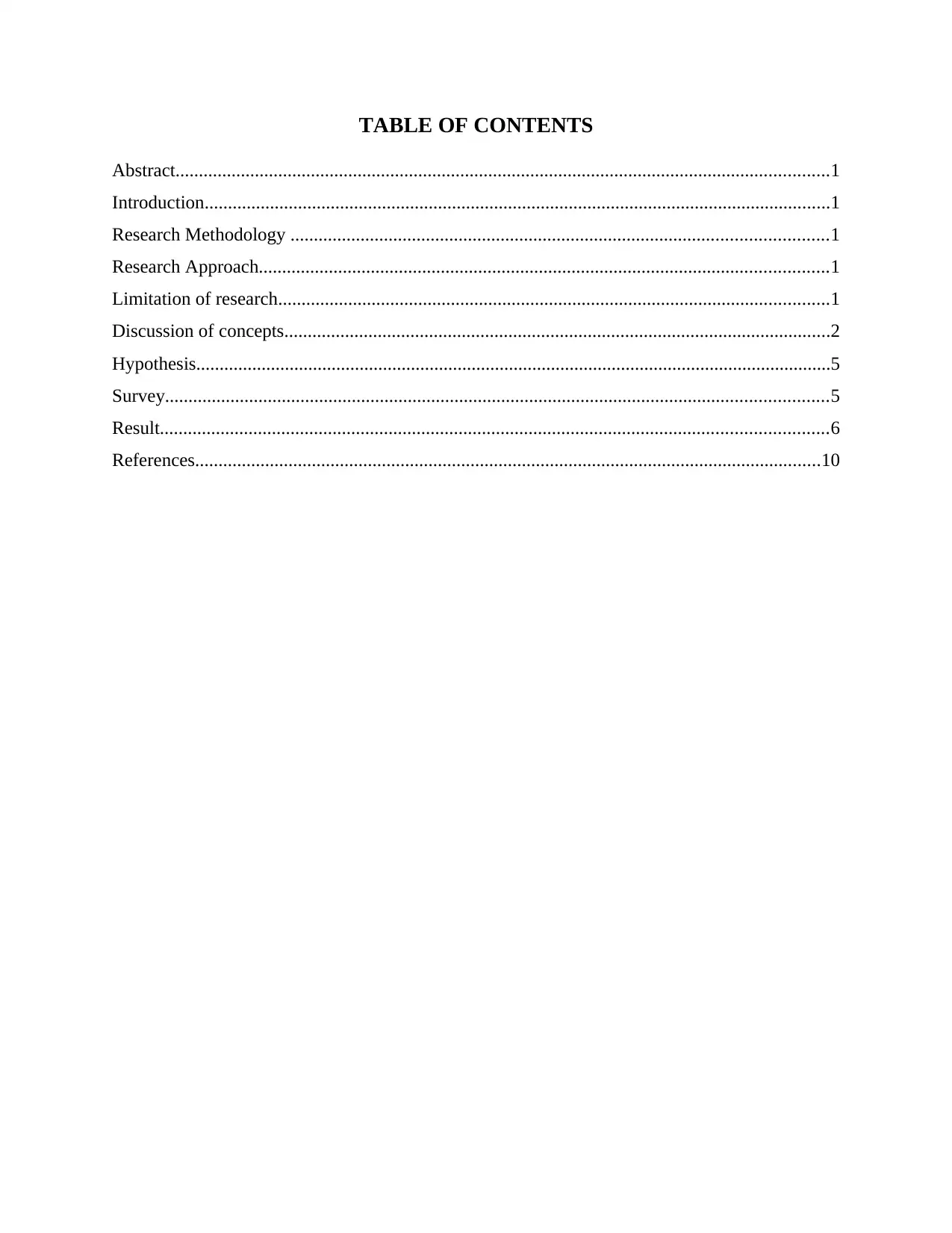
TABLE OF CONTENTS
Abstract............................................................................................................................................1
Introduction......................................................................................................................................1
Research Methodology ...................................................................................................................1
Research Approach..........................................................................................................................1
Limitation of research......................................................................................................................1
Discussion of concepts.....................................................................................................................2
Hypothesis........................................................................................................................................5
Survey..............................................................................................................................................5
Result...............................................................................................................................................6
References......................................................................................................................................10
Abstract............................................................................................................................................1
Introduction......................................................................................................................................1
Research Methodology ...................................................................................................................1
Research Approach..........................................................................................................................1
Limitation of research......................................................................................................................1
Discussion of concepts.....................................................................................................................2
Hypothesis........................................................................................................................................5
Survey..............................................................................................................................................5
Result...............................................................................................................................................6
References......................................................................................................................................10
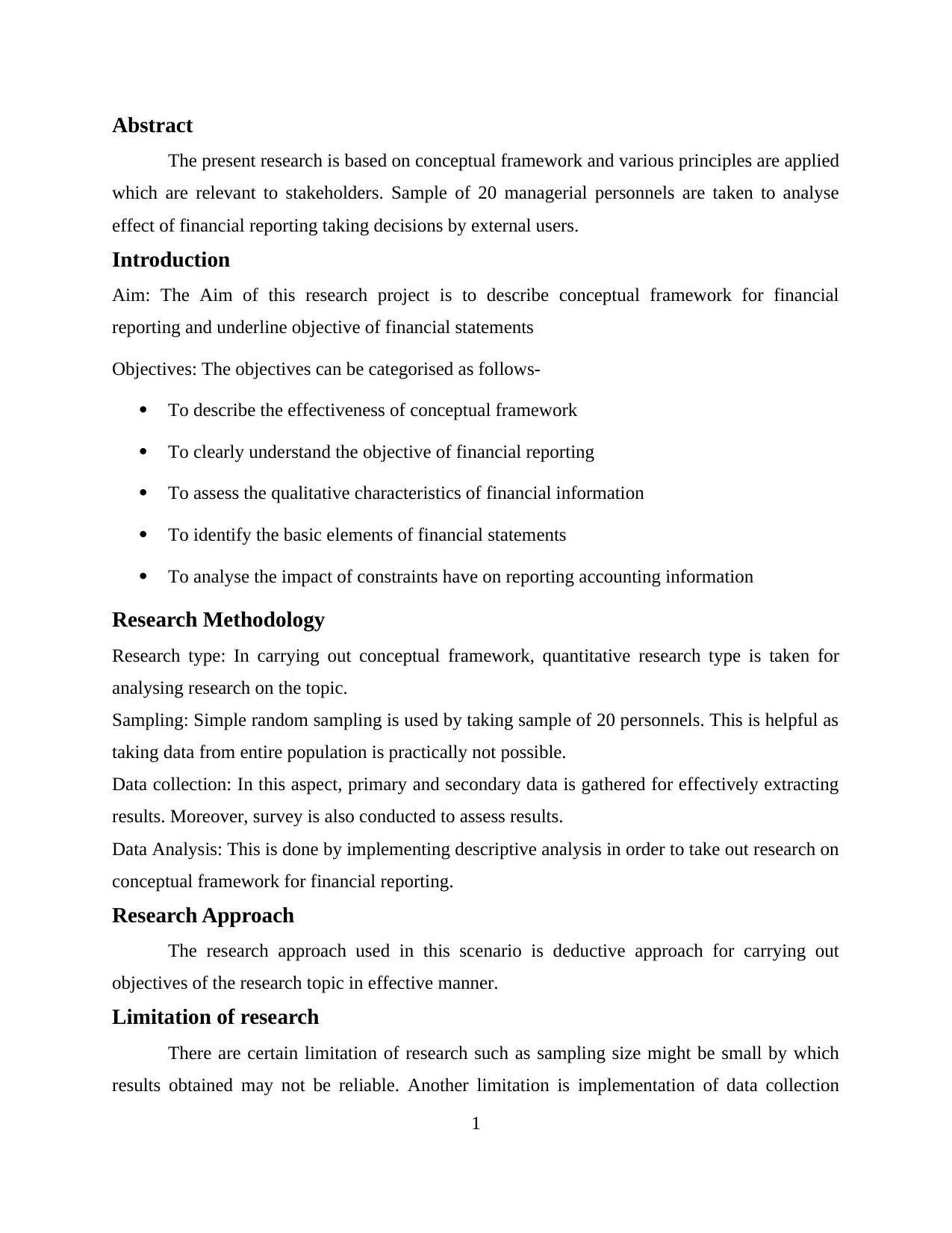
Abstract
The present research is based on conceptual framework and various principles are applied
which are relevant to stakeholders. Sample of 20 managerial personnels are taken to analyse
effect of financial reporting taking decisions by external users.
Introduction
Aim: The Aim of this research project is to describe conceptual framework for financial
reporting and underline objective of financial statements
Objectives: The objectives can be categorised as follows-
To describe the effectiveness of conceptual framework
To clearly understand the objective of financial reporting
To assess the qualitative characteristics of financial information
To identify the basic elements of financial statements
To analyse the impact of constraints have on reporting accounting information
Research Methodology
Research type: In carrying out conceptual framework, quantitative research type is taken for
analysing research on the topic.
Sampling: Simple random sampling is used by taking sample of 20 personnels. This is helpful as
taking data from entire population is practically not possible.
Data collection: In this aspect, primary and secondary data is gathered for effectively extracting
results. Moreover, survey is also conducted to assess results.
Data Analysis: This is done by implementing descriptive analysis in order to take out research on
conceptual framework for financial reporting.
Research Approach
The research approach used in this scenario is deductive approach for carrying out
objectives of the research topic in effective manner.
Limitation of research
There are certain limitation of research such as sampling size might be small by which
results obtained may not be reliable. Another limitation is implementation of data collection
1
The present research is based on conceptual framework and various principles are applied
which are relevant to stakeholders. Sample of 20 managerial personnels are taken to analyse
effect of financial reporting taking decisions by external users.
Introduction
Aim: The Aim of this research project is to describe conceptual framework for financial
reporting and underline objective of financial statements
Objectives: The objectives can be categorised as follows-
To describe the effectiveness of conceptual framework
To clearly understand the objective of financial reporting
To assess the qualitative characteristics of financial information
To identify the basic elements of financial statements
To analyse the impact of constraints have on reporting accounting information
Research Methodology
Research type: In carrying out conceptual framework, quantitative research type is taken for
analysing research on the topic.
Sampling: Simple random sampling is used by taking sample of 20 personnels. This is helpful as
taking data from entire population is practically not possible.
Data collection: In this aspect, primary and secondary data is gathered for effectively extracting
results. Moreover, survey is also conducted to assess results.
Data Analysis: This is done by implementing descriptive analysis in order to take out research on
conceptual framework for financial reporting.
Research Approach
The research approach used in this scenario is deductive approach for carrying out
objectives of the research topic in effective manner.
Limitation of research
There are certain limitation of research such as sampling size might be small by which
results obtained may not be reliable. Another limitation is implementation of data collection
1
⊘ This is a preview!⊘
Do you want full access?
Subscribe today to unlock all pages.

Trusted by 1+ million students worldwide
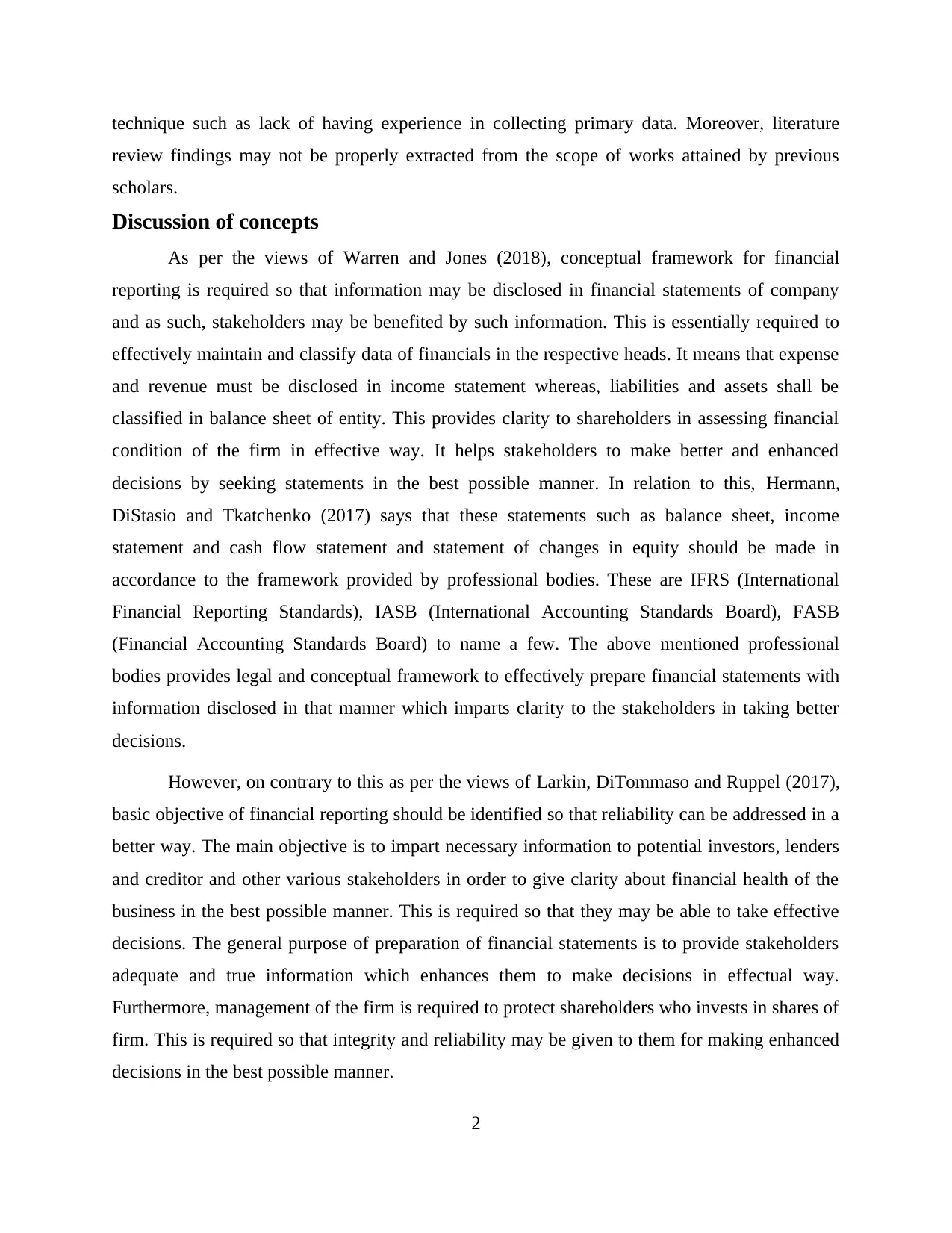
technique such as lack of having experience in collecting primary data. Moreover, literature
review findings may not be properly extracted from the scope of works attained by previous
scholars.
Discussion of concepts
As per the views of Warren and Jones (2018), conceptual framework for financial
reporting is required so that information may be disclosed in financial statements of company
and as such, stakeholders may be benefited by such information. This is essentially required to
effectively maintain and classify data of financials in the respective heads. It means that expense
and revenue must be disclosed in income statement whereas, liabilities and assets shall be
classified in balance sheet of entity. This provides clarity to shareholders in assessing financial
condition of the firm in effective way. It helps stakeholders to make better and enhanced
decisions by seeking statements in the best possible manner. In relation to this, Hermann,
DiStasio and Tkatchenko (2017) says that these statements such as balance sheet, income
statement and cash flow statement and statement of changes in equity should be made in
accordance to the framework provided by professional bodies. These are IFRS (International
Financial Reporting Standards), IASB (International Accounting Standards Board), FASB
(Financial Accounting Standards Board) to name a few. The above mentioned professional
bodies provides legal and conceptual framework to effectively prepare financial statements with
information disclosed in that manner which imparts clarity to the stakeholders in taking better
decisions.
However, on contrary to this as per the views of Larkin, DiTommaso and Ruppel (2017),
basic objective of financial reporting should be identified so that reliability can be addressed in a
better way. The main objective is to impart necessary information to potential investors, lenders
and creditor and other various stakeholders in order to give clarity about financial health of the
business in the best possible manner. This is required so that they may be able to take effective
decisions. The general purpose of preparation of financial statements is to provide stakeholders
adequate and true information which enhances them to make decisions in effectual way.
Furthermore, management of the firm is required to protect shareholders who invests in shares of
firm. This is required so that integrity and reliability may be given to them for making enhanced
decisions in the best possible manner.
2
review findings may not be properly extracted from the scope of works attained by previous
scholars.
Discussion of concepts
As per the views of Warren and Jones (2018), conceptual framework for financial
reporting is required so that information may be disclosed in financial statements of company
and as such, stakeholders may be benefited by such information. This is essentially required to
effectively maintain and classify data of financials in the respective heads. It means that expense
and revenue must be disclosed in income statement whereas, liabilities and assets shall be
classified in balance sheet of entity. This provides clarity to shareholders in assessing financial
condition of the firm in effective way. It helps stakeholders to make better and enhanced
decisions by seeking statements in the best possible manner. In relation to this, Hermann,
DiStasio and Tkatchenko (2017) says that these statements such as balance sheet, income
statement and cash flow statement and statement of changes in equity should be made in
accordance to the framework provided by professional bodies. These are IFRS (International
Financial Reporting Standards), IASB (International Accounting Standards Board), FASB
(Financial Accounting Standards Board) to name a few. The above mentioned professional
bodies provides legal and conceptual framework to effectively prepare financial statements with
information disclosed in that manner which imparts clarity to the stakeholders in taking better
decisions.
However, on contrary to this as per the views of Larkin, DiTommaso and Ruppel (2017),
basic objective of financial reporting should be identified so that reliability can be addressed in a
better way. The main objective is to impart necessary information to potential investors, lenders
and creditor and other various stakeholders in order to give clarity about financial health of the
business in the best possible manner. This is required so that they may be able to take effective
decisions. The general purpose of preparation of financial statements is to provide stakeholders
adequate and true information which enhances them to make decisions in effectual way.
Furthermore, management of the firm is required to protect shareholders who invests in shares of
firm. This is required so that integrity and reliability may be given to them for making enhanced
decisions in the best possible manner.
2
Paraphrase This Document
Need a fresh take? Get an instant paraphrase of this document with our AI Paraphraser
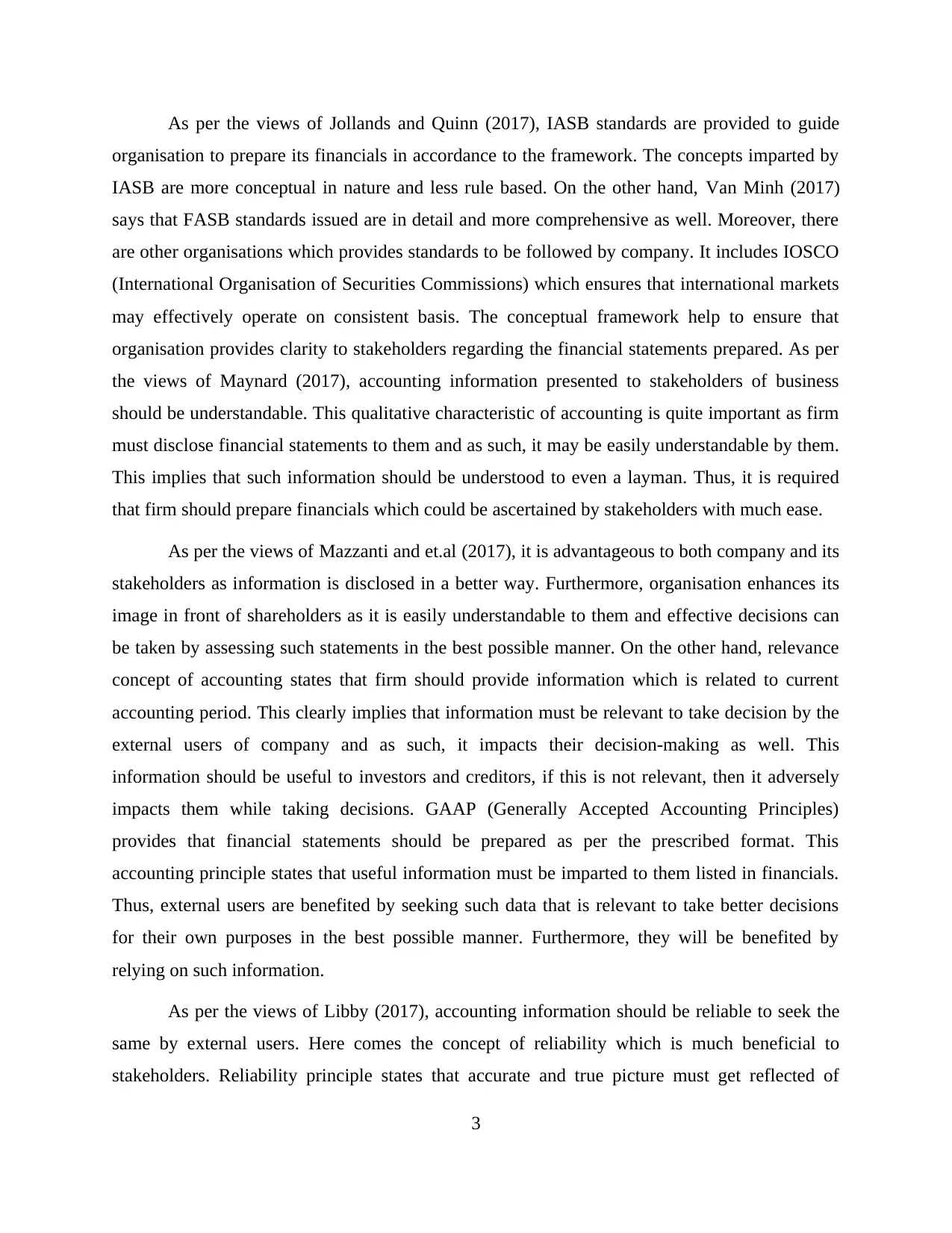
As per the views of Jollands and Quinn (2017), IASB standards are provided to guide
organisation to prepare its financials in accordance to the framework. The concepts imparted by
IASB are more conceptual in nature and less rule based. On the other hand, Van Minh (2017)
says that FASB standards issued are in detail and more comprehensive as well. Moreover, there
are other organisations which provides standards to be followed by company. It includes IOSCO
(International Organisation of Securities Commissions) which ensures that international markets
may effectively operate on consistent basis. The conceptual framework help to ensure that
organisation provides clarity to stakeholders regarding the financial statements prepared. As per
the views of Maynard (2017), accounting information presented to stakeholders of business
should be understandable. This qualitative characteristic of accounting is quite important as firm
must disclose financial statements to them and as such, it may be easily understandable by them.
This implies that such information should be understood to even a layman. Thus, it is required
that firm should prepare financials which could be ascertained by stakeholders with much ease.
As per the views of Mazzanti and et.al (2017), it is advantageous to both company and its
stakeholders as information is disclosed in a better way. Furthermore, organisation enhances its
image in front of shareholders as it is easily understandable to them and effective decisions can
be taken by assessing such statements in the best possible manner. On the other hand, relevance
concept of accounting states that firm should provide information which is related to current
accounting period. This clearly implies that information must be relevant to take decision by the
external users of company and as such, it impacts their decision-making as well. This
information should be useful to investors and creditors, if this is not relevant, then it adversely
impacts them while taking decisions. GAAP (Generally Accepted Accounting Principles)
provides that financial statements should be prepared as per the prescribed format. This
accounting principle states that useful information must be imparted to them listed in financials.
Thus, external users are benefited by seeking such data that is relevant to take better decisions
for their own purposes in the best possible manner. Furthermore, they will be benefited by
relying on such information.
As per the views of Libby (2017), accounting information should be reliable to seek the
same by external users. Here comes the concept of reliability which is much beneficial to
stakeholders. Reliability principle states that accurate and true picture must get reflected of
3
organisation to prepare its financials in accordance to the framework. The concepts imparted by
IASB are more conceptual in nature and less rule based. On the other hand, Van Minh (2017)
says that FASB standards issued are in detail and more comprehensive as well. Moreover, there
are other organisations which provides standards to be followed by company. It includes IOSCO
(International Organisation of Securities Commissions) which ensures that international markets
may effectively operate on consistent basis. The conceptual framework help to ensure that
organisation provides clarity to stakeholders regarding the financial statements prepared. As per
the views of Maynard (2017), accounting information presented to stakeholders of business
should be understandable. This qualitative characteristic of accounting is quite important as firm
must disclose financial statements to them and as such, it may be easily understandable by them.
This implies that such information should be understood to even a layman. Thus, it is required
that firm should prepare financials which could be ascertained by stakeholders with much ease.
As per the views of Mazzanti and et.al (2017), it is advantageous to both company and its
stakeholders as information is disclosed in a better way. Furthermore, organisation enhances its
image in front of shareholders as it is easily understandable to them and effective decisions can
be taken by assessing such statements in the best possible manner. On the other hand, relevance
concept of accounting states that firm should provide information which is related to current
accounting period. This clearly implies that information must be relevant to take decision by the
external users of company and as such, it impacts their decision-making as well. This
information should be useful to investors and creditors, if this is not relevant, then it adversely
impacts them while taking decisions. GAAP (Generally Accepted Accounting Principles)
provides that financial statements should be prepared as per the prescribed format. This
accounting principle states that useful information must be imparted to them listed in financials.
Thus, external users are benefited by seeking such data that is relevant to take better decisions
for their own purposes in the best possible manner. Furthermore, they will be benefited by
relying on such information.
As per the views of Libby (2017), accounting information should be reliable to seek the
same by external users. Here comes the concept of reliability which is much beneficial to
stakeholders. Reliability principle states that accurate and true picture must get reflected of
3
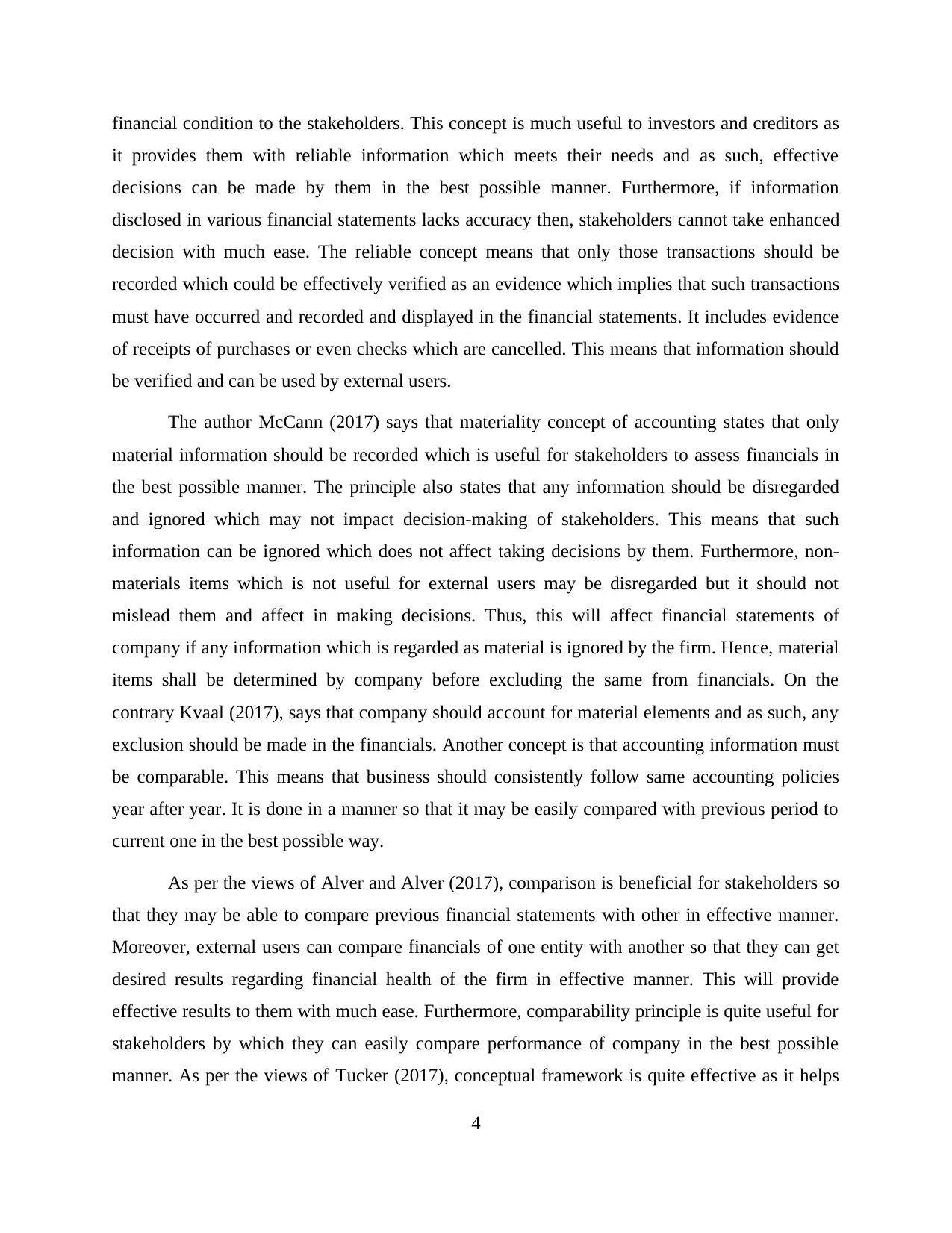
financial condition to the stakeholders. This concept is much useful to investors and creditors as
it provides them with reliable information which meets their needs and as such, effective
decisions can be made by them in the best possible manner. Furthermore, if information
disclosed in various financial statements lacks accuracy then, stakeholders cannot take enhanced
decision with much ease. The reliable concept means that only those transactions should be
recorded which could be effectively verified as an evidence which implies that such transactions
must have occurred and recorded and displayed in the financial statements. It includes evidence
of receipts of purchases or even checks which are cancelled. This means that information should
be verified and can be used by external users.
The author McCann (2017) says that materiality concept of accounting states that only
material information should be recorded which is useful for stakeholders to assess financials in
the best possible manner. The principle also states that any information should be disregarded
and ignored which may not impact decision-making of stakeholders. This means that such
information can be ignored which does not affect taking decisions by them. Furthermore, non-
materials items which is not useful for external users may be disregarded but it should not
mislead them and affect in making decisions. Thus, this will affect financial statements of
company if any information which is regarded as material is ignored by the firm. Hence, material
items shall be determined by company before excluding the same from financials. On the
contrary Kvaal (2017), says that company should account for material elements and as such, any
exclusion should be made in the financials. Another concept is that accounting information must
be comparable. This means that business should consistently follow same accounting policies
year after year. It is done in a manner so that it may be easily compared with previous period to
current one in the best possible way.
As per the views of Alver and Alver (2017), comparison is beneficial for stakeholders so
that they may be able to compare previous financial statements with other in effective manner.
Moreover, external users can compare financials of one entity with another so that they can get
desired results regarding financial health of the firm in effective manner. This will provide
effective results to them with much ease. Furthermore, comparability principle is quite useful for
stakeholders by which they can easily compare performance of company in the best possible
manner. As per the views of Tucker (2017), conceptual framework is quite effective as it helps
4
it provides them with reliable information which meets their needs and as such, effective
decisions can be made by them in the best possible manner. Furthermore, if information
disclosed in various financial statements lacks accuracy then, stakeholders cannot take enhanced
decision with much ease. The reliable concept means that only those transactions should be
recorded which could be effectively verified as an evidence which implies that such transactions
must have occurred and recorded and displayed in the financial statements. It includes evidence
of receipts of purchases or even checks which are cancelled. This means that information should
be verified and can be used by external users.
The author McCann (2017) says that materiality concept of accounting states that only
material information should be recorded which is useful for stakeholders to assess financials in
the best possible manner. The principle also states that any information should be disregarded
and ignored which may not impact decision-making of stakeholders. This means that such
information can be ignored which does not affect taking decisions by them. Furthermore, non-
materials items which is not useful for external users may be disregarded but it should not
mislead them and affect in making decisions. Thus, this will affect financial statements of
company if any information which is regarded as material is ignored by the firm. Hence, material
items shall be determined by company before excluding the same from financials. On the
contrary Kvaal (2017), says that company should account for material elements and as such, any
exclusion should be made in the financials. Another concept is that accounting information must
be comparable. This means that business should consistently follow same accounting policies
year after year. It is done in a manner so that it may be easily compared with previous period to
current one in the best possible way.
As per the views of Alver and Alver (2017), comparison is beneficial for stakeholders so
that they may be able to compare previous financial statements with other in effective manner.
Moreover, external users can compare financials of one entity with another so that they can get
desired results regarding financial health of the firm in effective manner. This will provide
effective results to them with much ease. Furthermore, comparability principle is quite useful for
stakeholders by which they can easily compare performance of company in the best possible
manner. As per the views of Tucker (2017), conceptual framework is quite effective as it helps
4
⊘ This is a preview!⊘
Do you want full access?
Subscribe today to unlock all pages.
Trusted by 1+ million students worldwide
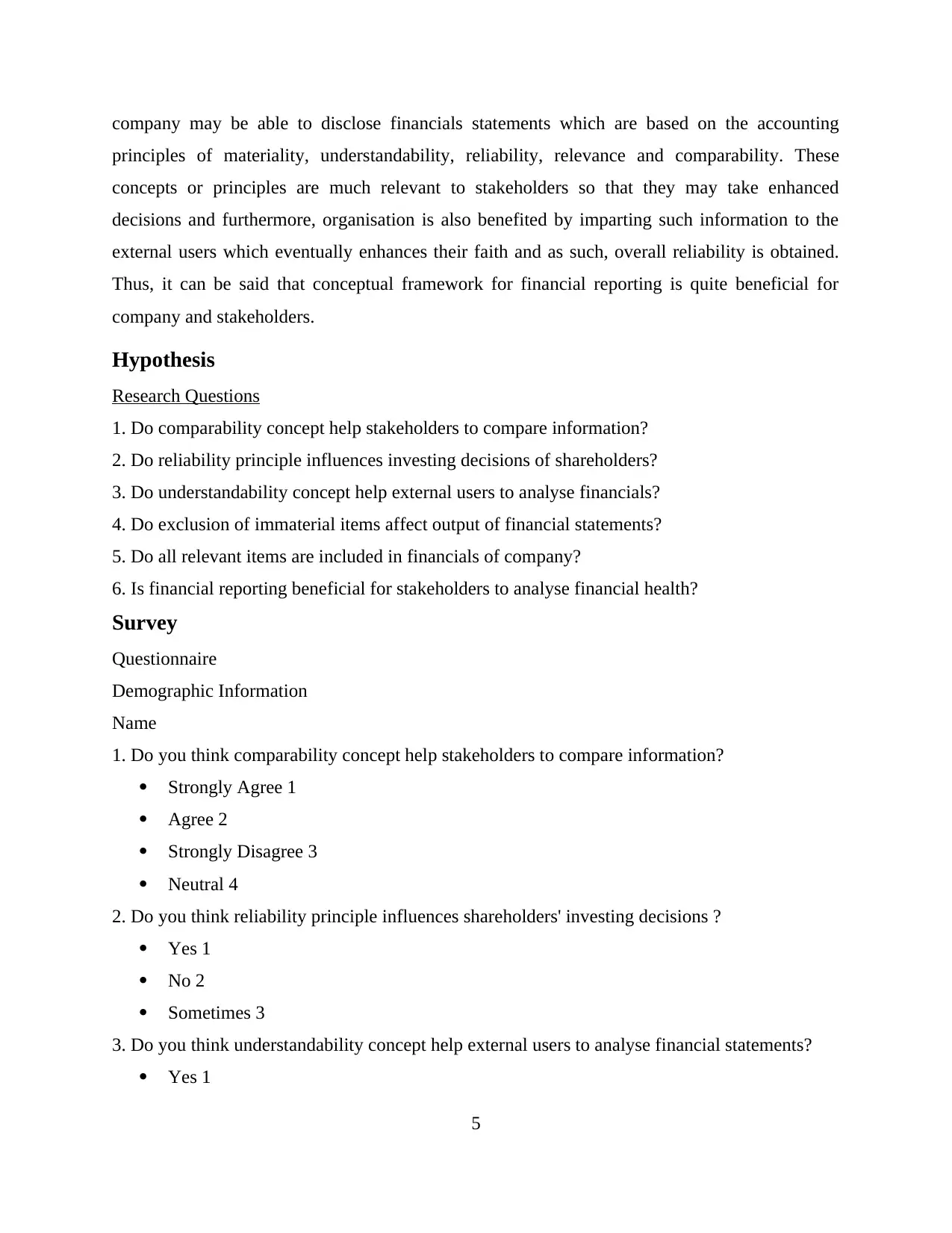
company may be able to disclose financials statements which are based on the accounting
principles of materiality, understandability, reliability, relevance and comparability. These
concepts or principles are much relevant to stakeholders so that they may take enhanced
decisions and furthermore, organisation is also benefited by imparting such information to the
external users which eventually enhances their faith and as such, overall reliability is obtained.
Thus, it can be said that conceptual framework for financial reporting is quite beneficial for
company and stakeholders.
Hypothesis
Research Questions
1. Do comparability concept help stakeholders to compare information?
2. Do reliability principle influences investing decisions of shareholders?
3. Do understandability concept help external users to analyse financials?
4. Do exclusion of immaterial items affect output of financial statements?
5. Do all relevant items are included in financials of company?
6. Is financial reporting beneficial for stakeholders to analyse financial health?
Survey
Questionnaire
Demographic Information
Name
1. Do you think comparability concept help stakeholders to compare information?
Strongly Agree 1
Agree 2
Strongly Disagree 3
Neutral 4
2. Do you think reliability principle influences shareholders' investing decisions ?
Yes 1
No 2
Sometimes 3
3. Do you think understandability concept help external users to analyse financial statements?
Yes 1
5
principles of materiality, understandability, reliability, relevance and comparability. These
concepts or principles are much relevant to stakeholders so that they may take enhanced
decisions and furthermore, organisation is also benefited by imparting such information to the
external users which eventually enhances their faith and as such, overall reliability is obtained.
Thus, it can be said that conceptual framework for financial reporting is quite beneficial for
company and stakeholders.
Hypothesis
Research Questions
1. Do comparability concept help stakeholders to compare information?
2. Do reliability principle influences investing decisions of shareholders?
3. Do understandability concept help external users to analyse financials?
4. Do exclusion of immaterial items affect output of financial statements?
5. Do all relevant items are included in financials of company?
6. Is financial reporting beneficial for stakeholders to analyse financial health?
Survey
Questionnaire
Demographic Information
Name
1. Do you think comparability concept help stakeholders to compare information?
Strongly Agree 1
Agree 2
Strongly Disagree 3
Neutral 4
2. Do you think reliability principle influences shareholders' investing decisions ?
Yes 1
No 2
Sometimes 3
3. Do you think understandability concept help external users to analyse financial statements?
Yes 1
5
Paraphrase This Document
Need a fresh take? Get an instant paraphrase of this document with our AI Paraphraser
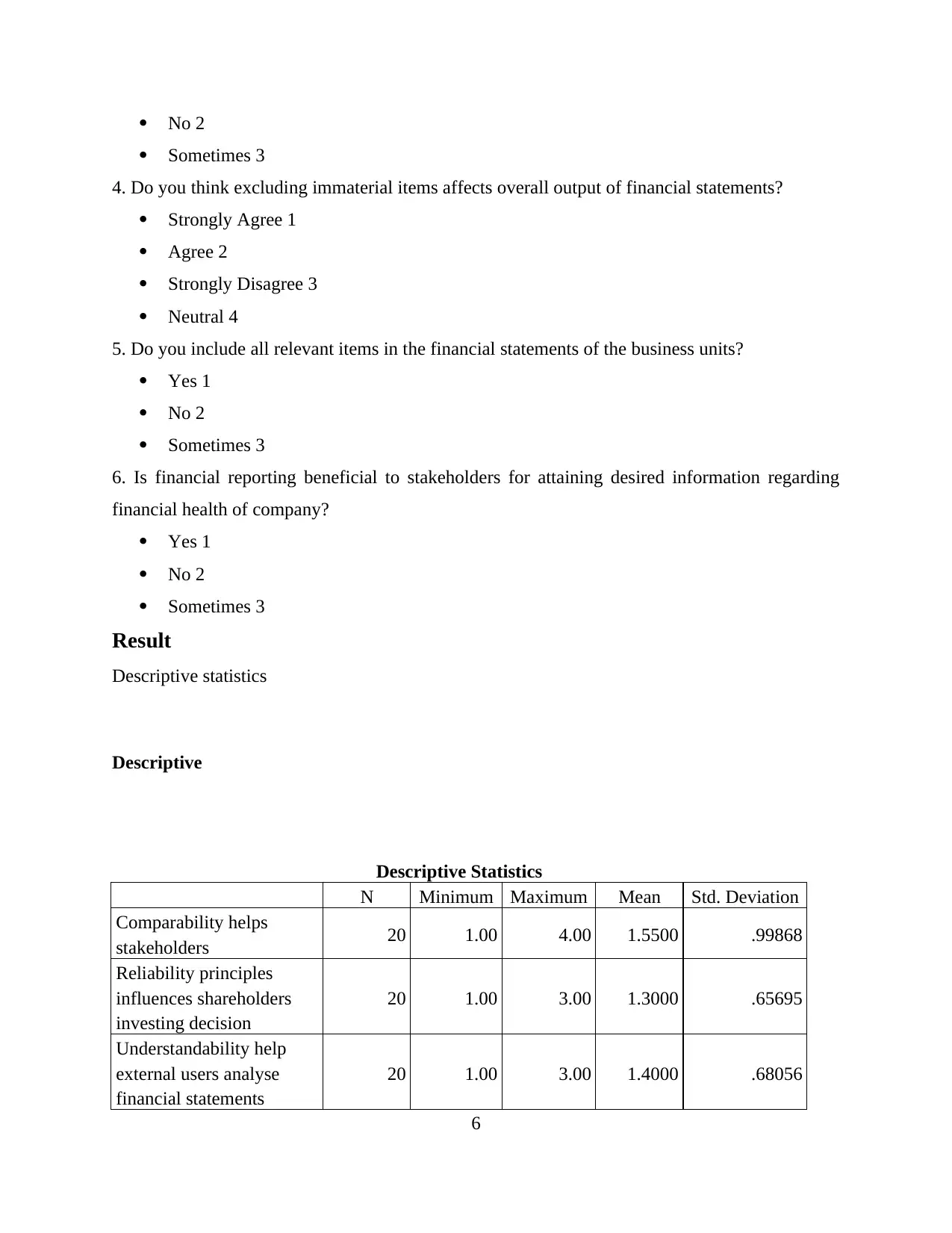
No 2
Sometimes 3
4. Do you think excluding immaterial items affects overall output of financial statements?
Strongly Agree 1
Agree 2
Strongly Disagree 3
Neutral 4
5. Do you include all relevant items in the financial statements of the business units?
Yes 1
No 2
Sometimes 3
6. Is financial reporting beneficial to stakeholders for attaining desired information regarding
financial health of company?
Yes 1
No 2
Sometimes 3
Result
Descriptive statistics
Descriptive
Descriptive Statistics
N Minimum Maximum Mean Std. Deviation
Comparability helps
stakeholders 20 1.00 4.00 1.5500 .99868
Reliability principles
influences shareholders
investing decision
20 1.00 3.00 1.3000 .65695
Understandability help
external users analyse
financial statements
20 1.00 3.00 1.4000 .68056
6
Sometimes 3
4. Do you think excluding immaterial items affects overall output of financial statements?
Strongly Agree 1
Agree 2
Strongly Disagree 3
Neutral 4
5. Do you include all relevant items in the financial statements of the business units?
Yes 1
No 2
Sometimes 3
6. Is financial reporting beneficial to stakeholders for attaining desired information regarding
financial health of company?
Yes 1
No 2
Sometimes 3
Result
Descriptive statistics
Descriptive
Descriptive Statistics
N Minimum Maximum Mean Std. Deviation
Comparability helps
stakeholders 20 1.00 4.00 1.5500 .99868
Reliability principles
influences shareholders
investing decision
20 1.00 3.00 1.3000 .65695
Understandability help
external users analyse
financial statements
20 1.00 3.00 1.4000 .68056
6
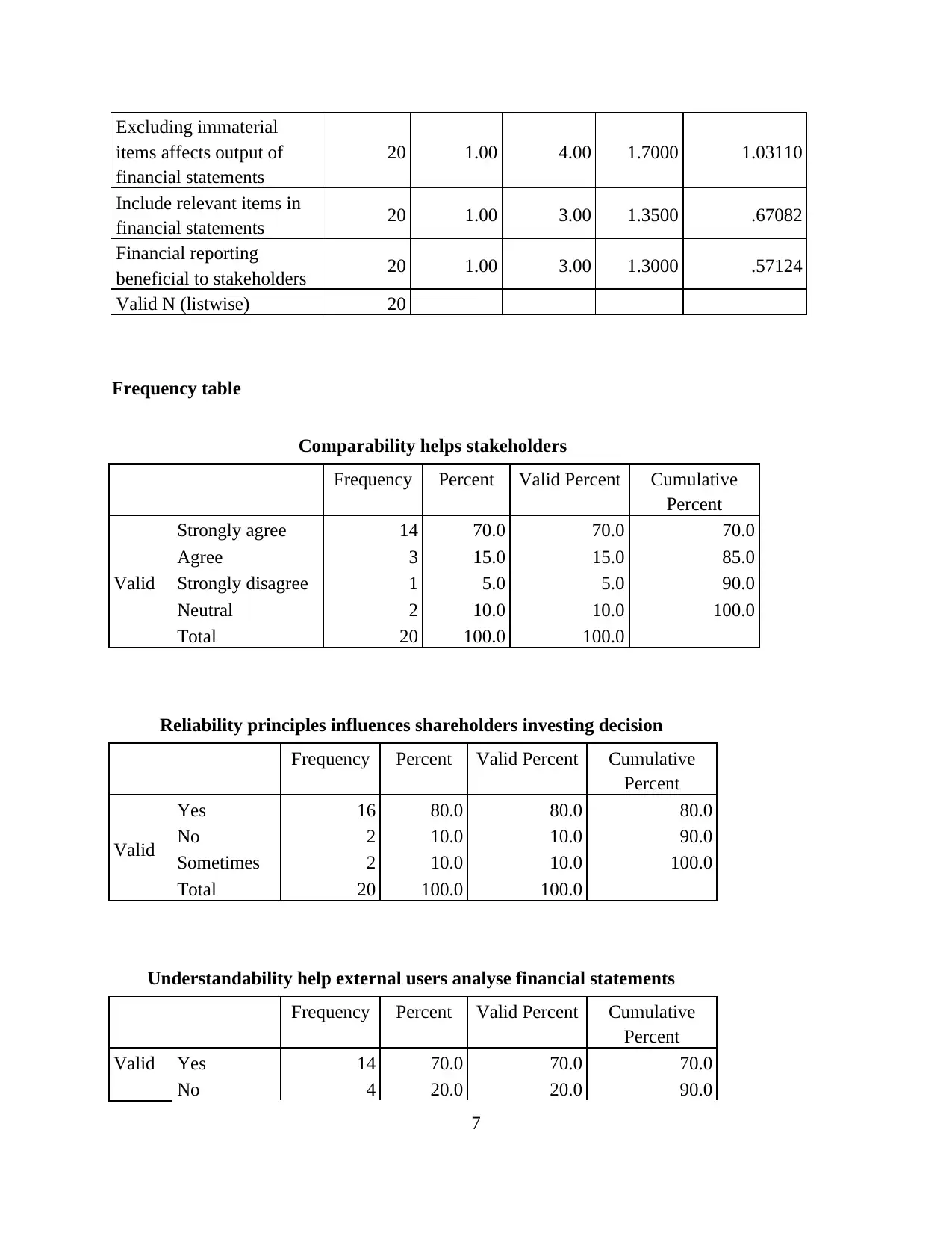
Excluding immaterial
items affects output of
financial statements
20 1.00 4.00 1.7000 1.03110
Include relevant items in
financial statements 20 1.00 3.00 1.3500 .67082
Financial reporting
beneficial to stakeholders 20 1.00 3.00 1.3000 .57124
Valid N (listwise) 20
Frequency table
Comparability helps stakeholders
Frequency Percent Valid Percent Cumulative
Percent
Valid
Strongly agree 14 70.0 70.0 70.0
Agree 3 15.0 15.0 85.0
Strongly disagree 1 5.0 5.0 90.0
Neutral 2 10.0 10.0 100.0
Total 20 100.0 100.0
Reliability principles influences shareholders investing decision
Frequency Percent Valid Percent Cumulative
Percent
Valid
Yes 16 80.0 80.0 80.0
No 2 10.0 10.0 90.0
Sometimes 2 10.0 10.0 100.0
Total 20 100.0 100.0
Understandability help external users analyse financial statements
Frequency Percent Valid Percent Cumulative
Percent
Valid Yes 14 70.0 70.0 70.0
No 4 20.0 20.0 90.0
7
items affects output of
financial statements
20 1.00 4.00 1.7000 1.03110
Include relevant items in
financial statements 20 1.00 3.00 1.3500 .67082
Financial reporting
beneficial to stakeholders 20 1.00 3.00 1.3000 .57124
Valid N (listwise) 20
Frequency table
Comparability helps stakeholders
Frequency Percent Valid Percent Cumulative
Percent
Valid
Strongly agree 14 70.0 70.0 70.0
Agree 3 15.0 15.0 85.0
Strongly disagree 1 5.0 5.0 90.0
Neutral 2 10.0 10.0 100.0
Total 20 100.0 100.0
Reliability principles influences shareholders investing decision
Frequency Percent Valid Percent Cumulative
Percent
Valid
Yes 16 80.0 80.0 80.0
No 2 10.0 10.0 90.0
Sometimes 2 10.0 10.0 100.0
Total 20 100.0 100.0
Understandability help external users analyse financial statements
Frequency Percent Valid Percent Cumulative
Percent
Valid Yes 14 70.0 70.0 70.0
No 4 20.0 20.0 90.0
7
⊘ This is a preview!⊘
Do you want full access?
Subscribe today to unlock all pages.
Trusted by 1+ million students worldwide
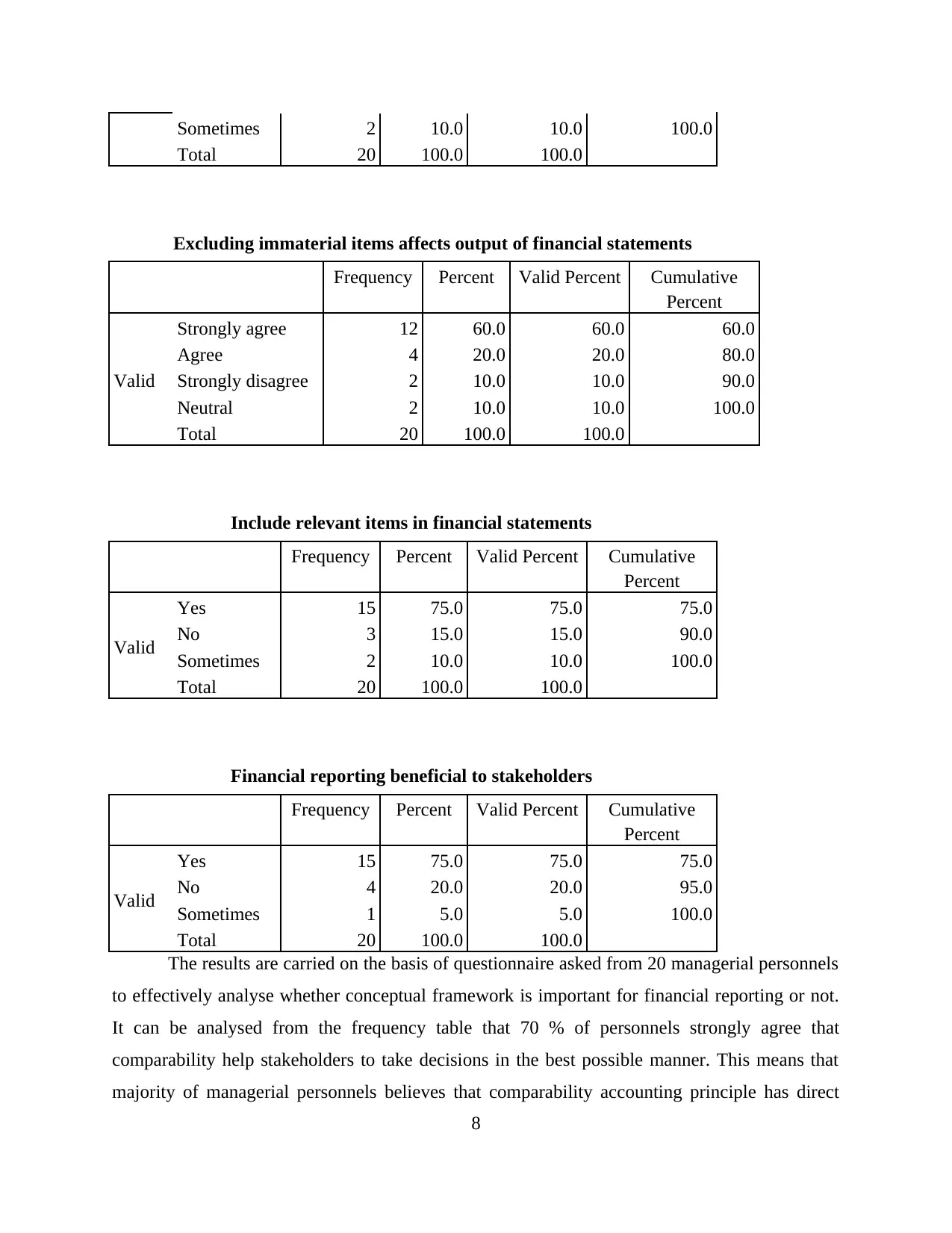
Sometimes 2 10.0 10.0 100.0
Total 20 100.0 100.0
Excluding immaterial items affects output of financial statements
Frequency Percent Valid Percent Cumulative
Percent
Valid
Strongly agree 12 60.0 60.0 60.0
Agree 4 20.0 20.0 80.0
Strongly disagree 2 10.0 10.0 90.0
Neutral 2 10.0 10.0 100.0
Total 20 100.0 100.0
Include relevant items in financial statements
Frequency Percent Valid Percent Cumulative
Percent
Valid
Yes 15 75.0 75.0 75.0
No 3 15.0 15.0 90.0
Sometimes 2 10.0 10.0 100.0
Total 20 100.0 100.0
Financial reporting beneficial to stakeholders
Frequency Percent Valid Percent Cumulative
Percent
Valid
Yes 15 75.0 75.0 75.0
No 4 20.0 20.0 95.0
Sometimes 1 5.0 5.0 100.0
Total 20 100.0 100.0
The results are carried on the basis of questionnaire asked from 20 managerial personnels
to effectively analyse whether conceptual framework is important for financial reporting or not.
It can be analysed from the frequency table that 70 % of personnels strongly agree that
comparability help stakeholders to take decisions in the best possible manner. This means that
majority of managerial personnels believes that comparability accounting principle has direct
8
Total 20 100.0 100.0
Excluding immaterial items affects output of financial statements
Frequency Percent Valid Percent Cumulative
Percent
Valid
Strongly agree 12 60.0 60.0 60.0
Agree 4 20.0 20.0 80.0
Strongly disagree 2 10.0 10.0 90.0
Neutral 2 10.0 10.0 100.0
Total 20 100.0 100.0
Include relevant items in financial statements
Frequency Percent Valid Percent Cumulative
Percent
Valid
Yes 15 75.0 75.0 75.0
No 3 15.0 15.0 90.0
Sometimes 2 10.0 10.0 100.0
Total 20 100.0 100.0
Financial reporting beneficial to stakeholders
Frequency Percent Valid Percent Cumulative
Percent
Valid
Yes 15 75.0 75.0 75.0
No 4 20.0 20.0 95.0
Sometimes 1 5.0 5.0 100.0
Total 20 100.0 100.0
The results are carried on the basis of questionnaire asked from 20 managerial personnels
to effectively analyse whether conceptual framework is important for financial reporting or not.
It can be analysed from the frequency table that 70 % of personnels strongly agree that
comparability help stakeholders to take decisions in the best possible manner. This means that
majority of managerial personnels believes that comparability accounting principle has direct
8
Paraphrase This Document
Need a fresh take? Get an instant paraphrase of this document with our AI Paraphraser
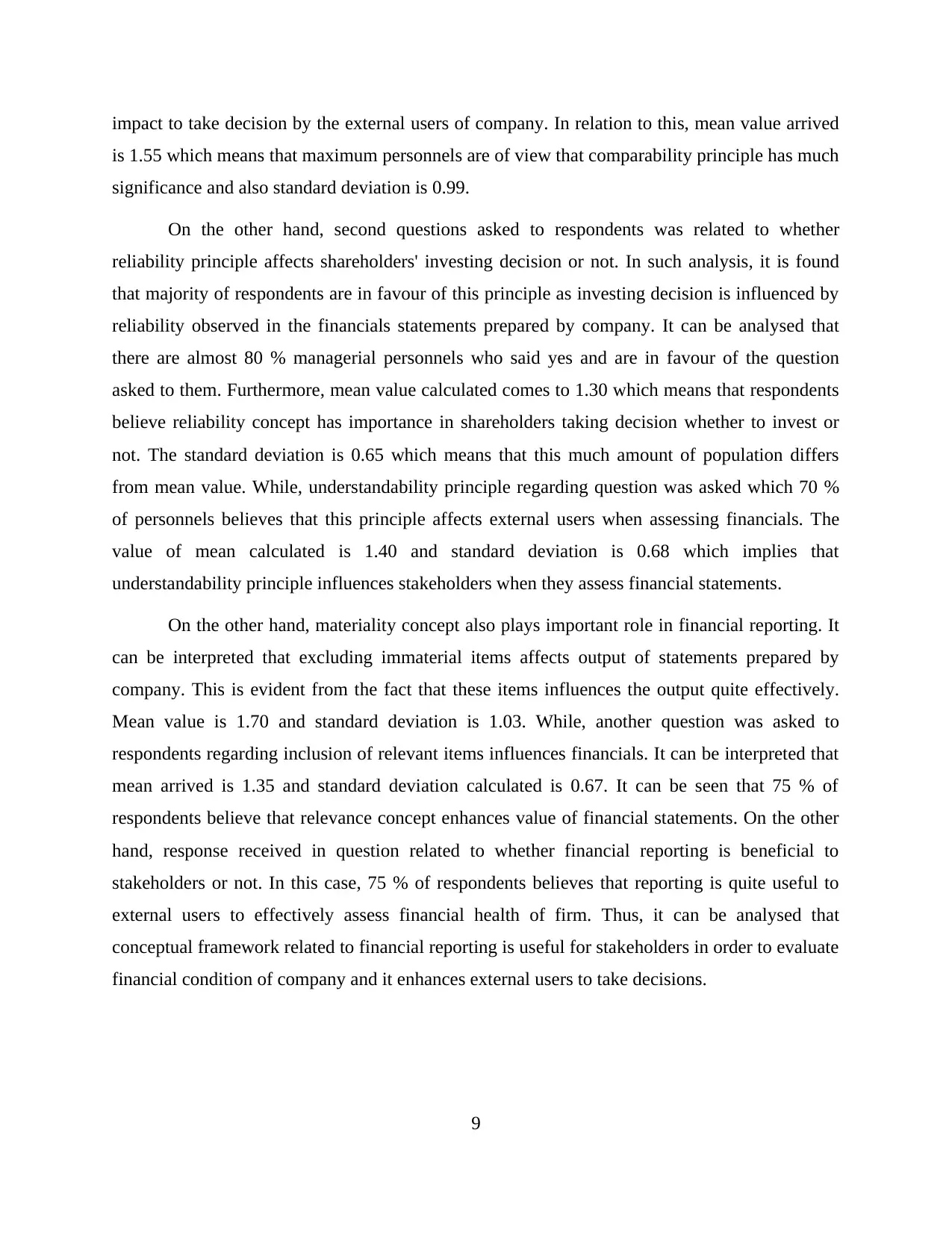
impact to take decision by the external users of company. In relation to this, mean value arrived
is 1.55 which means that maximum personnels are of view that comparability principle has much
significance and also standard deviation is 0.99.
On the other hand, second questions asked to respondents was related to whether
reliability principle affects shareholders' investing decision or not. In such analysis, it is found
that majority of respondents are in favour of this principle as investing decision is influenced by
reliability observed in the financials statements prepared by company. It can be analysed that
there are almost 80 % managerial personnels who said yes and are in favour of the question
asked to them. Furthermore, mean value calculated comes to 1.30 which means that respondents
believe reliability concept has importance in shareholders taking decision whether to invest or
not. The standard deviation is 0.65 which means that this much amount of population differs
from mean value. While, understandability principle regarding question was asked which 70 %
of personnels believes that this principle affects external users when assessing financials. The
value of mean calculated is 1.40 and standard deviation is 0.68 which implies that
understandability principle influences stakeholders when they assess financial statements.
On the other hand, materiality concept also plays important role in financial reporting. It
can be interpreted that excluding immaterial items affects output of statements prepared by
company. This is evident from the fact that these items influences the output quite effectively.
Mean value is 1.70 and standard deviation is 1.03. While, another question was asked to
respondents regarding inclusion of relevant items influences financials. It can be interpreted that
mean arrived is 1.35 and standard deviation calculated is 0.67. It can be seen that 75 % of
respondents believe that relevance concept enhances value of financial statements. On the other
hand, response received in question related to whether financial reporting is beneficial to
stakeholders or not. In this case, 75 % of respondents believes that reporting is quite useful to
external users to effectively assess financial health of firm. Thus, it can be analysed that
conceptual framework related to financial reporting is useful for stakeholders in order to evaluate
financial condition of company and it enhances external users to take decisions.
9
is 1.55 which means that maximum personnels are of view that comparability principle has much
significance and also standard deviation is 0.99.
On the other hand, second questions asked to respondents was related to whether
reliability principle affects shareholders' investing decision or not. In such analysis, it is found
that majority of respondents are in favour of this principle as investing decision is influenced by
reliability observed in the financials statements prepared by company. It can be analysed that
there are almost 80 % managerial personnels who said yes and are in favour of the question
asked to them. Furthermore, mean value calculated comes to 1.30 which means that respondents
believe reliability concept has importance in shareholders taking decision whether to invest or
not. The standard deviation is 0.65 which means that this much amount of population differs
from mean value. While, understandability principle regarding question was asked which 70 %
of personnels believes that this principle affects external users when assessing financials. The
value of mean calculated is 1.40 and standard deviation is 0.68 which implies that
understandability principle influences stakeholders when they assess financial statements.
On the other hand, materiality concept also plays important role in financial reporting. It
can be interpreted that excluding immaterial items affects output of statements prepared by
company. This is evident from the fact that these items influences the output quite effectively.
Mean value is 1.70 and standard deviation is 1.03. While, another question was asked to
respondents regarding inclusion of relevant items influences financials. It can be interpreted that
mean arrived is 1.35 and standard deviation calculated is 0.67. It can be seen that 75 % of
respondents believe that relevance concept enhances value of financial statements. On the other
hand, response received in question related to whether financial reporting is beneficial to
stakeholders or not. In this case, 75 % of respondents believes that reporting is quite useful to
external users to effectively assess financial health of firm. Thus, it can be analysed that
conceptual framework related to financial reporting is useful for stakeholders in order to evaluate
financial condition of company and it enhances external users to take decisions.
9
References
Alver, L. and Alver, J., 2017. The Role and Current Status of IFRS in the Completion of the
National Accounting Rules–Evidence from Estonia. Accounting in Europe. 14(1-2). pp.80-
87.
Hermann, J., DiStasio Jr, R. A. and Tkatchenko, A., 2017. First-principles models for van der
Waals interactions in molecules and materials: concepts, theory, and applications.
Jollands, S. and Quinn, M., 2017. Politicising the sustaining of water supply in Ireland–the role
of accounting concepts.Accounting, Auditing & Accountability Journal. 30(1). pp.164-190.
Kvaal, E., 2017. The role and current status of IFRS in the completion of national accounting
rules–Evidence from Norway. Accounting in Europe. 14(1-2). pp.150-157.
Larkin, R. F., DiTommaso, M. and Ruppel, W., 2017. Wiley Not-for-Profit GAAP 2017:
Interpretation and Application of Generally Accepted Accounting Principles. John Wiley
& Sons.
Libby, R., 2017. Accounting and human information processing. In The Routledge Companion
to Behavioural Accounting Research (pp. 42-54). Routledge.
Maynard, J., 2017. Financial Accounting, Reporting, and Analysis. Oxford University Press.
Mazzanti, P. and et.al, 2017, March. Geotechnical asset management for Italian transport
agencies: Implementation principles and concepts. In Transport Infrastructure and
Systems: Proceedings of the AIIT International Congress on Transport Infrastructure and
Systems (Rome, Italy, 10-12 April 2017) (p. 325). CRC Press.
McCann, L. M., 2017. Thinking outside the ledger: a visual representation project for accounting
students. The Accounting Educators' Journal. 26.
Tucker, B. P., 2017. Figuratively speaking: analogies in the accounting classroom. Accounting
Education. 26(2). pp.166-190.
Van Minh, N., 2017. Quantum gauss-Jordan elimination and simulation of accounting principles
on quantum computers.International Journal of Theoretical Physics. 56(6). pp.1948-1960.
Ward, D. M. and Calabrese, T., 2018. Accounting fundamentals for health care management.
Jones & Bartlett Learning.
10
Alver, L. and Alver, J., 2017. The Role and Current Status of IFRS in the Completion of the
National Accounting Rules–Evidence from Estonia. Accounting in Europe. 14(1-2). pp.80-
87.
Hermann, J., DiStasio Jr, R. A. and Tkatchenko, A., 2017. First-principles models for van der
Waals interactions in molecules and materials: concepts, theory, and applications.
Jollands, S. and Quinn, M., 2017. Politicising the sustaining of water supply in Ireland–the role
of accounting concepts.Accounting, Auditing & Accountability Journal. 30(1). pp.164-190.
Kvaal, E., 2017. The role and current status of IFRS in the completion of national accounting
rules–Evidence from Norway. Accounting in Europe. 14(1-2). pp.150-157.
Larkin, R. F., DiTommaso, M. and Ruppel, W., 2017. Wiley Not-for-Profit GAAP 2017:
Interpretation and Application of Generally Accepted Accounting Principles. John Wiley
& Sons.
Libby, R., 2017. Accounting and human information processing. In The Routledge Companion
to Behavioural Accounting Research (pp. 42-54). Routledge.
Maynard, J., 2017. Financial Accounting, Reporting, and Analysis. Oxford University Press.
Mazzanti, P. and et.al, 2017, March. Geotechnical asset management for Italian transport
agencies: Implementation principles and concepts. In Transport Infrastructure and
Systems: Proceedings of the AIIT International Congress on Transport Infrastructure and
Systems (Rome, Italy, 10-12 April 2017) (p. 325). CRC Press.
McCann, L. M., 2017. Thinking outside the ledger: a visual representation project for accounting
students. The Accounting Educators' Journal. 26.
Tucker, B. P., 2017. Figuratively speaking: analogies in the accounting classroom. Accounting
Education. 26(2). pp.166-190.
Van Minh, N., 2017. Quantum gauss-Jordan elimination and simulation of accounting principles
on quantum computers.International Journal of Theoretical Physics. 56(6). pp.1948-1960.
Ward, D. M. and Calabrese, T., 2018. Accounting fundamentals for health care management.
Jones & Bartlett Learning.
10
⊘ This is a preview!⊘
Do you want full access?
Subscribe today to unlock all pages.
Trusted by 1+ million students worldwide

1 out of 12


Related Documents


Your All-in-One AI-Powered Toolkit for Academic Success.
+13062052269
info@desklib.com
Available 24*7 on WhatsApp / Email
![[object Object]](/_next/static/media/star-bottom.7253800d.svg)
Unlock your academic potential
Copyright © 2020–2026 A2Z Services. All Rights Reserved. Developed and managed by ZUCOL.