Analyzing Conflict Resolution in an Interview: A Detailed Report
VerifiedAdded on 2020/04/07
|14
|4428
|35
Report
AI Summary
This report analyzes a transcript of an interview discussing the relationship between Islam and violence, and the treatment of women in Muslim-majority countries. The report focuses on the conflict resolution techniques employed (or not employed) by the interview participants. It examines the differing perspectives of the participants, including Reza Aslan, and the interviewers, and how their communication styles and approaches to the subject matter contributed to, or detracted from, effective conflict management. The report also identifies opportunities for improved communication and conflict resolution, and discusses strategies for managing disagreements in a constructive manner. The report provides suggestions for improved communication and conflict resolution and also discusses conflict management techniques. The purpose of each participant in the interview was to discuss the safety in Islamic countries and whether all Muslim countries are linked with ISIS or not. Along with this discussion on the topic of women mutilation and whether they are being respected there or not was also the purpose of the interview.

Conflict Resolution Technique

Paraphrase This Document
Need a fresh take? Get an instant paraphrase of this document with our AI Paraphraser
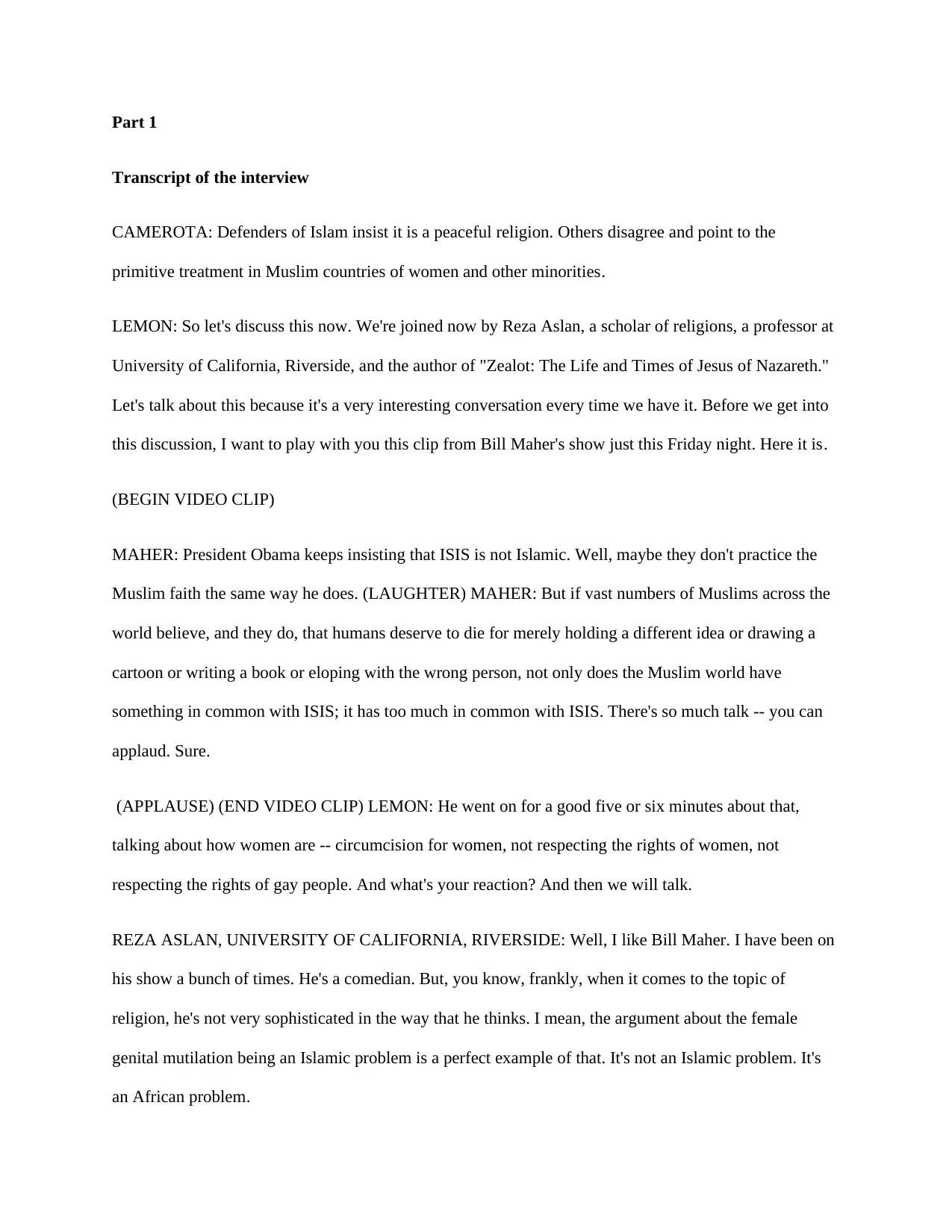
Part 1
Transcript of the interview
CAMEROTA: Defenders of Islam insist it is a peaceful religion. Others disagree and point to the
primitive treatment in Muslim countries of women and other minorities.
LEMON: So let's discuss this now. We're joined now by Reza Aslan, a scholar of religions, a professor at
University of California, Riverside, and the author of "Zealot: The Life and Times of Jesus of Nazareth."
Let's talk about this because it's a very interesting conversation every time we have it. Before we get into
this discussion, I want to play with you this clip from Bill Maher's show just this Friday night. Here it is.
(BEGIN VIDEO CLIP)
MAHER: President Obama keeps insisting that ISIS is not Islamic. Well, maybe they don't practice the
Muslim faith the same way he does. (LAUGHTER) MAHER: But if vast numbers of Muslims across the
world believe, and they do, that humans deserve to die for merely holding a different idea or drawing a
cartoon or writing a book or eloping with the wrong person, not only does the Muslim world have
something in common with ISIS; it has too much in common with ISIS. There's so much talk -- you can
applaud. Sure.
(APPLAUSE) (END VIDEO CLIP) LEMON: He went on for a good five or six minutes about that,
talking about how women are -- circumcision for women, not respecting the rights of women, not
respecting the rights of gay people. And what's your reaction? And then we will talk.
REZA ASLAN, UNIVERSITY OF CALIFORNIA, RIVERSIDE: Well, I like Bill Maher. I have been on
his show a bunch of times. He's a comedian. But, you know, frankly, when it comes to the topic of
religion, he's not very sophisticated in the way that he thinks. I mean, the argument about the female
genital mutilation being an Islamic problem is a perfect example of that. It's not an Islamic problem. It's
an African problem.
Transcript of the interview
CAMEROTA: Defenders of Islam insist it is a peaceful religion. Others disagree and point to the
primitive treatment in Muslim countries of women and other minorities.
LEMON: So let's discuss this now. We're joined now by Reza Aslan, a scholar of religions, a professor at
University of California, Riverside, and the author of "Zealot: The Life and Times of Jesus of Nazareth."
Let's talk about this because it's a very interesting conversation every time we have it. Before we get into
this discussion, I want to play with you this clip from Bill Maher's show just this Friday night. Here it is.
(BEGIN VIDEO CLIP)
MAHER: President Obama keeps insisting that ISIS is not Islamic. Well, maybe they don't practice the
Muslim faith the same way he does. (LAUGHTER) MAHER: But if vast numbers of Muslims across the
world believe, and they do, that humans deserve to die for merely holding a different idea or drawing a
cartoon or writing a book or eloping with the wrong person, not only does the Muslim world have
something in common with ISIS; it has too much in common with ISIS. There's so much talk -- you can
applaud. Sure.
(APPLAUSE) (END VIDEO CLIP) LEMON: He went on for a good five or six minutes about that,
talking about how women are -- circumcision for women, not respecting the rights of women, not
respecting the rights of gay people. And what's your reaction? And then we will talk.
REZA ASLAN, UNIVERSITY OF CALIFORNIA, RIVERSIDE: Well, I like Bill Maher. I have been on
his show a bunch of times. He's a comedian. But, you know, frankly, when it comes to the topic of
religion, he's not very sophisticated in the way that he thinks. I mean, the argument about the female
genital mutilation being an Islamic problem is a perfect example of that. It's not an Islamic problem. It's
an African problem.
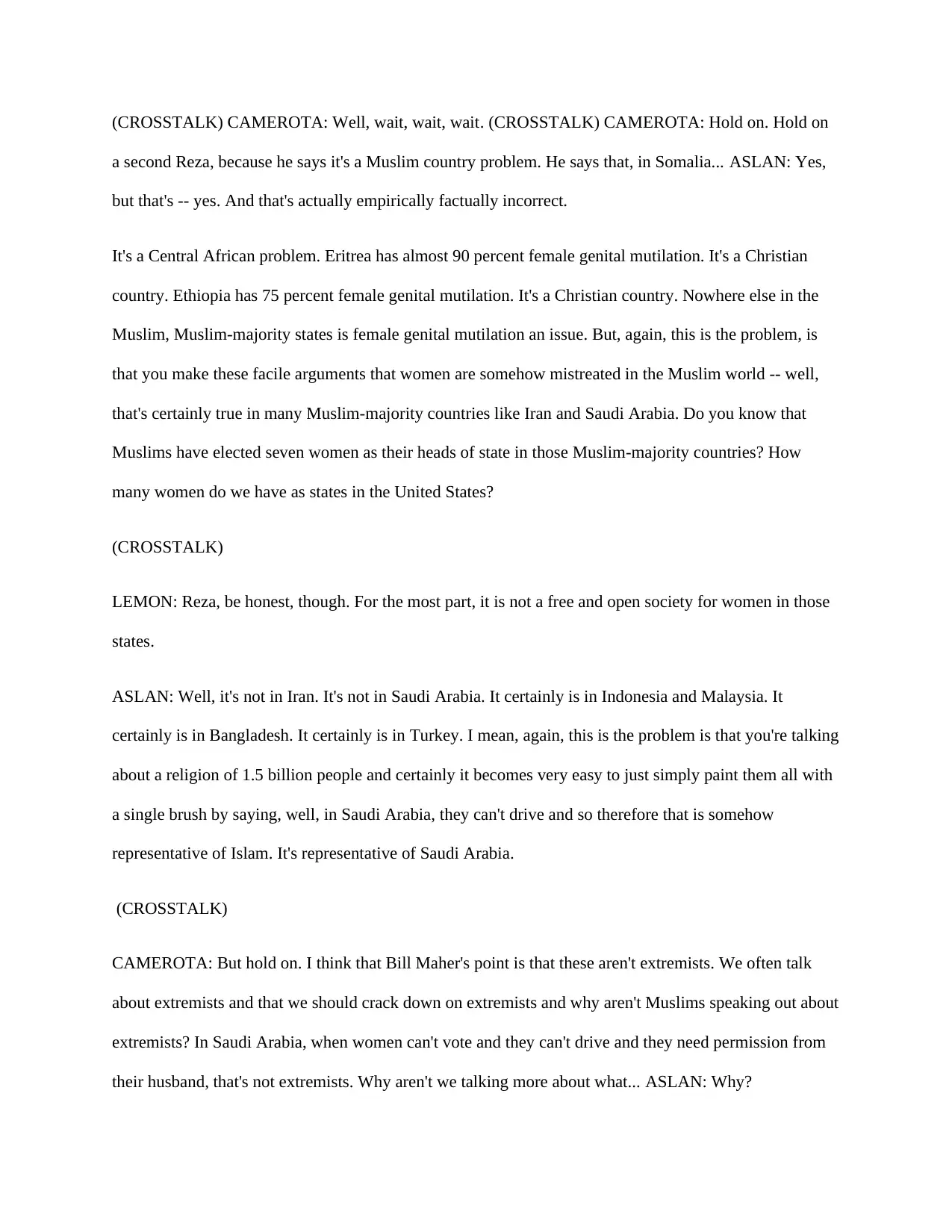
(CROSSTALK) CAMEROTA: Well, wait, wait, wait. (CROSSTALK) CAMEROTA: Hold on. Hold on
a second Reza, because he says it's a Muslim country problem. He says that, in Somalia... ASLAN: Yes,
but that's -- yes. And that's actually empirically factually incorrect.
It's a Central African problem. Eritrea has almost 90 percent female genital mutilation. It's a Christian
country. Ethiopia has 75 percent female genital mutilation. It's a Christian country. Nowhere else in the
Muslim, Muslim-majority states is female genital mutilation an issue. But, again, this is the problem, is
that you make these facile arguments that women are somehow mistreated in the Muslim world -- well,
that's certainly true in many Muslim-majority countries like Iran and Saudi Arabia. Do you know that
Muslims have elected seven women as their heads of state in those Muslim-majority countries? How
many women do we have as states in the United States?
(CROSSTALK)
LEMON: Reza, be honest, though. For the most part, it is not a free and open society for women in those
states.
ASLAN: Well, it's not in Iran. It's not in Saudi Arabia. It certainly is in Indonesia and Malaysia. It
certainly is in Bangladesh. It certainly is in Turkey. I mean, again, this is the problem is that you're talking
about a religion of 1.5 billion people and certainly it becomes very easy to just simply paint them all with
a single brush by saying, well, in Saudi Arabia, they can't drive and so therefore that is somehow
representative of Islam. It's representative of Saudi Arabia.
(CROSSTALK)
CAMEROTA: But hold on. I think that Bill Maher's point is that these aren't extremists. We often talk
about extremists and that we should crack down on extremists and why aren't Muslims speaking out about
extremists? In Saudi Arabia, when women can't vote and they can't drive and they need permission from
their husband, that's not extremists. Why aren't we talking more about what... ASLAN: Why?
a second Reza, because he says it's a Muslim country problem. He says that, in Somalia... ASLAN: Yes,
but that's -- yes. And that's actually empirically factually incorrect.
It's a Central African problem. Eritrea has almost 90 percent female genital mutilation. It's a Christian
country. Ethiopia has 75 percent female genital mutilation. It's a Christian country. Nowhere else in the
Muslim, Muslim-majority states is female genital mutilation an issue. But, again, this is the problem, is
that you make these facile arguments that women are somehow mistreated in the Muslim world -- well,
that's certainly true in many Muslim-majority countries like Iran and Saudi Arabia. Do you know that
Muslims have elected seven women as their heads of state in those Muslim-majority countries? How
many women do we have as states in the United States?
(CROSSTALK)
LEMON: Reza, be honest, though. For the most part, it is not a free and open society for women in those
states.
ASLAN: Well, it's not in Iran. It's not in Saudi Arabia. It certainly is in Indonesia and Malaysia. It
certainly is in Bangladesh. It certainly is in Turkey. I mean, again, this is the problem is that you're talking
about a religion of 1.5 billion people and certainly it becomes very easy to just simply paint them all with
a single brush by saying, well, in Saudi Arabia, they can't drive and so therefore that is somehow
representative of Islam. It's representative of Saudi Arabia.
(CROSSTALK)
CAMEROTA: But hold on. I think that Bill Maher's point is that these aren't extremists. We often talk
about extremists and that we should crack down on extremists and why aren't Muslims speaking out about
extremists? In Saudi Arabia, when women can't vote and they can't drive and they need permission from
their husband, that's not extremists. Why aren't we talking more about what... ASLAN: Why?
⊘ This is a preview!⊘
Do you want full access?
Subscribe today to unlock all pages.

Trusted by 1+ million students worldwide
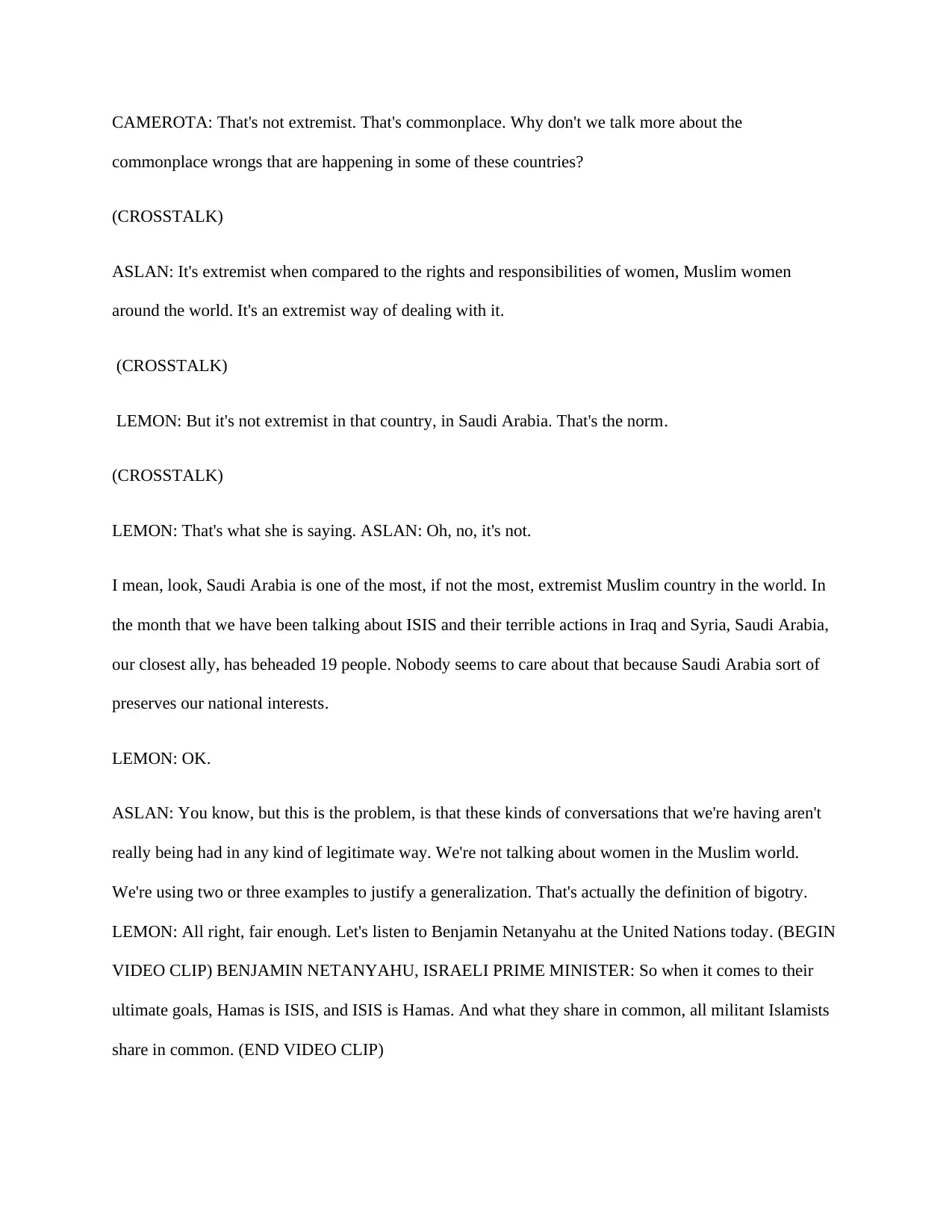
CAMEROTA: That's not extremist. That's commonplace. Why don't we talk more about the
commonplace wrongs that are happening in some of these countries?
(CROSSTALK)
ASLAN: It's extremist when compared to the rights and responsibilities of women, Muslim women
around the world. It's an extremist way of dealing with it.
(CROSSTALK)
LEMON: But it's not extremist in that country, in Saudi Arabia. That's the norm.
(CROSSTALK)
LEMON: That's what she is saying. ASLAN: Oh, no, it's not.
I mean, look, Saudi Arabia is one of the most, if not the most, extremist Muslim country in the world. In
the month that we have been talking about ISIS and their terrible actions in Iraq and Syria, Saudi Arabia,
our closest ally, has beheaded 19 people. Nobody seems to care about that because Saudi Arabia sort of
preserves our national interests.
LEMON: OK.
ASLAN: You know, but this is the problem, is that these kinds of conversations that we're having aren't
really being had in any kind of legitimate way. We're not talking about women in the Muslim world.
We're using two or three examples to justify a generalization. That's actually the definition of bigotry.
LEMON: All right, fair enough. Let's listen to Benjamin Netanyahu at the United Nations today. (BEGIN
VIDEO CLIP) BENJAMIN NETANYAHU, ISRAELI PRIME MINISTER: So when it comes to their
ultimate goals, Hamas is ISIS, and ISIS is Hamas. And what they share in common, all militant Islamists
share in common. (END VIDEO CLIP)
commonplace wrongs that are happening in some of these countries?
(CROSSTALK)
ASLAN: It's extremist when compared to the rights and responsibilities of women, Muslim women
around the world. It's an extremist way of dealing with it.
(CROSSTALK)
LEMON: But it's not extremist in that country, in Saudi Arabia. That's the norm.
(CROSSTALK)
LEMON: That's what she is saying. ASLAN: Oh, no, it's not.
I mean, look, Saudi Arabia is one of the most, if not the most, extremist Muslim country in the world. In
the month that we have been talking about ISIS and their terrible actions in Iraq and Syria, Saudi Arabia,
our closest ally, has beheaded 19 people. Nobody seems to care about that because Saudi Arabia sort of
preserves our national interests.
LEMON: OK.
ASLAN: You know, but this is the problem, is that these kinds of conversations that we're having aren't
really being had in any kind of legitimate way. We're not talking about women in the Muslim world.
We're using two or three examples to justify a generalization. That's actually the definition of bigotry.
LEMON: All right, fair enough. Let's listen to Benjamin Netanyahu at the United Nations today. (BEGIN
VIDEO CLIP) BENJAMIN NETANYAHU, ISRAELI PRIME MINISTER: So when it comes to their
ultimate goals, Hamas is ISIS, and ISIS is Hamas. And what they share in common, all militant Islamists
share in common. (END VIDEO CLIP)
Paraphrase This Document
Need a fresh take? Get an instant paraphrase of this document with our AI Paraphraser
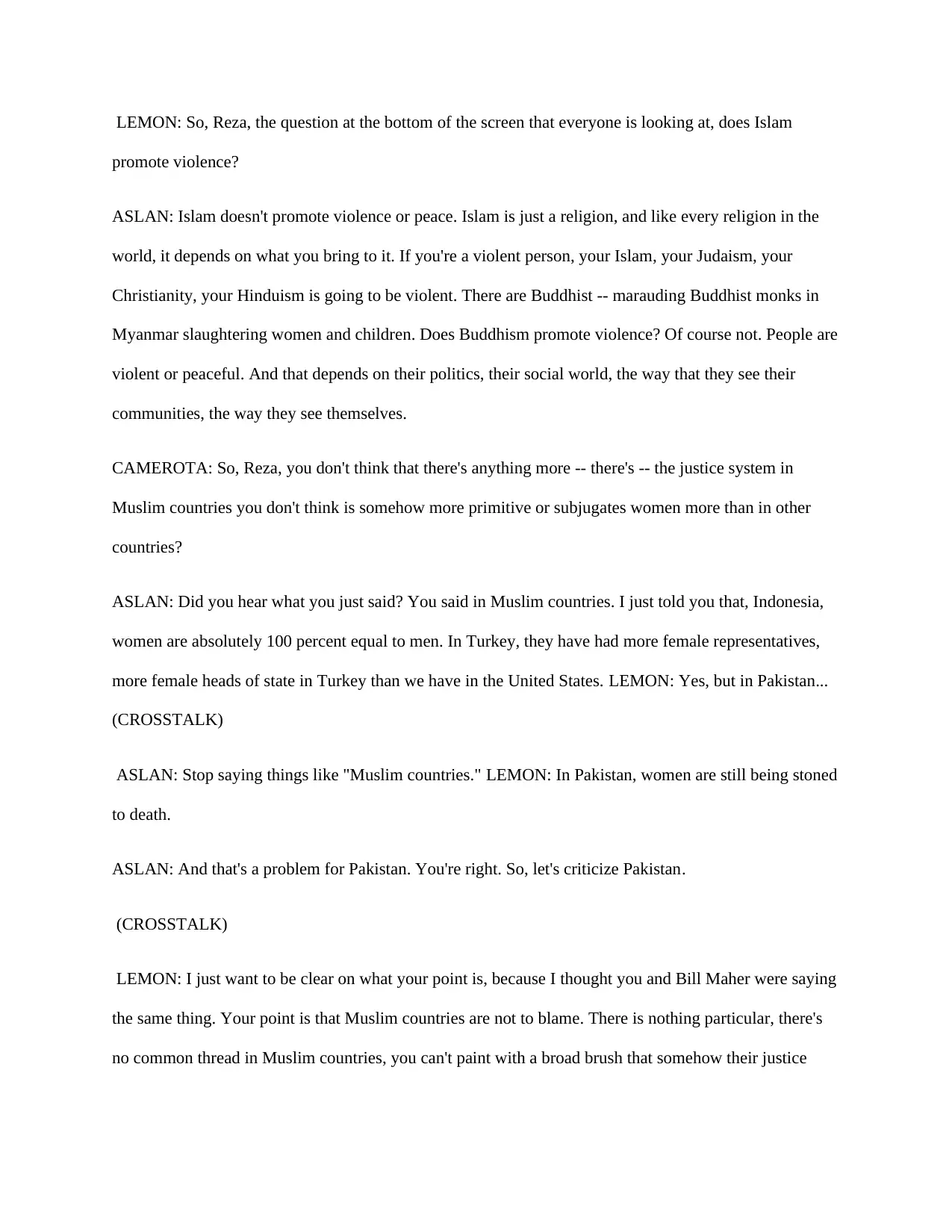
LEMON: So, Reza, the question at the bottom of the screen that everyone is looking at, does Islam
promote violence?
ASLAN: Islam doesn't promote violence or peace. Islam is just a religion, and like every religion in the
world, it depends on what you bring to it. If you're a violent person, your Islam, your Judaism, your
Christianity, your Hinduism is going to be violent. There are Buddhist -- marauding Buddhist monks in
Myanmar slaughtering women and children. Does Buddhism promote violence? Of course not. People are
violent or peaceful. And that depends on their politics, their social world, the way that they see their
communities, the way they see themselves.
CAMEROTA: So, Reza, you don't think that there's anything more -- there's -- the justice system in
Muslim countries you don't think is somehow more primitive or subjugates women more than in other
countries?
ASLAN: Did you hear what you just said? You said in Muslim countries. I just told you that, Indonesia,
women are absolutely 100 percent equal to men. In Turkey, they have had more female representatives,
more female heads of state in Turkey than we have in the United States. LEMON: Yes, but in Pakistan...
(CROSSTALK)
ASLAN: Stop saying things like "Muslim countries." LEMON: In Pakistan, women are still being stoned
to death.
ASLAN: And that's a problem for Pakistan. You're right. So, let's criticize Pakistan.
(CROSSTALK)
LEMON: I just want to be clear on what your point is, because I thought you and Bill Maher were saying
the same thing. Your point is that Muslim countries are not to blame. There is nothing particular, there's
no common thread in Muslim countries, you can't paint with a broad brush that somehow their justice
promote violence?
ASLAN: Islam doesn't promote violence or peace. Islam is just a religion, and like every religion in the
world, it depends on what you bring to it. If you're a violent person, your Islam, your Judaism, your
Christianity, your Hinduism is going to be violent. There are Buddhist -- marauding Buddhist monks in
Myanmar slaughtering women and children. Does Buddhism promote violence? Of course not. People are
violent or peaceful. And that depends on their politics, their social world, the way that they see their
communities, the way they see themselves.
CAMEROTA: So, Reza, you don't think that there's anything more -- there's -- the justice system in
Muslim countries you don't think is somehow more primitive or subjugates women more than in other
countries?
ASLAN: Did you hear what you just said? You said in Muslim countries. I just told you that, Indonesia,
women are absolutely 100 percent equal to men. In Turkey, they have had more female representatives,
more female heads of state in Turkey than we have in the United States. LEMON: Yes, but in Pakistan...
(CROSSTALK)
ASLAN: Stop saying things like "Muslim countries." LEMON: In Pakistan, women are still being stoned
to death.
ASLAN: And that's a problem for Pakistan. You're right. So, let's criticize Pakistan.
(CROSSTALK)
LEMON: I just want to be clear on what your point is, because I thought you and Bill Maher were saying
the same thing. Your point is that Muslim countries are not to blame. There is nothing particular, there's
no common thread in Muslim countries, you can't paint with a broad brush that somehow their justice
system or Sharia law or what they're doing in terms of stoning and female mutilation is different than in
other countries like Western countries?
ASLAN: Stoning and mutilation and those barbaric practices should be condemned and criticized by
everyone. The actions of individuals and societies and countries like Iran, like Pakistan, like Saudi Arabia
must be condemned, because they don't belong in the 21st century. But to say Muslim countries, as
though Pakistan and Turkey are the same, as though Indonesia and Saudi Arabia are the same, as though
somehow what is happening in the most extreme forms of these repressive countries, these autocratic
countries, is representative of what's happening in every other Muslim country, is, frankly -- and I use this
word seriously -- stupid. So let's stop doing that.
LEMON: OK, Reza. Let's -- I want you to listen to Benjamin Netanyahu again. This is actually the one I
wanted you to hear.
ASLAN: Yes, the ISIS.
(BEGIN VIDEO CLIP)
NETANYAHU: But our hopes and the world's hopes for peace are in danger, because everywhere we
look, militant Islam is on the march. It's not militants. It's not Islam. It's militant Islam. And, typically, its
first victims are other Muslims, but it spares no one.
(END VIDEO CLIP)
LEMON: He's making a clear distinction there. He says it's not militants, it's not Islam; it's militant Islam.
Do you understand his distinction there? Is he correct?
ASLAN: Well, he's correct in talking about militant Islam being a problem. He is absolutely incorrect in
talking about ISIS equaling Hamas. That's just ridiculous. No one takes him seriously when he says things
like that. And, frankly, it's precisely why, under his leadership, Israel has become so incredibly isolated
other countries like Western countries?
ASLAN: Stoning and mutilation and those barbaric practices should be condemned and criticized by
everyone. The actions of individuals and societies and countries like Iran, like Pakistan, like Saudi Arabia
must be condemned, because they don't belong in the 21st century. But to say Muslim countries, as
though Pakistan and Turkey are the same, as though Indonesia and Saudi Arabia are the same, as though
somehow what is happening in the most extreme forms of these repressive countries, these autocratic
countries, is representative of what's happening in every other Muslim country, is, frankly -- and I use this
word seriously -- stupid. So let's stop doing that.
LEMON: OK, Reza. Let's -- I want you to listen to Benjamin Netanyahu again. This is actually the one I
wanted you to hear.
ASLAN: Yes, the ISIS.
(BEGIN VIDEO CLIP)
NETANYAHU: But our hopes and the world's hopes for peace are in danger, because everywhere we
look, militant Islam is on the march. It's not militants. It's not Islam. It's militant Islam. And, typically, its
first victims are other Muslims, but it spares no one.
(END VIDEO CLIP)
LEMON: He's making a clear distinction there. He says it's not militants, it's not Islam; it's militant Islam.
Do you understand his distinction there? Is he correct?
ASLAN: Well, he's correct in talking about militant Islam being a problem. He is absolutely incorrect in
talking about ISIS equaling Hamas. That's just ridiculous. No one takes him seriously when he says things
like that. And, frankly, it's precisely why, under his leadership, Israel has become so incredibly isolated
⊘ This is a preview!⊘
Do you want full access?
Subscribe today to unlock all pages.
Trusted by 1+ million students worldwide
from the rest of the global community. Those kinds of statements are illogical, they're irrational, they are
so obviously propagandistic. In fact, he went so far as to then bring up the Nazis, which has become kind
of a verbal tick for him whenever he brings up either Hamas or ISIS. Again, these kinds of
oversimplifications I think only cause more danger. There is a very real problem. ISIS is a problem. Al
Qaeda is a problem. These militant Islamic groups like Hamas, like Hezbollah, like the Taliban have to be
dealt with. But it doesn't actually help us to deal with them when, instead of talking about rational
conflicts, rational criticisms of a particular religion, we instead so easily slip into bigotry by simply
painting everyone with a single brush, as we have been doing in this conversation, mind you
LEMON: Well, we're just asking the questions, Reza. And you're answering. And I think you answered
very fairly, and we appreciate it. Thank you, Reza Aslan. CAMEROTA: We appreciate your
perspective... ASLAN: My pleasure.
CAMEROTA: ... and helping everyone understands your perspective.
PART 2
Introduction
Managing conflict is an inventible part of any organization or discussion. This is so because conflict
disrupts the basic identity of the discussion and makes it disruptive. However, some conflicts are
constructive and it should be encouraged. Conflict management is a situation whereby both the parties at
discussion agree to a point which is beneficial for both. In an organization or at the time of general
discussion also conflicting situations arises which should be dealt cleverly. In the following discussion,
the manner in which both the parties in the interview could have managed themselves and carried out
interview more effectively has been discussed. Discussion, debates and clashing ideologies are a reason
for conflict (Himes, 2008). Furthermore, conflict management techniques will also be discussed to find
out the manner in which conflict could be reset before its arrival. Certain dimension on which conflict is
based will also be discussed along with discussing the behaviour of each participant. Along with conflict
so obviously propagandistic. In fact, he went so far as to then bring up the Nazis, which has become kind
of a verbal tick for him whenever he brings up either Hamas or ISIS. Again, these kinds of
oversimplifications I think only cause more danger. There is a very real problem. ISIS is a problem. Al
Qaeda is a problem. These militant Islamic groups like Hamas, like Hezbollah, like the Taliban have to be
dealt with. But it doesn't actually help us to deal with them when, instead of talking about rational
conflicts, rational criticisms of a particular religion, we instead so easily slip into bigotry by simply
painting everyone with a single brush, as we have been doing in this conversation, mind you
LEMON: Well, we're just asking the questions, Reza. And you're answering. And I think you answered
very fairly, and we appreciate it. Thank you, Reza Aslan. CAMEROTA: We appreciate your
perspective... ASLAN: My pleasure.
CAMEROTA: ... and helping everyone understands your perspective.
PART 2
Introduction
Managing conflict is an inventible part of any organization or discussion. This is so because conflict
disrupts the basic identity of the discussion and makes it disruptive. However, some conflicts are
constructive and it should be encouraged. Conflict management is a situation whereby both the parties at
discussion agree to a point which is beneficial for both. In an organization or at the time of general
discussion also conflicting situations arises which should be dealt cleverly. In the following discussion,
the manner in which both the parties in the interview could have managed themselves and carried out
interview more effectively has been discussed. Discussion, debates and clashing ideologies are a reason
for conflict (Himes, 2008). Furthermore, conflict management techniques will also be discussed to find
out the manner in which conflict could be reset before its arrival. Certain dimension on which conflict is
based will also be discussed along with discussing the behaviour of each participant. Along with conflict
Paraphrase This Document
Need a fresh take? Get an instant paraphrase of this document with our AI Paraphraser
resolution techniques, some suggestion will also be provided regarding managing conflict at the time of
discussion. . The purpose of each participant in the interview was somewhere same. The issue was to
discuss the safety in Islamic countries and whether all Muslim countries are linked with ISIS or not. It is a
contemporary issue as all the Islamic countries are somewhat linked with terrorism. The people all across
the globe have formed a perception that all the Islamic countries are associated with terrorist activities. It
is creating discrimination with the people from these countries. Along with this discussion on the topic of
women mutilation and whether they are being respected there or not was also the purpose of the
interview. It is common knowledge that the women in Islamic countries do not enjoy equal rights as that
of men. They are confined at home and their viewpoint is not given any importance. Their viewpoints
were somewhat different from each other. Amongst the three participants, two of them were against the
notion that Islamic countries were not safe and women are not respected there but Reza Aslan was of the
view that it is not so. He said it is the problem of a particular country and not the entire Muslim countries.
Their viewpoint is likely to cause conflict because each of them holds a different perception regarding
Muslim Religion. Aslan cited the examples of various Muslim countries which are well-developed
despite their beliefs and culture.
Conflict management
Conflict management should be managed by avoiding indulging in such situation which may create
conflict. In the interview, the participants could have managed themselves by avoiding such situation
where conflict arises. Conflict leads to malfunctioning and restricts the positive outcome of the
discussion. Conflict is often constructive also and that kind of conflict should be encouraged because
during such discussions some of the points are discussed or they come up which are beneficial for the
participants. There are certain dimensions on which conflict rests (Pammer and Killian, 2003). For
handling the conflict it is first important to understand the procedures and intervention strategies
discussion. . The purpose of each participant in the interview was somewhere same. The issue was to
discuss the safety in Islamic countries and whether all Muslim countries are linked with ISIS or not. It is a
contemporary issue as all the Islamic countries are somewhat linked with terrorism. The people all across
the globe have formed a perception that all the Islamic countries are associated with terrorist activities. It
is creating discrimination with the people from these countries. Along with this discussion on the topic of
women mutilation and whether they are being respected there or not was also the purpose of the
interview. It is common knowledge that the women in Islamic countries do not enjoy equal rights as that
of men. They are confined at home and their viewpoint is not given any importance. Their viewpoints
were somewhat different from each other. Amongst the three participants, two of them were against the
notion that Islamic countries were not safe and women are not respected there but Reza Aslan was of the
view that it is not so. He said it is the problem of a particular country and not the entire Muslim countries.
Their viewpoint is likely to cause conflict because each of them holds a different perception regarding
Muslim Religion. Aslan cited the examples of various Muslim countries which are well-developed
despite their beliefs and culture.
Conflict management
Conflict management should be managed by avoiding indulging in such situation which may create
conflict. In the interview, the participants could have managed themselves by avoiding such situation
where conflict arises. Conflict leads to malfunctioning and restricts the positive outcome of the
discussion. Conflict is often constructive also and that kind of conflict should be encouraged because
during such discussions some of the points are discussed or they come up which are beneficial for the
participants. There are certain dimensions on which conflict rests (Pammer and Killian, 2003). For
handling the conflict it is first important to understand the procedures and intervention strategies
available, for perusing resolution it is important to first understand the skill and diagnose different
alternatives available, understanding the context of conflict is also important so that the problem may be
understood properly and accordingly the solution may be found. In this case, the context is Muslim
countries and spread of violence, for managing conflict effectively be the participants of the interview it is
important to understand the dimension within which the conflict could arise and accordingly it can be
handled. The mediator should be appointed to resolve the conflict and he should be able to take decisions
without any bias. It is important to listen to the views of both the parties and bas the solution so that both
the parte can take disadvantage of the situation. None of the participants were threatened. It was only that
each of them was trying to prove their viewpoint correct while talking about extremist or whether Islam is
responsible for spreading violence. It only appeared that Camerota and lemon were trying to cross Aslan
viewpoint that Muslim countries are not extremist whereas Aslan said that when talked about rights and
responsibilities of Muslim women there is an extremist way of dealing with them. In another instance,
Aslan was little offended and he tried to while speaking about the justice system in Muslim countries and
responded in a sarcastic way. They discussed and questioned each other’s belief in the most respectful
manner. All the participants of the debate were open to listen to each other’s beliefs and were broad
minded. Camerota and Lemon were relying on opinion whereas Aslan viewpoints were based on facts.
Both of them were of the opinion that all Islamic countries spread violence. They were also of the opinion
that Genital mutilation is practiced in Islamic countries and they disrespect women whereas according to
Aslan this was not true. He presented factual data that the countries where women mutilation is done are
mostly Christian countries. Camerota and lemon were generalizing the Muslim population and according
to them the entire Muslim countries women are not respected and criticism of women takes place whereas
this was just an opinion. If these opinions were to be supported with facts and data it approved that it is
only an individual countries where these practices take place and this does not represent the entire
Muslim countries. There are a large number of Muslim countries wherein the women enjoy power and
position of social dignity and independence. The Muslim women are also holding positions of high social
alternatives available, understanding the context of conflict is also important so that the problem may be
understood properly and accordingly the solution may be found. In this case, the context is Muslim
countries and spread of violence, for managing conflict effectively be the participants of the interview it is
important to understand the dimension within which the conflict could arise and accordingly it can be
handled. The mediator should be appointed to resolve the conflict and he should be able to take decisions
without any bias. It is important to listen to the views of both the parties and bas the solution so that both
the parte can take disadvantage of the situation. None of the participants were threatened. It was only that
each of them was trying to prove their viewpoint correct while talking about extremist or whether Islam is
responsible for spreading violence. It only appeared that Camerota and lemon were trying to cross Aslan
viewpoint that Muslim countries are not extremist whereas Aslan said that when talked about rights and
responsibilities of Muslim women there is an extremist way of dealing with them. In another instance,
Aslan was little offended and he tried to while speaking about the justice system in Muslim countries and
responded in a sarcastic way. They discussed and questioned each other’s belief in the most respectful
manner. All the participants of the debate were open to listen to each other’s beliefs and were broad
minded. Camerota and Lemon were relying on opinion whereas Aslan viewpoints were based on facts.
Both of them were of the opinion that all Islamic countries spread violence. They were also of the opinion
that Genital mutilation is practiced in Islamic countries and they disrespect women whereas according to
Aslan this was not true. He presented factual data that the countries where women mutilation is done are
mostly Christian countries. Camerota and lemon were generalizing the Muslim population and according
to them the entire Muslim countries women are not respected and criticism of women takes place whereas
this was just an opinion. If these opinions were to be supported with facts and data it approved that it is
only an individual countries where these practices take place and this does not represent the entire
Muslim countries. There are a large number of Muslim countries wherein the women enjoy power and
position of social dignity and independence. The Muslim women are also holding positions of high social
⊘ This is a preview!⊘
Do you want full access?
Subscribe today to unlock all pages.
Trusted by 1+ million students worldwide
status in foreign countries which shows that the issue of women discrimination is geographical rather than
the cultural.
Certain techniques or strategies which could be used to avoid conflicting situations are as follows:
1. Ignoring the conflict (Withdrawal)
In this technique, the situation which may lead to conflict arousal is ignored or evaded. One of the
participants tries to be indifferent and apathetic and the conflict is left to chance. If the conflict is given
undue importance it is likely to be dead at the end. This also helps the people involved in the discussion to
divert their mind to some other topic and give weight to the essential factors rather than pondering over
one issue for a long time (Talloo, 2007).
Liasion group or representatives: There should be a third person or the expertise who would solve their
issues and arrive at a particular conclusion. Although in this interview Aslan was a scholar of religion and
he was of the opinion and the two interviewers had their points so there was a need to have one more
expertise who would handle the issue or conflicting situation rising during the interview.
Compromising: This is the oldest method of resolving the conflict. One or the other participant should
give up and is based on sacrificing and negotiation (Heldman and Mangano, 2009).
The participants could have taken up either of the above mention technique thus conflict could have been
avoided. However, it is also important to understand the importance of choosing right technique. Based
on the situation and condition of discussion it is evident that one of the participants which are the
interviewer could have compromised with the situation and should have presented their viewpoints with
relevant facts and figure.
It has been observed that conflict is vital if managed properly. If the topic so discussed should have been
supported with factual data it may have led to less arousal of conflict. Moreover, the interviewer could
have identified the opportunity that if the discussion is carried out more logically it could have answered
the cultural.
Certain techniques or strategies which could be used to avoid conflicting situations are as follows:
1. Ignoring the conflict (Withdrawal)
In this technique, the situation which may lead to conflict arousal is ignored or evaded. One of the
participants tries to be indifferent and apathetic and the conflict is left to chance. If the conflict is given
undue importance it is likely to be dead at the end. This also helps the people involved in the discussion to
divert their mind to some other topic and give weight to the essential factors rather than pondering over
one issue for a long time (Talloo, 2007).
Liasion group or representatives: There should be a third person or the expertise who would solve their
issues and arrive at a particular conclusion. Although in this interview Aslan was a scholar of religion and
he was of the opinion and the two interviewers had their points so there was a need to have one more
expertise who would handle the issue or conflicting situation rising during the interview.
Compromising: This is the oldest method of resolving the conflict. One or the other participant should
give up and is based on sacrificing and negotiation (Heldman and Mangano, 2009).
The participants could have taken up either of the above mention technique thus conflict could have been
avoided. However, it is also important to understand the importance of choosing right technique. Based
on the situation and condition of discussion it is evident that one of the participants which are the
interviewer could have compromised with the situation and should have presented their viewpoints with
relevant facts and figure.
It has been observed that conflict is vital if managed properly. If the topic so discussed should have been
supported with factual data it may have led to less arousal of conflict. Moreover, the interviewer could
have identified the opportunity that if the discussion is carried out more logically it could have answered
Paraphrase This Document
Need a fresh take? Get an instant paraphrase of this document with our AI Paraphraser
any question of the masses. A positive outlook about interview could have helped the participants to
avoid disusing on conflicting issues. It is not advisable to avoid conflict as can be seen from the
discussion held above. There was conflicting issue with regard to the Muslim countries and the
community causing violence. Aslan was the one whose viewpoint was taken argued each and every point
with proper reference and facts. He even gave the accurate data that it is not the religion but a particular
country which causes violence (Berger, 2017). This type of discussion is beneficial as they help to
uncover various truth and facts. Therefore the conflict could have been managed by the participants by
identifying the opportunity where they could foster growth and uncover the hidden truth.
Another way through which the arousal of conflict could have been managed is by not arriving at
conclusions instantly like which happened in the discussion held. It is evitable that firstly the situations
must be understood clearly and the same goes with Lemon and Cameroda. They should have first
understood that positive intent of the situation to avoid the occurrence of the problematic situation.
Secondly, the words used during discussion should be chosen wisely. Words chosen wisely reduce
conflict to a greater extent and for this to happen it is important to remain proactive.
Along with this some humour element could have been added from time to time as it lightens the
environment and removes the burden of discussions. Along with this, the interviewer could have shown
the video clips only after retrieving the facts and reality of the words spoken by the orator in the video
clip because the speech of the Israel president was without any facts as stated by Aslan and these
situations arises conflict.
Conflict Resolution Techniques
Empathy- This is an effective conflict resolution technique and it could have been adopted by any of the
participants. It is an important skill and in this, each of the participants could have understood the
situation of the other and acted accordingly.
avoid disusing on conflicting issues. It is not advisable to avoid conflict as can be seen from the
discussion held above. There was conflicting issue with regard to the Muslim countries and the
community causing violence. Aslan was the one whose viewpoint was taken argued each and every point
with proper reference and facts. He even gave the accurate data that it is not the religion but a particular
country which causes violence (Berger, 2017). This type of discussion is beneficial as they help to
uncover various truth and facts. Therefore the conflict could have been managed by the participants by
identifying the opportunity where they could foster growth and uncover the hidden truth.
Another way through which the arousal of conflict could have been managed is by not arriving at
conclusions instantly like which happened in the discussion held. It is evitable that firstly the situations
must be understood clearly and the same goes with Lemon and Cameroda. They should have first
understood that positive intent of the situation to avoid the occurrence of the problematic situation.
Secondly, the words used during discussion should be chosen wisely. Words chosen wisely reduce
conflict to a greater extent and for this to happen it is important to remain proactive.
Along with this some humour element could have been added from time to time as it lightens the
environment and removes the burden of discussions. Along with this, the interviewer could have shown
the video clips only after retrieving the facts and reality of the words spoken by the orator in the video
clip because the speech of the Israel president was without any facts as stated by Aslan and these
situations arises conflict.
Conflict Resolution Techniques
Empathy- This is an effective conflict resolution technique and it could have been adopted by any of the
participants. It is an important skill and in this, each of the participants could have understood the
situation of the other and acted accordingly.
Creative problem solving- solving problem in a creative way is another method that could have been
adopted by the participants. It helps in finding a new way to solve the issues. In this situation, the
interviewer could have discussed with certain points which could have eliminated the arrival of friction
among the parties involved (Doyle, 2017).
Importance of interviewer's Behaviour
For managing conflict effectively the foremost important thing to understand the behavior of each party
involved in the process. Lemon and Camerota were the interviewers and they were against the viewpoint
of Reza Aslan. Although their points were more of an opinion and were generalized viewpoints of the
common masses, Aslan points were more factual than theirs and therefore at times have become anxious
and doubtful when he heard some vague remarks regarding the Muslim religion.
It is important to note here that the emerging behaviour is a signal of arising conflict and one should try to
avoid it as soon as it rises (Geertz, 2016). However, it is also apparent that the kind of conflict arising
here is more of a constructive type because the discussion taking place among the participants is likely to
draw some conclusion on the topic and will eradicate the wrong notion about Muslim religion spreading
violence.
For managing interview effectively the interviewer should have created avoidance situation where there
will be either win-win situation or win-lose situation. A smooth transition of discussion would lead to
avoidance of such conflicts.
Conclusion
On the basis of the above discussion, it can e interpreted that conflict management technique is the
method through which conflict could be resolved. It has also been observed that many a times conflict is
constructive and should be encouraged but before it becomes destructive steps should be taken to
minimize it. Furthermore, it has also been observed that conflict management includes three dimensions
adopted by the participants. It helps in finding a new way to solve the issues. In this situation, the
interviewer could have discussed with certain points which could have eliminated the arrival of friction
among the parties involved (Doyle, 2017).
Importance of interviewer's Behaviour
For managing conflict effectively the foremost important thing to understand the behavior of each party
involved in the process. Lemon and Camerota were the interviewers and they were against the viewpoint
of Reza Aslan. Although their points were more of an opinion and were generalized viewpoints of the
common masses, Aslan points were more factual than theirs and therefore at times have become anxious
and doubtful when he heard some vague remarks regarding the Muslim religion.
It is important to note here that the emerging behaviour is a signal of arising conflict and one should try to
avoid it as soon as it rises (Geertz, 2016). However, it is also apparent that the kind of conflict arising
here is more of a constructive type because the discussion taking place among the participants is likely to
draw some conclusion on the topic and will eradicate the wrong notion about Muslim religion spreading
violence.
For managing interview effectively the interviewer should have created avoidance situation where there
will be either win-win situation or win-lose situation. A smooth transition of discussion would lead to
avoidance of such conflicts.
Conclusion
On the basis of the above discussion, it can e interpreted that conflict management technique is the
method through which conflict could be resolved. It has also been observed that many a times conflict is
constructive and should be encouraged but before it becomes destructive steps should be taken to
minimize it. Furthermore, it has also been observed that conflict management includes three dimensions
⊘ This is a preview!⊘
Do you want full access?
Subscribe today to unlock all pages.
Trusted by 1+ million students worldwide

1 out of 14


Related Documents


Your All-in-One AI-Powered Toolkit for Academic Success.
+13062052269
info@desklib.com
Available 24*7 on WhatsApp / Email
![[object Object]](/_next/static/media/star-bottom.7253800d.svg)
Unlock your academic potential
Copyright © 2020–2026 A2Z Services. All Rights Reserved. Developed and managed by ZUCOL.