Conflict Resolution Strategies: GFA, Vietnam War & Global Protection

Verified

Added on  2023/06/12

|3
|543
|454
Essay
AI Summary
This essay provides an analysis of conflict resolution through several lenses, beginning with an evaluation of the Good Friday Agreement (GFA) as a model for resolving other conflicts, highlighting the principle of consent and majority rule. It then critiques the United States' involvement in the Vietnam War, questioning its justification based on national interest and aid to South Vietnam, citing loss of life and economic crisis. The essay further addresses environmental protection, suggesting measures like sustainable mining and technological advancements to minimize waste. Finally, it discusses international community efforts to prevent war, genocide, and ethnic cleansing, particularly in light of failures like the Bosnian War, noting the development of genocide alert systems, emphasis on international law, and vigilance over development aid. Desklib provides access to similar solved assignments and study resources for students.
Document Page
CONFLICT RESOLUTION1
[Name]
Course
Professor’s Name
Institution
Location of Institution
Date
tabler-icon-diamond-filled.svg

Paraphrase This Document

Need a fresh take? Get an instant paraphrase of this document with our AI Paraphraser
Document Page
CONFLICT RESOLUTION2
Question one
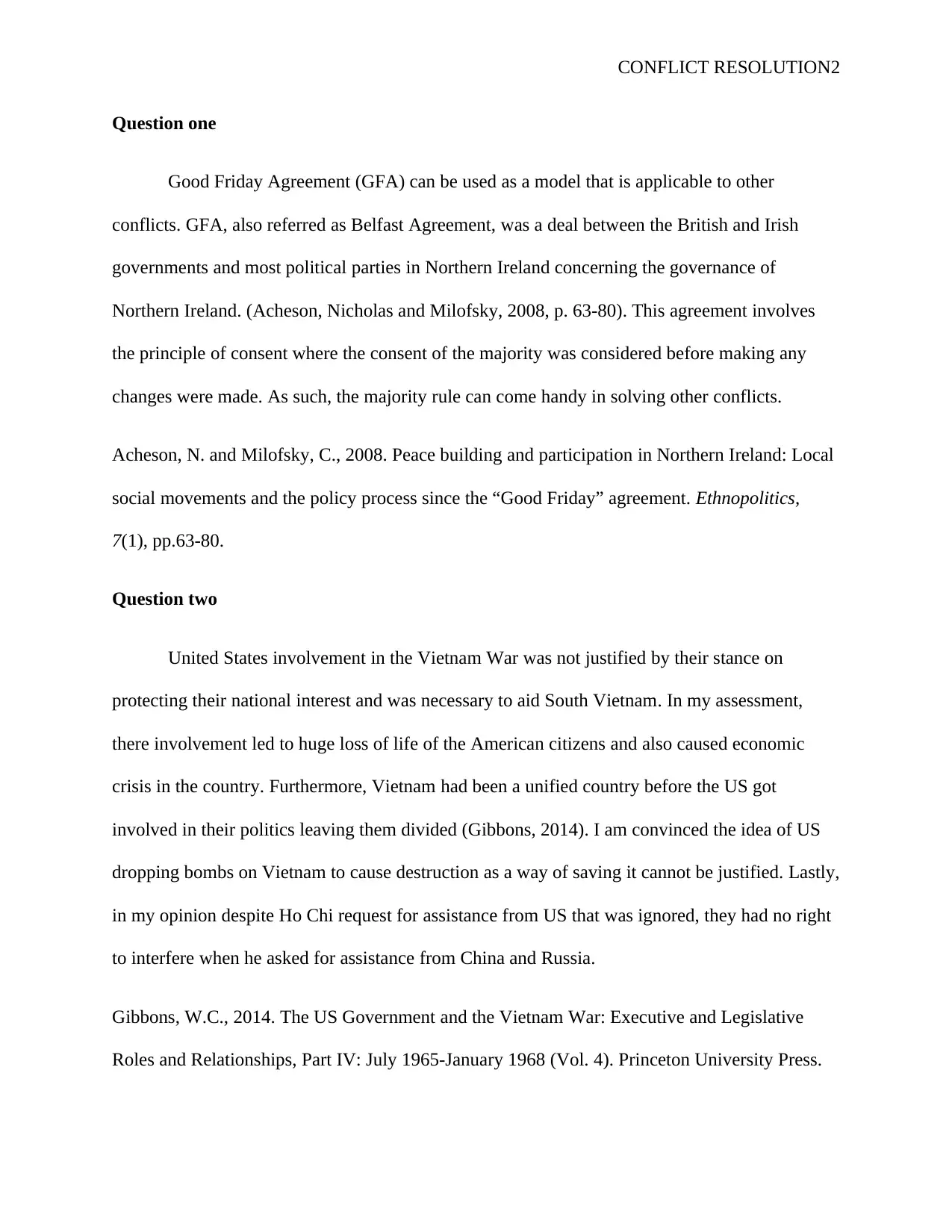
Good Friday Agreement (GFA) can be used as a model that is applicable to other
conflicts. GFA, also referred as Belfast Agreement, was a deal between the British and Irish
governments and most political parties in Northern Ireland concerning the governance of
Northern Ireland. (Acheson, Nicholas and Milofsky, 2008, p. 63-80). This agreement involves
the principle of consent where the consent of the majority was considered before making any
changes were made. As such, the majority rule can come handy in solving other conflicts.
Acheson, N. and Milofsky, C., 2008. Peace building and participation in Northern Ireland: Local
social movements and the policy process since the “Good Friday” agreement. Ethnopolitics,
7(1), pp.63-80.
Question two
United States involvement in the Vietnam War was not justified by their stance on
protecting their national interest and was necessary to aid South Vietnam. In my assessment,
there involvement led to huge loss of life of the American citizens and also caused economic
crisis in the country. Furthermore, Vietnam had been a unified country before the US got
involved in their politics leaving them divided (Gibbons, 2014). I am convinced the idea of US
dropping bombs on Vietnam to cause destruction as a way of saving it cannot be justified. Lastly,
in my opinion despite Ho Chi request for assistance from US that was ignored, they had no right
to interfere when he asked for assistance from China and Russia.
Gibbons, W.C., 2014. The US Government and the Vietnam War: Executive and Legislative
Roles and Relationships, Part IV: July 1965-January 1968 (Vol. 4). Princeton University Press.
Document Page
CONFLICT RESOLUTION3
Question three
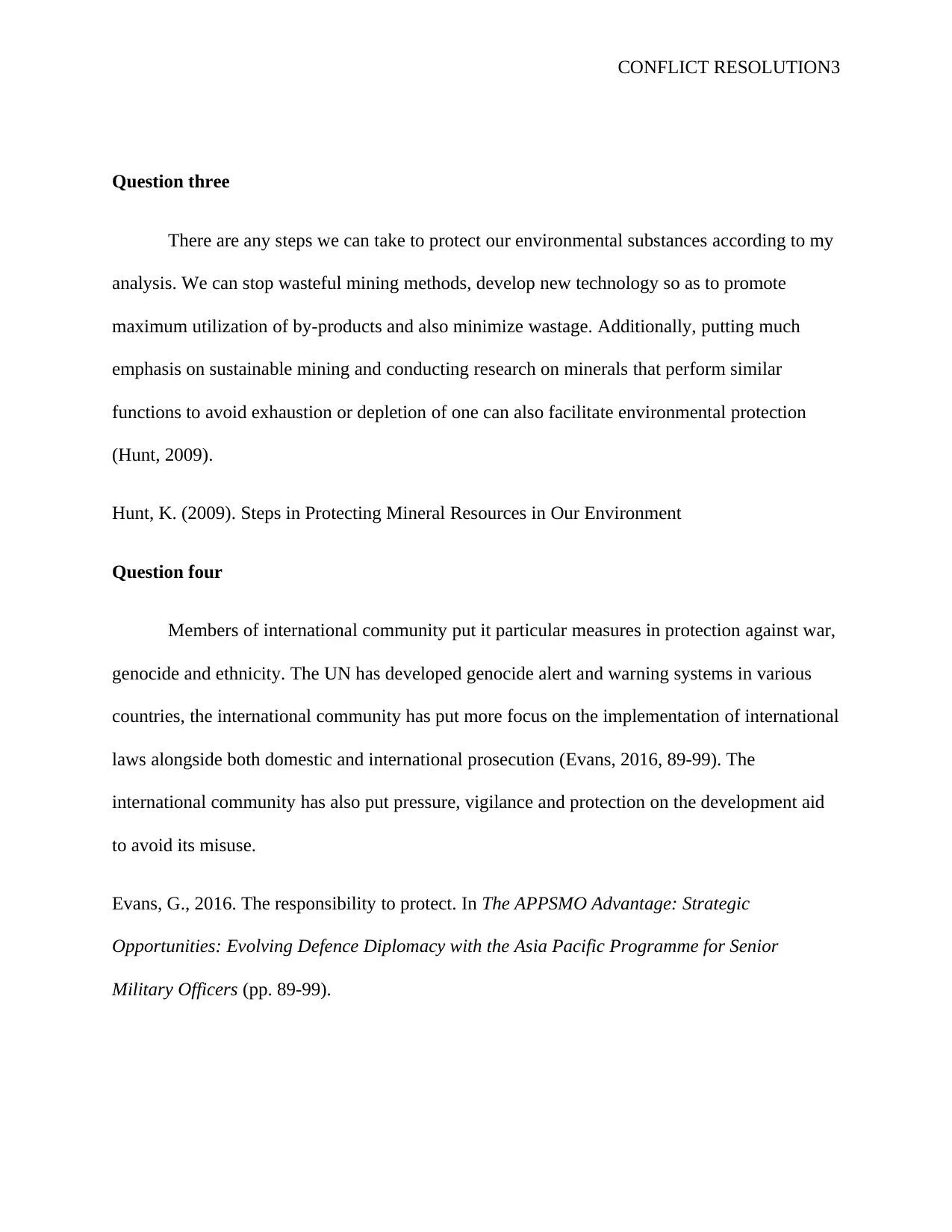
There are any steps we can take to protect our environmental substances according to my
analysis. We can stop wasteful mining methods, develop new technology so as to promote
maximum utilization of by-products and also minimize wastage. Additionally, putting much
emphasis on sustainable mining and conducting research on minerals that perform similar
functions to avoid exhaustion or depletion of one can also facilitate environmental protection
(Hunt, 2009).
Hunt, K. (2009). Steps in Protecting Mineral Resources in Our Environment
Question four
Members of international community put it particular measures in protection against war,
genocide and ethnicity. The UN has developed genocide alert and warning systems in various
countries, the international community has put more focus on the implementation of international
laws alongside both domestic and international prosecution (Evans, 2016, 89-99). The
international community has also put pressure, vigilance and protection on the development aid
to avoid its misuse.
Evans, G., 2016. The responsibility to protect. In The APPSMO Advantage: Strategic
Opportunities: Evolving Defence Diplomacy with the Asia Pacific Programme for Senior
Military Officers (pp. 89-99).
chevron_up_icon
1 out of 3
circle_padding
hide_on_mobile
zoom_out_icon
[object Object]