Conflicts in Research Publication: GM Food Study Retraction Analysis
VerifiedAdded on 2022/09/14
|6
|2097
|15
Report
AI Summary
This report analyzes the controversial publication and subsequent retraction of the Séralini et al. (2012) study on the long-term toxicity of genetically modified (GM) maize and Roundup herbicide. The study, published in Food and Chemical Toxicology, claimed that GM food consumption led to tumor development in rats, sparking significant criticism from the scientific community regarding methodology, sample size, statistical analysis, and ethical considerations. The report details the scientific background, peer review process, and science communication aspects surrounding the research. It explores the criticisms, including the use of a small sample size, inappropriate animal selection, and flawed statistical analysis. The report also highlights the ethical concerns related to animal treatment and the pre-publication dissemination of information. Furthermore, it discusses the journal's decision to retract the paper due to insufficient data and the subsequent republication in another journal, raising further ethical and methodological questions. The report concludes by emphasizing the importance of rigorous peer review, ethical conduct, and the responsibilities of journal editors in ensuring the integrity of scientific publications.
Running head = PUBLICATION OF RESEARCH
0
Publication of Research
Conflicts in research publication
SystemJP
[Pick the date]
0
Publication of Research
Conflicts in research publication
SystemJP
[Pick the date]

Paraphrase This Document
Need a fresh take? Get an instant paraphrase of this document with our AI Paraphraser
Publication of Research
1
The work presented by (Séralini et al., 2012), was in the collaboration of 8 authors the research
work was issued in the highly reputed journal “Food and Chemical Toxicology” of “Elsevier”
publication house. The primary aim of the work conducted by the researchers was to evaluate
and analyses the impact of genetically modified (GM) food in comparison to the naturally
occurring food on the health of rats. To evaluate the impact of GM food the rats were segregated
in groups one group was fed with Roundup©-resistant GM maize only, GM maize along with
Roundup© or Roundup© over a period for two years and it was reported that the test subject had
a greater proportion of tumors when compared with control subjects. The work was highly
criticized by the scientific community in terms of methods used in the work and ethical
implication of the work and ultimately it was retracted by the publication house in 2014 without
making any consideration with the author. This report will provide a brief overview of the
reaction of the scientific community towards the work along with the process of retraction of
publication.
The modernization of the world demand modification in agriculture to sustain the increasing
demand for healthy food for consistently increasing population, also the continuous utilization of
agricultural land for habitation and industrial purpose is constant stress on the agricultural
industry. One of the alternatives is the application of GM food, however, the application is still a
debatable topic in terms of risk associated with it on human wellbeing. Therefore various
policies have been drafted in the context of against the use of GM food or labeling GM food so
that the consumer should be aware of the risk associated with GM food. The scientific
community is divided into their view in terms of the use of GM food as one group argued s that
GM food is as safe as the normal food, whereas the other group argues for banning GM food. At
present, the European Union (EU) has permitted the various countries which are the members of
the union to self-regulate the production of GM food, but the labeling of food is must, however,
most of the countries in EU does not allow the import of GM food along with the sanction
towards the commercialization of GM food.
To evaluate the toxicity of GM food lab experiments are conducted which have been failed to
provide any substantial evidence concerning the threat accompanying with the consumption of
GM food. Most of the studies that are conducted in the laboratory are over a 90-day study on
rodents, which generally comprise of the high dose of feeding to rodents over a short duration of
1
The work presented by (Séralini et al., 2012), was in the collaboration of 8 authors the research
work was issued in the highly reputed journal “Food and Chemical Toxicology” of “Elsevier”
publication house. The primary aim of the work conducted by the researchers was to evaluate
and analyses the impact of genetically modified (GM) food in comparison to the naturally
occurring food on the health of rats. To evaluate the impact of GM food the rats were segregated
in groups one group was fed with Roundup©-resistant GM maize only, GM maize along with
Roundup© or Roundup© over a period for two years and it was reported that the test subject had
a greater proportion of tumors when compared with control subjects. The work was highly
criticized by the scientific community in terms of methods used in the work and ethical
implication of the work and ultimately it was retracted by the publication house in 2014 without
making any consideration with the author. This report will provide a brief overview of the
reaction of the scientific community towards the work along with the process of retraction of
publication.
The modernization of the world demand modification in agriculture to sustain the increasing
demand for healthy food for consistently increasing population, also the continuous utilization of
agricultural land for habitation and industrial purpose is constant stress on the agricultural
industry. One of the alternatives is the application of GM food, however, the application is still a
debatable topic in terms of risk associated with it on human wellbeing. Therefore various
policies have been drafted in the context of against the use of GM food or labeling GM food so
that the consumer should be aware of the risk associated with GM food. The scientific
community is divided into their view in terms of the use of GM food as one group argued s that
GM food is as safe as the normal food, whereas the other group argues for banning GM food. At
present, the European Union (EU) has permitted the various countries which are the members of
the union to self-regulate the production of GM food, but the labeling of food is must, however,
most of the countries in EU does not allow the import of GM food along with the sanction
towards the commercialization of GM food.
To evaluate the toxicity of GM food lab experiments are conducted which have been failed to
provide any substantial evidence concerning the threat accompanying with the consumption of
GM food. Most of the studies that are conducted in the laboratory are over a 90-day study on
rodents, which generally comprise of the high dose of feeding to rodents over a short duration of
Publication of Research
2
time, which makes it difficult to model in the context of longer duration influence of consuming
a moderate amount of GM food. Therefore studies of 2 years are used to model in the context of
longer duration influence of GM food feed on the health condition of rodents. The problem
associated with long terms study such as directed by (Séralini et al., 2012), is the strains used in
the study have been reported to develop health complication and a tumor on their own after
eighteen months, which makes it difficult to interpret the impact of GM food on the health of
rodent or it is just occurring due to the age of rodent. In the work published by (Séralini et al.,
2012), it was stated that rodents fed with GM food presented a greater case of tumor and tissue
destruction in comparison to the control group. The consequences were credited to the impact of
Roundup© and metabolic implication produced in the rodent due to the consumption of GM
maize. The authors also hypothesized that the disruption in endocrine from the effects of
glyphosate could be attributed to the transgene in food. In the conclusion of the study, the author
stated that the NKG603 GM maize and Roundup® are the source of health problems in rodents,
which further established the risk involved in the consumption of GM food over a longer
duration of time.
The work conducted by (Séralini et al., 2012), was highly criticized, and different research
groups and research institutions argued over the methods of the study and the unethical ways
research was conducted (Butler, 2012). The research showed by (Séralini et al., 2012) was
contradicted in terms of the sample size taken and it was disputed that the model size was too
insignificant to produce any conclusive results, with an emphasis made on the longer duration of
study on the test animal, who generally acquire health implication after 18 months (Robert et al.,
2013). The number of sample sizes that was suggested that would be appropriate for the study
was fifty samples in each category of gender (Langridge, 2013). The research was also criticized
in terms of animal choice as the rats had the propensity for developing the diseases after eighteen
months and it was suggested that the study should have used rodents with longer duration of
healthy life for the study (Arjó et al., 2013). The statistical analysis of the study was reported
flawed by the researchers in terms of endpoint study and it was reported that there was no
significant difference between the sample studied (Panchin, 2013). The major point that was
criticized by the authors was the lack of sufficient data provided in the paper in terms of, the
methodology applied for food preparation, the consumption concentration of food and water by
2
time, which makes it difficult to model in the context of longer duration influence of consuming
a moderate amount of GM food. Therefore studies of 2 years are used to model in the context of
longer duration influence of GM food feed on the health condition of rodents. The problem
associated with long terms study such as directed by (Séralini et al., 2012), is the strains used in
the study have been reported to develop health complication and a tumor on their own after
eighteen months, which makes it difficult to interpret the impact of GM food on the health of
rodent or it is just occurring due to the age of rodent. In the work published by (Séralini et al.,
2012), it was stated that rodents fed with GM food presented a greater case of tumor and tissue
destruction in comparison to the control group. The consequences were credited to the impact of
Roundup© and metabolic implication produced in the rodent due to the consumption of GM
maize. The authors also hypothesized that the disruption in endocrine from the effects of
glyphosate could be attributed to the transgene in food. In the conclusion of the study, the author
stated that the NKG603 GM maize and Roundup® are the source of health problems in rodents,
which further established the risk involved in the consumption of GM food over a longer
duration of time.
The work conducted by (Séralini et al., 2012), was highly criticized, and different research
groups and research institutions argued over the methods of the study and the unethical ways
research was conducted (Butler, 2012). The research showed by (Séralini et al., 2012) was
contradicted in terms of the sample size taken and it was disputed that the model size was too
insignificant to produce any conclusive results, with an emphasis made on the longer duration of
study on the test animal, who generally acquire health implication after 18 months (Robert et al.,
2013). The number of sample sizes that was suggested that would be appropriate for the study
was fifty samples in each category of gender (Langridge, 2013). The research was also criticized
in terms of animal choice as the rats had the propensity for developing the diseases after eighteen
months and it was suggested that the study should have used rodents with longer duration of
healthy life for the study (Arjó et al., 2013). The statistical analysis of the study was reported
flawed by the researchers in terms of endpoint study and it was reported that there was no
significant difference between the sample studied (Panchin, 2013). The major point that was
criticized by the authors was the lack of sufficient data provided in the paper in terms of, the
methodology applied for food preparation, the consumption concentration of food and water by
⊘ This is a preview!⊘
Do you want full access?
Subscribe today to unlock all pages.

Trusted by 1+ million students worldwide
Publication of Research
3
the test samples along with the pathological analysis carried out for the diagnosis of the rats'
conditions (Barale-Thomas, 2013). The critic was made in terms of insufficient experimental
data provided for the support of the work (Arjó et al., 2013). The treatment of animals in the
study was also criticized by many authors, such as the pain and tumor in rats that were allowed
to propagate in the study to the extent wherein normal condition euthanasia is provided to the
animals (Robert et al., 2013).
Before the presentation of the article in the journal the authors used a unique methodology for
the information transfer, which was not customary for the research published in the peer-
reviewed journal. The author shared the information of the research with a select group of
journalist/ media persona along with the signed stipulation with them to provide any leak of the
information of the research (Nicole, 2012).
The publication has drawn much attention in terms of flaws in the study and ethical issues related
to the treatment of the animals in the experiment. The journal published a different response that
was directed at the study of (Séralini et al., 2012)in March 2013, which provided the information
regarding the request for retraction of the paper on a technical and ethical basis. Based on the
issues raised the journal retracted the article, without discussing the decision with the authors. It
was reported that the journal editor was not able to find any sort of deception or falsification of
the data provided by the authors, the editors gave the argument provided by critics, in terms of
sample size, statistical variability was not sufficient for producing useful conclusion. Moreover,
the editor never stated that the data was incorrect, the however editor stated that the data was not
sufficient to cross threshold set at the research paper in that particular journal. The study further
raised concerns in terms of the attitude of publication house, as the author (Séralini et al., 2014)
published a little altered version of the study in “Environmental Sciences Europe” (ESE), a new,
open-access journal.
The subsequent, withdrawal and consequent presentation of the Séralini study elevates
significant logical and moral issues for the editors. The research journals that are measuring
research work with noteworthy logical and social ramifications should take exceptional
consideration to guarantee that a friend audit is thorough and reasonable. The retraction and
republication of the paper highlight the role of journal editors in terms of publication of a
3
the test samples along with the pathological analysis carried out for the diagnosis of the rats'
conditions (Barale-Thomas, 2013). The critic was made in terms of insufficient experimental
data provided for the support of the work (Arjó et al., 2013). The treatment of animals in the
study was also criticized by many authors, such as the pain and tumor in rats that were allowed
to propagate in the study to the extent wherein normal condition euthanasia is provided to the
animals (Robert et al., 2013).
Before the presentation of the article in the journal the authors used a unique methodology for
the information transfer, which was not customary for the research published in the peer-
reviewed journal. The author shared the information of the research with a select group of
journalist/ media persona along with the signed stipulation with them to provide any leak of the
information of the research (Nicole, 2012).
The publication has drawn much attention in terms of flaws in the study and ethical issues related
to the treatment of the animals in the experiment. The journal published a different response that
was directed at the study of (Séralini et al., 2012)in March 2013, which provided the information
regarding the request for retraction of the paper on a technical and ethical basis. Based on the
issues raised the journal retracted the article, without discussing the decision with the authors. It
was reported that the journal editor was not able to find any sort of deception or falsification of
the data provided by the authors, the editors gave the argument provided by critics, in terms of
sample size, statistical variability was not sufficient for producing useful conclusion. Moreover,
the editor never stated that the data was incorrect, the however editor stated that the data was not
sufficient to cross threshold set at the research paper in that particular journal. The study further
raised concerns in terms of the attitude of publication house, as the author (Séralini et al., 2014)
published a little altered version of the study in “Environmental Sciences Europe” (ESE), a new,
open-access journal.
The subsequent, withdrawal and consequent presentation of the Séralini study elevates
significant logical and moral issues for the editors. The research journals that are measuring
research work with noteworthy logical and social ramifications should take exceptional
consideration to guarantee that a friend audit is thorough and reasonable. The retraction and
republication of the paper highlight the role of journal editors in terms of publication of a
Paraphrase This Document
Need a fresh take? Get an instant paraphrase of this document with our AI Paraphraser
Publication of Research
4
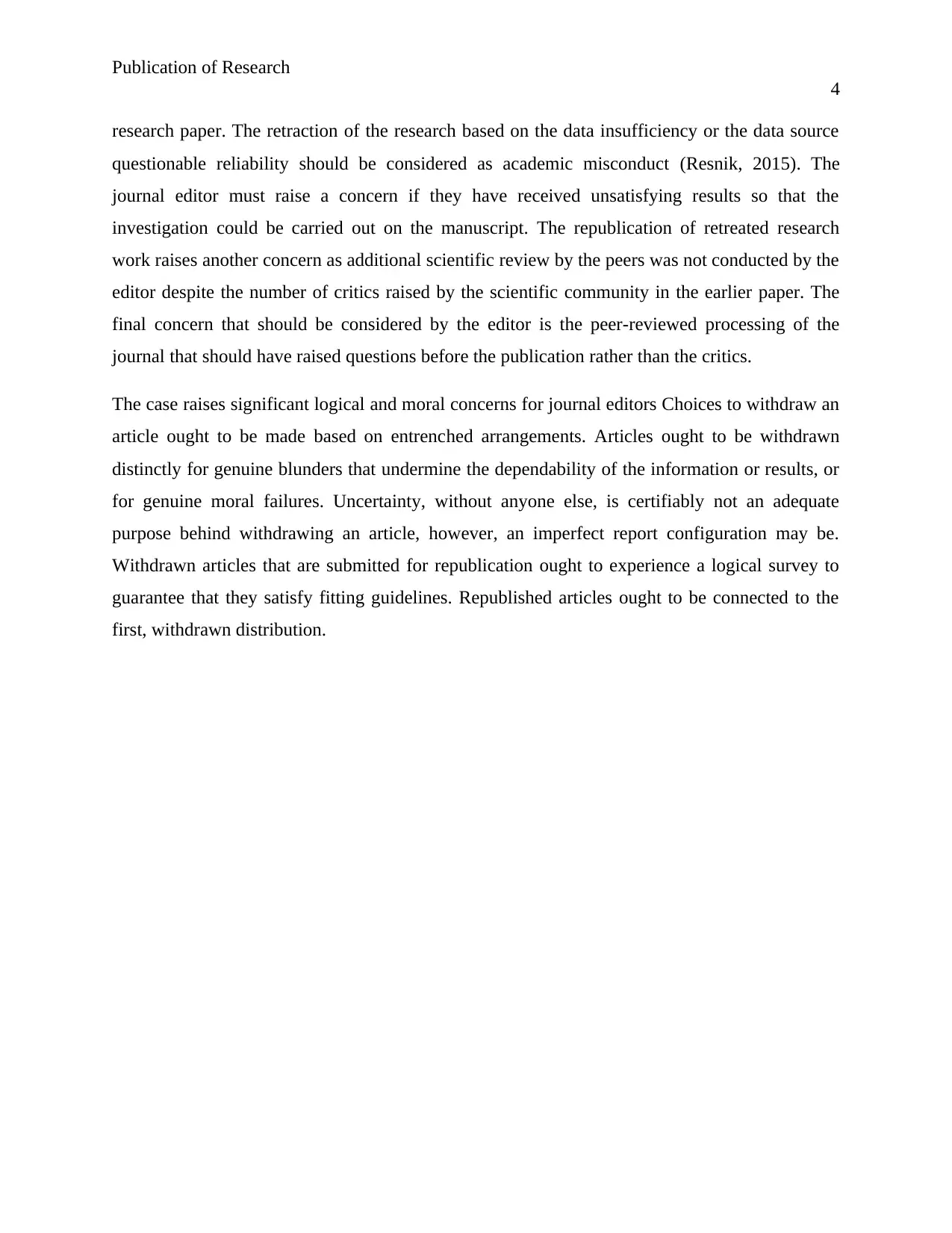
research paper. The retraction of the research based on the data insufficiency or the data source
questionable reliability should be considered as academic misconduct (Resnik, 2015). The
journal editor must raise a concern if they have received unsatisfying results so that the
investigation could be carried out on the manuscript. The republication of retreated research
work raises another concern as additional scientific review by the peers was not conducted by the
editor despite the number of critics raised by the scientific community in the earlier paper. The
final concern that should be considered by the editor is the peer-reviewed processing of the
journal that should have raised questions before the publication rather than the critics.
The case raises significant logical and moral concerns for journal editors Choices to withdraw an
article ought to be made based on entrenched arrangements. Articles ought to be withdrawn
distinctly for genuine blunders that undermine the dependability of the information or results, or
for genuine moral failures. Uncertainty, without anyone else, is certifiably not an adequate
purpose behind withdrawing an article, however, an imperfect report configuration may be.
Withdrawn articles that are submitted for republication ought to experience a logical survey to
guarantee that they satisfy fitting guidelines. Republished articles ought to be connected to the
first, withdrawn distribution.
4
research paper. The retraction of the research based on the data insufficiency or the data source
questionable reliability should be considered as academic misconduct (Resnik, 2015). The
journal editor must raise a concern if they have received unsatisfying results so that the
investigation could be carried out on the manuscript. The republication of retreated research
work raises another concern as additional scientific review by the peers was not conducted by the
editor despite the number of critics raised by the scientific community in the earlier paper. The
final concern that should be considered by the editor is the peer-reviewed processing of the
journal that should have raised questions before the publication rather than the critics.
The case raises significant logical and moral concerns for journal editors Choices to withdraw an
article ought to be made based on entrenched arrangements. Articles ought to be withdrawn
distinctly for genuine blunders that undermine the dependability of the information or results, or
for genuine moral failures. Uncertainty, without anyone else, is certifiably not an adequate
purpose behind withdrawing an article, however, an imperfect report configuration may be.
Withdrawn articles that are submitted for republication ought to experience a logical survey to
guarantee that they satisfy fitting guidelines. Republished articles ought to be connected to the
first, withdrawn distribution.
Publication of Research
5
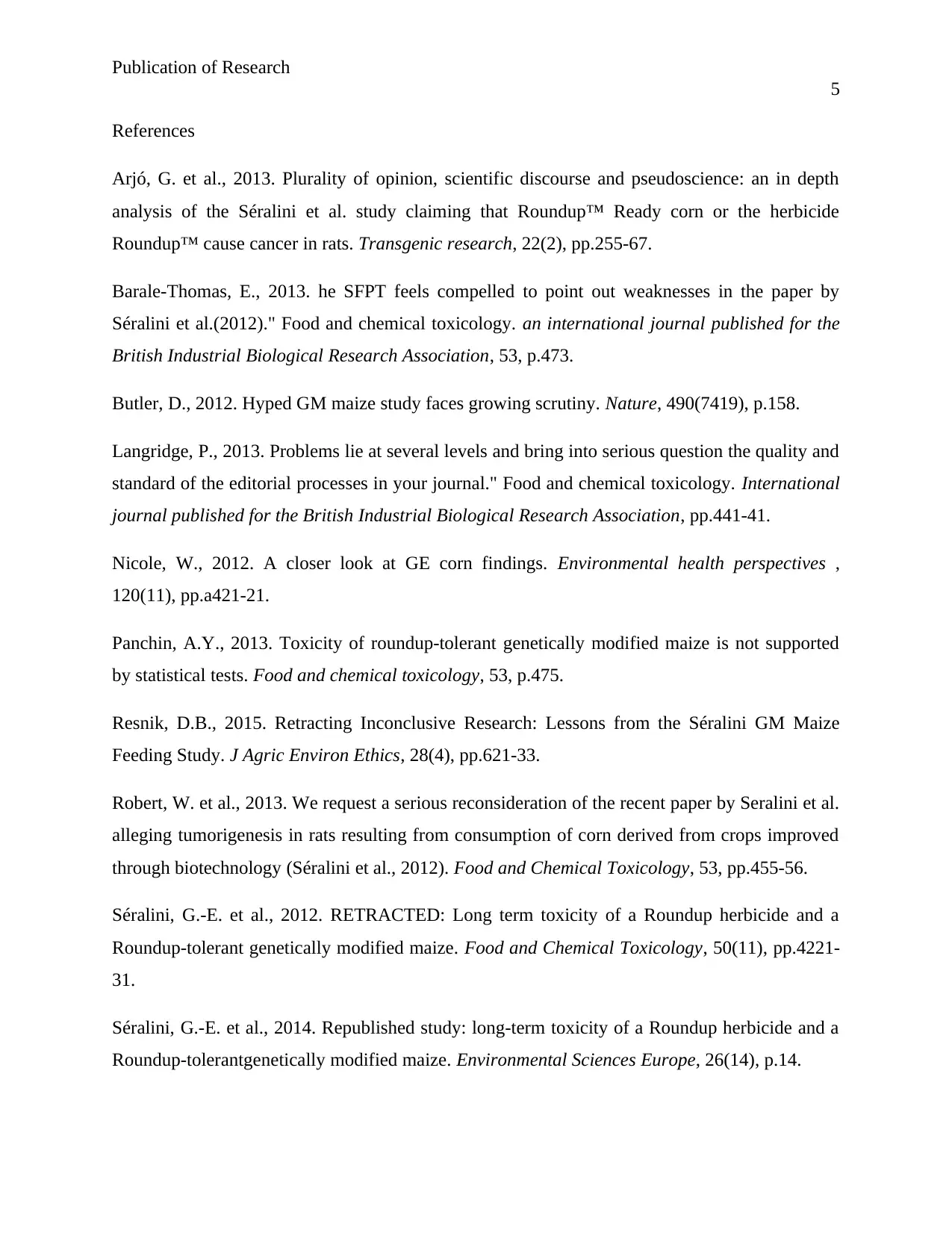
References
Arjó, G. et al., 2013. Plurality of opinion, scientific discourse and pseudoscience: an in depth
analysis of the Séralini et al. study claiming that Roundup™ Ready corn or the herbicide
Roundup™ cause cancer in rats. Transgenic research, 22(2), pp.255-67.
Barale-Thomas, E., 2013. he SFPT feels compelled to point out weaknesses in the paper by
Séralini et al.(2012)." Food and chemical toxicology. an international journal published for the
British Industrial Biological Research Association, 53, p.473.
Butler, D., 2012. Hyped GM maize study faces growing scrutiny. Nature, 490(7419), p.158.
Langridge, P., 2013. Problems lie at several levels and bring into serious question the quality and
standard of the editorial processes in your journal." Food and chemical toxicology. International
journal published for the British Industrial Biological Research Association, pp.441-41.
Nicole, W., 2012. A closer look at GE corn findings. Environmental health perspectives ,
120(11), pp.a421-21.
Panchin, A.Y., 2013. Toxicity of roundup-tolerant genetically modified maize is not supported
by statistical tests. Food and chemical toxicology, 53, p.475.
Resnik, D.B., 2015. Retracting Inconclusive Research: Lessons from the Séralini GM Maize
Feeding Study. J Agric Environ Ethics, 28(4), pp.621-33.
Robert, W. et al., 2013. We request a serious reconsideration of the recent paper by Seralini et al.
alleging tumorigenesis in rats resulting from consumption of corn derived from crops improved
through biotechnology (Séralini et al., 2012). Food and Chemical Toxicology, 53, pp.455-56.
Séralini, G.-E. et al., 2012. RETRACTED: Long term toxicity of a Roundup herbicide and a
Roundup-tolerant genetically modified maize. Food and Chemical Toxicology, 50(11), pp.4221-
31.
Séralini, G.-E. et al., 2014. Republished study: long-term toxicity of a Roundup herbicide and a
Roundup-tolerantgenetically modified maize. Environmental Sciences Europe, 26(14), p.14.
5
References
Arjó, G. et al., 2013. Plurality of opinion, scientific discourse and pseudoscience: an in depth
analysis of the Séralini et al. study claiming that Roundup™ Ready corn or the herbicide
Roundup™ cause cancer in rats. Transgenic research, 22(2), pp.255-67.
Barale-Thomas, E., 2013. he SFPT feels compelled to point out weaknesses in the paper by
Séralini et al.(2012)." Food and chemical toxicology. an international journal published for the
British Industrial Biological Research Association, 53, p.473.
Butler, D., 2012. Hyped GM maize study faces growing scrutiny. Nature, 490(7419), p.158.
Langridge, P., 2013. Problems lie at several levels and bring into serious question the quality and
standard of the editorial processes in your journal." Food and chemical toxicology. International
journal published for the British Industrial Biological Research Association, pp.441-41.
Nicole, W., 2012. A closer look at GE corn findings. Environmental health perspectives ,
120(11), pp.a421-21.
Panchin, A.Y., 2013. Toxicity of roundup-tolerant genetically modified maize is not supported
by statistical tests. Food and chemical toxicology, 53, p.475.
Resnik, D.B., 2015. Retracting Inconclusive Research: Lessons from the Séralini GM Maize
Feeding Study. J Agric Environ Ethics, 28(4), pp.621-33.
Robert, W. et al., 2013. We request a serious reconsideration of the recent paper by Seralini et al.
alleging tumorigenesis in rats resulting from consumption of corn derived from crops improved
through biotechnology (Séralini et al., 2012). Food and Chemical Toxicology, 53, pp.455-56.
Séralini, G.-E. et al., 2012. RETRACTED: Long term toxicity of a Roundup herbicide and a
Roundup-tolerant genetically modified maize. Food and Chemical Toxicology, 50(11), pp.4221-
31.
Séralini, G.-E. et al., 2014. Republished study: long-term toxicity of a Roundup herbicide and a
Roundup-tolerantgenetically modified maize. Environmental Sciences Europe, 26(14), p.14.
⊘ This is a preview!⊘
Do you want full access?
Subscribe today to unlock all pages.
Trusted by 1+ million students worldwide

1 out of 6


Your All-in-One AI-Powered Toolkit for Academic Success.
+13062052269
info@desklib.com
Available 24*7 on WhatsApp / Email
![[object Object]](/_next/static/media/star-bottom.7253800d.svg)
Unlock your academic potential
Copyright © 2020–2026 A2Z Services. All Rights Reserved. Developed and managed by ZUCOL.