A Report on the Implementation of Consent in Medical Treatment

Verified

Added on  2022/08/13

|8
|1593
|8
Report
AI Summary
This report provides a detailed analysis of the implementation of consent in medical treatment, focusing on its significance in healthcare, particularly within the context of Saudi Arabia. The introduction highlights the importance of consent in medical practice, emphasizing its ethical and legal dimensions. The problem statement identifies the need to analyze how promoting consent improves patient experiences and opens opportunities in the medical sector. The research explores the impact of consent on healthcare, patient rights, and the challenges faced by healthcare facilities. The literature review examines the historical context and cultural influences on consent. The methodology describes the use of quantitative methods, questionnaires, and online resources to gather data. Findings reveal the positive effects of consent on healthcare quality and research and development. The discussion addresses the physician-patient relationship, cultural and language barriers, and the need for improved communication skills among healthcare practitioners. The report also addresses limitations such as mental conditions and cultural beliefs. The conclusion emphasizes the need for interventions to enhance communication and promote patient involvement. The report uses the findings to analyze why every human has the right to give an opinion on the treatment they should be given. The research references various scholarly sources to support its arguments.
Document Page
IMPLEMENTATION OF CONSENT IN TREATMENT 1.
IMPLEMENTATION OF CONSENT IN TREATMENT
Name
Course
Tutor
School
Date
Introduction
Introduction
tabler-icon-diamond-filled.svg

Paraphrase This Document

Need a fresh take? Get an instant paraphrase of this document with our AI Paraphraser
Document Page
IMPLEMENTATION OF CONSENT IN TREATMENT 2.
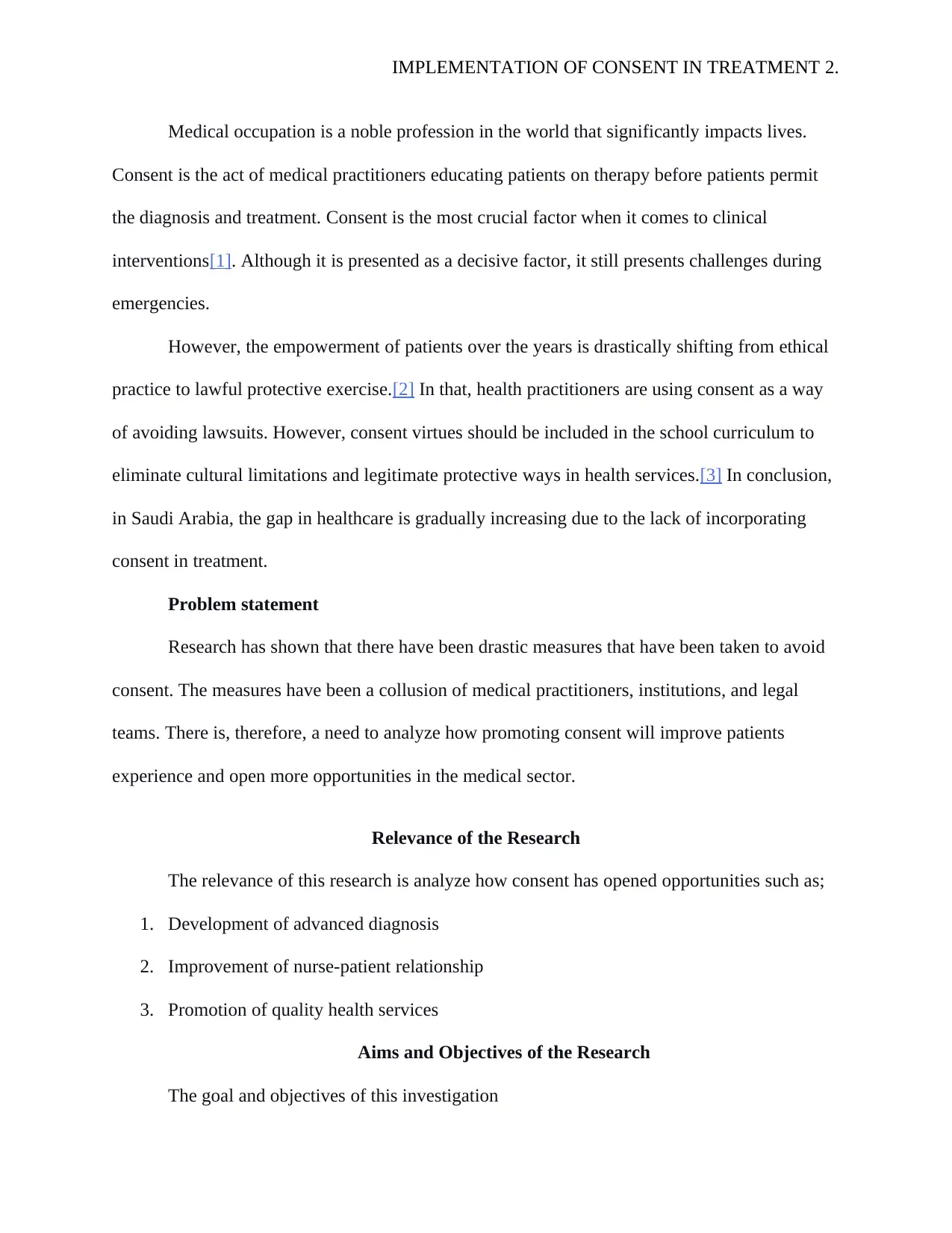
Medical occupation is a noble profession in the world that significantly impacts lives.
Consent is the act of medical practitioners educating patients on therapy before patients permit
the diagnosis and treatment. Consent is the most crucial factor when it comes to clinical
interventions[1]. Although it is presented as a decisive factor, it still presents challenges during
emergencies.
However, the empowerment of patients over the years is drastically shifting from ethical
practice to lawful protective exercise.[2] In that, health practitioners are using consent as a way
of avoiding lawsuits. However, consent virtues should be included in the school curriculum to
eliminate cultural limitations and legitimate protective ways in health services.[3] In conclusion,
in Saudi Arabia, the gap in healthcare is gradually increasing due to the lack of incorporating
consent in treatment.
Problem statement
Research has shown that there have been drastic measures that have been taken to avoid
consent. The measures have been a collusion of medical practitioners, institutions, and legal
teams. There is, therefore, a need to analyze how promoting consent will improve patients
experience and open more opportunities in the medical sector.
Relevance of the Research
The relevance of this research is analyze how consent has opened opportunities such as;
1. Development of advanced diagnosis
2. Improvement of nurse-patient relationship
3. Promotion of quality health services
Aims and Objectives of the Research
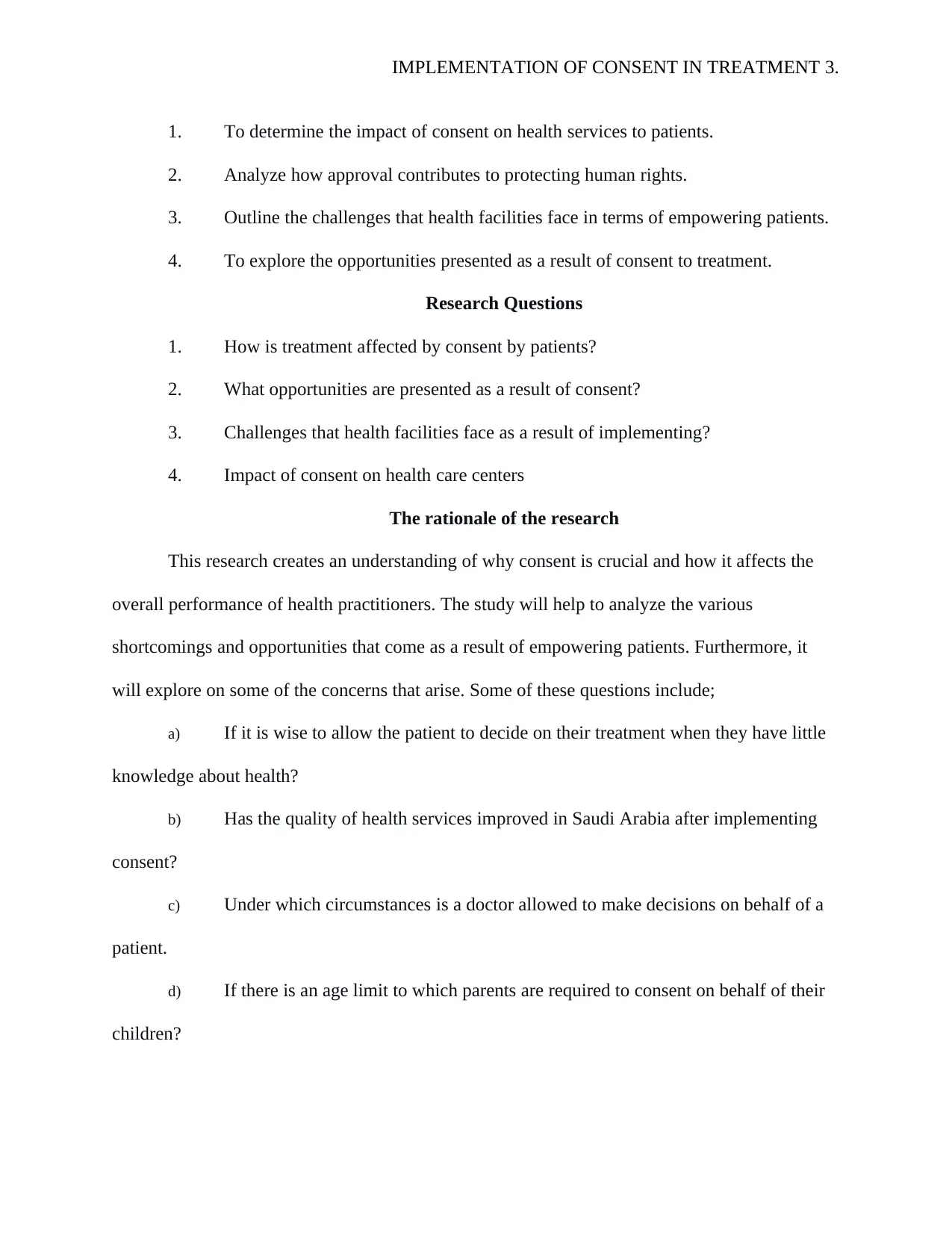
The goal and objectives of this investigation
Document Page
IMPLEMENTATION OF CONSENT IN TREATMENT 3.
1. To determine the impact of consent on health services to patients.
2. Analyze how approval contributes to protecting human rights.
3. Outline the challenges that health facilities face in terms of empowering patients.
4. To explore the opportunities presented as a result of consent to treatment.
Research Questions
1. How is treatment affected by consent by patients?
2. What opportunities are presented as a result of consent?
3. Challenges that health facilities face as a result of implementing?
4. Impact of consent on health care centers
The rationale of the research
This research creates an understanding of why consent is crucial and how it affects the
overall performance of health practitioners. The study will help to analyze the various
shortcomings and opportunities that come as a result of empowering patients. Furthermore, it
will explore on some of the concerns that arise. Some of these questions include;
a) If it is wise to allow the patient to decide on their treatment when they have little
knowledge about health?
b) Has the quality of health services improved in Saudi Arabia after implementing
consent?
c) Under which circumstances is a doctor allowed to make decisions on behalf of a
patient.
d) If there is an age limit to which parents are required to consent on behalf of their
children?
Document Page
IMPLEMENTATION OF CONSENT IN TREATMENT 4.
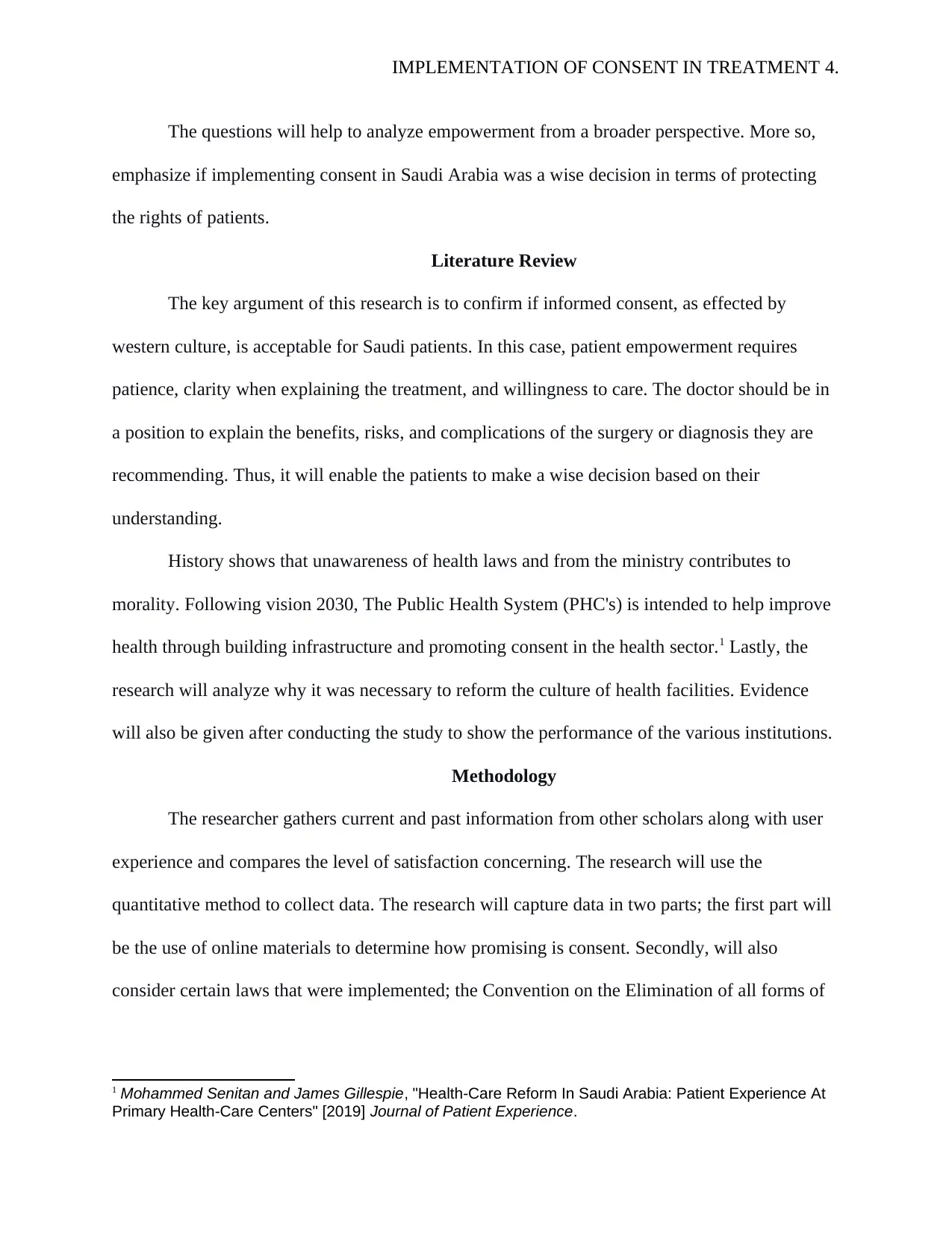
The questions will help to analyze empowerment from a broader perspective. More so,
emphasize if implementing consent in Saudi Arabia was a wise decision in terms of protecting
the rights of patients.
Literature Review
The key argument of this research is to confirm if informed consent, as effected by
western culture, is acceptable for Saudi patients. In this case, patient empowerment requires
patience, clarity when explaining the treatment, and willingness to care. The doctor should be in
a position to explain the benefits, risks, and complications of the surgery or diagnosis they are
recommending. Thus, it will enable the patients to make a wise decision based on their
understanding.
History shows that unawareness of health laws and from the ministry contributes to
morality. Following vision 2030, The Public Health System (PHC's) is intended to help improve
health through building infrastructure and promoting consent in the health sector.1 Lastly, the
research will analyze why it was necessary to reform the culture of health facilities. Evidence
will also be given after conducting the study to show the performance of the various institutions.
Methodology
The researcher gathers current and past information from other scholars along with user
experience and compares the level of satisfaction concerning. The research will use the
quantitative method to collect data. The research will capture data in two parts; the first part will
be the use of online materials to determine how promising is consent. Secondly, will also
consider certain laws that were implemented; the Convention on the Elimination of all forms of
1 Mohammed Senitan and James Gillespie, "Health-Care Reform In Saudi Arabia: Patient Experience At
Primary Health-Care Centers" [2019] Journal of Patient Experience.
tabler-icon-diamond-filled.svg

Paraphrase This Document

Need a fresh take? Get an instant paraphrase of this document with our AI Paraphraser
Document Page
IMPLEMENTATION OF CONSENT IN TREATMENT 5.
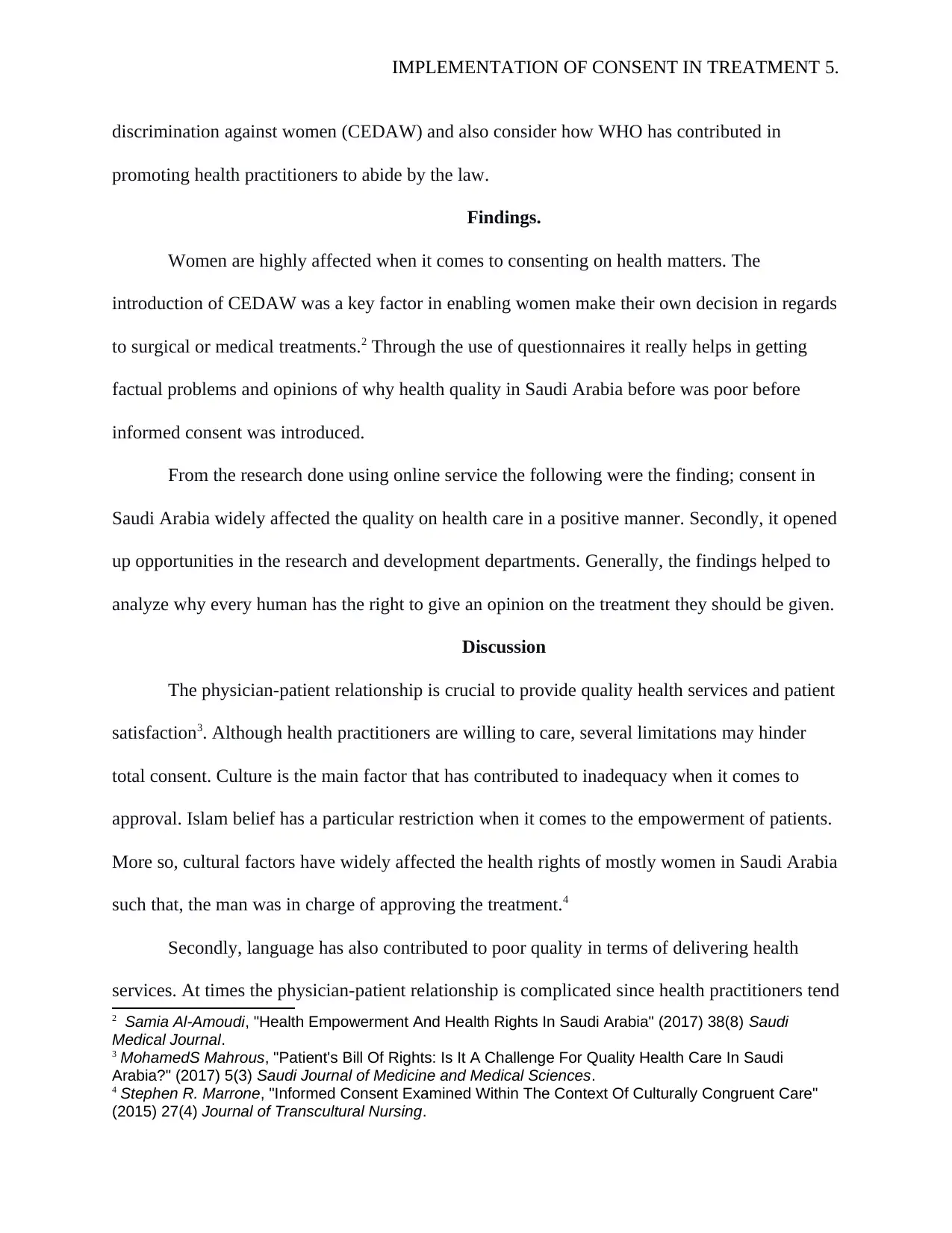
discrimination against women (CEDAW) and also consider how WHO has contributed in
promoting health practitioners to abide by the law.
Findings.
Women are highly affected when it comes to consenting on health matters. The
introduction of CEDAW was a key factor in enabling women make their own decision in regards
to surgical or medical treatments.2 Through the use of questionnaires it really helps in getting
factual problems and opinions of why health quality in Saudi Arabia before was poor before
informed consent was introduced.
From the research done using online service the following were the finding; consent in
Saudi Arabia widely affected the quality on health care in a positive manner. Secondly, it opened
up opportunities in the research and development departments. Generally, the findings helped to
analyze why every human has the right to give an opinion on the treatment they should be given.
Discussion
The physician-patient relationship is crucial to provide quality health services and patient
satisfaction3. Although health practitioners are willing to care, several limitations may hinder
total consent. Culture is the main factor that has contributed to inadequacy when it comes to
approval. Islam belief has a particular restriction when it comes to the empowerment of patients.
More so, cultural factors have widely affected the health rights of mostly women in Saudi Arabia
such that, the man was in charge of approving the treatment.4
Secondly, language has also contributed to poor quality in terms of delivering health
services. At times the physician-patient relationship is complicated since health practitioners tend
2 Samia Al-Amoudi, "Health Empowerment And Health Rights In Saudi Arabia" (2017) 38(8) Saudi
Medical Journal.
3 MohamedS Mahrous, "Patient's Bill Of Rights: Is It A Challenge For Quality Health Care In Saudi
Arabia?" (2017) 5(3) Saudi Journal of Medicine and Medical Sciences.
4 Stephen R. Marrone, "Informed Consent Examined Within The Context Of Culturally Congruent Care"
(2015) 27(4) Journal of Transcultural Nursing.
Document Page
IMPLEMENTATION OF CONSENT IN TREATMENT 6.
to implement non-verbal communication, which results in misunderstanding most of the time.
Lastly, the lack of appropriate skills when it comes to communication has also been raised as the
critical factor that has dramatically affected consent in Saudi Arabi. Health practitioners should
be in a position to explain without the use of jargon, listen, and honestly answer questions raised
by patients.
LIMITATIONS OF IMPLEMENTING CONSENT
a) Mental conditions. When an individual cannot decide on their own, and the next
of kin isn't available.
b) The age limit will also hinder. Parents with children below the age of 16 can
consent on behalf of the children.
c) Cultural beliefs have also played a major role in limiting consent in treatment.
Saudi citizens have strong believes when it comes to preserving the life of a person.
CONCLUSION.
Recent difficulties in nurse-patient communication have made it almost impossible
meeting the needs of Saudi patients as a result of language, religion, and cultural differences.5 To
entirely give patients quality services and proper care, several interventions should be
implemented. Firstly, health practitioners in Saudi Arabia need to be trained in excellent
communication skills, which means they have to know how and when they should interact when
it comes to giving medical advice.
Besides, citizens should be educated on the importance of consent and also involve them
in the medication process. Lastly, people fail to realize that through consent, it opens various
5 Mukhlid Alshammari, Jed Duff and Michelle Guilhermino, "Barriers To Nurse–Patient Communication In
Saudi Arabia: An Integrative Review" (2019) 18(1) BMC Nursing.
Document Page
IMPLEMENTATION OF CONSENT IN TREATMENT 7.
opportunities such as invention on new ways and treatment to different diseases and also hat
promotes the satisfaction of patients due to physician-patient communication.
tabler-icon-diamond-filled.svg

Paraphrase This Document

Need a fresh take? Get an instant paraphrase of this document with our AI Paraphraser
Document Page
IMPLEMENTATION OF CONSENT IN TREATMENT 8.
References
Abolfotouh, Mostafa and Abdallah A Adlan, "Quality Of Informed Consent For Invasive
Procedures In Central Saudi Arabia" [2012] International Journal of General Medicine
Al-Amoudi, Samia, "Health Empowerment And Health Rights In Saudi Arabia" (2017) 38(8) Saudi
Medical Journal
Al-Amoudi, Samia M. et al, "Health Rights Knowledge Among Medical School Students At King
Abdulaziz University, Jeddah, Saudi Arabia" (2017) 12(5) PLOS ONE
Alshammari, Mukhlid, Jed Duff and Michelle Guilhermino, "Barriers To Nurse–Patient
Communication In Saudi Arabia: An Integrative Review" (2019) 18(1) BMC Nursing
Mahrous, MohamedS, "Patient's Bill Of Rights: Is It A Challenge For Quality Health Care In Saudi
Arabia?" (2017) 5(3) Saudi Journal of Medicine and Medical Sciences
Kadam, Rashmi, "Informed Consent Process: A Step Further Towards Making It
Meaningful!", Pubmed Central (PMC) (Webpage, 2020)
<https://www.ncbi.nlm.nih.gov/pmc/articles/PMC5543760/>
Marrone, Stephen R., "Informed Consent Examined Within The Context Of Culturally Congruent
Care" (2015) 27(4) Journal of Transcultural Nursing
Senitan, Mohammed and James Gillespie, "Health-Care Reform In Saudi Arabia: Patient
Experience At Primary Health-Care Centers" [2019] Journal of Patient Experience
chevron_up_icon
1 out of 8
circle_padding
hide_on_mobile
zoom_out_icon
[object Object]