Consequences of Plagiarism in Academic Research: A Report
VerifiedAdded on 2020/01/07
|9
|2157
|201
Report
AI Summary
This report provides an executive summary and detailed analysis of plagiarism in academic research, emphasizing its severe consequences. It defines plagiarism as the act of stealing or using another's work or language. The report outlines the various levels of plagiarism and the penalties faced by students, including failing grades, suspension, or expulsion. It examines the consequences for students at different levels, from poor referencing to intentional copying, and discusses the impact on universities, such as damage to reputation and credibility. The report also addresses the effects on future academic integrity, emphasizing the importance of ethical practices and the role of universities in preventing plagiarism. It concludes with recommendations for avoiding plagiarism, such as proper citation, paraphrasing, and the use of quotations, to maintain academic integrity. The report stresses the importance of ethical behavior and the use of proper citation and referencing.
Plagiarism and its
consequences
consequences

Paraphrase This Document
Need a fresh take? Get an instant paraphrase of this document with our AI Paraphraser
EXECUTIVE SUMMARY
In the academic research there are various types of activities which are not allowed.
Plagiarism is one of them. It is that process in which an individual steal some other work
language. As per the college guidelines it is serious conduct which need to be avoided so the
integrity of the academic can be maintained. There are different types of polices are set by
educational institutions to avoid such practices.
2
In the academic research there are various types of activities which are not allowed.
Plagiarism is one of them. It is that process in which an individual steal some other work
language. As per the college guidelines it is serious conduct which need to be avoided so the
integrity of the academic can be maintained. There are different types of polices are set by
educational institutions to avoid such practices.
2
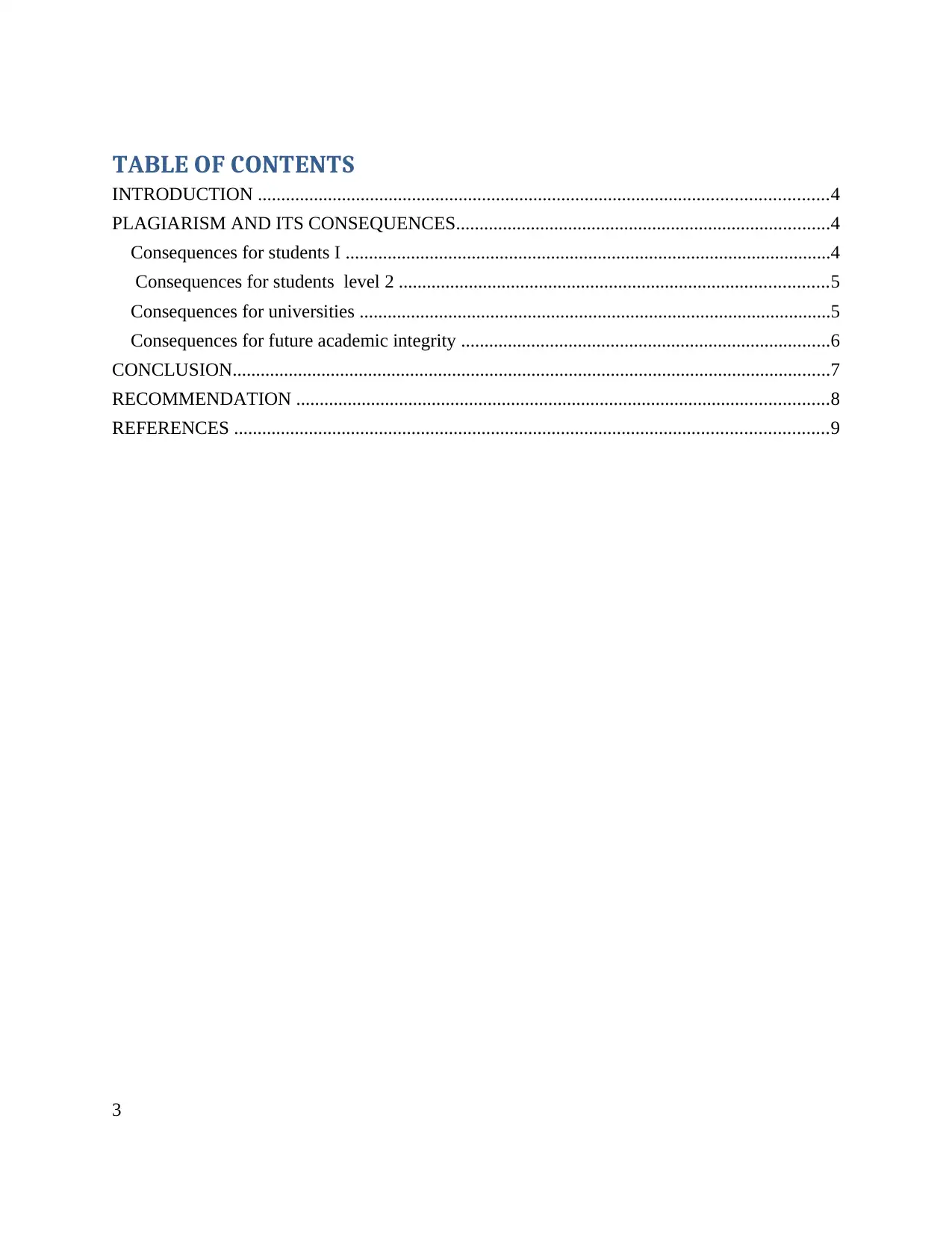
TABLE OF CONTENTS
INTRODUCTION ..........................................................................................................................4
PLAGIARISM AND ITS CONSEQUENCES................................................................................4
Consequences for students I ........................................................................................................4
Consequences for students level 2 ............................................................................................5
Consequences for universities .....................................................................................................5
Consequences for future academic integrity ...............................................................................6
CONCLUSION................................................................................................................................7
RECOMMENDATION ..................................................................................................................8
REFERENCES ...............................................................................................................................9
3
INTRODUCTION ..........................................................................................................................4
PLAGIARISM AND ITS CONSEQUENCES................................................................................4
Consequences for students I ........................................................................................................4
Consequences for students level 2 ............................................................................................5
Consequences for universities .....................................................................................................5
Consequences for future academic integrity ...............................................................................6
CONCLUSION................................................................................................................................7
RECOMMENDATION ..................................................................................................................8
REFERENCES ...............................................................................................................................9
3
⊘ This is a preview!⊘
Do you want full access?
Subscribe today to unlock all pages.

Trusted by 1+ million students worldwide
INTRODUCTION
Plagiarism is serious offensive activity in many educational institutions. It is that process
in which an individual make dishonesty or stealing someone other ideas to complete their work.
For determining plagiarism there are different level has been set which measure the level of
plagiarism done by person (Angélil-Carter, 2014). The present report is based on the plagiarism
and its consequence. This report make analysis on the different types of consequence which
faced by student due to plagiarism . Furthermore, it provides recommendation ways to
minimized the writing mistakes so academic integrity can be maintained.
PLAGIARISM AND ITS CONSEQUENCES
Plagiarism is wrongful appropriation and stealing and publication of another author's
ideas or expression. It is considered as the academic dishonesty and breach of journal ethics. In
many educational institutions considered it as serious crime e and in many institutions several
types of punishments are also set for their students.
Due to increases s in use information technology, this crime has also been increased. In
the education institutions such types of offense includes penalties, suspension and even
expulsion. In the academia world, plagiarism by students considered a very serious mistakes
that many results in the failing grade on particular assignment or even in the entire course
(Gallant, 2016). There are different types of polices made on plagiarism for students. Following
are the consequences of plagiarism.
Consequences for students I
There are different type of level set for the plagiarism. As according to the each level
penalties are also mentioned . In the level one of plagiarism includes poor use or understanding
of referencing, and convention. The level one generally apply to those students who does not
have knowledge how to write the answer correctly and how to formatted questions. During the
writing any type of the academic paper students use different material from various sources.
Some text or martial may be copied (Gullifer and Tyson, 2014). So that part is considered as the
plagiarism. So for avoiding such type of mistakes= it is important to make correct references in
the plagiarized part or paragraph so it can be minimized. . This type of work generally
inadmissible in academic institutions. In such type of work plagiarism appearer due to poor
4
Plagiarism is serious offensive activity in many educational institutions. It is that process
in which an individual make dishonesty or stealing someone other ideas to complete their work.
For determining plagiarism there are different level has been set which measure the level of
plagiarism done by person (Angélil-Carter, 2014). The present report is based on the plagiarism
and its consequence. This report make analysis on the different types of consequence which
faced by student due to plagiarism . Furthermore, it provides recommendation ways to
minimized the writing mistakes so academic integrity can be maintained.
PLAGIARISM AND ITS CONSEQUENCES
Plagiarism is wrongful appropriation and stealing and publication of another author's
ideas or expression. It is considered as the academic dishonesty and breach of journal ethics. In
many educational institutions considered it as serious crime e and in many institutions several
types of punishments are also set for their students.
Due to increases s in use information technology, this crime has also been increased. In
the education institutions such types of offense includes penalties, suspension and even
expulsion. In the academia world, plagiarism by students considered a very serious mistakes
that many results in the failing grade on particular assignment or even in the entire course
(Gallant, 2016). There are different types of polices made on plagiarism for students. Following
are the consequences of plagiarism.
Consequences for students I
There are different type of level set for the plagiarism. As according to the each level
penalties are also mentioned . In the level one of plagiarism includes poor use or understanding
of referencing, and convention. The level one generally apply to those students who does not
have knowledge how to write the answer correctly and how to formatted questions. During the
writing any type of the academic paper students use different material from various sources.
Some text or martial may be copied (Gullifer and Tyson, 2014). So that part is considered as the
plagiarism. So for avoiding such type of mistakes= it is important to make correct references in
the plagiarized part or paragraph so it can be minimized. . This type of work generally
inadmissible in academic institutions. In such type of work plagiarism appearer due to poor
4
Paraphrase This Document
Need a fresh take? Get an instant paraphrase of this document with our AI Paraphraser
understanding of references or indirect quotation. Due to the lack of knowledge regrading the
paraphrasing skills such type of the plagiarism occurred. In this type of mistakes generally,
educational institutions provide resubmitted work. In which the students needs to make proper
alternation in their work as per the guidelines provided by them (Hagen, Potthast and Stein,
2015). In this student marked without penalties. Generally this type of plagiarism does not count
as academic misconduct.
Consequences for students level 2
The level 2, it is considered as the academic misconduct. This type of plagiarism is
occurred at that time when students know what is constitutions plagiarism. Such type of
activities are appears when the individual copied the material from another sources or try to
copied the entire source. Level two is appeared in only that case when the entire paper coped
from other sources without making any type of alterations.
It mainly includes use of direct quotations, failure to acknowledge private or public
domain sources and Paraphrasing without appropriate recognition. In such type of plagiarism
academic made many types of penalties (Harris, 2017). Under this level individual get chance to
resubmitted their work by making some alternation in the academic papers., but as penalty
educational institutions deducted marks of students as per their polices and producers. So in
order to avoid the level second person should note that to avoid the copied the entire section
from nay type of material. Along with this they need to make proper citations of their work in the
plagiarized paragraphs and need to make rephrase their work in effective manner. By applying
all these techniques plagiarism can be avoided .Plagiarism Generally such type of plagiarism
comes out when students copied more than 20% material form other sources.
Consequences for universities
It can cause to the students fail in the class and even they may be expelled from the college.,
but there are some other consequences which are also levied with the educational institutions
(Hu. 2015) It not effects the student's reparation but also effect the college . There are many
colleges which publish student's research, if they use some other person 's work then it may
harm reputation the college and their integrity. Following are the consequences of the
plagiarism on universities.
5
paraphrasing skills such type of the plagiarism occurred. In this type of mistakes generally,
educational institutions provide resubmitted work. In which the students needs to make proper
alternation in their work as per the guidelines provided by them (Hagen, Potthast and Stein,
2015). In this student marked without penalties. Generally this type of plagiarism does not count
as academic misconduct.
Consequences for students level 2
The level 2, it is considered as the academic misconduct. This type of plagiarism is
occurred at that time when students know what is constitutions plagiarism. Such type of
activities are appears when the individual copied the material from another sources or try to
copied the entire source. Level two is appeared in only that case when the entire paper coped
from other sources without making any type of alterations.
It mainly includes use of direct quotations, failure to acknowledge private or public
domain sources and Paraphrasing without appropriate recognition. In such type of plagiarism
academic made many types of penalties (Harris, 2017). Under this level individual get chance to
resubmitted their work by making some alternation in the academic papers., but as penalty
educational institutions deducted marks of students as per their polices and producers. So in
order to avoid the level second person should note that to avoid the copied the entire section
from nay type of material. Along with this they need to make proper citations of their work in the
plagiarized paragraphs and need to make rephrase their work in effective manner. By applying
all these techniques plagiarism can be avoided .Plagiarism Generally such type of plagiarism
comes out when students copied more than 20% material form other sources.
Consequences for universities
It can cause to the students fail in the class and even they may be expelled from the college.,
but there are some other consequences which are also levied with the educational institutions
(Hu. 2015) It not effects the student's reparation but also effect the college . There are many
colleges which publish student's research, if they use some other person 's work then it may
harm reputation the college and their integrity. Following are the consequences of the
plagiarism on universities.
5
Plagiarism prevent learning
Submitting someone others work may prevent student from learning (Harris,
2017).College provide assignment to their student so they can make their classroom learning
more strong and helps and explore new learning in effective manner. But if student make any
type of cheating in form of plagiarism then it creates negative impact on their education . They
cannot learn about the structure and citing sources. Along with this it also prevents to develop
effective communication and writing skills.
Decrees the credibility of research
In the college, there are many types of research papers which provide to students for
conducting research (White, 2013). If student make use of plagiarized source then credibility of
research can be decreases. It can make research results more polluted if they are taken from the
unknown sources. With the plagiarized research papers students does not provide the correct
information which may also ruined reputation of authors as well.
Create distrustful environment
In the college or universities not all the students are make plagiarism. There are some
students which make their assignment properly end make conduct research as per the guideline
of their institutions, but if college allows plagiarism then it may create negative environment in
the educational place and bring bitterness among students.
Apart. From the above reasons there are some other reason as well (Wilcox, Cameron
and Reber,,2015). Plagiarism does not provide ethical practices so for the universities, it is
important that they avoid such practices from the workplace and maintained integrity. For
creating positive environment in the college it is also necessary that to
Consequences for future academic integrity
Academic integrity refers to the moral code and ethical policy of academic. There are
many colleges which make ethical standard in their educational environment. It is basically
include cheating, plagiarism and maintenance of honesty in research paper or other rules related
academic publishing.
There are many students which involved in the plagiarism and many other types of
activities which may ruined reputation of college along with academic integrity. Following are
the consequences of plagiarism for future of academic integrity.
6
Submitting someone others work may prevent student from learning (Harris,
2017).College provide assignment to their student so they can make their classroom learning
more strong and helps and explore new learning in effective manner. But if student make any
type of cheating in form of plagiarism then it creates negative impact on their education . They
cannot learn about the structure and citing sources. Along with this it also prevents to develop
effective communication and writing skills.
Decrees the credibility of research
In the college, there are many types of research papers which provide to students for
conducting research (White, 2013). If student make use of plagiarized source then credibility of
research can be decreases. It can make research results more polluted if they are taken from the
unknown sources. With the plagiarized research papers students does not provide the correct
information which may also ruined reputation of authors as well.
Create distrustful environment
In the college or universities not all the students are make plagiarism. There are some
students which make their assignment properly end make conduct research as per the guideline
of their institutions, but if college allows plagiarism then it may create negative environment in
the educational place and bring bitterness among students.
Apart. From the above reasons there are some other reason as well (Wilcox, Cameron
and Reber,,2015). Plagiarism does not provide ethical practices so for the universities, it is
important that they avoid such practices from the workplace and maintained integrity. For
creating positive environment in the college it is also necessary that to
Consequences for future academic integrity
Academic integrity refers to the moral code and ethical policy of academic. There are
many colleges which make ethical standard in their educational environment. It is basically
include cheating, plagiarism and maintenance of honesty in research paper or other rules related
academic publishing.
There are many students which involved in the plagiarism and many other types of
activities which may ruined reputation of college along with academic integrity. Following are
the consequences of plagiarism for future of academic integrity.
6
⊘ This is a preview!⊘
Do you want full access?
Subscribe today to unlock all pages.
Trusted by 1+ million students worldwide
In many universities there are separate committee are developed for the maintained of
academic integrity. In order to avoid the plagiarism they make polices and producers.
This polices and producers provide opportunities to students to make appropriate
decision (Gullifer and Tyson, 2014). If the plagiarism occurred then relationship in
between college and students can harm and reputation of academic integrity As
Another consequence of plagiarism which effects academic integrity is that qualification
of student also get harm. Academic integrity includes different aspects such as to
maintenance honesty on the research paper (Hagen, Potthast and Stein, 2015). If they can
plagiarize their research paper then it may harm the reputations of the research paper
and along with scholar. In many research's paper it is found that proper referencing is
also lacking and they are not provided the useful information about the research so it
may effects academic integrity. The future integrity of academic are effects, students can
not learn to apply their knowledge and skills. Along with do not learn actual purpose of
their education.
The last Consequence which effect the academic integrity is that, avoid the ethical
practices. Plagiarism means to stealing someone 's other work or material which comes
under the unethical practices (Gallant, 2016) .Aim of the academic integrity is to make
students aware about ethical practices. So it is important to that plagiarism must be
avoided and for that strict polices should be develop.
CONCLUSION
Summing up the above report it can be concluded that plagiarism and it's practices may
create many types of problems for educational institutions and their associates. With increases in
use of information technology such practices are also increases. Many institutions have set their
own polices and producers to the so they can minimize such practices. It is the biggest offense
which attempt by the individuals and damage reputation of the institutions. At last academic
writs should adopt such practices which minimize plagiarism which helps to maintain academic
integrity
7
academic integrity. In order to avoid the plagiarism they make polices and producers.
This polices and producers provide opportunities to students to make appropriate
decision (Gullifer and Tyson, 2014). If the plagiarism occurred then relationship in
between college and students can harm and reputation of academic integrity As
Another consequence of plagiarism which effects academic integrity is that qualification
of student also get harm. Academic integrity includes different aspects such as to
maintenance honesty on the research paper (Hagen, Potthast and Stein, 2015). If they can
plagiarize their research paper then it may harm the reputations of the research paper
and along with scholar. In many research's paper it is found that proper referencing is
also lacking and they are not provided the useful information about the research so it
may effects academic integrity. The future integrity of academic are effects, students can
not learn to apply their knowledge and skills. Along with do not learn actual purpose of
their education.
The last Consequence which effect the academic integrity is that, avoid the ethical
practices. Plagiarism means to stealing someone 's other work or material which comes
under the unethical practices (Gallant, 2016) .Aim of the academic integrity is to make
students aware about ethical practices. So it is important to that plagiarism must be
avoided and for that strict polices should be develop.
CONCLUSION
Summing up the above report it can be concluded that plagiarism and it's practices may
create many types of problems for educational institutions and their associates. With increases in
use of information technology such practices are also increases. Many institutions have set their
own polices and producers to the so they can minimize such practices. It is the biggest offense
which attempt by the individuals and damage reputation of the institutions. At last academic
writs should adopt such practices which minimize plagiarism which helps to maintain academic
integrity
7
Paraphrase This Document
Need a fresh take? Get an instant paraphrase of this document with our AI Paraphraser
RECOMMENDATION
In order to avoid the plagiarism there are many types of practices which can be adopted
by the individual or educational institutions. It helps to them for preventing plagiarism and
remains ethical. To Following are the recommendations, which needs to taken in to account for
maintain for academic integrity.
1. The very first step which is taken by individual for avoiding the plagiarism is that use of
proper citation and references. With the helps of such practices plagiarism can be
minimized During the writing the academic paper it is essential that give proper
references to each part so plagiarism so no plagiarism appears in paper and integrity can
be maintained.
For writing the research paper student take references from many types of sources such
as journals, books and internet. In such manner after obtaining information from the
sources, they need to make paraphrase of that information. Read information and then try
to writs it in own words. Develop a practice to not use more than two words in sentences
and if anyone uses more than two words give quotation in that sentence.
The last recommendation is use of quoting, paraphrase take lots of time. To manage to
writing the research paper use quoting so plagiarism can be avoided along with this use
lot of references to avoid the plagiarism.
8
In order to avoid the plagiarism there are many types of practices which can be adopted
by the individual or educational institutions. It helps to them for preventing plagiarism and
remains ethical. To Following are the recommendations, which needs to taken in to account for
maintain for academic integrity.
1. The very first step which is taken by individual for avoiding the plagiarism is that use of
proper citation and references. With the helps of such practices plagiarism can be
minimized During the writing the academic paper it is essential that give proper
references to each part so plagiarism so no plagiarism appears in paper and integrity can
be maintained.
For writing the research paper student take references from many types of sources such
as journals, books and internet. In such manner after obtaining information from the
sources, they need to make paraphrase of that information. Read information and then try
to writs it in own words. Develop a practice to not use more than two words in sentences
and if anyone uses more than two words give quotation in that sentence.
The last recommendation is use of quoting, paraphrase take lots of time. To manage to
writing the research paper use quoting so plagiarism can be avoided along with this use
lot of references to avoid the plagiarism.
8
REFERENCES
Books and Journals
Angélil-Carter, S. (2014). Stolen language?: Plagiarism in writing. Routledge.
Gallant, T. B. (2016). Modern Plagiarism. Sat, 3, 25am.
Gullifer, J. M., & Tyson, G. A. (2014). Who has read the policy on plagiarism? Unpacking
students' understanding of plagiarism. Studies in Higher Education. 39(7). 1202-1218.
Hagen, M., Potthast, M., & Stein, B. (2015). Source Retrieval for Plagiarism Detection from
Large Web Corpora: Recent Approaches. In CLEF (Working Notes).
Harris, R. A. (2017). Using sources effectively: Strengthening your writing and avoiding
plagiarism. Routledge.
Hu, G. (2015). Research on plagiarism in second language writing: Where to from here?.
Journal of Second Language Writing. 30. 100-102.
White, H. O. (2013). Plagiarism and Imitation Duri Cb: A Study in Critical Distinctions (Vol.
12). Routledge.
Wilcox, D. L., Cameron, G. T., & Reber, B. H. (2015). Public relations: Strategies and tactics.
A. Dodge (Ed.). New York, NY: Pearson.
9
Books and Journals
Angélil-Carter, S. (2014). Stolen language?: Plagiarism in writing. Routledge.
Gallant, T. B. (2016). Modern Plagiarism. Sat, 3, 25am.
Gullifer, J. M., & Tyson, G. A. (2014). Who has read the policy on plagiarism? Unpacking
students' understanding of plagiarism. Studies in Higher Education. 39(7). 1202-1218.
Hagen, M., Potthast, M., & Stein, B. (2015). Source Retrieval for Plagiarism Detection from
Large Web Corpora: Recent Approaches. In CLEF (Working Notes).
Harris, R. A. (2017). Using sources effectively: Strengthening your writing and avoiding
plagiarism. Routledge.
Hu, G. (2015). Research on plagiarism in second language writing: Where to from here?.
Journal of Second Language Writing. 30. 100-102.
White, H. O. (2013). Plagiarism and Imitation Duri Cb: A Study in Critical Distinctions (Vol.
12). Routledge.
Wilcox, D. L., Cameron, G. T., & Reber, B. H. (2015). Public relations: Strategies and tactics.
A. Dodge (Ed.). New York, NY: Pearson.
9
⊘ This is a preview!⊘
Do you want full access?
Subscribe today to unlock all pages.
Trusted by 1+ million students worldwide

1 out of 9


Related Documents


Your All-in-One AI-Powered Toolkit for Academic Success.
+13062052269
info@desklib.com
Available 24*7 on WhatsApp / Email
![[object Object]](/_next/static/media/star-bottom.7253800d.svg)
Unlock your academic potential
Copyright © 2020–2026 A2Z Services. All Rights Reserved. Developed and managed by ZUCOL.