Construction Contracts and Project Performance: Dissertation Proposal
VerifiedAdded on 2023/04/07
|13
|5570
|91
Report
AI Summary
This report proposal aims to analyze the impact of construction contracts on project performance, particularly within the context of Saudi Arabia's construction industry. It identifies problems such as contract notice glitches, project delays, ineffective management, and high employee turnover. The research questions focus on the relationship between different construction contract forms and project performance variables, as well as how to choose the appropriate contract types to maximize project success. The objectives include exploring the relationship between contract types and project performance, evaluating different contract types used in construction practices and their impacts, and assessing contract types and project performance within the Saudi Arabian context. The study's feasibility is supported by the availability of information from construction firms and the researcher's expertise in construction project management. The research intends to bridge the gap in understanding the interconnection between construction contracts and project success, offering benefits to stakeholders in the construction industry.
MANAGEMENT DISSERTATION PROPOSAL PROFORMA
1. Aim, objectives and feasibility of the dissertation (first draft required in
Week 1 of RMT module)
1.1- Background
(The aim of the paper is to analyze the issue of construction contracts and the value of the project
performance. According to the previous research, it is said that there is a profound connection between
the performance of a project and the different kinds of building contracts) This particular section of the
paper reflects the connexion between the performance of a project and different types of building
contracts and will answer that the contract selection will affect the project or not? A contract is an
agreement between the two or more parties, establishing mutual duties enforceable by law (Yih
Chong, Balamuralithara and Choy Chong, 2011). A building contract is a legal and agreement between
the two parties that depend on different policies and conditions that are documented. These two parties
may be one or more owners or one or more contractors (Koksal, 2011). There are mostly three types of
construction contracts: Traditional contracts, which is well known as 'design bid build' (such as: Fixed
price contracts), Management oriented contracts, and Integrated contracts (such as: Design & Build
contract). The types of construction contracts, define several areas of a project, for example,
A contract explains the scope of a particular project
It assigns risk factors between the parties
A contract can identify the non-performing factors in a project
A contract can identify or reduce project costs (Lambropoulos, 2013).
However it is to be noted that there are less number of previous study on the relationship between the
construction contracts and their relationship with the project success. It is also to be noted that the
relationship and interconnection between the two variables have not been discussed must in the
previous studies conducted. All the previous researches have largely focused on the conceptualisation
of the different building contracts and their elaborate description. However it is imperative to note that
the area of their interconnection and the positive impact that building contracts could make is not
clearly spelt out. Hence this paper will be focusing on the issues relating to the question of
construction contracts and their interrelationship with the likelihood of project success.
1.2- Problem statement
There are certain inherent issues with the construction contract in general and within the context
of Saudi Arabia. Some of the biggest challenges of the construction contract are namely: there are
issues like glitches in the contract notice, expected delay in the execution of the execution of the
projects, ineffective contract management and lack of proper administration. Lastly, it is important
to note that there is higher number of employee termination (Intersec-ksa.com, 2019). Even
though it is to be noted that there are large budget allocated for the construction of private sector
investment of and other reforms of the construction laws, there are issues of the construction
Page 1 of 13
1. Aim, objectives and feasibility of the dissertation (first draft required in
Week 1 of RMT module)
1.1- Background
(The aim of the paper is to analyze the issue of construction contracts and the value of the project
performance. According to the previous research, it is said that there is a profound connection between
the performance of a project and the different kinds of building contracts) This particular section of the
paper reflects the connexion between the performance of a project and different types of building
contracts and will answer that the contract selection will affect the project or not? A contract is an
agreement between the two or more parties, establishing mutual duties enforceable by law (Yih
Chong, Balamuralithara and Choy Chong, 2011). A building contract is a legal and agreement between
the two parties that depend on different policies and conditions that are documented. These two parties
may be one or more owners or one or more contractors (Koksal, 2011). There are mostly three types of
construction contracts: Traditional contracts, which is well known as 'design bid build' (such as: Fixed
price contracts), Management oriented contracts, and Integrated contracts (such as: Design & Build
contract). The types of construction contracts, define several areas of a project, for example,
A contract explains the scope of a particular project
It assigns risk factors between the parties
A contract can identify the non-performing factors in a project
A contract can identify or reduce project costs (Lambropoulos, 2013).
However it is to be noted that there are less number of previous study on the relationship between the
construction contracts and their relationship with the project success. It is also to be noted that the
relationship and interconnection between the two variables have not been discussed must in the
previous studies conducted. All the previous researches have largely focused on the conceptualisation
of the different building contracts and their elaborate description. However it is imperative to note that
the area of their interconnection and the positive impact that building contracts could make is not
clearly spelt out. Hence this paper will be focusing on the issues relating to the question of
construction contracts and their interrelationship with the likelihood of project success.
1.2- Problem statement
There are certain inherent issues with the construction contract in general and within the context
of Saudi Arabia. Some of the biggest challenges of the construction contract are namely: there are
issues like glitches in the contract notice, expected delay in the execution of the execution of the
projects, ineffective contract management and lack of proper administration. Lastly, it is important
to note that there is higher number of employee termination (Intersec-ksa.com, 2019). Even
though it is to be noted that there are large budget allocated for the construction of private sector
investment of and other reforms of the construction laws, there are issues of the construction
Page 1 of 13

Paraphrase This Document
Need a fresh take? Get an instant paraphrase of this document with our AI Paraphraser
contracts which requires detailed research. It is to be argued from the above discussion that that
the construction industry of Saudi Arabia is comparatively young than the rest of the countries
with a successful past due to oil resource of the country however it is important to note that the
country is suffering due to the issue of quality, work and time. One of the crucial factors that are
affecting the Saudi construction industry is the completion of the job within the assigned period
and the quality of performance related to the efficiency. It is further argued that the task is not
being allocated at right time and in most of the cases it is faced with the issues of tussle between
the different stakeholders. Hence it is to be argued that there is a lack of research in understanding
the different contract issues and the problem arising out of them. Hence this paper will be focusing
on the analysis of the areas of different contract and their relation with project performance in the
construction industry of Saudi Arabia. It has been observed that the construction sector of the
Saudi Arabia is facing with some of the issue of slowdown in growth and this is something to be
focused upon the problem arising out of the construction contracts and their effective assessment
(Adriaanse, 2016). Hence it can be suggested that there is need to develop the issue of different
construction contracts and their relation for the effective performance of projects.
1.3- Draft research questions and hypotheses
This particular research paper proposes to investigate answers to the following questions:
1- What is the relationship between different forms of construction contracts and the variables of
project performance?
2- How to choose the appropriate construction contract types in order to maximise the likelihood of
project success?
The questions posed above are justified through a review of literature and determination of the
literature gap that this study proposes to fulfil. A study of literature revealed that there are two main
problems identified concerning construction contracts. Firstly, neither of the contractual parties is
aware of the impact that construction contract types have on project performance (Doloi, Iyer and
Sawhney, 2011; Alzahrani and Emsley, 2013). This is probably because convenience is being
considered a more viable factor in the choice of construction contract type rather than knowledge of
the impact of contract choice. The creation of this awareness through a multi-step process and with
academic quantitative evidence can help contractors as well as owners to understand the true
significance of the issue and make informed choices regarding the nature of outcomes associated with
each of the contract types.
Secondly, although the shift from traditional to newer forms like management-oriented and integrated
contracts signified issues with the traditional contracts related to project performance, there is still no
conclusive evidence to show that these relatively more unique types of construction contracts are in
any way superior to traditional contracts. Thirdly, and more importantly, there has been limited focus
on a comparative study of the types of construction contracts and impact on project performance on a
global basis. The topic has been under-researched, and those papers that do focus on the issue
investigate it from a theoretical or single-country perspective (Kagiri and Wainaina, 2017). Therefore,
I can say that the three research questions proposed above; have hence been formulated with the stated
theoretical justification.
Page 2 of 13
the construction industry of Saudi Arabia is comparatively young than the rest of the countries
with a successful past due to oil resource of the country however it is important to note that the
country is suffering due to the issue of quality, work and time. One of the crucial factors that are
affecting the Saudi construction industry is the completion of the job within the assigned period
and the quality of performance related to the efficiency. It is further argued that the task is not
being allocated at right time and in most of the cases it is faced with the issues of tussle between
the different stakeholders. Hence it is to be argued that there is a lack of research in understanding
the different contract issues and the problem arising out of them. Hence this paper will be focusing
on the analysis of the areas of different contract and their relation with project performance in the
construction industry of Saudi Arabia. It has been observed that the construction sector of the
Saudi Arabia is facing with some of the issue of slowdown in growth and this is something to be
focused upon the problem arising out of the construction contracts and their effective assessment
(Adriaanse, 2016). Hence it can be suggested that there is need to develop the issue of different
construction contracts and their relation for the effective performance of projects.
1.3- Draft research questions and hypotheses
This particular research paper proposes to investigate answers to the following questions:
1- What is the relationship between different forms of construction contracts and the variables of
project performance?
2- How to choose the appropriate construction contract types in order to maximise the likelihood of
project success?
The questions posed above are justified through a review of literature and determination of the
literature gap that this study proposes to fulfil. A study of literature revealed that there are two main
problems identified concerning construction contracts. Firstly, neither of the contractual parties is
aware of the impact that construction contract types have on project performance (Doloi, Iyer and
Sawhney, 2011; Alzahrani and Emsley, 2013). This is probably because convenience is being
considered a more viable factor in the choice of construction contract type rather than knowledge of
the impact of contract choice. The creation of this awareness through a multi-step process and with
academic quantitative evidence can help contractors as well as owners to understand the true
significance of the issue and make informed choices regarding the nature of outcomes associated with
each of the contract types.
Secondly, although the shift from traditional to newer forms like management-oriented and integrated
contracts signified issues with the traditional contracts related to project performance, there is still no
conclusive evidence to show that these relatively more unique types of construction contracts are in
any way superior to traditional contracts. Thirdly, and more importantly, there has been limited focus
on a comparative study of the types of construction contracts and impact on project performance on a
global basis. The topic has been under-researched, and those papers that do focus on the issue
investigate it from a theoretical or single-country perspective (Kagiri and Wainaina, 2017). Therefore,
I can say that the three research questions proposed above; have hence been formulated with the stated
theoretical justification.
Page 2 of 13
Hypotheses
H0: Use of the integrated contracts improves the performance of building projects.
H1: Use of Integrated contracts does not improve the performance of building projects.
1.4- Aim and Objectives
The aim of the research is to analyse the relationship between the construction practices and their
contribution in the project performance. Hence following questions have been formed to address
the issues. The objectives of the research are:
To explore the issue of relation between the contract types and its contribution to the
project performance.
To explore different types of contracts used in construction practices and their impacts
on the project performances. This objective will be beneficial to understand the various
types of the contracts used in the building projects and their advantages and
disadvantages. Thus, a cost benefit analysis of the different types of contracts can be
performed to identify the right kind of contract to achieve the maximum success of a
construction project.
To evaluate the contract types and the project performance within the global context by
taking up the case study of Saudi Arabia. To achieve this objective, secondary data on
the contract types and their outcomes in the respective projects should be collected for
the construction industry of Saudi Arabia and that information will be analyzed using
appropriate methods to evaluate the performance of the projects. The research
hypothesis will be tested with specific data on Saudi Arabia and a general inference
will be drawn for the global context. Secondary data on the global construction industry
will also be explored to make a valid comparison on the impact of contracts on the
construction projects.
The leading role of a construction contract is to identify the scope of a project and to establish
obligations, rights and responsibilities among the parties, and along with this, allocation of risks is also
there. Therefore, the acceptance of a contractual contract reflects an acceptance of the duties that come
from an equal risk that is the risk of lower or zero-performance, and non-compliance of the obligations
that affect the performance of a project regarding its costs, time and quality (Hughes, Champion and
Murdoch, 2015).
The purpose of the paper is to study different types of construction contracts, for example, Integrated
and Traditional Contract on project building and the performance of the cost. This particular study
may also elaborate on the conception of the Architects, Quality Inspectors, Project Managers and
Contractors as well (Bhargava et al., 2010).
1.5- Feasibility of the Study
In the construction industry, the project becomes over budget is a common problem that is faced by
the contractors (Kikwasi, 2013). So, this particular paper will be helpful for those organisations that
need to control their project costs in the pre-determined project's period. The contractors face this
particular issue because construction contracts are made at a very early stage of a project
Page 3 of 13
H0: Use of the integrated contracts improves the performance of building projects.
H1: Use of Integrated contracts does not improve the performance of building projects.
1.4- Aim and Objectives
The aim of the research is to analyse the relationship between the construction practices and their
contribution in the project performance. Hence following questions have been formed to address
the issues. The objectives of the research are:
To explore the issue of relation between the contract types and its contribution to the
project performance.
To explore different types of contracts used in construction practices and their impacts
on the project performances. This objective will be beneficial to understand the various
types of the contracts used in the building projects and their advantages and
disadvantages. Thus, a cost benefit analysis of the different types of contracts can be
performed to identify the right kind of contract to achieve the maximum success of a
construction project.
To evaluate the contract types and the project performance within the global context by
taking up the case study of Saudi Arabia. To achieve this objective, secondary data on
the contract types and their outcomes in the respective projects should be collected for
the construction industry of Saudi Arabia and that information will be analyzed using
appropriate methods to evaluate the performance of the projects. The research
hypothesis will be tested with specific data on Saudi Arabia and a general inference
will be drawn for the global context. Secondary data on the global construction industry
will also be explored to make a valid comparison on the impact of contracts on the
construction projects.
The leading role of a construction contract is to identify the scope of a project and to establish
obligations, rights and responsibilities among the parties, and along with this, allocation of risks is also
there. Therefore, the acceptance of a contractual contract reflects an acceptance of the duties that come
from an equal risk that is the risk of lower or zero-performance, and non-compliance of the obligations
that affect the performance of a project regarding its costs, time and quality (Hughes, Champion and
Murdoch, 2015).
The purpose of the paper is to study different types of construction contracts, for example, Integrated
and Traditional Contract on project building and the performance of the cost. This particular study
may also elaborate on the conception of the Architects, Quality Inspectors, Project Managers and
Contractors as well (Bhargava et al., 2010).
1.5- Feasibility of the Study
In the construction industry, the project becomes over budget is a common problem that is faced by
the contractors (Kikwasi, 2013). So, this particular paper will be helpful for those organisations that
need to control their project costs in the pre-determined project's period. The contractors face this
particular issue because construction contracts are made at a very early stage of a project
Page 3 of 13
⊘ This is a preview!⊘
Do you want full access?
Subscribe today to unlock all pages.

Trusted by 1+ million students worldwide
(Ramanathan, Narayanan and Idrus, 2012). In order to judge the feasibility of this report, it may get
sufficient information regarding the identified issue from the different construction firms around the
world, and with this, I have sufficient experience, skills, and knowledge in the arena of construction
projects management; in order to do research adequately.
1.6- Why study this topic
This study proposes to investigate the effects of construction contract types on project performance.
This specific focus area has been exclusively under-researched in Saudi Arabia, with no documented
evidence for the current practice in terms of the contract type favoured by professionals. Since there is
relatively limited information regarding the most frequent construction contract agreement between
stakeholders, there is in consequence even less information regarding the impact of the types of
contract agreements on the project performance in the country. Therefore, this study will potentially
benefit multiple stakeholders; it will add to the limited literature base on construction contract
agreements favoured and the impact of construction contracts on project performance. It will also be
beneficial to construction contractors and associated professionals like architects, quality inspectors
and project managers intimately involved in the construction process. This study will likewise prove
advantageous to the country by providing knowledge about current trends and practices in terms of
construction contract agreements and the inter-connected factors that impact these agreements in the
first place.
The study has also been proposed to fulfil an important research gap that exists within Saudi Arabia in
the context of current practice trends in construction contracts as well as the project performances
based on the contract agreements employed.
2. Literature review (first draft required in Week 3 of RMT module)
Find at least ten sources of academic information (references) connected to the work
you propose to do and analyse them to show how your work may fill or extend an
existing gap. Compare and contrast the sources with each other and with your approach.
At least half of the sources must be from refereed academic journals, which will be
found in the online library. Citations from the leading textbooks used for your modules
are NOT sufficient here.
(Week 3 of RM module requires three academic articles. You will then extend this
to 10 when working in your DA classes.)
2.1- Theoretical framework
Undoubtedly, theories are articulated to demonstrate, predict, and explain phenomena. In various
cases, they can challenge and broaden present knowledge within the limitations of a research study.
The conceptual context also called its theoretical outline is the structure that will hold, or backing, a
theory of an investigation study.
Numerous factors from prior studies have been identified to impact the choice of the type of contract
agreement. These include social issues like trust and commitment factors, inter-organisational factors
such as the definition of the scope of work and resultant risk and uncertainty and external factors like
economic environment, national policies, political stability as well as market volatility (Suprapto et al.,
2016; Fugar and Agyakwah-Baah, 2010). Additionally, even if all these factors are considered while
Page 4 of 13
sufficient information regarding the identified issue from the different construction firms around the
world, and with this, I have sufficient experience, skills, and knowledge in the arena of construction
projects management; in order to do research adequately.
1.6- Why study this topic
This study proposes to investigate the effects of construction contract types on project performance.
This specific focus area has been exclusively under-researched in Saudi Arabia, with no documented
evidence for the current practice in terms of the contract type favoured by professionals. Since there is
relatively limited information regarding the most frequent construction contract agreement between
stakeholders, there is in consequence even less information regarding the impact of the types of
contract agreements on the project performance in the country. Therefore, this study will potentially
benefit multiple stakeholders; it will add to the limited literature base on construction contract
agreements favoured and the impact of construction contracts on project performance. It will also be
beneficial to construction contractors and associated professionals like architects, quality inspectors
and project managers intimately involved in the construction process. This study will likewise prove
advantageous to the country by providing knowledge about current trends and practices in terms of
construction contract agreements and the inter-connected factors that impact these agreements in the
first place.
The study has also been proposed to fulfil an important research gap that exists within Saudi Arabia in
the context of current practice trends in construction contracts as well as the project performances
based on the contract agreements employed.
2. Literature review (first draft required in Week 3 of RMT module)
Find at least ten sources of academic information (references) connected to the work
you propose to do and analyse them to show how your work may fill or extend an
existing gap. Compare and contrast the sources with each other and with your approach.
At least half of the sources must be from refereed academic journals, which will be
found in the online library. Citations from the leading textbooks used for your modules
are NOT sufficient here.
(Week 3 of RM module requires three academic articles. You will then extend this
to 10 when working in your DA classes.)
2.1- Theoretical framework
Undoubtedly, theories are articulated to demonstrate, predict, and explain phenomena. In various
cases, they can challenge and broaden present knowledge within the limitations of a research study.
The conceptual context also called its theoretical outline is the structure that will hold, or backing, a
theory of an investigation study.
Numerous factors from prior studies have been identified to impact the choice of the type of contract
agreement. These include social issues like trust and commitment factors, inter-organisational factors
such as the definition of the scope of work and resultant risk and uncertainty and external factors like
economic environment, national policies, political stability as well as market volatility (Suprapto et al.,
2016; Fugar and Agyakwah-Baah, 2010). Additionally, even if all these factors are considered while
Page 4 of 13
Paraphrase This Document
Need a fresh take? Get an instant paraphrase of this document with our AI Paraphraser
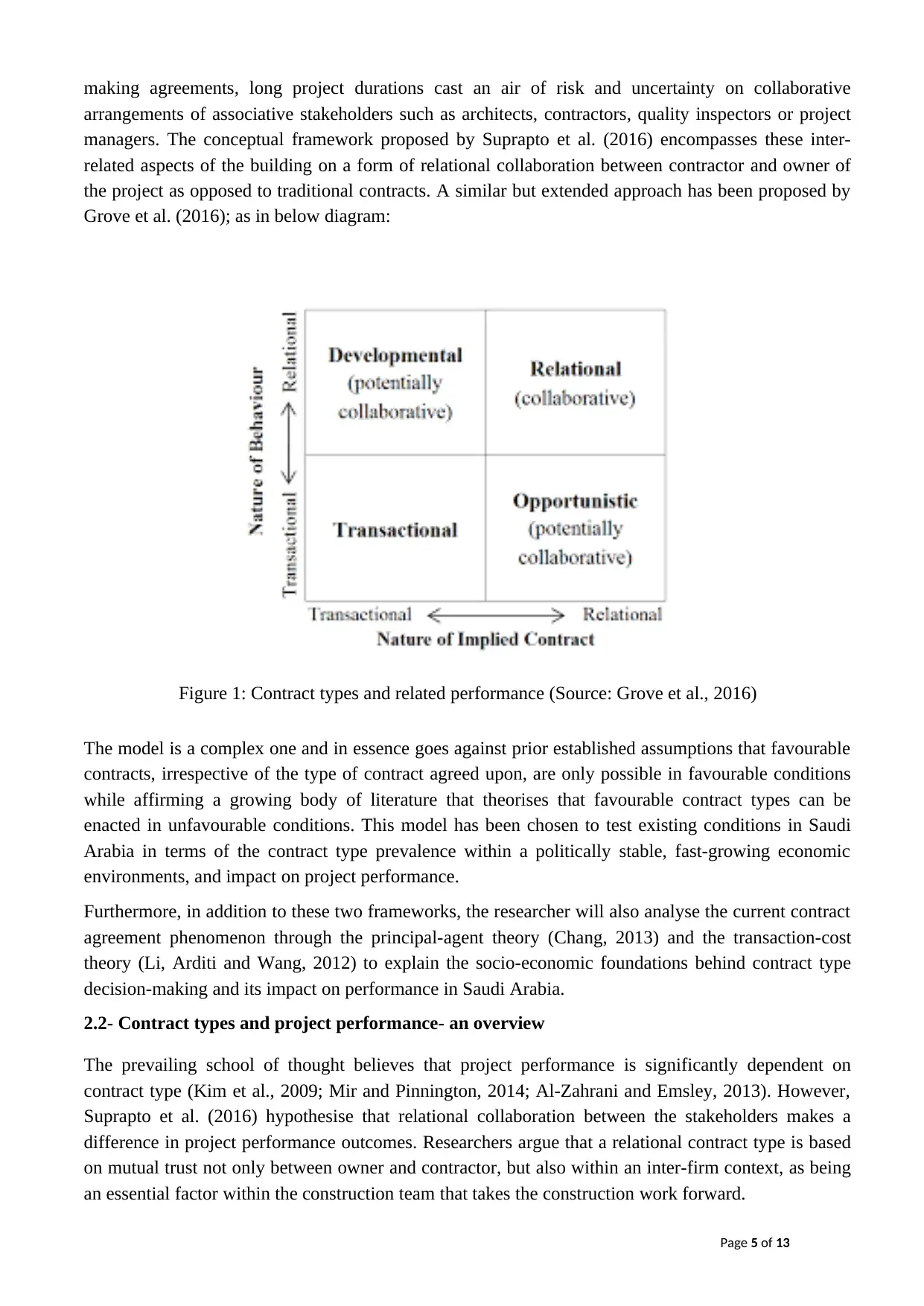
making agreements, long project durations cast an air of risk and uncertainty on collaborative
arrangements of associative stakeholders such as architects, contractors, quality inspectors or project
managers. The conceptual framework proposed by Suprapto et al. (2016) encompasses these inter-
related aspects of the building on a form of relational collaboration between contractor and owner of
the project as opposed to traditional contracts. A similar but extended approach has been proposed by
Grove et al. (2016); as in below diagram:
Figure 1: Contract types and related performance (Source: Grove et al., 2016)
The model is a complex one and in essence goes against prior established assumptions that favourable
contracts, irrespective of the type of contract agreed upon, are only possible in favourable conditions
while affirming a growing body of literature that theorises that favourable contract types can be
enacted in unfavourable conditions. This model has been chosen to test existing conditions in Saudi
Arabia in terms of the contract type prevalence within a politically stable, fast-growing economic
environments, and impact on project performance.
Furthermore, in addition to these two frameworks, the researcher will also analyse the current contract
agreement phenomenon through the principal-agent theory (Chang, 2013) and the transaction-cost
theory (Li, Arditi and Wang, 2012) to explain the socio-economic foundations behind contract type
decision-making and its impact on performance in Saudi Arabia.
2.2- Contract types and project performance- an overview
The prevailing school of thought believes that project performance is significantly dependent on
contract type (Kim et al., 2009; Mir and Pinnington, 2014; Al-Zahrani and Emsley, 2013). However,
Suprapto et al. (2016) hypothesise that relational collaboration between the stakeholders makes a
difference in project performance outcomes. Researchers argue that a relational contract type is based
on mutual trust not only between owner and contractor, but also within an inter-firm context, as being
an essential factor within the construction team that takes the construction work forward.
Page 5 of 13
arrangements of associative stakeholders such as architects, contractors, quality inspectors or project
managers. The conceptual framework proposed by Suprapto et al. (2016) encompasses these inter-
related aspects of the building on a form of relational collaboration between contractor and owner of
the project as opposed to traditional contracts. A similar but extended approach has been proposed by
Grove et al. (2016); as in below diagram:
Figure 1: Contract types and related performance (Source: Grove et al., 2016)
The model is a complex one and in essence goes against prior established assumptions that favourable
contracts, irrespective of the type of contract agreed upon, are only possible in favourable conditions
while affirming a growing body of literature that theorises that favourable contract types can be
enacted in unfavourable conditions. This model has been chosen to test existing conditions in Saudi
Arabia in terms of the contract type prevalence within a politically stable, fast-growing economic
environments, and impact on project performance.
Furthermore, in addition to these two frameworks, the researcher will also analyse the current contract
agreement phenomenon through the principal-agent theory (Chang, 2013) and the transaction-cost
theory (Li, Arditi and Wang, 2012) to explain the socio-economic foundations behind contract type
decision-making and its impact on performance in Saudi Arabia.
2.2- Contract types and project performance- an overview
The prevailing school of thought believes that project performance is significantly dependent on
contract type (Kim et al., 2009; Mir and Pinnington, 2014; Al-Zahrani and Emsley, 2013). However,
Suprapto et al. (2016) hypothesise that relational collaboration between the stakeholders makes a
difference in project performance outcomes. Researchers argue that a relational contract type is based
on mutual trust not only between owner and contractor, but also within an inter-firm context, as being
an essential factor within the construction team that takes the construction work forward.
Page 5 of 13
Ning (2018) like Suprapto et al. (2016) affirms that contract types have no impact on project
performance except in cases where the contract is not well-drafted and is not clear on its scope of
definition and performance variables expected. However, the researcher considers that deviance in the
written contract and its practical application impact project performance more significantly than the
actual contract type itself.
Performance is both affected and evaluated by two central factors inherent in construction projects-
these are time and cost overruns. Although projects should ideally be completed within the budgeted
time and cost, this rarely happens. The contract agreement becomes crucial in the determination of
final performance measures as well as any changes required at a later stage (Invernizzi, Locatelli and
Brookes, 2018). Traditional contracts (which are usually awarded to the lowest bidders) are the most
common contracting method across the world. However, these contract types, also called adversarial
contracts, face a majority of issues during the construction phase specifically due to contractor
inexperience in managing the labour workforce (Enshassi, Al-Najjar and Kumaraswamy, 2009). The
design-and-build type of contract has been a significant improvement in the traditional form of
contract agreement mainly because of its management of cost and quality in the construction phase
(Kent and Becerik-Gerber, 2010). However, integrated project delivery contract types are
increasingly being considered a viable construction mechanism because they form mutually inclusive
relationships between various stakeholders through communication and knowledge transfer as well as
building and maintaining trust and cooperation among the stakeholders, paving for amenable
opportunities in case of time and cost overruns (Ghassemi and Bercerik-Gerber, 2011). While the
system is undertaken through integrated information technologies in developed countries, this may not
be entirely applicable in developing countries that neither possesses infrastructure nor human skills
and competencies to manage operations. However, even so, Suprapto (2015; 2016) elaborate on
relationship contractual agreements in developing countries, modelled on the integrated project
delivery contract types followed in developed nations. Irrespective of the advancements in contract
types as well as modes of delivery, however, there has been no concrete evidence to suggest that one
type of contract agreement is superior to another, especially in the measurement and management of
risk and uncertainty (Kent and Becerik-Gerber, 2010; Porwal and Hewage, 2013). The Engineering,
procurement and construction which is also known as the turnkey contracts are basically is the single
contract for the designing a project. The EPC project is basically a project where the supplier is
responsible for the completion of the project from the initial process to the end. This also includes
projects like turn-key implementation of the IT systems. However it is to be noted that the process of
complex.
There is less research available on the field of the superiority of one form of contract and their
importance in the context of project performance. Hence it is to be argued that there is a need t further
research for deriving the understanding on the nuances of the different type of construction contracts
and how it is contributing to the development of better performance. Since it is argued that
performance is based on the several factors, it is to be analyzed what are the contributing factors for
the effective performance.
The research questions proposed are a direct consequence of the literature reviewed above and are
drafted to scope out current trends and practices within Saudi Arabia.
Page 6 of 13
performance except in cases where the contract is not well-drafted and is not clear on its scope of
definition and performance variables expected. However, the researcher considers that deviance in the
written contract and its practical application impact project performance more significantly than the
actual contract type itself.
Performance is both affected and evaluated by two central factors inherent in construction projects-
these are time and cost overruns. Although projects should ideally be completed within the budgeted
time and cost, this rarely happens. The contract agreement becomes crucial in the determination of
final performance measures as well as any changes required at a later stage (Invernizzi, Locatelli and
Brookes, 2018). Traditional contracts (which are usually awarded to the lowest bidders) are the most
common contracting method across the world. However, these contract types, also called adversarial
contracts, face a majority of issues during the construction phase specifically due to contractor
inexperience in managing the labour workforce (Enshassi, Al-Najjar and Kumaraswamy, 2009). The
design-and-build type of contract has been a significant improvement in the traditional form of
contract agreement mainly because of its management of cost and quality in the construction phase
(Kent and Becerik-Gerber, 2010). However, integrated project delivery contract types are
increasingly being considered a viable construction mechanism because they form mutually inclusive
relationships between various stakeholders through communication and knowledge transfer as well as
building and maintaining trust and cooperation among the stakeholders, paving for amenable
opportunities in case of time and cost overruns (Ghassemi and Bercerik-Gerber, 2011). While the
system is undertaken through integrated information technologies in developed countries, this may not
be entirely applicable in developing countries that neither possesses infrastructure nor human skills
and competencies to manage operations. However, even so, Suprapto (2015; 2016) elaborate on
relationship contractual agreements in developing countries, modelled on the integrated project
delivery contract types followed in developed nations. Irrespective of the advancements in contract
types as well as modes of delivery, however, there has been no concrete evidence to suggest that one
type of contract agreement is superior to another, especially in the measurement and management of
risk and uncertainty (Kent and Becerik-Gerber, 2010; Porwal and Hewage, 2013). The Engineering,
procurement and construction which is also known as the turnkey contracts are basically is the single
contract for the designing a project. The EPC project is basically a project where the supplier is
responsible for the completion of the project from the initial process to the end. This also includes
projects like turn-key implementation of the IT systems. However it is to be noted that the process of
complex.
There is less research available on the field of the superiority of one form of contract and their
importance in the context of project performance. Hence it is to be argued that there is a need t further
research for deriving the understanding on the nuances of the different type of construction contracts
and how it is contributing to the development of better performance. Since it is argued that
performance is based on the several factors, it is to be analyzed what are the contributing factors for
the effective performance.
The research questions proposed are a direct consequence of the literature reviewed above and are
drafted to scope out current trends and practices within Saudi Arabia.
Page 6 of 13
⊘ This is a preview!⊘
Do you want full access?
Subscribe today to unlock all pages.
Trusted by 1+ million students worldwide
3. Research methodology and methods (first draft required in Week 4 of
RM module)
In this section, you will discuss your research methodology and epistemological
approach (e.g. positivist, relativist, constructionist) This will inform the research design
you choose as well as the research methods that you will use to collect both the
secondary and primary data. You must be able to justify your choice regarding your
learning objectives, your research question and your research approach.
3.1- Methodology
Research philosophies portray how researchers view their world and construct meaning around them
(Quinlan et al., 2019). These philosophies are intricately linked to the research methods that the
researcher adopts (Saunders, Lewis and Thornhill, 2009). Since the researcher ascribes to the positivist
philosophy, this research will be based on quantitative research. The decisive rationale behind this
choice is that quantitative findings can be generalised to target populations while at the same time, be
considered reliable. The focus on this type of approach is to find a relationship between the variables
being studied within the sample population and then generalise it to the target population. Provision of
study descriptions is of essential importance in the quantitative approach. Certainly, the study must
address the issues of choice of populations and sample sizes, data collection, tools, and hypothetical
assumptions in substantial detail to allow replication and improve the study reliability and validity.
Hence, irrespective of whether the researcher is a novice or experienced, sample characteristics must
be approximately identified and described while the sampling strategy chosen must be discussed in
detail.
Moreover, a survey design will be adopted by the researcher response the questions which were asked
in research. This is a type of primary investigation whereby a representative sample is approached for
study (Ritchie et al., 2013). Thus, questionnaires usually are used to learn about inter-related
phenomena and explain the relationship that generally exists over the entire representative population.
Data collection will be undertaken through a structured questionnaire via SurveyMonkey. This will be
constructed once the researcher has critically reviewed relevant literature not only to identify the gaps
in literature but also to enable the researcher to focus on essential variables and their inter-connection
so that a relevant questionnaire can be prepared and data obtained in keeping with the study aim and
objectives. Additionally, to develop the questionnaire until meet reliability and validity of research;
will be planned to use the pilot test.
Furthermore, the target population is expected to comprise of project managers and contract managers
from project management organisations working in Saudi Arabia. Other related professionals like
contractors, surveyors, and engineers associated with the project management firms will likewise be
approached. Project management organisations will be selected through perusal of construction
reviews as well as the Governmental bodies who are responsible for public construction projects. The
related professionals mentioned above, working with the chosen project management firms, will be
selected and approached for the quantitative survey. The selection of an optimum sample size
represents a degree of uncertainty and challenge in quantitative research (Sekaran and Bougie, 2016).
Whereas scholars like Gay, Mills and Airasian (2006) state that although the entire population of
sample sizes below 100 are considered approachable, others like Kvam and Vidakovic (2007) specify
that for larger populations, the sample size should be at least 30 and preferably larger, but below 1000.
Page 7 of 13
RM module)
In this section, you will discuss your research methodology and epistemological
approach (e.g. positivist, relativist, constructionist) This will inform the research design
you choose as well as the research methods that you will use to collect both the
secondary and primary data. You must be able to justify your choice regarding your
learning objectives, your research question and your research approach.
3.1- Methodology
Research philosophies portray how researchers view their world and construct meaning around them
(Quinlan et al., 2019). These philosophies are intricately linked to the research methods that the
researcher adopts (Saunders, Lewis and Thornhill, 2009). Since the researcher ascribes to the positivist
philosophy, this research will be based on quantitative research. The decisive rationale behind this
choice is that quantitative findings can be generalised to target populations while at the same time, be
considered reliable. The focus on this type of approach is to find a relationship between the variables
being studied within the sample population and then generalise it to the target population. Provision of
study descriptions is of essential importance in the quantitative approach. Certainly, the study must
address the issues of choice of populations and sample sizes, data collection, tools, and hypothetical
assumptions in substantial detail to allow replication and improve the study reliability and validity.
Hence, irrespective of whether the researcher is a novice or experienced, sample characteristics must
be approximately identified and described while the sampling strategy chosen must be discussed in
detail.
Moreover, a survey design will be adopted by the researcher response the questions which were asked
in research. This is a type of primary investigation whereby a representative sample is approached for
study (Ritchie et al., 2013). Thus, questionnaires usually are used to learn about inter-related
phenomena and explain the relationship that generally exists over the entire representative population.
Data collection will be undertaken through a structured questionnaire via SurveyMonkey. This will be
constructed once the researcher has critically reviewed relevant literature not only to identify the gaps
in literature but also to enable the researcher to focus on essential variables and their inter-connection
so that a relevant questionnaire can be prepared and data obtained in keeping with the study aim and
objectives. Additionally, to develop the questionnaire until meet reliability and validity of research;
will be planned to use the pilot test.
Furthermore, the target population is expected to comprise of project managers and contract managers
from project management organisations working in Saudi Arabia. Other related professionals like
contractors, surveyors, and engineers associated with the project management firms will likewise be
approached. Project management organisations will be selected through perusal of construction
reviews as well as the Governmental bodies who are responsible for public construction projects. The
related professionals mentioned above, working with the chosen project management firms, will be
selected and approached for the quantitative survey. The selection of an optimum sample size
represents a degree of uncertainty and challenge in quantitative research (Sekaran and Bougie, 2016).
Whereas scholars like Gay, Mills and Airasian (2006) state that although the entire population of
sample sizes below 100 are considered approachable, others like Kvam and Vidakovic (2007) specify
that for larger populations, the sample size should be at least 30 and preferably larger, but below 1000.
Page 7 of 13
Paraphrase This Document
Need a fresh take? Get an instant paraphrase of this document with our AI Paraphraser
Population for a study refers to a large collection of individuals or objects, which is the primary focus
of the survey. It is to be noted that the target population chosen for conducting the research because
contract managers and the project managers will be useful to provide insight into the issues faced by
them while implementing the construction contracts. The rationale behind choosing them is the easy
accessibility and feasibility of the interviewing and surveying these sample size. Lastly, it is
imperative to note that the people chosen for the survey are the people who are impacted by the issues.
It can be highlighted that construction industry is one of the largest industries of Saudi Arabia, and
currently, more than 5200 projects are rolling in the country (Brown 2018). Thus, the population for
this given study on the importance of contracts in the performance and success of the building projects
consists of millions of people who are associated with the construction industry. However, as it is not
possible to address the entire population that are spread across the country due to time and budget
constraint. Hence, the population that is considered for this study is 100 individuals, associated with
construction projects in Jeddah. At the same time, reaching out to 100 people will be time consuming
too and therefore, a sample from those 100 people will be drawn by applying simple random sampling.
As stated by Bartlett, Kotrlik and Higgins (2001), the optimum sample size for a population of 100
categorical data with 0.05 margin of error would be 74 (t = 1.65). Thus, 74 questionnaire need to be
collected for achieving the minimum sample size for the study.
Undoubtedly, many project management organisations are associated with public works, and this may
deter their participation in the study. Once the research is underway, the researcher will be able to
obtain approximate figures for the target population, based on which sample size calculations will be
made to select a sample size. Since the target population is not composed solely of project managers
and includes other professionals intricately linked to construction projects, stratified sampling
techniques will enable a balanced sample size to be chosen.
Finally, quantitative data will be analysed through a multistage process. The data obtained will first be
tabulated to classify it for a quick comparison across the investigated variables in the questionnaire.
The means of the time and cost overruns will be calculated and based on this the corresponding
standard deviations will be calculated. This data collected from the quantitative analysis would be
represented in graphical representation and charts. These charts and data would be compared and
contrasted for the determining the generalizations and propositions. Along with the primary method of
data collection, some secondary sources would be used for the detailed analysis of the issues.
Quantitative data analysis supported by the secondary research will be helpful for forming the
foundation of the research and this will be helpful for deriving the data and generalizations. The data
driven from analysis would be analyzed by using the SPSS text analytics. This software would be
particularly used for deriving the results from the responses derived. Use of this analytics is easy and it
is helpful to derive the analysis in the meaningful way. This will be compared with the types of a
construction contract, indicating the performance of each type. However, Pearson's chi-square test will
be used for statistical analysis while inferences will be made to estimate the degree of the application
on larger populations. Precisely, the difference-between-means tests will also be calculated to assess
the statistical degree of change within two variables, time and cost of construction projects. The test
statistics obtained will be compared against sampling distribution values through calculations of both
levels of significance and degrees of freedom. The sample population will also be asked to indicate the
most preferred contract type of their clients and compare these choices against the values obtained.
Page 8 of 13
of the survey. It is to be noted that the target population chosen for conducting the research because
contract managers and the project managers will be useful to provide insight into the issues faced by
them while implementing the construction contracts. The rationale behind choosing them is the easy
accessibility and feasibility of the interviewing and surveying these sample size. Lastly, it is
imperative to note that the people chosen for the survey are the people who are impacted by the issues.
It can be highlighted that construction industry is one of the largest industries of Saudi Arabia, and
currently, more than 5200 projects are rolling in the country (Brown 2018). Thus, the population for
this given study on the importance of contracts in the performance and success of the building projects
consists of millions of people who are associated with the construction industry. However, as it is not
possible to address the entire population that are spread across the country due to time and budget
constraint. Hence, the population that is considered for this study is 100 individuals, associated with
construction projects in Jeddah. At the same time, reaching out to 100 people will be time consuming
too and therefore, a sample from those 100 people will be drawn by applying simple random sampling.
As stated by Bartlett, Kotrlik and Higgins (2001), the optimum sample size for a population of 100
categorical data with 0.05 margin of error would be 74 (t = 1.65). Thus, 74 questionnaire need to be
collected for achieving the minimum sample size for the study.
Undoubtedly, many project management organisations are associated with public works, and this may
deter their participation in the study. Once the research is underway, the researcher will be able to
obtain approximate figures for the target population, based on which sample size calculations will be
made to select a sample size. Since the target population is not composed solely of project managers
and includes other professionals intricately linked to construction projects, stratified sampling
techniques will enable a balanced sample size to be chosen.
Finally, quantitative data will be analysed through a multistage process. The data obtained will first be
tabulated to classify it for a quick comparison across the investigated variables in the questionnaire.
The means of the time and cost overruns will be calculated and based on this the corresponding
standard deviations will be calculated. This data collected from the quantitative analysis would be
represented in graphical representation and charts. These charts and data would be compared and
contrasted for the determining the generalizations and propositions. Along with the primary method of
data collection, some secondary sources would be used for the detailed analysis of the issues.
Quantitative data analysis supported by the secondary research will be helpful for forming the
foundation of the research and this will be helpful for deriving the data and generalizations. The data
driven from analysis would be analyzed by using the SPSS text analytics. This software would be
particularly used for deriving the results from the responses derived. Use of this analytics is easy and it
is helpful to derive the analysis in the meaningful way. This will be compared with the types of a
construction contract, indicating the performance of each type. However, Pearson's chi-square test will
be used for statistical analysis while inferences will be made to estimate the degree of the application
on larger populations. Precisely, the difference-between-means tests will also be calculated to assess
the statistical degree of change within two variables, time and cost of construction projects. The test
statistics obtained will be compared against sampling distribution values through calculations of both
levels of significance and degrees of freedom. The sample population will also be asked to indicate the
most preferred contract type of their clients and compare these choices against the values obtained.
Page 8 of 13
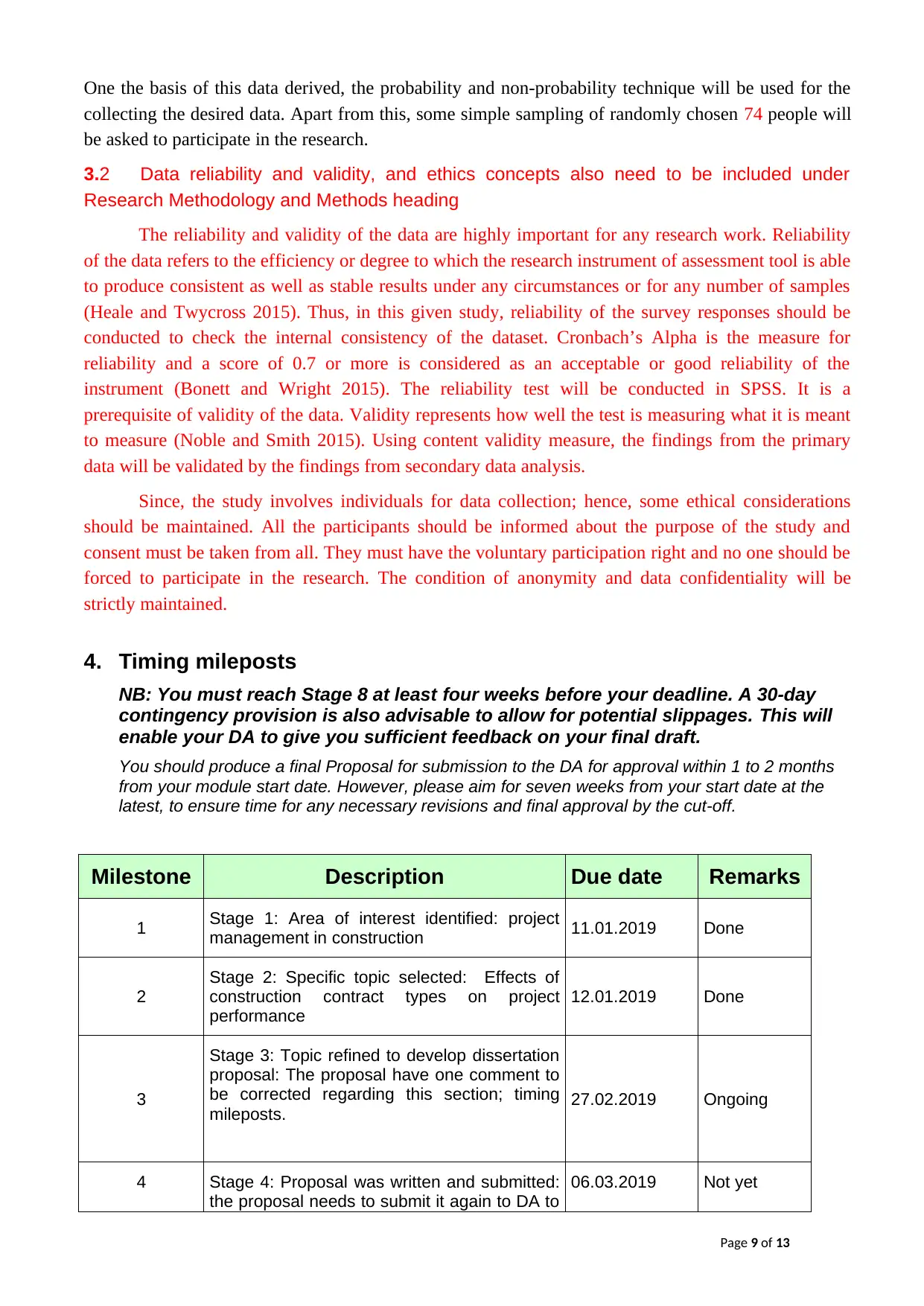
One the basis of this data derived, the probability and non-probability technique will be used for the
collecting the desired data. Apart from this, some simple sampling of randomly chosen 74 people will
be asked to participate in the research.
3.2 Data reliability and validity, and ethics concepts also need to be included under
Research Methodology and Methods heading
The reliability and validity of the data are highly important for any research work. Reliability
of the data refers to the efficiency or degree to which the research instrument of assessment tool is able
to produce consistent as well as stable results under any circumstances or for any number of samples
(Heale and Twycross 2015). Thus, in this given study, reliability of the survey responses should be
conducted to check the internal consistency of the dataset. Cronbach’s Alpha is the measure for
reliability and a score of 0.7 or more is considered as an acceptable or good reliability of the
instrument (Bonett and Wright 2015). The reliability test will be conducted in SPSS. It is a
prerequisite of validity of the data. Validity represents how well the test is measuring what it is meant
to measure (Noble and Smith 2015). Using content validity measure, the findings from the primary
data will be validated by the findings from secondary data analysis.
Since, the study involves individuals for data collection; hence, some ethical considerations
should be maintained. All the participants should be informed about the purpose of the study and
consent must be taken from all. They must have the voluntary participation right and no one should be
forced to participate in the research. The condition of anonymity and data confidentiality will be
strictly maintained.
4. Timing mileposts
NB: You must reach Stage 8 at least four weeks before your deadline. A 30-day
contingency provision is also advisable to allow for potential slippages. This will
enable your DA to give you sufficient feedback on your final draft.
You should produce a final Proposal for submission to the DA for approval within 1 to 2 months
from your module start date. However, please aim for seven weeks from your start date at the
latest, to ensure time for any necessary revisions and final approval by the cut-off.
Milestone Description Due date Remarks
1 Stage 1: Area of interest identified: project
management in construction 11.01.2019 Done
2
Stage 2: Specific topic selected: Effects of
construction contract types on project
performance
12.01.2019 Done
3
Stage 3: Topic refined to develop dissertation
proposal: The proposal have one comment to
be corrected regarding this section; timing
mileposts. 27.02.2019 Ongoing
4 Stage 4: Proposal was written and submitted:
the proposal needs to submit it again to DA to
06.03.2019 Not yet
Page 9 of 13
collecting the desired data. Apart from this, some simple sampling of randomly chosen 74 people will
be asked to participate in the research.
3.2 Data reliability and validity, and ethics concepts also need to be included under
Research Methodology and Methods heading
The reliability and validity of the data are highly important for any research work. Reliability
of the data refers to the efficiency or degree to which the research instrument of assessment tool is able
to produce consistent as well as stable results under any circumstances or for any number of samples
(Heale and Twycross 2015). Thus, in this given study, reliability of the survey responses should be
conducted to check the internal consistency of the dataset. Cronbach’s Alpha is the measure for
reliability and a score of 0.7 or more is considered as an acceptable or good reliability of the
instrument (Bonett and Wright 2015). The reliability test will be conducted in SPSS. It is a
prerequisite of validity of the data. Validity represents how well the test is measuring what it is meant
to measure (Noble and Smith 2015). Using content validity measure, the findings from the primary
data will be validated by the findings from secondary data analysis.
Since, the study involves individuals for data collection; hence, some ethical considerations
should be maintained. All the participants should be informed about the purpose of the study and
consent must be taken from all. They must have the voluntary participation right and no one should be
forced to participate in the research. The condition of anonymity and data confidentiality will be
strictly maintained.
4. Timing mileposts
NB: You must reach Stage 8 at least four weeks before your deadline. A 30-day
contingency provision is also advisable to allow for potential slippages. This will
enable your DA to give you sufficient feedback on your final draft.
You should produce a final Proposal for submission to the DA for approval within 1 to 2 months
from your module start date. However, please aim for seven weeks from your start date at the
latest, to ensure time for any necessary revisions and final approval by the cut-off.
Milestone Description Due date Remarks
1 Stage 1: Area of interest identified: project
management in construction 11.01.2019 Done
2
Stage 2: Specific topic selected: Effects of
construction contract types on project
performance
12.01.2019 Done
3
Stage 3: Topic refined to develop dissertation
proposal: The proposal have one comment to
be corrected regarding this section; timing
mileposts. 27.02.2019 Ongoing
4 Stage 4: Proposal was written and submitted:
the proposal needs to submit it again to DA to
06.03.2019 Not yet
Page 9 of 13
⊘ This is a preview!⊘
Do you want full access?
Subscribe today to unlock all pages.
Trusted by 1+ million students worldwide
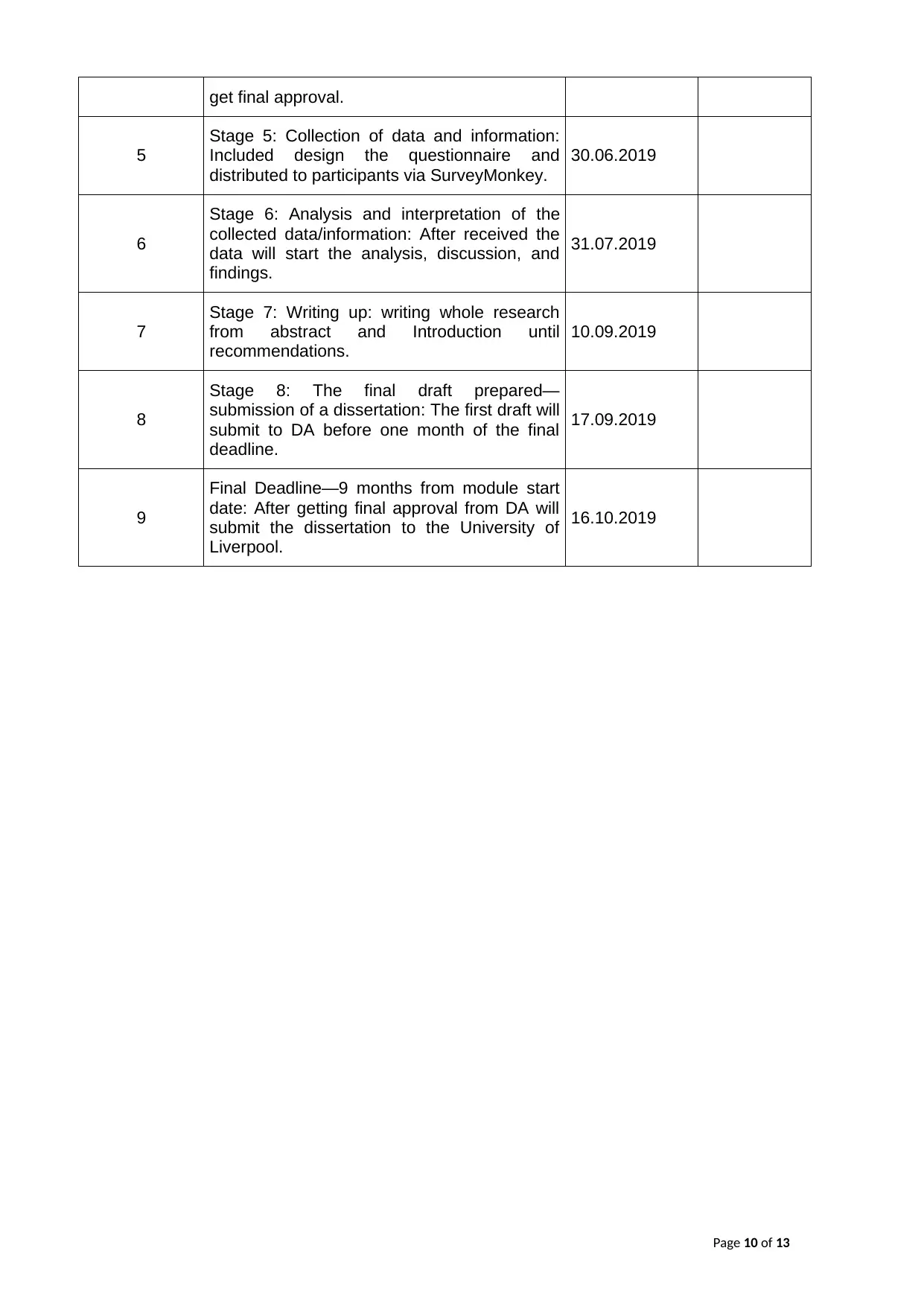
get final approval.
5
Stage 5: Collection of data and information:
Included design the questionnaire and
distributed to participants via SurveyMonkey.
30.06.2019
6
Stage 6: Analysis and interpretation of the
collected data/information: After received the
data will start the analysis, discussion, and
findings.
31.07.2019
7
Stage 7: Writing up: writing whole research
from abstract and Introduction until
recommendations.
10.09.2019
8
Stage 8: The final draft prepared—
submission of a dissertation: The first draft will
submit to DA before one month of the final
deadline.
17.09.2019
9
Final Deadline—9 months from module start
date: After getting final approval from DA will
submit the dissertation to the University of
Liverpool.
16.10.2019
Page 10 of 13
5
Stage 5: Collection of data and information:
Included design the questionnaire and
distributed to participants via SurveyMonkey.
30.06.2019
6
Stage 6: Analysis and interpretation of the
collected data/information: After received the
data will start the analysis, discussion, and
findings.
31.07.2019
7
Stage 7: Writing up: writing whole research
from abstract and Introduction until
recommendations.
10.09.2019
8
Stage 8: The final draft prepared—
submission of a dissertation: The first draft will
submit to DA before one month of the final
deadline.
17.09.2019
9
Final Deadline—9 months from module start
date: After getting final approval from DA will
submit the dissertation to the University of
Liverpool.
16.10.2019
Page 10 of 13
Paraphrase This Document
Need a fresh take? Get an instant paraphrase of this document with our AI Paraphraser
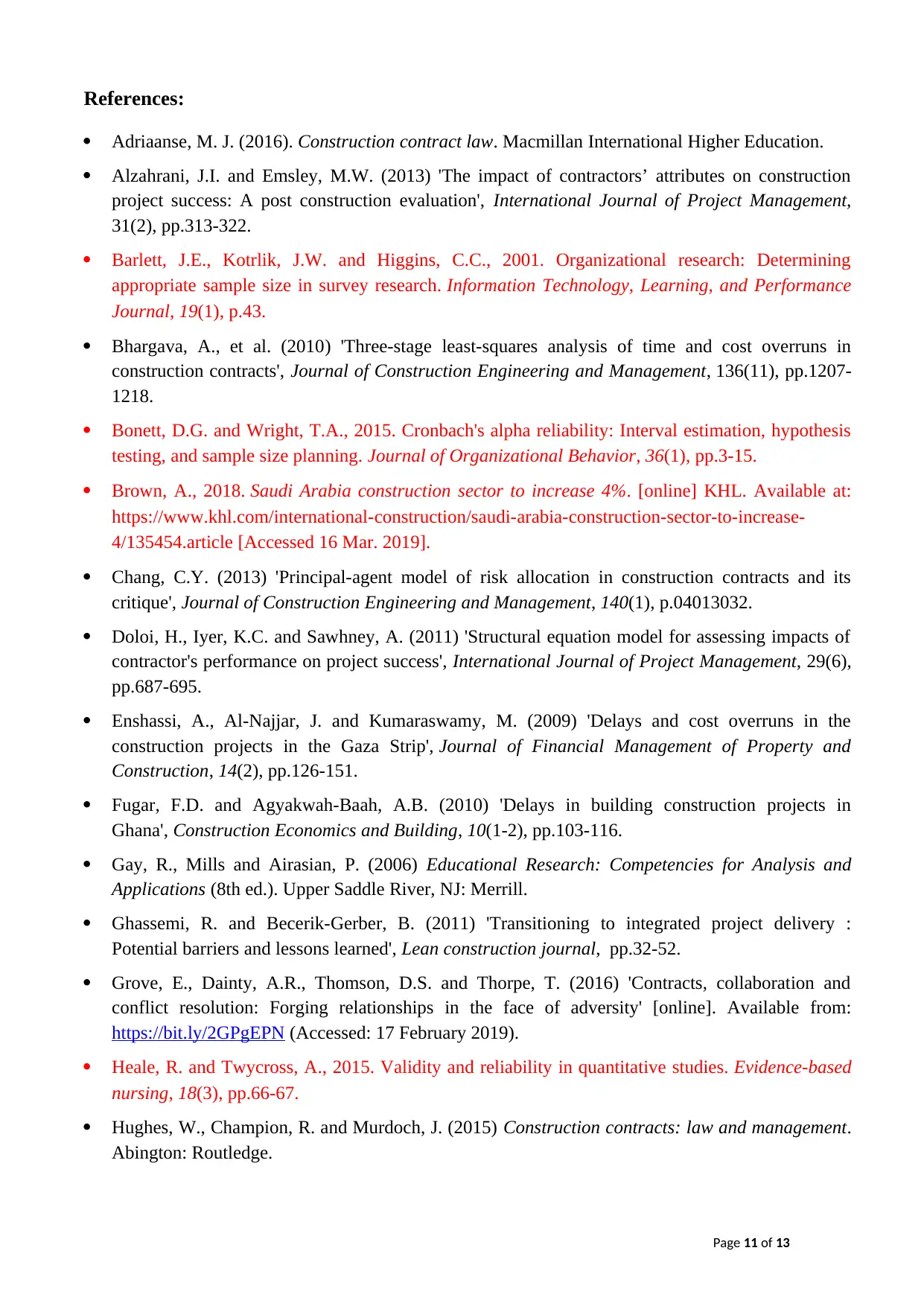
References:
Adriaanse, M. J. (2016). Construction contract law. Macmillan International Higher Education.
Alzahrani, J.I. and Emsley, M.W. (2013) 'The impact of contractors’ attributes on construction
project success: A post construction evaluation', International Journal of Project Management,
31(2), pp.313-322.
Barlett, J.E., Kotrlik, J.W. and Higgins, C.C., 2001. Organizational research: Determining
appropriate sample size in survey research. Information Technology, Learning, and Performance
Journal, 19(1), p.43.
Bhargava, A., et al. (2010) 'Three-stage least-squares analysis of time and cost overruns in
construction contracts', Journal of Construction Engineering and Management, 136(11), pp.1207-
1218.
Bonett, D.G. and Wright, T.A., 2015. Cronbach's alpha reliability: Interval estimation, hypothesis
testing, and sample size planning. Journal of Organizational Behavior, 36(1), pp.3-15.
Brown, A., 2018. Saudi Arabia construction sector to increase 4%. [online] KHL. Available at:
https://www.khl.com/international-construction/saudi-arabia-construction-sector-to-increase-
4/135454.article [Accessed 16 Mar. 2019].
Chang, C.Y. (2013) 'Principal-agent model of risk allocation in construction contracts and its
critique', Journal of Construction Engineering and Management, 140(1), p.04013032.
Doloi, H., Iyer, K.C. and Sawhney, A. (2011) 'Structural equation model for assessing impacts of
contractor's performance on project success', International Journal of Project Management, 29(6),
pp.687-695.
Enshassi, A., Al-Najjar, J. and Kumaraswamy, M. (2009) 'Delays and cost overruns in the
construction projects in the Gaza Strip', Journal of Financial Management of Property and
Construction, 14(2), pp.126-151.
Fugar, F.D. and Agyakwah-Baah, A.B. (2010) 'Delays in building construction projects in
Ghana', Construction Economics and Building, 10(1-2), pp.103-116.
Gay, R., Mills and Airasian, P. (2006) Educational Research: Competencies for Analysis and
Applications (8th ed.). Upper Saddle River, NJ: Merrill.
Ghassemi, R. and Becerik-Gerber, B. (2011) 'Transitioning to integrated project delivery :
Potential barriers and lessons learned', Lean construction journal, pp.32-52.
Grove, E., Dainty, A.R., Thomson, D.S. and Thorpe, T. (2016) 'Contracts, collaboration and
conflict resolution: Forging relationships in the face of adversity' [online]. Available from:
https://bit.ly/2GPgEPN (Accessed: 17 February 2019).
Heale, R. and Twycross, A., 2015. Validity and reliability in quantitative studies. Evidence-based
nursing, 18(3), pp.66-67.
Hughes, W., Champion, R. and Murdoch, J. (2015) Construction contracts: law and management.
Abington: Routledge.
Page 11 of 13
Adriaanse, M. J. (2016). Construction contract law. Macmillan International Higher Education.
Alzahrani, J.I. and Emsley, M.W. (2013) 'The impact of contractors’ attributes on construction
project success: A post construction evaluation', International Journal of Project Management,
31(2), pp.313-322.
Barlett, J.E., Kotrlik, J.W. and Higgins, C.C., 2001. Organizational research: Determining
appropriate sample size in survey research. Information Technology, Learning, and Performance
Journal, 19(1), p.43.
Bhargava, A., et al. (2010) 'Three-stage least-squares analysis of time and cost overruns in
construction contracts', Journal of Construction Engineering and Management, 136(11), pp.1207-
1218.
Bonett, D.G. and Wright, T.A., 2015. Cronbach's alpha reliability: Interval estimation, hypothesis
testing, and sample size planning. Journal of Organizational Behavior, 36(1), pp.3-15.
Brown, A., 2018. Saudi Arabia construction sector to increase 4%. [online] KHL. Available at:
https://www.khl.com/international-construction/saudi-arabia-construction-sector-to-increase-
4/135454.article [Accessed 16 Mar. 2019].
Chang, C.Y. (2013) 'Principal-agent model of risk allocation in construction contracts and its
critique', Journal of Construction Engineering and Management, 140(1), p.04013032.
Doloi, H., Iyer, K.C. and Sawhney, A. (2011) 'Structural equation model for assessing impacts of
contractor's performance on project success', International Journal of Project Management, 29(6),
pp.687-695.
Enshassi, A., Al-Najjar, J. and Kumaraswamy, M. (2009) 'Delays and cost overruns in the
construction projects in the Gaza Strip', Journal of Financial Management of Property and
Construction, 14(2), pp.126-151.
Fugar, F.D. and Agyakwah-Baah, A.B. (2010) 'Delays in building construction projects in
Ghana', Construction Economics and Building, 10(1-2), pp.103-116.
Gay, R., Mills and Airasian, P. (2006) Educational Research: Competencies for Analysis and
Applications (8th ed.). Upper Saddle River, NJ: Merrill.
Ghassemi, R. and Becerik-Gerber, B. (2011) 'Transitioning to integrated project delivery :
Potential barriers and lessons learned', Lean construction journal, pp.32-52.
Grove, E., Dainty, A.R., Thomson, D.S. and Thorpe, T. (2016) 'Contracts, collaboration and
conflict resolution: Forging relationships in the face of adversity' [online]. Available from:
https://bit.ly/2GPgEPN (Accessed: 17 February 2019).
Heale, R. and Twycross, A., 2015. Validity and reliability in quantitative studies. Evidence-based
nursing, 18(3), pp.66-67.
Hughes, W., Champion, R. and Murdoch, J. (2015) Construction contracts: law and management.
Abington: Routledge.
Page 11 of 13
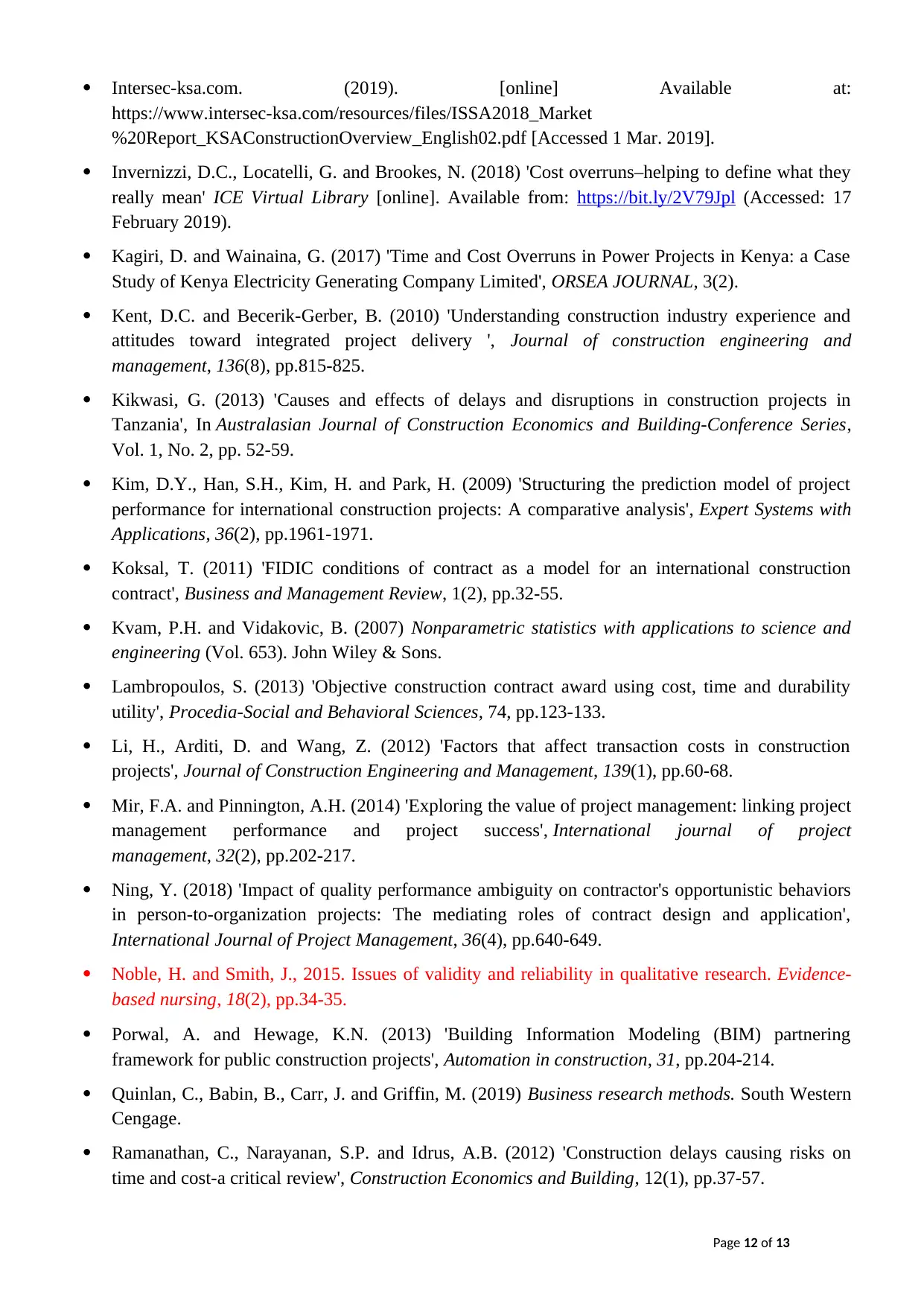
Intersec-ksa.com. (2019). [online] Available at:
https://www.intersec-ksa.com/resources/files/ISSA2018_Market
%20Report_KSAConstructionOverview_English02.pdf [Accessed 1 Mar. 2019].
Invernizzi, D.C., Locatelli, G. and Brookes, N. (2018) 'Cost overruns–helping to define what they
really mean' ICE Virtual Library [online]. Available from: https://bit.ly/2V79Jpl (Accessed: 17
February 2019).
Kagiri, D. and Wainaina, G. (2017) 'Time and Cost Overruns in Power Projects in Kenya: a Case
Study of Kenya Electricity Generating Company Limited', ORSEA JOURNAL, 3(2).
Kent, D.C. and Becerik-Gerber, B. (2010) 'Understanding construction industry experience and
attitudes toward integrated project delivery ', Journal of construction engineering and
management, 136(8), pp.815-825.
Kikwasi, G. (2013) 'Causes and effects of delays and disruptions in construction projects in
Tanzania', In Australasian Journal of Construction Economics and Building-Conference Series,
Vol. 1, No. 2, pp. 52-59.
Kim, D.Y., Han, S.H., Kim, H. and Park, H. (2009) 'Structuring the prediction model of project
performance for international construction projects: A comparative analysis', Expert Systems with
Applications, 36(2), pp.1961-1971.
Koksal, T. (2011) 'FIDIC conditions of contract as a model for an international construction
contract', Business and Management Review, 1(2), pp.32-55.
Kvam, P.H. and Vidakovic, B. (2007) Nonparametric statistics with applications to science and
engineering (Vol. 653). John Wiley & Sons.
Lambropoulos, S. (2013) 'Objective construction contract award using cost, time and durability
utility', Procedia-Social and Behavioral Sciences, 74, pp.123-133.
Li, H., Arditi, D. and Wang, Z. (2012) 'Factors that affect transaction costs in construction
projects', Journal of Construction Engineering and Management, 139(1), pp.60-68.
Mir, F.A. and Pinnington, A.H. (2014) 'Exploring the value of project management: linking project
management performance and project success', International journal of project
management, 32(2), pp.202-217.
Ning, Y. (2018) 'Impact of quality performance ambiguity on contractor's opportunistic behaviors
in person-to-organization projects: The mediating roles of contract design and application',
International Journal of Project Management, 36(4), pp.640-649.
Noble, H. and Smith, J., 2015. Issues of validity and reliability in qualitative research. Evidence-
based nursing, 18(2), pp.34-35.
Porwal, A. and Hewage, K.N. (2013) 'Building Information Modeling (BIM) partnering
framework for public construction projects', Automation in construction, 31, pp.204-214.
Quinlan, C., Babin, B., Carr, J. and Griffin, M. (2019) Business research methods. South Western
Cengage.
Ramanathan, C., Narayanan, S.P. and Idrus, A.B. (2012) 'Construction delays causing risks on
time and cost-a critical review', Construction Economics and Building, 12(1), pp.37-57.
Page 12 of 13
https://www.intersec-ksa.com/resources/files/ISSA2018_Market
%20Report_KSAConstructionOverview_English02.pdf [Accessed 1 Mar. 2019].
Invernizzi, D.C., Locatelli, G. and Brookes, N. (2018) 'Cost overruns–helping to define what they
really mean' ICE Virtual Library [online]. Available from: https://bit.ly/2V79Jpl (Accessed: 17
February 2019).
Kagiri, D. and Wainaina, G. (2017) 'Time and Cost Overruns in Power Projects in Kenya: a Case
Study of Kenya Electricity Generating Company Limited', ORSEA JOURNAL, 3(2).
Kent, D.C. and Becerik-Gerber, B. (2010) 'Understanding construction industry experience and
attitudes toward integrated project delivery ', Journal of construction engineering and
management, 136(8), pp.815-825.
Kikwasi, G. (2013) 'Causes and effects of delays and disruptions in construction projects in
Tanzania', In Australasian Journal of Construction Economics and Building-Conference Series,
Vol. 1, No. 2, pp. 52-59.
Kim, D.Y., Han, S.H., Kim, H. and Park, H. (2009) 'Structuring the prediction model of project
performance for international construction projects: A comparative analysis', Expert Systems with
Applications, 36(2), pp.1961-1971.
Koksal, T. (2011) 'FIDIC conditions of contract as a model for an international construction
contract', Business and Management Review, 1(2), pp.32-55.
Kvam, P.H. and Vidakovic, B. (2007) Nonparametric statistics with applications to science and
engineering (Vol. 653). John Wiley & Sons.
Lambropoulos, S. (2013) 'Objective construction contract award using cost, time and durability
utility', Procedia-Social and Behavioral Sciences, 74, pp.123-133.
Li, H., Arditi, D. and Wang, Z. (2012) 'Factors that affect transaction costs in construction
projects', Journal of Construction Engineering and Management, 139(1), pp.60-68.
Mir, F.A. and Pinnington, A.H. (2014) 'Exploring the value of project management: linking project
management performance and project success', International journal of project
management, 32(2), pp.202-217.
Ning, Y. (2018) 'Impact of quality performance ambiguity on contractor's opportunistic behaviors
in person-to-organization projects: The mediating roles of contract design and application',
International Journal of Project Management, 36(4), pp.640-649.
Noble, H. and Smith, J., 2015. Issues of validity and reliability in qualitative research. Evidence-
based nursing, 18(2), pp.34-35.
Porwal, A. and Hewage, K.N. (2013) 'Building Information Modeling (BIM) partnering
framework for public construction projects', Automation in construction, 31, pp.204-214.
Quinlan, C., Babin, B., Carr, J. and Griffin, M. (2019) Business research methods. South Western
Cengage.
Ramanathan, C., Narayanan, S.P. and Idrus, A.B. (2012) 'Construction delays causing risks on
time and cost-a critical review', Construction Economics and Building, 12(1), pp.37-57.
Page 12 of 13
⊘ This is a preview!⊘
Do you want full access?
Subscribe today to unlock all pages.
Trusted by 1+ million students worldwide

1 out of 13


Related Documents


Your All-in-One AI-Powered Toolkit for Academic Success.
+13062052269
info@desklib.com
Available 24*7 on WhatsApp / Email
![[object Object]](/_next/static/media/star-bottom.7253800d.svg)
Unlock your academic potential
Copyright © 2020–2026 A2Z Services. All Rights Reserved. Developed and managed by ZUCOL.