CPCCBC4010B Assessment 6: Building Codes, Regulations, and Services
VerifiedAdded on 2020/04/13
|8
|1733
|245
Homework Assignment
AI Summary
This document presents a detailed solution to a civil engineering assignment, focusing on various aspects of construction and building regulations. The assignment addresses demolition planning, outlining necessary steps for environmental protection, safety measures, and compliance with regulations. It further examines building requirements in areas prone to bushfires, high winds, earthquakes, and alpine conditions, referencing relevant Australian standards and building codes. The document then delves into site assessment, providing a checklist for evaluating factors such as septic tank location, groundwater, and potential contaminants. Additionally, the assignment covers plumbing, drainage, electrical, mechanical, fencing, landscaping, paving, and road services. Finally, it specifies construction requirements for footings, timber floors, concrete floors, timber frame walls, masonry walls, truss roofs, and framed roofs, ensuring adherence to relevant standards and best practices.
Name:
Course:
Professor:
Date:
LA017855 Assessment6,CPCCBC4010B,Ed 4
© New South Wales Technical and Further Education Commission, 2017(TAFE NSW), Archive version3,September 2017
Course:
Professor:
Date:
LA017855 Assessment6,CPCCBC4010B,Ed 4
© New South Wales Technical and Further Education Commission, 2017(TAFE NSW), Archive version3,September 2017
Paraphrase This Document
Need a fresh take? Get an instant paraphrase of this document with our AI Paraphraser

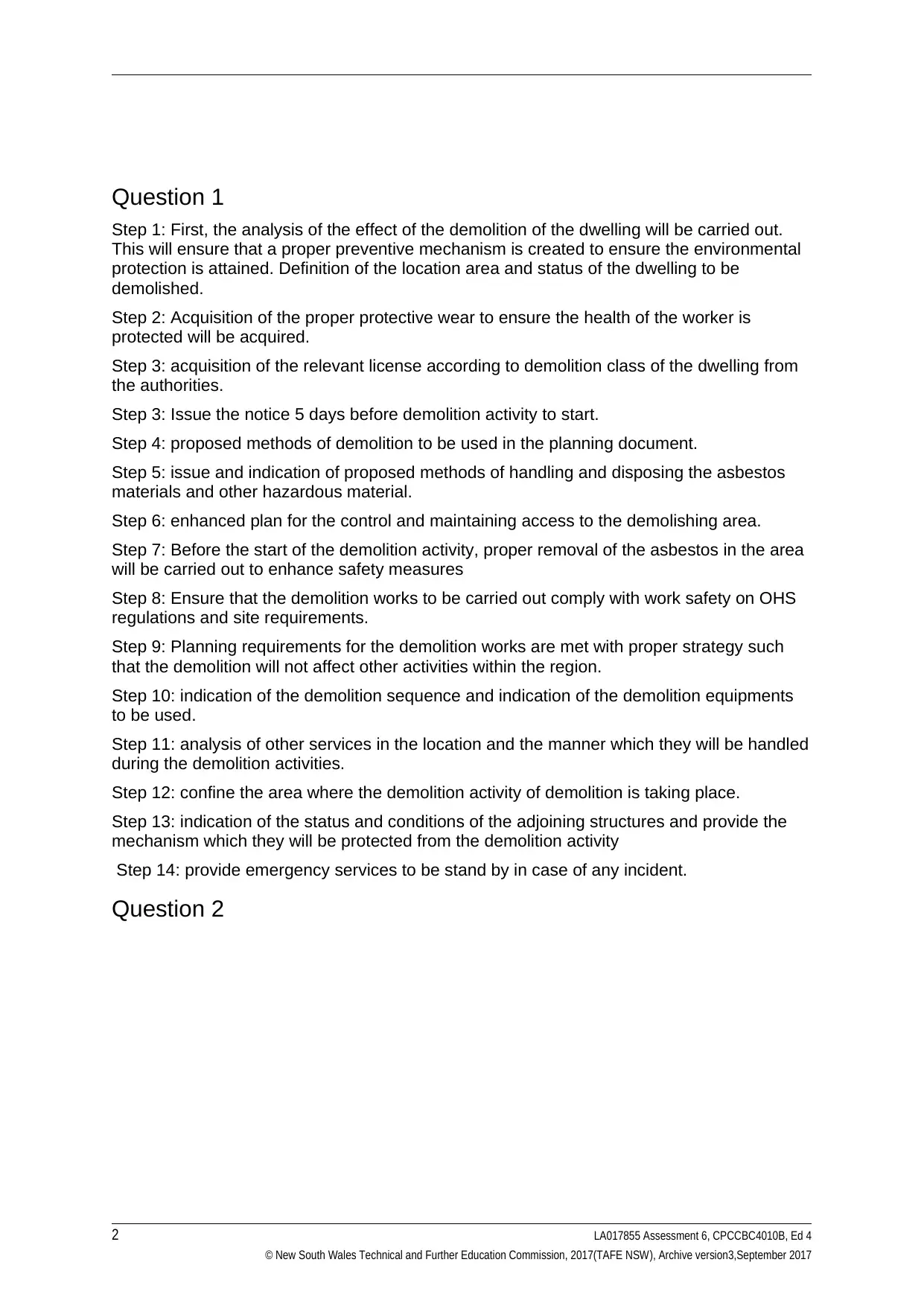
Question 1
Step 1: First, the analysis of the effect of the demolition of the dwelling will be carried out.
This will ensure that a proper preventive mechanism is created to ensure the environmental
protection is attained. Definition of the location area and status of the dwelling to be
demolished.
Step 2: Acquisition of the proper protective wear to ensure the health of the worker is
protected will be acquired.
Step 3: acquisition of the relevant license according to demolition class of the dwelling from
the authorities.
Step 3: Issue the notice 5 days before demolition activity to start.
Step 4: proposed methods of demolition to be used in the planning document.
Step 5: issue and indication of proposed methods of handling and disposing the asbestos
materials and other hazardous material.
Step 6: enhanced plan for the control and maintaining access to the demolishing area.
Step 7: Before the start of the demolition activity, proper removal of the asbestos in the area
will be carried out to enhance safety measures
Step 8: Ensure that the demolition works to be carried out comply with work safety on OHS
regulations and site requirements.
Step 9: Planning requirements for the demolition works are met with proper strategy such
that the demolition will not affect other activities within the region.
Step 10: indication of the demolition sequence and indication of the demolition equipments
to be used.
Step 11: analysis of other services in the location and the manner which they will be handled
during the demolition activities.
Step 12: confine the area where the demolition activity of demolition is taking place.
Step 13: indication of the status and conditions of the adjoining structures and provide the
mechanism which they will be protected from the demolition activity
Step 14: provide emergency services to be stand by in case of any incident.
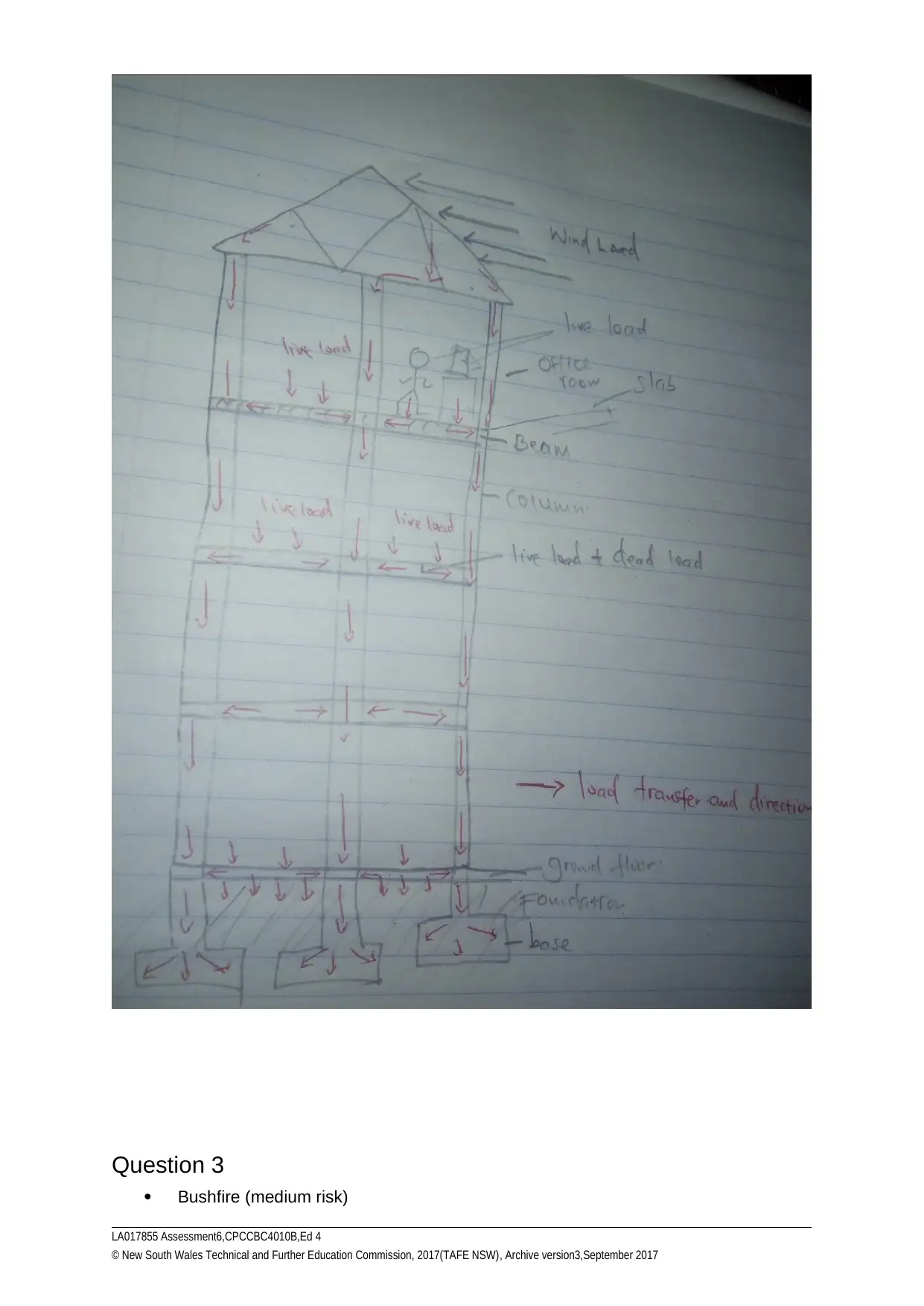
Question 2
2 LA017855 Assessment 6, CPCCBC4010B, Ed 4
© New South Wales Technical and Further Education Commission, 2017(TAFE NSW), Archive version3,September 2017
Step 1: First, the analysis of the effect of the demolition of the dwelling will be carried out.
This will ensure that a proper preventive mechanism is created to ensure the environmental
protection is attained. Definition of the location area and status of the dwelling to be
demolished.
Step 2: Acquisition of the proper protective wear to ensure the health of the worker is
protected will be acquired.
Step 3: acquisition of the relevant license according to demolition class of the dwelling from
the authorities.
Step 3: Issue the notice 5 days before demolition activity to start.
Step 4: proposed methods of demolition to be used in the planning document.
Step 5: issue and indication of proposed methods of handling and disposing the asbestos
materials and other hazardous material.
Step 6: enhanced plan for the control and maintaining access to the demolishing area.
Step 7: Before the start of the demolition activity, proper removal of the asbestos in the area
will be carried out to enhance safety measures
Step 8: Ensure that the demolition works to be carried out comply with work safety on OHS
regulations and site requirements.
Step 9: Planning requirements for the demolition works are met with proper strategy such
that the demolition will not affect other activities within the region.
Step 10: indication of the demolition sequence and indication of the demolition equipments
to be used.
Step 11: analysis of other services in the location and the manner which they will be handled
during the demolition activities.
Step 12: confine the area where the demolition activity of demolition is taking place.
Step 13: indication of the status and conditions of the adjoining structures and provide the
mechanism which they will be protected from the demolition activity
Step 14: provide emergency services to be stand by in case of any incident.
Question 2
2 LA017855 Assessment 6, CPCCBC4010B, Ed 4
© New South Wales Technical and Further Education Commission, 2017(TAFE NSW), Archive version3,September 2017

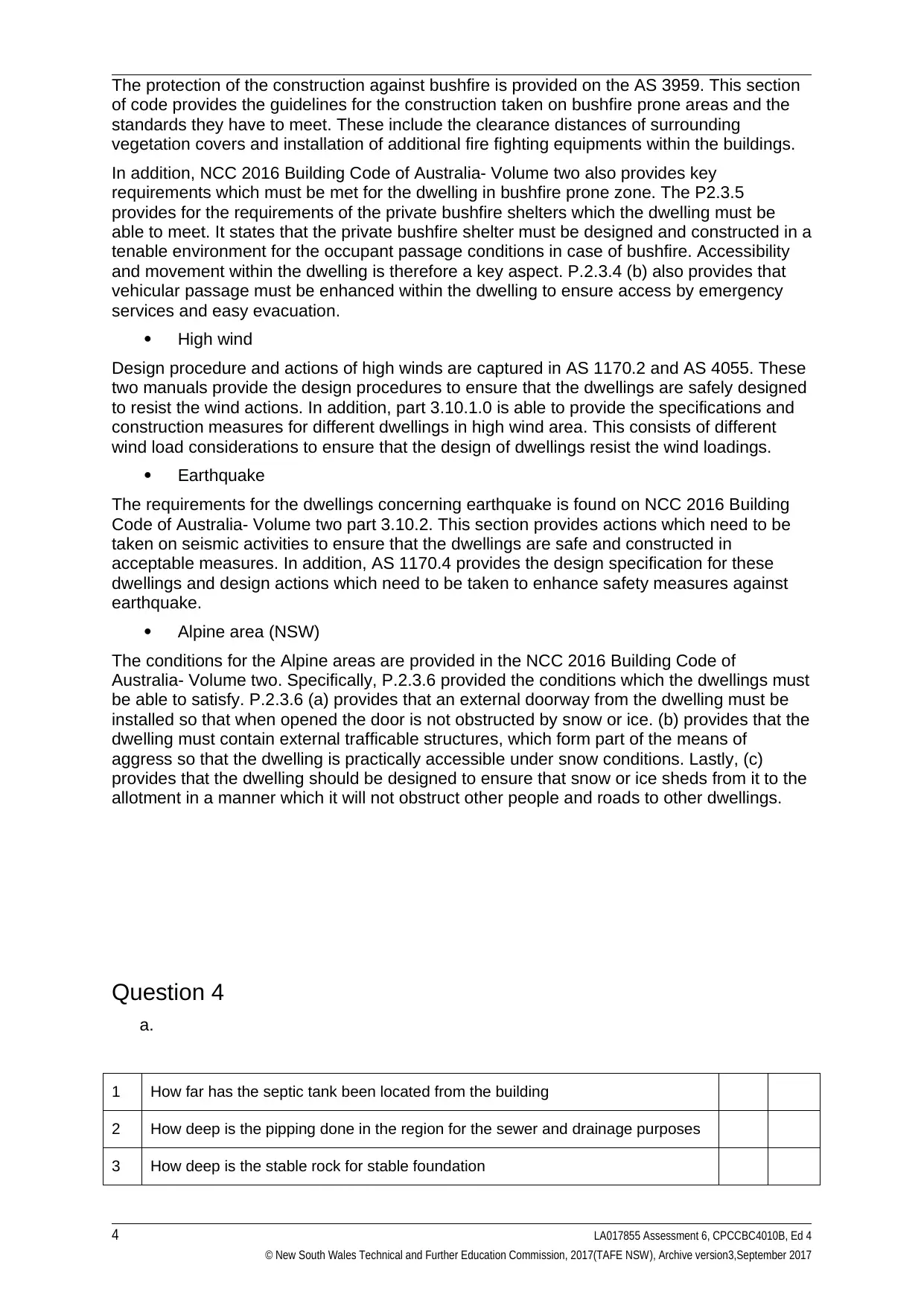
Question 3
Bushfire (medium risk)
LA017855 Assessment6,CPCCBC4010B,Ed 4
© New South Wales Technical and Further Education Commission, 2017(TAFE NSW), Archive version3,September 2017
Bushfire (medium risk)
LA017855 Assessment6,CPCCBC4010B,Ed 4
© New South Wales Technical and Further Education Commission, 2017(TAFE NSW), Archive version3,September 2017
⊘ This is a preview!⊘
Do you want full access?
Subscribe today to unlock all pages.

Trusted by 1+ million students worldwide

The protection of the construction against bushfire is provided on the AS 3959. This section
of code provides the guidelines for the construction taken on bushfire prone areas and the
standards they have to meet. These include the clearance distances of surrounding
vegetation covers and installation of additional fire fighting equipments within the buildings.
In addition, NCC 2016 Building Code of Australia- Volume two also provides key
requirements which must be met for the dwelling in bushfire prone zone. The P2.3.5
provides for the requirements of the private bushfire shelters which the dwelling must be
able to meet. It states that the private bushfire shelter must be designed and constructed in a
tenable environment for the occupant passage conditions in case of bushfire. Accessibility
and movement within the dwelling is therefore a key aspect. P.2.3.4 (b) also provides that
vehicular passage must be enhanced within the dwelling to ensure access by emergency
services and easy evacuation.
High wind
Design procedure and actions of high winds are captured in AS 1170.2 and AS 4055. These
two manuals provide the design procedures to ensure that the dwellings are safely designed
to resist the wind actions. In addition, part 3.10.1.0 is able to provide the specifications and
construction measures for different dwellings in high wind area. This consists of different
wind load considerations to ensure that the design of dwellings resist the wind loadings.
Earthquake
The requirements for the dwellings concerning earthquake is found on NCC 2016 Building
Code of Australia- Volume two part 3.10.2. This section provides actions which need to be
taken on seismic activities to ensure that the dwellings are safe and constructed in
acceptable measures. In addition, AS 1170.4 provides the design specification for these
dwellings and design actions which need to be taken to enhance safety measures against
earthquake.
Alpine area (NSW)
The conditions for the Alpine areas are provided in the NCC 2016 Building Code of
Australia- Volume two. Specifically, P.2.3.6 provided the conditions which the dwellings must
be able to satisfy. P.2.3.6 (a) provides that an external doorway from the dwelling must be
installed so that when opened the door is not obstructed by snow or ice. (b) provides that the
dwelling must contain external trafficable structures, which form part of the means of
aggress so that the dwelling is practically accessible under snow conditions. Lastly, (c)
provides that the dwelling should be designed to ensure that snow or ice sheds from it to the
allotment in a manner which it will not obstruct other people and roads to other dwellings.
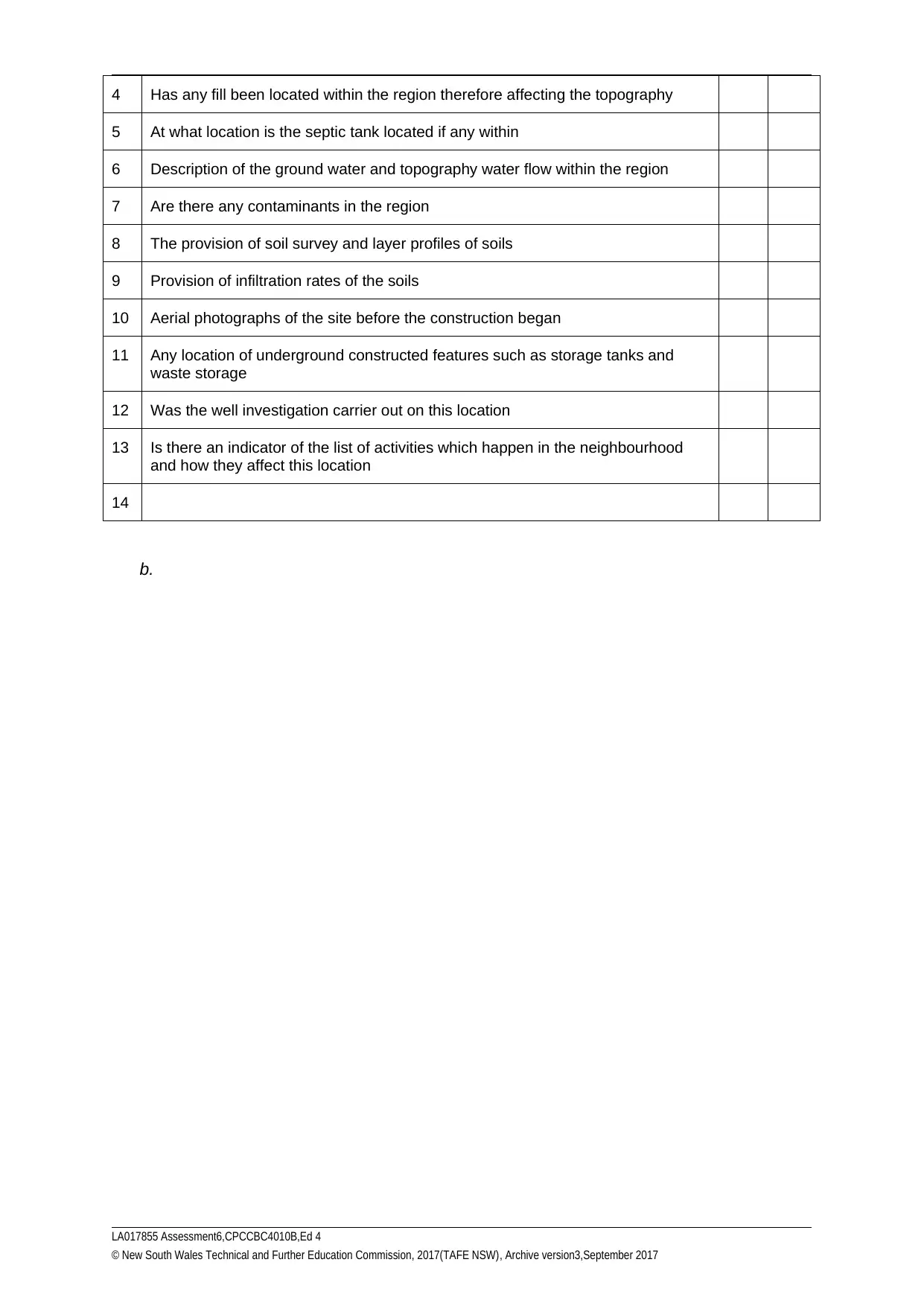
Question 4
a.
1 How far has the septic tank been located from the building
2 How deep is the pipping done in the region for the sewer and drainage purposes
3 How deep is the stable rock for stable foundation
4 LA017855 Assessment 6, CPCCBC4010B, Ed 4
© New South Wales Technical and Further Education Commission, 2017(TAFE NSW), Archive version3,September 2017
of code provides the guidelines for the construction taken on bushfire prone areas and the
standards they have to meet. These include the clearance distances of surrounding
vegetation covers and installation of additional fire fighting equipments within the buildings.
In addition, NCC 2016 Building Code of Australia- Volume two also provides key
requirements which must be met for the dwelling in bushfire prone zone. The P2.3.5
provides for the requirements of the private bushfire shelters which the dwelling must be
able to meet. It states that the private bushfire shelter must be designed and constructed in a
tenable environment for the occupant passage conditions in case of bushfire. Accessibility
and movement within the dwelling is therefore a key aspect. P.2.3.4 (b) also provides that
vehicular passage must be enhanced within the dwelling to ensure access by emergency
services and easy evacuation.
High wind
Design procedure and actions of high winds are captured in AS 1170.2 and AS 4055. These
two manuals provide the design procedures to ensure that the dwellings are safely designed
to resist the wind actions. In addition, part 3.10.1.0 is able to provide the specifications and
construction measures for different dwellings in high wind area. This consists of different
wind load considerations to ensure that the design of dwellings resist the wind loadings.
Earthquake
The requirements for the dwellings concerning earthquake is found on NCC 2016 Building
Code of Australia- Volume two part 3.10.2. This section provides actions which need to be
taken on seismic activities to ensure that the dwellings are safe and constructed in
acceptable measures. In addition, AS 1170.4 provides the design specification for these
dwellings and design actions which need to be taken to enhance safety measures against
earthquake.
Alpine area (NSW)
The conditions for the Alpine areas are provided in the NCC 2016 Building Code of
Australia- Volume two. Specifically, P.2.3.6 provided the conditions which the dwellings must
be able to satisfy. P.2.3.6 (a) provides that an external doorway from the dwelling must be
installed so that when opened the door is not obstructed by snow or ice. (b) provides that the
dwelling must contain external trafficable structures, which form part of the means of
aggress so that the dwelling is practically accessible under snow conditions. Lastly, (c)
provides that the dwelling should be designed to ensure that snow or ice sheds from it to the
allotment in a manner which it will not obstruct other people and roads to other dwellings.
Question 4
a.
1 How far has the septic tank been located from the building
2 How deep is the pipping done in the region for the sewer and drainage purposes
3 How deep is the stable rock for stable foundation
4 LA017855 Assessment 6, CPCCBC4010B, Ed 4
© New South Wales Technical and Further Education Commission, 2017(TAFE NSW), Archive version3,September 2017
Paraphrase This Document
Need a fresh take? Get an instant paraphrase of this document with our AI Paraphraser

4 Has any fill been located within the region therefore affecting the topography
5 At what location is the septic tank located if any within
6 Description of the ground water and topography water flow within the region
7 Are there any contaminants in the region
8 The provision of soil survey and layer profiles of soils
9 Provision of infiltration rates of the soils
10 Aerial photographs of the site before the construction began
11 Any location of underground constructed features such as storage tanks and
waste storage
12 Was the well investigation carrier out on this location
13 Is there an indicator of the list of activities which happen in the neighbourhood
and how they affect this location
14
b.
LA017855 Assessment6,CPCCBC4010B,Ed 4
© New South Wales Technical and Further Education Commission, 2017(TAFE NSW), Archive version3,September 2017
5 At what location is the septic tank located if any within
6 Description of the ground water and topography water flow within the region
7 Are there any contaminants in the region
8 The provision of soil survey and layer profiles of soils
9 Provision of infiltration rates of the soils
10 Aerial photographs of the site before the construction began
11 Any location of underground constructed features such as storage tanks and
waste storage
12 Was the well investigation carrier out on this location
13 Is there an indicator of the list of activities which happen in the neighbourhood
and how they affect this location
14
b.
LA017855 Assessment6,CPCCBC4010B,Ed 4
© New South Wales Technical and Further Education Commission, 2017(TAFE NSW), Archive version3,September 2017

Question 5
1. Plumbing and drainage services – the drainage and plumbing services will be both in
the building and outside. To start with, proper trenching for these services must be
done. Connection to the main sewer line must be considered as a clear option for the
drainage services. Proper backfill and compaction methods must be done on the
excavated and sewer area. Wastewater and stormwater should have different
drainage systems.
6 LA017855 Assessment 6, CPCCBC4010B, Ed 4
© New South Wales Technical and Further Education Commission, 2017(TAFE NSW), Archive version3,September 2017
1. Plumbing and drainage services – the drainage and plumbing services will be both in
the building and outside. To start with, proper trenching for these services must be
done. Connection to the main sewer line must be considered as a clear option for the
drainage services. Proper backfill and compaction methods must be done on the
excavated and sewer area. Wastewater and stormwater should have different
drainage systems.
6 LA017855 Assessment 6, CPCCBC4010B, Ed 4
© New South Wales Technical and Further Education Commission, 2017(TAFE NSW), Archive version3,September 2017
⊘ This is a preview!⊘
Do you want full access?
Subscribe today to unlock all pages.

Trusted by 1+ million students worldwide

2. Electrical and mechanical services – the electrical services will be both in the building
and outside. Proper and clear lighting will be ensured through proper lighting services
at the different locations. Each room should have enough lighting facilities to ensure
proper lighting. Alarm systems for incidences such as fire need to be installed and
tested to ensure that they are functioning.
3. Fences and external wall – these services will be provided on the external sections in
order to enhance the security measures. Electric fence can be in cooperated on the
fence and wall sections. The walls should be created with proper footing sections to
ensure they are strong.
4. Landscaping services – in order to enhance the aesthetic features of the compound,
the landscaping services will be needed around the building. Weed eradication once
landscaping has been done will be a key procedure to ensure the area is enhanced.
Non-residual glyphosate herbicide is recommended to be used. Excavations and
levelling the ground around the building will be key to achieve the set standards.
5. Paving and road sections – these services will enhance the accessibility to the
building. Sub grade, base, sub base and surfacing layers has to be monitored
according to the required traffic on the different pavements.
Question 6
footing according to AS 2870 and NCC BCA vol. 2 part 3.2
Excavation of the footing should lie on a strong base
Footing excavation should be free from loose earth, tree roots, mud and debris immediately
before pouring of concrete.
Excavation of footings adjacent to other buildings should b done at an angle in order to
determine safe area of excavation.
In addition, footing excavation of new footings has to be placed as soon as practicable after
the exposing the existing footing.
Footings adjoining should not be left exposed after completion of works.
Compaction of fills used to support footing must be done to required standard.
The bearing capacity has to be uniform with the different footing according to their classes.
Timber floor
The timber floor must be able to attain the water proof of the sections
Proper width of the floor must be placed on the floor sections
Proper painting and floor coating should be placed to ensure that water resistivity is ensured.
Well cured clear moisture polyurethane must be applied on the floor section
Concrete Floor
All the heated water pipping has to be done well and enclosed on the concrete floor.
Chemical reticulation system has to be laid beneath the concrete floor slab
Has the anti-termite treatment been done on the ground floor before placement of the slab?
Timber frame walls
Installation of the electrical outlets, offset at the clear required distances on the wall section
Proper flashing and well fastened elements with the timber framed wall sections.
LA017855 Assessment6,CPCCBC4010B,Ed 4
© New South Wales Technical and Further Education Commission, 2017(TAFE NSW), Archive version3,September 2017
and outside. Proper and clear lighting will be ensured through proper lighting services
at the different locations. Each room should have enough lighting facilities to ensure
proper lighting. Alarm systems for incidences such as fire need to be installed and
tested to ensure that they are functioning.
3. Fences and external wall – these services will be provided on the external sections in
order to enhance the security measures. Electric fence can be in cooperated on the
fence and wall sections. The walls should be created with proper footing sections to
ensure they are strong.
4. Landscaping services – in order to enhance the aesthetic features of the compound,
the landscaping services will be needed around the building. Weed eradication once
landscaping has been done will be a key procedure to ensure the area is enhanced.
Non-residual glyphosate herbicide is recommended to be used. Excavations and
levelling the ground around the building will be key to achieve the set standards.
5. Paving and road sections – these services will enhance the accessibility to the
building. Sub grade, base, sub base and surfacing layers has to be monitored
according to the required traffic on the different pavements.
Question 6
footing according to AS 2870 and NCC BCA vol. 2 part 3.2
Excavation of the footing should lie on a strong base
Footing excavation should be free from loose earth, tree roots, mud and debris immediately
before pouring of concrete.
Excavation of footings adjacent to other buildings should b done at an angle in order to
determine safe area of excavation.
In addition, footing excavation of new footings has to be placed as soon as practicable after
the exposing the existing footing.
Footings adjoining should not be left exposed after completion of works.
Compaction of fills used to support footing must be done to required standard.
The bearing capacity has to be uniform with the different footing according to their classes.
Timber floor
The timber floor must be able to attain the water proof of the sections
Proper width of the floor must be placed on the floor sections
Proper painting and floor coating should be placed to ensure that water resistivity is ensured.
Well cured clear moisture polyurethane must be applied on the floor section
Concrete Floor
All the heated water pipping has to be done well and enclosed on the concrete floor.
Chemical reticulation system has to be laid beneath the concrete floor slab
Has the anti-termite treatment been done on the ground floor before placement of the slab?
Timber frame walls
Installation of the electrical outlets, offset at the clear required distances on the wall section
Proper flashing and well fastened elements with the timber framed wall sections.
LA017855 Assessment6,CPCCBC4010B,Ed 4
© New South Wales Technical and Further Education Commission, 2017(TAFE NSW), Archive version3,September 2017
Paraphrase This Document
Need a fresh take? Get an instant paraphrase of this document with our AI Paraphraser

Masonry walls
Installation of the electrical openings within the masonry walling sections
Clear indication of the width of both internal and external wall sections
Indication of the type of masonry wall section in each part, i.e single of double leaf masonry
wall
Clear indication of the heights of the masonry wall at different sections
Guidelines to connect other members with the masonry walls should be provided.
Truss roof
Proper wall cladding guidelines are provided for the truss roof fitting
Termite treatment is done to ensure durability of the truss roof
Provision of the required joist, rafter and purlins to ensure proper placement of the truss roof
Proper fabrication method which is understandable is provided
Framed Roof
Proper issue of roof fasteners to ensure quality and durable framed structure
8 LA017855 Assessment 6, CPCCBC4010B, Ed 4
© New South Wales Technical and Further Education Commission, 2017(TAFE NSW), Archive version3,September 2017
Installation of the electrical openings within the masonry walling sections
Clear indication of the width of both internal and external wall sections
Indication of the type of masonry wall section in each part, i.e single of double leaf masonry
wall
Clear indication of the heights of the masonry wall at different sections
Guidelines to connect other members with the masonry walls should be provided.
Truss roof
Proper wall cladding guidelines are provided for the truss roof fitting
Termite treatment is done to ensure durability of the truss roof
Provision of the required joist, rafter and purlins to ensure proper placement of the truss roof
Proper fabrication method which is understandable is provided
Framed Roof
Proper issue of roof fasteners to ensure quality and durable framed structure
8 LA017855 Assessment 6, CPCCBC4010B, Ed 4
© New South Wales Technical and Further Education Commission, 2017(TAFE NSW), Archive version3,September 2017
1 out of 8
Your All-in-One AI-Powered Toolkit for Academic Success.
+13062052269
info@desklib.com
Available 24*7 on WhatsApp / Email
Unlock your academic potential
Copyright © 2020–2025 A2Z Services. All Rights Reserved. Developed and managed by ZUCOL.