Construction Financial Management: Ratios, Analysis & Project Choice
VerifiedAdded on 2023/06/11
|12
|2746
|158
Report
AI Summary
This report provides a detailed analysis of construction financial management, beginning with a discussion of the construction industry's necessity to the national economy, highlighting its role in generating employment, developing infrastructure, and contributing to economic growth. It compares two potential projects using the Annual Worth Method and Present Worth Method, ultimately recommending the RC open Culvert project based on its lower cost. The report includes a prepared Profit and Loss account and Balance Sheet for a construction company, followed by an evaluation of the company's financial health using key financial ratios such as Interest Coverage Ratio, Current Ratio, Acid Test Ratio, and Gearing Ratio. Based on the analysis, the report suggests maintaining the current strategy with minor adjustments to decrease operating expenses to enhance profitability and productivity.

Construction
Financial
Management
Financial
Management

Paraphrase This Document
Need a fresh take? Get an instant paraphrase of this document with our AI Paraphraser


Contents
QUESTION 1.............................................................................................................................4
Critically discuss the necessity of construction industry to the national economy................4
QUESTION 2.............................................................................................................................6
Compare and suggest the project that needs to be selected...................................................6
QUESTION 3.............................................................................................................................8
a) Prepare Profit and loss account and balance sheet.............................................................8
b) Evaluate the company’s financial health using four financial standing ratios and give
comments on it. Advise the company if there is a need to remain with the current strategy
or change to a new strategy for the company’s financial standing......................................10
REFERENCES.........................................................................................................................12
QUESTION 1.............................................................................................................................4
Critically discuss the necessity of construction industry to the national economy................4
QUESTION 2.............................................................................................................................6
Compare and suggest the project that needs to be selected...................................................6
QUESTION 3.............................................................................................................................8
a) Prepare Profit and loss account and balance sheet.............................................................8
b) Evaluate the company’s financial health using four financial standing ratios and give
comments on it. Advise the company if there is a need to remain with the current strategy
or change to a new strategy for the company’s financial standing......................................10
REFERENCES.........................................................................................................................12
⊘ This is a preview!⊘
Do you want full access?
Subscribe today to unlock all pages.

Trusted by 1+ million students worldwide
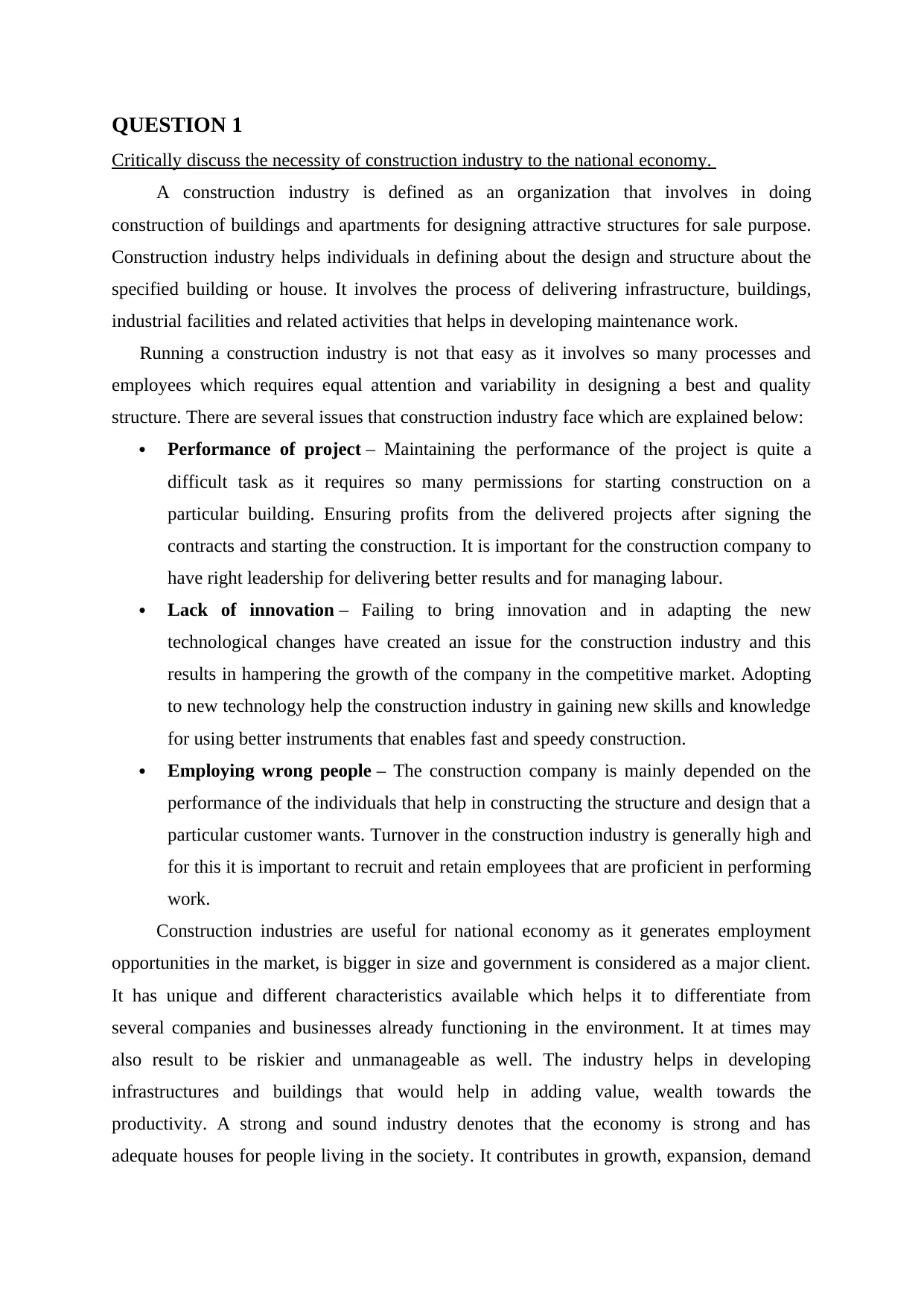
QUESTION 1
Critically discuss the necessity of construction industry to the national economy.
A construction industry is defined as an organization that involves in doing
construction of buildings and apartments for designing attractive structures for sale purpose.
Construction industry helps individuals in defining about the design and structure about the
specified building or house. It involves the process of delivering infrastructure, buildings,
industrial facilities and related activities that helps in developing maintenance work.
Running a construction industry is not that easy as it involves so many processes and
employees which requires equal attention and variability in designing a best and quality
structure. There are several issues that construction industry face which are explained below:
Performance of project – Maintaining the performance of the project is quite a
difficult task as it requires so many permissions for starting construction on a
particular building. Ensuring profits from the delivered projects after signing the
contracts and starting the construction. It is important for the construction company to
have right leadership for delivering better results and for managing labour.
Lack of innovation – Failing to bring innovation and in adapting the new
technological changes have created an issue for the construction industry and this
results in hampering the growth of the company in the competitive market. Adopting
to new technology help the construction industry in gaining new skills and knowledge
for using better instruments that enables fast and speedy construction.
Employing wrong people – The construction company is mainly depended on the
performance of the individuals that help in constructing the structure and design that a
particular customer wants. Turnover in the construction industry is generally high and
for this it is important to recruit and retain employees that are proficient in performing
work.
Construction industries are useful for national economy as it generates employment
opportunities in the market, is bigger in size and government is considered as a major client.
It has unique and different characteristics available which helps it to differentiate from
several companies and businesses already functioning in the environment. It at times may
also result to be riskier and unmanageable as well. The industry helps in developing
infrastructures and buildings that would help in adding value, wealth towards the
productivity. A strong and sound industry denotes that the economy is strong and has
adequate houses for people living in the society. It contributes in growth, expansion, demand
Critically discuss the necessity of construction industry to the national economy.
A construction industry is defined as an organization that involves in doing
construction of buildings and apartments for designing attractive structures for sale purpose.
Construction industry helps individuals in defining about the design and structure about the
specified building or house. It involves the process of delivering infrastructure, buildings,
industrial facilities and related activities that helps in developing maintenance work.
Running a construction industry is not that easy as it involves so many processes and
employees which requires equal attention and variability in designing a best and quality
structure. There are several issues that construction industry face which are explained below:
Performance of project – Maintaining the performance of the project is quite a
difficult task as it requires so many permissions for starting construction on a
particular building. Ensuring profits from the delivered projects after signing the
contracts and starting the construction. It is important for the construction company to
have right leadership for delivering better results and for managing labour.
Lack of innovation – Failing to bring innovation and in adapting the new
technological changes have created an issue for the construction industry and this
results in hampering the growth of the company in the competitive market. Adopting
to new technology help the construction industry in gaining new skills and knowledge
for using better instruments that enables fast and speedy construction.
Employing wrong people – The construction company is mainly depended on the
performance of the individuals that help in constructing the structure and design that a
particular customer wants. Turnover in the construction industry is generally high and
for this it is important to recruit and retain employees that are proficient in performing
work.
Construction industries are useful for national economy as it generates employment
opportunities in the market, is bigger in size and government is considered as a major client.
It has unique and different characteristics available which helps it to differentiate from
several companies and businesses already functioning in the environment. It at times may
also result to be riskier and unmanageable as well. The industry helps in developing
infrastructures and buildings that would help in adding value, wealth towards the
productivity. A strong and sound industry denotes that the economy is strong and has
adequate houses for people living in the society. It contributes in growth, expansion, demand
Paraphrase This Document
Need a fresh take? Get an instant paraphrase of this document with our AI Paraphraser
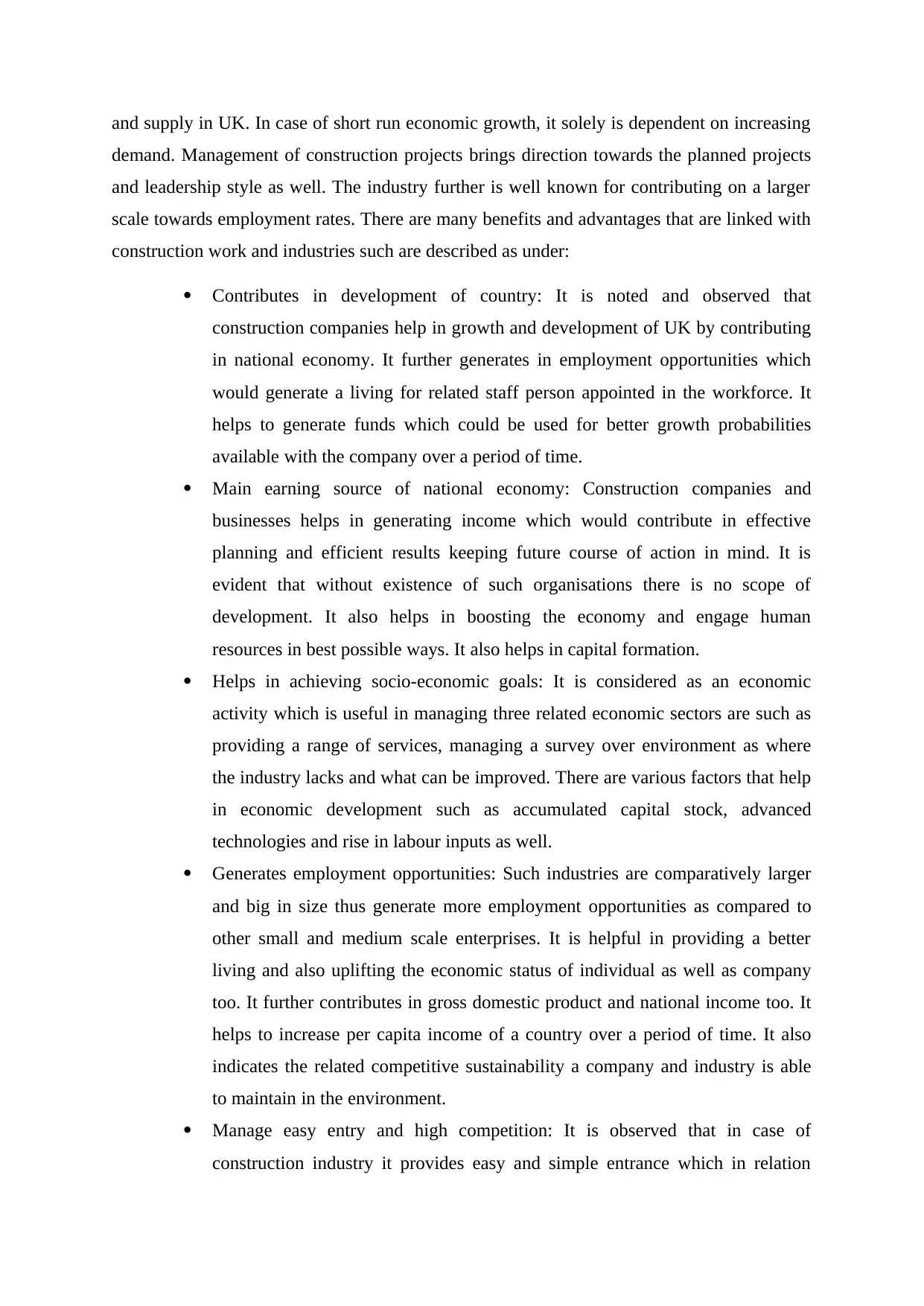
and supply in UK. In case of short run economic growth, it solely is dependent on increasing
demand. Management of construction projects brings direction towards the planned projects
and leadership style as well. The industry further is well known for contributing on a larger
scale towards employment rates. There are many benefits and advantages that are linked with
construction work and industries such are described as under:
Contributes in development of country: It is noted and observed that
construction companies help in growth and development of UK by contributing
in national economy. It further generates in employment opportunities which
would generate a living for related staff person appointed in the workforce. It
helps to generate funds which could be used for better growth probabilities
available with the company over a period of time.
Main earning source of national economy: Construction companies and
businesses helps in generating income which would contribute in effective
planning and efficient results keeping future course of action in mind. It is
evident that without existence of such organisations there is no scope of
development. It also helps in boosting the economy and engage human
resources in best possible ways. It also helps in capital formation.
Helps in achieving socio-economic goals: It is considered as an economic
activity which is useful in managing three related economic sectors are such as
providing a range of services, managing a survey over environment as where
the industry lacks and what can be improved. There are various factors that help
in economic development such as accumulated capital stock, advanced
technologies and rise in labour inputs as well.
Generates employment opportunities: Such industries are comparatively larger
and big in size thus generate more employment opportunities as compared to
other small and medium scale enterprises. It is helpful in providing a better
living and also uplifting the economic status of individual as well as company
too. It further contributes in gross domestic product and national income too. It
helps to increase per capita income of a country over a period of time. It also
indicates the related competitive sustainability a company and industry is able
to maintain in the environment.
Manage easy entry and high competition: It is observed that in case of
construction industry it provides easy and simple entrance which in relation
demand. Management of construction projects brings direction towards the planned projects
and leadership style as well. The industry further is well known for contributing on a larger
scale towards employment rates. There are many benefits and advantages that are linked with
construction work and industries such are described as under:
Contributes in development of country: It is noted and observed that
construction companies help in growth and development of UK by contributing
in national economy. It further generates in employment opportunities which
would generate a living for related staff person appointed in the workforce. It
helps to generate funds which could be used for better growth probabilities
available with the company over a period of time.
Main earning source of national economy: Construction companies and
businesses helps in generating income which would contribute in effective
planning and efficient results keeping future course of action in mind. It is
evident that without existence of such organisations there is no scope of
development. It also helps in boosting the economy and engage human
resources in best possible ways. It also helps in capital formation.
Helps in achieving socio-economic goals: It is considered as an economic
activity which is useful in managing three related economic sectors are such as
providing a range of services, managing a survey over environment as where
the industry lacks and what can be improved. There are various factors that help
in economic development such as accumulated capital stock, advanced
technologies and rise in labour inputs as well.
Generates employment opportunities: Such industries are comparatively larger
and big in size thus generate more employment opportunities as compared to
other small and medium scale enterprises. It is helpful in providing a better
living and also uplifting the economic status of individual as well as company
too. It further contributes in gross domestic product and national income too. It
helps to increase per capita income of a country over a period of time. It also
indicates the related competitive sustainability a company and industry is able
to maintain in the environment.
Manage easy entry and high competition: It is observed that in case of
construction industry it provides easy and simple entrance which in relation
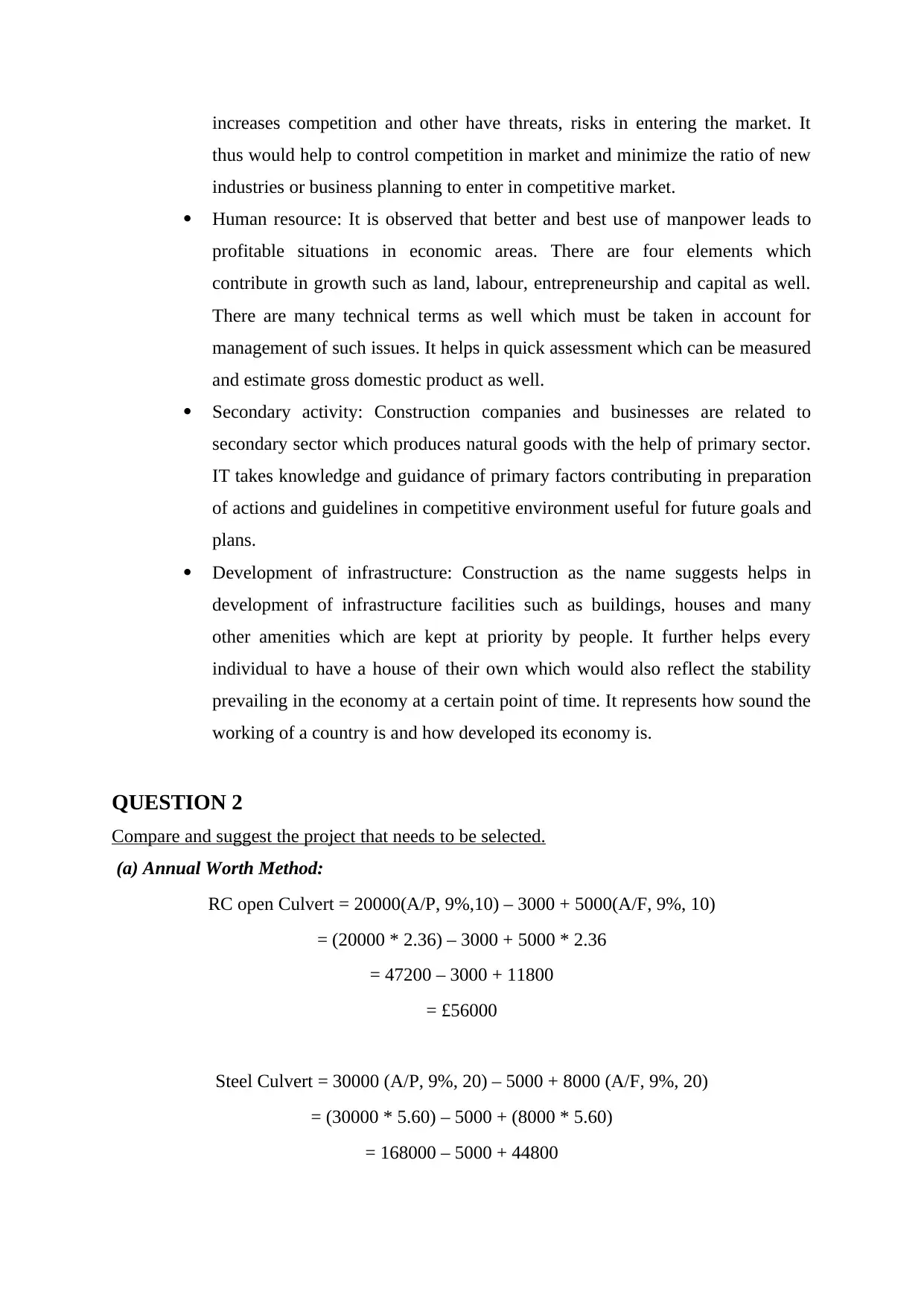
increases competition and other have threats, risks in entering the market. It
thus would help to control competition in market and minimize the ratio of new
industries or business planning to enter in competitive market.
Human resource: It is observed that better and best use of manpower leads to
profitable situations in economic areas. There are four elements which
contribute in growth such as land, labour, entrepreneurship and capital as well.
There are many technical terms as well which must be taken in account for
management of such issues. It helps in quick assessment which can be measured
and estimate gross domestic product as well.
Secondary activity: Construction companies and businesses are related to
secondary sector which produces natural goods with the help of primary sector.
IT takes knowledge and guidance of primary factors contributing in preparation
of actions and guidelines in competitive environment useful for future goals and
plans.
Development of infrastructure: Construction as the name suggests helps in
development of infrastructure facilities such as buildings, houses and many
other amenities which are kept at priority by people. It further helps every
individual to have a house of their own which would also reflect the stability
prevailing in the economy at a certain point of time. It represents how sound the
working of a country is and how developed its economy is.
QUESTION 2
Compare and suggest the project that needs to be selected.
(a) Annual Worth Method:
RC open Culvert = 20000(A/P, 9%,10) – 3000 + 5000(A/F, 9%, 10)
= (20000 * 2.36) – 3000 + 5000 * 2.36
= 47200 – 3000 + 11800
= £56000
Steel Culvert = 30000 (A/P, 9%, 20) – 5000 + 8000 (A/F, 9%, 20)
= (30000 * 5.60) – 5000 + (8000 * 5.60)
= 168000 – 5000 + 44800
thus would help to control competition in market and minimize the ratio of new
industries or business planning to enter in competitive market.
Human resource: It is observed that better and best use of manpower leads to
profitable situations in economic areas. There are four elements which
contribute in growth such as land, labour, entrepreneurship and capital as well.
There are many technical terms as well which must be taken in account for
management of such issues. It helps in quick assessment which can be measured
and estimate gross domestic product as well.
Secondary activity: Construction companies and businesses are related to
secondary sector which produces natural goods with the help of primary sector.
IT takes knowledge and guidance of primary factors contributing in preparation
of actions and guidelines in competitive environment useful for future goals and
plans.
Development of infrastructure: Construction as the name suggests helps in
development of infrastructure facilities such as buildings, houses and many
other amenities which are kept at priority by people. It further helps every
individual to have a house of their own which would also reflect the stability
prevailing in the economy at a certain point of time. It represents how sound the
working of a country is and how developed its economy is.
QUESTION 2
Compare and suggest the project that needs to be selected.
(a) Annual Worth Method:
RC open Culvert = 20000(A/P, 9%,10) – 3000 + 5000(A/F, 9%, 10)
= (20000 * 2.36) – 3000 + 5000 * 2.36
= 47200 – 3000 + 11800
= £56000
Steel Culvert = 30000 (A/P, 9%, 20) – 5000 + 8000 (A/F, 9%, 20)
= (30000 * 5.60) – 5000 + (8000 * 5.60)
= 168000 – 5000 + 44800
⊘ This is a preview!⊘
Do you want full access?
Subscribe today to unlock all pages.
Trusted by 1+ million students worldwide
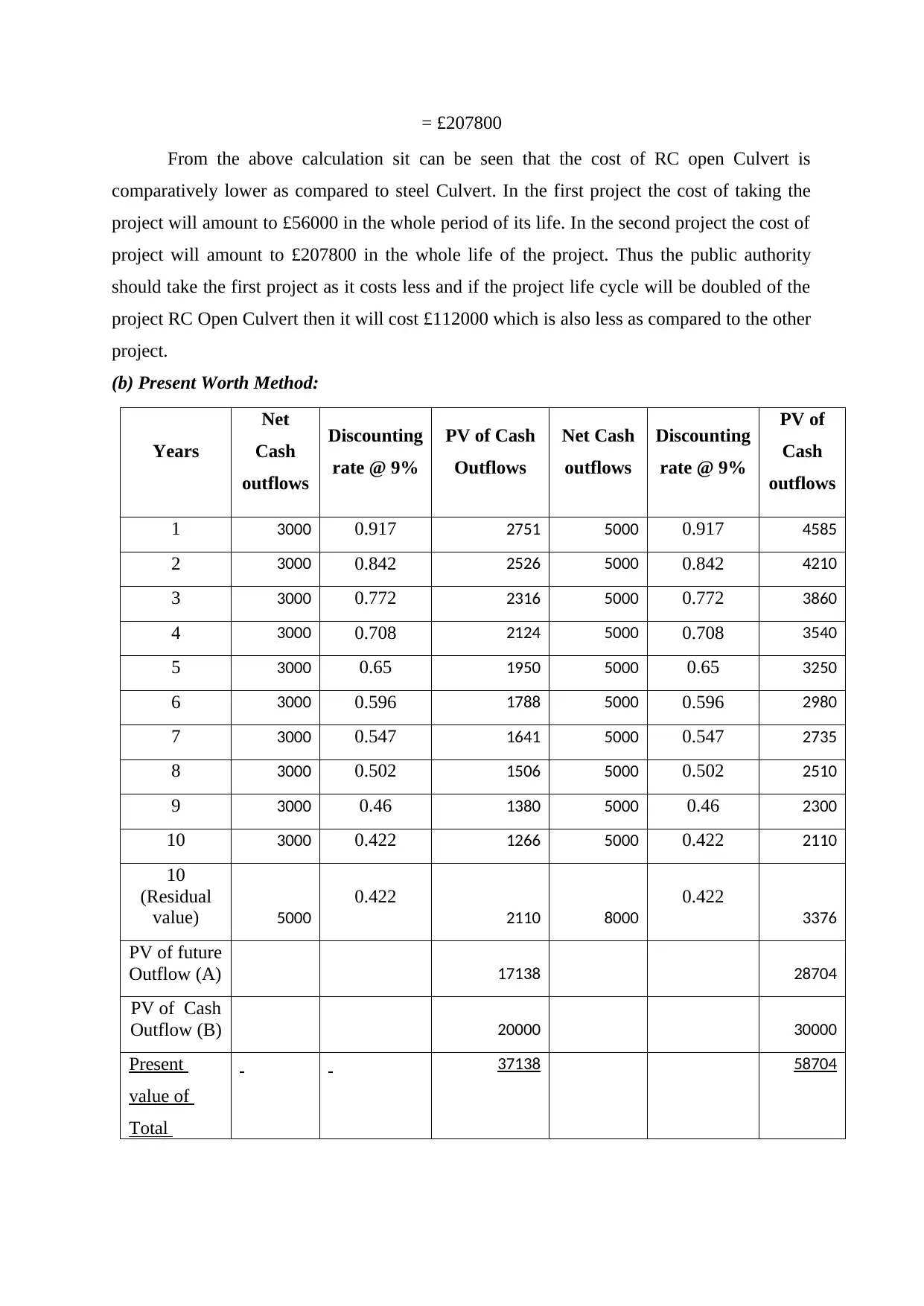
= £207800
From the above calculation sit can be seen that the cost of RC open Culvert is
comparatively lower as compared to steel Culvert. In the first project the cost of taking the
project will amount to £56000 in the whole period of its life. In the second project the cost of
project will amount to £207800 in the whole life of the project. Thus the public authority
should take the first project as it costs less and if the project life cycle will be doubled of the
project RC Open Culvert then it will cost £112000 which is also less as compared to the other
project.
(b) Present Worth Method:
Years
Net
Cash
outflows
Discounting
rate @ 9%
PV of Cash
Outflows
Net Cash
outflows
Discounting
rate @ 9%
PV of
Cash
outflows
1 3000 0.917 2751 5000 0.917 4585
2 3000 0.842 2526 5000 0.842 4210
3 3000 0.772 2316 5000 0.772 3860
4 3000 0.708 2124 5000 0.708 3540
5 3000 0.65 1950 5000 0.65 3250
6 3000 0.596 1788 5000 0.596 2980
7 3000 0.547 1641 5000 0.547 2735
8 3000 0.502 1506 5000 0.502 2510
9 3000 0.46 1380 5000 0.46 2300
10 3000 0.422 1266 5000 0.422 2110
10
(Residual
value) 5000
0.422
2110 8000
0.422
3376
PV of future
Outflow (A) 17138 28704
PV of Cash
Outflow (B) 20000 30000
Present
value of
Total
37138 58704
From the above calculation sit can be seen that the cost of RC open Culvert is
comparatively lower as compared to steel Culvert. In the first project the cost of taking the
project will amount to £56000 in the whole period of its life. In the second project the cost of
project will amount to £207800 in the whole life of the project. Thus the public authority
should take the first project as it costs less and if the project life cycle will be doubled of the
project RC Open Culvert then it will cost £112000 which is also less as compared to the other
project.
(b) Present Worth Method:
Years
Net
Cash
outflows
Discounting
rate @ 9%
PV of Cash
Outflows
Net Cash
outflows
Discounting
rate @ 9%
PV of
Cash
outflows
1 3000 0.917 2751 5000 0.917 4585
2 3000 0.842 2526 5000 0.842 4210
3 3000 0.772 2316 5000 0.772 3860
4 3000 0.708 2124 5000 0.708 3540
5 3000 0.65 1950 5000 0.65 3250
6 3000 0.596 1788 5000 0.596 2980
7 3000 0.547 1641 5000 0.547 2735
8 3000 0.502 1506 5000 0.502 2510
9 3000 0.46 1380 5000 0.46 2300
10 3000 0.422 1266 5000 0.422 2110
10
(Residual
value) 5000
0.422
2110 8000
0.422
3376
PV of future
Outflow (A) 17138 28704
PV of Cash
Outflow (B) 20000 30000
Present
value of
Total
37138 58704
Paraphrase This Document
Need a fresh take? Get an instant paraphrase of this document with our AI Paraphraser
Outflow
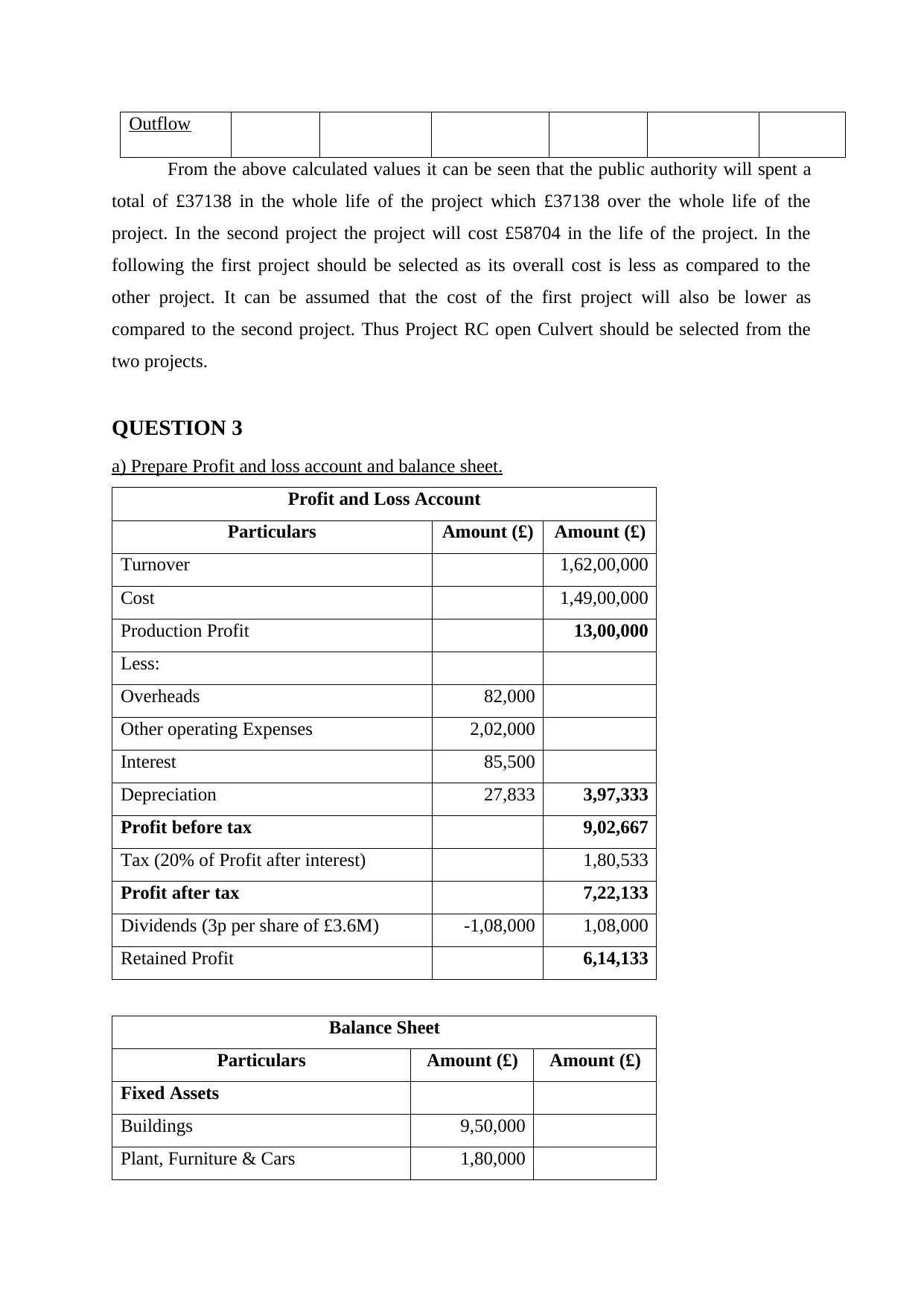
From the above calculated values it can be seen that the public authority will spent a
total of £37138 in the whole life of the project which £37138 over the whole life of the
project. In the second project the project will cost £58704 in the life of the project. In the
following the first project should be selected as its overall cost is less as compared to the
other project. It can be assumed that the cost of the first project will also be lower as
compared to the second project. Thus Project RC open Culvert should be selected from the
two projects.
QUESTION 3
a) Prepare Profit and loss account and balance sheet.
Profit and Loss Account
Particulars Amount (£) Amount (£)
Turnover 1,62,00,000
Cost 1,49,00,000
Production Profit 13,00,000
Less:
Overheads 82,000
Other operating Expenses 2,02,000
Interest 85,500
Depreciation 27,833 3,97,333
Profit before tax 9,02,667
Tax (20% of Profit after interest) 1,80,533
Profit after tax 7,22,133
Dividends (3p per share of £3.6M) -1,08,000 1,08,000
Retained Profit 6,14,133
Balance Sheet
Particulars Amount (£) Amount (£)
Fixed Assets
Buildings 9,50,000
Plant, Furniture & Cars 1,80,000
From the above calculated values it can be seen that the public authority will spent a
total of £37138 in the whole life of the project which £37138 over the whole life of the
project. In the second project the project will cost £58704 in the life of the project. In the
following the first project should be selected as its overall cost is less as compared to the
other project. It can be assumed that the cost of the first project will also be lower as
compared to the second project. Thus Project RC open Culvert should be selected from the
two projects.
QUESTION 3
a) Prepare Profit and loss account and balance sheet.
Profit and Loss Account
Particulars Amount (£) Amount (£)
Turnover 1,62,00,000
Cost 1,49,00,000
Production Profit 13,00,000
Less:
Overheads 82,000
Other operating Expenses 2,02,000
Interest 85,500
Depreciation 27,833 3,97,333
Profit before tax 9,02,667
Tax (20% of Profit after interest) 1,80,533
Profit after tax 7,22,133
Dividends (3p per share of £3.6M) -1,08,000 1,08,000
Retained Profit 6,14,133
Balance Sheet
Particulars Amount (£) Amount (£)
Fixed Assets
Buildings 9,50,000
Plant, Furniture & Cars 1,80,000
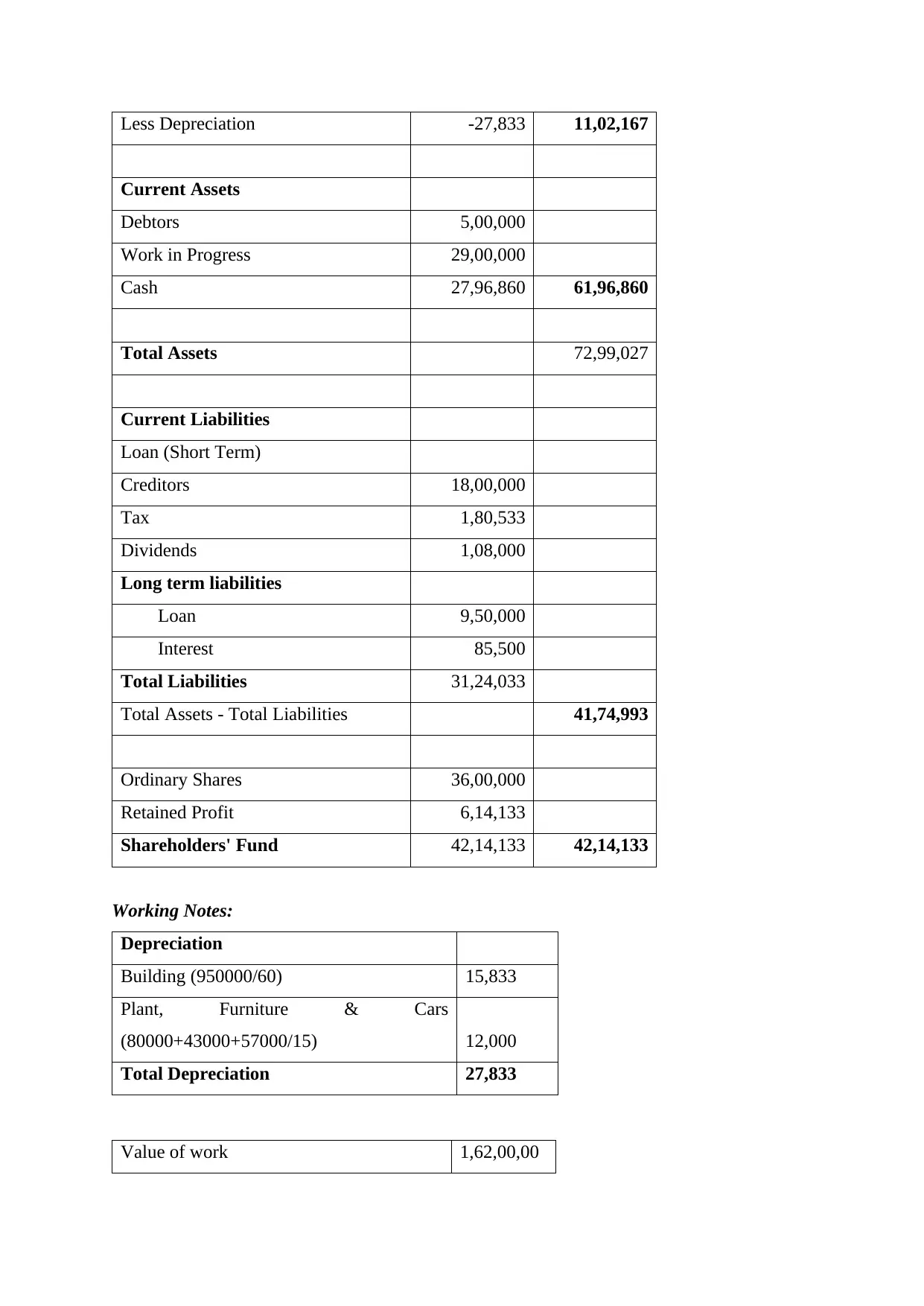
Less Depreciation -27,833 11,02,167
Current Assets
Debtors 5,00,000
Work in Progress 29,00,000
Cash 27,96,860 61,96,860
Total Assets 72,99,027
Current Liabilities
Loan (Short Term)
Creditors 18,00,000
Tax 1,80,533
Dividends 1,08,000
Long term liabilities
Loan 9,50,000
Interest 85,500
Total Liabilities 31,24,033
Total Assets - Total Liabilities 41,74,993
Ordinary Shares 36,00,000
Retained Profit 6,14,133
Shareholders' Fund 42,14,133 42,14,133
Working Notes:
Depreciation
Building (950000/60) 15,833
Plant, Furniture & Cars
(80000+43000+57000/15) 12,000
Total Depreciation 27,833
Value of work 1,62,00,00
Current Assets
Debtors 5,00,000
Work in Progress 29,00,000
Cash 27,96,860 61,96,860
Total Assets 72,99,027
Current Liabilities
Loan (Short Term)
Creditors 18,00,000
Tax 1,80,533
Dividends 1,08,000
Long term liabilities
Loan 9,50,000
Interest 85,500
Total Liabilities 31,24,033
Total Assets - Total Liabilities 41,74,993
Ordinary Shares 36,00,000
Retained Profit 6,14,133
Shareholders' Fund 42,14,133 42,14,133
Working Notes:
Depreciation
Building (950000/60) 15,833
Plant, Furniture & Cars
(80000+43000+57000/15) 12,000
Total Depreciation 27,833
Value of work 1,62,00,00
⊘ This is a preview!⊘
Do you want full access?
Subscribe today to unlock all pages.
Trusted by 1+ million students worldwide
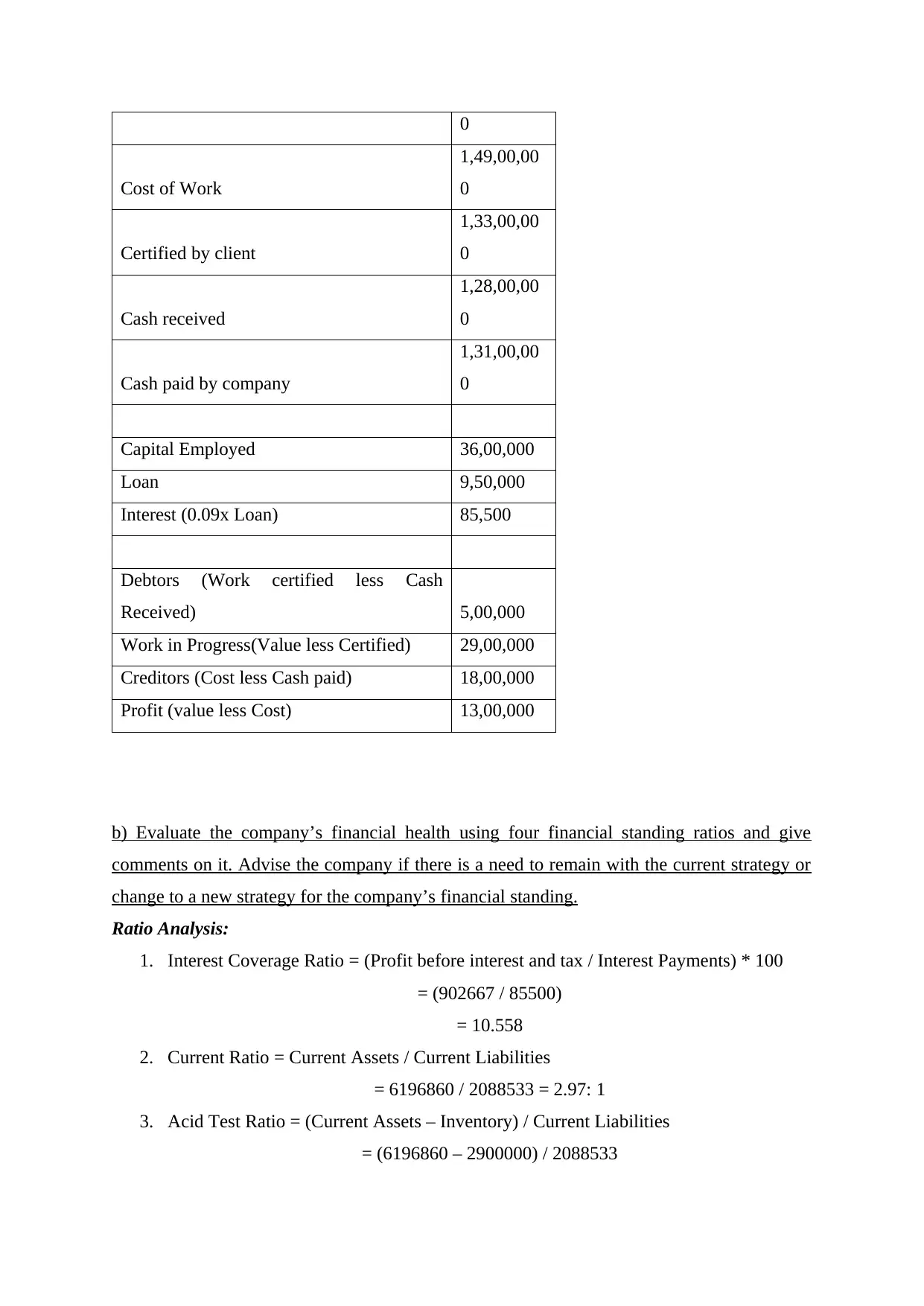
0
Cost of Work
1,49,00,00
0
Certified by client
1,33,00,00
0
Cash received
1,28,00,00
0
Cash paid by company
1,31,00,00
0
Capital Employed 36,00,000
Loan 9,50,000
Interest (0.09x Loan) 85,500
Debtors (Work certified less Cash
Received) 5,00,000
Work in Progress(Value less Certified) 29,00,000
Creditors (Cost less Cash paid) 18,00,000
Profit (value less Cost) 13,00,000
b) Evaluate the company’s financial health using four financial standing ratios and give
comments on it. Advise the company if there is a need to remain with the current strategy or
change to a new strategy for the company’s financial standing.
Ratio Analysis:
1. Interest Coverage Ratio = (Profit before interest and tax / Interest Payments) * 100
= (902667 / 85500)
= 10.558
2. Current Ratio = Current Assets / Current Liabilities
= 6196860 / 2088533 = 2.97: 1
3. Acid Test Ratio = (Current Assets – Inventory) / Current Liabilities
= (6196860 – 2900000) / 2088533
Cost of Work
1,49,00,00
0
Certified by client
1,33,00,00
0
Cash received
1,28,00,00
0
Cash paid by company
1,31,00,00
0
Capital Employed 36,00,000
Loan 9,50,000
Interest (0.09x Loan) 85,500
Debtors (Work certified less Cash
Received) 5,00,000
Work in Progress(Value less Certified) 29,00,000
Creditors (Cost less Cash paid) 18,00,000
Profit (value less Cost) 13,00,000
b) Evaluate the company’s financial health using four financial standing ratios and give
comments on it. Advise the company if there is a need to remain with the current strategy or
change to a new strategy for the company’s financial standing.
Ratio Analysis:
1. Interest Coverage Ratio = (Profit before interest and tax / Interest Payments) * 100
= (902667 / 85500)
= 10.558
2. Current Ratio = Current Assets / Current Liabilities
= 6196860 / 2088533 = 2.97: 1
3. Acid Test Ratio = (Current Assets – Inventory) / Current Liabilities
= (6196860 – 2900000) / 2088533
Paraphrase This Document
Need a fresh take? Get an instant paraphrase of this document with our AI Paraphraser
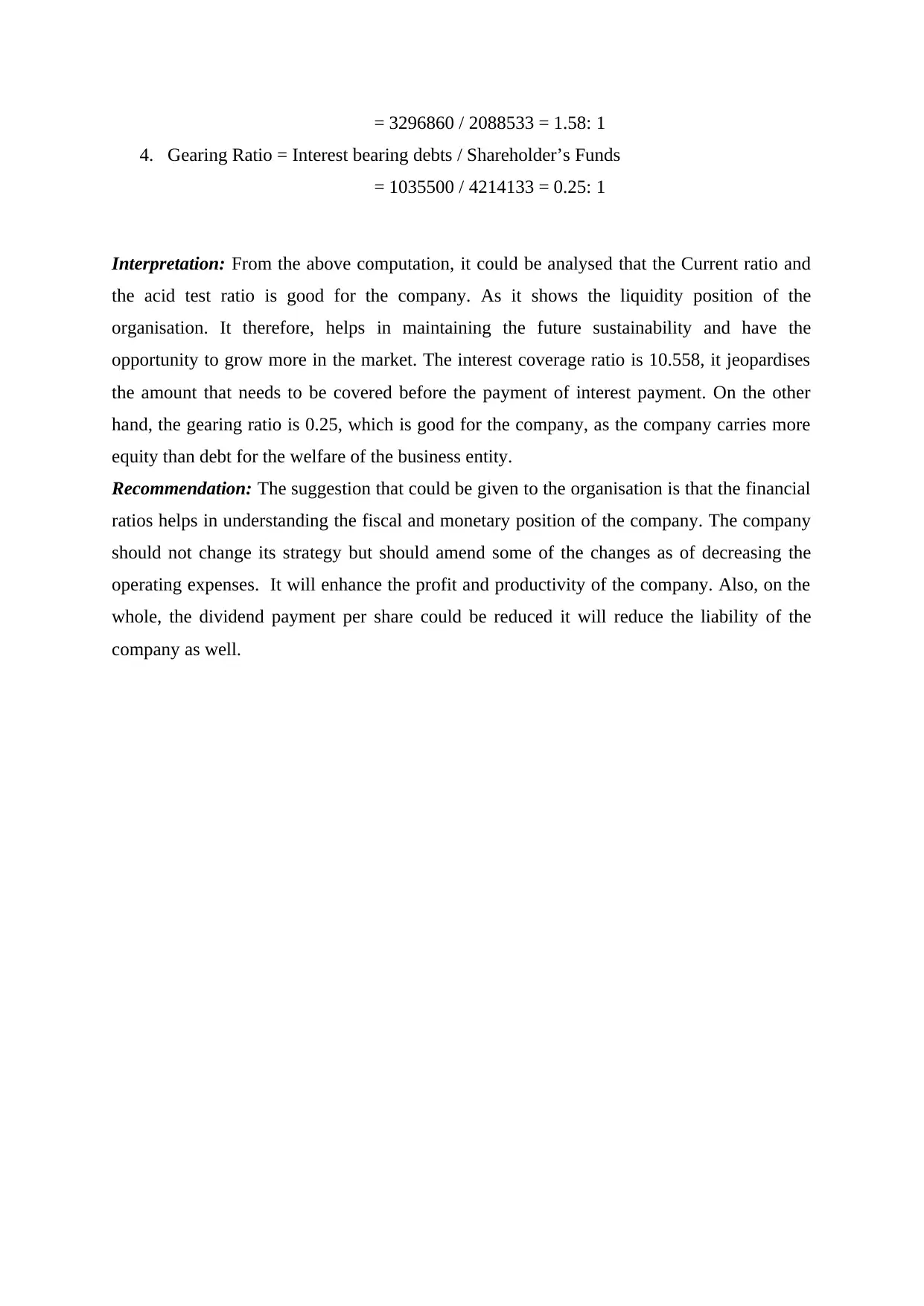
= 3296860 / 2088533 = 1.58: 1
4. Gearing Ratio = Interest bearing debts / Shareholder’s Funds
= 1035500 / 4214133 = 0.25: 1
Interpretation: From the above computation, it could be analysed that the Current ratio and
the acid test ratio is good for the company. As it shows the liquidity position of the
organisation. It therefore, helps in maintaining the future sustainability and have the
opportunity to grow more in the market. The interest coverage ratio is 10.558, it jeopardises
the amount that needs to be covered before the payment of interest payment. On the other
hand, the gearing ratio is 0.25, which is good for the company, as the company carries more
equity than debt for the welfare of the business entity.
Recommendation: The suggestion that could be given to the organisation is that the financial
ratios helps in understanding the fiscal and monetary position of the company. The company
should not change its strategy but should amend some of the changes as of decreasing the
operating expenses. It will enhance the profit and productivity of the company. Also, on the
whole, the dividend payment per share could be reduced it will reduce the liability of the
company as well.
4. Gearing Ratio = Interest bearing debts / Shareholder’s Funds
= 1035500 / 4214133 = 0.25: 1
Interpretation: From the above computation, it could be analysed that the Current ratio and
the acid test ratio is good for the company. As it shows the liquidity position of the
organisation. It therefore, helps in maintaining the future sustainability and have the
opportunity to grow more in the market. The interest coverage ratio is 10.558, it jeopardises
the amount that needs to be covered before the payment of interest payment. On the other
hand, the gearing ratio is 0.25, which is good for the company, as the company carries more
equity than debt for the welfare of the business entity.
Recommendation: The suggestion that could be given to the organisation is that the financial
ratios helps in understanding the fiscal and monetary position of the company. The company
should not change its strategy but should amend some of the changes as of decreasing the
operating expenses. It will enhance the profit and productivity of the company. Also, on the
whole, the dividend payment per share could be reduced it will reduce the liability of the
company as well.
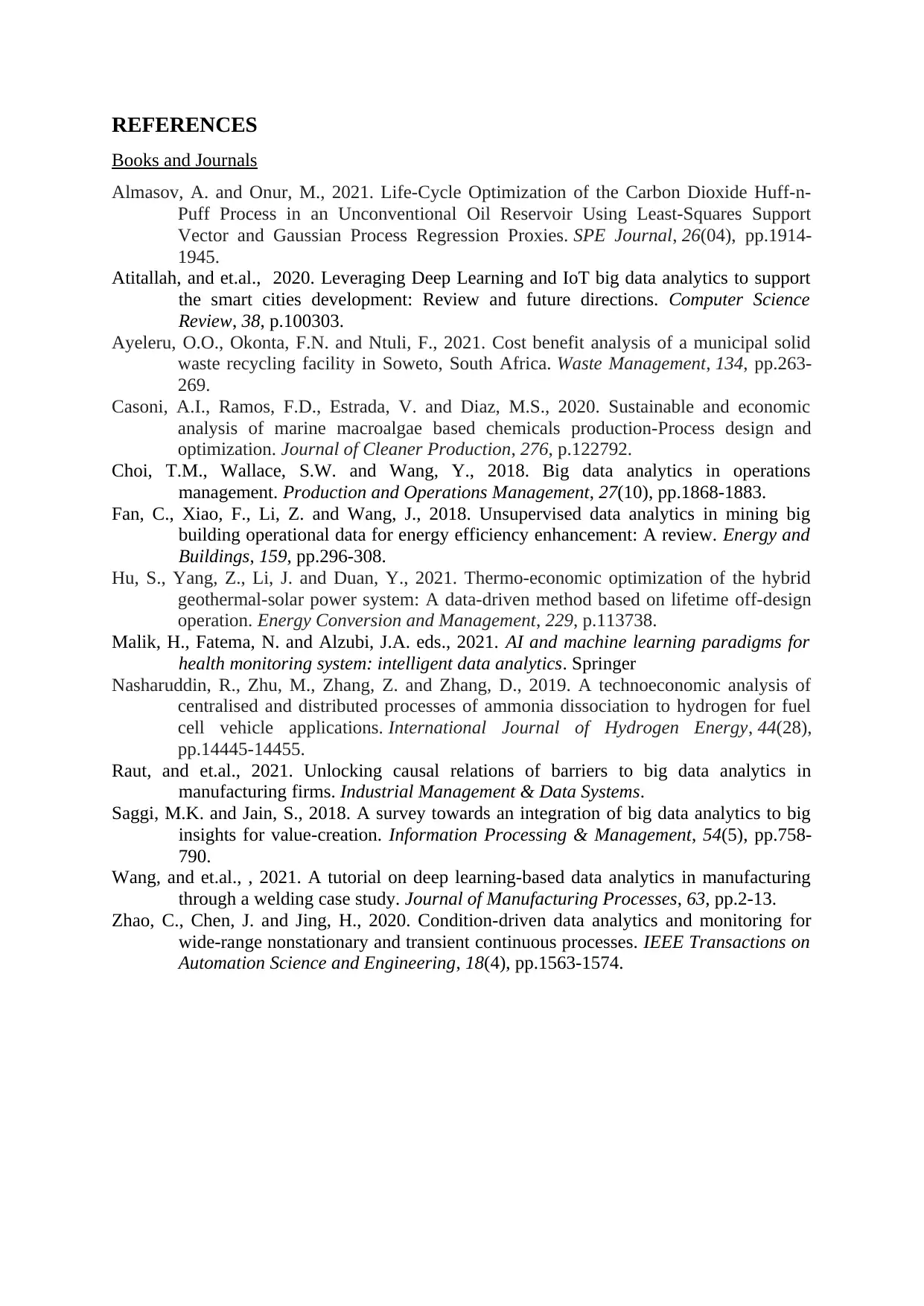
REFERENCES
Books and Journals
Almasov, A. and Onur, M., 2021. Life-Cycle Optimization of the Carbon Dioxide Huff-n-
Puff Process in an Unconventional Oil Reservoir Using Least-Squares Support
Vector and Gaussian Process Regression Proxies. SPE Journal, 26(04), pp.1914-
1945.
Atitallah, and et.al., 2020. Leveraging Deep Learning and IoT big data analytics to support
the smart cities development: Review and future directions. Computer Science
Review, 38, p.100303.
Ayeleru, O.O., Okonta, F.N. and Ntuli, F., 2021. Cost benefit analysis of a municipal solid
waste recycling facility in Soweto, South Africa. Waste Management, 134, pp.263-
269.
Casoni, A.I., Ramos, F.D., Estrada, V. and Diaz, M.S., 2020. Sustainable and economic
analysis of marine macroalgae based chemicals production-Process design and
optimization. Journal of Cleaner Production, 276, p.122792.
Choi, T.M., Wallace, S.W. and Wang, Y., 2018. Big data analytics in operations
management. Production and Operations Management, 27(10), pp.1868-1883.
Fan, C., Xiao, F., Li, Z. and Wang, J., 2018. Unsupervised data analytics in mining big
building operational data for energy efficiency enhancement: A review. Energy and
Buildings, 159, pp.296-308.
Hu, S., Yang, Z., Li, J. and Duan, Y., 2021. Thermo-economic optimization of the hybrid
geothermal-solar power system: A data-driven method based on lifetime off-design
operation. Energy Conversion and Management, 229, p.113738.
Malik, H., Fatema, N. and Alzubi, J.A. eds., 2021. AI and machine learning paradigms for
health monitoring system: intelligent data analytics. Springer
Nasharuddin, R., Zhu, M., Zhang, Z. and Zhang, D., 2019. A technoeconomic analysis of
centralised and distributed processes of ammonia dissociation to hydrogen for fuel
cell vehicle applications. International Journal of Hydrogen Energy, 44(28),
pp.14445-14455.
Raut, and et.al., 2021. Unlocking causal relations of barriers to big data analytics in
manufacturing firms. Industrial Management & Data Systems.
Saggi, M.K. and Jain, S., 2018. A survey towards an integration of big data analytics to big
insights for value-creation. Information Processing & Management, 54(5), pp.758-
790.
Wang, and et.al., , 2021. A tutorial on deep learning-based data analytics in manufacturing
through a welding case study. Journal of Manufacturing Processes, 63, pp.2-13.
Zhao, C., Chen, J. and Jing, H., 2020. Condition-driven data analytics and monitoring for
wide-range nonstationary and transient continuous processes. IEEE Transactions on
Automation Science and Engineering, 18(4), pp.1563-1574.
Books and Journals
Almasov, A. and Onur, M., 2021. Life-Cycle Optimization of the Carbon Dioxide Huff-n-
Puff Process in an Unconventional Oil Reservoir Using Least-Squares Support
Vector and Gaussian Process Regression Proxies. SPE Journal, 26(04), pp.1914-
1945.
Atitallah, and et.al., 2020. Leveraging Deep Learning and IoT big data analytics to support
the smart cities development: Review and future directions. Computer Science
Review, 38, p.100303.
Ayeleru, O.O., Okonta, F.N. and Ntuli, F., 2021. Cost benefit analysis of a municipal solid
waste recycling facility in Soweto, South Africa. Waste Management, 134, pp.263-
269.
Casoni, A.I., Ramos, F.D., Estrada, V. and Diaz, M.S., 2020. Sustainable and economic
analysis of marine macroalgae based chemicals production-Process design and
optimization. Journal of Cleaner Production, 276, p.122792.
Choi, T.M., Wallace, S.W. and Wang, Y., 2018. Big data analytics in operations
management. Production and Operations Management, 27(10), pp.1868-1883.
Fan, C., Xiao, F., Li, Z. and Wang, J., 2018. Unsupervised data analytics in mining big
building operational data for energy efficiency enhancement: A review. Energy and
Buildings, 159, pp.296-308.
Hu, S., Yang, Z., Li, J. and Duan, Y., 2021. Thermo-economic optimization of the hybrid
geothermal-solar power system: A data-driven method based on lifetime off-design
operation. Energy Conversion and Management, 229, p.113738.
Malik, H., Fatema, N. and Alzubi, J.A. eds., 2021. AI and machine learning paradigms for
health monitoring system: intelligent data analytics. Springer
Nasharuddin, R., Zhu, M., Zhang, Z. and Zhang, D., 2019. A technoeconomic analysis of
centralised and distributed processes of ammonia dissociation to hydrogen for fuel
cell vehicle applications. International Journal of Hydrogen Energy, 44(28),
pp.14445-14455.
Raut, and et.al., 2021. Unlocking causal relations of barriers to big data analytics in
manufacturing firms. Industrial Management & Data Systems.
Saggi, M.K. and Jain, S., 2018. A survey towards an integration of big data analytics to big
insights for value-creation. Information Processing & Management, 54(5), pp.758-
790.
Wang, and et.al., , 2021. A tutorial on deep learning-based data analytics in manufacturing
through a welding case study. Journal of Manufacturing Processes, 63, pp.2-13.
Zhao, C., Chen, J. and Jing, H., 2020. Condition-driven data analytics and monitoring for
wide-range nonstationary and transient continuous processes. IEEE Transactions on
Automation Science and Engineering, 18(4), pp.1563-1574.
⊘ This is a preview!⊘
Do you want full access?
Subscribe today to unlock all pages.
Trusted by 1+ million students worldwide

1 out of 12


Related Documents


Your All-in-One AI-Powered Toolkit for Academic Success.
+13062052269
info@desklib.com
Available 24*7 on WhatsApp / Email
![[object Object]](/_next/static/media/star-bottom.7253800d.svg)
Unlock your academic potential
Copyright © 2020–2026 A2Z Services. All Rights Reserved. Developed and managed by ZUCOL.