Construction Procurement Report: Methods, Aspects, and Analysis
VerifiedAdded on 2020/04/01
|12
|3222
|43
Report
AI Summary
This report provides a comprehensive analysis of three distinct construction procurement methods: Design Bid Build (DBB), Public-Private Partnership (PPP), and Design and Construct. The report begins with an executive summary, followed by background information setting the stage for the discussion. The core of the report delves into the characteristics, advantages, and disadvantages of each procurement method, considering their effects on developers/clients, builders, consultants, end-users, and subcontractors. For DBB, the report examines the design, tender/bidding, and construction phases, highlighting its cost estimation benefits and limitations in contractor input. The PPP section explores the collaboration between public and private sectors, emphasizing its role in encouraging investments and efficient resource management, while also acknowledging potential communication challenges and higher costs. Finally, the Design and Construct method is presented as a single-entity approach, emphasizing its quick tracking and reduced risks due to contractor involvement from the design phase. The report concludes by summarizing the key findings and implications of each procurement method, providing valuable insights for construction project stakeholders.
Procurement Report 1
REPORT ON THE POSITIVE AND NEGATIVE ASPECTS OF THREE DIFFERENT
CONSTRUCTION METHODS
A Report Paper on Procurement By
Student’s Name
Name of the Professor
Institutional Affiliation
City/State
Year/Month/Day
REPORT ON THE POSITIVE AND NEGATIVE ASPECTS OF THREE DIFFERENT
CONSTRUCTION METHODS
A Report Paper on Procurement By
Student’s Name
Name of the Professor
Institutional Affiliation
City/State
Year/Month/Day

Paraphrase This Document
Need a fresh take? Get an instant paraphrase of this document with our AI Paraphraser
Procurement Report 2
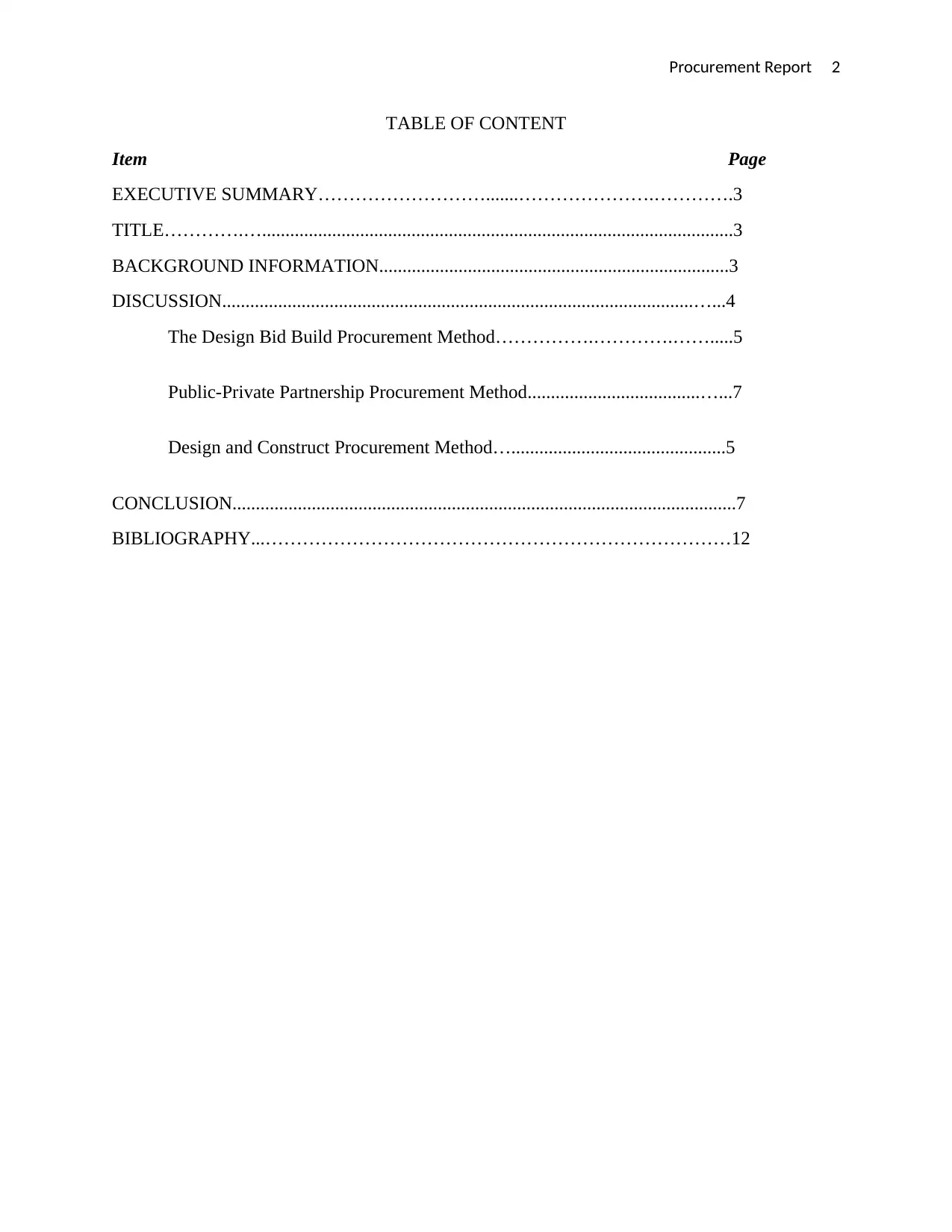
TABLE OF CONTENT
Item Page
EXECUTIVE SUMMARY……………………….......………………….………….3
TITLE………….….....................................................................................................3
BACKGROUND INFORMATION...........................................................................3
DISCUSSION.....................................................................................................…...4
The Design Bid Build Procurement Method…………….………….…….....5
Public-Private Partnership Procurement Method.....................................…...7
Design and Construct Procurement Method…..............................................5
CONCLUSION............................................................................................................7
BIBLIOGRAPHY...…………………………………………………………………12
TABLE OF CONTENT
Item Page
EXECUTIVE SUMMARY……………………….......………………….………….3
TITLE………….….....................................................................................................3
BACKGROUND INFORMATION...........................................................................3
DISCUSSION.....................................................................................................…...4
The Design Bid Build Procurement Method…………….………….…….....5
Public-Private Partnership Procurement Method.....................................…...7
Design and Construct Procurement Method…..............................................5
CONCLUSION............................................................................................................7
BIBLIOGRAPHY...…………………………………………………………………12
Procurement Report 3
EXECUTIVE SUMMARY
This report is the description and analysis of the negative and positive aspects of the three
methods of procurement for the construction. The three modern procurement methods are also
discussed exclusively together with other modern types of procurement methods have also been
reported. Some of the types of procurement include Public-Private Partnership, construction
management method, Design and Construct, and Design, Bid, Build (DBB). The procurement for
construction assists agencies to realize prosperous project results through provision of support
and guidance to assist in risks minimization as well as overruns in cost, helping agencies, and
their advisers to apply suitable discipline levels to procurement and through provision of a
consistent basis for interface management between private sector and government.
Some of the factors influencing the strategy of procurement include timing, project
characteristics, external factors such as commercial, social, and political factors, cost issues,
client resources, ability to make changes, and project characteristic. The three types of
procurement that have been discussed exclusively in this paper include Public-Private
Partnership, construction management method, Design and Construct, and Design, Bid, Build
(DBB). Their characteristics, positive and negative aspects of the above three mentioned
procurement methods are also discussed with the concentration made of their effects on
developer/client, builders, consultants, end-users, and sub-contractors.
EXECUTIVE SUMMARY
This report is the description and analysis of the negative and positive aspects of the three
methods of procurement for the construction. The three modern procurement methods are also
discussed exclusively together with other modern types of procurement methods have also been
reported. Some of the types of procurement include Public-Private Partnership, construction
management method, Design and Construct, and Design, Bid, Build (DBB). The procurement for
construction assists agencies to realize prosperous project results through provision of support
and guidance to assist in risks minimization as well as overruns in cost, helping agencies, and
their advisers to apply suitable discipline levels to procurement and through provision of a
consistent basis for interface management between private sector and government.
Some of the factors influencing the strategy of procurement include timing, project
characteristics, external factors such as commercial, social, and political factors, cost issues,
client resources, ability to make changes, and project characteristic. The three types of
procurement that have been discussed exclusively in this paper include Public-Private
Partnership, construction management method, Design and Construct, and Design, Bid, Build
(DBB). Their characteristics, positive and negative aspects of the above three mentioned
procurement methods are also discussed with the concentration made of their effects on
developer/client, builders, consultants, end-users, and sub-contractors.
⊘ This is a preview!⊘
Do you want full access?
Subscribe today to unlock all pages.

Trusted by 1+ million students worldwide
Procurement Report 4
Title: REPORT ON THE POSITIVE AND NEGATIVE ASPECTS OF THREE DIFFERENT
CONSTRUCTION METHODS
Background Information
This report is the description and analysis of the negative and positive aspects of the three
methods of procurement for the construction. The three modern procurement methods are also
discussed exclusively together with other modern types of procurement methods have also been
reported. The problems and benefits that these procurement methods have on developer/client,
end-users, builders, and consultants. Some of the types of procurement include Public-Private
Partnership, construction management method, Design and Construct, and Design, Bid, Build
(DBB).
The procurement for construction is a solution which gives the necessary support and
guidance to assist in reducing the cost and risks overruns. This system assists agencies to realize
prosperous project results through provision of support and guidance to assist in risks
minimization as well as overruns in cost, helping agencies, and their advisers to apply suitable
discipline levels to procurement and through provision of a consistent basis for interface
management between private sector and government (Akintola Akintoye, 2015, p. 189).
The procurement system for construction gives support for selecting appropriate
contracting and procurement strategies, preparing for tender contracts and documents based on
forms that are standard, selecting consultants and contractors with records of performance that is
proven, efficient contracts management such as checklist of sample letter, resolution of disputes
and claims that are contractual, and maintaining efficient system of performance management
through reporting and monitoring. Some of the factors influencing the strategy of procurement
Title: REPORT ON THE POSITIVE AND NEGATIVE ASPECTS OF THREE DIFFERENT
CONSTRUCTION METHODS
Background Information
This report is the description and analysis of the negative and positive aspects of the three
methods of procurement for the construction. The three modern procurement methods are also
discussed exclusively together with other modern types of procurement methods have also been
reported. The problems and benefits that these procurement methods have on developer/client,
end-users, builders, and consultants. Some of the types of procurement include Public-Private
Partnership, construction management method, Design and Construct, and Design, Bid, Build
(DBB).
The procurement for construction is a solution which gives the necessary support and
guidance to assist in reducing the cost and risks overruns. This system assists agencies to realize
prosperous project results through provision of support and guidance to assist in risks
minimization as well as overruns in cost, helping agencies, and their advisers to apply suitable
discipline levels to procurement and through provision of a consistent basis for interface
management between private sector and government (Akintola Akintoye, 2015, p. 189).
The procurement system for construction gives support for selecting appropriate
contracting and procurement strategies, preparing for tender contracts and documents based on
forms that are standard, selecting consultants and contractors with records of performance that is
proven, efficient contracts management such as checklist of sample letter, resolution of disputes
and claims that are contractual, and maintaining efficient system of performance management
through reporting and monitoring. Some of the factors influencing the strategy of procurement
Paraphrase This Document
Need a fresh take? Get an instant paraphrase of this document with our AI Paraphraser
Procurement Report 5
include timing, project characteristics, external factors such as commercial, social, and political
factors, cost issues, client resources, ability to make changes, and project characteristic
(Austroads Limited, 2012, p. 158).
Discussion
The three types of procurement that have been discussed exclusively in this paper include
Public-Private Partnership, construction management method, Design and Construct, and
Design, Bid, Build (DBB). Their characteristics, positive and negative aspects of the above three
mentioned procurement methods are also discussed with the concentration made of their effects
on developer/client, builders, consultants, end-users, and sub-contractors(Derek H. T. Walker,
2013, p. 278).
Procurement Methods
The Design Bid Build Procurement Method
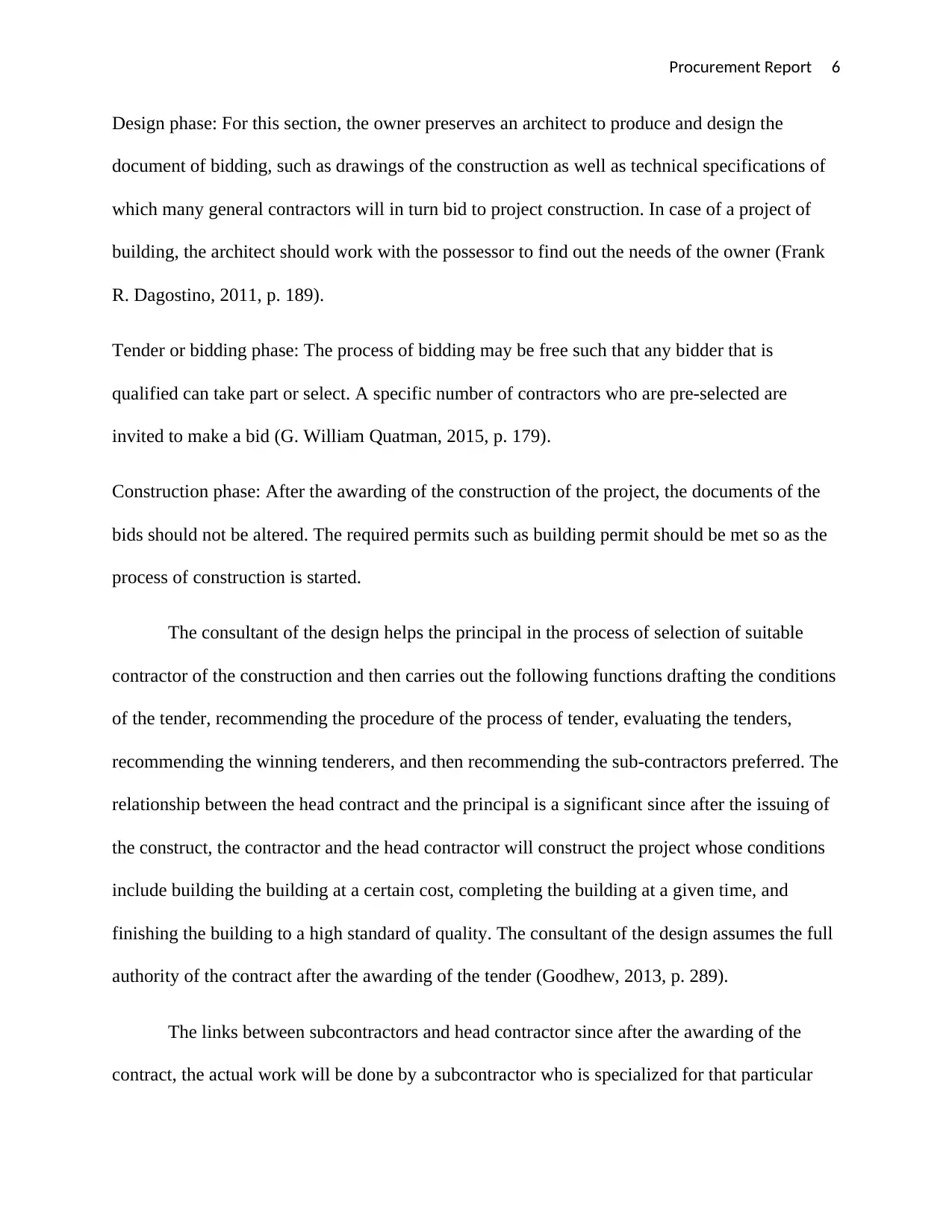
The major parties involved in the DBB method are the contractor, design consultant, and
principal as illustrated in the figure below:
The DBB is a construction delivery procedure such that the owner or agency contracts
with different entities for construction and project design. The three major categories of DBB
method include:
include timing, project characteristics, external factors such as commercial, social, and political
factors, cost issues, client resources, ability to make changes, and project characteristic
(Austroads Limited, 2012, p. 158).
Discussion
The three types of procurement that have been discussed exclusively in this paper include
Public-Private Partnership, construction management method, Design and Construct, and
Design, Bid, Build (DBB). Their characteristics, positive and negative aspects of the above three
mentioned procurement methods are also discussed with the concentration made of their effects
on developer/client, builders, consultants, end-users, and sub-contractors(Derek H. T. Walker,
2013, p. 278).
Procurement Methods
The Design Bid Build Procurement Method
The major parties involved in the DBB method are the contractor, design consultant, and
principal as illustrated in the figure below:
The DBB is a construction delivery procedure such that the owner or agency contracts
with different entities for construction and project design. The three major categories of DBB
method include:
Procurement Report 6
Design phase: For this section, the owner preserves an architect to produce and design the
document of bidding, such as drawings of the construction as well as technical specifications of
which many general contractors will in turn bid to project construction. In case of a project of
building, the architect should work with the possessor to find out the needs of the owner (Frank
R. Dagostino, 2011, p. 189).
Tender or bidding phase: The process of bidding may be free such that any bidder that is
qualified can take part or select. A specific number of contractors who are pre-selected are
invited to make a bid (G. William Quatman, 2015, p. 179).
Construction phase: After the awarding of the construction of the project, the documents of the
bids should not be altered. The required permits such as building permit should be met so as the
process of construction is started.
The consultant of the design helps the principal in the process of selection of suitable
contractor of the construction and then carries out the following functions drafting the conditions
of the tender, recommending the procedure of the process of tender, evaluating the tenders,
recommending the winning tenderers, and then recommending the sub-contractors preferred. The
relationship between the head contract and the principal is a significant since after the issuing of
the construct, the contractor and the head contractor will construct the project whose conditions
include building the building at a certain cost, completing the building at a given time, and
finishing the building to a high standard of quality. The consultant of the design assumes the full
authority of the contract after the awarding of the tender (Goodhew, 2013, p. 289).
The links between subcontractors and head contractor since after the awarding of the
contract, the actual work will be done by a subcontractor who is specialized for that particular
Design phase: For this section, the owner preserves an architect to produce and design the
document of bidding, such as drawings of the construction as well as technical specifications of
which many general contractors will in turn bid to project construction. In case of a project of
building, the architect should work with the possessor to find out the needs of the owner (Frank
R. Dagostino, 2011, p. 189).
Tender or bidding phase: The process of bidding may be free such that any bidder that is
qualified can take part or select. A specific number of contractors who are pre-selected are
invited to make a bid (G. William Quatman, 2015, p. 179).
Construction phase: After the awarding of the construction of the project, the documents of the
bids should not be altered. The required permits such as building permit should be met so as the
process of construction is started.
The consultant of the design helps the principal in the process of selection of suitable
contractor of the construction and then carries out the following functions drafting the conditions
of the tender, recommending the procedure of the process of tender, evaluating the tenders,
recommending the winning tenderers, and then recommending the sub-contractors preferred. The
relationship between the head contract and the principal is a significant since after the issuing of
the construct, the contractor and the head contractor will construct the project whose conditions
include building the building at a certain cost, completing the building at a given time, and
finishing the building to a high standard of quality. The consultant of the design assumes the full
authority of the contract after the awarding of the tender (Goodhew, 2013, p. 289).
The links between subcontractors and head contractor since after the awarding of the
contract, the actual work will be done by a subcontractor who is specialized for that particular
⊘ This is a preview!⊘
Do you want full access?
Subscribe today to unlock all pages.
Trusted by 1+ million students worldwide
Procurement Report 7
field. The head contractor splits the actual contract into a smaller contract as then assumes the
role of construction activities manager which include resource allocation, subcontractors co-
ordination, and budgeting and programming (Goodhew, 2013, p. 308).
Positive aspects of the Design Bid Build
The estimation of the cost may be made before the awarding of the contract fairly.
There is the limitation of financial risks because the majority of the risks are taken by the
construction contractor.
The variations in design are minimized since the documentation of the design are
finalized before the awarding of the construction to the contractor.
The design team take note of the owner’s interest
There is fairness during the bidding process on the bidders that are potential and develops
the process of decision-making since the owner has a wide variety of probable choices
(Jeffrey L. Beard, 2010, p. 189).
Negative aspects of Design Bid Build
The construction of the project cannot begin until it is fully documented and designed.
The contractor of the construction does not take part in the design hence does not input
their management and technical expertise.
There are high risks of predatory bidding if there are documentation and design errors.
The construction and design team can be under pressure because of competing for
interests (Jeffrey N. Buxbaum, 2014, p. 216).
Public-Private Partnership Procurement Method
This is an arrangement that is corporative among tow or even more private and public
sectors generally of a long duration. The Public-Private Partnership is a method of transferring
the responsibilities to the private sector such as a construction company owned by an individual
from the public sector owned by the government such as transferring construction contract from
the public sector to private sector. This procurement approach may be (BOOT) which is an
abbreviation of Build Own Operate Transfer (BOOT) or (BOT) which is an abbreviation of
Build Operate Transfer method of delivery such that the computer doing the construction
field. The head contractor splits the actual contract into a smaller contract as then assumes the
role of construction activities manager which include resource allocation, subcontractors co-
ordination, and budgeting and programming (Goodhew, 2013, p. 308).
Positive aspects of the Design Bid Build
The estimation of the cost may be made before the awarding of the contract fairly.
There is the limitation of financial risks because the majority of the risks are taken by the
construction contractor.
The variations in design are minimized since the documentation of the design are
finalized before the awarding of the construction to the contractor.
The design team take note of the owner’s interest
There is fairness during the bidding process on the bidders that are potential and develops
the process of decision-making since the owner has a wide variety of probable choices
(Jeffrey L. Beard, 2010, p. 189).
Negative aspects of Design Bid Build
The construction of the project cannot begin until it is fully documented and designed.
The contractor of the construction does not take part in the design hence does not input
their management and technical expertise.
There are high risks of predatory bidding if there are documentation and design errors.
The construction and design team can be under pressure because of competing for
interests (Jeffrey N. Buxbaum, 2014, p. 216).
Public-Private Partnership Procurement Method
This is an arrangement that is corporative among tow or even more private and public
sectors generally of a long duration. The Public-Private Partnership is a method of transferring
the responsibilities to the private sector such as a construction company owned by an individual
from the public sector owned by the government such as transferring construction contract from
the public sector to private sector. This procurement approach may be (BOOT) which is an
abbreviation of Build Own Operate Transfer (BOOT) or (BOT) which is an abbreviation of
Build Operate Transfer method of delivery such that the computer doing the construction
Paraphrase This Document
Need a fresh take? Get an instant paraphrase of this document with our AI Paraphraser
Procurement Report 8
constructs the project, take ownership for a given duration, operates the building for the duration
it is owning it, and then transferring the assets back to the real owner (Jeffrey N. Buxbaum,
2014, p. 218).
An example of the Public Private Partnership is the M7 motorway project. The links
between the principal together with the consortium and promoter in the Public Private
Partnership is a mutual relationship. The consortium and promoter commence the process of
construction and management of the construction. The promoter and the consortium have the
responsibility of funding the construction. The promoter then engages the contractor of the
construction who in turn takes on the design and construction risks. The principal may
incorporate guarantees into the construction plan so as to reduce the traffic flow or else allowing
the operator to carry out the construction in return for rent (John Bennett (P.A.), 2010, p. 149).
Benefits of the Private Public Partnership
This method is important by encouraging investments into the public sector and more
efficient management of public resources.
This method provides higher timely and quality provision of the services to the public.
The private entity is given a chance to acquire an implementation that is long-term.
There is the faster completion of the projects and construction as well as limited delays on
projects of infrastructure.
This method ensures higher efficiency since the government budget deficits and budgets are
greatly reduced (John Bennett (P.A.), 2013, p. 169).
Negative aspects of the Private Public Partnership
Poor communication and understanding due to the diversity of and differing in languages
spoken between the sectors. Factors such as regulation, performance measurements, nature
funding, and government regulations can be interpreted differently.
Conflicts can arise from disagreements causing the partnership to be a halt. Lack of
understanding and poor communications are usually the major causing conflicts between the
members involved in the construction.
constructs the project, take ownership for a given duration, operates the building for the duration
it is owning it, and then transferring the assets back to the real owner (Jeffrey N. Buxbaum,
2014, p. 218).
An example of the Public Private Partnership is the M7 motorway project. The links
between the principal together with the consortium and promoter in the Public Private
Partnership is a mutual relationship. The consortium and promoter commence the process of
construction and management of the construction. The promoter and the consortium have the
responsibility of funding the construction. The promoter then engages the contractor of the
construction who in turn takes on the design and construction risks. The principal may
incorporate guarantees into the construction plan so as to reduce the traffic flow or else allowing
the operator to carry out the construction in return for rent (John Bennett (P.A.), 2010, p. 149).
Benefits of the Private Public Partnership
This method is important by encouraging investments into the public sector and more
efficient management of public resources.
This method provides higher timely and quality provision of the services to the public.
The private entity is given a chance to acquire an implementation that is long-term.
There is the faster completion of the projects and construction as well as limited delays on
projects of infrastructure.
This method ensures higher efficiency since the government budget deficits and budgets are
greatly reduced (John Bennett (P.A.), 2013, p. 169).
Negative aspects of the Private Public Partnership
Poor communication and understanding due to the diversity of and differing in languages
spoken between the sectors. Factors such as regulation, performance measurements, nature
funding, and government regulations can be interpreted differently.
Conflicts can arise from disagreements causing the partnership to be a halt. Lack of
understanding and poor communications are usually the major causing conflicts between the
members involved in the construction.
Procurement Report 9
This procurement method is also faced by the funding priorities since the parties involved
cannot decide on where the funding should be placed leading to loss of some time and
resources making the project to delay.
The services and infrastructure being delivered by the constructor may be more expensive
than other procurement methods.
The procedures involved in the Public Private Partnership are more costly and takes a longer
duration as compared to other procurement methods (Keith Potts, 2012, p. 179).
Design and Construct Procurement Method
The Design and Construct procurement method is where a person design and construct
within a single organization. This method is also known as turn-key or package deal methods.
The Design and Construct method is usually carried out in a construction company which
subcontracts the design to consultants of the design, a company which has the authority to do
construction and design or a combined venture which uses a construction company and design
company (Marcus C. Jefferies, 2011, p. 139).
The Design and Construct method needs some quick tracking during the process through
overlapping the construction and design stages. The principal has a greater involvement in this
method compared to the approach of Design Bid Build. The principal in the Design and
Construct method has a sole point of contact which is normally the contractor of the
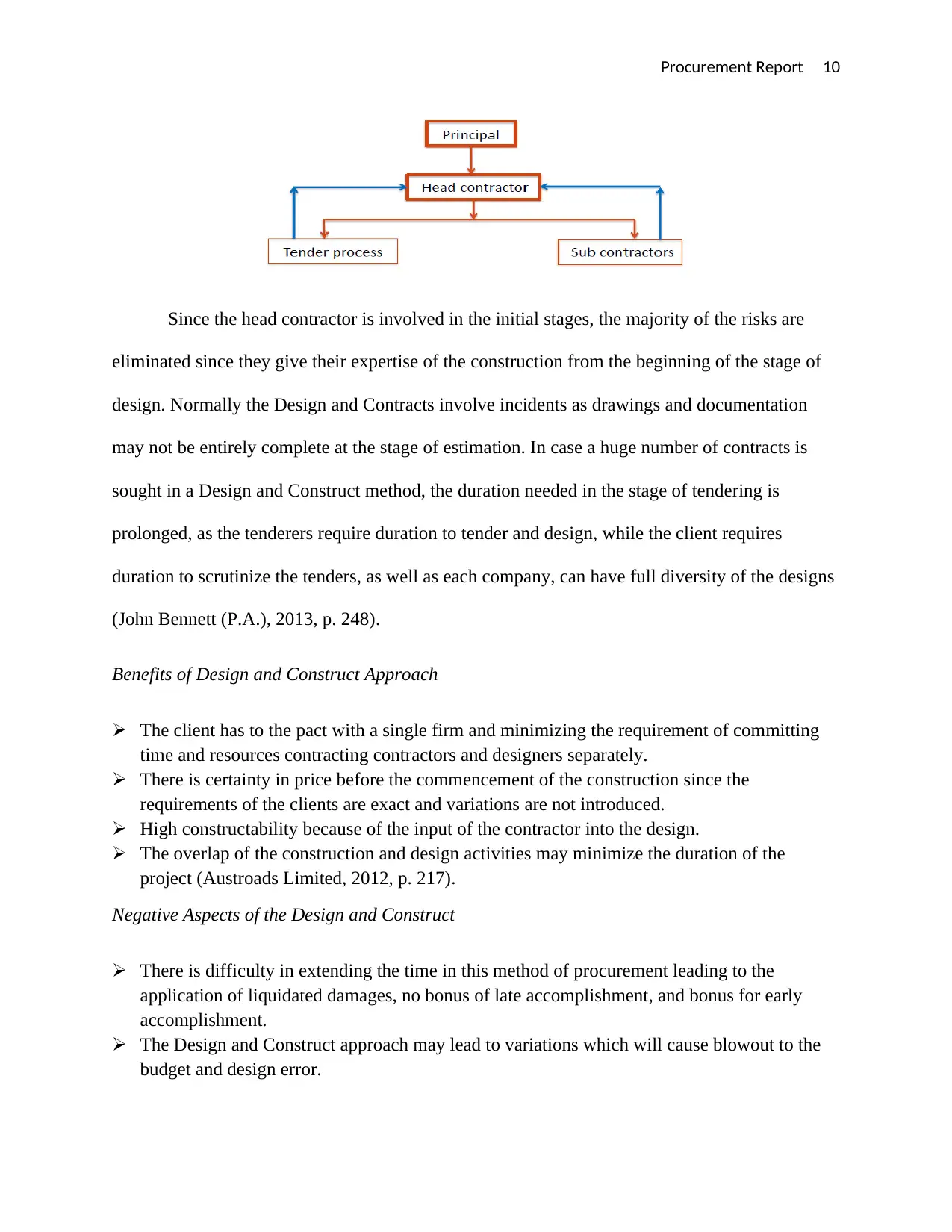
construction. The major parties that take part in the Design and Construct method of
procurement are the head contractor and the principal, where the head contractor being the point
of contact for the subcontractors and consultants of the design. This is illustrated in the figure
below:
This procurement method is also faced by the funding priorities since the parties involved
cannot decide on where the funding should be placed leading to loss of some time and
resources making the project to delay.
The services and infrastructure being delivered by the constructor may be more expensive
than other procurement methods.
The procedures involved in the Public Private Partnership are more costly and takes a longer
duration as compared to other procurement methods (Keith Potts, 2012, p. 179).
Design and Construct Procurement Method
The Design and Construct procurement method is where a person design and construct
within a single organization. This method is also known as turn-key or package deal methods.
The Design and Construct method is usually carried out in a construction company which
subcontracts the design to consultants of the design, a company which has the authority to do
construction and design or a combined venture which uses a construction company and design
company (Marcus C. Jefferies, 2011, p. 139).
The Design and Construct method needs some quick tracking during the process through
overlapping the construction and design stages. The principal has a greater involvement in this
method compared to the approach of Design Bid Build. The principal in the Design and
Construct method has a sole point of contact which is normally the contractor of the
construction. The major parties that take part in the Design and Construct method of
procurement are the head contractor and the principal, where the head contractor being the point
of contact for the subcontractors and consultants of the design. This is illustrated in the figure
below:
⊘ This is a preview!⊘
Do you want full access?
Subscribe today to unlock all pages.
Trusted by 1+ million students worldwide
Procurement Report 10
Since the head contractor is involved in the initial stages, the majority of the risks are
eliminated since they give their expertise of the construction from the beginning of the stage of
design. Normally the Design and Contracts involve incidents as drawings and documentation
may not be entirely complete at the stage of estimation. In case a huge number of contracts is
sought in a Design and Construct method, the duration needed in the stage of tendering is
prolonged, as the tenderers require duration to tender and design, while the client requires
duration to scrutinize the tenders, as well as each company, can have full diversity of the designs
(John Bennett (P.A.), 2013, p. 248).
Benefits of Design and Construct Approach
The client has to the pact with a single firm and minimizing the requirement of committing
time and resources contracting contractors and designers separately.
There is certainty in price before the commencement of the construction since the
requirements of the clients are exact and variations are not introduced.
High constructability because of the input of the contractor into the design.
The overlap of the construction and design activities may minimize the duration of the
project (Austroads Limited, 2012, p. 217).
Negative Aspects of the Design and Construct
There is difficulty in extending the time in this method of procurement leading to the
application of liquidated damages, no bonus of late accomplishment, and bonus for early
accomplishment.
The Design and Construct approach may lead to variations which will cause blowout to the
budget and design error.
Since the head contractor is involved in the initial stages, the majority of the risks are
eliminated since they give their expertise of the construction from the beginning of the stage of
design. Normally the Design and Contracts involve incidents as drawings and documentation
may not be entirely complete at the stage of estimation. In case a huge number of contracts is
sought in a Design and Construct method, the duration needed in the stage of tendering is
prolonged, as the tenderers require duration to tender and design, while the client requires
duration to scrutinize the tenders, as well as each company, can have full diversity of the designs
(John Bennett (P.A.), 2013, p. 248).
Benefits of Design and Construct Approach
The client has to the pact with a single firm and minimizing the requirement of committing
time and resources contracting contractors and designers separately.
There is certainty in price before the commencement of the construction since the
requirements of the clients are exact and variations are not introduced.
High constructability because of the input of the contractor into the design.
The overlap of the construction and design activities may minimize the duration of the
project (Austroads Limited, 2012, p. 217).
Negative Aspects of the Design and Construct
There is difficulty in extending the time in this method of procurement leading to the
application of liquidated damages, no bonus of late accomplishment, and bonus for early
accomplishment.
The Design and Construct approach may lead to variations which will cause blowout to the
budget and design error.
Paraphrase This Document
Need a fresh take? Get an instant paraphrase of this document with our AI Paraphraser
Procurement Report 11
There is also need of including special conditions in the contract when implementing this
procurement approach (Frank R. Dagostino, 2011, p. 179).
Conclusion
This report is the description and analysis of the negative and positive aspects of the three
methods of procurement for the construction. The three modern procurement methods that have
been discussed exclusively together with other modern types of procurement methods have also
been reported. The problems and benefits that these procurement methods have on
developer/client, end-users, builders, and consultants have also been discussed in this report.
Some of the types of procurement discussed in this report include Public-Private Partnership,
construction management method, Design and Construct, and Design, Bid, Build (DBB).
The DBB is a construction delivery procedure such that the owner or agency contracts
with different entities for construction and a project design. The Public-Private Partnership is a
method of transferring the responsibilities to the private sector such as a construction company
owned by an individual from the public sector owned by the government such as transferring
construction contract from the public sector to private sector. The Design and Construct
procurement method is where a person design and construct within a single organization. This
method is also known as turn-key or package deal methods.
There is also need of including special conditions in the contract when implementing this
procurement approach (Frank R. Dagostino, 2011, p. 179).
Conclusion
This report is the description and analysis of the negative and positive aspects of the three
methods of procurement for the construction. The three modern procurement methods that have
been discussed exclusively together with other modern types of procurement methods have also
been reported. The problems and benefits that these procurement methods have on
developer/client, end-users, builders, and consultants have also been discussed in this report.
Some of the types of procurement discussed in this report include Public-Private Partnership,
construction management method, Design and Construct, and Design, Bid, Build (DBB).
The DBB is a construction delivery procedure such that the owner or agency contracts
with different entities for construction and a project design. The Public-Private Partnership is a
method of transferring the responsibilities to the private sector such as a construction company
owned by an individual from the public sector owned by the government such as transferring
construction contract from the public sector to private sector. The Design and Construct
procurement method is where a person design and construct within a single organization. This
method is also known as turn-key or package deal methods.
Procurement Report 12
Bibliography
Akintola Akintoye, M. B. C. H., 2015. Public-Private Partnerships: Managing Risks and Opportunities.
Paris: John Wiley & Sons.
Austroads Limited, E. C., 2012. Building and Construction Procurement Guide: Principles and Options.
London: Austroads Limited.
Austroads Limited, E. C., 2013. Building and Construction Procurement Guide: Principles and Options.
Michigan: Austroads Limited.
Derek H. T. Walker, B. M. L.-W., 2013. Collaborative Project Procurement Arrangements. California:
Project Management Institute.
Elias G. Carayannis, Y.-H. K. F. T. A., 2015. The Story of Managing Projects: An Interdisciplinary Approach.
Michigan: Greenwood Publishing Group.
Elisa Casey, P. L. C. M., 2016. Guide to Project Delivery. Paris: Elisa Casey, Peter Letts, Colin MacKay.
Frank R. Dagostino, L. F., 2011. Project Management Institute. Chicago: Prentice Hall.
G. William Quatman, I. R. (. D., 2015. The Architect's Guide to Design-Build Services. New York: John
Wiley & Sons.
Goodhew, S., 2013. Sustainable Construction Processes: A Resource Text. London: John Wiley & Sons.
Jeffrey L. Beard, L. E. E. C. W., 2010. Design-Build: Planning Through Development. London: McGraw Hill
Professional.
Jeffrey N. Buxbaum, I. N. O., 2014. Public Sector Decision Making for Public-private Partnerships.
Colorado: Transportation Research Board.
John Bennett (P.A.), E. P. G. R., 2010. Designing and Building a World-class Industry: The University of
Reading Design and Build Forum Report. Paris: Centre for Strategic Studies in Construction.
John Bennett (P.A.), E. P. G. R., 2013. Designing and Building a World-class Industry: The University of
Reading Design and Build Forum Report. Colorado: University of Reading. Centre for Strategic Studies in
Construction.
Keith Potts, N. A., 2012. Construction Cost Management: Learning from Case Studies. Toledo: Routledge.
Levy, S. M., 2012. Design-Build Project Delivery: Managing the Building Process from Proposal Through
Construction. London: McGraw Hill Professional.
Marcus C. Jefferies, S. R., 2011. New Forms of Procurement: PPP and Relational Contracting in the 21st
Century. New York: Routledge.
Bibliography
Akintola Akintoye, M. B. C. H., 2015. Public-Private Partnerships: Managing Risks and Opportunities.
Paris: John Wiley & Sons.
Austroads Limited, E. C., 2012. Building and Construction Procurement Guide: Principles and Options.
London: Austroads Limited.
Austroads Limited, E. C., 2013. Building and Construction Procurement Guide: Principles and Options.
Michigan: Austroads Limited.
Derek H. T. Walker, B. M. L.-W., 2013. Collaborative Project Procurement Arrangements. California:
Project Management Institute.
Elias G. Carayannis, Y.-H. K. F. T. A., 2015. The Story of Managing Projects: An Interdisciplinary Approach.
Michigan: Greenwood Publishing Group.
Elisa Casey, P. L. C. M., 2016. Guide to Project Delivery. Paris: Elisa Casey, Peter Letts, Colin MacKay.
Frank R. Dagostino, L. F., 2011. Project Management Institute. Chicago: Prentice Hall.
G. William Quatman, I. R. (. D., 2015. The Architect's Guide to Design-Build Services. New York: John
Wiley & Sons.
Goodhew, S., 2013. Sustainable Construction Processes: A Resource Text. London: John Wiley & Sons.
Jeffrey L. Beard, L. E. E. C. W., 2010. Design-Build: Planning Through Development. London: McGraw Hill
Professional.
Jeffrey N. Buxbaum, I. N. O., 2014. Public Sector Decision Making for Public-private Partnerships.
Colorado: Transportation Research Board.
John Bennett (P.A.), E. P. G. R., 2010. Designing and Building a World-class Industry: The University of
Reading Design and Build Forum Report. Paris: Centre for Strategic Studies in Construction.
John Bennett (P.A.), E. P. G. R., 2013. Designing and Building a World-class Industry: The University of
Reading Design and Build Forum Report. Colorado: University of Reading. Centre for Strategic Studies in
Construction.
Keith Potts, N. A., 2012. Construction Cost Management: Learning from Case Studies. Toledo: Routledge.
Levy, S. M., 2012. Design-Build Project Delivery: Managing the Building Process from Proposal Through
Construction. London: McGraw Hill Professional.
Marcus C. Jefferies, S. R., 2011. New Forms of Procurement: PPP and Relational Contracting in the 21st
Century. New York: Routledge.
⊘ This is a preview!⊘
Do you want full access?
Subscribe today to unlock all pages.
Trusted by 1+ million students worldwide

1 out of 12


Related Documents


Your All-in-One AI-Powered Toolkit for Academic Success.
+13062052269
info@desklib.com
Available 24*7 on WhatsApp / Email
![[object Object]](/_next/static/media/star-bottom.7253800d.svg)
Unlock your academic potential
Copyright © 2020–2026 A2Z Services. All Rights Reserved. Developed and managed by ZUCOL.