Construction Management: Valuing Progress and NZS3910 Contract

Verified

Added on  2023/06/07

|11
|2410
|435
Report
AI Summary
This report delves into various aspects of construction management, emphasizing the NZS3910 Conditions of Contract and approaches to valuing construction progress. It explores progressive payment methods in construction contracts, highlighting the systematic procedure involving regular progress claims submitted to the architect at each payment stage. The report discusses two primary approaches to valuing construction progress: the actual basis, which determines the value of materials and labor used, and the equivalent unit approach, which equates partly finished sections to finished work. Estimation techniques, including the production function technique, empirical cost inference, and BQ costs, are examined for their relative merits in valuing work progress. Furthermore, the report elucidates the NZS3910 Conditions of Contract, outlining their benefits for clients, consultants, and contractors in managing construction contracts, understanding obligations, and addressing issues like contract variations, extensions, and terminations. The document concludes by referencing relevant studies and highlighting the evolution of construction management processes to meet client preferences while adhering to construction standards. Desklib provides access to similar solved assignments and resources for students.
Document Page
Running head: CONSTRUCTION MANAGEMENT 1
Construction Management
Name
Institution
tabler-icon-diamond-filled.svg

Paraphrase This Document

Need a fresh take? Get an instant paraphrase of this document with our AI Paraphraser
Document Page
CONSTRUCTION MANAGEMENT 2
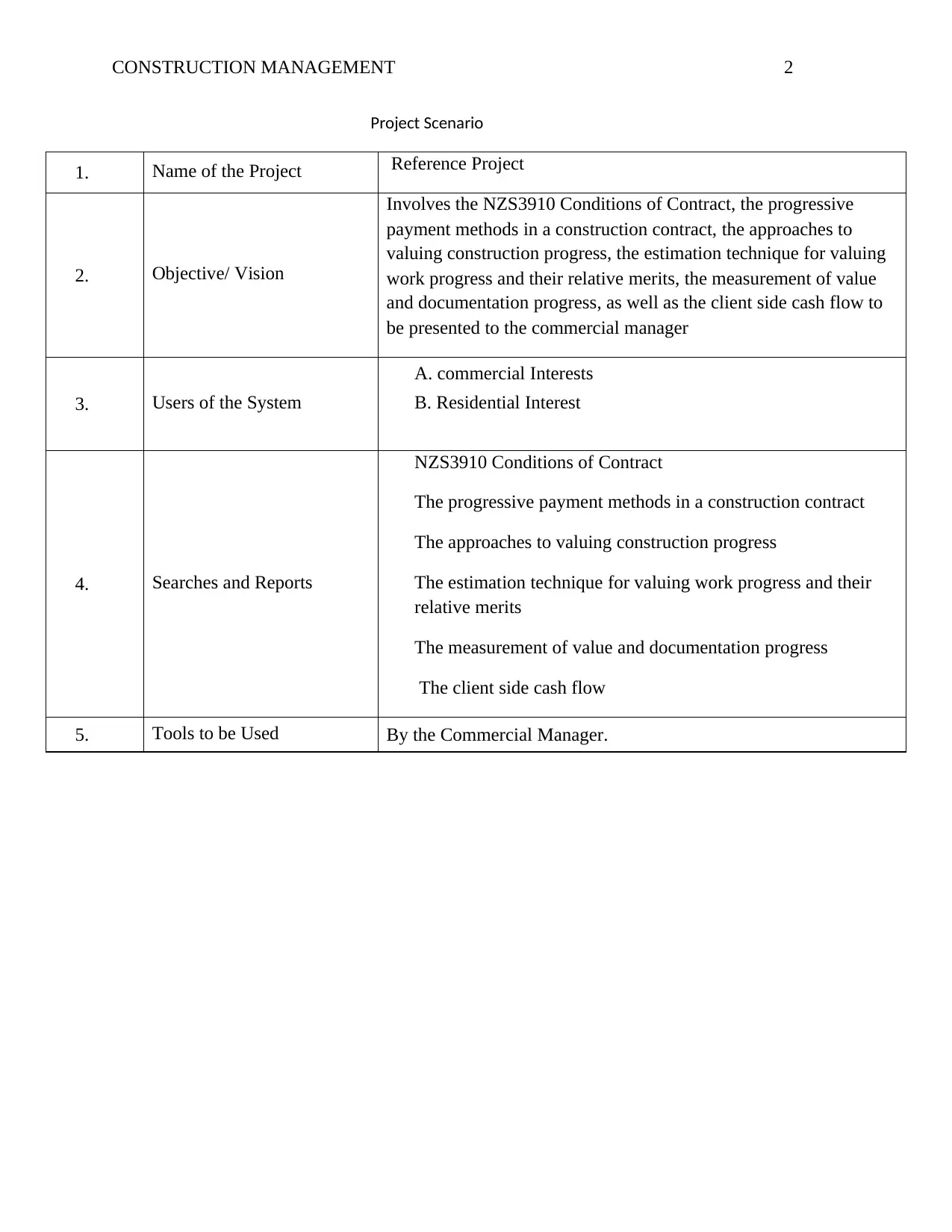
Project Scenario
1. Name of the Project Reference Project
2. Objective/ Vision
Involves the NZS3910 Conditions of Contract, the progressive
payment methods in a construction contract, the approaches to
valuing construction progress, the estimation technique for valuing
work progress and their relative merits, the measurement of value
and documentation progress, as well as the client side cash flow to
be presented to the commercial manager
3. Users of the System
A. commercial Interests
B. Residential Interest
4. Searches and Reports
NZS3910 Conditions of Contract
The progressive payment methods in a construction contract
The approaches to valuing construction progress
The estimation technique for valuing work progress and their
relative merits
The measurement of value and documentation progress
The client side cash flow
5. Tools to be Used By the Commercial Manager.
Document Page
CONSTRUCTION MANAGEMENT 3
In the face of urbanization, there is an increased pace of commercial and residential
interest in the real estate development. This means that the number of commercial and residential
buildings in the urban centers is being dictated by the influx of people into the urban areas for
one socio-economic reason or another. Due to this, as a construction managers, it is recognizable
the high alert and demand because under our watch, projects are directed, completed, and
planned based on time and budget at any level of management-client agreement. In this case, the
line of tasks for the construction managers involves planning, budgeting, and supervising the
construction project from the initial step, which is conception of the project, to the final steps,
that is project completion.
1.1 The progressive payment methods in a construction contract
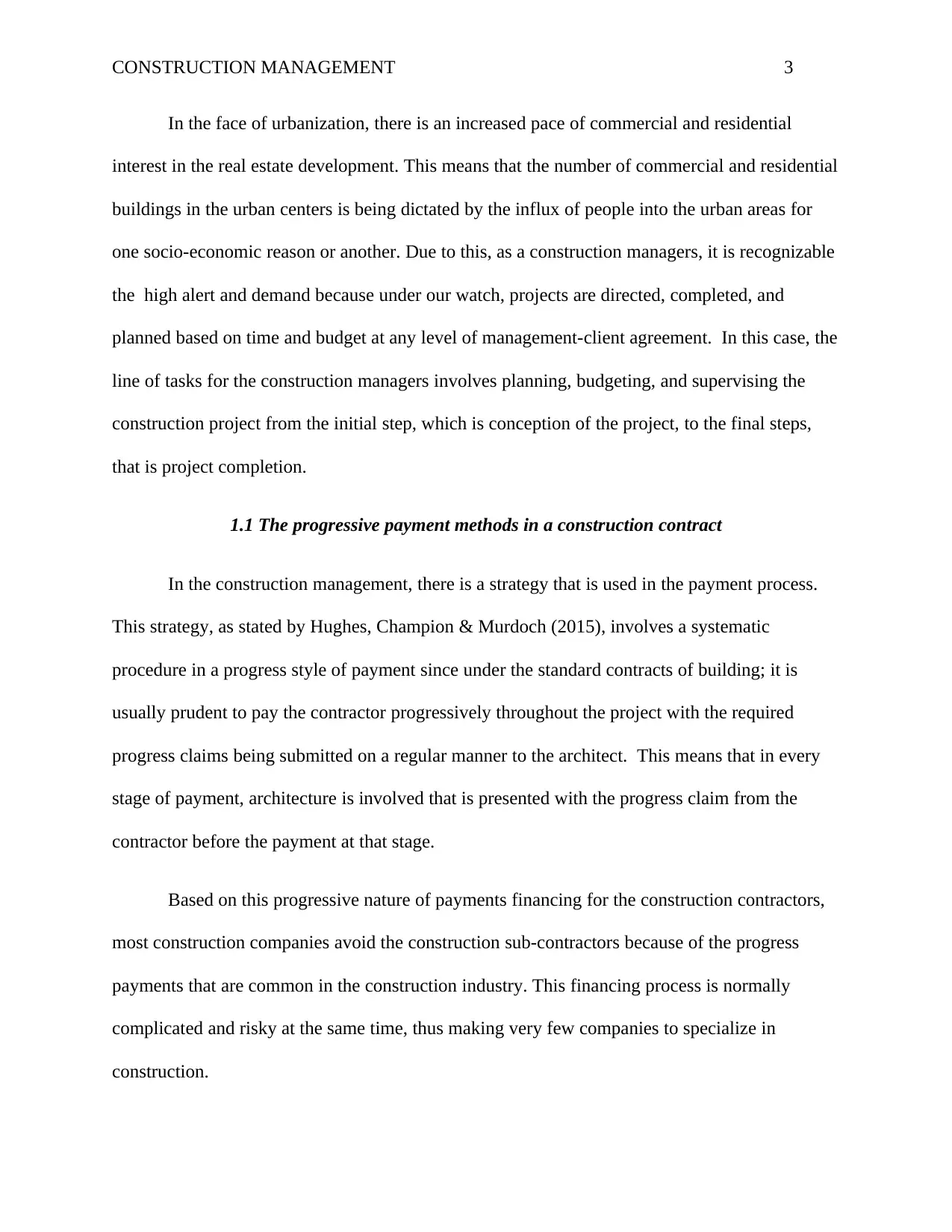
In the construction management, there is a strategy that is used in the payment process.
This strategy, as stated by Hughes, Champion & Murdoch (2015), involves a systematic
procedure in a progress style of payment since under the standard contracts of building; it is
usually prudent to pay the contractor progressively throughout the project with the required
progress claims being submitted on a regular manner to the architect. This means that in every
stage of payment, architecture is involved that is presented with the progress claim from the
contractor before the payment at that stage.
Based on this progressive nature of payments financing for the construction contractors,
most construction companies avoid the construction sub-contractors because of the progress
payments that are common in the construction industry. This financing process is normally
complicated and risky at the same time, thus making very few companies to specialize in
construction.
Document Page
CONSTRUCTION MANAGEMENT 4
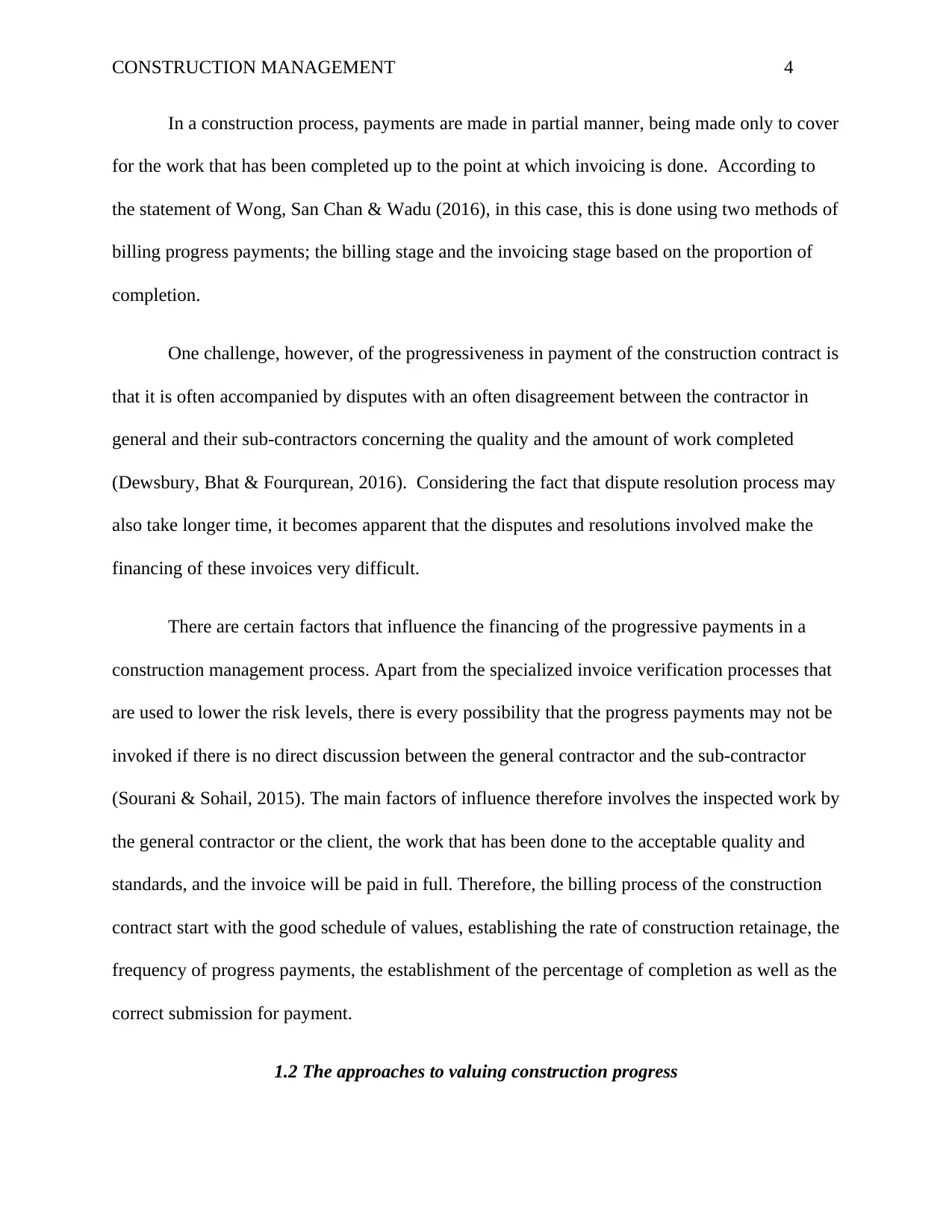
In a construction process, payments are made in partial manner, being made only to cover
for the work that has been completed up to the point at which invoicing is done. According to
the statement of Wong, San Chan & Wadu (2016), in this case, this is done using two methods of
billing progress payments; the billing stage and the invoicing stage based on the proportion of
completion.
One challenge, however, of the progressiveness in payment of the construction contract is
that it is often accompanied by disputes with an often disagreement between the contractor in
general and their sub-contractors concerning the quality and the amount of work completed
(Dewsbury, Bhat & Fourqurean, 2016). Considering the fact that dispute resolution process may
also take longer time, it becomes apparent that the disputes and resolutions involved make the
financing of these invoices very difficult.
There are certain factors that influence the financing of the progressive payments in a
construction management process. Apart from the specialized invoice verification processes that
are used to lower the risk levels, there is every possibility that the progress payments may not be
invoked if there is no direct discussion between the general contractor and the sub-contractor
(Sourani & Sohail, 2015). The main factors of influence therefore involves the inspected work by
the general contractor or the client, the work that has been done to the acceptable quality and
standards, and the invoice will be paid in full. Therefore, the billing process of the construction
contract start with the good schedule of values, establishing the rate of construction retainage, the
frequency of progress payments, the establishment of the percentage of completion as well as the
correct submission for payment.
1.2 The approaches to valuing construction progress
tabler-icon-diamond-filled.svg

Paraphrase This Document

Need a fresh take? Get an instant paraphrase of this document with our AI Paraphraser
Document Page
CONSTRUCTION MANAGEMENT 5
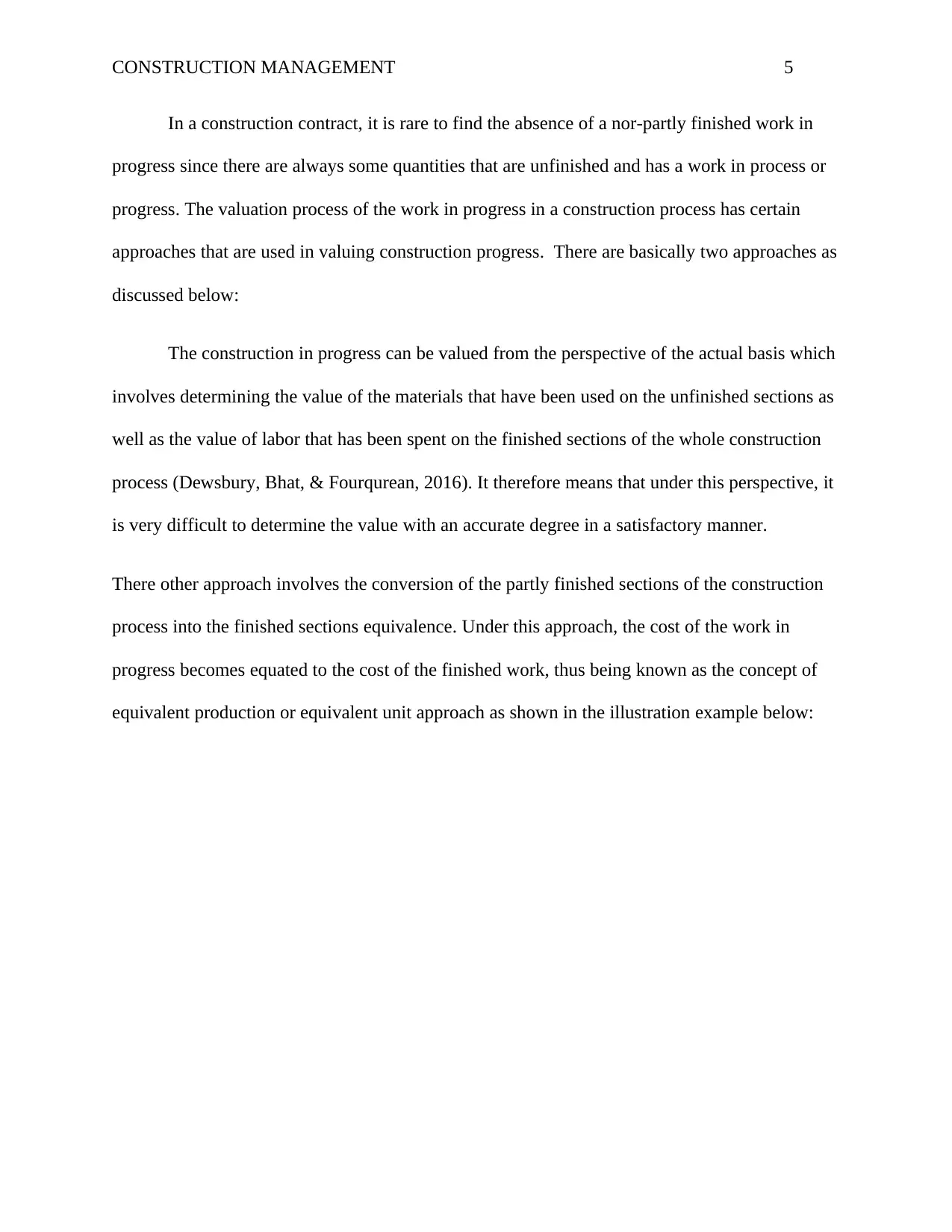
In a construction contract, it is rare to find the absence of a nor-partly finished work in
progress since there are always some quantities that are unfinished and has a work in process or
progress. The valuation process of the work in progress in a construction process has certain
approaches that are used in valuing construction progress. There are basically two approaches as
discussed below:
The construction in progress can be valued from the perspective of the actual basis which
involves determining the value of the materials that have been used on the unfinished sections as
well as the value of labor that has been spent on the finished sections of the whole construction
process (Dewsbury, Bhat, & Fourqurean, 2016). It therefore means that under this perspective, it
is very difficult to determine the value with an accurate degree in a satisfactory manner.
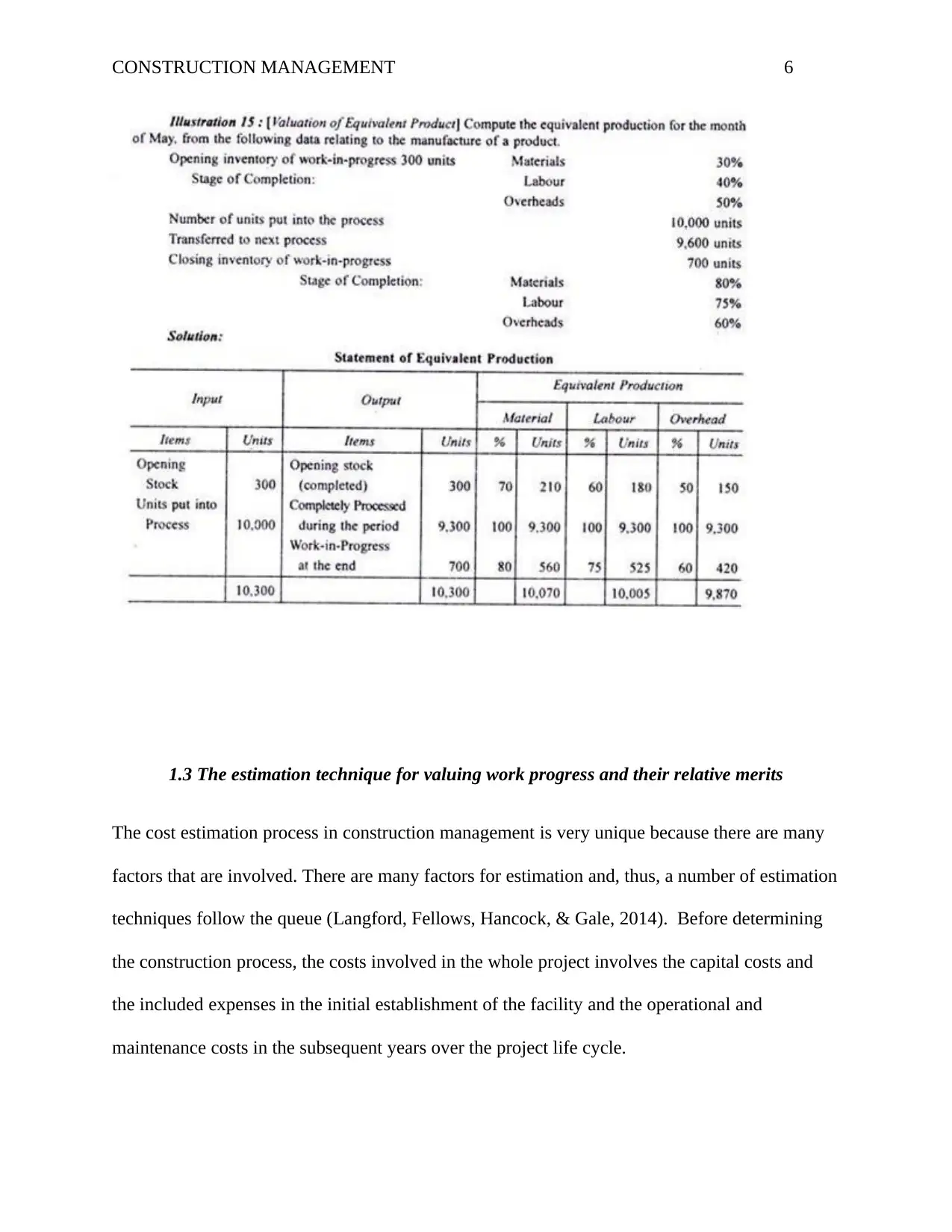
There other approach involves the conversion of the partly finished sections of the construction
process into the finished sections equivalence. Under this approach, the cost of the work in
progress becomes equated to the cost of the finished work, thus being known as the concept of
equivalent production or equivalent unit approach as shown in the illustration example below:
Document Page
CONSTRUCTION MANAGEMENT 6
1.3 The estimation technique for valuing work progress and their relative merits
The cost estimation process in construction management is very unique because there are many
factors that are involved. There are many factors for estimation and, thus, a number of estimation
techniques follow the queue (Langford, Fellows, Hancock, & Gale, 2014). Before determining
the construction process, the costs involved in the whole project involves the capital costs and
the included expenses in the initial establishment of the facility and the operational and
maintenance costs in the subsequent years over the project life cycle.
Document Page
CONSTRUCTION MANAGEMENT 7
The cost estimates in a construction process involves establishing the base line for project cost
strategies at different stages of the project development. Based on the available data, the cost
estimations are done using the following techniques:
The production function technique: This is a macroeconomic technique involving the use of the
output and the input in the production process. Under this process, there are a number of resource
inputs that are involved and an output is expected (Cummins, Graham, Thomas, & Lucey (2016).
In construction process, the production function may be expressed in terms of the volume of
construction and the labor or capital as the factors of production. It therefore, means, that the
production function in construction that must be estimated include the material inputs, labor and
equipment. The values can be set in numerical values to initiate the process of cost minimization.
Thus, the size of the building construction project is determined by the input labor and the size
itself.
Empirical cost inference: The other technique in cost estimation in construction management
involves the empirical cost inference whereby there is need for a cost determination relating to
the cost of constructing or operating a facility to a few important characteristics or attributes of
the system (Myers, 2016). Therefore, the cost inference estimates the value of the parameters by
assuming the cost function, normally involving the regression analysis techniques.
The BQ costs: BQ stands for the bill of quantities that gives the platform for assigning every
component of the work and quantities with the cost assigned to each of them (Barbier, 2016).
The overall cost or cost in total is the product of the quantities and units cost that correspond
with them.
tabler-icon-diamond-filled.svg

Paraphrase This Document

Need a fresh take? Get an instant paraphrase of this document with our AI Paraphraser
Document Page
CONSTRUCTION MANAGEMENT 8
1.4 The NZS3910 Conditions of Contract
The NZS3910 Conditions of Contract constitute rules and regulations that administer and
manage civil engineering and building contracts. As a practical construction ordeal, the
NZS3910 Conditions of Contract, from a practical perspective have benefits to the construction
client, the consultants, and the contractors based on the management and administration of the
construction contract. More than that, it assists the construction team and management to
understand their obligations, expectations, and liabilities based on the terms of the general
conditions of the contract into which they have entered (Burr, 2016). For complete understanding
of the NZS3910 Conditions of Contract there are certain aspects of construction that are involved
in the NZS3910 Conditions of Contract. Some of the include the types of the contracts, the
contractor and client obligations, the role of the engineer or his/her representative, the variations
and their valuations, the extension period, the disagreements, and contract termination or sub
contract termination (Raina, 2015).
The calculation of the percentages for the onsite costs as well as the overhead costs and
profits or rate in a day’s working are also involved (Ross, 2017). Through the NZS3910
Conditions of Contract knowledge, it is easier to effectively understand and utilize the
management of contracts, to be familiar with the different types of contracts and the fitting
process of the tender documents into the contracts, the procedure of the lodging claims, and to be
able to value the existing variations as well as extension time with their implications and costs
that are involved.
Document Page
CONSTRUCTION MANAGEMENT 9
According to the study done by Paracchini, Correia, Loupa-Ramos, Capitani & Madeira
(2016), the construction management processes are in the phase of being tailored to meet the
tastes and preferences of the clients without infringing any construction standard in the process.
Also known as the New Zealand Standards of construction, the NZS3910 Conditions of
Contract, has paved way for the progress of the building and civil engineering construction
conditions of contract into a new level. In this new level, there are substantive changes that it has
come with. Some of them involve clarification of the nature of the cost reimbursement contract,
the clarification of the process of contract, simplification of the payment process, provision of
the design and construct contract, as well as provision for warranty on the works among others.
All the above issues make the NZS3910 Conditions of Contract to have a real meaning in the
construction management process.
In accordance with the Conditions of Contract, the requirements of the Construction
Contracts Act and other governing legislation, the spreadsheet attached shows the measure and
value of the construction progress.
Document Page
CONSTRUCTION MANAGEMENT 10
References
Barbier, E. B. (2016). The protective service of mangrove ecosystems: A review of valuation
methods. Marine pollution bulletin, 109(2), 676-681.
Burr, A. (2016). Delay and disruption in construction contracts. Informa Law from Routledge.
Cummins, A., Graham, B., Thomas, K., & Lucey, T. (2016, September). The Effectiveness of
Managing Through Trust the Middle Management Layer of a Construction Company:
Proposed Ethnographic Research. In Proceedings of the 32nd Annual ARCOM
Conference (pp. 5-7).
Dewsbury, B. M., Bhat, M., & Fourqurean, J. W. (2016). A review of seagrass economic
valuations: gaps and progress in valuation approaches. Ecosystem Services, 18, 68-77.
Hughes, W., Champion, R., & Murdoch, J. (2015). Construction contracts: law and
management. Routledge.
Langford, D., Fellows, R. F., Hancock, M. R., & Gale, A. W. (2014). Human resources
management in construction. Routledge.
Maynard, S., James, D., & Davidson, A. (2015). Determining the value of multiple ecosystem
services in terms of community wellbeing: who should be the valuing agent?. Ecological
Economics, 115, 22-28.
Myers, D. (2016). Construction economics: A new approach. Routledge.
Paracchini, M. L., Correia, T. P., Loupa-Ramos, I., Capitani, C., & Madeira, L. (2016). Progress
in indicators to assess agricultural landscape valuation: how and what is measured at
different levels of governance. Land Use Policy, 53, 71-85.
tabler-icon-diamond-filled.svg

Paraphrase This Document

Need a fresh take? Get an instant paraphrase of this document with our AI Paraphraser
Document Page
CONSTRUCTION MANAGEMENT 11
Raina, P. (2015). An examination of the retention practice in the New Zealand construction
industry (Doctoral dissertation, Auckland University of Technology).
Ross, A. (2017). Retaining Retention Money A Critical Analysis of the Retentions Regime in the
Construction Contracts Amendment Act 2015.
Sourani, A., & Sohail, M. (2015). The Delphi method: Review and use in construction
management research. International Journal of Construction Education and Research,
11(1), 54-76.
Wong, J. K. W., San Chan, J. K., & Wadu, M. J. (2016). Facilitating effective green
procurement in construction projects: An empirical study of the enablers. Journal of
cleaner production, 135, 859-871.
chevron_up_icon
1 out of 11
circle_padding
hide_on_mobile
zoom_out_icon
[object Object]