Construction Project Management Methods and Challenges Portfolio
VerifiedAdded on 2020/04/21
|22
|5939
|101
Project
AI Summary
This project management portfolio delves into critical aspects of construction project management. It examines three key areas: the management of construction materials on-site, the interfacing and complexity issues inherent in construction project management, and the challenges faced by project management systems in developing countries. The portfolio includes discussions on material management planning, including purchasing, storage, distribution, quality assurance, and cost reduction. It explores the processes involved in material management, such as analyzing existing stock, order processing, and quality checks. Furthermore, it analyses the complexities and interface issues in project management, referencing a case study of a condominium construction project. Finally, the portfolio addresses the challenges confronting construction project management systems in developing countries. The research employs various methodologies, including quantitative data analysis techniques like ABC and EOQ analysis, and S-curve analysis to assess project costs. The portfolio highlights the importance of effective project management for successful project outcomes and offers insights into improving construction processes.
Running head: PROJECT MANAGEMENT METHODS
Project Management Methods
Name of the Student:
Student ID:
Name of the University:
Author’s Note:
Project Management Methods
Name of the Student:
Student ID:
Name of the University:
Author’s Note:

Paraphrase This Document
Need a fresh take? Get an instant paraphrase of this document with our AI Paraphraser
1PROJECT MANAGEMENT METHODS
Table of Contents
Introduction......................................................................................................................................3
1. Description and Discussion of Topic 1........................................................................................4
1.1 Purpose of Material Management Planning in Construction Projects...................................4
1.2 Process of Material Management Planning in Construction Projects...................................7
1.3 Research Methodology..........................................................................................................7
1.4 Final Outcome of the research paper.....................................................................................8
2. Description and Discussion of Topic 2........................................................................................8
2.1 General introduction to the topic...........................................................................................9
2.2 Literature review....................................................................................................................9
2.3 Research methodology.........................................................................................................11
2.4 Result and its analysis..........................................................................................................11
2.5 Final conclusion...................................................................................................................12
3. Discussion and Description of the topic 3.................................................................................12
3.1 Introduction..........................................................................................................................12
3.2 Review of Related Studies...................................................................................................13
3.3 Challenges Facing Project Management System in Developing Countries........................13
Table of Contents
Introduction......................................................................................................................................3
1. Description and Discussion of Topic 1........................................................................................4
1.1 Purpose of Material Management Planning in Construction Projects...................................4
1.2 Process of Material Management Planning in Construction Projects...................................7
1.3 Research Methodology..........................................................................................................7
1.4 Final Outcome of the research paper.....................................................................................8
2. Description and Discussion of Topic 2........................................................................................8
2.1 General introduction to the topic...........................................................................................9
2.2 Literature review....................................................................................................................9
2.3 Research methodology.........................................................................................................11
2.4 Result and its analysis..........................................................................................................11
2.5 Final conclusion...................................................................................................................12
3. Discussion and Description of the topic 3.................................................................................12
3.1 Introduction..........................................................................................................................12
3.2 Review of Related Studies...................................................................................................13
3.3 Challenges Facing Project Management System in Developing Countries........................13
2PROJECT MANAGEMENT METHODS
3.4 Research Methods................................................................................................................14
3.5 Data Analysis and Result.....................................................................................................14
3.6 Discussions of Findings.......................................................................................................16
3.7 Conclusions and Recommendation......................................................................................16
Conclusion.....................................................................................................................................17
References......................................................................................................................................19
3.4 Research Methods................................................................................................................14
3.5 Data Analysis and Result.....................................................................................................14
3.6 Discussions of Findings.......................................................................................................16
3.7 Conclusions and Recommendation......................................................................................16
Conclusion.....................................................................................................................................17
References......................................................................................................................................19
⊘ This is a preview!⊘
Do you want full access?
Subscribe today to unlock all pages.

Trusted by 1+ million students worldwide
3PROJECT MANAGEMENT METHODS
Introduction
The project management holds an integral part for the development of the improved
function analysis and development (Nasir, Nawi and Radzuan 2016). It is very important for the
deployment of the improved services for ensuring that the operations of the construction projects.
The implication of the effective project management is formed for the integration of the activities
of project and deploys the management of the construction management and functions. The
system integration and development of the profound management is formed for ensuring that the
construction projects are completed successfully. According to Demirkesen and Ozorhon (2017),
the alignment of the operations would be formed for forming the development of the activities of
the project and align them for the integration of the effective management functions.
The following assignment is a portfolio that is based on the topic of project management
in construction. The deployment of the construction project management would be employed for
ensuring that the project is constructed and formed for the management of the improvement of
the effective processes of the project. The deployment of the facilities would be formed for
integrating the analysis of the process formation. The three topics for the consideration of the
following portfolio are “Management of construction materials on project site”, “Interfacing and
complexity issues in construction project management”, and “Challenges confronting
construction project management system for sustainable construction in developing countries”.
These topics would be analysed in this portfolio for developing the analysis of the effective and
improved services. The integration of the profound development would be helpful for consisting
the development of the operations and deployment of the arbitrary development of the system
integration.
Introduction
The project management holds an integral part for the development of the improved
function analysis and development (Nasir, Nawi and Radzuan 2016). It is very important for the
deployment of the improved services for ensuring that the operations of the construction projects.
The implication of the effective project management is formed for the integration of the activities
of project and deploys the management of the construction management and functions. The
system integration and development of the profound management is formed for ensuring that the
construction projects are completed successfully. According to Demirkesen and Ozorhon (2017),
the alignment of the operations would be formed for forming the development of the activities of
the project and align them for the integration of the effective management functions.
The following assignment is a portfolio that is based on the topic of project management
in construction. The deployment of the construction project management would be employed for
ensuring that the project is constructed and formed for the management of the improvement of
the effective processes of the project. The deployment of the facilities would be formed for
integrating the analysis of the process formation. The three topics for the consideration of the
following portfolio are “Management of construction materials on project site”, “Interfacing and
complexity issues in construction project management”, and “Challenges confronting
construction project management system for sustainable construction in developing countries”.
These topics would be analysed in this portfolio for developing the analysis of the effective and
improved services. The integration of the profound development would be helpful for consisting
the development of the operations and deployment of the arbitrary development of the system
integration.
Paraphrase This Document
Need a fresh take? Get an instant paraphrase of this document with our AI Paraphraser
4PROJECT MANAGEMENT METHODS
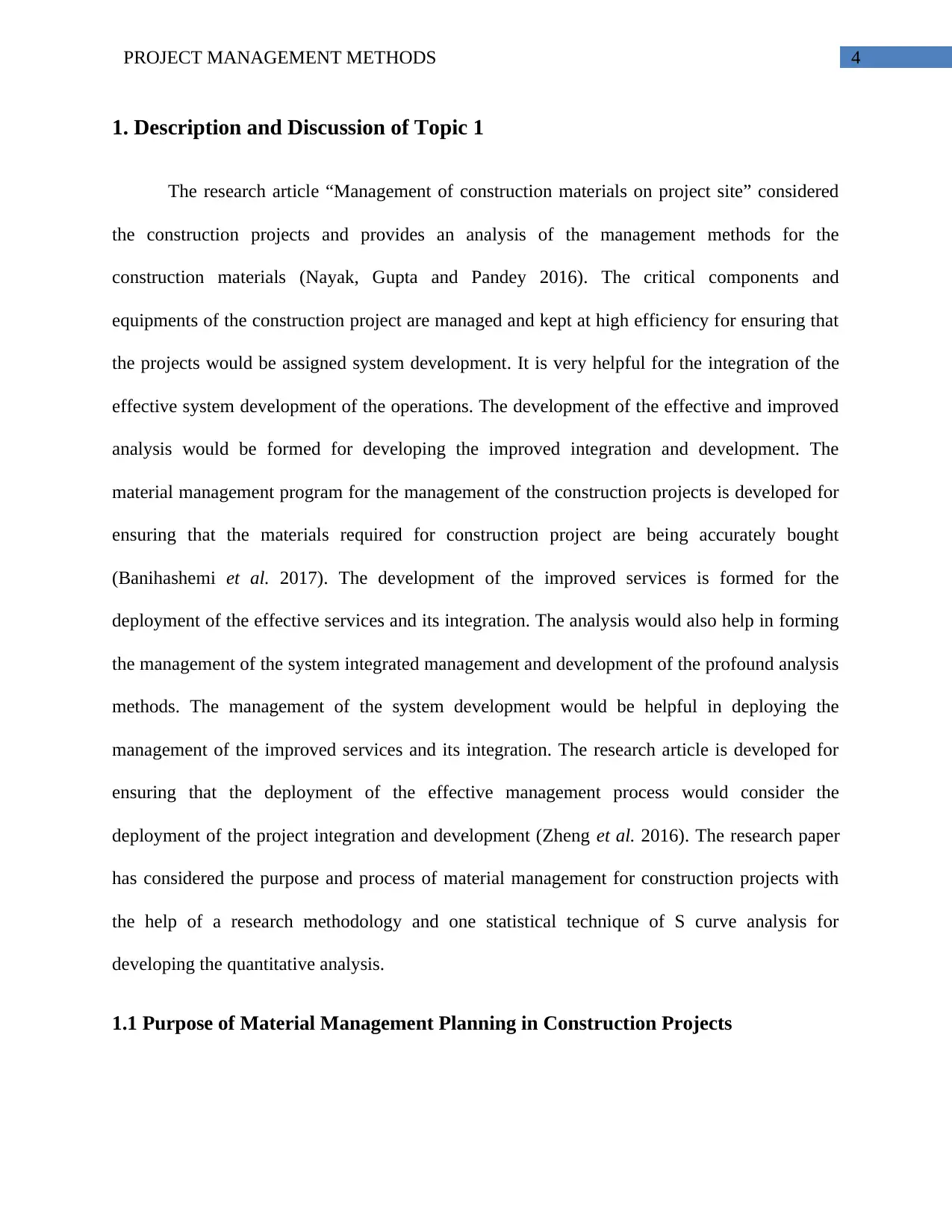
1. Description and Discussion of Topic 1
The research article “Management of construction materials on project site” considered
the construction projects and provides an analysis of the management methods for the
construction materials (Nayak, Gupta and Pandey 2016). The critical components and
equipments of the construction project are managed and kept at high efficiency for ensuring that
the projects would be assigned system development. It is very helpful for the integration of the
effective system development of the operations. The development of the effective and improved
analysis would be formed for developing the improved integration and development. The
material management program for the management of the construction projects is developed for
ensuring that the materials required for construction project are being accurately bought
(Banihashemi et al. 2017). The development of the improved services is formed for the
deployment of the effective services and its integration. The analysis would also help in forming
the management of the system integrated management and development of the profound analysis
methods. The management of the system development would be helpful in deploying the
management of the improved services and its integration. The research article is developed for
ensuring that the deployment of the effective management process would consider the
deployment of the project integration and development (Zheng et al. 2016). The research paper
has considered the purpose and process of material management for construction projects with
the help of a research methodology and one statistical technique of S curve analysis for
developing the quantitative analysis.
1.1 Purpose of Material Management Planning in Construction Projects
1. Description and Discussion of Topic 1
The research article “Management of construction materials on project site” considered
the construction projects and provides an analysis of the management methods for the
construction materials (Nayak, Gupta and Pandey 2016). The critical components and
equipments of the construction project are managed and kept at high efficiency for ensuring that
the projects would be assigned system development. It is very helpful for the integration of the
effective system development of the operations. The development of the effective and improved
analysis would be formed for developing the improved integration and development. The
material management program for the management of the construction projects is developed for
ensuring that the materials required for construction project are being accurately bought
(Banihashemi et al. 2017). The development of the improved services is formed for the
deployment of the effective services and its integration. The analysis would also help in forming
the management of the system integrated management and development of the profound analysis
methods. The management of the system development would be helpful in deploying the
management of the improved services and its integration. The research article is developed for
ensuring that the deployment of the effective management process would consider the
deployment of the project integration and development (Zheng et al. 2016). The research paper
has considered the purpose and process of material management for construction projects with
the help of a research methodology and one statistical technique of S curve analysis for
developing the quantitative analysis.
1.1 Purpose of Material Management Planning in Construction Projects
5PROJECT MANAGEMENT METHODS
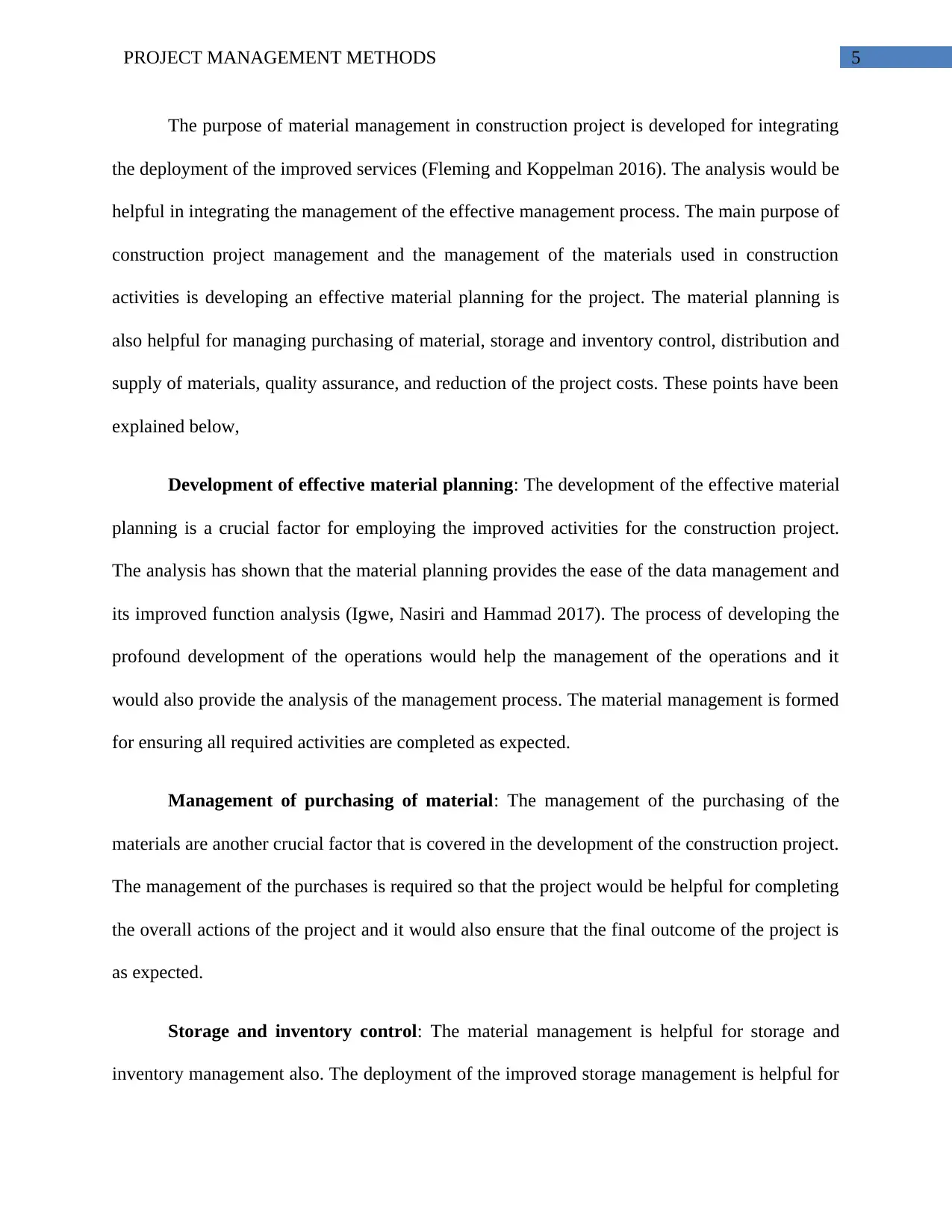
The purpose of material management in construction project is developed for integrating
the deployment of the improved services (Fleming and Koppelman 2016). The analysis would be
helpful in integrating the management of the effective management process. The main purpose of
construction project management and the management of the materials used in construction
activities is developing an effective material planning for the project. The material planning is
also helpful for managing purchasing of material, storage and inventory control, distribution and
supply of materials, quality assurance, and reduction of the project costs. These points have been
explained below,
Development of effective material planning: The development of the effective material
planning is a crucial factor for employing the improved activities for the construction project.
The analysis has shown that the material planning provides the ease of the data management and
its improved function analysis (Igwe, Nasiri and Hammad 2017). The process of developing the
profound development of the operations would help the management of the operations and it
would also provide the analysis of the management process. The material management is formed
for ensuring all required activities are completed as expected.
Management of purchasing of material: The management of the purchasing of the
materials are another crucial factor that is covered in the development of the construction project.
The management of the purchases is required so that the project would be helpful for completing
the overall actions of the project and it would also ensure that the final outcome of the project is
as expected.
Storage and inventory control: The material management is helpful for storage and
inventory management also. The deployment of the improved storage management is helpful for
The purpose of material management in construction project is developed for integrating
the deployment of the improved services (Fleming and Koppelman 2016). The analysis would be
helpful in integrating the management of the effective management process. The main purpose of
construction project management and the management of the materials used in construction
activities is developing an effective material planning for the project. The material planning is
also helpful for managing purchasing of material, storage and inventory control, distribution and
supply of materials, quality assurance, and reduction of the project costs. These points have been
explained below,
Development of effective material planning: The development of the effective material
planning is a crucial factor for employing the improved activities for the construction project.
The analysis has shown that the material planning provides the ease of the data management and
its improved function analysis (Igwe, Nasiri and Hammad 2017). The process of developing the
profound development of the operations would help the management of the operations and it
would also provide the analysis of the management process. The material management is formed
for ensuring all required activities are completed as expected.
Management of purchasing of material: The management of the purchasing of the
materials are another crucial factor that is covered in the development of the construction project.
The management of the purchases is required so that the project would be helpful for completing
the overall actions of the project and it would also ensure that the final outcome of the project is
as expected.
Storage and inventory control: The material management is helpful for storage and
inventory management also. The deployment of the improved storage management is helpful for
⊘ This is a preview!⊘
Do you want full access?
Subscribe today to unlock all pages.
Trusted by 1+ million students worldwide
6PROJECT MANAGEMENT METHODS
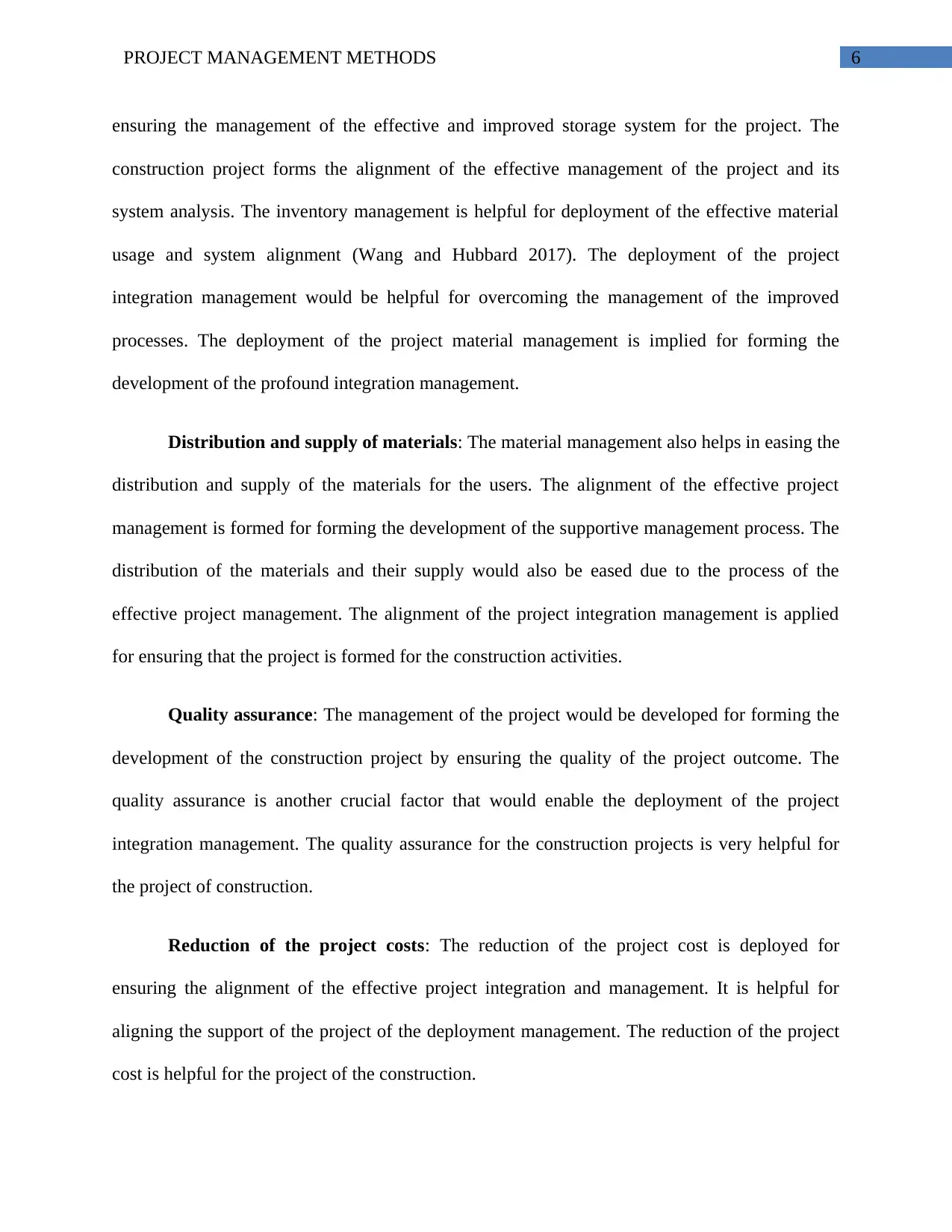
ensuring the management of the effective and improved storage system for the project. The
construction project forms the alignment of the effective management of the project and its
system analysis. The inventory management is helpful for deployment of the effective material
usage and system alignment (Wang and Hubbard 2017). The deployment of the project
integration management would be helpful for overcoming the management of the improved
processes. The deployment of the project material management is implied for forming the
development of the profound integration management.
Distribution and supply of materials: The material management also helps in easing the
distribution and supply of the materials for the users. The alignment of the effective project
management is formed for forming the development of the supportive management process. The
distribution of the materials and their supply would also be eased due to the process of the
effective project management. The alignment of the project integration management is applied
for ensuring that the project is formed for the construction activities.
Quality assurance: The management of the project would be developed for forming the
development of the construction project by ensuring the quality of the project outcome. The
quality assurance is another crucial factor that would enable the deployment of the project
integration management. The quality assurance for the construction projects is very helpful for
the project of construction.
Reduction of the project costs: The reduction of the project cost is deployed for
ensuring the alignment of the effective project integration and management. It is helpful for
aligning the support of the project of the deployment management. The reduction of the project
cost is helpful for the project of the construction.
ensuring the management of the effective and improved storage system for the project. The
construction project forms the alignment of the effective management of the project and its
system analysis. The inventory management is helpful for deployment of the effective material
usage and system alignment (Wang and Hubbard 2017). The deployment of the project
integration management would be helpful for overcoming the management of the improved
processes. The deployment of the project material management is implied for forming the
development of the profound integration management.
Distribution and supply of materials: The material management also helps in easing the
distribution and supply of the materials for the users. The alignment of the effective project
management is formed for forming the development of the supportive management process. The
distribution of the materials and their supply would also be eased due to the process of the
effective project management. The alignment of the project integration management is applied
for ensuring that the project is formed for the construction activities.
Quality assurance: The management of the project would be developed for forming the
development of the construction project by ensuring the quality of the project outcome. The
quality assurance is another crucial factor that would enable the deployment of the project
integration management. The quality assurance for the construction projects is very helpful for
the project of construction.
Reduction of the project costs: The reduction of the project cost is deployed for
ensuring the alignment of the effective project integration and management. It is helpful for
aligning the support of the project of the deployment management. The reduction of the project
cost is helpful for the project of the construction.
Paraphrase This Document
Need a fresh take? Get an instant paraphrase of this document with our AI Paraphraser
7PROJECT MANAGEMENT METHODS
1.2 Process of Material Management Planning in Construction Projects
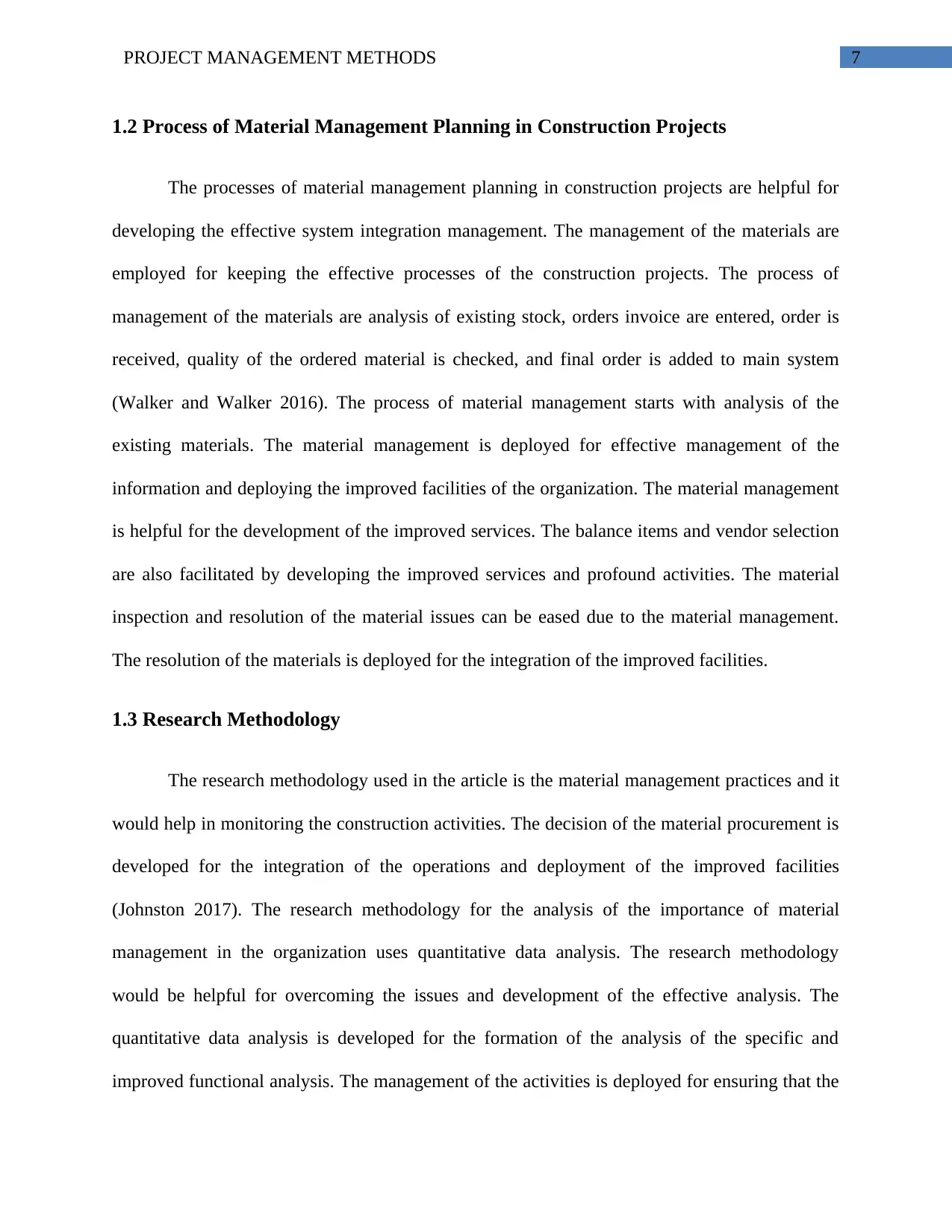
The processes of material management planning in construction projects are helpful for
developing the effective system integration management. The management of the materials are
employed for keeping the effective processes of the construction projects. The process of
management of the materials are analysis of existing stock, orders invoice are entered, order is
received, quality of the ordered material is checked, and final order is added to main system
(Walker and Walker 2016). The process of material management starts with analysis of the
existing materials. The material management is deployed for effective management of the
information and deploying the improved facilities of the organization. The material management
is helpful for the development of the improved services. The balance items and vendor selection
are also facilitated by developing the improved services and profound activities. The material
inspection and resolution of the material issues can be eased due to the material management.
The resolution of the materials is deployed for the integration of the improved facilities.
1.3 Research Methodology
The research methodology used in the article is the material management practices and it
would help in monitoring the construction activities. The decision of the material procurement is
developed for the integration of the operations and deployment of the improved facilities
(Johnston 2017). The research methodology for the analysis of the importance of material
management in the organization uses quantitative data analysis. The research methodology
would be helpful for overcoming the issues and development of the effective analysis. The
quantitative data analysis is developed for the formation of the analysis of the specific and
improved functional analysis. The management of the activities is deployed for ensuring that the
1.2 Process of Material Management Planning in Construction Projects
The processes of material management planning in construction projects are helpful for
developing the effective system integration management. The management of the materials are
employed for keeping the effective processes of the construction projects. The process of
management of the materials are analysis of existing stock, orders invoice are entered, order is
received, quality of the ordered material is checked, and final order is added to main system
(Walker and Walker 2016). The process of material management starts with analysis of the
existing materials. The material management is deployed for effective management of the
information and deploying the improved facilities of the organization. The material management
is helpful for the development of the improved services. The balance items and vendor selection
are also facilitated by developing the improved services and profound activities. The material
inspection and resolution of the material issues can be eased due to the material management.
The resolution of the materials is deployed for the integration of the improved facilities.
1.3 Research Methodology
The research methodology used in the article is the material management practices and it
would help in monitoring the construction activities. The decision of the material procurement is
developed for the integration of the operations and deployment of the improved facilities
(Johnston 2017). The research methodology for the analysis of the importance of material
management in the organization uses quantitative data analysis. The research methodology
would be helpful for overcoming the issues and development of the effective analysis. The
quantitative data analysis is developed for the formation of the analysis of the specific and
improved functional analysis. The management of the activities is deployed for ensuring that the
8PROJECT MANAGEMENT METHODS
specific and successive development of the operations is formed for the system integration and
development. The management scheme for the materials is developed for overcoming the gap in
the study of the research topic. The quantitative study is formed with the help of ABC and EOQ
analysis. The technique of ABC analysis consists of the principle that the small part of the items
can show a bulk of monetary value. The A category represents 70-75% of the money value, the
B category represents 15-20% of the money value, and C category represents the 5-10% of the
money value. The economic order quantity or EOQ would result in analysing the specific item’s
costs and the total number of orders of least value (Woodgate, Zurba and Tennent 2016). The
research paper also deals with the use of S-curve analysis for showing the relation between the
actual and planned costs of the materials.
1.4 Final Outcome of the research paper
The data gathered and the analysis of the available data has shown that the S-curve and
EOQ analysis would be helpful for deducing the specific and profound RCC design of the data
would tend to show that the construction project would require the use of the material
management for the completion of the project. The specification has shown that the deviation in
items would result in forming the fluctuations in the cost of the specific cost estimation. The
material management is helpful for construction project to quote accurate values in the tender
and then ensure that the overall quote of the costs does not exceed than the expectations.
2. Description and Discussion of Topic 2
The journal article is titled “Interfacing and Complexity Issues in Project Management: A
Case Study of a Condominium Construction Project in Klang Valley” and it provides an analysis
of the complexity and interface issues that major construction projects face. The reason of
specific and successive development of the operations is formed for the system integration and
development. The management scheme for the materials is developed for overcoming the gap in
the study of the research topic. The quantitative study is formed with the help of ABC and EOQ
analysis. The technique of ABC analysis consists of the principle that the small part of the items
can show a bulk of monetary value. The A category represents 70-75% of the money value, the
B category represents 15-20% of the money value, and C category represents the 5-10% of the
money value. The economic order quantity or EOQ would result in analysing the specific item’s
costs and the total number of orders of least value (Woodgate, Zurba and Tennent 2016). The
research paper also deals with the use of S-curve analysis for showing the relation between the
actual and planned costs of the materials.
1.4 Final Outcome of the research paper
The data gathered and the analysis of the available data has shown that the S-curve and
EOQ analysis would be helpful for deducing the specific and profound RCC design of the data
would tend to show that the construction project would require the use of the material
management for the completion of the project. The specification has shown that the deviation in
items would result in forming the fluctuations in the cost of the specific cost estimation. The
material management is helpful for construction project to quote accurate values in the tender
and then ensure that the overall quote of the costs does not exceed than the expectations.
2. Description and Discussion of Topic 2
The journal article is titled “Interfacing and Complexity Issues in Project Management: A
Case Study of a Condominium Construction Project in Klang Valley” and it provides an analysis
of the complexity and interface issues that major construction projects face. The reason of
⊘ This is a preview!⊘
Do you want full access?
Subscribe today to unlock all pages.
Trusted by 1+ million students worldwide
9PROJECT MANAGEMENT METHODS
project failure is always argued to be either human or the materials. According to Tan (2016), the
above research analyse two factors namely complexity and interfaces that would result in the
generation of the issues in project management. The paper consists of a general introduction to
the topic, literature review section, research methodology, result and its analysis, and final
conclusion.
2.1 General introduction to the topic
The first part of the research paper provides the analysis of the various reasons of the
project failure. The present world is well aware of the fact that out of 6927 construction projects
worth RM 131 billion was kicked off due to some issues (Nicholas and Steyn 2017). The use of
the technological development has been largely used for ensuring that the projects are completed
successfully. However, due to the use of the technological equipments, the probability of the
occurrence of the issues has increased too. The analysis would show that the development of the
issues and the use of the equipments had been simultaneously increasing. The statistics have
shown that only 39% of the overall construction projects have been successful in terms of
budget, time, and quality. The remaining 61% of the projects have failed due to cost overrun,
delay, and other features (Erdogan, Saparauskas and Turskis 2017). The project is cancelled due
to the unpredictable and profound issues in the project. The projects that had headed to failure in
terms of budget, time or quality are due to the internal issues. Very few of the project team
members or client want to talk about the reasons for the failure of the project and do not admit
even if it is their fault.
2.2 Literature review
project failure is always argued to be either human or the materials. According to Tan (2016), the
above research analyse two factors namely complexity and interfaces that would result in the
generation of the issues in project management. The paper consists of a general introduction to
the topic, literature review section, research methodology, result and its analysis, and final
conclusion.
2.1 General introduction to the topic
The first part of the research paper provides the analysis of the various reasons of the
project failure. The present world is well aware of the fact that out of 6927 construction projects
worth RM 131 billion was kicked off due to some issues (Nicholas and Steyn 2017). The use of
the technological development has been largely used for ensuring that the projects are completed
successfully. However, due to the use of the technological equipments, the probability of the
occurrence of the issues has increased too. The analysis would show that the development of the
issues and the use of the equipments had been simultaneously increasing. The statistics have
shown that only 39% of the overall construction projects have been successful in terms of
budget, time, and quality. The remaining 61% of the projects have failed due to cost overrun,
delay, and other features (Erdogan, Saparauskas and Turskis 2017). The project is cancelled due
to the unpredictable and profound issues in the project. The projects that had headed to failure in
terms of budget, time or quality are due to the internal issues. Very few of the project team
members or client want to talk about the reasons for the failure of the project and do not admit
even if it is their fault.
2.2 Literature review
Paraphrase This Document
Need a fresh take? Get an instant paraphrase of this document with our AI Paraphraser
10PROJECT MANAGEMENT METHODS
The literature review section explains the interface management and complexity in
project operations. The research method is formed for the understanding the importance of a
good interface as opined by many construction practitioners (Redwood et al. 2017). The
alignment of the improved processes would be implied for the development of the effective and
improved functional analysis for the development of the effective and improved functional
analysis. The interface management is nothing but a systematic and effective interface design of
the construction project activities and its role in forming the development of the effective and
improved development module. There are three types of interfaces namely Organizational
Interfaces, Personal Interfaces, and Systematic Interfaces. The construction projects are
outsourced as it needs the help of the several contractors for the management of the operations.
The alignment of the sponsor, construction team, designer, supplier, and manufacturer are
aligned for the development of the improved functional analysis. The interfaces are helpful for
linking two or more entities of the construction project along with stakeholders and project
scopes (Jin et al. 2017). The independent system acts on the each other for the development of
the profound system development. However, there are 3 more classifications of the interfaces
namely Material Interfaces, Psychological Interfaces, and Information Interfaces. The
physical and functional projects are formed for the management of the construction project. The
ability of the management of the project objectives would be developed for the integration and
development of the project integration management. The ability for the management of the many
interfaces of the project is developed for the specialised working. Later on, authors proposed five
types of interfaces namely Technology Interface, Contract Interface, Execution Integration
Interface, Monitor Interface, and Interacting Behaviour. All these types of interfaces are
being analysed for developing the specific behaviour of the profound development of the
The literature review section explains the interface management and complexity in
project operations. The research method is formed for the understanding the importance of a
good interface as opined by many construction practitioners (Redwood et al. 2017). The
alignment of the improved processes would be implied for the development of the effective and
improved functional analysis for the development of the effective and improved functional
analysis. The interface management is nothing but a systematic and effective interface design of
the construction project activities and its role in forming the development of the effective and
improved development module. There are three types of interfaces namely Organizational
Interfaces, Personal Interfaces, and Systematic Interfaces. The construction projects are
outsourced as it needs the help of the several contractors for the management of the operations.
The alignment of the sponsor, construction team, designer, supplier, and manufacturer are
aligned for the development of the improved functional analysis. The interfaces are helpful for
linking two or more entities of the construction project along with stakeholders and project
scopes (Jin et al. 2017). The independent system acts on the each other for the development of
the profound system development. However, there are 3 more classifications of the interfaces
namely Material Interfaces, Psychological Interfaces, and Information Interfaces. The
physical and functional projects are formed for the management of the construction project. The
ability of the management of the project objectives would be developed for the integration and
development of the project integration management. The ability for the management of the many
interfaces of the project is developed for the specialised working. Later on, authors proposed five
types of interfaces namely Technology Interface, Contract Interface, Execution Integration
Interface, Monitor Interface, and Interacting Behaviour. All these types of interfaces are
being analysed for developing the specific behaviour of the profound development of the
11PROJECT MANAGEMENT METHODS
interface management. The project complexity is a result of the issues and other factors that have
reasoned for increasing the time required for the project operations. The input of the large
number of the projects is developed for the formation of the issues and problems in the project.
The inclusion of the various requirements in the construction project leads to the development of
the specific project complexity generation. The complexities of the project can be broadly
classified into System Behaviour, Human Behaviour, and Ambiguity. The system behaviour
depends upon the connectedness, dependency, and system dynamics of the construction projects.
The human behaviour depends upon the individual behaviour, communication control, and
design development. The uncertainty and emergency are a part of the Ambiguity.
2.3 Research methodology
The research method used in this research paper is based on research questions and
sampling theory. The research method used for the analysis consists of 4 stages for developing
an understanding of the specific method development (Zainal 2017). The first stage would
comprise of identification of the existing theories and developing the appropriate solution for the
development of the specific modulation. In the second stage, the conduction of the field study for
the ongoing project is also done for developing the understanding of the research methodology.
The third stage is characterized by the analysis of the improved functional development and it
would be resulted in developing the issues of the specific development module (Rosner et al.
2016). The identification of the similarities of the existing theories and differences are developed
for the formation of the improved functional analysis.
2.4 Result and its analysis
The results of the analysis has shown the following outcomes,
interface management. The project complexity is a result of the issues and other factors that have
reasoned for increasing the time required for the project operations. The input of the large
number of the projects is developed for the formation of the issues and problems in the project.
The inclusion of the various requirements in the construction project leads to the development of
the specific project complexity generation. The complexities of the project can be broadly
classified into System Behaviour, Human Behaviour, and Ambiguity. The system behaviour
depends upon the connectedness, dependency, and system dynamics of the construction projects.
The human behaviour depends upon the individual behaviour, communication control, and
design development. The uncertainty and emergency are a part of the Ambiguity.
2.3 Research methodology
The research method used in this research paper is based on research questions and
sampling theory. The research method used for the analysis consists of 4 stages for developing
an understanding of the specific method development (Zainal 2017). The first stage would
comprise of identification of the existing theories and developing the appropriate solution for the
development of the specific modulation. In the second stage, the conduction of the field study for
the ongoing project is also done for developing the understanding of the research methodology.
The third stage is characterized by the analysis of the improved functional development and it
would be resulted in developing the issues of the specific development module (Rosner et al.
2016). The identification of the similarities of the existing theories and differences are developed
for the formation of the improved functional analysis.
2.4 Result and its analysis
The results of the analysis has shown the following outcomes,
⊘ This is a preview!⊘
Do you want full access?
Subscribe today to unlock all pages.
Trusted by 1+ million students worldwide

1 out of 22


Related Documents


Your All-in-One AI-Powered Toolkit for Academic Success.
+13062052269
info@desklib.com
Available 24*7 on WhatsApp / Email
![[object Object]](/_next/static/media/star-bottom.7253800d.svg)
Unlock your academic potential
Copyright © 2020–2026 A2Z Services. All Rights Reserved. Developed and managed by ZUCOL.