Risk Management and Supply Chain Analysis: ACC Construction
VerifiedAdded on 2023/04/23
|23
|4765
|416
Case Study
AI Summary
This case study examines risk management and operational challenges within the construction industry, using the Arabian Construction Company (ACC) as a focal point. It delves into various aspects of ACC's operations, including lean management strategies for waste reduction, inventory control methods such as ABC analysis, and the impact of logistical factors like landlocked countries on the supply chain. The study also evaluates the role of third-party logistics firms and the importance of supplier relationship management. Furthermore, it analyzes the effects of inventory levels on liquidity and provides recommendations for improving quality and efficiency within ACC's operations. The analysis underscores the significance of proactive risk management and optimized supply chain practices for construction companies operating in dynamic global markets. Desklib provides access to similar case studies and solved assignments for students.
Running head: RISK MANAGEMENT IN CONSTRUCTION INDUSTRY
Risk Management in Construction Industry
Name of the Student
Name of the University
Author note
Risk Management in Construction Industry
Name of the Student
Name of the University
Author note

Paraphrase This Document
Need a fresh take? Get an instant paraphrase of this document with our AI Paraphraser
1
RISK MANAGEMENT IN CONSTRUCTION INDUSTRY
RISK MANAGEMENT IN CONSTRUCTION INDUSTRY
2
RISK MANAGEMENT IN CONSTRUCTION INDUSTRY
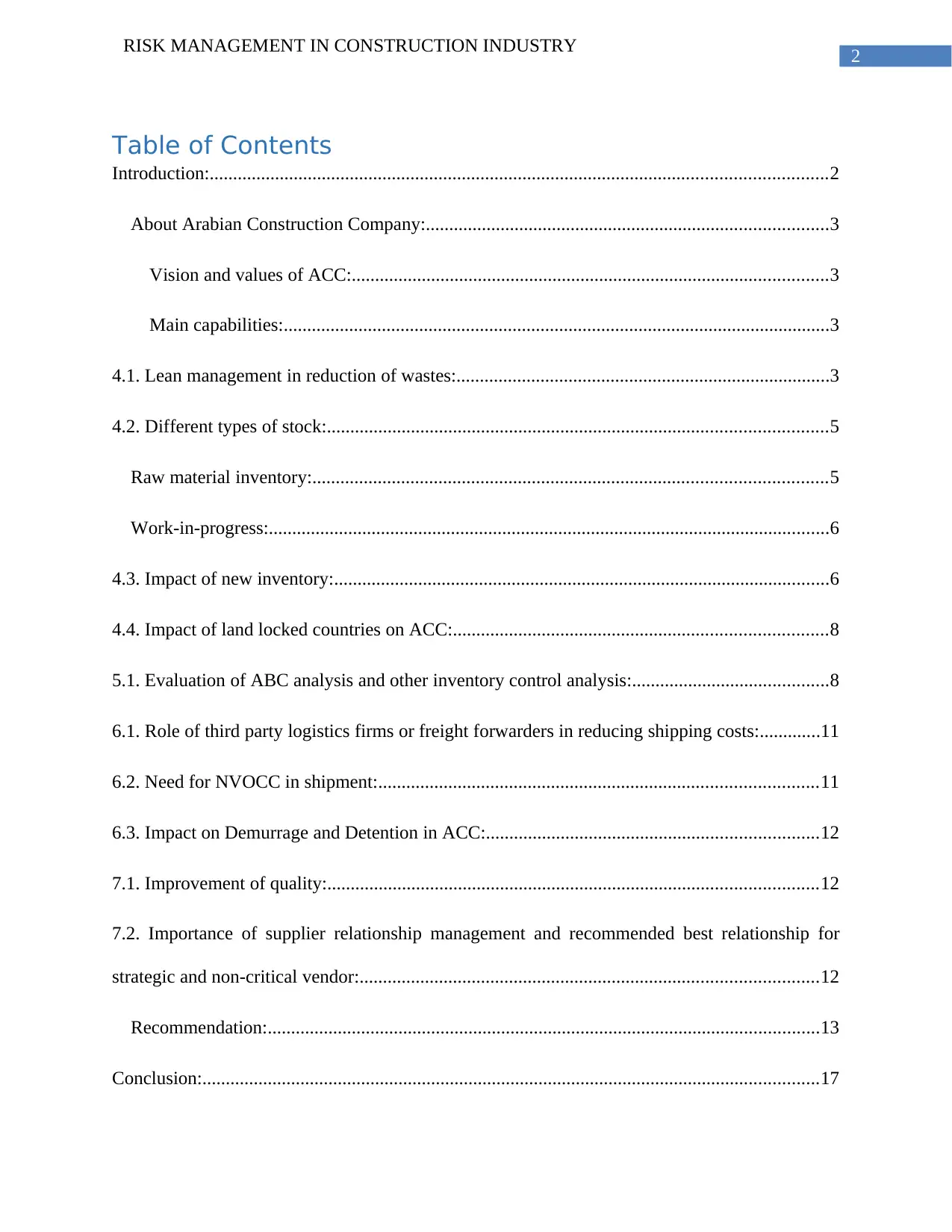
Table of Contents
Introduction:....................................................................................................................................2
About Arabian Construction Company:......................................................................................3
Vision and values of ACC:......................................................................................................3
Main capabilities:.....................................................................................................................3
4.1. Lean management in reduction of wastes:................................................................................3
4.2. Different types of stock:...........................................................................................................5
Raw material inventory:..............................................................................................................5
Work-in-progress:........................................................................................................................6
4.3. Impact of new inventory:..........................................................................................................6
4.4. Impact of land locked countries on ACC:................................................................................8
5.1. Evaluation of ABC analysis and other inventory control analysis:..........................................8
6.1. Role of third party logistics firms or freight forwarders in reducing shipping costs:.............11
6.2. Need for NVOCC in shipment:..............................................................................................11
6.3. Impact on Demurrage and Detention in ACC:.......................................................................12
7.1. Improvement of quality:.........................................................................................................12
7.2. Importance of supplier relationship management and recommended best relationship for
strategic and non-critical vendor:..................................................................................................12
Recommendation:......................................................................................................................13
Conclusion:....................................................................................................................................17
RISK MANAGEMENT IN CONSTRUCTION INDUSTRY
Table of Contents
Introduction:....................................................................................................................................2
About Arabian Construction Company:......................................................................................3
Vision and values of ACC:......................................................................................................3
Main capabilities:.....................................................................................................................3
4.1. Lean management in reduction of wastes:................................................................................3
4.2. Different types of stock:...........................................................................................................5
Raw material inventory:..............................................................................................................5
Work-in-progress:........................................................................................................................6
4.3. Impact of new inventory:..........................................................................................................6
4.4. Impact of land locked countries on ACC:................................................................................8
5.1. Evaluation of ABC analysis and other inventory control analysis:..........................................8
6.1. Role of third party logistics firms or freight forwarders in reducing shipping costs:.............11
6.2. Need for NVOCC in shipment:..............................................................................................11
6.3. Impact on Demurrage and Detention in ACC:.......................................................................12
7.1. Improvement of quality:.........................................................................................................12
7.2. Importance of supplier relationship management and recommended best relationship for
strategic and non-critical vendor:..................................................................................................12
Recommendation:......................................................................................................................13
Conclusion:....................................................................................................................................17
⊘ This is a preview!⊘
Do you want full access?
Subscribe today to unlock all pages.

Trusted by 1+ million students worldwide
3
RISK MANAGEMENT IN CONSTRUCTION INDUSTRY
RISK MANAGEMENT IN CONSTRUCTION INDUSTRY
Paraphrase This Document
Need a fresh take? Get an instant paraphrase of this document with our AI Paraphraser
4
RISK MANAGEMENT IN CONSTRUCTION INDUSTRY
Introduction:
Construction industry is one of the fastest growing and booming industry all over the
world. The industry plays a very significant role in development of all the other industry and
contributes towards economic development of countries. International market research firm
Deloitte reports that global construction industry is facing several challenges like extremely high
material price, talent management issues and mounting overhead costs. The advancement in
technology and changing political scenarios are also challenges which are looming over the
construction industry (Deloitte.com. 2019). While these factors are challenges which the
construction industry is experiencing several emerging positive trends are forecast to have long
lasting effect. Use of prefabricated structure, using of green technology in construction, better
safety equipment, sustainability, project management solutions and building information
modelling are some of the positive trends which are predicted to boost the construction industry
(News.jm.com. 2019). Krausmann et al.(2017) mention that construction industry builds assets
like road and bridges which in turn form the base of economic development of nations. The
revenue generation in the construction industry is dependent on the amount of economic
development in nations. This is evident from the fact that most of the multinational construction
companies are shifting their operations towards emerging markets of Middle East and South East
Asia, the two booming economic regions (Prnewswire.com. 2019). The aim of the paper is to
delve into the operational aspect of the construction companies. The company chosen for the
study is Arabian Construction Company based Beirut, Lebanon.
RISK MANAGEMENT IN CONSTRUCTION INDUSTRY
Introduction:
Construction industry is one of the fastest growing and booming industry all over the
world. The industry plays a very significant role in development of all the other industry and
contributes towards economic development of countries. International market research firm
Deloitte reports that global construction industry is facing several challenges like extremely high
material price, talent management issues and mounting overhead costs. The advancement in
technology and changing political scenarios are also challenges which are looming over the
construction industry (Deloitte.com. 2019). While these factors are challenges which the
construction industry is experiencing several emerging positive trends are forecast to have long
lasting effect. Use of prefabricated structure, using of green technology in construction, better
safety equipment, sustainability, project management solutions and building information
modelling are some of the positive trends which are predicted to boost the construction industry
(News.jm.com. 2019). Krausmann et al.(2017) mention that construction industry builds assets
like road and bridges which in turn form the base of economic development of nations. The
revenue generation in the construction industry is dependent on the amount of economic
development in nations. This is evident from the fact that most of the multinational construction
companies are shifting their operations towards emerging markets of Middle East and South East
Asia, the two booming economic regions (Prnewswire.com. 2019). The aim of the paper is to
delve into the operational aspect of the construction companies. The company chosen for the
study is Arabian Construction Company based Beirut, Lebanon.
5
RISK MANAGEMENT IN CONSTRUCTION INDUSTRY
About Arabian Construction Company:
Arabian Construction Company is a multinational construction company based in
Lebanon and follows a family business owned format. The owners of the company are Merehbi
and Mikati families.
Vision and values of ACC:
The vision of ACC is to emerge as the leader in the construction markets it operates and
to be one of the most sought after construction companies by the potential clients namely,
governments and leading corporates. ACC seeks to cement its presence on the grounds of
reliable execution, cost effectiveness and use of global standard technology.
The core values of ACC rest on six main pillars. They are excellence, teamwork,
integrity, commitment, sustainability and accountability.
Main capabilities:
The main capabilities of ACC are civil construction, construction of different types of
buildings including skyscrapers and industrial plant construction which includes oil and gas
industry as well. The company also engages in turnkey contracting contracting, value
engineering and procurement of industrial equipment. The main markets of ACC are Middle
East, Egypy and India.
4.1. Lean management in reduction of wastes:
Lean management helps organisations to reduce their wastes and associated financial
losses. Nikakhtar et al.(2015) point out that lean management results in operations in ways so as
to reduce the waste of resources by ensuring optimum amount of resources procured. This is very
pertinent for the construction industry because the industry has to acquire raw materials which
RISK MANAGEMENT IN CONSTRUCTION INDUSTRY
About Arabian Construction Company:
Arabian Construction Company is a multinational construction company based in
Lebanon and follows a family business owned format. The owners of the company are Merehbi
and Mikati families.
Vision and values of ACC:
The vision of ACC is to emerge as the leader in the construction markets it operates and
to be one of the most sought after construction companies by the potential clients namely,
governments and leading corporates. ACC seeks to cement its presence on the grounds of
reliable execution, cost effectiveness and use of global standard technology.
The core values of ACC rest on six main pillars. They are excellence, teamwork,
integrity, commitment, sustainability and accountability.
Main capabilities:
The main capabilities of ACC are civil construction, construction of different types of
buildings including skyscrapers and industrial plant construction which includes oil and gas
industry as well. The company also engages in turnkey contracting contracting, value
engineering and procurement of industrial equipment. The main markets of ACC are Middle
East, Egypy and India.
4.1. Lean management in reduction of wastes:
Lean management helps organisations to reduce their wastes and associated financial
losses. Nikakhtar et al.(2015) point out that lean management results in operations in ways so as
to reduce the waste of resources by ensuring optimum amount of resources procured. This is very
pertinent for the construction industry because the industry has to acquire raw materials which
⊘ This is a preview!⊘
Do you want full access?
Subscribe today to unlock all pages.
Trusted by 1+ million students worldwide
6
RISK MANAGEMENT IN CONSTRUCTION INDUSTRY
are expensive and have to be procured from different countries. Thus, it can be pointed out that
the large amount of waste of building and construction raw materials actually result in huge
financial losses. Tezel, Koskela and Aziz (2018) points out the challenges which adoption of lean
management would face in construction industry. The construction materials are very expensive
and attract heavy taxes. The equipment and plants used in the construction works have to
procured from companies usually based in foreign markets like the United States of America.
While speaking about the challenges which lean management application in the construction
industry is facing, Sarhan et al.(2017) points out that lean management requires use of advanced
software to control the entire process of the project execution. This project management
operations in construction works, especially the high-end construction works are dependent on
use of project management software which is capable of integrating the different stages of the
work along with the manpower and costs related to them. Ansah, Sorooshian and Mustafa (2016)
mention that software should be able to present the entire project both in parts and as a whole.
This would allow controlling of the project efficiently to ensure that at each stage materials are
used optimally. This would ultimately lead to the reduction of wastes of materials. For example,
ACC operates in several markets in Asia and Africa which requires the company to bear huge
expenditure to procure the materials. This means that means that due to markets spanning from
Africa to Asia, lack of control over projects would lead to wastage of materials and result in
immense financial losses. ACC can appoint its representatives in each construction site in which
the company or its agents are involved to ensure that the sub-contractors optimally utilise the
materials in order to ensure low amount wastes from construction works.
Lean management reduces wastes by streamlining the entire operations towards the
customer expectations thus ensuring optimum use of the materials and minimum wastage. For
RISK MANAGEMENT IN CONSTRUCTION INDUSTRY
are expensive and have to be procured from different countries. Thus, it can be pointed out that
the large amount of waste of building and construction raw materials actually result in huge
financial losses. Tezel, Koskela and Aziz (2018) points out the challenges which adoption of lean
management would face in construction industry. The construction materials are very expensive
and attract heavy taxes. The equipment and plants used in the construction works have to
procured from companies usually based in foreign markets like the United States of America.
While speaking about the challenges which lean management application in the construction
industry is facing, Sarhan et al.(2017) points out that lean management requires use of advanced
software to control the entire process of the project execution. This project management
operations in construction works, especially the high-end construction works are dependent on
use of project management software which is capable of integrating the different stages of the
work along with the manpower and costs related to them. Ansah, Sorooshian and Mustafa (2016)
mention that software should be able to present the entire project both in parts and as a whole.
This would allow controlling of the project efficiently to ensure that at each stage materials are
used optimally. This would ultimately lead to the reduction of wastes of materials. For example,
ACC operates in several markets in Asia and Africa which requires the company to bear huge
expenditure to procure the materials. This means that means that due to markets spanning from
Africa to Asia, lack of control over projects would lead to wastage of materials and result in
immense financial losses. ACC can appoint its representatives in each construction site in which
the company or its agents are involved to ensure that the sub-contractors optimally utilise the
materials in order to ensure low amount wastes from construction works.
Lean management reduces wastes by streamlining the entire operations towards the
customer expectations thus ensuring optimum use of the materials and minimum wastage. For
Paraphrase This Document
Need a fresh take? Get an instant paraphrase of this document with our AI Paraphraser
7
RISK MANAGEMENT IN CONSTRUCTION INDUSTRY
example, ACC serves cleints which are either government bodies, international organisations or
body corporates. The company using its advanced project management technology breaks down
the entire scope of the construction works into a number of component like hiring of sub-
contractors and hiring of equipment contractors. The company enters into contracts with all the
suppliers which follow the procurement policy of the company. The contracts provide the firm
the power to inspect the usage of materials and equipment. ACC in order to maintain stronger
vigil on the construction work often builds temporary offices at the sites. The company deploys
specialists like engineers who manage each stage of work and ensure that the sub-contractors use
the materials optimally and do not result in huge wastage. The representatives of the company
maintains communication with the management and the regional offices of ACC to communicate
them about the commencement of the work. The representatives of ACC ensure that the
materials and equipment are stored in appropriate ways which reduces loss due to spilling and
slack material storage system. This way lean management would result in reduction of wastage
of materials and ensure optimum utilisation of materials in the construction work.
4.2. Different types of stock:
The following are the three types of stock which ACC holds:
Raw material inventory:
The raw material inventory consists of raw materials which acquired forusage in the
construction works. As far as ACC is concerned, the raw materials which the firm acquires
consists of bricks, sand, construction materials, cement of different kind and rods. The raw
materials also consist of different types of chemicals which find use in the construction work.
RISK MANAGEMENT IN CONSTRUCTION INDUSTRY
example, ACC serves cleints which are either government bodies, international organisations or
body corporates. The company using its advanced project management technology breaks down
the entire scope of the construction works into a number of component like hiring of sub-
contractors and hiring of equipment contractors. The company enters into contracts with all the
suppliers which follow the procurement policy of the company. The contracts provide the firm
the power to inspect the usage of materials and equipment. ACC in order to maintain stronger
vigil on the construction work often builds temporary offices at the sites. The company deploys
specialists like engineers who manage each stage of work and ensure that the sub-contractors use
the materials optimally and do not result in huge wastage. The representatives of the company
maintains communication with the management and the regional offices of ACC to communicate
them about the commencement of the work. The representatives of ACC ensure that the
materials and equipment are stored in appropriate ways which reduces loss due to spilling and
slack material storage system. This way lean management would result in reduction of wastage
of materials and ensure optimum utilisation of materials in the construction work.
4.2. Different types of stock:
The following are the three types of stock which ACC holds:
Raw material inventory:
The raw material inventory consists of raw materials which acquired forusage in the
construction works. As far as ACC is concerned, the raw materials which the firm acquires
consists of bricks, sand, construction materials, cement of different kind and rods. The raw
materials also consist of different types of chemicals which find use in the construction work.
8
RISK MANAGEMENT IN CONSTRUCTION INDUSTRY
Work-in-progress:
The second category of materials which construction companies use are work-in-progress
materials. They consist of prefabricated structures which are used in the construction work. As
far as ACC is concerned, firm constructs structures like buildings and plants. The prefabricated
structure which the company uses in the construction work like prefabricated bridges and beams
fall into the category of work-in-progress.
4.3. Impact of new inventory:
High inventory of raw materials, WIP and finished products results in reduction in
liquidity. Diamond and Kashyap (2016) defines the term liquidity as the power of firms to sell
assets in the market and convert them back into cash. Adrian et al. (2017) defines liquidly as tahe
rate by which business organisations can convery their current assets in cash so as to redirect
towards procurement of more assets. It is clear from this definitions that liquidity is of utmost
importance to companies. It can be pointed out that the construction firms have to invest
immense amount of capital to procure and hold stock of raw materials. Masuda (2015) in this
respect points out that construction raw materials are extremely bulky and have to be stored in
warehouses. This means that companies like ACC have to spend immense amount of capital
towards both procurement and holding of raw materials. Moreover, the logistics expenses of
transporting the materials are also very high. This means at the initial stage the firm has to spend
amount of capital to make materials available at construction sites. Now, if the firm fails to
mobilise the raw materials on time towards construction, it has to bear immense amount of
recurring expenditure of holding the materials. This results in shortage of liquid cash with the
company which reduces its liquidity. This can be explained with the table given showing two
situations, the first showing the effect of high liquidity while the second shows that impact of
RISK MANAGEMENT IN CONSTRUCTION INDUSTRY
Work-in-progress:
The second category of materials which construction companies use are work-in-progress
materials. They consist of prefabricated structures which are used in the construction work. As
far as ACC is concerned, firm constructs structures like buildings and plants. The prefabricated
structure which the company uses in the construction work like prefabricated bridges and beams
fall into the category of work-in-progress.
4.3. Impact of new inventory:
High inventory of raw materials, WIP and finished products results in reduction in
liquidity. Diamond and Kashyap (2016) defines the term liquidity as the power of firms to sell
assets in the market and convert them back into cash. Adrian et al. (2017) defines liquidly as tahe
rate by which business organisations can convery their current assets in cash so as to redirect
towards procurement of more assets. It is clear from this definitions that liquidity is of utmost
importance to companies. It can be pointed out that the construction firms have to invest
immense amount of capital to procure and hold stock of raw materials. Masuda (2015) in this
respect points out that construction raw materials are extremely bulky and have to be stored in
warehouses. This means that companies like ACC have to spend immense amount of capital
towards both procurement and holding of raw materials. Moreover, the logistics expenses of
transporting the materials are also very high. This means at the initial stage the firm has to spend
amount of capital to make materials available at construction sites. Now, if the firm fails to
mobilise the raw materials on time towards construction, it has to bear immense amount of
recurring expenditure of holding the materials. This results in shortage of liquid cash with the
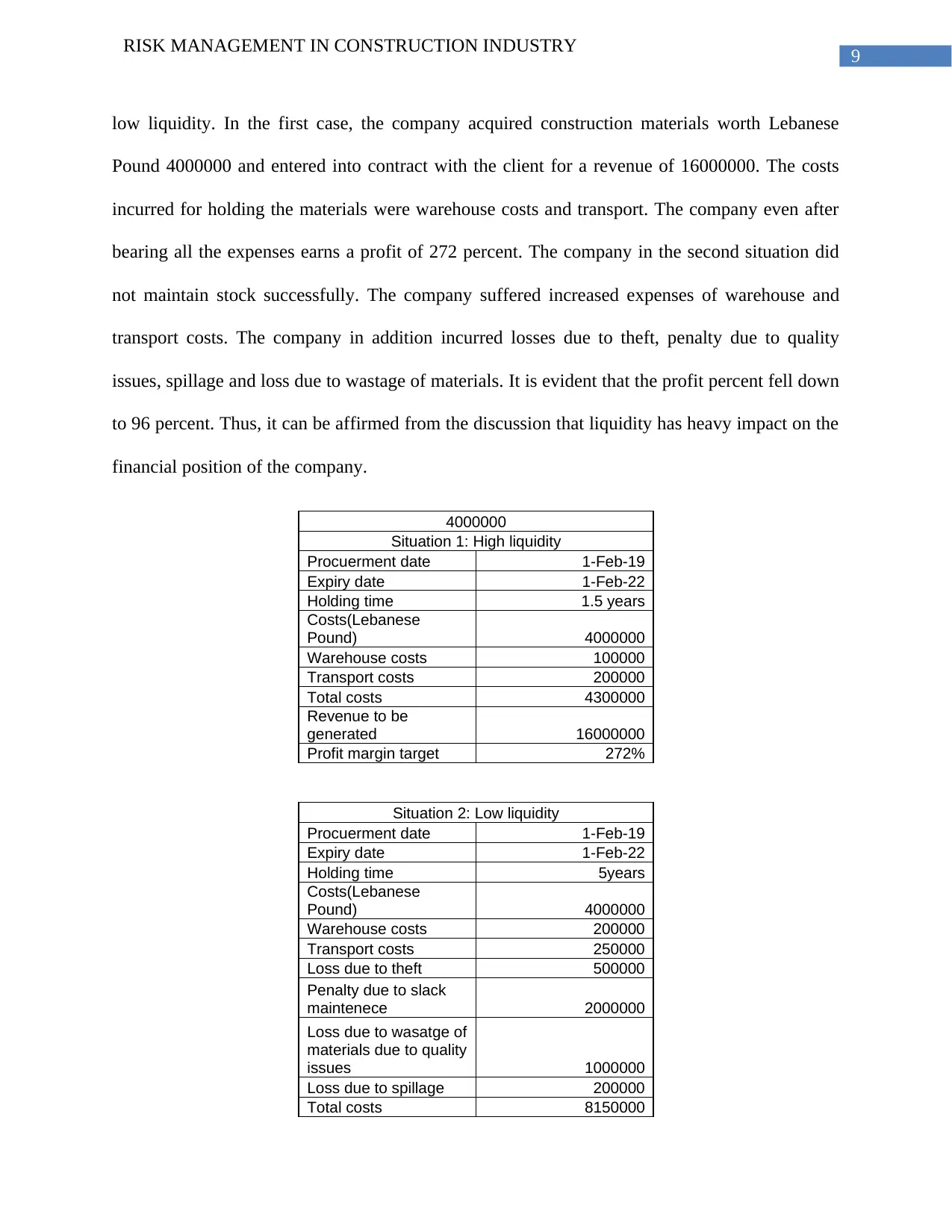
company which reduces its liquidity. This can be explained with the table given showing two
situations, the first showing the effect of high liquidity while the second shows that impact of
⊘ This is a preview!⊘
Do you want full access?
Subscribe today to unlock all pages.
Trusted by 1+ million students worldwide
9
RISK MANAGEMENT IN CONSTRUCTION INDUSTRY
low liquidity. In the first case, the company acquired construction materials worth Lebanese
Pound 4000000 and entered into contract with the client for a revenue of 16000000. The costs
incurred for holding the materials were warehouse costs and transport. The company even after
bearing all the expenses earns a profit of 272 percent. The company in the second situation did
not maintain stock successfully. The company suffered increased expenses of warehouse and
transport costs. The company in addition incurred losses due to theft, penalty due to quality
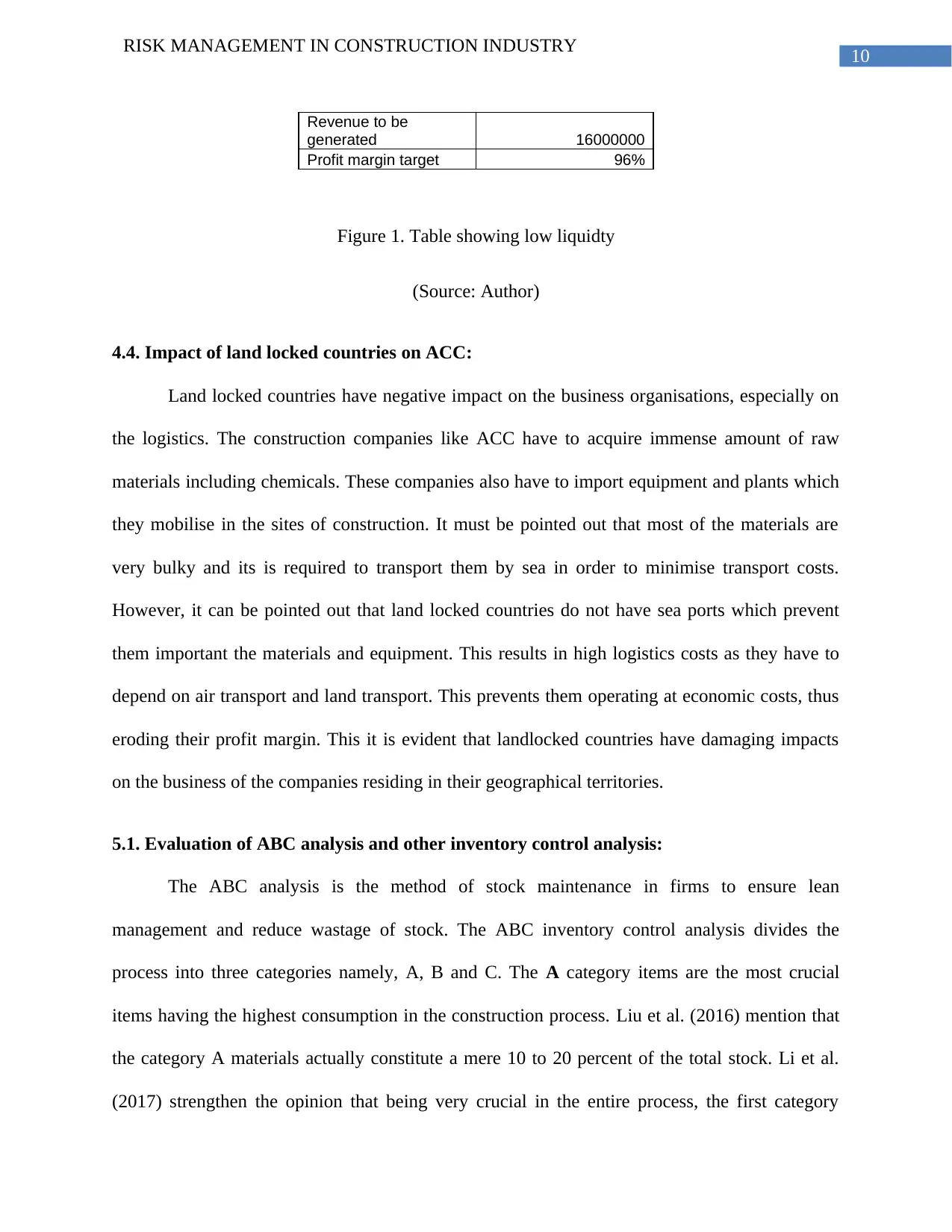
issues, spillage and loss due to wastage of materials. It is evident that the profit percent fell down
to 96 percent. Thus, it can be affirmed from the discussion that liquidity has heavy impact on the
financial position of the company.
4000000
Situation 1: High liquidity
Procuerment date 1-Feb-19
Expiry date 1-Feb-22
Holding time 1.5 years
Costs(Lebanese
Pound) 4000000
Warehouse costs 100000
Transport costs 200000
Total costs 4300000
Revenue to be
generated 16000000
Profit margin target 272%
Situation 2: Low liquidity
Procuerment date 1-Feb-19
Expiry date 1-Feb-22
Holding time 5years
Costs(Lebanese
Pound) 4000000
Warehouse costs 200000
Transport costs 250000
Loss due to theft 500000
Penalty due to slack
maintenece 2000000
Loss due to wasatge of
materials due to quality
issues 1000000
Loss due to spillage 200000
Total costs 8150000
RISK MANAGEMENT IN CONSTRUCTION INDUSTRY
low liquidity. In the first case, the company acquired construction materials worth Lebanese
Pound 4000000 and entered into contract with the client for a revenue of 16000000. The costs
incurred for holding the materials were warehouse costs and transport. The company even after
bearing all the expenses earns a profit of 272 percent. The company in the second situation did
not maintain stock successfully. The company suffered increased expenses of warehouse and
transport costs. The company in addition incurred losses due to theft, penalty due to quality
issues, spillage and loss due to wastage of materials. It is evident that the profit percent fell down
to 96 percent. Thus, it can be affirmed from the discussion that liquidity has heavy impact on the
financial position of the company.
4000000
Situation 1: High liquidity
Procuerment date 1-Feb-19
Expiry date 1-Feb-22
Holding time 1.5 years
Costs(Lebanese
Pound) 4000000
Warehouse costs 100000
Transport costs 200000
Total costs 4300000
Revenue to be
generated 16000000
Profit margin target 272%
Situation 2: Low liquidity
Procuerment date 1-Feb-19
Expiry date 1-Feb-22
Holding time 5years
Costs(Lebanese
Pound) 4000000
Warehouse costs 200000
Transport costs 250000
Loss due to theft 500000
Penalty due to slack
maintenece 2000000
Loss due to wasatge of
materials due to quality
issues 1000000
Loss due to spillage 200000
Total costs 8150000
Paraphrase This Document
Need a fresh take? Get an instant paraphrase of this document with our AI Paraphraser
10
RISK MANAGEMENT IN CONSTRUCTION INDUSTRY
Revenue to be
generated 16000000
Profit margin target 96%
Figure 1. Table showing low liquidty
(Source: Author)
4.4. Impact of land locked countries on ACC:
Land locked countries have negative impact on the business organisations, especially on
the logistics. The construction companies like ACC have to acquire immense amount of raw
materials including chemicals. These companies also have to import equipment and plants which
they mobilise in the sites of construction. It must be pointed out that most of the materials are
very bulky and its is required to transport them by sea in order to minimise transport costs.
However, it can be pointed out that land locked countries do not have sea ports which prevent
them important the materials and equipment. This results in high logistics costs as they have to
depend on air transport and land transport. This prevents them operating at economic costs, thus
eroding their profit margin. This it is evident that landlocked countries have damaging impacts
on the business of the companies residing in their geographical territories.
5.1. Evaluation of ABC analysis and other inventory control analysis:
The ABC analysis is the method of stock maintenance in firms to ensure lean
management and reduce wastage of stock. The ABC inventory control analysis divides the
process into three categories namely, A, B and C. The A category items are the most crucial
items having the highest consumption in the construction process. Liu et al. (2016) mention that
the category A materials actually constitute a mere 10 to 20 percent of the total stock. Li et al.
(2017) strengthen the opinion that being very crucial in the entire process, the first category
RISK MANAGEMENT IN CONSTRUCTION INDUSTRY
Revenue to be
generated 16000000
Profit margin target 96%
Figure 1. Table showing low liquidty
(Source: Author)
4.4. Impact of land locked countries on ACC:
Land locked countries have negative impact on the business organisations, especially on
the logistics. The construction companies like ACC have to acquire immense amount of raw
materials including chemicals. These companies also have to import equipment and plants which
they mobilise in the sites of construction. It must be pointed out that most of the materials are
very bulky and its is required to transport them by sea in order to minimise transport costs.
However, it can be pointed out that land locked countries do not have sea ports which prevent
them important the materials and equipment. This results in high logistics costs as they have to
depend on air transport and land transport. This prevents them operating at economic costs, thus
eroding their profit margin. This it is evident that landlocked countries have damaging impacts
on the business of the companies residing in their geographical territories.
5.1. Evaluation of ABC analysis and other inventory control analysis:
The ABC analysis is the method of stock maintenance in firms to ensure lean
management and reduce wastage of stock. The ABC inventory control analysis divides the
process into three categories namely, A, B and C. The A category items are the most crucial
items having the highest consumption in the construction process. Liu et al. (2016) mention that
the category A materials actually constitute a mere 10 to 20 percent of the total stock. Li et al.
(2017) strengthen the opinion that being very crucial in the entire process, the first category
11
RISK MANAGEMENT IN CONSTRUCTION INDUSTRY
require stringent storage requirements. The construction companies have to report the availability
of the category materials on frequently or even on regular basis. This is because these materials
are so critical to the manufacturing process that it cannot without them.
As far as the ACC is concerned, the category A materials consists of important
components like bricks, rods and cement of different types without which civil construction
works cannot proceed. It can also be pointed out that these materials are subject to theft and
corrosion. This requires the construction company to report the stock of these materials regularly
to ensure minimum loss due to theft.
The second category or category B of materials consists of items with medium
consumption requirements and account to about a quarter of the all the materials used. As far as
ACC is concerned, the chemicals used to support the category A materials belong to this
category,
The least C category of materials constitute of about half the total volume of materials
required. This class materials attract the lowest price of procurement around 10 to 15 percent.
The companies like ACC acquire materials like pipes, electrical items and glass, all of which
constitute the category C materials.
RISK MANAGEMENT IN CONSTRUCTION INDUSTRY
require stringent storage requirements. The construction companies have to report the availability
of the category materials on frequently or even on regular basis. This is because these materials
are so critical to the manufacturing process that it cannot without them.
As far as the ACC is concerned, the category A materials consists of important
components like bricks, rods and cement of different types without which civil construction
works cannot proceed. It can also be pointed out that these materials are subject to theft and
corrosion. This requires the construction company to report the stock of these materials regularly
to ensure minimum loss due to theft.
The second category or category B of materials consists of items with medium
consumption requirements and account to about a quarter of the all the materials used. As far as
ACC is concerned, the chemicals used to support the category A materials belong to this
category,
The least C category of materials constitute of about half the total volume of materials
required. This class materials attract the lowest price of procurement around 10 to 15 percent.
The companies like ACC acquire materials like pipes, electrical items and glass, all of which
constitute the category C materials.
⊘ This is a preview!⊘
Do you want full access?
Subscribe today to unlock all pages.
Trusted by 1+ million students worldwide

1 out of 23


Related Documents


Your All-in-One AI-Powered Toolkit for Academic Success.
+13062052269
info@desklib.com
Available 24*7 on WhatsApp / Email
![[object Object]](/_next/static/media/star-bottom.7253800d.svg)
Unlock your academic potential
Copyright © 2020–2025 A2Z Services. All Rights Reserved. Developed and managed by ZUCOL.