CPCCBC4002A: Manage Occupational Health & Safety Report - 2018
VerifiedAdded on 2023/05/30
|10
|2033
|422
Report
AI Summary
This report, prepared for the CPCCBC4002A unit, focuses on managing occupational health and safety in a construction environment. It identifies and discusses three key safety hazards: manual lifting tasks, gravity (falling people or objects), and electricity. The report provides an in-depth analysis of each hazard, detailing potential risks and associated injuries. Furthermore, it outlines specific safety control measures that can be implemented to mitigate these hazards, ensuring a safer workplace. The report includes a discussion of how these controls would be reported and communicated, along with a sample Safe Work Method Statement (SWMS) for each hazard. The SWMS details the steps used in communicating safe work methods and emphasizes the importance of documentation and procedures for reviewing and monitoring the effectiveness of safety controls. The report emphasizes the importance of proactive safety measures to prevent accidents and ensure the well-being of construction workers.
Control and review safety hazards 1
Control and review safety hazards
Student Name
Name of the Course
Professor Name
Name of the School
City or State located
Date
Control and review safety hazards
Student Name
Name of the Course
Professor Name
Name of the School
City or State located
Date

Paraphrase This Document
Need a fresh take? Get an instant paraphrase of this document with our AI Paraphraser
Control and review safety hazards 2
Assessment Task.
Students are required to Discuss safety hazards for the scenario below.
When managing a construction site, we need to control the hazards associated with the work undertaken.
Write a report on the following hazards and the safety controls you would implement to maintain a safe
workplace for the below safety hazards.
Safety Hazards
- Manual Lifting Tasks
- Gravity (Falling people or objects)
- Electricity
Explain how you will report and communicate each of these controls. Also include and fill out a Safe
work method statement for each of the safety hazards and discuss the steps used in communicating the
safe work methods and discuss the methods, documentation, and procedures put in place to review and
monitor controls of safety hazards.
Assessment Task.
Students are required to Discuss safety hazards for the scenario below.
When managing a construction site, we need to control the hazards associated with the work undertaken.
Write a report on the following hazards and the safety controls you would implement to maintain a safe
workplace for the below safety hazards.
Safety Hazards
- Manual Lifting Tasks
- Gravity (Falling people or objects)
- Electricity
Explain how you will report and communicate each of these controls. Also include and fill out a Safe
work method statement for each of the safety hazards and discuss the steps used in communicating the
safe work methods and discuss the methods, documentation, and procedures put in place to review and
monitor controls of safety hazards.
Control and review safety hazards 3
Table of Contents
Introduction.................................................................................................................................................4
Safety hazards..............................................................................................................................................4
Manual lifting tasks.................................................................................................................................4
Gravity (Falling people or objects)..........................................................................................................5
Electricity................................................................................................................................................6
Conclusion...................................................................................................................................................7
References...................................................................................................................................................8
Appendix.....................................................................................................................................................9
Sample Safe Work Method Statement (SWMS)......................................................................................9
Table of Contents
Introduction.................................................................................................................................................4
Safety hazards..............................................................................................................................................4
Manual lifting tasks.................................................................................................................................4
Gravity (Falling people or objects)..........................................................................................................5
Electricity................................................................................................................................................6
Conclusion...................................................................................................................................................7
References...................................................................................................................................................8
Appendix.....................................................................................................................................................9
Sample Safe Work Method Statement (SWMS)......................................................................................9
⊘ This is a preview!⊘
Do you want full access?
Subscribe today to unlock all pages.

Trusted by 1+ million students worldwide
Control and review safety hazards 4
Introduction.
Safety hazards exist in every workplace. However, in construction, hazards have remained the
same for years even after improving on ways to encounter the hazards. Hazards refer to a source of harm
that may affect the safety or health of a person (Health and Safety Authority, 2018). Besides, safety
hazards are mostly related to occupational safety and health. This report will discuss three basic safety
hazards that are experienced in construction sites. In addition, the report will discuss safety controls that
can be implemented on the above safety hazards so as to ensure a safe workplace. Lastly, the safe work
method statement for each safety hazard will be employed so as to both discuss and document the
methods used in the communication of the safe work methods.
Safety hazards.
Manual lifting tasks
Manual lifting tasks refer to tasks where one has to lift, carry or restrain something in a
construction site. Manual lifting tasks can cause injuries such as neck and back injuries, musculoskeletal
disorders, strains and sprains, slips and crush accidents, cuts and bruises and also hernia (Site Safe, 2018).
According to the workers' compensation data in the Workplace and Health and Safety Queensland,
musculoskeletal disorders were considered the most serious non-fatal injury caused by manual lifting
tasks in construction (WorkSafe Queensland, 2018). Manual lifting tasks involve specific hazards
including; One, we have loads. Bulky, heavy, unstable and difficult to grasp loads may lead to injuries.
Two, we have repetitive lifting. Repetitive lifting actions hurt the soft tissue as well as tire muscles.
Lastly, we have bad posture. How we hold the material carried may affect or impact muscles and blood
flow.
In an effort to control the manual lifting tasks safety hazard, different safety controls can be
employed so to ensure safety. However, in determining the safety control measures, different factors are
considered. They include; duration and frequency of manual lifting tasks, the design of the work area,
postures and movement, weight or size of items being lifted, systems of work used, and lastly the
workplace environmental conditions. Safety controls that would be crucial in maintaining a safe
workplace for the manual lifting tasks will include;
- Loads that may block the vision of a person should not be carried.
- Trolleys should be provided when handling large loads.
- Asking for help when carrying a load may be necessary or taking breaks may also be essential.
- Working activity should be measured against an individual’s fitness level.
Introduction.
Safety hazards exist in every workplace. However, in construction, hazards have remained the
same for years even after improving on ways to encounter the hazards. Hazards refer to a source of harm
that may affect the safety or health of a person (Health and Safety Authority, 2018). Besides, safety
hazards are mostly related to occupational safety and health. This report will discuss three basic safety
hazards that are experienced in construction sites. In addition, the report will discuss safety controls that
can be implemented on the above safety hazards so as to ensure a safe workplace. Lastly, the safe work
method statement for each safety hazard will be employed so as to both discuss and document the
methods used in the communication of the safe work methods.
Safety hazards.
Manual lifting tasks
Manual lifting tasks refer to tasks where one has to lift, carry or restrain something in a
construction site. Manual lifting tasks can cause injuries such as neck and back injuries, musculoskeletal
disorders, strains and sprains, slips and crush accidents, cuts and bruises and also hernia (Site Safe, 2018).
According to the workers' compensation data in the Workplace and Health and Safety Queensland,
musculoskeletal disorders were considered the most serious non-fatal injury caused by manual lifting
tasks in construction (WorkSafe Queensland, 2018). Manual lifting tasks involve specific hazards
including; One, we have loads. Bulky, heavy, unstable and difficult to grasp loads may lead to injuries.
Two, we have repetitive lifting. Repetitive lifting actions hurt the soft tissue as well as tire muscles.
Lastly, we have bad posture. How we hold the material carried may affect or impact muscles and blood
flow.
In an effort to control the manual lifting tasks safety hazard, different safety controls can be
employed so to ensure safety. However, in determining the safety control measures, different factors are
considered. They include; duration and frequency of manual lifting tasks, the design of the work area,
postures and movement, weight or size of items being lifted, systems of work used, and lastly the
workplace environmental conditions. Safety controls that would be crucial in maintaining a safe
workplace for the manual lifting tasks will include;
- Loads that may block the vision of a person should not be carried.
- Trolleys should be provided when handling large loads.
- Asking for help when carrying a load may be necessary or taking breaks may also be essential.
- Working activity should be measured against an individual’s fitness level.
Paraphrase This Document
Need a fresh take? Get an instant paraphrase of this document with our AI Paraphraser
Control and review safety hazards 5
- Wearing suitable protective equipment such as safety boots and gloves may protect against
crushed toes or cuts.
- Ensuring adequate lighting may be crucial when lifting the load to a specific area.
- Avoiding unnecessary twisting movements.
Gravity (Falling people or objects).
Each year, falls contribute a high number of fatalities in the construction space. According to
OSHA, between 2003 and 2013, falls were considered the leading cause of deaths in the construction
industry (Safety and health magazine, 2018). Falls from rooftops contributed to about 34% of the total
deaths. On the other hand, non-fatal falls also result in disability, decreased quality of life, long-term pain
and work time loss. Most causes of fall-related injuries and deaths are attributed to hazards such as;
- Misuse of portable ladders.
- Unprotected floor holes, edges, and wall openings.
- Protruding and unguarded steel rebars.
- Improper scaffold construction.
- Unstable working surfaces.
- Human error.
- Failure to use fall protection equipment.
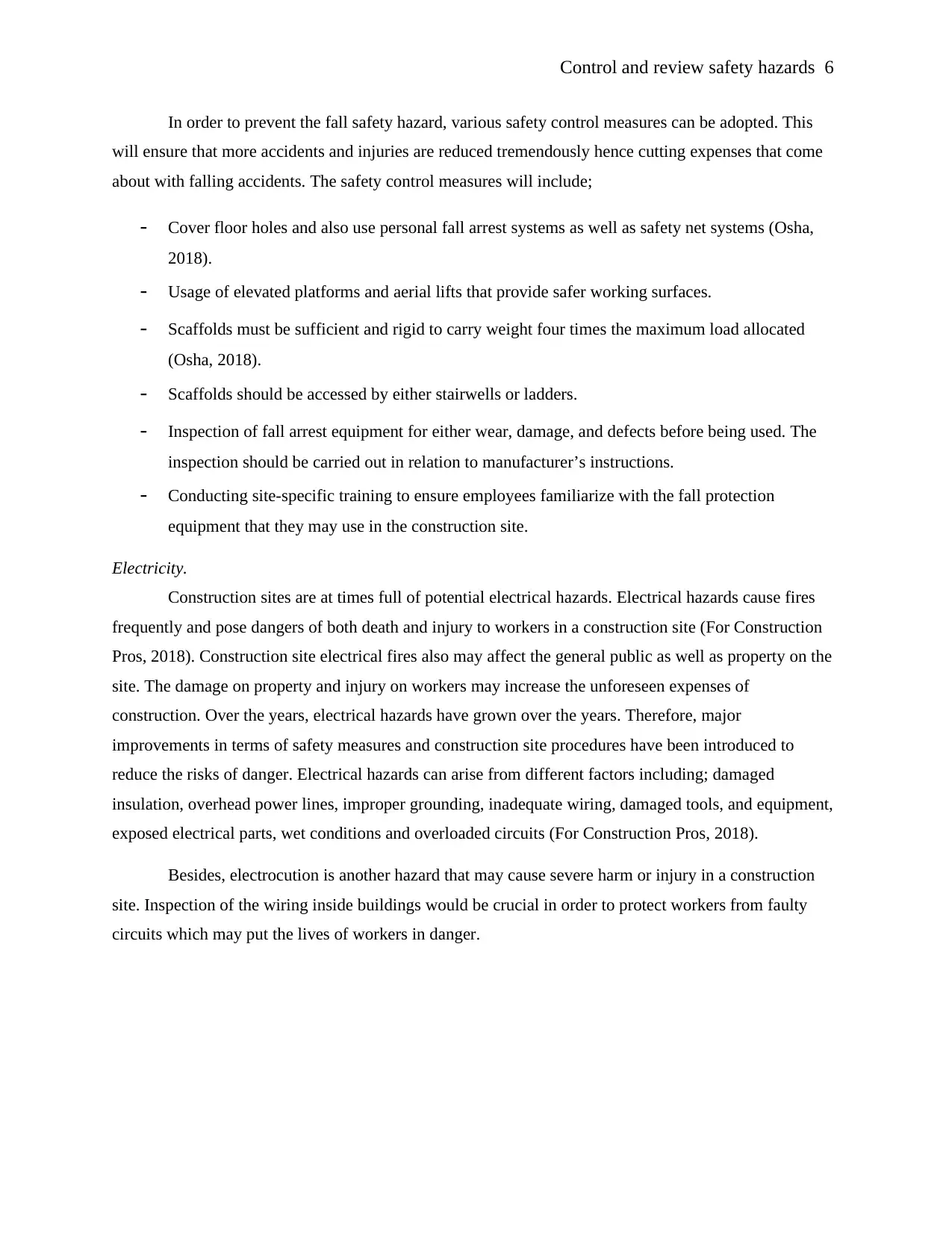
In construction, roofing is considered a dangerous activity since the roofing workers are three
times likely to experience fatal injuries as compared to other workers. Besides, when scaffolds are not
properly erected, fall occur frequently.
Figure 1.1 Erection of Scaffolds. Source: https://safety.grainger.com/facilities/height-safety
- Wearing suitable protective equipment such as safety boots and gloves may protect against
crushed toes or cuts.
- Ensuring adequate lighting may be crucial when lifting the load to a specific area.
- Avoiding unnecessary twisting movements.
Gravity (Falling people or objects).
Each year, falls contribute a high number of fatalities in the construction space. According to
OSHA, between 2003 and 2013, falls were considered the leading cause of deaths in the construction
industry (Safety and health magazine, 2018). Falls from rooftops contributed to about 34% of the total
deaths. On the other hand, non-fatal falls also result in disability, decreased quality of life, long-term pain
and work time loss. Most causes of fall-related injuries and deaths are attributed to hazards such as;
- Misuse of portable ladders.
- Unprotected floor holes, edges, and wall openings.
- Protruding and unguarded steel rebars.
- Improper scaffold construction.
- Unstable working surfaces.
- Human error.
- Failure to use fall protection equipment.
In construction, roofing is considered a dangerous activity since the roofing workers are three
times likely to experience fatal injuries as compared to other workers. Besides, when scaffolds are not
properly erected, fall occur frequently.
Figure 1.1 Erection of Scaffolds. Source: https://safety.grainger.com/facilities/height-safety
Control and review safety hazards 6
In order to prevent the fall safety hazard, various safety control measures can be adopted. This
will ensure that more accidents and injuries are reduced tremendously hence cutting expenses that come
about with falling accidents. The safety control measures will include;
- Cover floor holes and also use personal fall arrest systems as well as safety net systems (Osha,
2018).
- Usage of elevated platforms and aerial lifts that provide safer working surfaces.
- Scaffolds must be sufficient and rigid to carry weight four times the maximum load allocated
(Osha, 2018).
- Scaffolds should be accessed by either stairwells or ladders.
- Inspection of fall arrest equipment for either wear, damage, and defects before being used. The
inspection should be carried out in relation to manufacturer’s instructions.
- Conducting site-specific training to ensure employees familiarize with the fall protection
equipment that they may use in the construction site.
Electricity.
Construction sites are at times full of potential electrical hazards. Electrical hazards cause fires
frequently and pose dangers of both death and injury to workers in a construction site (For Construction
Pros, 2018). Construction site electrical fires also may affect the general public as well as property on the
site. The damage on property and injury on workers may increase the unforeseen expenses of
construction. Over the years, electrical hazards have grown over the years. Therefore, major
improvements in terms of safety measures and construction site procedures have been introduced to
reduce the risks of danger. Electrical hazards can arise from different factors including; damaged
insulation, overhead power lines, improper grounding, inadequate wiring, damaged tools, and equipment,
exposed electrical parts, wet conditions and overloaded circuits (For Construction Pros, 2018).
Besides, electrocution is another hazard that may cause severe harm or injury in a construction
site. Inspection of the wiring inside buildings would be crucial in order to protect workers from faulty
circuits which may put the lives of workers in danger.
In order to prevent the fall safety hazard, various safety control measures can be adopted. This
will ensure that more accidents and injuries are reduced tremendously hence cutting expenses that come
about with falling accidents. The safety control measures will include;
- Cover floor holes and also use personal fall arrest systems as well as safety net systems (Osha,
2018).
- Usage of elevated platforms and aerial lifts that provide safer working surfaces.
- Scaffolds must be sufficient and rigid to carry weight four times the maximum load allocated
(Osha, 2018).
- Scaffolds should be accessed by either stairwells or ladders.
- Inspection of fall arrest equipment for either wear, damage, and defects before being used. The
inspection should be carried out in relation to manufacturer’s instructions.
- Conducting site-specific training to ensure employees familiarize with the fall protection
equipment that they may use in the construction site.
Electricity.
Construction sites are at times full of potential electrical hazards. Electrical hazards cause fires
frequently and pose dangers of both death and injury to workers in a construction site (For Construction
Pros, 2018). Construction site electrical fires also may affect the general public as well as property on the
site. The damage on property and injury on workers may increase the unforeseen expenses of
construction. Over the years, electrical hazards have grown over the years. Therefore, major
improvements in terms of safety measures and construction site procedures have been introduced to
reduce the risks of danger. Electrical hazards can arise from different factors including; damaged
insulation, overhead power lines, improper grounding, inadequate wiring, damaged tools, and equipment,
exposed electrical parts, wet conditions and overloaded circuits (For Construction Pros, 2018).
Besides, electrocution is another hazard that may cause severe harm or injury in a construction
site. Inspection of the wiring inside buildings would be crucial in order to protect workers from faulty
circuits which may put the lives of workers in danger.
⊘ This is a preview!⊘
Do you want full access?
Subscribe today to unlock all pages.
Trusted by 1+ million students worldwide
Control and review safety hazards 7
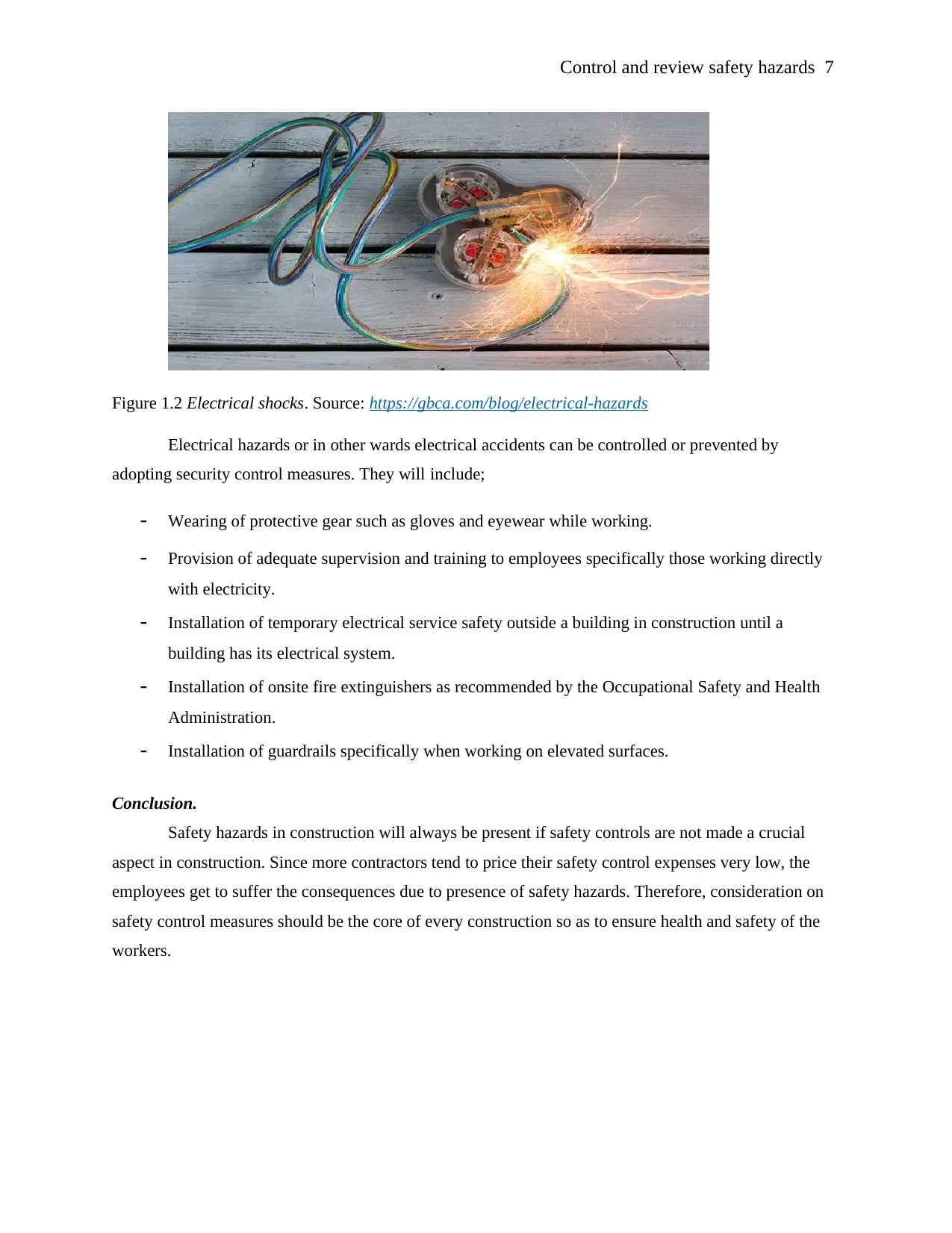
Figure 1.2 Electrical shocks. Source: https://gbca.com/blog/electrical-hazards
Electrical hazards or in other wards electrical accidents can be controlled or prevented by
adopting security control measures. They will include;
- Wearing of protective gear such as gloves and eyewear while working.
- Provision of adequate supervision and training to employees specifically those working directly
with electricity.
- Installation of temporary electrical service safety outside a building in construction until a
building has its electrical system.
- Installation of onsite fire extinguishers as recommended by the Occupational Safety and Health
Administration.
- Installation of guardrails specifically when working on elevated surfaces.
Conclusion.
Safety hazards in construction will always be present if safety controls are not made a crucial
aspect in construction. Since more contractors tend to price their safety control expenses very low, the
employees get to suffer the consequences due to presence of safety hazards. Therefore, consideration on
safety control measures should be the core of every construction so as to ensure health and safety of the
workers.
Figure 1.2 Electrical shocks. Source: https://gbca.com/blog/electrical-hazards
Electrical hazards or in other wards electrical accidents can be controlled or prevented by
adopting security control measures. They will include;
- Wearing of protective gear such as gloves and eyewear while working.
- Provision of adequate supervision and training to employees specifically those working directly
with electricity.
- Installation of temporary electrical service safety outside a building in construction until a
building has its electrical system.
- Installation of onsite fire extinguishers as recommended by the Occupational Safety and Health
Administration.
- Installation of guardrails specifically when working on elevated surfaces.
Conclusion.
Safety hazards in construction will always be present if safety controls are not made a crucial
aspect in construction. Since more contractors tend to price their safety control expenses very low, the
employees get to suffer the consequences due to presence of safety hazards. Therefore, consideration on
safety control measures should be the core of every construction so as to ensure health and safety of the
workers.
Paraphrase This Document
Need a fresh take? Get an instant paraphrase of this document with our AI Paraphraser
Control and review safety hazards 8
References
For Construction Pros. (2018). Safety - Electrical Hazards on Construction Sites. [online] Available at:
https://www.forconstructionpros.com/business/construction-safety/article/10745783/safety-electrical-
hazards-on-construction-sites [Accessed 20 Nov. 2018].
Health and Safety Authority. (2018). Hazards - Health and Safety Authority. [online] Available at:
https://www.hsa.ie/eng/Topics/Hazards/ [Accessed 20 Nov. 2018].
Osha. (2018). Worker Safety Series - Construction | Occupational Safety and Health Administration.
[online] Available at: https://www.osha.gov/Publications/OSHA3252/3252.html [Accessed 20 Nov.
2018].
Safety and health magazine. (2018). Falls in construction: A deadly hazard. [online] Available at:
https://www.safetyandhealthmagazine.com/articles/14832-falls-in-construction-a-deadly-hazard
[Accessed 20 Nov. 2018].
Site Safe. (2018). Manual Handling. [online] Available at: https://www.sitesafe.org.nz/guides--
resources/practical-safety-advice/manual-handling/ [Accessed 20 Nov. 2018].
WorkSafe Queensland. (2018). Manual tasks in construction. [online] Available at:
https://www.worksafe.qld.gov.au/construction/workplace-hazards/manual-tasks-in-construction
[Accessed 20 Nov. 2018].
References
For Construction Pros. (2018). Safety - Electrical Hazards on Construction Sites. [online] Available at:
https://www.forconstructionpros.com/business/construction-safety/article/10745783/safety-electrical-
hazards-on-construction-sites [Accessed 20 Nov. 2018].
Health and Safety Authority. (2018). Hazards - Health and Safety Authority. [online] Available at:
https://www.hsa.ie/eng/Topics/Hazards/ [Accessed 20 Nov. 2018].
Osha. (2018). Worker Safety Series - Construction | Occupational Safety and Health Administration.
[online] Available at: https://www.osha.gov/Publications/OSHA3252/3252.html [Accessed 20 Nov.
2018].
Safety and health magazine. (2018). Falls in construction: A deadly hazard. [online] Available at:
https://www.safetyandhealthmagazine.com/articles/14832-falls-in-construction-a-deadly-hazard
[Accessed 20 Nov. 2018].
Site Safe. (2018). Manual Handling. [online] Available at: https://www.sitesafe.org.nz/guides--
resources/practical-safety-advice/manual-handling/ [Accessed 20 Nov. 2018].
WorkSafe Queensland. (2018). Manual tasks in construction. [online] Available at:
https://www.worksafe.qld.gov.au/construction/workplace-hazards/manual-tasks-in-construction
[Accessed 20 Nov. 2018].
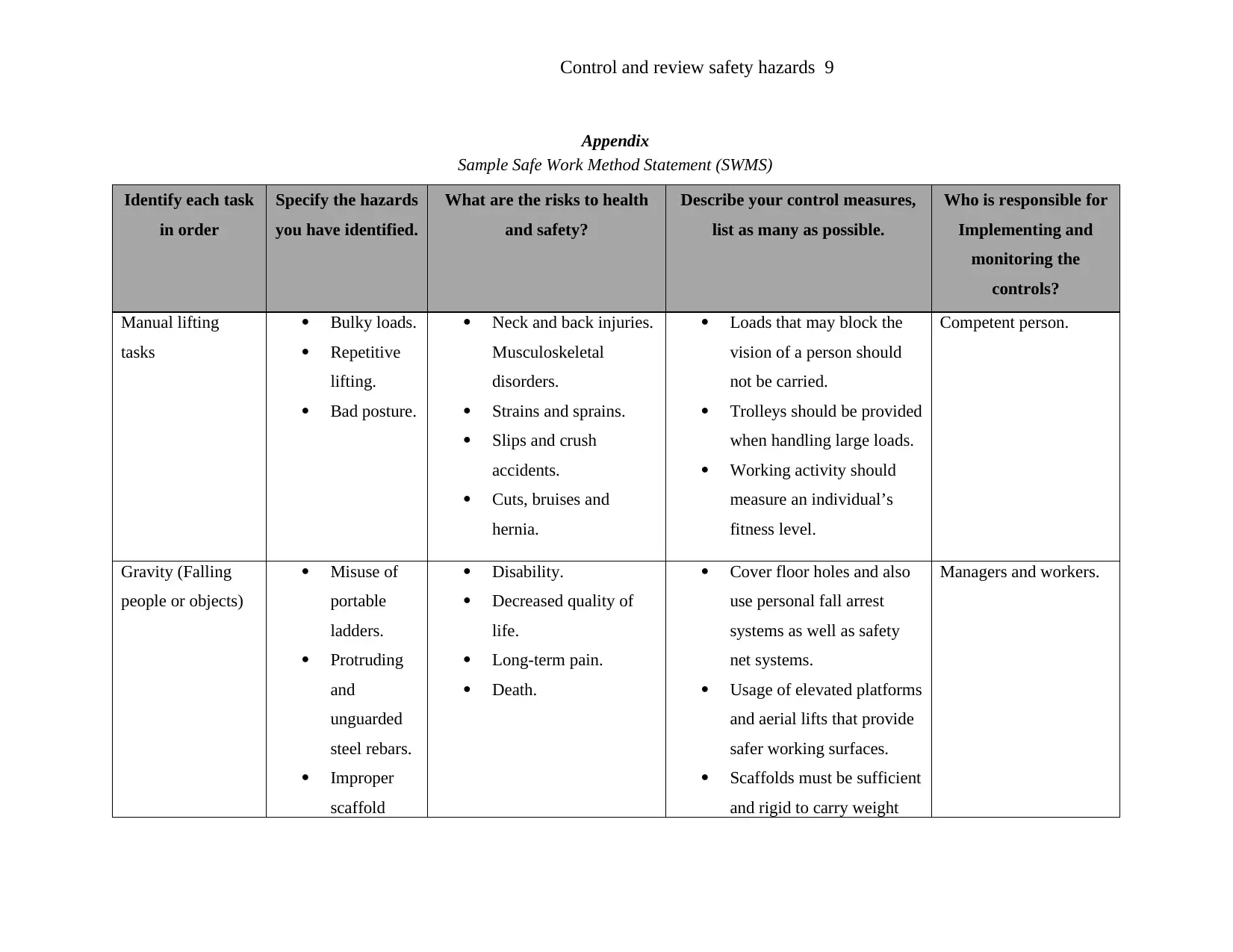
Control and review safety hazards 9
Appendix
Sample Safe Work Method Statement (SWMS)
Identify each task
in order
Specify the hazards
you have identified.
What are the risks to health
and safety?
Describe your control measures,
list as many as possible.
Who is responsible for
Implementing and
monitoring the
controls?
Manual lifting
tasks
Bulky loads.
Repetitive
lifting.
Bad posture.
Neck and back injuries.
Musculoskeletal
disorders.
Strains and sprains.
Slips and crush
accidents.
Cuts, bruises and
hernia.
Loads that may block the
vision of a person should
not be carried.
Trolleys should be provided
when handling large loads.
Working activity should
measure an individual’s
fitness level.
Competent person.
Gravity (Falling
people or objects)
Misuse of
portable
ladders.
Protruding
and
unguarded
steel rebars.
Improper
scaffold
Disability.
Decreased quality of
life.
Long-term pain.
Death.
Cover floor holes and also
use personal fall arrest
systems as well as safety
net systems.
Usage of elevated platforms
and aerial lifts that provide
safer working surfaces.
Scaffolds must be sufficient
and rigid to carry weight
Managers and workers.
Appendix
Sample Safe Work Method Statement (SWMS)
Identify each task
in order
Specify the hazards
you have identified.
What are the risks to health
and safety?
Describe your control measures,
list as many as possible.
Who is responsible for
Implementing and
monitoring the
controls?
Manual lifting
tasks
Bulky loads.
Repetitive
lifting.
Bad posture.
Neck and back injuries.
Musculoskeletal
disorders.
Strains and sprains.
Slips and crush
accidents.
Cuts, bruises and
hernia.
Loads that may block the
vision of a person should
not be carried.
Trolleys should be provided
when handling large loads.
Working activity should
measure an individual’s
fitness level.
Competent person.
Gravity (Falling
people or objects)
Misuse of
portable
ladders.
Protruding
and
unguarded
steel rebars.
Improper
scaffold
Disability.
Decreased quality of
life.
Long-term pain.
Death.
Cover floor holes and also
use personal fall arrest
systems as well as safety
net systems.
Usage of elevated platforms
and aerial lifts that provide
safer working surfaces.
Scaffolds must be sufficient
and rigid to carry weight
Managers and workers.
⊘ This is a preview!⊘
Do you want full access?
Subscribe today to unlock all pages.
Trusted by 1+ million students worldwide
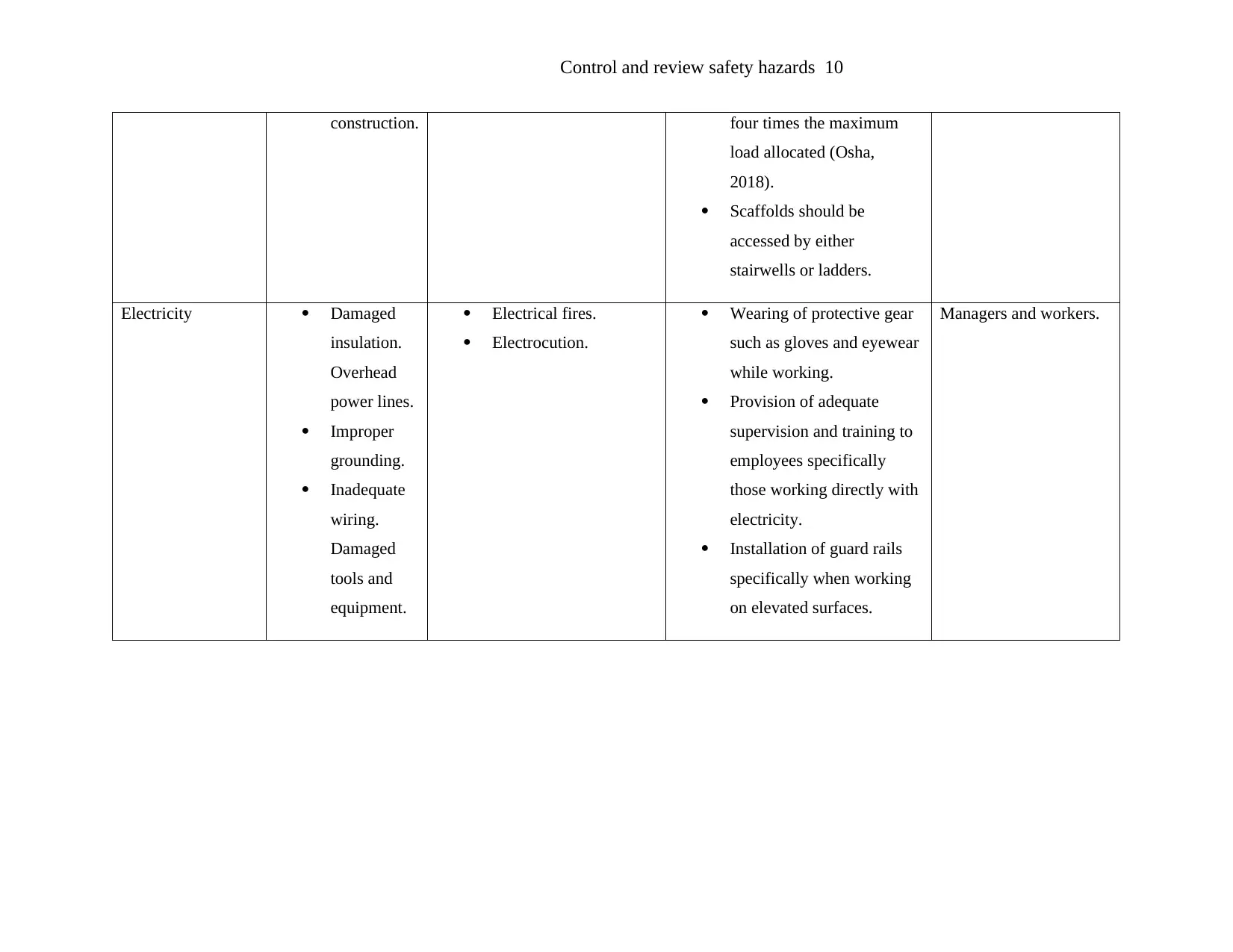
Control and review safety hazards 10
construction. four times the maximum
load allocated (Osha,
2018).
Scaffolds should be
accessed by either
stairwells or ladders.
Electricity Damaged
insulation.
Overhead
power lines.
Improper
grounding.
Inadequate
wiring.
Damaged
tools and
equipment.
Electrical fires.
Electrocution.
Wearing of protective gear
such as gloves and eyewear
while working.
Provision of adequate
supervision and training to
employees specifically
those working directly with
electricity.
Installation of guard rails
specifically when working
on elevated surfaces.
Managers and workers.
construction. four times the maximum
load allocated (Osha,
2018).
Scaffolds should be
accessed by either
stairwells or ladders.
Electricity Damaged
insulation.
Overhead
power lines.
Improper
grounding.
Inadequate
wiring.
Damaged
tools and
equipment.
Electrical fires.
Electrocution.
Wearing of protective gear
such as gloves and eyewear
while working.
Provision of adequate
supervision and training to
employees specifically
those working directly with
electricity.
Installation of guard rails
specifically when working
on elevated surfaces.
Managers and workers.

1 out of 10


Related Documents


Your All-in-One AI-Powered Toolkit for Academic Success.
+13062052269
info@desklib.com
Available 24*7 on WhatsApp / Email
![[object Object]](/_next/static/media/star-bottom.7253800d.svg)
Unlock your academic potential
Copyright © 2020–2026 A2Z Services. All Rights Reserved. Developed and managed by ZUCOL.