Construction Technology Report: Hospital Building, Unit 2, 2021/22
VerifiedAdded on 2021/06/30
|24
|3582
|563
Report
AI Summary
This report presents a comprehensive analysis of the construction technology employed in a 15-story hospital building project. It begins with an executive summary and introduction, outlining the project's aims and scope. The report delves into construction terminology, differentiating between residential, commercial, and industrial buildings, and specifying functional characteristics and design selection criteria, including sustainability considerations. It examines the superstructure and substructure, including pre-design studies like site reconnaissance and soil reports. The report further explores the characteristics of primary and secondary elements of the substructure and superstructure, such as foundations, roofs, floors, and walls. Building services are also discussed, covering the practical aspects of hospital construction. The report concludes with a summary of findings and references.

CENTRE NAME: THE INSTITUTE OF BUSINESS ENGINEERING & TECHNOLOGY PVT. LTD.
CENTRE NUMBER: 92556
PROGRAMME: BTEC HND QUANTITY SURVEYING
FRAME WORK: RQF
MODULE: CONSTRUCTION TECHNOLOGY
UNIT: 2
UNIT CODE: Y/615/1388
ACADEMIC YEAR: 2021/22
LEARNER: ASHEN PASINDU MANOHARA
STUDENT NO: CBED / 01 / 19 / 303
COURSEWORK
ASSESSMENT
CENTRE NUMBER: 92556
PROGRAMME: BTEC HND QUANTITY SURVEYING
FRAME WORK: RQF
MODULE: CONSTRUCTION TECHNOLOGY
UNIT: 2
UNIT CODE: Y/615/1388
ACADEMIC YEAR: 2021/22
LEARNER: ASHEN PASINDU MANOHARA
STUDENT NO: CBED / 01 / 19 / 303
COURSEWORK
ASSESSMENT
Paraphrase This Document
Need a fresh take? Get an instant paraphrase of this document with our AI Paraphraser

Unit / Module 2/CONSTRUCTION TECHNOLOGY
Assessment CONSTRUCTION TECHNOLOGY
Lecturer THUSHARA INDIKA
Student Name H. Ashen Pasindu Manohara ID 960830164V
Hand Out Date 08th May2021 Hand In Date 29th June 2021
Initial Submission Date 27th June 2021 Re-Submission
Date
06th August 2021
Student to
Tick if
Attempted
Grading
Opportunity
Criteria Met?
Assessor Feedback
Initially On
Resubmission
P.1
P.2
P.3
P.4
P.5
P.6
P.7
P.8
P.9
M1
M2
M3
M4
M5
D1
D2
D3
Assessed By
(Name):
Signature: Date:
Assessment CONSTRUCTION TECHNOLOGY
Lecturer THUSHARA INDIKA
Student Name H. Ashen Pasindu Manohara ID 960830164V
Hand Out Date 08th May2021 Hand In Date 29th June 2021
Initial Submission Date 27th June 2021 Re-Submission
Date
06th August 2021
Student to
Tick if
Attempted
Grading
Opportunity
Criteria Met?
Assessor Feedback
Initially On
Resubmission
P.1
P.2
P.3
P.4
P.5
P.6
P.7
P.8
P.9
M1
M2
M3
M4
M5
D1
D2
D3
Assessed By
(Name):
Signature: Date:

Assignment cover sheet
Note: (1) The attention of students is drawn to: the Regulations, the Honesty Policy
and the Assessment Policy, all of which are available in the hand book.
(2) A de-identified copy of your assignment may be retained for Institute quality (audit)
processes, benchmarking or moderation.
Student Number/s: Student Surname/s: Given name/s:
CBED / 01 / 19 / 303 HETHUMUNI ASHEN PASINDU MANOHARA
Course: BTEC HND QUANTITY SURVEYING
School:
Unit code: Y/615/1388 Unit title: CONSTRUCTION TECHNOLOGY (RQF)
Hand Out Date: 08th May 2021 Hand In Date: 27th June 2021
Lecturer-in-Charge: THUSHARA INDIKA Module Leader: THUSHARA INDIKA
Assignment Title and/or number: CONSTRUCTION TECHNOLOGY
DECLARATION OF ORIGINALITY
By submitting this assignment for assessment, I acknowledge and agree that:
1. This assignment is submitted in accordance with the Institute Academic Regulations,
Assessment Policy and Honesty Policy. I also understand the serious nature of academic
dishonesty (such as plagiarism) and the penalties attached to being found guilty of
committing such offences.
2. No part of this assignment has been copied from any other source without acknowledgement of
the source.
3. No part of this assignment has been written by any other person, except to the
extent of collaboration and/or group work as defined in the unitoutline.
4. This assignment has not been recycled, using work substantially the same as work I have
completed previously and which has been counted towards satisfactory completion of
another unit of study or credited towards another qualification, unless the Lecturer in
Charge has granted prior written consent to do so.
5. A copy of the original assignment is retained by me and that I may be required to
submit the original assignment to the Lecturer in Charge upon request.
6. The Lecturer-in-Charge may, for the purpose of assessing this assignment:
6.1. Reproduce this assignment;
6.2. authorize the reproduction of thisassignment;
6.3. Provide a copy of this assignment to another member of the University; and/or
6.4. Communicate, or authorize communication of, a copy of this assignment to a
plagiarism checking service, such as the “Turnitin” service operated by I Paradigms
LLC (or such other service utilized by the University at its absolute discretion). I
acknowledge that a plagiarism checking service provider may then retain a copy of this
assignment on its database for the purpose of future plagiarism checking.
Note: (1) The attention of students is drawn to: the Regulations, the Honesty Policy
and the Assessment Policy, all of which are available in the hand book.
(2) A de-identified copy of your assignment may be retained for Institute quality (audit)
processes, benchmarking or moderation.
Student Number/s: Student Surname/s: Given name/s:
CBED / 01 / 19 / 303 HETHUMUNI ASHEN PASINDU MANOHARA
Course: BTEC HND QUANTITY SURVEYING
School:
Unit code: Y/615/1388 Unit title: CONSTRUCTION TECHNOLOGY (RQF)
Hand Out Date: 08th May 2021 Hand In Date: 27th June 2021
Lecturer-in-Charge: THUSHARA INDIKA Module Leader: THUSHARA INDIKA
Assignment Title and/or number: CONSTRUCTION TECHNOLOGY
DECLARATION OF ORIGINALITY
By submitting this assignment for assessment, I acknowledge and agree that:
1. This assignment is submitted in accordance with the Institute Academic Regulations,
Assessment Policy and Honesty Policy. I also understand the serious nature of academic
dishonesty (such as plagiarism) and the penalties attached to being found guilty of
committing such offences.
2. No part of this assignment has been copied from any other source without acknowledgement of
the source.
3. No part of this assignment has been written by any other person, except to the
extent of collaboration and/or group work as defined in the unitoutline.
4. This assignment has not been recycled, using work substantially the same as work I have
completed previously and which has been counted towards satisfactory completion of
another unit of study or credited towards another qualification, unless the Lecturer in
Charge has granted prior written consent to do so.
5. A copy of the original assignment is retained by me and that I may be required to
submit the original assignment to the Lecturer in Charge upon request.
6. The Lecturer-in-Charge may, for the purpose of assessing this assignment:
6.1. Reproduce this assignment;
6.2. authorize the reproduction of thisassignment;
6.3. Provide a copy of this assignment to another member of the University; and/or
6.4. Communicate, or authorize communication of, a copy of this assignment to a
plagiarism checking service, such as the “Turnitin” service operated by I Paradigms
LLC (or such other service utilized by the University at its absolute discretion). I
acknowledge that a plagiarism checking service provider may then retain a copy of this
assignment on its database for the purpose of future plagiarism checking.
⊘ This is a preview!⊘
Do you want full access?
Subscribe today to unlock all pages.

Trusted by 1+ million students worldwide

Signature of student: …………………………………………….. Date: 27/ 06/ 2021
Paraphrase This Document
Need a fresh take? Get an instant paraphrase of this document with our AI Paraphraser

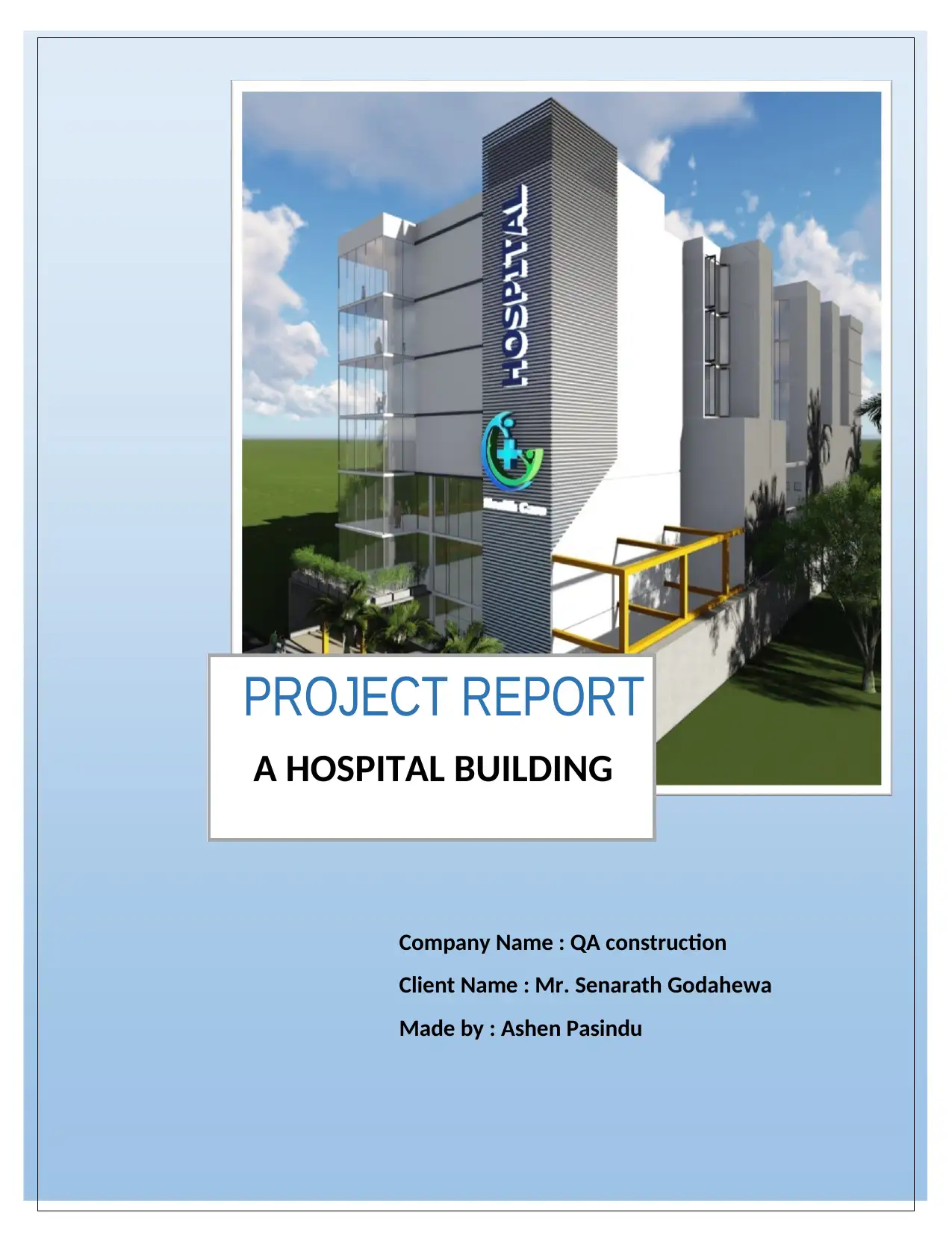
PROJECT REPORT
A HOSPITAL BUILDING
Company Name : QA construction
Client Name : Mr. Senarath Godahewa
Made by : Ashen Pasindu
A HOSPITAL BUILDING
Company Name : QA construction
Client Name : Mr. Senarath Godahewa
Made by : Ashen Pasindu

1
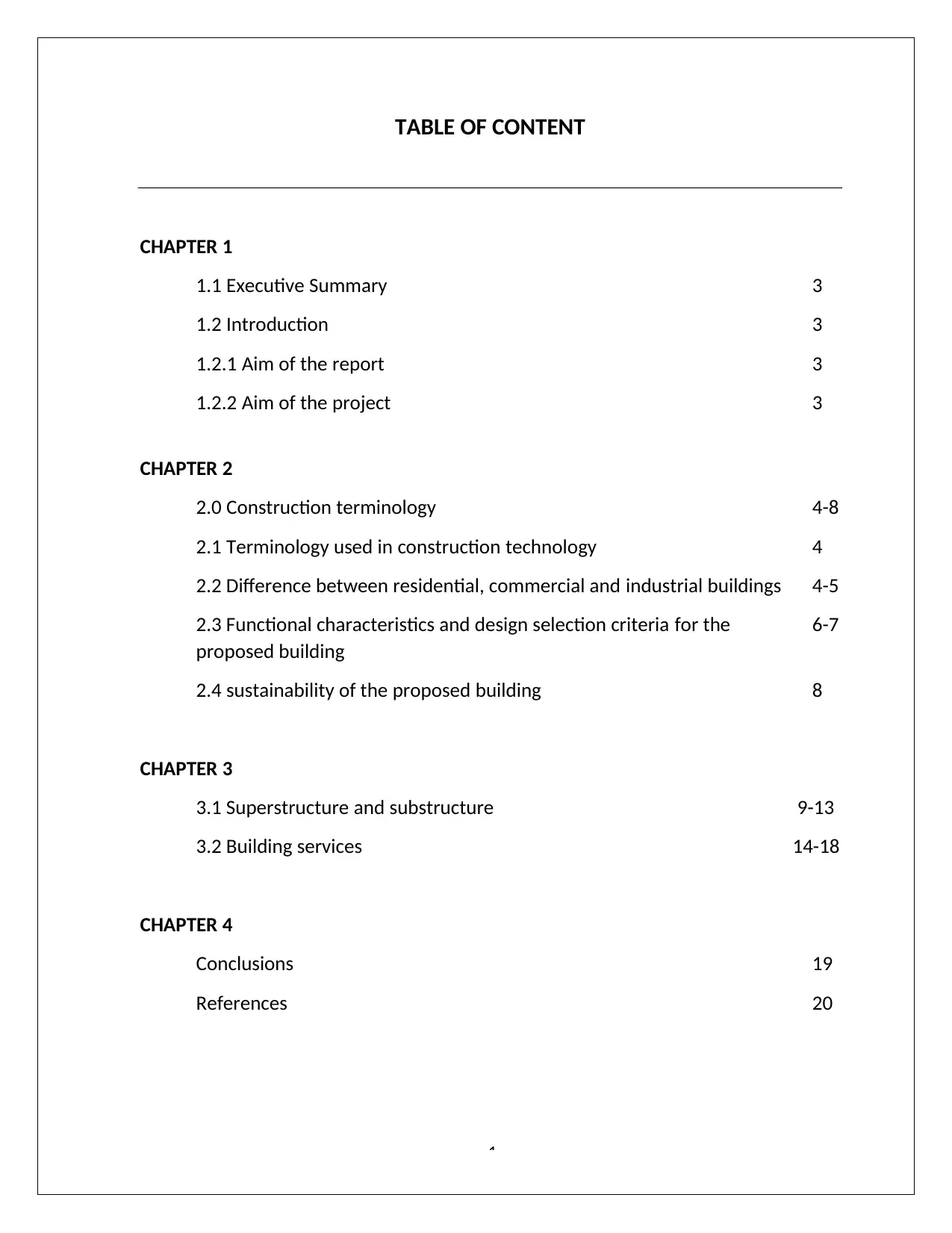
TABLE OF CONTENT
CHAPTER 1
1.1 Executive Summary 3
1.2 Introduction 3
1.2.1 Aim of the report 3
1.2.2 Aim of the project 3
CHAPTER 2
2.0 Construction terminology 4-8
2.1 Terminology used in construction technology 4
2.2 Difference between residential, commercial and industrial buildings 4-5
2.3 Functional characteristics and design selection criteria for the 6-7
proposed building
2.4 sustainability of the proposed building 8
CHAPTER 3
3.1 Superstructure and substructure 9-13
3.2 Building services 14-18
CHAPTER 4
Conclusions 19
References 20
TABLE OF CONTENT
CHAPTER 1
1.1 Executive Summary 3
1.2 Introduction 3
1.2.1 Aim of the report 3
1.2.2 Aim of the project 3
CHAPTER 2
2.0 Construction terminology 4-8
2.1 Terminology used in construction technology 4
2.2 Difference between residential, commercial and industrial buildings 4-5
2.3 Functional characteristics and design selection criteria for the 6-7
proposed building
2.4 sustainability of the proposed building 8
CHAPTER 3
3.1 Superstructure and substructure 9-13
3.2 Building services 14-18
CHAPTER 4
Conclusions 19
References 20
⊘ This is a preview!⊘
Do you want full access?
Subscribe today to unlock all pages.

Trusted by 1+ million students worldwide

2
CHAPTER 1
1.1 EXECUTIVE SUMMARY
The project described in this paper is a 15 storey Hospital building is to be constructed in
capital of Sri Lanka. The project is owned by a private company, which does not have their
technical staff. Therefore the project has been handed over by the client to a leading
construction consultancy firm in the country. The client prefers to have a basement car
parking due to space constraints. Also the client needs to apply sustainability concepts into
this project. The author of this paper tries to discuss about the terminology used in
construction of this building and different types of construction technologies can be used.
1.2 INTRODUCTION
1.2.1 AIM OF THE PAPER
The paper describes and discusses about a Hospital building in the capital of the country.
The building is designed to have 15 floors and the land has an extent of 75 perch. This paper
aims to describe and analyze the terminology used in the construction, construction
technology and how the design selection criteria and sustainability may influence the design
of the building.
1.2.2 AIM OF THE PROJECT
The particular building was designed to fulfil on of the main requirements in the capital. A
Hospital becomes a major necessity when the population increases. Hospitals matter to
people and often mark central points in their lives. They also matter to health systems by
being instrumental for care coordination and integration. And provide a setting for
education of doctors, nurses and other health-care professionals and are a critical base for
clinical research. Therefore this construction will be a great addition to the capital.
CHAPTER 1
1.1 EXECUTIVE SUMMARY
The project described in this paper is a 15 storey Hospital building is to be constructed in
capital of Sri Lanka. The project is owned by a private company, which does not have their
technical staff. Therefore the project has been handed over by the client to a leading
construction consultancy firm in the country. The client prefers to have a basement car
parking due to space constraints. Also the client needs to apply sustainability concepts into
this project. The author of this paper tries to discuss about the terminology used in
construction of this building and different types of construction technologies can be used.
1.2 INTRODUCTION
1.2.1 AIM OF THE PAPER
The paper describes and discusses about a Hospital building in the capital of the country.
The building is designed to have 15 floors and the land has an extent of 75 perch. This paper
aims to describe and analyze the terminology used in the construction, construction
technology and how the design selection criteria and sustainability may influence the design
of the building.
1.2.2 AIM OF THE PROJECT
The particular building was designed to fulfil on of the main requirements in the capital. A
Hospital becomes a major necessity when the population increases. Hospitals matter to
people and often mark central points in their lives. They also matter to health systems by
being instrumental for care coordination and integration. And provide a setting for
education of doctors, nurses and other health-care professionals and are a critical base for
clinical research. Therefore this construction will be a great addition to the capital.
Paraphrase This Document
Need a fresh take? Get an instant paraphrase of this document with our AI Paraphraser

3
CHAPTER 2
2.0 CONSTRUCTION TERMINOLOGY
2.1 TERMINOLOGY USED IN CONSTRUCTION TECHNOLOGY
There are different aspects of construction and the design stage is one of the most crucial in
moulding and delivering a building which fits for the client’s needs. Depending on the
client’s preference and the budget, different techniques and materials can be used. Mainly
there are three types of buildings, they are residential buildings, commercial buildings and
industrial building.
2.2 DIFFERENCE BETWEEN RESIDENTIAL, COMMERCIAL AND INDUSTRIAL BUILDINGS
a) Residential buildings
Residential buildings involve houses, apartment buildings and even high rise residential
buildings where people live. These are included,
Single or multiple family homes.
Apartment complexes.
High rise and luxury homes.
Retirement homes.
Residential buildings have certain requirements such as kitchen, living room, bedrooms,
bathrooms, parking etc..
CHAPTER 2
2.0 CONSTRUCTION TERMINOLOGY
2.1 TERMINOLOGY USED IN CONSTRUCTION TECHNOLOGY
There are different aspects of construction and the design stage is one of the most crucial in
moulding and delivering a building which fits for the client’s needs. Depending on the
client’s preference and the budget, different techniques and materials can be used. Mainly
there are three types of buildings, they are residential buildings, commercial buildings and
industrial building.
2.2 DIFFERENCE BETWEEN RESIDENTIAL, COMMERCIAL AND INDUSTRIAL BUILDINGS
a) Residential buildings
Residential buildings involve houses, apartment buildings and even high rise residential
buildings where people live. These are included,
Single or multiple family homes.
Apartment complexes.
High rise and luxury homes.
Retirement homes.
Residential buildings have certain requirements such as kitchen, living room, bedrooms,
bathrooms, parking etc..

4
b) Commercial buildings
Commercial buildings tends to have maximum occupancy limits which are workplaces,
offices, shopping complexes, hospitals, institutes. They are vastly different from residential
buildings. This variation is can be due to different rules and regulations and different building
codes.
Commercial buildings are structures that are dedicated almost entirely to commercial
activities. When we are planning for a commercial building we need to be careful about
state and local building codes, fire safety, security, provision for handicaps etc.. Types of
commercial buildings are,
Restaurants, hotels and cafes.
Shopping malls and another shopping centers.
Storage facilities.
Factories.
Privately owned recreation venues.
c) Industrial buildings
Industrial buildings are usually large, open space structures with office room, machinery
woks, storage, toilets and rest rooms. The same general requirements are included in these
type of buildings such as fire protection, safety, lighting etc.. Also the industries are owned
by large co-operations like medical, power generations and manufacturing products. Some
types of industrial buildings include,
Office/ factory and warehouse building.
Telecom centers
Manufacturing factories
Industrial parks
Power generation plants
Lighting manufacturing buildings
b) Commercial buildings
Commercial buildings tends to have maximum occupancy limits which are workplaces,
offices, shopping complexes, hospitals, institutes. They are vastly different from residential
buildings. This variation is can be due to different rules and regulations and different building
codes.
Commercial buildings are structures that are dedicated almost entirely to commercial
activities. When we are planning for a commercial building we need to be careful about
state and local building codes, fire safety, security, provision for handicaps etc.. Types of
commercial buildings are,
Restaurants, hotels and cafes.
Shopping malls and another shopping centers.
Storage facilities.
Factories.
Privately owned recreation venues.
c) Industrial buildings
Industrial buildings are usually large, open space structures with office room, machinery
woks, storage, toilets and rest rooms. The same general requirements are included in these
type of buildings such as fire protection, safety, lighting etc.. Also the industries are owned
by large co-operations like medical, power generations and manufacturing products. Some
types of industrial buildings include,
Office/ factory and warehouse building.
Telecom centers
Manufacturing factories
Industrial parks
Power generation plants
Lighting manufacturing buildings
⊘ This is a preview!⊘
Do you want full access?
Subscribe today to unlock all pages.

Trusted by 1+ million students worldwide

5
2.3 FUNCTIONAL CHARACTERISTICS AND DESIGN SELECTION CRITERIA FOR THE
PROPOSED BUILDING
A clear understanding about functional and physical is requirements of the building is
essential to provide the maximum usage of the building. When the design satisfy the social
and cultural needs of the people who use and its functions, we can say it is functionally
successful. When we are designing a hospital we have to explore in durability, usability,
aesthetic and service life etc.. Due to space constraints it is supposed to have a basement
parking. And space between floors may kept as high as possible to provide sufficient air
circulation and lighting. The minimum floor to ceiling height can be taken as 3 meters.
The proposed building can be considered as a high rise building (height of the building is
more than 12 storeys) and is used for multiple functions.
Deep pile foundation
A deep pile foundation can be proposed to the basement of the designed building since the
total height of the building is very high. Piled foundations are typically used where there is a
need for very deep foundations.
Fig : deep foundation
2.3 FUNCTIONAL CHARACTERISTICS AND DESIGN SELECTION CRITERIA FOR THE
PROPOSED BUILDING
A clear understanding about functional and physical is requirements of the building is
essential to provide the maximum usage of the building. When the design satisfy the social
and cultural needs of the people who use and its functions, we can say it is functionally
successful. When we are designing a hospital we have to explore in durability, usability,
aesthetic and service life etc.. Due to space constraints it is supposed to have a basement
parking. And space between floors may kept as high as possible to provide sufficient air
circulation and lighting. The minimum floor to ceiling height can be taken as 3 meters.
The proposed building can be considered as a high rise building (height of the building is
more than 12 storeys) and is used for multiple functions.
Deep pile foundation
A deep pile foundation can be proposed to the basement of the designed building since the
total height of the building is very high. Piled foundations are typically used where there is a
need for very deep foundations.
Fig : deep foundation
Paraphrase This Document
Need a fresh take? Get an instant paraphrase of this document with our AI Paraphraser

6
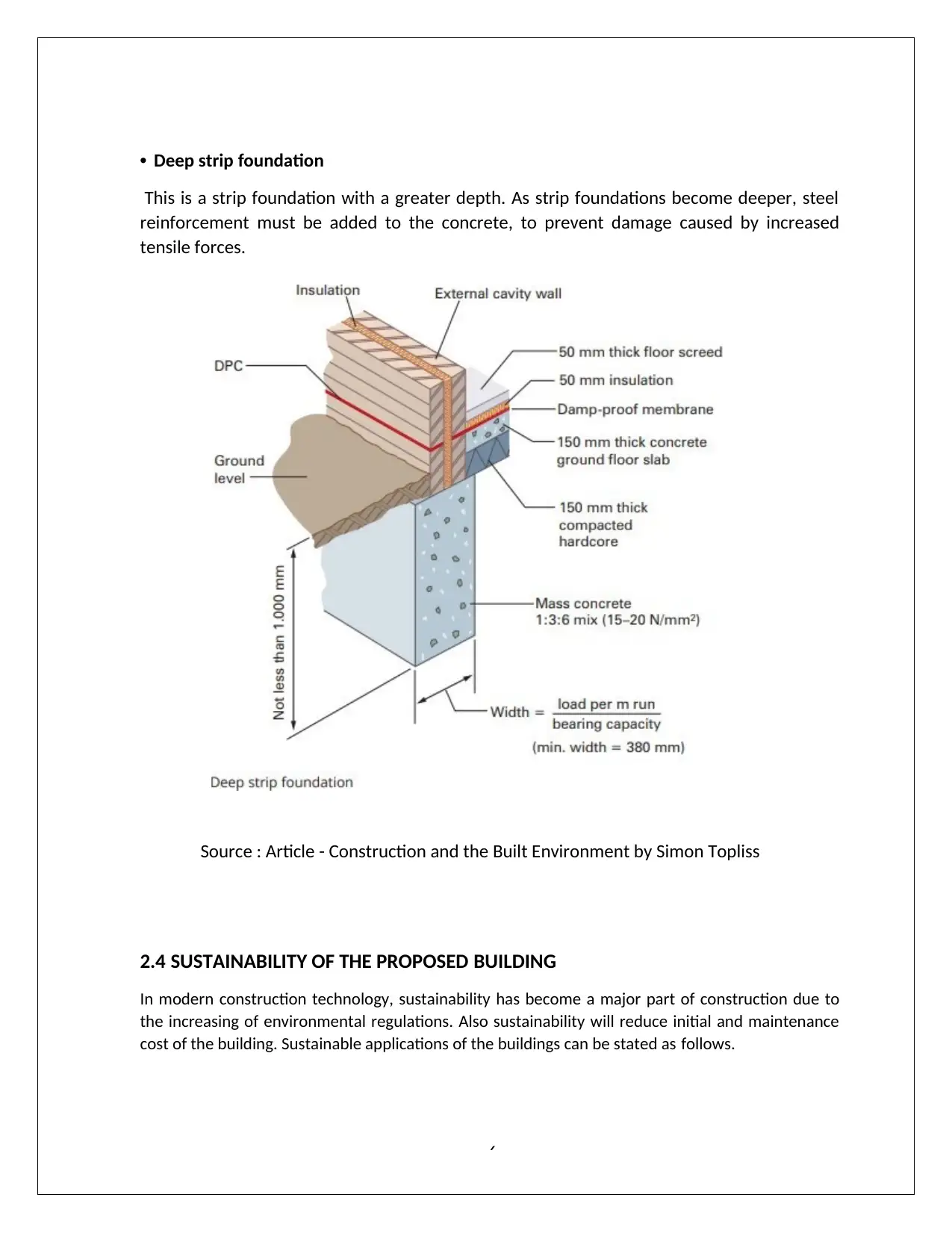
• Deep strip foundation
This is a strip foundation with a greater depth. As strip foundations become deeper, steel
reinforcement must be added to the concrete, to prevent damage caused by increased
tensile forces.
Source : Article - Construction and the Built Environment by Simon Topliss
2.4 SUSTAINABILITY OF THE PROPOSED BUILDING
In modern construction technology, sustainability has become a major part of construction due to
the increasing of environmental regulations. Also sustainability will reduce initial and maintenance
cost of the building. Sustainable applications of the buildings can be stated as follows.
• Deep strip foundation
This is a strip foundation with a greater depth. As strip foundations become deeper, steel
reinforcement must be added to the concrete, to prevent damage caused by increased
tensile forces.
Source : Article - Construction and the Built Environment by Simon Topliss
2.4 SUSTAINABILITY OF THE PROPOSED BUILDING
In modern construction technology, sustainability has become a major part of construction due to
the increasing of environmental regulations. Also sustainability will reduce initial and maintenance
cost of the building. Sustainable applications of the buildings can be stated as follows.

7
Solar thermal energy production is preferred to use as a thermal energy source. Also can
take maximum usage of natural lighting at day time to increase the efficiency.
Optimal use of storm water, reuse of grey and black water. Stored water on site can
potentially be used for irrigation. It is necessary to pay attention to minimize water
consumption, prevent leakage, maintenance and algae.
The building can take advantage of outdoor space. Even the buildings in urban areas can
take advantage of outdoor space by hardscaping, which require less planting and
maintenance but more useful for patients, family and staff.
There are ways to zone a site in terms of the intensity of plant material, and the degree of
maintenance and irrigation required if the facility sits on a large tract of land.
Position of the building in the land also an important consideration. There is a warm side
and cold side of the building according to the sun’s movement. Also windows can be
placed such a way that it allows maximum air circulation into the building.
Natural lighting can used as much as possible. Reduced lighting in some places will help the
patients to spend time peacefully and calmly.
Solar thermal energy production is preferred to use as a thermal energy source. Also can
take maximum usage of natural lighting at day time to increase the efficiency.
Optimal use of storm water, reuse of grey and black water. Stored water on site can
potentially be used for irrigation. It is necessary to pay attention to minimize water
consumption, prevent leakage, maintenance and algae.
The building can take advantage of outdoor space. Even the buildings in urban areas can
take advantage of outdoor space by hardscaping, which require less planting and
maintenance but more useful for patients, family and staff.
There are ways to zone a site in terms of the intensity of plant material, and the degree of
maintenance and irrigation required if the facility sits on a large tract of land.
Position of the building in the land also an important consideration. There is a warm side
and cold side of the building according to the sun’s movement. Also windows can be
placed such a way that it allows maximum air circulation into the building.
Natural lighting can used as much as possible. Reduced lighting in some places will help the
patients to spend time peacefully and calmly.
⊘ This is a preview!⊘
Do you want full access?
Subscribe today to unlock all pages.

Trusted by 1+ million students worldwide
1 out of 24
Related Documents
Your All-in-One AI-Powered Toolkit for Academic Success.
+13062052269
info@desklib.com
Available 24*7 on WhatsApp / Email
Unlock your academic potential
Copyright © 2020–2025 A2Z Services. All Rights Reserved. Developed and managed by ZUCOL.