A Detailed Report on Global Construction Waste Management Practices
VerifiedAdded on 2023/04/21
|14
|3196
|84
Report
AI Summary
This report provides a detailed overview of construction waste management techniques across different countries, including India, Nigeria, Australia, and the United Kingdom. It discusses various methods such as landfilling, incineration, and energy recovery, highlighting the challenges and strategies adopted in each region. The report emphasizes the importance of proper waste segregation, regulatory frameworks, and technological advancements in minimizing the environmental impact of construction waste. It also addresses issues like insufficient funding, rapid urbanization, and the need for improved infrastructure and data management systems in developing countries. Furthermore, it explores specific practices like making new bottles from scrap waste materials and the role of recycling and composting in sustainable waste disposal. The document is contributed by a student to be published on the website Desklib, a platform providing AI-based study tools for students.
Running head: CONSTRUCTION MANAGEMENT
CONSTRUCTION MANAGEMENT
Name of the student:
Name of the university:
Author note:
CONSTRUCTION MANAGEMENT
Name of the student:
Name of the university:
Author note:

Paraphrase This Document
Need a fresh take? Get an instant paraphrase of this document with our AI Paraphraser
1CONSTRUCTION MANAGEMENT
Table of Contents
Introduction:...............................................................................................................................2
Waste management in India:......................................................................................................2
Landfill:..................................................................................................................................3
Incineration:...........................................................................................................................3
Recovery of Energy:..............................................................................................................4
Waste management in Nigeria:..................................................................................................4
Waste management in Australia:...............................................................................................6
Landfills:................................................................................................................................6
Making new bottles from scrap waste materials:...................................................................7
Waste disposal in United Kingdom:..........................................................................................8
Landfilling..............................................................................................................................8
Energy Recovery:...................................................................................................................8
Conclusion:................................................................................................................................9
References:...............................................................................................................................10
Table of Contents
Introduction:...............................................................................................................................2
Waste management in India:......................................................................................................2
Landfill:..................................................................................................................................3
Incineration:...........................................................................................................................3
Recovery of Energy:..............................................................................................................4
Waste management in Nigeria:..................................................................................................4
Waste management in Australia:...............................................................................................6
Landfills:................................................................................................................................6
Making new bottles from scrap waste materials:...................................................................7
Waste disposal in United Kingdom:..........................................................................................8
Landfilling..............................................................................................................................8
Energy Recovery:...................................................................................................................8
Conclusion:................................................................................................................................9
References:...............................................................................................................................10
2CONSTRUCTION MANAGEMENT
Introduction:
Waste management is one of the most important task of any country. Due to the
increasing amount of waste from the construction industry in the world today there are
growing number of issues such as global warming and greenhouse effect. There is increasing
emissions\ of greenhouse gases as well as other kinds of pollutants from the construction
industry that adversely affects the environment. It cases a steep decrease in the natural
ecosystems as well as the flora and the fauna in the different countries. The following report
will study the waste management techniques from the construction industry. By the end of
the report, the reader will have a clear idea on the different aspects of the construction waste
management techniques.
Waste management in India:
Some of the prime duties of waste Generators in India are:
- The waste generators shall be responsible for segregating the construction as well as
demolition waste and deposit them at the centre of collection centre. It can also be
handed over to the facilities of authorised processing.
- The waste depositors should ensure waste littering as well as deposition is minimised
to prevent blockage of the drains.
- Large generators, which generate more than 20 tons or more than 300 tons of waste
per project in a particular month, will have to submit a proper waste management plan
and get the necessary local approvals for the work to be construction to be carried out.
- There should be proper environment management plans for the large generators that
should be able to handle the environmental issues from the processes such as
demolition, storage as well as processes of transportation process and waste disposal
and reuse in other industries.
Introduction:
Waste management is one of the most important task of any country. Due to the
increasing amount of waste from the construction industry in the world today there are
growing number of issues such as global warming and greenhouse effect. There is increasing
emissions\ of greenhouse gases as well as other kinds of pollutants from the construction
industry that adversely affects the environment. It cases a steep decrease in the natural
ecosystems as well as the flora and the fauna in the different countries. The following report
will study the waste management techniques from the construction industry. By the end of
the report, the reader will have a clear idea on the different aspects of the construction waste
management techniques.
Waste management in India:
Some of the prime duties of waste Generators in India are:
- The waste generators shall be responsible for segregating the construction as well as
demolition waste and deposit them at the centre of collection centre. It can also be
handed over to the facilities of authorised processing.
- The waste depositors should ensure waste littering as well as deposition is minimised
to prevent blockage of the drains.
- Large generators, which generate more than 20 tons or more than 300 tons of waste
per project in a particular month, will have to submit a proper waste management plan
and get the necessary local approvals for the work to be construction to be carried out.
- There should be proper environment management plans for the large generators that
should be able to handle the environmental issues from the processes such as
demolition, storage as well as processes of transportation process and waste disposal
and reuse in other industries.
⊘ This is a preview!⊘
Do you want full access?
Subscribe today to unlock all pages.

Trusted by 1+ million students worldwide
3CONSTRUCTION MANAGEMENT
- The larger generators should carry out segregation in order to segregate the waste
products into four different streams, which are concrete, soil, steel as well as wood
and plastics. Some other segments include brick and mortar.
- Large generators should be able to pay relevant charges for processes such as
transportation, collection of the wastes, processing as well as their proper disposal at
the specified waste disposal sites as specified by the government.
The State Pollution Control Board or the Pollution Control Committee shall be
responsible for granting authorization to the construction as well as demolition waste
processing facility. It will also be responsible for monitoring the implementation of these set
of rules from the local bodies as well as the competent authorities (Gupta et al. 2014). The
state government shall send an annual report to the Central Pollution Control Board and the
State Government or Union Territory as well as other nodal agencies of the State level (Ann
et al. 2013). It will contain all the important comprehensive data regarding the waste
management from the different sites all across India (Hongping 2014). Some of the most
common techniques of waste management that re followed all across India are explained
below:
Landfill:
In this process, the wasted from the different construction sites are buried
underground. It is mainly used in places where there are potholes or other irregularities on the
earth surface (Guerrero et al. 2015). This helps in ensuring a smoother surface as well as
constructive use of the wastes form the construction sites.
Incineration:
Waste incineration is an effective waste treatment process that in which the organic
substances of the waste materials are burned and it is often termed as "thermal treatment" of
- The larger generators should carry out segregation in order to segregate the waste
products into four different streams, which are concrete, soil, steel as well as wood
and plastics. Some other segments include brick and mortar.
- Large generators should be able to pay relevant charges for processes such as
transportation, collection of the wastes, processing as well as their proper disposal at
the specified waste disposal sites as specified by the government.
The State Pollution Control Board or the Pollution Control Committee shall be
responsible for granting authorization to the construction as well as demolition waste
processing facility. It will also be responsible for monitoring the implementation of these set
of rules from the local bodies as well as the competent authorities (Gupta et al. 2014). The
state government shall send an annual report to the Central Pollution Control Board and the
State Government or Union Territory as well as other nodal agencies of the State level (Ann
et al. 2013). It will contain all the important comprehensive data regarding the waste
management from the different sites all across India (Hongping 2014). Some of the most
common techniques of waste management that re followed all across India are explained
below:
Landfill:
In this process, the wasted from the different construction sites are buried
underground. It is mainly used in places where there are potholes or other irregularities on the
earth surface (Guerrero et al. 2015). This helps in ensuring a smoother surface as well as
constructive use of the wastes form the construction sites.
Incineration:
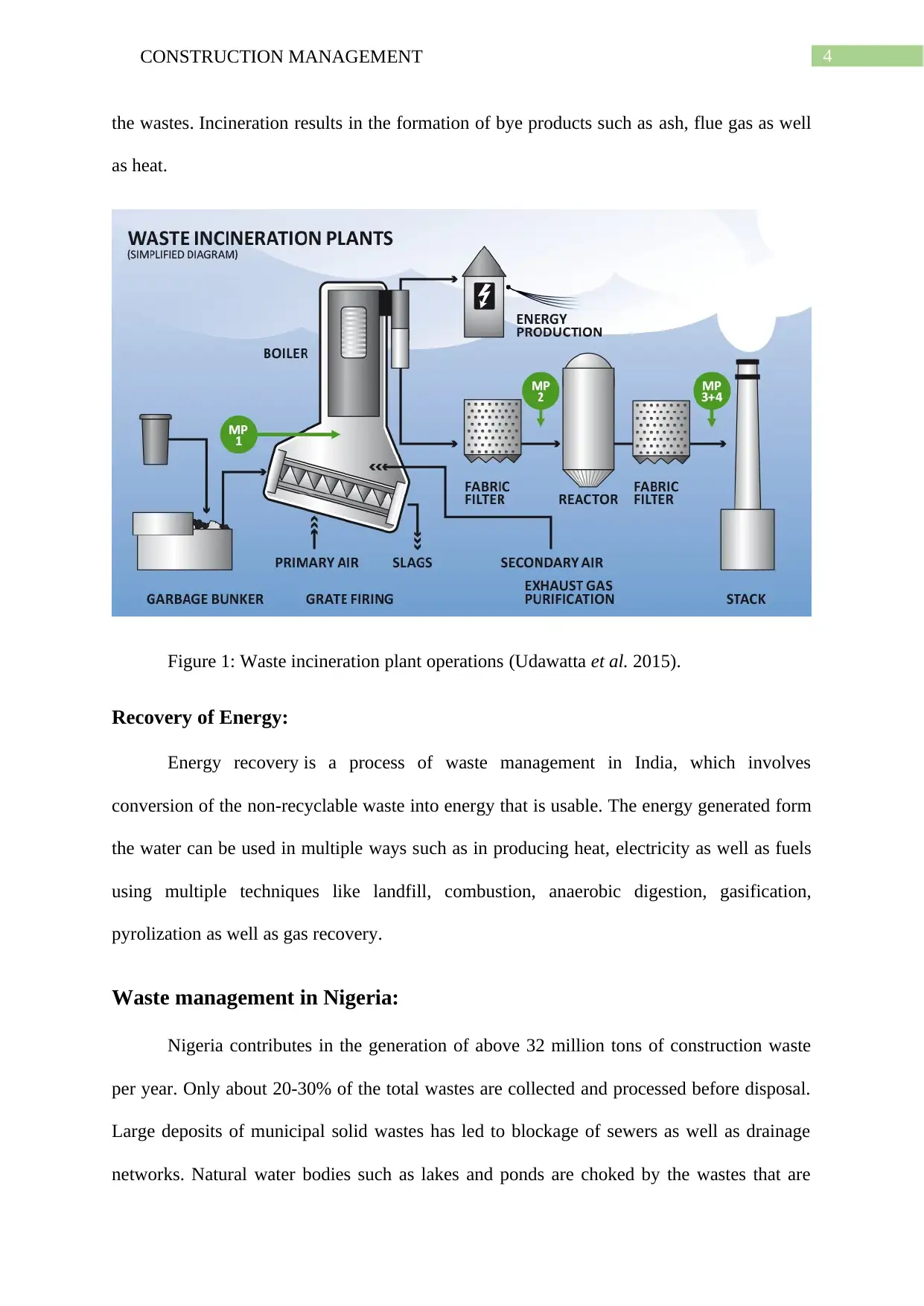
Waste incineration is an effective waste treatment process that in which the organic
substances of the waste materials are burned and it is often termed as "thermal treatment" of
Paraphrase This Document
Need a fresh take? Get an instant paraphrase of this document with our AI Paraphraser
4CONSTRUCTION MANAGEMENT
the wastes. Incineration results in the formation of bye products such as ash, flue gas as well
as heat.
Figure 1: Waste incineration plant operations (Udawatta et al. 2015).
Recovery of Energy:
Energy recovery is a process of waste management in India, which involves
conversion of the non-recyclable waste into energy that is usable. The energy generated form
the water can be used in multiple ways such as in producing heat, electricity as well as fuels
using multiple techniques like landfill, combustion, anaerobic digestion, gasification,
pyrolization as well as gas recovery.
Waste management in Nigeria:
Nigeria contributes in the generation of above 32 million tons of construction waste
per year. Only about 20-30% of the total wastes are collected and processed before disposal.
Large deposits of municipal solid wastes has led to blockage of sewers as well as drainage
networks. Natural water bodies such as lakes and ponds are choked by the wastes that are
the wastes. Incineration results in the formation of bye products such as ash, flue gas as well
as heat.
Figure 1: Waste incineration plant operations (Udawatta et al. 2015).
Recovery of Energy:
Energy recovery is a process of waste management in India, which involves
conversion of the non-recyclable waste into energy that is usable. The energy generated form
the water can be used in multiple ways such as in producing heat, electricity as well as fuels
using multiple techniques like landfill, combustion, anaerobic digestion, gasification,
pyrolization as well as gas recovery.
Waste management in Nigeria:
Nigeria contributes in the generation of above 32 million tons of construction waste
per year. Only about 20-30% of the total wastes are collected and processed before disposal.
Large deposits of municipal solid wastes has led to blockage of sewers as well as drainage
networks. Natural water bodies such as lakes and ponds are choked by the wastes that are
5CONSTRUCTION MANAGEMENT
disposed. Most of the wastes are by local construction industries as well as traders, which
pollutes the surroundings (Butu and Mshelia 2015). Environmental catastrophe is being
caused by the disposal of the wastes since the country lacks adequate provisions of budget
from the government for the implementation of strategic waste management processes
(Aiyetan, Olatunji and Smallwood 2015). Presently, there are a number of problems faced by
Nigeria in waste management. They are listed below:
- Insufficient funding: Improper funding strategies can result in lack of proper
distribution of the resources. This can lead to improper waste collection.
- Rapid growth of population: This again is a major issue since rapid growth in
population can result in excessive disposal of household wastages
- Poor investment in development of infrastructure: Poor investment in Nigeria can
result in lack of resources as well as more corruption among the government officials
in the waste management department.
- Incompetent administrative as well as managerial personnel: Lack of technical
knowledge of the personnel is again an issue.
- Lack of effective data management systems: lack of proper information systems as
well as data management systems in the waste management departments.
- Uncoordinated functions of institutions: There is improper coordination among the
different government employees.
- Improper planning: Improper planning and lack of communication of information is
another issue in Nigeria in waste management.
- Legal framework as well as government policies need improvements as well as
corrections: Improper framing of government rules and policies in waste
management.
disposed. Most of the wastes are by local construction industries as well as traders, which
pollutes the surroundings (Butu and Mshelia 2015). Environmental catastrophe is being
caused by the disposal of the wastes since the country lacks adequate provisions of budget
from the government for the implementation of strategic waste management processes
(Aiyetan, Olatunji and Smallwood 2015). Presently, there are a number of problems faced by
Nigeria in waste management. They are listed below:
- Insufficient funding: Improper funding strategies can result in lack of proper
distribution of the resources. This can lead to improper waste collection.
- Rapid growth of population: This again is a major issue since rapid growth in
population can result in excessive disposal of household wastages
- Poor investment in development of infrastructure: Poor investment in Nigeria can
result in lack of resources as well as more corruption among the government officials
in the waste management department.
- Incompetent administrative as well as managerial personnel: Lack of technical
knowledge of the personnel is again an issue.
- Lack of effective data management systems: lack of proper information systems as
well as data management systems in the waste management departments.
- Uncoordinated functions of institutions: There is improper coordination among the
different government employees.
- Improper planning: Improper planning and lack of communication of information is
another issue in Nigeria in waste management.
- Legal framework as well as government policies need improvements as well as
corrections: Improper framing of government rules and policies in waste
management.
⊘ This is a preview!⊘
Do you want full access?
Subscribe today to unlock all pages.
Trusted by 1+ million students worldwide
6CONSTRUCTION MANAGEMENT
- Existing rules are not followed: The existing rules are not followed in the country
regarding waste management (Udawatta et al. 2016). There is a lack of basic civic
sense among the citizens as well as the labours working at construction sites.
- Uncontrolled growth in urbanization: Due to increasing number of houses and other
infrastructure development in Nigeria there is increasing problems with waste
disposal in the different parts of Nigeria.
Waste management in Australia:
Waste management is one of the major issues in Australia. There are different issues
in terms of budget management. Most of the waste that is generated from the construction
industry, which has not been recycled or re-used within Australia, is often disposed in the
landfills. Air, water as well as land quality is degraded by the landfills (Adewuyi and Otali
2013). Some of the landfill gases such as methane can have adverse effects on the
environment such as global warming. They also increase greenhouse effect on the
environment. Methane can help in decomposing organic wastes as well as other
environmental issues in Australia.
Landfills:
Landfills are the most widely used waste management technique in Australia. More
than 40% of the construction waste are disposed using this technique. They consist of mixed
waste, mainly because of the availability of different kinds of resources and existing facilities
within Australia. The low cost of landfilling as compared to other options of waste
management is the reason options to recover more resources (Kiddee et al. 2014). Australia
has more than 1168 operational licensed as well as unlicensed landfills that help in disposing
more than 20 million tons of waste per year.
- Existing rules are not followed: The existing rules are not followed in the country
regarding waste management (Udawatta et al. 2016). There is a lack of basic civic
sense among the citizens as well as the labours working at construction sites.
- Uncontrolled growth in urbanization: Due to increasing number of houses and other
infrastructure development in Nigeria there is increasing problems with waste
disposal in the different parts of Nigeria.
Waste management in Australia:
Waste management is one of the major issues in Australia. There are different issues
in terms of budget management. Most of the waste that is generated from the construction
industry, which has not been recycled or re-used within Australia, is often disposed in the
landfills. Air, water as well as land quality is degraded by the landfills (Adewuyi and Otali
2013). Some of the landfill gases such as methane can have adverse effects on the
environment such as global warming. They also increase greenhouse effect on the
environment. Methane can help in decomposing organic wastes as well as other
environmental issues in Australia.
Landfills:
Landfills are the most widely used waste management technique in Australia. More
than 40% of the construction waste are disposed using this technique. They consist of mixed
waste, mainly because of the availability of different kinds of resources and existing facilities
within Australia. The low cost of landfilling as compared to other options of waste
management is the reason options to recover more resources (Kiddee et al. 2014). Australia
has more than 1168 operational licensed as well as unlicensed landfills that help in disposing
more than 20 million tons of waste per year.
Paraphrase This Document
Need a fresh take? Get an instant paraphrase of this document with our AI Paraphraser
7CONSTRUCTION MANAGEMENT
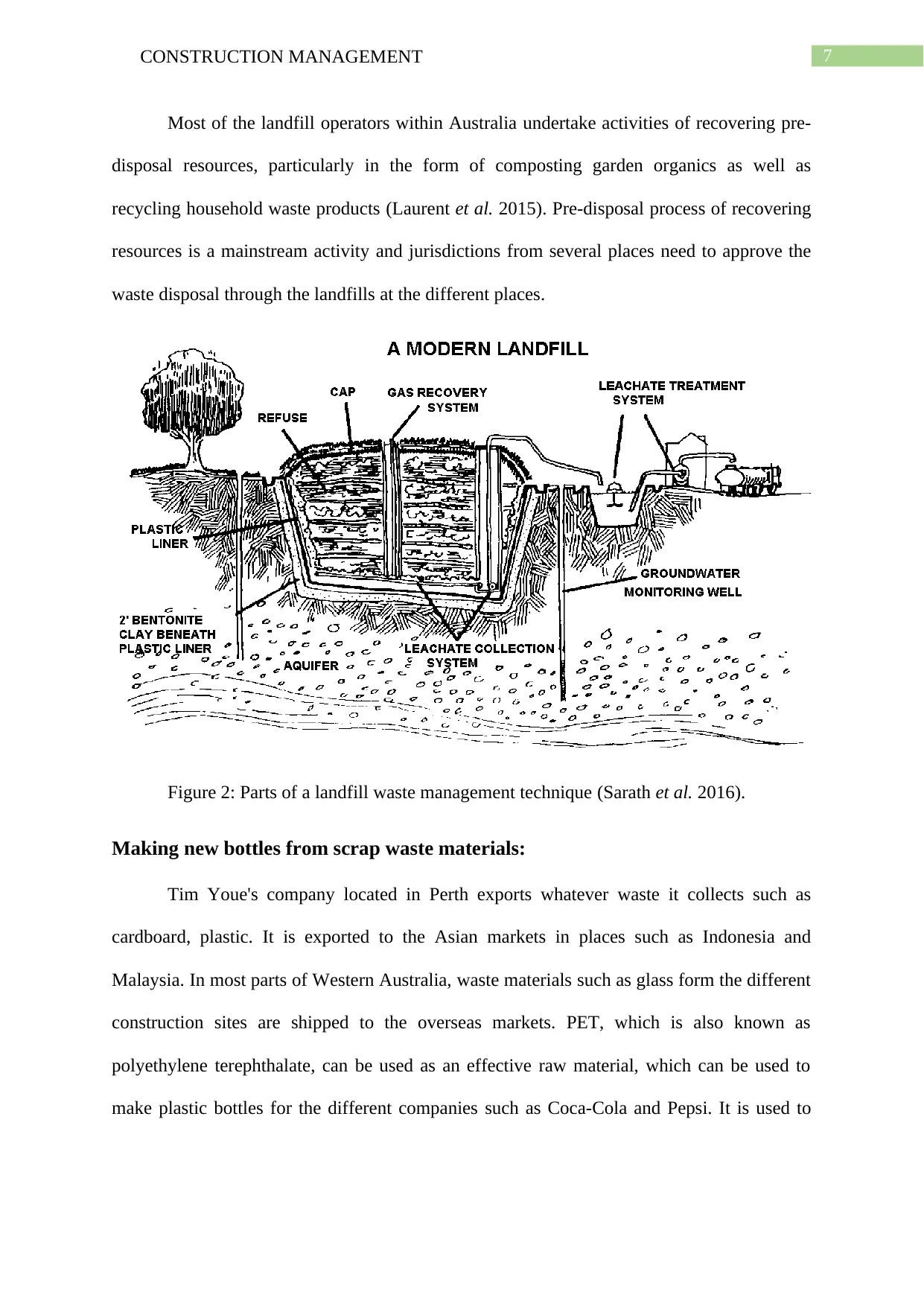
Most of the landfill operators within Australia undertake activities of recovering pre-
disposal resources, particularly in the form of composting garden organics as well as
recycling household waste products (Laurent et al. 2015). Pre-disposal process of recovering
resources is a mainstream activity and jurisdictions from several places need to approve the
waste disposal through the landfills at the different places.
Figure 2: Parts of a landfill waste management technique (Sarath et al. 2016).
Making new bottles from scrap waste materials:
Tim Youe's company located in Perth exports whatever waste it collects such as
cardboard, plastic. It is exported to the Asian markets in places such as Indonesia and
Malaysia. In most parts of Western Australia, waste materials such as glass form the different
construction sites are shipped to the overseas markets. PET, which is also known as
polyethylene terephthalate, can be used as an effective raw material, which can be used to
make plastic bottles for the different companies such as Coca-Cola and Pepsi. It is used to
Most of the landfill operators within Australia undertake activities of recovering pre-
disposal resources, particularly in the form of composting garden organics as well as
recycling household waste products (Laurent et al. 2015). Pre-disposal process of recovering
resources is a mainstream activity and jurisdictions from several places need to approve the
waste disposal through the landfills at the different places.
Figure 2: Parts of a landfill waste management technique (Sarath et al. 2016).
Making new bottles from scrap waste materials:
Tim Youe's company located in Perth exports whatever waste it collects such as
cardboard, plastic. It is exported to the Asian markets in places such as Indonesia and
Malaysia. In most parts of Western Australia, waste materials such as glass form the different
construction sites are shipped to the overseas markets. PET, which is also known as
polyethylene terephthalate, can be used as an effective raw material, which can be used to
make plastic bottles for the different companies such as Coca-Cola and Pepsi. It is used to
8CONSTRUCTION MANAGEMENT
make packaging bottles for these companies (Zaman 2013). These materials can also be used
to make containers.
Waste disposal in United Kingdom:
Recycling, composting as well as conversion of waste to energy are the most popular
waste disposal strategies in the United Kingdom UK, which helps in managing wastes in a
sustainable way (Laurent et al. 2014). The most common waste disposal strategies in United
Kingdom are explained below as:
Landfilling
About 40.3% of the construction wastes from the municipal corporation are sent to
UK’s 725 active sites for landfilling, that produce around 4979 GWh of electrical energy
from the recovered methane. The methane comes from different sources all across the United
Kingdom. However, almost 1700 sites of landfill sites have not been used since the year 2001
(Weisheng and Tam 2016). Statistics have shown that England is using less of the landfilling
technique with less than 0.18 tonnes per capita of landfilling, followed by Wales (0.23) and
Ireland (0.32).
Energy Recovery:
Out of the total municipal corporation waste that is produced in the United Kingdom
in 2012, around 16.1% was efficiently processed to produce energy that can be used in the
energy plants across all the construction sites as well as other industries in UK. It is found
that around 5% of the total renewable energy of the country is provided from the recycling of
the waste materials that is collected from the different construction sites across United
Kingdom (Marshall, Rachael and Farahbakhsh 2016). A total improvement of 300% has been
seen in the production of renewable energy with around 1739 GWh of electricity as well as
heat energy that has been produced since 2012.
make packaging bottles for these companies (Zaman 2013). These materials can also be used
to make containers.
Waste disposal in United Kingdom:
Recycling, composting as well as conversion of waste to energy are the most popular
waste disposal strategies in the United Kingdom UK, which helps in managing wastes in a
sustainable way (Laurent et al. 2014). The most common waste disposal strategies in United
Kingdom are explained below as:
Landfilling
About 40.3% of the construction wastes from the municipal corporation are sent to
UK’s 725 active sites for landfilling, that produce around 4979 GWh of electrical energy
from the recovered methane. The methane comes from different sources all across the United
Kingdom. However, almost 1700 sites of landfill sites have not been used since the year 2001
(Weisheng and Tam 2016). Statistics have shown that England is using less of the landfilling
technique with less than 0.18 tonnes per capita of landfilling, followed by Wales (0.23) and
Ireland (0.32).
Energy Recovery:
Out of the total municipal corporation waste that is produced in the United Kingdom
in 2012, around 16.1% was efficiently processed to produce energy that can be used in the
energy plants across all the construction sites as well as other industries in UK. It is found
that around 5% of the total renewable energy of the country is provided from the recycling of
the waste materials that is collected from the different construction sites across United
Kingdom (Marshall, Rachael and Farahbakhsh 2016). A total improvement of 300% has been
seen in the production of renewable energy with around 1739 GWh of electricity as well as
heat energy that has been produced since 2012.
⊘ This is a preview!⊘
Do you want full access?
Subscribe today to unlock all pages.
Trusted by 1+ million students worldwide
9CONSTRUCTION MANAGEMENT
Around 24 conversion plants currently operate all across the United Kingdom. There
are14 new waste collection facilities in the different areas of construction. In England, around
0.09 tonnes of waste is processed per capita that converted into renewable energy to be used
in different purposes. 2011/12. Another important technique known as the Mechanical
Biological Treatment or MBT which is extensively used in England, processes around 1.4%
of the municipal waste that is generated in the UK. It helps in producing Solid Recovered
Fuel or SRF or Refuse Derived Fuel (Miezah et al. 2014). This amount is only about 0.008
tonnes per capita, which shows that there is lot of development of the waste management that
is needed in England (Zaman 2013). In Scotland as well as in Northern Ireland no MBT
plants are present, whereas in Wales around 0.005 tonnes of waste per capita is processed
into RDF.
Conclusion:
Therefore, it can be concluded from the above paragraphs that waste management is
one of the most important tasks for the government of any country. If the waste is improperly
collected or processed it is capable of causing different issues such as air and water pollution.
Improper waste management can adversely affect the environment and cause extinction of
different species of plants as well as animals. Therefore, it is extremely important for the
governments of the different nations to come up with proper guidelines and policies that has
to be mandatorily followed by the construction companies at the time of any of their
construction. This can ensure proper protection of the natural resources and ensure a safe
place for the residents residing in and around the construction sites. Proper waste
management can also help in reduce health hazard of the citizens. Less greenhouse gases will
be emitted and which in turn can help in reducing greenhouse effect and effects such s global
warming. The governments of the different countries can look forward to investing more as
well as hiring more experts of waste management to ensure that the waste management is
Around 24 conversion plants currently operate all across the United Kingdom. There
are14 new waste collection facilities in the different areas of construction. In England, around
0.09 tonnes of waste is processed per capita that converted into renewable energy to be used
in different purposes. 2011/12. Another important technique known as the Mechanical
Biological Treatment or MBT which is extensively used in England, processes around 1.4%
of the municipal waste that is generated in the UK. It helps in producing Solid Recovered
Fuel or SRF or Refuse Derived Fuel (Miezah et al. 2014). This amount is only about 0.008
tonnes per capita, which shows that there is lot of development of the waste management that
is needed in England (Zaman 2013). In Scotland as well as in Northern Ireland no MBT
plants are present, whereas in Wales around 0.005 tonnes of waste per capita is processed
into RDF.
Conclusion:
Therefore, it can be concluded from the above paragraphs that waste management is
one of the most important tasks for the government of any country. If the waste is improperly
collected or processed it is capable of causing different issues such as air and water pollution.
Improper waste management can adversely affect the environment and cause extinction of
different species of plants as well as animals. Therefore, it is extremely important for the
governments of the different nations to come up with proper guidelines and policies that has
to be mandatorily followed by the construction companies at the time of any of their
construction. This can ensure proper protection of the natural resources and ensure a safe
place for the residents residing in and around the construction sites. Proper waste
management can also help in reduce health hazard of the citizens. Less greenhouse gases will
be emitted and which in turn can help in reducing greenhouse effect and effects such s global
warming. The governments of the different countries can look forward to investing more as
well as hiring more experts of waste management to ensure that the waste management is
Paraphrase This Document
Need a fresh take? Get an instant paraphrase of this document with our AI Paraphraser
10CONSTRUCTION MANAGEMENT
done in a smooth way and they are efficiently treated across all the plants in a constructive
way. Effective recycling of construction materials can help in making raw materials that can
be used in other industries.
done in a smooth way and they are efficiently treated across all the plants in a constructive
way. Effective recycling of construction materials can help in making raw materials that can
be used in other industries.
11CONSTRUCTION MANAGEMENT
References:
Adewuyi, T. O., and M. Otali. "Evaluation of causes of construction material waste: Case of
River State, Nigeria." Ethiopian Journal of Environmental Studies and Management6, no. 6
(2013): 746-753.
Aiyetan, Olatunji, and John Smallwood. "Materials management and waste minimisation on
construction sites in Lagos State, Nigeria." In Proceedings of the 4th International
Conference on Engineering, Project, and Production Management (EPPM), pp. 1161-1172.
2013 (2015).
Ann, T. W., C. S. Poon, Agnes Wong, Robin Yip, and Lara Jaillon. "Impact of construction
waste disposal charging scheme on work practices at construction sites in Hong
Kong." Waste management 33, no. 1 (2013): 138-146.
Butu, A. W., and S. S. Mshelia. "Municipal solid waste disposal and environmental issues in
Kano metropolis, Nigeria." British Journal of Environmental Sciences 2, no. 1 (2014): 1-16.
Guerrero, Lilliana Abarca, Ger Maas, and William Hogland. "Solid waste management
challenges for cities in developing countries." Waste management 33, no. 1 (2013): 220-232.
Gupta, Neha, Krishna Kumar Yadav, and Vinit Kumar. "A review on current status of
municipal solid waste management in India." Journal of environmental sciences 37 (2015):
206-217.
Kiddee, Peeranart, Ravi Naidu, and Ming H. Wong. "Electronic waste management
approaches: An overview." Waste management 33, no. 5 (2013): 1237-1250.
Laurent, Alexis, Ioannis Bakas, Julie Clavreul, Anna Bernstad, Monia Niero, Emmanuel
Gentil, Michael Z. Hauschild, and Thomas H. Christensen. "Review of LCA studies of solid
References:
Adewuyi, T. O., and M. Otali. "Evaluation of causes of construction material waste: Case of
River State, Nigeria." Ethiopian Journal of Environmental Studies and Management6, no. 6
(2013): 746-753.
Aiyetan, Olatunji, and John Smallwood. "Materials management and waste minimisation on
construction sites in Lagos State, Nigeria." In Proceedings of the 4th International
Conference on Engineering, Project, and Production Management (EPPM), pp. 1161-1172.
2013 (2015).
Ann, T. W., C. S. Poon, Agnes Wong, Robin Yip, and Lara Jaillon. "Impact of construction
waste disposal charging scheme on work practices at construction sites in Hong
Kong." Waste management 33, no. 1 (2013): 138-146.
Butu, A. W., and S. S. Mshelia. "Municipal solid waste disposal and environmental issues in
Kano metropolis, Nigeria." British Journal of Environmental Sciences 2, no. 1 (2014): 1-16.
Guerrero, Lilliana Abarca, Ger Maas, and William Hogland. "Solid waste management
challenges for cities in developing countries." Waste management 33, no. 1 (2013): 220-232.
Gupta, Neha, Krishna Kumar Yadav, and Vinit Kumar. "A review on current status of
municipal solid waste management in India." Journal of environmental sciences 37 (2015):
206-217.
Kiddee, Peeranart, Ravi Naidu, and Ming H. Wong. "Electronic waste management
approaches: An overview." Waste management 33, no. 5 (2013): 1237-1250.
Laurent, Alexis, Ioannis Bakas, Julie Clavreul, Anna Bernstad, Monia Niero, Emmanuel
Gentil, Michael Z. Hauschild, and Thomas H. Christensen. "Review of LCA studies of solid
⊘ This is a preview!⊘
Do you want full access?
Subscribe today to unlock all pages.
Trusted by 1+ million students worldwide

1 out of 14


Related Documents


Your All-in-One AI-Powered Toolkit for Academic Success.
+13062052269
info@desklib.com
Available 24*7 on WhatsApp / Email
![[object Object]](/_next/static/media/star-bottom.7253800d.svg)
Unlock your academic potential
Copyright © 2020–2026 A2Z Services. All Rights Reserved. Developed and managed by ZUCOL.