Construction Worker's Health: Identifying Stress and Fatigue Signs

Verified

Added on  2023/06/04

|5
|915
|201
Essay
AI Summary
This essay critically evaluates the significance of capturing early signs of stress, fatigue, and mental health issues among construction workers to enhance Occupational Safety and Health (OSH). It delves into the psychological and physical symptoms of stress, fatigue, and mental health problems such as depression and anxiety, highlighting early warning signs like confusion, inability to perform daily tasks, and thoughts of self-harm. The essay identifies extended working hours, environmental factors, and the physically and mentally demanding nature of construction work as primary causes of these issues. By identifying these signs early, employers and colleagues can provide support, prevent isolation, and restore self-esteem, thereby preventing negligence, reducing suicide rates, and minimizing low output. Ultimately, the essay emphasizes that early detection and intervention are crucial for preventing fatal injuries and deaths, promoting a safer and healthier work environment in the construction industry. Desklib provides past papers and solved assignments to help students further explore this topic.
Document Page
Stress, Fatigue and Mental Health at Work
By Students Name
Professor
University Affiliate
City & State
Course
Date
tabler-icon-diamond-filled.svg

Paraphrase This Document

Need a fresh take? Get an instant paraphrase of this document with our AI Paraphraser
Document Page
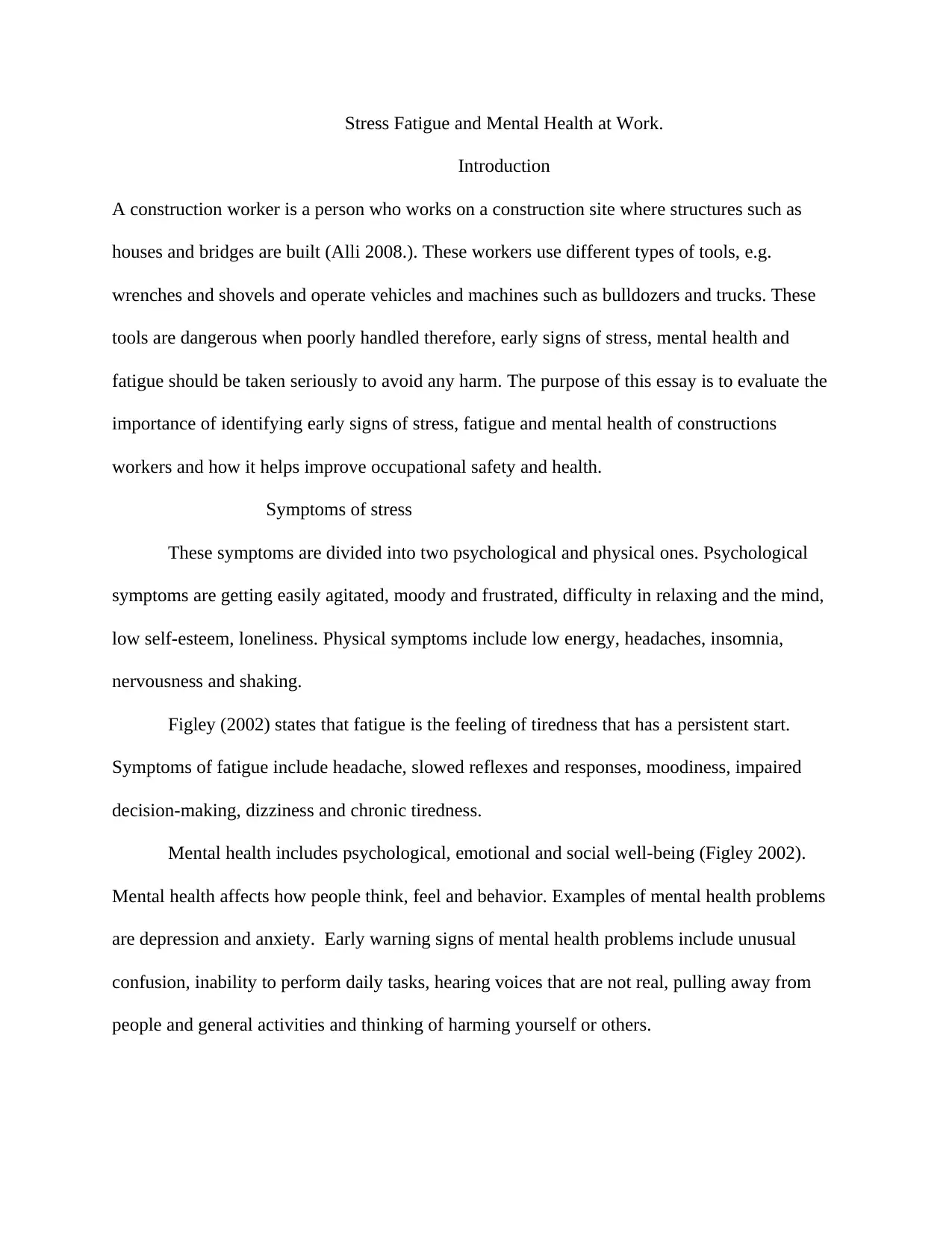
Stress Fatigue and Mental Health at Work.
Introduction
A construction worker is a person who works on a construction site where structures such as
houses and bridges are built (Alli 2008.). These workers use different types of tools, e.g.
wrenches and shovels and operate vehicles and machines such as bulldozers and trucks. These
tools are dangerous when poorly handled therefore, early signs of stress, mental health and
fatigue should be taken seriously to avoid any harm. The purpose of this essay is to evaluate the
importance of identifying early signs of stress, fatigue and mental health of constructions
workers and how it helps improve occupational safety and health.
Symptoms of stress
These symptoms are divided into two psychological and physical ones. Psychological
symptoms are getting easily agitated, moody and frustrated, difficulty in relaxing and the mind,
low self-esteem, loneliness. Physical symptoms include low energy, headaches, insomnia,
nervousness and shaking.
Figley (2002) states that fatigue is the feeling of tiredness that has a persistent start.
Symptoms of fatigue include headache, slowed reflexes and responses, moodiness, impaired
decision-making, dizziness and chronic tiredness.
Mental health includes psychological, emotional and social well-being (Figley 2002).
Mental health affects how people think, feel and behavior. Examples of mental health problems
are depression and anxiety. Early warning signs of mental health problems include unusual
confusion, inability to perform daily tasks, hearing voices that are not real, pulling away from
people and general activities and thinking of harming yourself or others.
Document Page
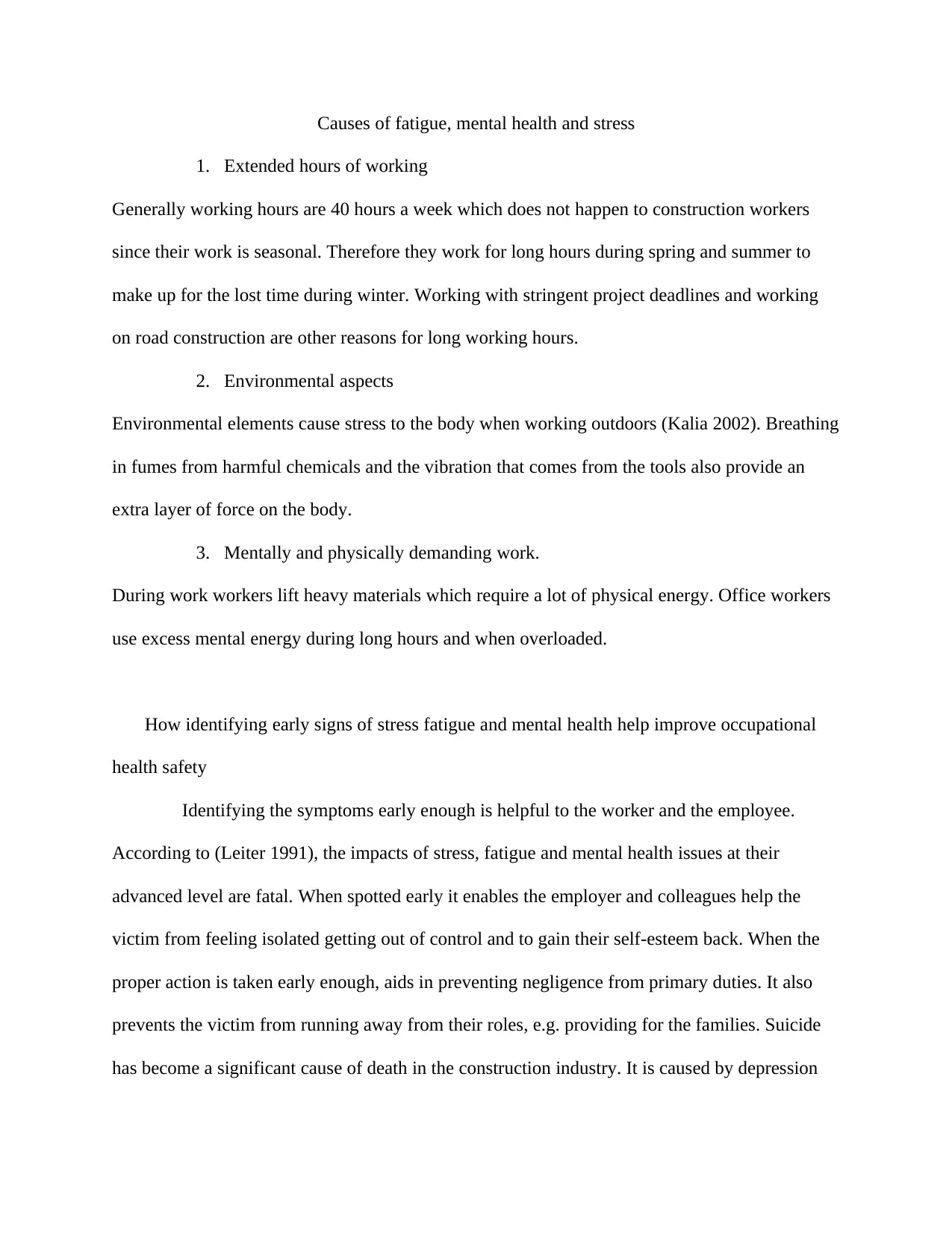
Causes of fatigue, mental health and stress
1. Extended hours of working
Generally working hours are 40 hours a week which does not happen to construction workers
since their work is seasonal. Therefore they work for long hours during spring and summer to
make up for the lost time during winter. Working with stringent project deadlines and working
on road construction are other reasons for long working hours.
2. Environmental aspects
Environmental elements cause stress to the body when working outdoors (Kalia 2002). Breathing
in fumes from harmful chemicals and the vibration that comes from the tools also provide an
extra layer of force on the body.
3. Mentally and physically demanding work.
During work workers lift heavy materials which require a lot of physical energy. Office workers
use excess mental energy during long hours and when overloaded.
How identifying early signs of stress fatigue and mental health help improve occupational
health safety
Identifying the symptoms early enough is helpful to the worker and the employee.
According to (Leiter 1991), the impacts of stress, fatigue and mental health issues at their
advanced level are fatal. When spotted early it enables the employer and colleagues help the
victim from feeling isolated getting out of control and to gain their self-esteem back. When the
proper action is taken early enough, aids in preventing negligence from primary duties. It also
prevents the victim from running away from their roles, e.g. providing for the families. Suicide
has become a significant cause of death in the construction industry. It is caused by depression
Document Page
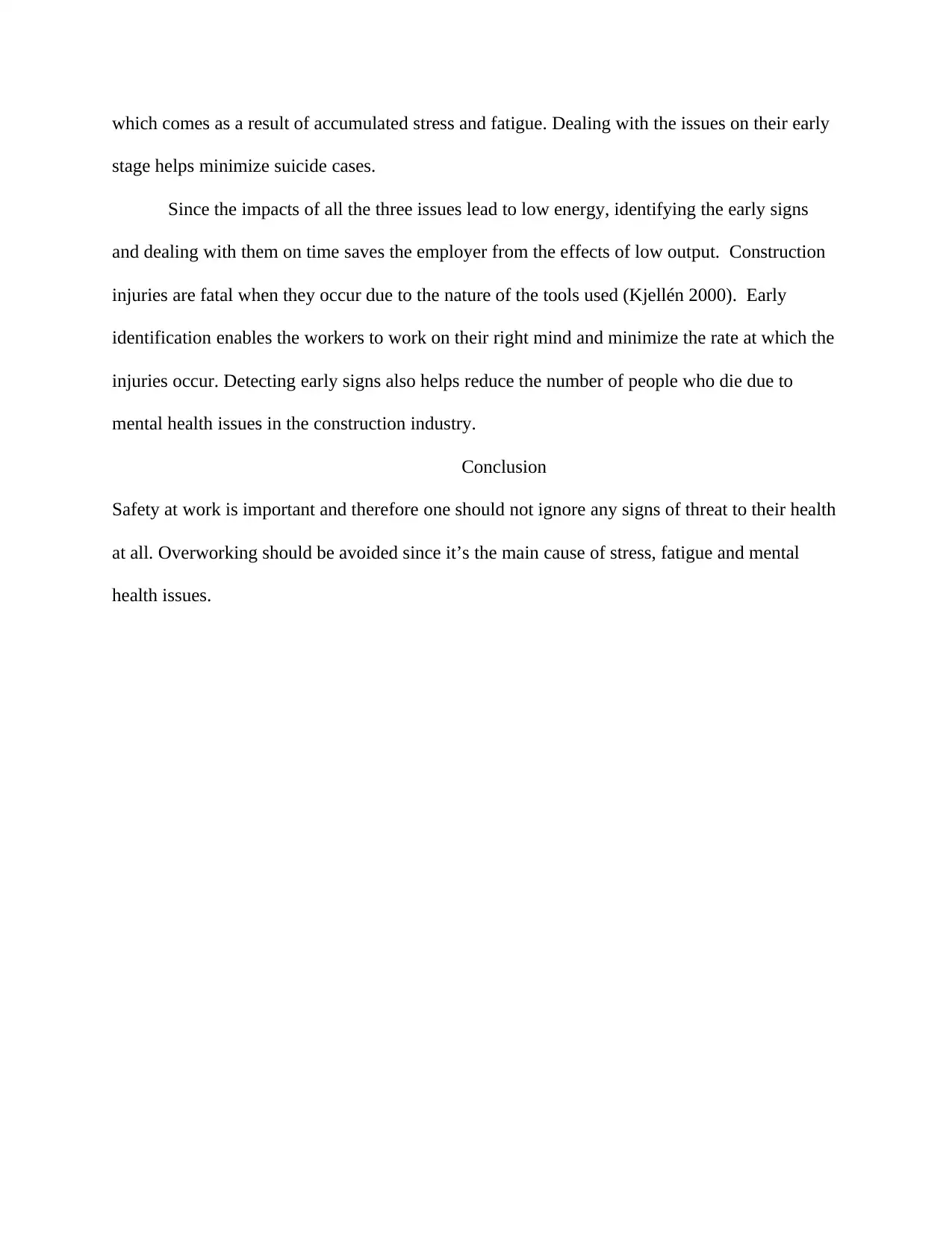
which comes as a result of accumulated stress and fatigue. Dealing with the issues on their early
stage helps minimize suicide cases.
Since the impacts of all the three issues lead to low energy, identifying the early signs
and dealing with them on time saves the employer from the effects of low output. Construction
injuries are fatal when they occur due to the nature of the tools used (Kjellén 2000). Early
identification enables the workers to work on their right mind and minimize the rate at which the
injuries occur. Detecting early signs also helps reduce the number of people who die due to
mental health issues in the construction industry.
Conclusion
Safety at work is important and therefore one should not ignore any signs of threat to their health
at all. Overworking should be avoided since it’s the main cause of stress, fatigue and mental
health issues.
tabler-icon-diamond-filled.svg

Paraphrase This Document

Need a fresh take? Get an instant paraphrase of this document with our AI Paraphraser
Document Page
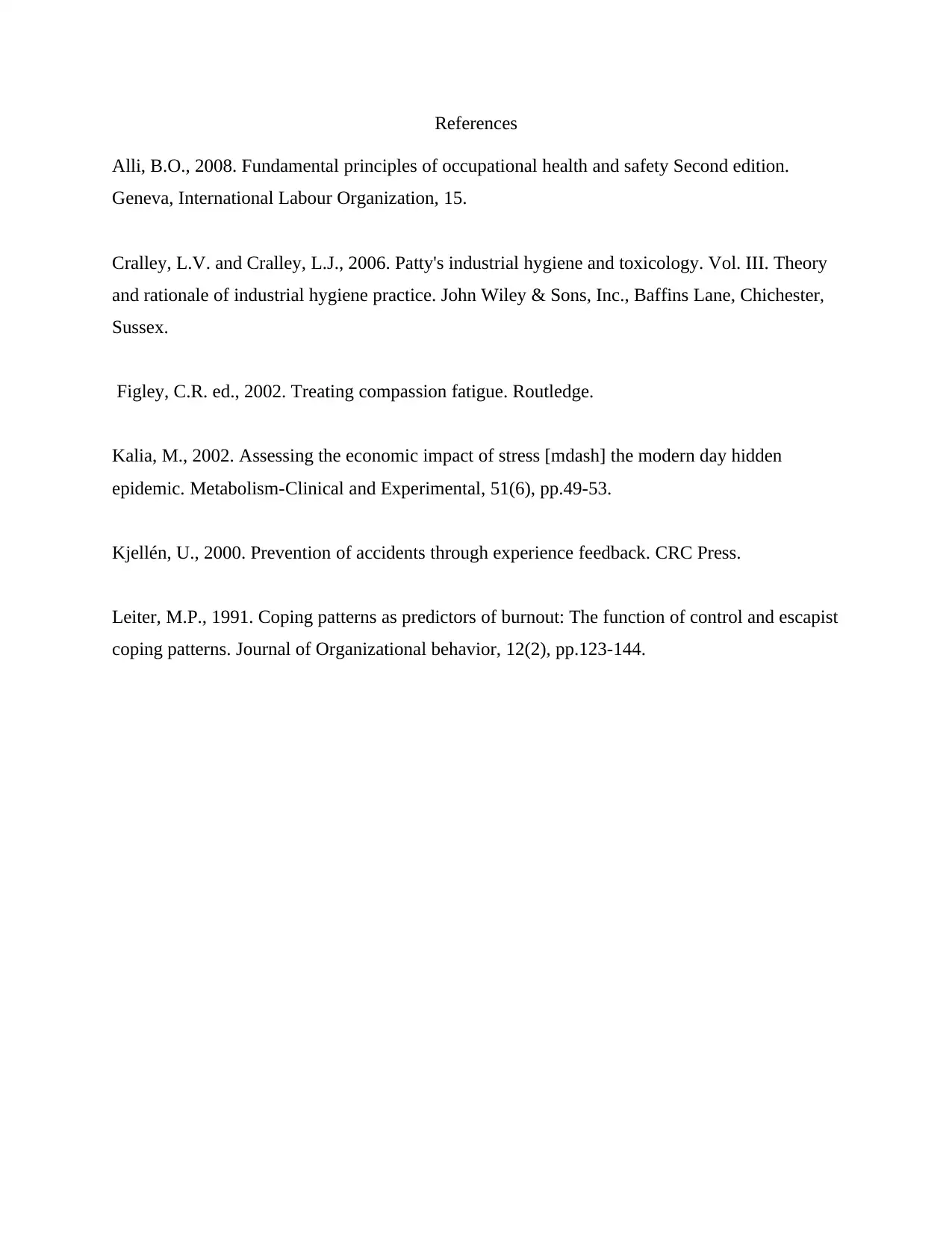
References
Alli, B.O., 2008. Fundamental principles of occupational health and safety Second edition.
Geneva, International Labour Organization, 15.
Cralley, L.V. and Cralley, L.J., 2006. Patty's industrial hygiene and toxicology. Vol. III. Theory
and rationale of industrial hygiene practice. John Wiley & Sons, Inc., Baffins Lane, Chichester,
Sussex.
Figley, C.R. ed., 2002. Treating compassion fatigue. Routledge.
Kalia, M., 2002. Assessing the economic impact of stress [mdash] the modern day hidden
epidemic. Metabolism-Clinical and Experimental, 51(6), pp.49-53.
Kjellén, U., 2000. Prevention of accidents through experience feedback. CRC Press.
Leiter, M.P., 1991. Coping patterns as predictors of burnout: The function of control and escapist
coping patterns. Journal of Organizational behavior, 12(2), pp.123-144.
chevron_up_icon
1 out of 5
circle_padding
hide_on_mobile
zoom_out_icon
[object Object]