GRA20009 - Analysis of Constructivism: Naum Gabo's Influence on Design
VerifiedAdded on 2023/05/29
|11
|1998
|421
Report
AI Summary
This report delves into the Constructivist movement, tracing its origins to post-World War I Russia and its aim to integrate art into social change. It highlights key figures like Vladimir Tatlin and Alexander Rodchenko, and explores the movement's core concepts of Faktura and Tektonika. The report focuses on Naum Gabo, a prominent Constructivist sculptor and innovator of kinetic sculpture, analyzing his works 'Construction in Space (Crystal)' and 'Constructed Head No. 2'. It also examines contemporary designer Shepard Fairey, known for his 'Hope' poster, as a modern continuation of Constructivist principles. The report concludes by emphasizing Constructivism's lasting impact on art and architecture by promoting social purpose and challenging traditional artistic boundaries.
Running head: 20TH CENTURY DESIGN
20TH CENTURY DESIGN
Name of the Student
Name of the University
Author note:
20TH CENTURY DESIGN
Name of the Student
Name of the University
Author note:

Paraphrase This Document
Need a fresh take? Get an instant paraphrase of this document with our AI Paraphraser
120TH CENTURY DESIGN
Table of Contents
Introduction......................................................................................................................................2
Description of Movement................................................................................................................2
Description of the Artist..................................................................................................................3
Two of his arts.................................................................................................................................5
Contemporary Designer...................................................................................................................7
Two of his works.............................................................................................................................8
Conclusion.......................................................................................................................................8
Reference:......................................................................................................................................10
Table of Contents
Introduction......................................................................................................................................2
Description of Movement................................................................................................................2
Description of the Artist..................................................................................................................3
Two of his arts.................................................................................................................................5
Contemporary Designer...................................................................................................................7
Two of his works.............................................................................................................................8
Conclusion.......................................................................................................................................8
Reference:......................................................................................................................................10
220TH CENTURY DESIGN
Introduction
A movement with causes in Russia, Constructivism was essentially an art and building
movement. It dismissed the possibility of art for the good of arts also the conventional normal
section of the society for which in the past art has provided required supplements to survive and
find meaning from life (Thompson 2015). This particular movement has treated art as a medium
that can bring about the necessary social changes and that would fulfill one of the required social
needs. This particular art movement was mainly created after the World War I, this particular art
movement desired to help in the creation of an almost utopian society which will be quite
different from the society which had caused the World War I. The particular term constructivism
and the art form developed by Kasmir Malevich who took his reference from Aleksander
Rodchenko. The art form spread itself to various other genres such as publications, books, logos
among other formats and did not limit itself to just paintings (Fosnot 2013). Rodchenko has been
an inspiration to many artists worldwide who desired to continue the art form. The inspired
artists include Jan Tschichold who went on to become very successful.
Description of Movement
The political condition that lead to the constructivism movement was the development of
the Russian Futurism after the World War 1 (Broude 2018). To be more precise, the exhibited
counter reliefs of Vladimir Tatlin in the year 1915 was considered to be the political background
of the Constructivism. The particular art form of constructivism had the desire to change the way
art is taking its course in the society and what role does art play in order to transform the society
from its roots. Art should not be limited to just a medium for entertainment, it must be one of the
driving forces for the society (Phillips 2013).
Introduction
A movement with causes in Russia, Constructivism was essentially an art and building
movement. It dismissed the possibility of art for the good of arts also the conventional normal
section of the society for which in the past art has provided required supplements to survive and
find meaning from life (Thompson 2015). This particular movement has treated art as a medium
that can bring about the necessary social changes and that would fulfill one of the required social
needs. This particular art movement was mainly created after the World War I, this particular art
movement desired to help in the creation of an almost utopian society which will be quite
different from the society which had caused the World War I. The particular term constructivism
and the art form developed by Kasmir Malevich who took his reference from Aleksander
Rodchenko. The art form spread itself to various other genres such as publications, books, logos
among other formats and did not limit itself to just paintings (Fosnot 2013). Rodchenko has been
an inspiration to many artists worldwide who desired to continue the art form. The inspired
artists include Jan Tschichold who went on to become very successful.
Description of Movement
The political condition that lead to the constructivism movement was the development of
the Russian Futurism after the World War 1 (Broude 2018). To be more precise, the exhibited
counter reliefs of Vladimir Tatlin in the year 1915 was considered to be the political background
of the Constructivism. The particular art form of constructivism had the desire to change the way
art is taking its course in the society and what role does art play in order to transform the society
from its roots. Art should not be limited to just a medium for entertainment, it must be one of the
driving forces for the society (Phillips 2013).
⊘ This is a preview!⊘
Do you want full access?
Subscribe today to unlock all pages.

Trusted by 1+ million students worldwide
320TH CENTURY DESIGN
On the other hand the social background of the movement was the series of debates that
took place in the time span from the year 1920 to 1922 at the Institute of the Artistic Culture in
the city of Moscow. The development of the concept was triggered with the overthrowing of the
first chairman Wassily Kandinsky for his “Mysticism”. After the deposing, a group of
constructivists in form of Liubov Popova, Varvara Stepanova, Alexander Vesnin and Rodchenko
along with a group of theorists like Aleksei Gan, Osip Brik and Boris Arvatov deveopled he
concept with the combination of the Faktura and Tektonika (Groys 2014). The societal
interpretation of the Faktura is considered to be the material property of an object and on the
other hand the Tektonika is considered to be the special presence of it.
The mentioned architectural philosophy was focused in opposing and rejection of the
ideas of the autonomous arts. The movement was significantly focused in favoring the art as the
practice of the social purposes. The solution it offered was the formation of the eagerness to
“construct art”. This was having great significance in influencing the 20th century modern art
movements and the major trends of it like Bauhaus and De Stijl (Birringer 2013).
The key characters for the movement were Vladimir Tatlin, Liubov Popova, Varvara
Stepanova, Alexander Vesnin and Rodchenko, Aleksei Gan, Osip Brik and Boris Arvatov (Groys
2014). Both the introduction and the development of the philosophy significantly depended on
the mentioned figures. The active time span of the movement was from 1913 to 1940.
Description of the Artist
The chosen artist will be Naum Gabo. Gabo was a Russian sculptor and was significantly
connected to the constructivist art movement. Along with this, he was considered as the
innovator of the Kinetic sculpture. The man was key figure in the avant-garde of the post-
On the other hand the social background of the movement was the series of debates that
took place in the time span from the year 1920 to 1922 at the Institute of the Artistic Culture in
the city of Moscow. The development of the concept was triggered with the overthrowing of the
first chairman Wassily Kandinsky for his “Mysticism”. After the deposing, a group of
constructivists in form of Liubov Popova, Varvara Stepanova, Alexander Vesnin and Rodchenko
along with a group of theorists like Aleksei Gan, Osip Brik and Boris Arvatov deveopled he
concept with the combination of the Faktura and Tektonika (Groys 2014). The societal
interpretation of the Faktura is considered to be the material property of an object and on the
other hand the Tektonika is considered to be the special presence of it.
The mentioned architectural philosophy was focused in opposing and rejection of the
ideas of the autonomous arts. The movement was significantly focused in favoring the art as the
practice of the social purposes. The solution it offered was the formation of the eagerness to
“construct art”. This was having great significance in influencing the 20th century modern art
movements and the major trends of it like Bauhaus and De Stijl (Birringer 2013).
The key characters for the movement were Vladimir Tatlin, Liubov Popova, Varvara
Stepanova, Alexander Vesnin and Rodchenko, Aleksei Gan, Osip Brik and Boris Arvatov (Groys
2014). Both the introduction and the development of the philosophy significantly depended on
the mentioned figures. The active time span of the movement was from 1913 to 1940.
Description of the Artist
The chosen artist will be Naum Gabo. Gabo was a Russian sculptor and was significantly
connected to the constructivist art movement. Along with this, he was considered as the
innovator of the Kinetic sculpture. The man was key figure in the avant-garde of the post-
Paraphrase This Document
Need a fresh take? Get an instant paraphrase of this document with our AI Paraphraser
420TH CENTURY DESIGN
revolutionary Russia and was significantly influential in the De Stijl and Buhaus schools of art
(Janecek 2014). He was considered to have a notably eventful life visiting cities like the Berlin,
Oslo, London, Moscow and Par in response to the scientific and political revolutions that
happened during his timespan. The development of the Cubism, Abstraction-Creation, the
Bauhaus, Futurism, Constructivism and De Stijl was notable within the major avant-garde
movements (Koloogani and Ghazvini 2017). Gabo was able to elaborate his ideas in the
constructivist Realistic Manifesto of the static views of him regarding the decorative usage of the
color, line, solid mass and volume for the new element that he termed as “the Kinetic Rhythms”.
Gabo’s theory of art was concerned with the exploration of the space where he was observed to
believe that the exploration can be done without any sort of depiction of the mass.
revolutionary Russia and was significantly influential in the De Stijl and Buhaus schools of art
(Janecek 2014). He was considered to have a notably eventful life visiting cities like the Berlin,
Oslo, London, Moscow and Par in response to the scientific and political revolutions that
happened during his timespan. The development of the Cubism, Abstraction-Creation, the
Bauhaus, Futurism, Constructivism and De Stijl was notable within the major avant-garde
movements (Koloogani and Ghazvini 2017). Gabo was able to elaborate his ideas in the
constructivist Realistic Manifesto of the static views of him regarding the decorative usage of the
color, line, solid mass and volume for the new element that he termed as “the Kinetic Rhythms”.
Gabo’s theory of art was concerned with the exploration of the space where he was observed to
believe that the exploration can be done without any sort of depiction of the mass.
520TH CENTURY DESIGN
Two of his arts
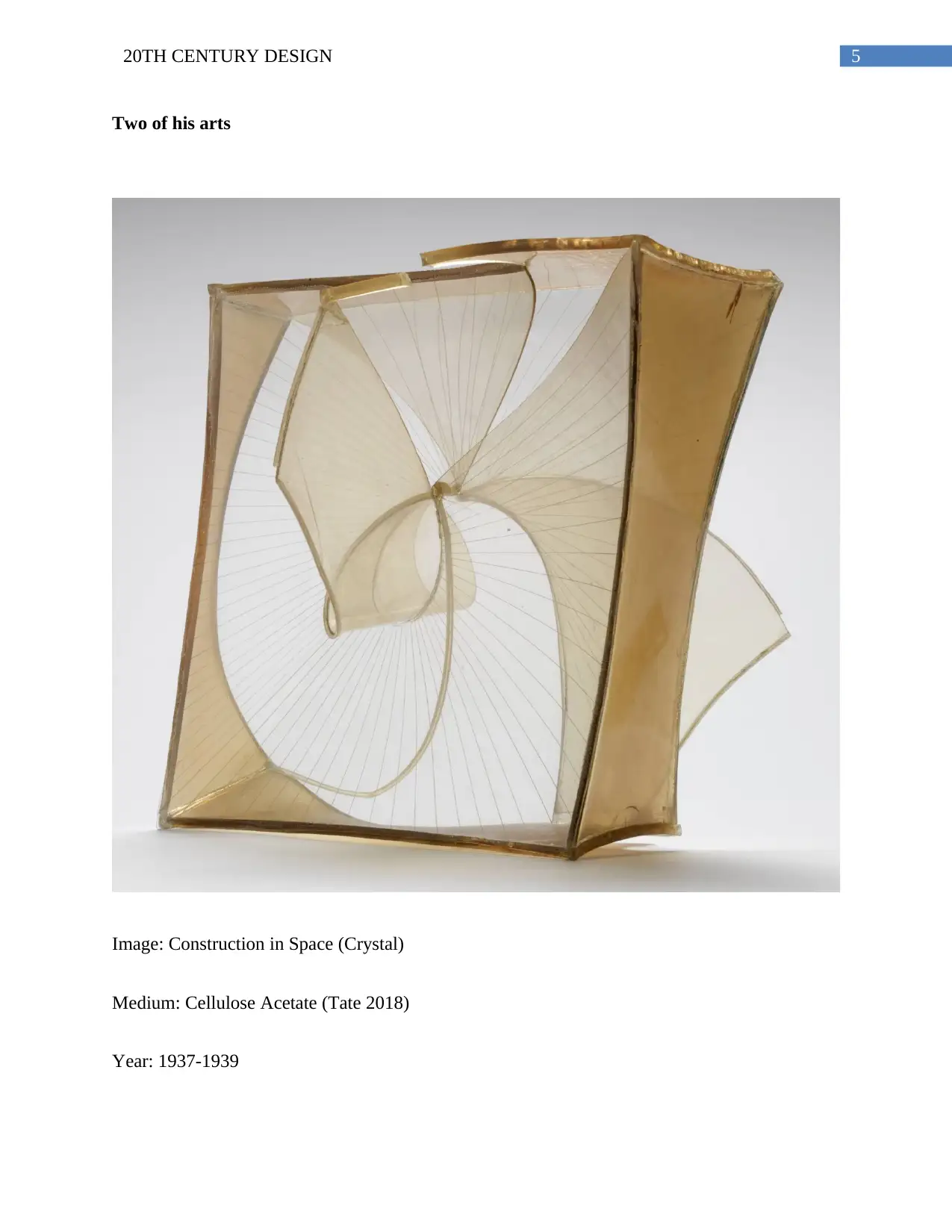
Image: Construction in Space (Crystal)
Medium: Cellulose Acetate (Tate 2018)
Year: 1937-1939
Two of his arts
Image: Construction in Space (Crystal)
Medium: Cellulose Acetate (Tate 2018)
Year: 1937-1939
⊘ This is a preview!⊘
Do you want full access?
Subscribe today to unlock all pages.
Trusted by 1+ million students worldwide
620TH CENTURY DESIGN
Reference: T06978
Reference: T06978
Paraphrase This Document
Need a fresh take? Get an instant paraphrase of this document with our AI Paraphraser
720TH CENTURY DESIGN
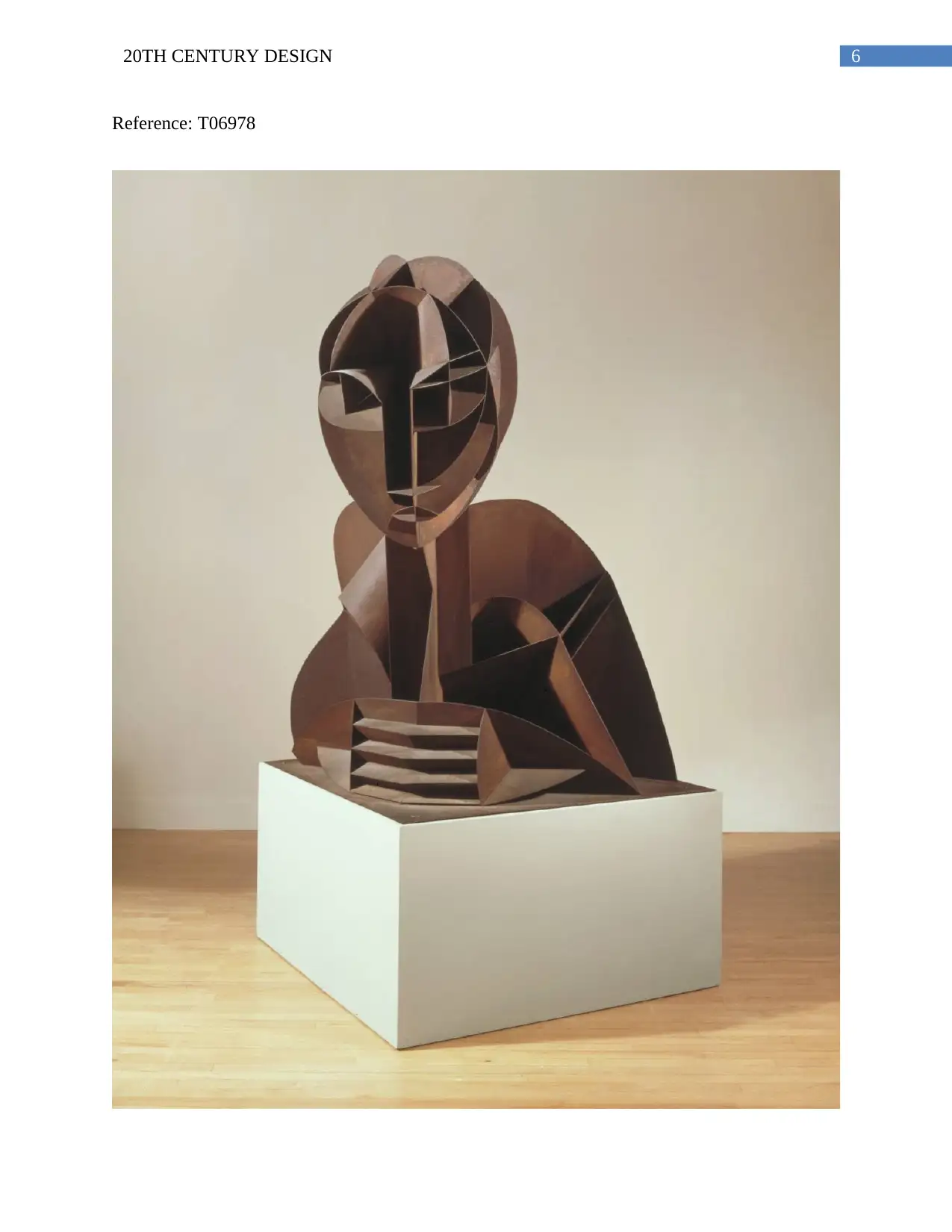
Image: Constructed head no. 2
Medium: Steel (Tate 2018)
Year: 1916 and the enlarged version came in the year 1964
Reference: T01520
Comparison of the two arts
The first work of art belongs to Naum Gabo who had been fascinated by the scientific
theories and models and adapted their general conclusions for the sculptural ends of his arts. It
has been found that the work was highly inspired by a mathematical model. The model
particularly was typical of the geometry handbooks along with representing an ‘oscillating
developable of a cubic ellipse’. Notably, the surrealists were significantly attracted by its
uniqueness and became exhibited in the ‘Exposition surréaliste d’objets’ in Paris, 1936. In the
same year it became featured by Cahiers d’Art and Gabo had produced the primary sketches of
the work in the Encyclopaedia Britannica. A sense of circular movement is produced by
incising the sculpture with radiating lines and sticking together with glue. The title word
‘crystal’ suggests a familiarity with crystallography which is a flourishing science that brought
together the organic and geometric having examined the internal structure of the molecules so
that it is revealed mathematically. On the other hand, the second work of art also belongs to
the same artist, based on the ‘stereometric construction’. With the help of this method the artist
a form descriptive of the space in a better way instead of the establishment of mass. The artist
further used planes in order to construct figures and heads demonstrating the application of this
particular method. The second piece of art known titled as the ‘Head no 2’ is a further
enlargement of the dramatic models.
Image: Constructed head no. 2
Medium: Steel (Tate 2018)
Year: 1916 and the enlarged version came in the year 1964
Reference: T01520
Comparison of the two arts
The first work of art belongs to Naum Gabo who had been fascinated by the scientific
theories and models and adapted their general conclusions for the sculptural ends of his arts. It
has been found that the work was highly inspired by a mathematical model. The model
particularly was typical of the geometry handbooks along with representing an ‘oscillating
developable of a cubic ellipse’. Notably, the surrealists were significantly attracted by its
uniqueness and became exhibited in the ‘Exposition surréaliste d’objets’ in Paris, 1936. In the
same year it became featured by Cahiers d’Art and Gabo had produced the primary sketches of
the work in the Encyclopaedia Britannica. A sense of circular movement is produced by
incising the sculpture with radiating lines and sticking together with glue. The title word
‘crystal’ suggests a familiarity with crystallography which is a flourishing science that brought
together the organic and geometric having examined the internal structure of the molecules so
that it is revealed mathematically. On the other hand, the second work of art also belongs to
the same artist, based on the ‘stereometric construction’. With the help of this method the artist
a form descriptive of the space in a better way instead of the establishment of mass. The artist
further used planes in order to construct figures and heads demonstrating the application of this
particular method. The second piece of art known titled as the ‘Head no 2’ is a further
enlargement of the dramatic models.
820TH CENTURY DESIGN
Contemporary Designer
Shepard Fairey is the designer of the contemporary times whose works are cited in this
regards. Frank Shepard Fairey who was born on 1970, February 15th, is one of the American
contemporary street artist, activist, graphic designer, and illustrator. He is also an entrepreneur
and owns the brand called Obey Clothing. This brand is built on the creative ideas of Shepard
Fairey and he is one of the contemporary artists taking forward the art of Constructivism. He
rose to his fame when he designed the “Hope” poster for Barack Obama (Gries 2017). This
particular poster had the elements that had driven the 2008 elections. Obama’s face had a
particular kind of expression which reflected the confidence of Obama and the title Hope had
complimented the poster. Many of his works are put together and exhibited at The Smithsonian,
the Lost Angeles County Museum of Art.
Two of his works
The two works chosen in this case are Hope and Embrace Justice by the artist. The
Barack Obama "Hope" poster is a picture of Barack Obama planned by artist Shepard Fairey,
which was broadly depicted as famous and came to speak to his 2008 presidential campaign. It
comprises of an adapted stencil representation of Obama in strong red, beige and (light and dim)
blue, with "advance", "hope" or "change" underneath (and different words in a few variants). The
plan was made in one day and printed first as a poster. Fairey sold 290 of the posters on the street
promptly in the wake of printing them. It was then more generally conveyed—both as an
advanced picture and other stuff—amid the 2008 decision season, at first freely yet with the
endorsement of the authority Obama battle. The picture wound up a standout amongst the most
broadly perceived images of Obama's battle message, bringing forth numerous varieties and
Contemporary Designer
Shepard Fairey is the designer of the contemporary times whose works are cited in this
regards. Frank Shepard Fairey who was born on 1970, February 15th, is one of the American
contemporary street artist, activist, graphic designer, and illustrator. He is also an entrepreneur
and owns the brand called Obey Clothing. This brand is built on the creative ideas of Shepard
Fairey and he is one of the contemporary artists taking forward the art of Constructivism. He
rose to his fame when he designed the “Hope” poster for Barack Obama (Gries 2017). This
particular poster had the elements that had driven the 2008 elections. Obama’s face had a
particular kind of expression which reflected the confidence of Obama and the title Hope had
complimented the poster. Many of his works are put together and exhibited at The Smithsonian,
the Lost Angeles County Museum of Art.
Two of his works
The two works chosen in this case are Hope and Embrace Justice by the artist. The
Barack Obama "Hope" poster is a picture of Barack Obama planned by artist Shepard Fairey,
which was broadly depicted as famous and came to speak to his 2008 presidential campaign. It
comprises of an adapted stencil representation of Obama in strong red, beige and (light and dim)
blue, with "advance", "hope" or "change" underneath (and different words in a few variants). The
plan was made in one day and printed first as a poster. Fairey sold 290 of the posters on the street
promptly in the wake of printing them. It was then more generally conveyed—both as an
advanced picture and other stuff—amid the 2008 decision season, at first freely yet with the
endorsement of the authority Obama battle. The picture wound up a standout amongst the most
broadly perceived images of Obama's battle message, bringing forth numerous varieties and
⊘ This is a preview!⊘
Do you want full access?
Subscribe today to unlock all pages.
Trusted by 1+ million students worldwide
920TH CENTURY DESIGN
impersonations, including some authorized by the Obama crusade. Embrace Justice on the other
hand was aimed at justice delivered to the Afro-Americans and how it is biased in many cases.
Conclusion
On a concluding note, it can be said that the evolution of the artistic and the architectural
philosophy in the form of Constructivism was triggered in the year 1913 by Vladimir Tatlin in
Russia. The main focus of movement was the rejection of the autonomous art and the enthusiasm
to start constructing the art. The movement had the motive to inspire the portrayal of the social
purposes in the form of art.
impersonations, including some authorized by the Obama crusade. Embrace Justice on the other
hand was aimed at justice delivered to the Afro-Americans and how it is biased in many cases.
Conclusion
On a concluding note, it can be said that the evolution of the artistic and the architectural
philosophy in the form of Constructivism was triggered in the year 1913 by Vladimir Tatlin in
Russia. The main focus of movement was the rejection of the autonomous art and the enthusiasm
to start constructing the art. The movement had the motive to inspire the portrayal of the social
purposes in the form of art.
Paraphrase This Document
Need a fresh take? Get an instant paraphrase of this document with our AI Paraphraser
1020TH CENTURY DESIGN
Reference:
Birringer, J., 2013. Bauhaus, constructivism, performance. PAJ: A Journal of Performance and
Art, 35(2), pp.39-52.
Broude, N., 2018. The expanding discourse: feminism and art history. Routledge.
Fosnot, C.T., 2013. Constructivism: Theory, perspectives, and practice. Teachers College Press.
Gries, L., 2017. Mapping Obama hope: A data visualization project for visual rhetorics.
Groys, B., 2014. On art activism. e-flux journal, 56, pp.1-14.
Janecek, G., 2014. The Look of Russian Literature: avant-garde visual experiments, 1900-1930
(Vol. 641). Princeton University Press.
Koloogani, M.A. and Ghazvini, P.S., 2017. An Explanation of the Machine Aesthetics in
Russian Avant-garde Art Based on Marx’s Ideas. BAGH-E NAZAR, 14(48), pp.45-60.
Tate. 2018. ‘Construction in Space (Crystal)’, Naum Gabo, 1937-9 | Tate. [online] Available at:
https://www.tate.org.uk/art/artworks/gabo-construction-in-space-crystal-t06978
Tate. 2018. ‘Head No. 2’, Naum Gabo, 1916, enlarged version 1964 | Tate. [online] Available at:
https://www.tate.org.uk/art/artworks/gabo-head-no-2-t01520
Thompson, C.M., 2015. Constructivism in the art classroom: Praxis and policy. Arts Education
Policy Review, 116(3), pp.118-127.
Reference:
Birringer, J., 2013. Bauhaus, constructivism, performance. PAJ: A Journal of Performance and
Art, 35(2), pp.39-52.
Broude, N., 2018. The expanding discourse: feminism and art history. Routledge.
Fosnot, C.T., 2013. Constructivism: Theory, perspectives, and practice. Teachers College Press.
Gries, L., 2017. Mapping Obama hope: A data visualization project for visual rhetorics.
Groys, B., 2014. On art activism. e-flux journal, 56, pp.1-14.
Janecek, G., 2014. The Look of Russian Literature: avant-garde visual experiments, 1900-1930
(Vol. 641). Princeton University Press.
Koloogani, M.A. and Ghazvini, P.S., 2017. An Explanation of the Machine Aesthetics in
Russian Avant-garde Art Based on Marx’s Ideas. BAGH-E NAZAR, 14(48), pp.45-60.
Tate. 2018. ‘Construction in Space (Crystal)’, Naum Gabo, 1937-9 | Tate. [online] Available at:
https://www.tate.org.uk/art/artworks/gabo-construction-in-space-crystal-t06978
Tate. 2018. ‘Head No. 2’, Naum Gabo, 1916, enlarged version 1964 | Tate. [online] Available at:
https://www.tate.org.uk/art/artworks/gabo-head-no-2-t01520
Thompson, C.M., 2015. Constructivism in the art classroom: Praxis and policy. Arts Education
Policy Review, 116(3), pp.118-127.

1 out of 11


Related Documents


Your All-in-One AI-Powered Toolkit for Academic Success.
+13062052269
info@desklib.com
Available 24*7 on WhatsApp / Email
![[object Object]](/_next/static/media/star-bottom.7253800d.svg)
Unlock your academic potential
Copyright © 2020–2026 A2Z Services. All Rights Reserved. Developed and managed by ZUCOL.