Consumer Behaviour Analysis: Introduction, Attitudes, and Strategies
VerifiedAdded on 2019/10/31
|14
|4690
|432
Essay
AI Summary
This essay provides a comprehensive overview of consumer behaviour, examining key concepts such as attitudes, marketing strategies, and decision-making processes. It introduces the importance of understanding consumer behaviour for businesses, highlighting how consumer uniqueness influences purchasing patterns. The essay delves into the significance of consumer behaviour studies for marketers, emphasizing the 'what, why, when, how, and where' of consumer purchases. It also explores the application of PESTLE analysis and STP models to evaluate external environments and segment consumer markets effectively. Furthermore, the essay discusses the impact of attitudes on consumer behaviour, the influence of beliefs, feelings, and behavioral intentions. Real-world examples from the hospitality industry are used to illustrate these concepts, demonstrating how businesses can leverage consumer insights to develop effective marketing strategies and achieve competitive advantages.
CONSUMER BEHAVIOUR
1
1

Paraphrase This Document
Need a fresh take? Get an instant paraphrase of this document with our AI Paraphraser
Table of Contents
TOPIC 1: INTRODUCTION TO CONSUMER BEHAVIOUR...............................................3
Introduction:...............................................................................................................................3
Discussion:.................................................................................................................................4
Conclusion:................................................................................................................................6
TOPIC 4: ATTITUDE AND CONSUMER BEHAVIOUR.....................................................8
Introduction:...............................................................................................................................8
Theories, Concepts and Models of Consumer Behaviour:.......................................................10
Conclusion:..............................................................................................................................12
Reference lists:.........................................................................................................................13
2
TOPIC 1: INTRODUCTION TO CONSUMER BEHAVIOUR...............................................3
Introduction:...............................................................................................................................3
Discussion:.................................................................................................................................4
Conclusion:................................................................................................................................6
TOPIC 4: ATTITUDE AND CONSUMER BEHAVIOUR.....................................................8
Introduction:...............................................................................................................................8
Theories, Concepts and Models of Consumer Behaviour:.......................................................10
Conclusion:..............................................................................................................................12
Reference lists:.........................................................................................................................13
2
TOPIC 1: INTRODUCTION TO CONSUMER BEHAVIOUR
Introduction:
In business arena, every consumer is accepted as unique and the uniqueness is generally
reflects on the pattern of consumption and their purchasing behaviour. The easy on
“consumer behaviour” sheds light on the fact that why every consumer differs from each
other on the basis of their purchasing behaviour or from the pattern used for consuming any
products or services from market (Bowen, 2017). The study of CB or consumer behaviour is
very important and crucial for the marketer as it can enable them to comprehend and to make
accurate prediction on the consumer purchasing behaviour from marketplace. This study not
only highlights upon what a consumer purchase from the market but it also concerns with
why he purchases it and when, how and from where he purchases it. In business education,
the study of Customer behaviour is one of the most important topics, because the
fundamental criterion of business is to acquire and attain customer for prolonged period of
time.
A marketer can acquire and/or maintain his customer through proper marketing strategies. Or
on the other word, quality of the marketing strategies in business arena is considered as
influential for creating and maintaining customer over a period of time (Loureiro et al.
2017). Moreover, it can also be said that a marketer can achieved ultimate business success
by fulfilling the organisational objectives which in turn can be possible by satisfying the
customer with wide range of products and services in accordance with their expectation. So,
therefore, it can be concluded that the sound knowledge and proper information about the
customer is not only important but it is also essential for the marketer by which he can
develop productive and profit-making marketing strategy and also can create strong
relationship with the customer. It not only helpful for him or for his organisation to create
market reputation but it can also drive him to achieve competitive edge of contemporary
business arena with ease and efficacy (Robinson, 2017).
“Customer behaviour” this term refers to the behavioural approach of a consumer that he
exhibit in searching of products and/or services which can suit his taste as well as desire.
Customer behaviour is also concerned with the fact that how a customer can take necessary
decision by spending their available resources like time, money and efforts for buying
3
Introduction:
In business arena, every consumer is accepted as unique and the uniqueness is generally
reflects on the pattern of consumption and their purchasing behaviour. The easy on
“consumer behaviour” sheds light on the fact that why every consumer differs from each
other on the basis of their purchasing behaviour or from the pattern used for consuming any
products or services from market (Bowen, 2017). The study of CB or consumer behaviour is
very important and crucial for the marketer as it can enable them to comprehend and to make
accurate prediction on the consumer purchasing behaviour from marketplace. This study not
only highlights upon what a consumer purchase from the market but it also concerns with
why he purchases it and when, how and from where he purchases it. In business education,
the study of Customer behaviour is one of the most important topics, because the
fundamental criterion of business is to acquire and attain customer for prolonged period of
time.
A marketer can acquire and/or maintain his customer through proper marketing strategies. Or
on the other word, quality of the marketing strategies in business arena is considered as
influential for creating and maintaining customer over a period of time (Loureiro et al.
2017). Moreover, it can also be said that a marketer can achieved ultimate business success
by fulfilling the organisational objectives which in turn can be possible by satisfying the
customer with wide range of products and services in accordance with their expectation. So,
therefore, it can be concluded that the sound knowledge and proper information about the
customer is not only important but it is also essential for the marketer by which he can
develop productive and profit-making marketing strategy and also can create strong
relationship with the customer. It not only helpful for him or for his organisation to create
market reputation but it can also drive him to achieve competitive edge of contemporary
business arena with ease and efficacy (Robinson, 2017).
“Customer behaviour” this term refers to the behavioural approach of a consumer that he
exhibit in searching of products and/or services which can suit his taste as well as desire.
Customer behaviour is also concerned with the fact that how a customer can take necessary
decision by spending their available resources like time, money and efforts for buying
3
⊘ This is a preview!⊘
Do you want full access?
Subscribe today to unlock all pages.

Trusted by 1+ million students worldwide
products which can satisfy his needs. This includes some important factor like: what he buy,
when he buy it, why he buy it, from where he buy it and how he buy it (Chan et al. 2017).
These few factors are generally shed light on the customer behaviour towards their pattern of
purchasing. Similarly, customer behaviour also highlights upon another few aspects like: how
often a customer use the product that he buys from market or how the customer can evaluate
the product after buy it (Gummerus et al. 2017). Henceforth, consumer behaviour can be
described as the behavioural approach of an individual or a customer towards acquiring,
utilizing and to disposing of the products. Use of customer related information can be the
easy way for a marketer or business organisation by which he can utilise the “consumer
behavioural” approach with ease and efficacy. So, in that context, it can be concluded that
effective communication with the customer and to receive the feedbacks from them regarding
the products and services being offered by the organisation are two important parts of the
“consumer behaviour” concept. In order to shed light on this effective and productive
business conception, “hospitality industry” or “ hotel industry” can be taken as model
business setup.
Discussion:
From the above discussion, it can be understood that, effective implication of “consumer
behaviour” in market arena, marketer or organisation has the necessity and responsibility to
choose such place from where customer can avail the products and services easily which is
being offered by them. More formally, it can be said that, choice of proper market place is the
foremost necessity of any business organisation especially for hospitality industry (Jeong et
al. 2017). So, in that case, according to my perception, UK business market can be effective
and suitable enough from where any business organisation can operate their business related
activities with ease and efficacy. The effectiveness or suitability of external environment of
any business organisation can be evaluated by PESTLE analysis process. This analytical tool
is widely used in business arena as it sheds light over the external environment by which one
can easily recognize and comprehend the relationship between the company and the external
surroundings of the organisation and on the basis of that, the marketer can take initiatives for
adopting certain change in the organisational macro-environment (Tung, Chen and Schuckert,
2017). In other word, it can be said that PESTLE analysis can provide ample amount of
opportunity to the marketer to capture the understanding about the important aspect of
external environments and their impacts on business activities by using prompts like Political,
4
when he buy it, why he buy it, from where he buy it and how he buy it (Chan et al. 2017).
These few factors are generally shed light on the customer behaviour towards their pattern of
purchasing. Similarly, customer behaviour also highlights upon another few aspects like: how
often a customer use the product that he buys from market or how the customer can evaluate
the product after buy it (Gummerus et al. 2017). Henceforth, consumer behaviour can be
described as the behavioural approach of an individual or a customer towards acquiring,
utilizing and to disposing of the products. Use of customer related information can be the
easy way for a marketer or business organisation by which he can utilise the “consumer
behavioural” approach with ease and efficacy. So, in that context, it can be concluded that
effective communication with the customer and to receive the feedbacks from them regarding
the products and services being offered by the organisation are two important parts of the
“consumer behaviour” concept. In order to shed light on this effective and productive
business conception, “hospitality industry” or “ hotel industry” can be taken as model
business setup.
Discussion:
From the above discussion, it can be understood that, effective implication of “consumer
behaviour” in market arena, marketer or organisation has the necessity and responsibility to
choose such place from where customer can avail the products and services easily which is
being offered by them. More formally, it can be said that, choice of proper market place is the
foremost necessity of any business organisation especially for hospitality industry (Jeong et
al. 2017). So, in that case, according to my perception, UK business market can be effective
and suitable enough from where any business organisation can operate their business related
activities with ease and efficacy. The effectiveness or suitability of external environment of
any business organisation can be evaluated by PESTLE analysis process. This analytical tool
is widely used in business arena as it sheds light over the external environment by which one
can easily recognize and comprehend the relationship between the company and the external
surroundings of the organisation and on the basis of that, the marketer can take initiatives for
adopting certain change in the organisational macro-environment (Tung, Chen and Schuckert,
2017). In other word, it can be said that PESTLE analysis can provide ample amount of
opportunity to the marketer to capture the understanding about the important aspect of
external environments and their impacts on business activities by using prompts like Political,
4
Paraphrase This Document
Need a fresh take? Get an instant paraphrase of this document with our AI Paraphraser
Economical, Sociological, technological, legal and the environment. In hospitality industry,
political, economical, legal and environmental factors of the UK can provide effective and
long-term impact as those factors are closely related with the acquisition and the retention
process of the customers. Similarly, the technological factors of an organisation can also be
utilised as contributory factor as it sheds light on the fact that how an organisation in
hospitality industry can offer effective and superior services by using modified and most
scientific technological process. So, as a whole, it can be concluded that, though “PESTLE”
analysis process can be widely used for evaluating external environment of business
organisation, but it can provide effective impact on “consumer behaviour” approach (Jeong et
al. 2017). By evaluating external environment, the business organisation can offer superior
services and wide range of products to the customer in accordance to their demands and
needs. by a simple example it can be clarified: economical factor in PESTLE analysis
concerns with the financial background of the population, NI and GDP rate of the nation,
gross annual income of the population of that nation. So, by analysing those factors, a hotel
or its organisational management can provide such services or products that can make the
customer satisfied and gleeful. Similarly, social factor highlights upon the educational
background of the nation (UK), literacy rate, and cultural diversity and so on. So, diverse
social perspective and ethnicity of the population can make the nation appealing for other
nations which ultimately can impact upon the hospitality industry of that concerned nation.
Apart from the PESTLE analysis, STP can be another important model which can enhance
both the marketing strategy as well as the “consumer behaviour” approach of the business
organisation. STP model is accepted as a audience focused or customer centric business
approaches by which marketer can create effective interaction which in turns can help them
to convey the message to the commercially appealing customers regarding their services and
products being offered by them (Gummerus et al. 2017). By segmentation, marketer can
identify and recognise the niches with the specified demand and requirements. In case of
hospitality industry, segmentation of the large populace of the country can be segmented on
the basis of the demographics, psychographics, livelihoods, the beliefs and the values of the
customer and on the basis of their behavioural approach. As an example, in hospitality
industry, the hoteliers of ABC hotel in UK can segmented their customer in a few categories
in accordance to their demands and economical background. Segment A is set up only for the
married couples, who are interested in eco-friendly vocational trip but in affordable price.
Segment B can be made up for middle-class families who are interested in safe, family
5
political, economical, legal and environmental factors of the UK can provide effective and
long-term impact as those factors are closely related with the acquisition and the retention
process of the customers. Similarly, the technological factors of an organisation can also be
utilised as contributory factor as it sheds light on the fact that how an organisation in
hospitality industry can offer effective and superior services by using modified and most
scientific technological process. So, as a whole, it can be concluded that, though “PESTLE”
analysis process can be widely used for evaluating external environment of business
organisation, but it can provide effective impact on “consumer behaviour” approach (Jeong et
al. 2017). By evaluating external environment, the business organisation can offer superior
services and wide range of products to the customer in accordance to their demands and
needs. by a simple example it can be clarified: economical factor in PESTLE analysis
concerns with the financial background of the population, NI and GDP rate of the nation,
gross annual income of the population of that nation. So, by analysing those factors, a hotel
or its organisational management can provide such services or products that can make the
customer satisfied and gleeful. Similarly, social factor highlights upon the educational
background of the nation (UK), literacy rate, and cultural diversity and so on. So, diverse
social perspective and ethnicity of the population can make the nation appealing for other
nations which ultimately can impact upon the hospitality industry of that concerned nation.
Apart from the PESTLE analysis, STP can be another important model which can enhance
both the marketing strategy as well as the “consumer behaviour” approach of the business
organisation. STP model is accepted as a audience focused or customer centric business
approaches by which marketer can create effective interaction which in turns can help them
to convey the message to the commercially appealing customers regarding their services and
products being offered by them (Gummerus et al. 2017). By segmentation, marketer can
identify and recognise the niches with the specified demand and requirements. In case of
hospitality industry, segmentation of the large populace of the country can be segmented on
the basis of the demographics, psychographics, livelihoods, the beliefs and the values of the
customer and on the basis of their behavioural approach. As an example, in hospitality
industry, the hoteliers of ABC hotel in UK can segmented their customer in a few categories
in accordance to their demands and economical background. Segment A is set up only for the
married couples, who are interested in eco-friendly vocational trip but in affordable price.
Segment B can be made up for middle-class families who are interested in safe, family
5
friendly vocational packages and Segment C consists of economic class of people who are
interested in stylise, comfortable and luxurious vacation (Chan et al. 2017).
In order to enhance the potentiality of the organisation and to enhance the commercial
attractiveness of every segment, the organisational management can focus upon few factors
for market targeting and those are:
Size: the chosen market place should be large enough in order to justify the segmenting.
Difference: An appropriate, effective and measurable difference should exist between each
segment (Loureiro et al. 2017)
Accessibility: the population across the nation must be segmented in such a way, so that it
can be accessible by the organisational management. It in turns can help them to create
effective correlation with the segmented customer.
As an example: in order to calculate the earning revenue, the organisational management of
hotel ABC checks that from segment A, he earns huge profit compared to other two segment.
So, it can be concluded that the size of Segment A is big enough and the hotelier can earn
profit on focusing upon that segment in near future.
The last important factor of this customer-centric approach is “product positioning” or more
formally it indicates that how the organisational management can position his products or
services in order to attract or to target most valuable and important customer segment. Proper
creation of positioning map, unique selling proposal, value proposition can be ideal for any
organisational management to target precious and the most valuable consumer for long period
of time (Bowen, 2017).
Conclusion:
In order to accomplish this essay, it can be conclude that, proper customisation process,
unique selling proposition, segmentation and so on can be considered as some important
marketing strategies or plans by which marketer can pay maximum importance on the high-
value customers as well as on their behavioural approaches towards any products or services.
This essay also includes PESTLE analysis as a marketing tool by which an organisational
management can understand the effective relation between the company and the external
business environment. This can ultimately help the organisational management to evaluate
6
interested in stylise, comfortable and luxurious vacation (Chan et al. 2017).
In order to enhance the potentiality of the organisation and to enhance the commercial
attractiveness of every segment, the organisational management can focus upon few factors
for market targeting and those are:
Size: the chosen market place should be large enough in order to justify the segmenting.
Difference: An appropriate, effective and measurable difference should exist between each
segment (Loureiro et al. 2017)
Accessibility: the population across the nation must be segmented in such a way, so that it
can be accessible by the organisational management. It in turns can help them to create
effective correlation with the segmented customer.
As an example: in order to calculate the earning revenue, the organisational management of
hotel ABC checks that from segment A, he earns huge profit compared to other two segment.
So, it can be concluded that the size of Segment A is big enough and the hotelier can earn
profit on focusing upon that segment in near future.
The last important factor of this customer-centric approach is “product positioning” or more
formally it indicates that how the organisational management can position his products or
services in order to attract or to target most valuable and important customer segment. Proper
creation of positioning map, unique selling proposal, value proposition can be ideal for any
organisational management to target precious and the most valuable consumer for long period
of time (Bowen, 2017).
Conclusion:
In order to accomplish this essay, it can be conclude that, proper customisation process,
unique selling proposition, segmentation and so on can be considered as some important
marketing strategies or plans by which marketer can pay maximum importance on the high-
value customers as well as on their behavioural approaches towards any products or services.
This essay also includes PESTLE analysis as a marketing tool by which an organisational
management can understand the effective relation between the company and the external
business environment. This can ultimately help the organisational management to evaluate
6
⊘ This is a preview!⊘
Do you want full access?
Subscribe today to unlock all pages.
Trusted by 1+ million students worldwide
and understand the actual needs of the customer and behavioural approach towards any
products and services which in turn can drive them towards ultimate business success by
offering best services to their targeted customers.
7
products and services which in turn can drive them towards ultimate business success by
offering best services to their targeted customers.
7
Paraphrase This Document
Need a fresh take? Get an instant paraphrase of this document with our AI Paraphraser
TOPIC 4: ATTITUDE AND CONSUMER BEHAVIOUR
Introduction:
The term “attitude” can be described as a erudite predisposition which can be used for
making effective response in favourable and/ or unfavourable manner on the basis of some
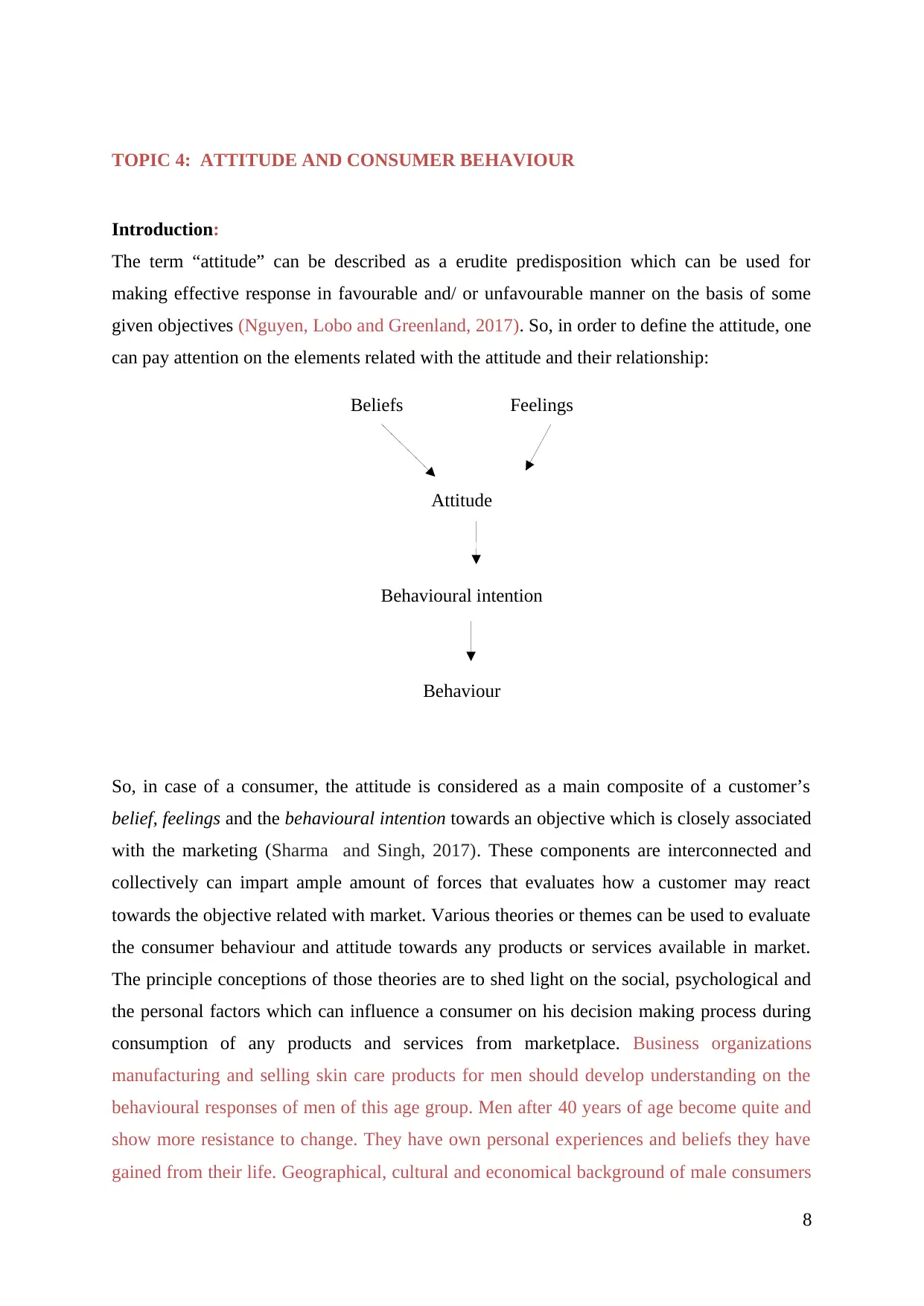
given objectives (Nguyen, Lobo and Greenland, 2017). So, in order to define the attitude, one
can pay attention on the elements related with the attitude and their relationship:
Beliefs Feelings
Attitude
Behavioural intention
Behaviour
So, in case of a consumer, the attitude is considered as a main composite of a customer’s
belief, feelings and the behavioural intention towards an objective which is closely associated
with the marketing (Sharma and Singh, 2017). These components are interconnected and
collectively can impart ample amount of forces that evaluates how a customer may react
towards the objective related with market. Various theories or themes can be used to evaluate
the consumer behaviour and attitude towards any products or services available in market.
The principle conceptions of those theories are to shed light on the social, psychological and
the personal factors which can influence a consumer on his decision making process during
consumption of any products and services from marketplace. Business organizations
manufacturing and selling skin care products for men should develop understanding on the
behavioural responses of men of this age group. Men after 40 years of age become quite and
show more resistance to change. They have own personal experiences and beliefs they have
gained from their life. Geographical, cultural and economical background of male consumers
8
Introduction:
The term “attitude” can be described as a erudite predisposition which can be used for
making effective response in favourable and/ or unfavourable manner on the basis of some
given objectives (Nguyen, Lobo and Greenland, 2017). So, in order to define the attitude, one
can pay attention on the elements related with the attitude and their relationship:
Beliefs Feelings
Attitude
Behavioural intention
Behaviour
So, in case of a consumer, the attitude is considered as a main composite of a customer’s
belief, feelings and the behavioural intention towards an objective which is closely associated
with the marketing (Sharma and Singh, 2017). These components are interconnected and
collectively can impart ample amount of forces that evaluates how a customer may react
towards the objective related with market. Various theories or themes can be used to evaluate
the consumer behaviour and attitude towards any products or services available in market.
The principle conceptions of those theories are to shed light on the social, psychological and
the personal factors which can influence a consumer on his decision making process during
consumption of any products and services from marketplace. Business organizations
manufacturing and selling skin care products for men should develop understanding on the
behavioural responses of men of this age group. Men after 40 years of age become quite and
show more resistance to change. They have own personal experiences and beliefs they have
gained from their life. Geographical, cultural and economical background of male consumers
8
directly or indirectly influences their behaviour regarding consumption of goods and services.
Business organizations should explore the background of male community members they are
targeting to influence. Marketing strategies of the business organizations should be developed
considering the preferences of male community members aged more than 40 years.
Behaviour is a process to make effective response to stimuli. Similarly, Consumer behaviour
is also discussed the activities of consumers which is being done by them in acquiring or in
using any products and services, it includes the decision making procedures or skills of the
consumer that ultimately precedes and evaluate the purchases (Harris et al. 2017). Therefore
it can stated that attitude and consumer behaviour can provides a proper framework for
understanding and indentifying the actual needs and demands of the consumer. A customer
may have both positive attitude and negative attitudes towards any products and services
available in market. A customer with the positive attitude or behavioural approach is more
likely to purchase any products or services from market in accordance to his needs and
demands which in turn can be impacted upon the marketing plan and procedures of an
organisation (Tung et al. 2017). Or more formally it can be said that, consumer behavioural
approach is a strategic framework by which organisational management can understand or
indentify the basic or fundamental needs of customer. On the basis of the marketing analysis,
the marketer can offer superior services and wide range of products to the high-value
customer to meet their expectation. This can be an effective and the best possible way by
which marketer can create effective impact or bring change on customer behavioural
approaches towards purchasing ability or procedure (Pérezi et al. 2017).
Men of more than 40 years of age are prone express their manhood to the society they live.
They keep trying to say the world that are as productive as they were in their younger days.
Considering the ups and downs they have seen in their life, they become quite rigid to their
choices. They think more when they are choosing goods and services of certain brands.
Marketing strategies of skin care products for men of this age group should be based on
profound understanding about this group (Tung, Chen and Schuckert, 2017). Men of different
cultural and economic background react differently when it comes to the purchase of skin
care products. They put more emphasis on the utility of the products rather than packaging. It
is bit more difficult to influence this group by attractive advertisements. Marketing and
advertisement strategies of men's skin care products should be straight forward and realistic
content based.
9
Business organizations should explore the background of male community members they are
targeting to influence. Marketing strategies of the business organizations should be developed
considering the preferences of male community members aged more than 40 years.
Behaviour is a process to make effective response to stimuli. Similarly, Consumer behaviour
is also discussed the activities of consumers which is being done by them in acquiring or in
using any products and services, it includes the decision making procedures or skills of the
consumer that ultimately precedes and evaluate the purchases (Harris et al. 2017). Therefore
it can stated that attitude and consumer behaviour can provides a proper framework for
understanding and indentifying the actual needs and demands of the consumer. A customer
may have both positive attitude and negative attitudes towards any products and services
available in market. A customer with the positive attitude or behavioural approach is more
likely to purchase any products or services from market in accordance to his needs and
demands which in turn can be impacted upon the marketing plan and procedures of an
organisation (Tung et al. 2017). Or more formally it can be said that, consumer behavioural
approach is a strategic framework by which organisational management can understand or
indentify the basic or fundamental needs of customer. On the basis of the marketing analysis,
the marketer can offer superior services and wide range of products to the high-value
customer to meet their expectation. This can be an effective and the best possible way by
which marketer can create effective impact or bring change on customer behavioural
approaches towards purchasing ability or procedure (Pérezi et al. 2017).
Men of more than 40 years of age are prone express their manhood to the society they live.
They keep trying to say the world that are as productive as they were in their younger days.
Considering the ups and downs they have seen in their life, they become quite rigid to their
choices. They think more when they are choosing goods and services of certain brands.
Marketing strategies of skin care products for men of this age group should be based on
profound understanding about this group (Tung, Chen and Schuckert, 2017). Men of different
cultural and economic background react differently when it comes to the purchase of skin
care products. They put more emphasis on the utility of the products rather than packaging. It
is bit more difficult to influence this group by attractive advertisements. Marketing and
advertisement strategies of men's skin care products should be straight forward and realistic
content based.
9
⊘ This is a preview!⊘
Do you want full access?
Subscribe today to unlock all pages.
Trusted by 1+ million students worldwide
Theories, Concepts and Models of Consumer Behaviour:
Attitude of the men of this age group is mainly comprises with belief, feeling and the
behavioural intentions towards the marketing objectives.
Belief is an important component in customer attitude and consumer behaviour. It can be
either positive or it can be negative on the basis of the marketing objective (Heise and
Theuvsen, 2017). Like, human beliefs, customer attitude or purchasing behaviour may
fluctuate or vary in accordance to the market situation or availability of products and services
being offered by any organisation. Some men of this age believe that use of skin care
products may be harmful to their manhood. Some of them think that skin care products are
for the female members of the society and men do not have to use skin care products to
preserve their youth.
Apart from the belief, men of this age group also possesses specific feelings towards any
products and services or more specifically on any brands. Like, beliefs, feelings of the
customer for any brands or some certain products can be changed. For example, some men of
this age group may feel uneasy while buying products of skin care(Gil et al. 2017). They
may think what others will think if they see a man buying skin care products. Marketing
strategies of the organization should be able reduce the conflicts of these age by
advertisement the actual meaning of manhood. They can use model figures, like actors or
crickets in their advertisement of skin care products.
A behavioural intention sheds light over the purchasing plan of men of this age group with
respect to products or services. Behavioural intention can be described by a simple example-
influenced by the advertisement of skin care products they may try to find out a way of
reaching to the products and services. Influence of social media or communities and of
environment in which he lives is significant in this regard (Schmidt, Herzog and
Hammerschmidt, 2017).
Tri-component Model:
In order to understand the consumer attitude as well as attitude of men after 40 years of age in
an effective manner, one can shed light over few models of attitude, and among those models,
“Tri-component Model" has been considered as beneficial:
According to this model, customer attitude generally consists of three important components:
10
Attitude of the men of this age group is mainly comprises with belief, feeling and the
behavioural intentions towards the marketing objectives.
Belief is an important component in customer attitude and consumer behaviour. It can be
either positive or it can be negative on the basis of the marketing objective (Heise and
Theuvsen, 2017). Like, human beliefs, customer attitude or purchasing behaviour may
fluctuate or vary in accordance to the market situation or availability of products and services
being offered by any organisation. Some men of this age believe that use of skin care
products may be harmful to their manhood. Some of them think that skin care products are
for the female members of the society and men do not have to use skin care products to
preserve their youth.
Apart from the belief, men of this age group also possesses specific feelings towards any
products and services or more specifically on any brands. Like, beliefs, feelings of the
customer for any brands or some certain products can be changed. For example, some men of
this age group may feel uneasy while buying products of skin care(Gil et al. 2017). They
may think what others will think if they see a man buying skin care products. Marketing
strategies of the organization should be able reduce the conflicts of these age by
advertisement the actual meaning of manhood. They can use model figures, like actors or
crickets in their advertisement of skin care products.
A behavioural intention sheds light over the purchasing plan of men of this age group with
respect to products or services. Behavioural intention can be described by a simple example-
influenced by the advertisement of skin care products they may try to find out a way of
reaching to the products and services. Influence of social media or communities and of
environment in which he lives is significant in this regard (Schmidt, Herzog and
Hammerschmidt, 2017).
Tri-component Model:
In order to understand the consumer attitude as well as attitude of men after 40 years of age in
an effective manner, one can shed light over few models of attitude, and among those models,
“Tri-component Model" has been considered as beneficial:
According to this model, customer attitude generally consists of three important components:
10
Paraphrase This Document
Need a fresh take? Get an instant paraphrase of this document with our AI Paraphraser
Cognitive component: this component generally sheds light over the customer’s knowledge
and their perception towards any products and services by addressing customer’s own
experiences. This knowledge in turns may highlights over the consumer belief and specific
behaviours towards products and services available in market (Ong, Frewer and Chan, 2017).
Affective component: this component consists of an individual’s feelings, sentiments,
perspectives, emotions for any particular brands or products or the services being provided by
the brand (Le and Vo2017). The state of the mind of a consumer always play effective role
which in turns can provide effective impact on the attitude and/or the behavioural approach of
the consumer.
Conative component: this component composes of customer’s intention and/or the
likelihood towards any particular products or services. This component actually sheds light
over the exact behavioural approach or the intention of the customer towards market
(O’Sullivan et al. 2017).
Business organizations planning to sale their skin care products to the men of 40s can use this
Tri-component Model in developing appropriate marketing strategies.
Function of customer attitude:
Adjustment function: proper or effective attitude can help the customer to adjust in different
situation. This can be beneficial for the marketer in developing effective correlation or strong
relation with the customer and can also offer superior services and products to them in
accordance to their needs and within a proper time framework (Heise and Theuvsen, 2017).
Skin care products for men should be designed in such a way that they can adjust with their
requirements.
Value expression function: attitude can impact upon the value of a customer that he
possess. This value in turn can encourage or discourage the customer for buying any products
or services. The value of customer can be considered as an important contributor for market
as it enables the marketer to evaluate or to understand the actual needs or expectation of the
customer. And on the basis of that analysis, organisation can offer products and services by
which the marketer can make his customer satisfy and gleeful (Gil et al. 2017). Values of
men of concerned age group is quite different from other age groups. Men in this age enjoy
absolute maturity and want to access better experiences from their decisions of purchases.
Marketing strategies of the business organization should consider this fact.
11
and their perception towards any products and services by addressing customer’s own
experiences. This knowledge in turns may highlights over the consumer belief and specific
behaviours towards products and services available in market (Ong, Frewer and Chan, 2017).
Affective component: this component consists of an individual’s feelings, sentiments,
perspectives, emotions for any particular brands or products or the services being provided by
the brand (Le and Vo2017). The state of the mind of a consumer always play effective role
which in turns can provide effective impact on the attitude and/or the behavioural approach of
the consumer.
Conative component: this component composes of customer’s intention and/or the
likelihood towards any particular products or services. This component actually sheds light
over the exact behavioural approach or the intention of the customer towards market
(O’Sullivan et al. 2017).
Business organizations planning to sale their skin care products to the men of 40s can use this
Tri-component Model in developing appropriate marketing strategies.
Function of customer attitude:
Adjustment function: proper or effective attitude can help the customer to adjust in different
situation. This can be beneficial for the marketer in developing effective correlation or strong
relation with the customer and can also offer superior services and products to them in
accordance to their needs and within a proper time framework (Heise and Theuvsen, 2017).
Skin care products for men should be designed in such a way that they can adjust with their
requirements.
Value expression function: attitude can impact upon the value of a customer that he
possess. This value in turn can encourage or discourage the customer for buying any products
or services. The value of customer can be considered as an important contributor for market
as it enables the marketer to evaluate or to understand the actual needs or expectation of the
customer. And on the basis of that analysis, organisation can offer products and services by
which the marketer can make his customer satisfy and gleeful (Gil et al. 2017). Values of
men of concerned age group is quite different from other age groups. Men in this age enjoy
absolute maturity and want to access better experiences from their decisions of purchases.
Marketing strategies of the business organization should consider this fact.
11
Knowledge function: Attitude can help a customer in gathering knowledge and information
regarding any products or services that he wants to buy from market. The knowledge and
proper information regarding any products and/or the services can provide ample opportunity
to the customer to make effective comparison with similar other products and can attract
them towards the best services available in market (Heise and Theuvsen, 2017). On the other
hand, it can be said that, knowledge or information can increase the purchasing capability of
a customer as well as it can be beneficial for the marketer too. Effective information
regarding any particular products or service may expand the way by which the organisational
management can gain customer loyalty and reliability, which ultimately help them to achieve
ultimate business success. Business organizations should be able to satisfy the queries of men
of concerned age group by providing them enough information of the skin care products
through their advertisements.
Conclusion:
In order to accomplish this essay, it can be concluded that the attitudes and the behaviour of a
consumer can provide effective impact on the marketing strategy in business arena. By
evaluating and understanding or by identifying the customer attitude and purchasing
behaviour towards any products, services or any brands, a marketer can adopt effective
marketing plan or brings effective changes in production process. It can enable them to offer
wide range of products and services to the high-valued and targeted customers so that the
marketer can offer positive customer experience and can achieve ultimate organisational
success in competitive business arena.
12
regarding any products or services that he wants to buy from market. The knowledge and
proper information regarding any products and/or the services can provide ample opportunity
to the customer to make effective comparison with similar other products and can attract
them towards the best services available in market (Heise and Theuvsen, 2017). On the other
hand, it can be said that, knowledge or information can increase the purchasing capability of
a customer as well as it can be beneficial for the marketer too. Effective information
regarding any particular products or service may expand the way by which the organisational
management can gain customer loyalty and reliability, which ultimately help them to achieve
ultimate business success. Business organizations should be able to satisfy the queries of men
of concerned age group by providing them enough information of the skin care products
through their advertisements.
Conclusion:
In order to accomplish this essay, it can be concluded that the attitudes and the behaviour of a
consumer can provide effective impact on the marketing strategy in business arena. By
evaluating and understanding or by identifying the customer attitude and purchasing
behaviour towards any products, services or any brands, a marketer can adopt effective
marketing plan or brings effective changes in production process. It can enable them to offer
wide range of products and services to the high-valued and targeted customers so that the
marketer can offer positive customer experience and can achieve ultimate organisational
success in competitive business arena.
12
⊘ This is a preview!⊘
Do you want full access?
Subscribe today to unlock all pages.
Trusted by 1+ million students worldwide

1 out of 14


Related Documents


Your All-in-One AI-Powered Toolkit for Academic Success.
+13062052269
info@desklib.com
Available 24*7 on WhatsApp / Email
![[object Object]](/_next/static/media/star-bottom.7253800d.svg)
Unlock your academic potential
Copyright © 2020–2026 A2Z Services. All Rights Reserved. Developed and managed by ZUCOL.