Marketing Report: Consumer Behavior and Luxury Product Analysis
VerifiedAdded on 2021/06/14
|16
|4505
|52
Report
AI Summary
This report provides a comprehensive analysis of consumer behavior in the context of luxury products. It begins with an introduction to the concept of luxury, differentiating it from basic needs and highlighting its growth in the modern market. The literature review explores various definitions of luxury, the impact of globalization, and the evolution of luxury brands. The report then delves into the stimulus-response model of consumer buying behavior, outlining the marketing and environmental stimuli, buyer characteristics, and decision-making processes. It examines factors such as social status, perception, and attitude, and how they influence purchasing decisions. Furthermore, the report explores the influence of demographic factors (age, gender, occupation, and income), motivation (personal and interpersonal), cultural factors, and brand equity on consumer behavior towards luxury goods. The report concludes with a summary of the key findings and insights, emphasizing the complex interplay of various factors that shape consumer choices in the luxury market.
Running head: Consumer Behaviour 1
Marketing Consumer behaviour
Marketing Consumer behaviour

Paraphrase This Document
Need a fresh take? Get an instant paraphrase of this document with our AI Paraphraser
Consumer Behaviour 2
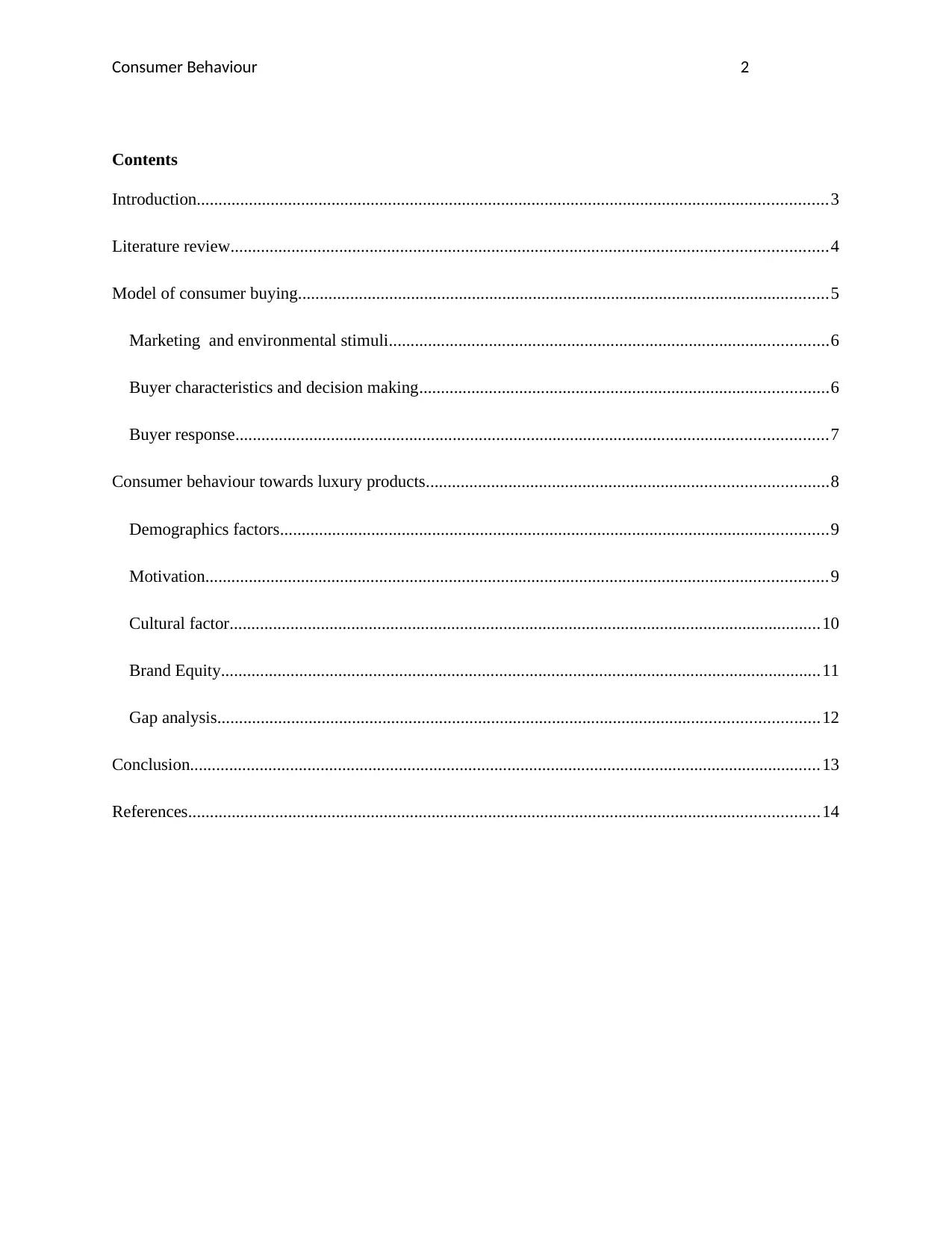
Contents
Introduction.................................................................................................................................................3
Literature review.........................................................................................................................................4
Model of consumer buying..........................................................................................................................5
Marketing and environmental stimuli.....................................................................................................6
Buyer characteristics and decision making..............................................................................................6
Buyer response........................................................................................................................................7
Consumer behaviour towards luxury products............................................................................................8
Demographics factors..............................................................................................................................9
Motivation...............................................................................................................................................9
Cultural factor........................................................................................................................................10
Brand Equity..........................................................................................................................................11
Gap analysis..........................................................................................................................................12
Conclusion.................................................................................................................................................13
References.................................................................................................................................................14
Contents
Introduction.................................................................................................................................................3
Literature review.........................................................................................................................................4
Model of consumer buying..........................................................................................................................5
Marketing and environmental stimuli.....................................................................................................6
Buyer characteristics and decision making..............................................................................................6
Buyer response........................................................................................................................................7
Consumer behaviour towards luxury products............................................................................................8
Demographics factors..............................................................................................................................9
Motivation...............................................................................................................................................9
Cultural factor........................................................................................................................................10
Brand Equity..........................................................................................................................................11
Gap analysis..........................................................................................................................................12
Conclusion.................................................................................................................................................13
References.................................................................................................................................................14
Consumer Behaviour 3
Introduction
Luxury is a requirement that initiates where requirement ends. Luxury products are considered privilege
to possess. The time has changed rapidly and the luxury good market has grown significantly, the luxury
products have become more affordable for the consumer of the middle class. Furthermore, the role of
Industrial Revolution is huge in carrying in more wealth, for these luxury products have become more
attainable for all customers. It has been found in the United Kingdom that more than 50% customers have
enhanced towards the purchasing of the products who have features of luxury. Wang, (n.d), stated that the
consumer behaviour towards purchasing of luxury products is increased due to social and business
factors. There are number of products that are measured under luxury products and make the market size
undeterminable. The varieties of luxury products come under automobiles, fashion, accessories, food and
jewellery. Homes and cars are some of the emerging features of luxury that are consumed by consumers.
The role of important moments and events keep the huge importance in influencing the life of the
individuals. These moments and events can involve economy, superstars, icons, wars and technology that
have the ability to influence the perceptions and values of the individuals. This paper will elaborate the
consumer behavior towards luxury products in the literature review section. It will be supported by
various authors to make it more reliable. At last, the conclusion will be drawn from analysis of the
arguments of various authors on the consumer behaviour towards the purchasing of luxury products.
Introduction
Luxury is a requirement that initiates where requirement ends. Luxury products are considered privilege
to possess. The time has changed rapidly and the luxury good market has grown significantly, the luxury
products have become more affordable for the consumer of the middle class. Furthermore, the role of
Industrial Revolution is huge in carrying in more wealth, for these luxury products have become more
attainable for all customers. It has been found in the United Kingdom that more than 50% customers have
enhanced towards the purchasing of the products who have features of luxury. Wang, (n.d), stated that the
consumer behaviour towards purchasing of luxury products is increased due to social and business
factors. There are number of products that are measured under luxury products and make the market size
undeterminable. The varieties of luxury products come under automobiles, fashion, accessories, food and
jewellery. Homes and cars are some of the emerging features of luxury that are consumed by consumers.
The role of important moments and events keep the huge importance in influencing the life of the
individuals. These moments and events can involve economy, superstars, icons, wars and technology that
have the ability to influence the perceptions and values of the individuals. This paper will elaborate the
consumer behavior towards luxury products in the literature review section. It will be supported by
various authors to make it more reliable. At last, the conclusion will be drawn from analysis of the
arguments of various authors on the consumer behaviour towards the purchasing of luxury products.
⊘ This is a preview!⊘
Do you want full access?
Subscribe today to unlock all pages.

Trusted by 1+ million students worldwide
Consumer Behaviour 4
Literature review
According to the Srinivasan, Srivastava & Bhanot, (2014). it is not easy to define “luxury” word in-depth
manner because what is luxury for someone is just simple for others. In relation to economic, the objects
of luxury can be defined to be those, whose quality as well as prices are considered as the highest in the
entire market. It has been criticized by Brodie, Ilic, Juric & Hollebeek, (2013) that the price cannot be
considered only to show the importance of luxury products, but the price degree of difference between
luxury products and products with comparable functions. As per the theory of customer surplus, the main
aim of consumers spending on goods or services for attaining utility so that they get efficient services
without any issues. It has been observed that the customers are really based on their usefulness for
services and goods bought desired to decide the amount of money paid. However, the real price of goods
on the market is frequently not in line in comparison of subjective desire.
In the 21st century, the consumptions of luxury products have become so popular even though the fact
that there are a few numbers of companies regarding luxury products (Tong, Su & Xu, 2017). It has been
analyzed that there have been a number of luxury brands made in the entire world over the last decades.
The role of globalization is huge in providing the luxury products of one country to another and this is
driven with the help of development of industries, new trades, economy and communication (Soh, Rezaei
& Gu, 2017). For instance, there is a number of famous Japanese luxury brands in the country of Europe
and there are an addiction of Asians to European luxury brands, apart from that there are luxury brands of
European that take use of Chinese silk in the form of raw materials in their productions.
Model of consumer buying
There is a huge importance of consumer buying behavior and as per Islam, Sheikh, Hameed, Khan &
Azam, (2018), the stimulus-responses model is being used in the form of the basic framework in customer
Literature review
According to the Srinivasan, Srivastava & Bhanot, (2014). it is not easy to define “luxury” word in-depth
manner because what is luxury for someone is just simple for others. In relation to economic, the objects
of luxury can be defined to be those, whose quality as well as prices are considered as the highest in the
entire market. It has been criticized by Brodie, Ilic, Juric & Hollebeek, (2013) that the price cannot be
considered only to show the importance of luxury products, but the price degree of difference between
luxury products and products with comparable functions. As per the theory of customer surplus, the main
aim of consumers spending on goods or services for attaining utility so that they get efficient services
without any issues. It has been observed that the customers are really based on their usefulness for
services and goods bought desired to decide the amount of money paid. However, the real price of goods
on the market is frequently not in line in comparison of subjective desire.
In the 21st century, the consumptions of luxury products have become so popular even though the fact
that there are a few numbers of companies regarding luxury products (Tong, Su & Xu, 2017). It has been
analyzed that there have been a number of luxury brands made in the entire world over the last decades.
The role of globalization is huge in providing the luxury products of one country to another and this is
driven with the help of development of industries, new trades, economy and communication (Soh, Rezaei
& Gu, 2017). For instance, there is a number of famous Japanese luxury brands in the country of Europe
and there are an addiction of Asians to European luxury brands, apart from that there are luxury brands of
European that take use of Chinese silk in the form of raw materials in their productions.
Model of consumer buying
There is a huge importance of consumer buying behavior and as per Islam, Sheikh, Hameed, Khan &
Azam, (2018), the stimulus-responses model is being used in the form of the basic framework in customer
Paraphrase This Document
Need a fresh take? Get an instant paraphrase of this document with our AI Paraphraser
Consumer Behaviour 5
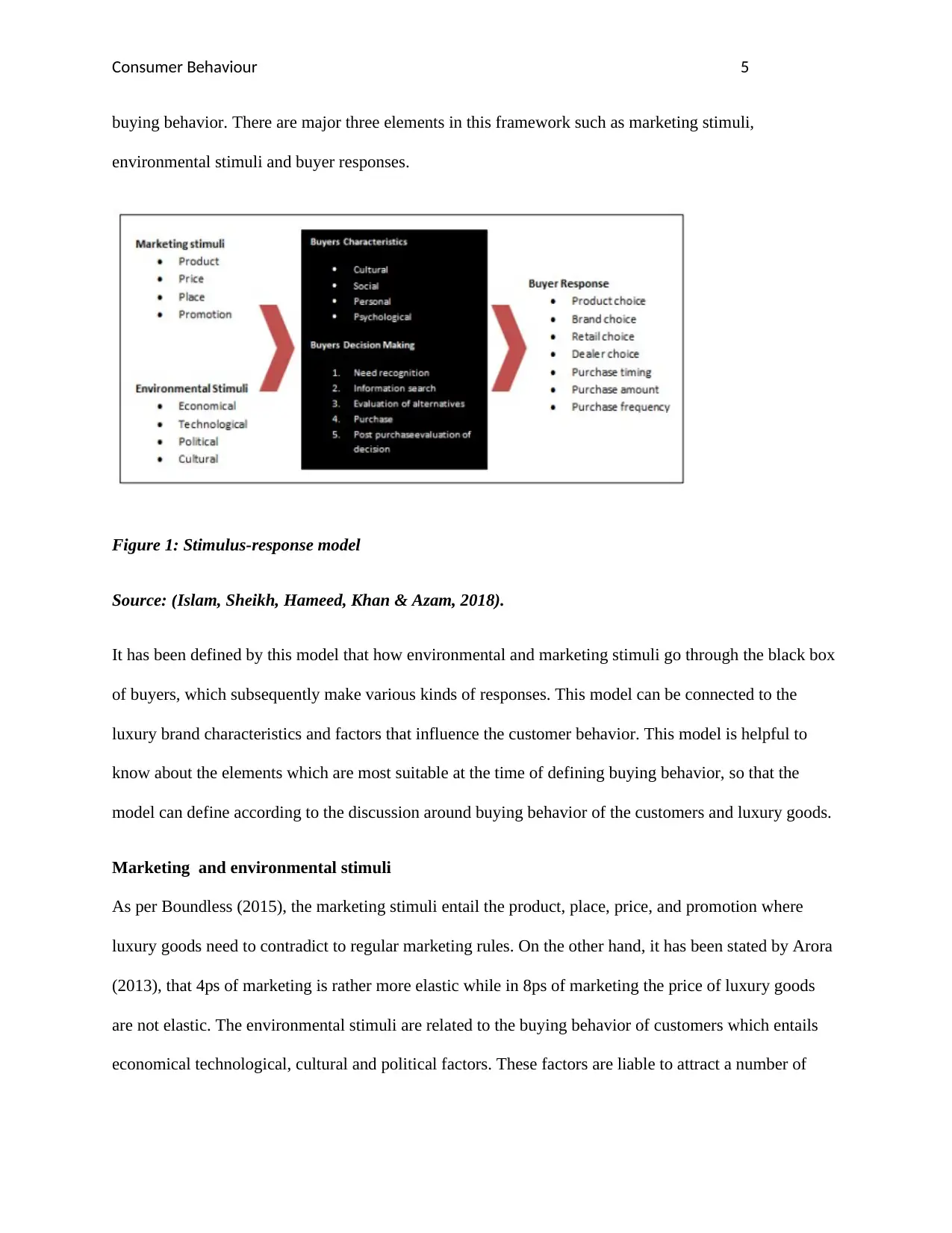
buying behavior. There are major three elements in this framework such as marketing stimuli,
environmental stimuli and buyer responses.
Figure 1: Stimulus-response model
Source: (Islam, Sheikh, Hameed, Khan & Azam, 2018).
It has been defined by this model that how environmental and marketing stimuli go through the black box
of buyers, which subsequently make various kinds of responses. This model can be connected to the
luxury brand characteristics and factors that influence the customer behavior. This model is helpful to
know about the elements which are most suitable at the time of defining buying behavior, so that the
model can define according to the discussion around buying behavior of the customers and luxury goods.
Marketing and environmental stimuli
As per Boundless (2015), the marketing stimuli entail the product, place, price, and promotion where
luxury goods need to contradict to regular marketing rules. On the other hand, it has been stated by Arora
(2013), that 4ps of marketing is rather more elastic while in 8ps of marketing the price of luxury goods
are not elastic. The environmental stimuli are related to the buying behavior of customers which entails
economical technological, cultural and political factors. These factors are liable to attract a number of
buying behavior. There are major three elements in this framework such as marketing stimuli,
environmental stimuli and buyer responses.
Figure 1: Stimulus-response model
Source: (Islam, Sheikh, Hameed, Khan & Azam, 2018).
It has been defined by this model that how environmental and marketing stimuli go through the black box
of buyers, which subsequently make various kinds of responses. This model can be connected to the
luxury brand characteristics and factors that influence the customer behavior. This model is helpful to
know about the elements which are most suitable at the time of defining buying behavior, so that the
model can define according to the discussion around buying behavior of the customers and luxury goods.
Marketing and environmental stimuli
As per Boundless (2015), the marketing stimuli entail the product, place, price, and promotion where
luxury goods need to contradict to regular marketing rules. On the other hand, it has been stated by Arora
(2013), that 4ps of marketing is rather more elastic while in 8ps of marketing the price of luxury goods
are not elastic. The environmental stimuli are related to the buying behavior of customers which entails
economical technological, cultural and political factors. These factors are liable to attract a number of
Consumer Behaviour 6
customers towards purchasing. It is considered as the more relevant factor in the discussion of luxury
goods.
Buyer characteristics and decision making
According to Perreau (2013), the social status and role are a major factor that has noteworthy influences
on buying behavior, considerably the social status is considered as the signal through buying luxury
goods. The social component of the buyer characteristics is highly apparent. Customers want to relate to a
group and be identified. It has been analyzed that the perception is a most vital aspect of the relations of
buying behavior because when awareness about the products and services can increase the selling in the
markets. It has been found that young people are more aware of the luxury products which entail
perfumes, leather goods, accessories, fashion and clothes. It has been observed that influencing buying
decisions of customers to develop into possible if correct perceptions of customers about the related
product are attained (Mukherjee, Satija, Goyal, Mantrala & Zou, 2012). It shows that the perception of a
product through customers influences a lot on their purchasing behaviors and certainly on the advantages
and aims of the organization.
It has been indicated by the (Yi, Yuan & Kumah, 2013), that attitude is a large haul that force to purchase
luxury products. State of mind has the capability to assume a basic component when a purchaser buys
something from the business. There are two kinds of nature such as negative and positive towards the
luxury products. It has been found that rich person has the positive disposition regarding the
excessiveness products. Luxury products show the extra care and quality in comparison of normal
products that is why the rate of this products and services are higher in comparison of normal products. It
has been analyzed that people prefer luxury products for getting high quality services and the rich people
are willing to pay for high quality services and products (Zain, Perry & Quinn, 2018). There is an
example of hospitality industry where it has been observed that there are many kinds of hotels and
restaurant services available. These services are distinguished as per the category of the hotels in which
five stars hotel such as Marriott, the mark hotel, Hotel President Wilson and many more have higher
customers towards purchasing. It is considered as the more relevant factor in the discussion of luxury
goods.
Buyer characteristics and decision making
According to Perreau (2013), the social status and role are a major factor that has noteworthy influences
on buying behavior, considerably the social status is considered as the signal through buying luxury
goods. The social component of the buyer characteristics is highly apparent. Customers want to relate to a
group and be identified. It has been analyzed that the perception is a most vital aspect of the relations of
buying behavior because when awareness about the products and services can increase the selling in the
markets. It has been found that young people are more aware of the luxury products which entail
perfumes, leather goods, accessories, fashion and clothes. It has been observed that influencing buying
decisions of customers to develop into possible if correct perceptions of customers about the related
product are attained (Mukherjee, Satija, Goyal, Mantrala & Zou, 2012). It shows that the perception of a
product through customers influences a lot on their purchasing behaviors and certainly on the advantages
and aims of the organization.
It has been indicated by the (Yi, Yuan & Kumah, 2013), that attitude is a large haul that force to purchase
luxury products. State of mind has the capability to assume a basic component when a purchaser buys
something from the business. There are two kinds of nature such as negative and positive towards the
luxury products. It has been found that rich person has the positive disposition regarding the
excessiveness products. Luxury products show the extra care and quality in comparison of normal
products that is why the rate of this products and services are higher in comparison of normal products. It
has been analyzed that people prefer luxury products for getting high quality services and the rich people
are willing to pay for high quality services and products (Zain, Perry & Quinn, 2018). There is an
example of hospitality industry where it has been observed that there are many kinds of hotels and
restaurant services available. These services are distinguished as per the category of the hotels in which
five stars hotel such as Marriott, the mark hotel, Hotel President Wilson and many more have higher
⊘ This is a preview!⊘
Do you want full access?
Subscribe today to unlock all pages.
Trusted by 1+ million students worldwide
Consumer Behaviour 7
prices of their room and services while 3 star hotels have a lower price in comparison of other hotels.
People prefer luxurious hotels to get all facilities at one place where they can get spa, gym, restaurant,
sports activities, swimming and many more things at one place.
Buyer response
It has been cleared that the kind of luxury product one purchases is dependent on the different needs and
priority of the individual personal. There are various determinants which can influence the intentions of
buying luxury products which can be social factors, demographic factors, personal factors, cultural factors
and marketing mix factors. It has been stated by Yi, Yuan & Kumah, (2013). that there are two kinds of
luxury products that is an old luxury and new luxury products. New luxury can be distinguished into three
broad types such as accessible super premium, old luxury brand extensions and mass prestige. Accessible
super premium products can be afforded by medium class because the prices of products under this
category are almost near the top of their category. Old luxury brand extensions are lower price of goods
and the price of the products are lower in comparison to their code product range. Mass prestige is the
subtype of new luxury which is positioned between mass and class (Islam, Sheikh, Hameed, Khan &
Azam, 2018). However, they want a premium over the daily usage products, but the price of these
products are below super premium which makes it more affordable for this segment of the population.
Consumer behavior towards luxury products
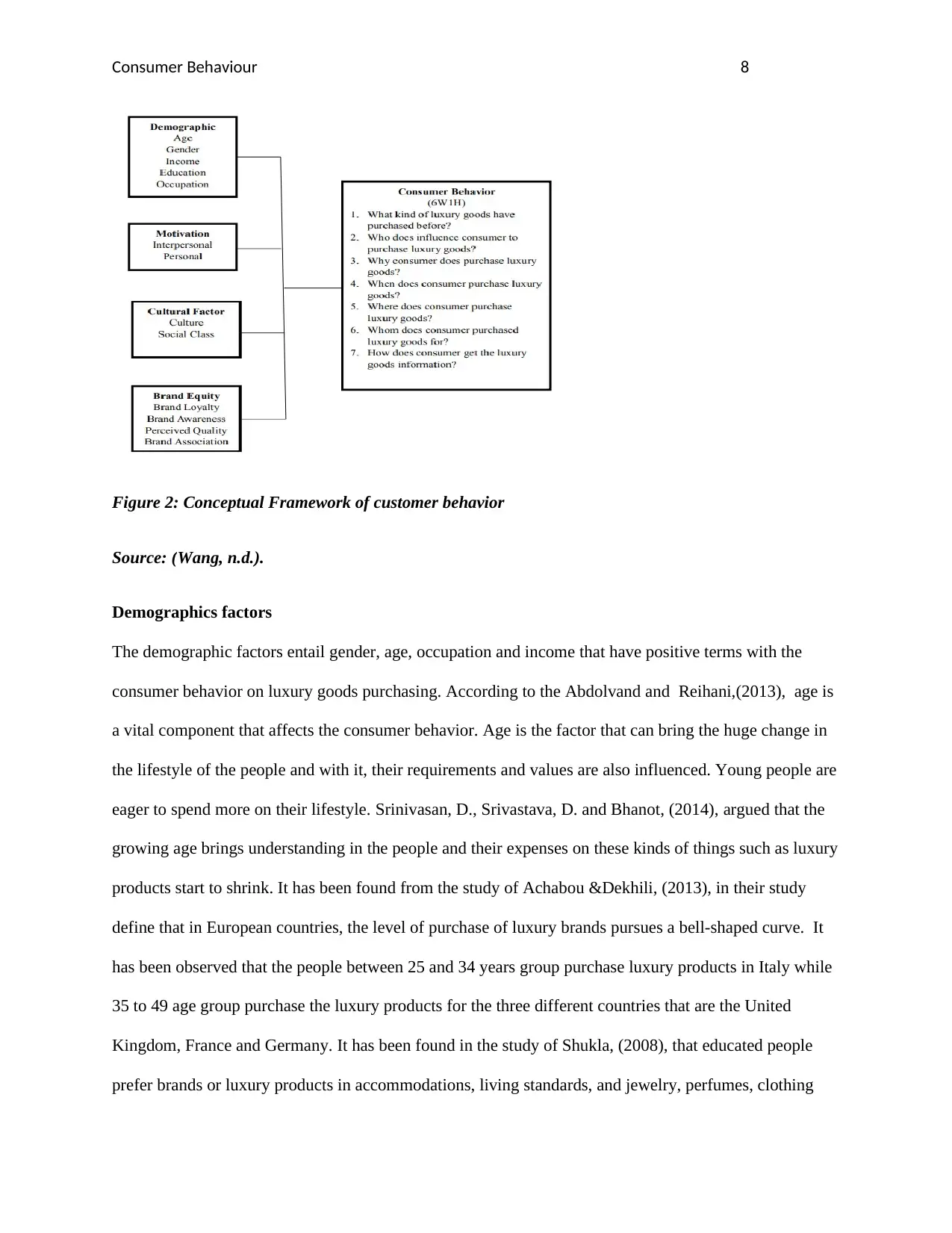
According to there are various factors that may influence the consumer behavior towards purchasing of
products and goods. These factors are demographic, motivation, cultural factors and brand equity that
influence consumer behavior on luxury goods (Zhang & Benyoucef, 2016).
prices of their room and services while 3 star hotels have a lower price in comparison of other hotels.
People prefer luxurious hotels to get all facilities at one place where they can get spa, gym, restaurant,
sports activities, swimming and many more things at one place.
Buyer response
It has been cleared that the kind of luxury product one purchases is dependent on the different needs and
priority of the individual personal. There are various determinants which can influence the intentions of
buying luxury products which can be social factors, demographic factors, personal factors, cultural factors
and marketing mix factors. It has been stated by Yi, Yuan & Kumah, (2013). that there are two kinds of
luxury products that is an old luxury and new luxury products. New luxury can be distinguished into three
broad types such as accessible super premium, old luxury brand extensions and mass prestige. Accessible
super premium products can be afforded by medium class because the prices of products under this
category are almost near the top of their category. Old luxury brand extensions are lower price of goods
and the price of the products are lower in comparison to their code product range. Mass prestige is the
subtype of new luxury which is positioned between mass and class (Islam, Sheikh, Hameed, Khan &
Azam, 2018). However, they want a premium over the daily usage products, but the price of these
products are below super premium which makes it more affordable for this segment of the population.
Consumer behavior towards luxury products
According to there are various factors that may influence the consumer behavior towards purchasing of
products and goods. These factors are demographic, motivation, cultural factors and brand equity that
influence consumer behavior on luxury goods (Zhang & Benyoucef, 2016).
Paraphrase This Document
Need a fresh take? Get an instant paraphrase of this document with our AI Paraphraser
Consumer Behaviour 8
Figure 2: Conceptual Framework of customer behavior
Source: (Wang, n.d.).
Demographics factors
The demographic factors entail gender, age, occupation and income that have positive terms with the
consumer behavior on luxury goods purchasing. According to the Abdolvand and Reihani,(2013), age is
a vital component that affects the consumer behavior. Age is the factor that can bring the huge change in
the lifestyle of the people and with it, their requirements and values are also influenced. Young people are
eager to spend more on their lifestyle. Srinivasan, D., Srivastava, D. and Bhanot, (2014), argued that the
growing age brings understanding in the people and their expenses on these kinds of things such as luxury
products start to shrink. It has been found from the study of Achabou &Dekhili, (2013), in their study
define that in European countries, the level of purchase of luxury brands pursues a bell-shaped curve. It
has been observed that the people between 25 and 34 years group purchase luxury products in Italy while
35 to 49 age group purchase the luxury products for the three different countries that are the United
Kingdom, France and Germany. It has been found in the study of Shukla, (2008), that educated people
prefer brands or luxury products in accommodations, living standards, and jewelry, perfumes, clothing
Figure 2: Conceptual Framework of customer behavior
Source: (Wang, n.d.).
Demographics factors
The demographic factors entail gender, age, occupation and income that have positive terms with the
consumer behavior on luxury goods purchasing. According to the Abdolvand and Reihani,(2013), age is
a vital component that affects the consumer behavior. Age is the factor that can bring the huge change in
the lifestyle of the people and with it, their requirements and values are also influenced. Young people are
eager to spend more on their lifestyle. Srinivasan, D., Srivastava, D. and Bhanot, (2014), argued that the
growing age brings understanding in the people and their expenses on these kinds of things such as luxury
products start to shrink. It has been found from the study of Achabou &Dekhili, (2013), in their study
define that in European countries, the level of purchase of luxury brands pursues a bell-shaped curve. It
has been observed that the people between 25 and 34 years group purchase luxury products in Italy while
35 to 49 age group purchase the luxury products for the three different countries that are the United
Kingdom, France and Germany. It has been found in the study of Shukla, (2008), that educated people
prefer brands or luxury products in accommodations, living standards, and jewelry, perfumes, clothing
Consumer Behaviour 9
and daily consumption things. It has been found from this article that two major criteria for brand
association and psychological background considerably influence the consumptions behavior of luxury
products among youth.
Motivation
Motivation factor is entailed personal and interpersonal components. It has been observed that the level of
motivation influences the buying behavior of customers. There are various people all over the world and
each person has different biological needs, social needs, psychological needs etc. According to the
Petersen, Kushwaha & Kumar, (2015), consumer motivation can be differentiated into the interpersonal
insight motivation, involving the uniqueness, personal motivation, bandwagon, conspicuous. In the
context of conspicuous, it can be said that the luxury products are higher designed; there are various
countries such as China, United Kingdom, UAE and US which are at the show off stage (Bian, Haque &
Smith, 2015). The people of these countries are tripping over each other endeavoring to acquire the
symbols of wealth and showing the people in more conspicuous manner. the products under this
component are more expensive.
Uniqueness is able to increase the one’s self-image along with the social image. There are various
companies that produce unique items and due to a speciality in that product, it becomes the part of rare
and unique which affect on demand of customers. It has been defined by Srinivasan, Srivastava &
Bhanot, (2014), that bandwagon motivation has represented the consumers who buy luxury products
because they want to maintain the social status with a specific group. It has been observed that people
purchase luxury products and services to link themselves to similar kind of people. Furthermore, the
education of the prosperous or wealthy lifestyle is affected and copied in reality by buying these luxury
products that are televised (Chen, Teng, Liu & Zhu, 2015).
and daily consumption things. It has been found from this article that two major criteria for brand
association and psychological background considerably influence the consumptions behavior of luxury
products among youth.
Motivation
Motivation factor is entailed personal and interpersonal components. It has been observed that the level of
motivation influences the buying behavior of customers. There are various people all over the world and
each person has different biological needs, social needs, psychological needs etc. According to the
Petersen, Kushwaha & Kumar, (2015), consumer motivation can be differentiated into the interpersonal
insight motivation, involving the uniqueness, personal motivation, bandwagon, conspicuous. In the
context of conspicuous, it can be said that the luxury products are higher designed; there are various
countries such as China, United Kingdom, UAE and US which are at the show off stage (Bian, Haque &
Smith, 2015). The people of these countries are tripping over each other endeavoring to acquire the
symbols of wealth and showing the people in more conspicuous manner. the products under this
component are more expensive.
Uniqueness is able to increase the one’s self-image along with the social image. There are various
companies that produce unique items and due to a speciality in that product, it becomes the part of rare
and unique which affect on demand of customers. It has been defined by Srinivasan, Srivastava &
Bhanot, (2014), that bandwagon motivation has represented the consumers who buy luxury products
because they want to maintain the social status with a specific group. It has been observed that people
purchase luxury products and services to link themselves to similar kind of people. Furthermore, the
education of the prosperous or wealthy lifestyle is affected and copied in reality by buying these luxury
products that are televised (Chen, Teng, Liu & Zhu, 2015).
⊘ This is a preview!⊘
Do you want full access?
Subscribe today to unlock all pages.
Trusted by 1+ million students worldwide
Consumer Behaviour 10
Cultural factor
Cultural factor has impacted the consumer behavior towards the luxury products. Fundamentally, culture
is the component of each company and is considered as the major reason of the individual who wants and
behavior. There are various kinds of culture all over the world that may influence the purchasing behavior
of the consumers; therefore it is essential for the sellers of the luxury products to be very careful in the
process of analysis of the culture of various groups of different countries. There are various countries
such as India, China, Malaysia and many other that follow the trends of exchanging gifts. Gifting is
essential in these countries to make a better relationship in which relatives buy gifts for every occasions
and festival. It has been observed that Asians often buy luxury goods for different occasions for families
and relatives to show off the wealth and status of the family (Schultz & Jain, 2018). According to the
collectivist culture, the society of China highlights the harmonious interpersonal relationships. The role of
exchanging gifts is huge in the society of Asian countries as it facilitates to maintain and enlarge the
relationship.
Brand Equity
This factor includes the brand loyalty, brand awareness perceived quality and brand associations. It has
been found in the context of brand loyalty that it is considered as the attachment that has a consumer has
to a brand. It is vital for the brand loyalty that customer should be associated with the company for a long
time. The role of the quality of the products and services are highlighted for developing the usage of
luxury brands and consumer brand loyalty towards the luxury brands. On the other hand according to
Huang & Sarigöllü (2014), brand awareness is considered as the ability of the customer to identify and
recall the brand as revealed by their capability to recognize the brand under various conditions and to
connect the brand logo, name and symbol. The role of brand awareness is wide to increase the number of
potential customers as it has a significant part in the consumer’s decision-making process. It has been
suggested by Previte, Russell‐Bennett & Parkinson, (2015), that consumers might link luxury products
with higher quality, which may lead to a perceived value for a brand. The brand association defines that
Cultural factor
Cultural factor has impacted the consumer behavior towards the luxury products. Fundamentally, culture
is the component of each company and is considered as the major reason of the individual who wants and
behavior. There are various kinds of culture all over the world that may influence the purchasing behavior
of the consumers; therefore it is essential for the sellers of the luxury products to be very careful in the
process of analysis of the culture of various groups of different countries. There are various countries
such as India, China, Malaysia and many other that follow the trends of exchanging gifts. Gifting is
essential in these countries to make a better relationship in which relatives buy gifts for every occasions
and festival. It has been observed that Asians often buy luxury goods for different occasions for families
and relatives to show off the wealth and status of the family (Schultz & Jain, 2018). According to the
collectivist culture, the society of China highlights the harmonious interpersonal relationships. The role of
exchanging gifts is huge in the society of Asian countries as it facilitates to maintain and enlarge the
relationship.
Brand Equity
This factor includes the brand loyalty, brand awareness perceived quality and brand associations. It has
been found in the context of brand loyalty that it is considered as the attachment that has a consumer has
to a brand. It is vital for the brand loyalty that customer should be associated with the company for a long
time. The role of the quality of the products and services are highlighted for developing the usage of
luxury brands and consumer brand loyalty towards the luxury brands. On the other hand according to
Huang & Sarigöllü (2014), brand awareness is considered as the ability of the customer to identify and
recall the brand as revealed by their capability to recognize the brand under various conditions and to
connect the brand logo, name and symbol. The role of brand awareness is wide to increase the number of
potential customers as it has a significant part in the consumer’s decision-making process. It has been
suggested by Previte, Russell‐Bennett & Parkinson, (2015), that consumers might link luxury products
with higher quality, which may lead to a perceived value for a brand. The brand association defines that
Paraphrase This Document
Need a fresh take? Get an instant paraphrase of this document with our AI Paraphraser
Consumer Behaviour 11
the entire things include the imagination of the customer, features of the products and the uses about
brand in the mind and the personality and symbols. It is considered as the most adapted factor of brand
equity (Gürhan-Canli, Hayran & Sarial-Abi, 2016).
According to the report of Deloitte, it has been found that the customers are spending on luxury goods
increasingly. It has been considered by the Deloitte survey that China, Russia, and the UAE are emerging
luxury markets. It has been analyzed that the sale of luxury products are fallen under major six products
of watches, cosmetics and fragrances, bags and accessories, shoes, clothes and jewelry. Along with that, it
has been analyzed that more than half of luxury products are made by customers who are traveling where
31% of people buy luxury products from foreign markets and 16% of people buy luxury products at the
airport (Deloitte, 2017). Luxuries are not only in products and services rather it covers the person as well.
There are various persons such as artists, Designers, Stylist, musicians, architects, rich person, actors,
athletes, bloggers, YouTubers, politicians and many more who consider as the top influence of the luxury
world. It has been found that there were some strongest performers that raised the ratio of profit
significantly. Brazilian Fashion Company has grown up by approx 55% whereas Gitanjali Gems jewelers
of India’s sales increased by 43%, and many more companies which sales are increased due to branded
products (Deloitte, 2017).
Gap analysis
It has been analyzed that the impact of social status, culture, demographic, motivation and other factors
are shown but other factors of consumer behavior have not been considered (Srinivasan, Srivastava &
Bhanot, 2014). It has been focused by Zhang & Benyoucef, (2016), that various demographic factors are
studied by this research including the age, education and income but depth understanding about these
factors are lacked under this research which could be fulfilled by taking various viewpoints of different
authors. The motivation factors have been considered under this research but it can be elaborated in
sufficient manner by defining the impact of various demographic factors on consumer behavior. High
value of luxury goods have been defined which illustrate symbolic and experimental values in the
the entire things include the imagination of the customer, features of the products and the uses about
brand in the mind and the personality and symbols. It is considered as the most adapted factor of brand
equity (Gürhan-Canli, Hayran & Sarial-Abi, 2016).
According to the report of Deloitte, it has been found that the customers are spending on luxury goods
increasingly. It has been considered by the Deloitte survey that China, Russia, and the UAE are emerging
luxury markets. It has been analyzed that the sale of luxury products are fallen under major six products
of watches, cosmetics and fragrances, bags and accessories, shoes, clothes and jewelry. Along with that, it
has been analyzed that more than half of luxury products are made by customers who are traveling where
31% of people buy luxury products from foreign markets and 16% of people buy luxury products at the
airport (Deloitte, 2017). Luxuries are not only in products and services rather it covers the person as well.
There are various persons such as artists, Designers, Stylist, musicians, architects, rich person, actors,
athletes, bloggers, YouTubers, politicians and many more who consider as the top influence of the luxury
world. It has been found that there were some strongest performers that raised the ratio of profit
significantly. Brazilian Fashion Company has grown up by approx 55% whereas Gitanjali Gems jewelers
of India’s sales increased by 43%, and many more companies which sales are increased due to branded
products (Deloitte, 2017).
Gap analysis
It has been analyzed that the impact of social status, culture, demographic, motivation and other factors
are shown but other factors of consumer behavior have not been considered (Srinivasan, Srivastava &
Bhanot, 2014). It has been focused by Zhang & Benyoucef, (2016), that various demographic factors are
studied by this research including the age, education and income but depth understanding about these
factors are lacked under this research which could be fulfilled by taking various viewpoints of different
authors. The motivation factors have been considered under this research but it can be elaborated in
sufficient manner by defining the impact of various demographic factors on consumer behavior. High
value of luxury goods have been defined which illustrate symbolic and experimental values in the
Consumer Behaviour 12
viewpoints of owners but there is a lack of details about the income factors on the purchase of luxury
brands. Achabou &Dekhili, (2013), defined the conceptual framework of consumer behaviour towards
purchasing of luxury goods in which four parts has been divided with cultural factors, motivation factors,
brand equity and demographic factors but there is a gap of designing the reason that why a consumer
should move towards the purchasing of branded products. Stimulus-response model has been defined by
Giovannini, Xu & Thomas, (2015). with showing various factors of consumer decision making process
but it should involve some examples of the brand for making clear understanding about the different
products however the area of brands have been elaborated in an effective manner.
viewpoints of owners but there is a lack of details about the income factors on the purchase of luxury
brands. Achabou &Dekhili, (2013), defined the conceptual framework of consumer behaviour towards
purchasing of luxury goods in which four parts has been divided with cultural factors, motivation factors,
brand equity and demographic factors but there is a gap of designing the reason that why a consumer
should move towards the purchasing of branded products. Stimulus-response model has been defined by
Giovannini, Xu & Thomas, (2015). with showing various factors of consumer decision making process
but it should involve some examples of the brand for making clear understanding about the different
products however the area of brands have been elaborated in an effective manner.
⊘ This is a preview!⊘
Do you want full access?
Subscribe today to unlock all pages.
Trusted by 1+ million students worldwide

1 out of 16


Related Documents


Your All-in-One AI-Powered Toolkit for Academic Success.
+13062052269
info@desklib.com
Available 24*7 on WhatsApp / Email
![[object Object]](/_next/static/media/star-bottom.7253800d.svg)
Unlock your academic potential
Copyright © 2020–2026 A2Z Services. All Rights Reserved. Developed and managed by ZUCOL.